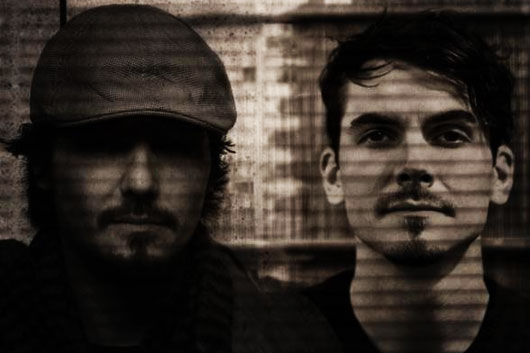
Three years after the release of Norwegian producer Joachim Dyrdahl’s debut album, Staying In, comes his second full-length record as the futuristic prog-disco peddling Diskjokke. En Fin Tid—which roughly translates to “happy time”—is slated for release June 22 thanks to Dyrdahl’s fellow Norwegians at Smalltown Supersound. The eight-song album was recorded and self-produced in Diskjokke’s brand-new studio, and is said to be heavily influenced by usual suspects Tangerine Dream, Arthur Russell, Alan Parsons Project, and mid-’80s Holger Czukay. Check out En Fin Tid‘s tracklist below.
1. Reset and Begin 2. En Fin Tid 3. Big Flash 4. Rosenrød 5. 1987 6. Bastard Alliance 7. The Bund 8. Nattestid
It might seem like Teengirl Fantasy is playing at every amazing warehouse party in Brooklyn these days, but the band actually spends much of its time at Oberlin, where band members Logan Takahashi and Nick Weiss are still finishing up their degrees. When they’re not studying, the duo crafts a fuzzy brand of lo-fi electronic dance music that references shoegaze, classic Nintendo, rave divas, and washy ’80s synths. To date, only a few Teengirl Fantasy singles have been released, but a debut album for True Panther/Merok is on the way, along with remixes for Lemonade and HEALTH and a collaborative 12″ with fellow Oberliners Blondes.
XLR8R Couldn't find the embed function for type: "vimeo" and source: "<embed src="http://vimeo.com/moogaloop.swf?clip_id=6039869&server=vimeo.com&show_title=1&show_byline=1&show_portrait=0&color=00ADEF&fullscreen=1" type="application/x-shockwave-flash" allowfullscreen="true" allowscriptaccess="always" width="530" height="358">".
8-bit tunes are so 2005. Seattle’s premiere bass-toting, hip-hop-obsessed gamers-cum-production duo, Splatinum up the resolution on its latest single, “Pumping Quarterz.” The track’s hard-hitting beat and vocodered hook (“fat booty bitches is so delicious”) speak to the outfit’s club-lovin’ side, but the buzzing synths and assorted sound effects are clearly the work of pure video game fanboys. It would be a stretch to call “Pumping Quarterz” geek-hop, or any other contrived genre title, but Splatinum offers sounds for both ends of that spectrum—along with remixes from Mochipet and Inaudible—on its Pumping Quarterz EP, available for free download here.
Call it sound collage, call it electronic indie, or call it totally unclassifiable, but the songs created by The Books stand in a special realm of true ingenuity and innovation. It’s been five years since the NY-based duo released its third album, Lost and Safe, but news of the goings-on with the band has finally surfaced. Nick Zammuto and Paul de Jong, the two men behind The Books, have switched homes from the German label Tomlab to NYC’s Temporary Residence for the release of a new album, entitled The Way Out, which should be arriving around July of this year. That’s just about all that’s available to tell as of now, but make sure to check The Books’ blog for a lengthy bit of verbiage on the group’s hiatus and its move to a new label, with further updates to surface in the months to come.
It was only recently, after having been together for nearly a decade, that Barcelona-based quartet Delorean had their biggest breakthrough: They didn’t need to be a “band” anymore, at least not in the conventional sense. It’s this epiphany that explains the group’s dissatisfaction with their most widely acclaimed release to date, last year’s ecstatic, gloriously immediate Ayrton Senna EP (Mushroom Pillow/Fool House). “We were not very happy with it musically,” explains singer and bassist Ekhi Lopetegi, over the phone from Spain. “It sounds too clean and too obvious. We were still sounding like a four-piece band.” They had undoubtedly made a sturdy, infectious disc by any listener’s standards, but it’s only with the realization of their newest record, Subiza, that the band has achieved the kind of lush electronic production they’ve been striving for.
Delorean started out 10 years ago, when its members were teenagers living in the coastal Basque town of Zarautz, about 20 minutes outside of San Sebastian in Spain. There, Lopetegi met drummer Igor Escudero, keyboardist Unai Lazcano, and the band’s original guitarist, Tomas Palomo. Away from their straight-ahead punk bands—each of them was entrenched in the local hardcore scene—Delorean was their pop project, and though they were initially heavily influenced by emo and hardcore, pop and electronic sounds would gradually shift to the forefront of their music.
Until 2007, says Lopetegi, Delorean was still a punk band, but there is, as he points out, an aesthetic continuity in all of their work. As he explains it, “the common background to the different periods of Delorean is club music.” It only plays a peripheral role on their 2004 self-titled debut for BCore Disc, an angst-ridden punk record colored by ’80s new wave instrumentation. But its follow-up, 2005’s Metropolitan Death EP, showcased their increasing fondness for the dark, minimal pulses proliferated by Kompakt and Border Community, and that affinity manifests itself even more apparently on the 2006 full-length Into the Plateau. This album bridged their love of goth-punk and German minimal house in quite compelling fashion. Following that album, Palomo departed the band, and was replaced by guitarist Guillermo Astrain in 2008, by which point everyone in the group had moved to Barcelona.
“After 2007, we just spent a lot of time without making any songs,” says Lopetegi. “It was time for us to rethink stuff, as we just started to be a little fed up with the techno scene.” Their tastes fanned out considerably as they got into grime, piano house, ghettotech (especially DJ Assault and DJ Funk), bassline house—”all sorts of club music” alongside hip-hop, R&B, and older, elaborately produced pop bands like Prefab Sprout and Cocteau Twins. This blossoming of taste is evident in one of Delorean’s most notable contributions to the Barcelona music scene: Desparrame, a club night and mixtape-filled blog they co-curate with DJ K**O (pronounced “Kigo”/”key-go”), part of the Plat Du Jour crew and a friend of theirs from Basque Country. Heading into the project in early 2008, the band was unsatisfied with the nightlife locally on offer. Barcelona techno clubs, says Lopetegi, were “not a scene for the kind of club music we’d like to listen to,” naming bassline and dubstep as two genres notably missing from dancefloors. To combat this absence, Delorean translated their joyous, adventurous musical vision into Desparrame, hosting parties with Radioclit, Numbers’ Jack “Jackmaster” Revill, and Finland’s Top Billin’, among others. “I started to have fun for the first time with our own parties,” exclaims Lopetegi with palpable conviction. “Like truly fun, in a small club with friends… not super-dark techno, it’s more bouncy and friendly.”
“Deli”
The newfound, hard-earned sense of fun conjured by these club nights played a great deal into Delorean’s transition from techno-influenced punk to airy, ecstatic pop. The aforementioned Ayrton Senna EP, named for the late Brazilian racecar driver and Formula One champion, marked an enormous stylistic leap forward for the band: Three cuts of bright, breezy pop infused with the beat and effervescent spirit of house, held together by savvy songwriting and sharp production. Opening track “Deli,” for example, is one of the freshest, most satisfying dance tracks of last year, direct and affecting in its simplicity of form and lyrical sentiment: “I like the time I spend with you, girl/With you, girl.” Though the band was pleased with the attention it garnered, they now see the EP mostly as a stepping stone to Subiza, a record the band seems genuinely proud of.
Since recording Ayrton Senna, Delorean’s way of writing, producing, and working as a band has changed a great deal, and it has everything to do with remixing. Up to and concurrent with the recording of Subiza, a large portion of the band’s time was spent doing remixes for other artists, including The Big Pink, Mystery Jets, Glasser, and Franz Ferdinand. Their remix of The xx’s “Islands” was recently released, while remixes for Cold Cave and Tanlines are in the works. All this remix work has increased Delorean’s sound palette considerably, but more importantly, it’s brought about the band-wide realization that purely live instrumentation wasn’t necessarily ideal for their desired end result.
“The sound [of Subiza] is more related to our remixes than the EP that we released before,” explains Lopetegi of their new, primarily computer-based composition process. The band has their own studio in Barcelona, in which they could be found every day, nonstop, for the first half of 2009, laboring on their individual computers to write and arrange their new album. “What we didn’t like about the [Ayrton Senna] EP was that it was still halfway from the live rock sound to actual electronic production.” Although Lopetegi and Escudero play bass and drums respectively, neither ended up playing a single live bass or drum part on Subiza. The band used Cubase and Nuendo to sequence, sample, arrange, and write melodies on the members’ four individual computers, sending song ideas back and forth between each individual member, each one adding rhythms, keyboards, synths—reshaping the track at will. “We decided if it sounded better to use a plugin sub-bass bassline that we would do it,” Lopetegi says. “What mattered to me was the final result of the song, not whether it was played live.”
When the work at their own studio was finished, they entered Hans Krüger’s studio in Pamplona, where the necessary work proved to be much different than what Delorean was used to. With each song—for instance, “Warmer Places,” which Lopetegi says has over 80 individual tracks—each and every track would be bounced one at a time into the mixing board, sometimes with added analog reverb. At the studio, they recorded vocals, guitars, and some keyboards—everything else on the record had been produced electronically. After cleaning everything up, each track was bounced from the mixing board to an analog tape recorder and back to Krüger’s computer, where the pre-mix was completed. In the end, their studio time was spent mostly transferring tracks and only partly recording—hardly a typical studio experience for a pop band, especially one that had been used to recording and performing everything live.
Mixing Subiza proved to be just as atypical of a process: a trans-Atlantic effort with veteran engineer Chris Coady (Telepathe, !!!, Lemonade, TV on the Radio) requiring live communication with the band via iChat. “He would send us a link, we would open it with iTunes, and we would listen to what he was doing in the studio in real time,” says Lopetegi, reimagining the process: “‘Chris, why don’t you turn up that drum snare? Or turn down the vocals? The bass is too loud…’ It was a weird way to work, very new to us, but it’s 2010 and these kinds of things happen.”
The end result has an overwhelming, enveloping warmth to it. Subiza is certainly their most soulful statement yet: the resulting sound, while difficult to pin down, might bring to mind diva-graced dubstep filtered through Primal Scream’s take on acid house, or, alternately, the swirling, elaborately constructed feel of My Bloody Valentine’s shoegaze-raver classic, “Soon.” The layered, tightly woven drum tracks and keyboards of album opener “Stay Close,” for instance, add up to a kaleidoscopic banger with a wistful, urban air. Delorean melds their myriad influences into a new, unmistakable shape, creating a record that offers immediate, ecstatic pleasures, yet requires hundreds of listens to begin to unravel.
It’s such a densely constructed album that one cannot help but wonder how it would sound live. “We cannot translate 100% of the record,” says Lopetegi of performing these new recordings, which will require several synths to recreate on stage; there are, after all, up to 30 percussion tracks and several layers of keyboards and synths on each song on Subiza. As Lopetegi explains, one keyboard line might be played with a piano, but in the next verse, it’ll be played with a Korg Mono/Poly. These sorts of difficulties, Lopetegi emphasizes, are surmountable, and the album’s stunning end result is a victory for substance over any concerns the band may have had about integrity. If the transformations brought about by Subiza are any indication, performing these songs live is the closest that Delorean will ever come to repeating themselves—a destiny that Lopetegi makes clear that the band wishes to avoid—and complexities aside, their modus operandi remains pretty simple. “We just want to have cool songs!”
It’s pretty awesome that Scion brought out the big guns to release this brand-new track from veteran garage producer Todd Edwards as the next installment of its Scion A/V Remix series. More awesome still is the host of remixers corralled to flesh out the release: 2-step legend MJ Cole, Feadz, and future-dubstep darling Joy Orbison all have a go at Edwards’ original. Here, Orbison tones down the ecstatic sounds of “I Might Be” for an even-keeled number that places subtle synth melodies and sub-bass rumbles far below the soulful Auto-Tuned vocal hooks and stuttering dance beats. If you’re interested in doing some comparisons on your own, you can grab Edwards’ original version and the rest of the remixes over here, well before the EP’s official release date on April 12.
Taken from Bustin’ Loose, the fourth compilation released by the DC-based T&A label (run by Tittsworth and DJ Ayers), this remix of Steve Starks‘ “Lydia” by Smalltown Romeo is a high-energy exercise in rolling basslines, bouncing disco-house beats, and a seemingly endless arsenal of swelling background sounds. The Canadian supergroup—made up of the Smalltown DJs duo and Wax Romeo—seems to have only left the original’s Spanish vocal intact, but even that is vocodered into oblivion. Basically, “Lydia” receives an almost complete 180—effectively transforming from a gritty street-bass number into something more suitable for a nightclub with a dress code.
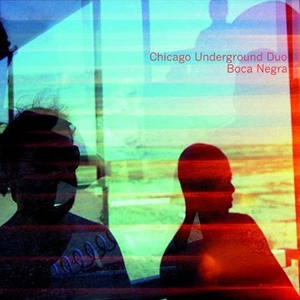
The post-rock family tree inevitably leads to the Chicago Underground collective. At the heart of that group are Rob Mazurek and Chad Taylor, who, despite their endless “rock” credits, are secretly an avant-garde free-jazz duo in the Ornette Coleman model. With Boca Negra, they pilot bare-bones drums, brass, and marimbas straight into the unorthodox tunings and slippery structures of Coleman’s harmolodics, even covering his “Broken Shadows” to make the intent clear. Boca Negra can be discordant and difficult, with shifting time signatures and sparse instrumentation delaying nearly all gratification, but when “Confliction” locks together with a vicious swing to the rhythm, their unorthodoxy makes sense.
Two of the Bay Area’s most forward-thinking producers of all sorts of experimental electronic sounds, Amon Tobin and Eskmo, have joined their genre-pushing forces under the collaborative moniker Eskamon. The duo simultaneously unveiled its first single, an exploration of field recordings and studio-generated sound manipulation called “Fine Objects,” released on Eskmo’s own imprint, Ancestor Media. But it wouldn’t be terribly inventive were that the extent of it. To entice fans and fellow sound makers to check out Eskamon’s firstborn, a sound bank and Ableton Live pack made up entirely of sounds used in the “Fine Objects” track are available for download from the duo’s website in exchange for your email address. While there, you can also check out a snippet of “Fine Objects,” and read more about the track and the project’s genesis. If that’s not enough to whet your bass-lusting appetite, the latest solo tune from Eskmo, “Sister, You Have Got to Listen,” is available for free download from Amon Tobin’s online store.
While Sweden’s Club 8 are among the most popular independent acts in their native country, their profile overseas has been virtually non-existent. Their sixth full-length, The People’s Record, promises to change that circumstance, what with its pop hooks and indebtedness to world musics. Here, countrymen Pallers take the slick Afrobeat of “Western Hospitality” and transform it into a synth-drenched, dubby excursion. Maintaining the guitar melodies of the original through lovely buzzing synth parts, the duo have crafted a piece that fans of Tanlines and Lemonade will certainly appreciate.