Ellen Allien and Berlin clubbing institution Watergate have had a long relationship, so it’s disappointing that her entry in their mix series is such a dud. Watergate 05 may begin in familiar territory—the icy, emotive techno of DJ Yellow and John Tejada have typically been her bread and butter—but soon we’re thrown into everything from wobbly bass to bongo-laden micro-house to second-rate electro. The mixing is jarring, the pacing erratic. Watergate 05 has its moments—a transition from Matias Aguayo’s bizarro “Bo Jack” to Alexi Delano’s “Molar One” is flawless, but it’s a rare delight. In trying to honor a diverse set of sounds, Allien has failed to do any of them justice.
Check it: The new vid for Aloe Blacc’s soulful slice, “I Need a Dollar,” directed by Kahlil Joseph. Download it: from XLR8R.com. Buy it: Good Things arrives on Stones Throw in July.
The dancehall-meets-funky club fire that is Sticky and Natalie Storm‘s “Look Pon Me” has finally been given the go-ahead for remixes, and Mixpak has opened it up a contest to all willing producers. Check out the official rules and download the acapella here. With prizes like a custom Natalie Storm dubplate, where she works your production/DJ name into a track for use in your club sets, who wouldn’t want to enter a remix into the contest?
Jneiro Jarel has produced under as many monikers as Kool Keith, and luckily, his output shines as brightly as Black Elvis’. On “Black Blocks,” Jarel channels something of Electronic Warfare-era Underground Resistance, utilizing a foreboding bass throb, high frequency distorted industrial loops, and guitar harmonies to create a piece of dark electronic funk that is just begging for a DJ Assault rework. With deep, pitch-shifted vocals intoning throughout, there’s also a political side to “Black Blocks” that is unmistakably influenced by Mike Banks. While the rest of the Android Love Mayhem EP isn’t as indebted to Detroit’s best production crew, its tones and sonic palette waver somewhere between FlyLo and Nomadico, which is definitely a good thing for our ears.
The clanking trip-hop beat that leads in the original version of Pollyn‘s “Can’t Get Into It” is traded out for a steady and straightforward house beat on Altair Nouveau‘s remix. In fact, the only element left intact on DFA producer Brandon Mitchell’s rework is the ethereal vocal delivery of singer Genevieve Artadi. Altair’s arsenal of vintage synth tones and space-boogie grooves provide the instrumental background instead, and transform “Can’t Get Into It” into a dancefloor number you’d have to be deaf not to get into.
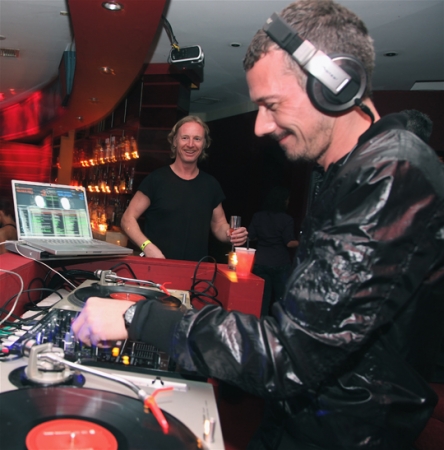
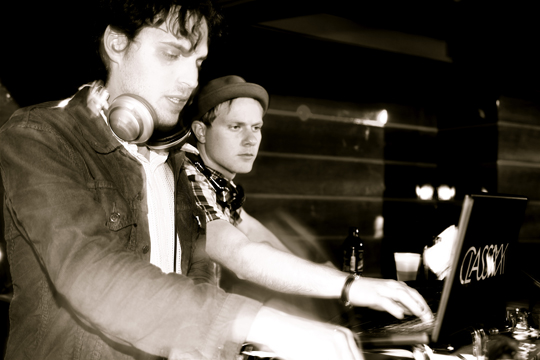
Last week in Miami, XLR8R, OM Records, and Onitsuka Tiger pulled out all the stops to bring WMC’s swell of dance-music fanatics more than they could handle. Classixx, DJ Hell, Peter Kruder, Mark Farina, and more brought the heat, and now, we bring you the proof.
Being an electronic pop act is a lot harder than it used to be.
It wasn’t that long ago that lo-fi electronic pop was all the rage with the indie set—remember when The Postal Service was blowing everyone’s mind in 2003? Whether cobbled together by a lone soldier in his bedroom, or assembled with old synths, some spare instrumentation, and often sparer musical ability, the music was ostensibly indie pop, owing a lot more to C86 and twee than it did Detroit techno or Chicago house. Now that 2010 has rolled around, the indie pendulum continues to swing back and forth between laptop producers and more traditional guitar-based instrumentation, but the simple act of being a DIY electronic act is no longer revolutionary. As such, new albums from High Places and Javelin, not to mention genre veterans Lali Puna, have a tougher hill to climb than their counterparts of a decade prior.
German outfit Lali Puna has been conspicuously absent in recent years, last releasing an album in 2004 with Faking the Books. As part of the Morr Music roster, Lali Puna—with the help of like-minded acts Ms. John Soda, B. Fleischmann, and The Notwist—helped put a very particular brand of electronic music on the map in the early ’00s, one marked by clean synths, minimal percussion, plenty of sonic white space, melodic vocals delivered in a nearly deadpan manner, and traditional pop songwriting. And while Our Inventions may have been six years in the making, very little has changed; it’s telling that even when the band collaborates with Yellow Magic Orchestra’s Yukihiro Takahashi on the exceedingly pleasant album closer, “Out There,” the repeated refrain is “seems just like always.” Make no mistake, Our Inventions is a very nice album—”Rest Your Head” and “Everything is Always” are precious little slices of pop music—just don’t expect kids who have been gorging on the psychedelic exploits of Animal Collective to flip out over this one.
Much more likely to capture their imagination is No Más, the debut album from sample-loving Brooklyn duo Javelin. Within the first seconds of bouncy album opener “Vibrationz,” it’s clear that these boys are piloting a quirky, fun-filled journey through decades of oddball pop stylings. Whether it’s helium-voiced 8-bit B-Boy hip-hop (“Oh! Centra”), spazzy, falsetto ’80s electro (“On It on It”), glamorous synth disco with Beach Boys-esque vocal harmonies (“Moscow 1980”), or chopped-and-sliced piano funk (“Susie Cues”), No Más offers one lighthearted romp after the next. And while the album’s unique collage of what seems like vintage sounds will prompt endless “is that a sample?” debates amongst crate diggers, the pure joy offered by just listening will hopefully reveal those arguments for what they are—beside the point.
Fellow Brooklynites High Places are far less likely to find such diplomacy in response to High Places vs. Mankind, their second full-length. Past efforts often came across as pastoral, with Mary Pearson’s childlike vocals dancing above sparse, loop-based electronic soundscapes, and similar moments (“She’s a Wild Horse,” “Canada”) do populate the new album. But some lo-fi purists will undoubtedly cry foul when they hear “The Longest Shadows” or “When It Comes,” which bookend the album with slightly glossier production and an ’80s goth-disco vibe that recalls Siouxsie and The Banshees or The Church. These tracks, along with “On Giving Up” and “Constant Winter,” undeniably signal High Places’ shift toward a more accessible sound, but they also happen to be some of the brightest spots on the album. More likely to please everyone is the ingenuous standout “On a Hill in a Bed on a Road in a House,” which successfully balances the band’s scrabbly beginnings with their desire to keep moving forward. And isn’t that the point? The phrase “stagnation is death” may be a little strong, but change is certainly preferable to having your latest album referred to as “nice.”
Ratings: Lali Puna Our Inventions: 6.5 Javelin No Más: 8.0 High Places High Places vs. Mankind: 7.5

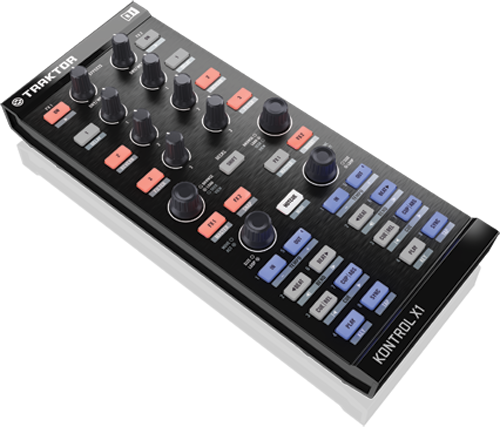
Previewed online in November 2009, this slender panel of rubberized knobs and LED-backlit buttons revealed Native Instruments‘ New Year’s resolutions in more ways than one. The Traktor Kontrol X1 (MSRP: $199) shows its German parent company finally resolute in offering, well, native hardware support for its premier digital-DJ software. Plus, the USB-tethered unit operates on proprietary NHL high-resolution protocols to rival MIDI in precision of bi-directional response with visual feedback. Coupled to Traktor Scratch Pro 1.2.4, this plug-and-play, hot-swappable dualdeck controller instantly maps to intuitive track selection, cue assignments, and filter-triggering settings.
The northernmost potentiometers offer customizable mid-points for comfortably adjusting multiple parameters of dual FX channels (activated as three pre-chained effects or a single one selected from the banks by a tab-forward function). In the mid-section, two firm push encoders scroll smoothly through tracks to assign the A/B channels. And the lower two knobs plus 16 buttons access/edit loop and transport functions. The shift button expands each button’s functionality—to toggle multiple cues, beat/pitch effects, etc.—and a second assignable MIDI layer exists for the presetphobic.
Ultimately, the X1 best suits gear-augmented live remix artists (the kind likely to already have NI’s Maschine, M-Audio’s Trigger Finger, some Allen & Heath, etc.). It’s not a complete solution, as there’s no mixer, EQ, or actual audio interface (though knowing Native’s style of integrated suites, it’s likely more custom boxes will follow). But the X1 does offer a stable, seamless extension for tweaking Traktor, coaxing traditional in-the-out DJs further out into a more active element.
The hype surrounding London’s Roska is inescapable, and for good reason: his work is some of the freshest bass-driven beat music around. Though he’s been throughout Europe and the UK several times, this April marks his first venture to North America, with high-profile stops in LA, San Francisco, and New York City. Check out tour dates after the jump!
Roska North American Tour Dates:
April 7 – Scion House Party @ The Roxy, Los Angeles April 8 – Heat @ Lava Lounge, Atlanta April 9 – Subdivision @ Khyber Upstairs, Philadelphia April 10 – Tormenta Tropical @ Elbo Room, San Francisco April 11 – Deep Groove Society Sundaze @ Jambalaya, Arcata April 14 – Trouble & Bass @ Webster Hall, NYC April 15 – SUBduction @ Enormous Room, Boston April 16 – Scion Sessions @ The Crown Room, Denver April 17 – Hype! @ The Social, Toronto April 18 – @ Jupiter Room, Montreal
Sitting on the back of a truck rolling through foothills of the South African bush, Nthato Mokgata’s cell phone keeps cutting out. Yet the 24-year-old rapper/DJ/singer/graphic designer, better known as Spoek Mathambo, brims with cocksure swagger even while bouncing across the rural landscape to film a video with his dancers. When you’re as busy as this dude, sometimes you have to do the walk-and-talk. Spoek specializes in playful, often dirty rhymes that at moments recall the sing-song stylings of Isis from Thunderheist or the potty mouth of Spank Rock’s Naeem Juwan.
Sekta feat. Spoek Mathambo – “Peter Pan (Doc Daneeka Remix)”
On the recent “Punani,” he incites female listeners to shake their bits atop French producer Douster’s aggressively minimal Egyptian-style beats, rendering Spoek a ravey pharaoh, while the amped-up “Jabajaws,” helmed by Warsaw’s Sekta, sees the MC bemoaning loose-lipped (and otherwise loose) women, intoning, “He said I said she said what/Shorty talk shit like she talk out her butt/Girl, go wipe your face/Get out my business/That ain’t your place.“
Against the backdrop of a thriving South African dance music scene (“You go to any random club and hear bangers after bangers, and then you’ll ask the DJ what this is and he’ll say ‘I made it,’” he explains), Spoek’s awareness of the need to keep it fresh drives his bedazzled hand to root around in numerous musical pots. He’s constantly spewing forth singles and EPs with his groups Sweat.X, Slush Puppy Kids, and Playdoe, singing as Mleke Mbebe, DJing South African kwaito tunes as H.I.V.I.P., and collaborating with international producers like Schlachthofbronx and Djedtronic.
XLR8R Couldn't find the embed function for type: "vimeo" and source: "<embed src="http://vimeo.com/moogaloop.swf?clip_id=10028672&server=vimeo.com&show_title=1&show_byline=1&show_portrait=0&color=&fullscreen=1" type="application/x-shockwave-flash" allowfullscreen="true" allowscriptaccess="always" width="530" height="298">".
Spoek Mathambo & Mshini Wam – “Gwababa (Don’t Be Scared)”
Historically, Spoek has described his sound as “future primitivism’’—invoking a tribal, trance-inducing power by wielding traditional African basslines while pushing next-level beats and raps. But at the turn of a dime, he lambastes himself for describing his work this way, insisting there is nothing retrospective about his own tracks, or any others currently emerging from the region. “In my own kind of slave mind, I thought that Africa meant a certain sense of the past. But Africa is strong and long every day. The fiber is so beyond primitivism. That’s really condescending of me to have put it like that,” he admits.
While this historical conception of ‘Africa’ may not directly influence his creations, Spoek is quick to explain that his forthcoming solo album takes cues from the dark tone of local music created in the wake of apartheid and AIDS. “After apartheid and the heaviness of that kind of oppression, people just got into party mode. To a large degree, the AIDS pandemic was born out of that party mode,” he explains. This cultural moment is reflected via his DJ moniker, H.I.V.I.P., meant to highlight the important convergence of oppression, promiscuity, and disease that marks a deceptively fun moment in the recent annals of African experience.
Though he has moved to Malmö, Sweden with his wife and sometime-collaborator Gnucci Banana, Spoek has spent the first few months of 2010 back home in South Africa, recording his album and trying to reconnect with the newest sounds emanating from the streets. “Whenever I land I’ll flick on the TV after 12 o’clock at night and it’ll just be the maddest music,” he ruminates. “It reminds me of when I was a kid and I’d want to record videos—because the stuff is so amazing!”