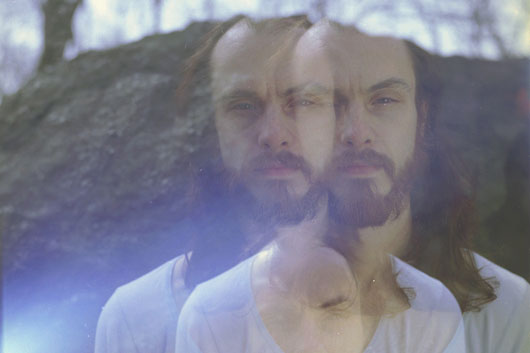
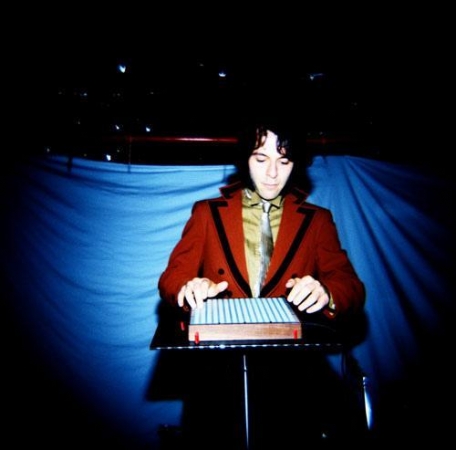
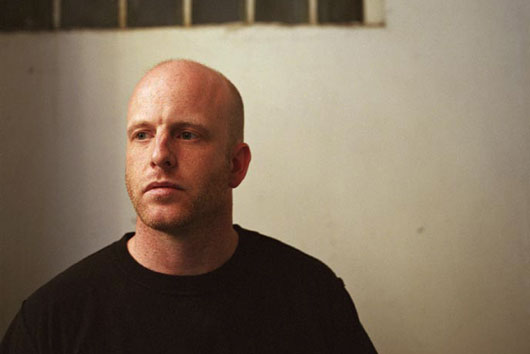
The man behind the epic proto-techno jams of Black Meteoric Star, DFA bad-boy Gavin Russom, returned home after spending over a month on tour in Brazil with a new set of musical inspirations that have come together to form his latest project, The Crystal Ark. Under this moniker, Russom, along with vocalist Viva Ruiz, has written a new single, a 12-minute slow-burning number called “The City Never Sleeps,” for release on the prolific DFA label. While the sounds heard on The Crystal Ark’s debut track aren’t unfamiliar for Russom’s catalog, the strong vocal presence throughout the song is a new leaf for a producer who erases nearly any human element from his work. “The City Never Sleeps” will be available March 16 on 12″ and digital download.
Taken from Daedelus‘ upcoming album, Righteous Fists of Harmony, “Order of the Golden Dawn” is a lovely slice of lounge-y music, featuring bossa nova instrumentation over a chunky hip-hop beat. Featuring the sublimely pure vocals of his wife Laura Darling, the track is perfect for intimate gatherings or a round of passionate afternoon sex, or as the ever-romantic Daedelus might prefer, lovemaking.
Within a week-long period in March, two festivals of epic proportions will be taking place in Mexico’s lovely city of Monterrey (pictured above). First up is the Festival Nrmal, which features XLR8R favorites such as YACHT, Daedelus, White Rainbow, Toy Selectah, and many more. With the aim of providing Mexican fans the opportunity to see groups they wouldn’t otherwise get a chance to see perform, the day-long festival is certain to be packed. What’s more, a week later, New York’s Todd P and Mexico’s Yo Garage are hosting the MtyMx festival, a three-day event featuring Acid Mothers Temple, Neon Indian, Tanlines, and Telepathe, and so many other groups that it’s a bit mind-boggling, except when one considers that SXSW is going on during the same period. Still, both festivals promise to deliver an amazing musical experience to an eager public in one of Mexico’s most beautiful cities.
Festival Nrmal happens on March 13. For more information, visit the event’s site.
MtyMX happens from March 20-22. For more information, visit the event’s site.
The Seven Fields of Aphelion has crafted a perfect album for ambient daydreaming with Periphery, and “Grown” is no exception: it expresses an intense wistfulness, opening with piano lines on top of drones and building to a swirl of piano-synth harmonies. High-frequency sine-wave dapplings and a healthy amount of delay round out the track’s gorgeous ache. Though she’s a member of Black Moth Super Rainbow, the simple grace of the Seven Fields of Aphelion’s music is a most unexpected and welcome reprieve from the sensory overload often caused by that group’s aural antics.
As owner of Bristol’s Rooted Records shop and founder of the Punch Drunk label, Tom Ford (a.k.a. Peverelist) doesn’t have trouble staying current. But the dubstep producer’s full-length debut, named after the inventor of the artificial heart valve, incorporates futurist techno vibes into his dub vibrations and low-end rhythms. Boasting seven new tracks, along with previous singles “Infinity Is Now” and “Clunk Click Every Trip,” Jarvik Mindstate showcases his tight style, crisp rhythms, and junglist roots. “Yesterday I Saw the Future” rolls a bit on gentle synth currents, pitched forward by staccato beats and satisfying bass thumps, while “Valves” runs slight but solid, with swatches of sound bouncing on shifting beats. These are tracks that move forward but keep the past firmly in focus.
East coast duo Kon & Amir are set to bring forth the third installment of their Off Track mix series April 26 via BBE. We talked to the crate digging beat-heads a couple years back while they scoured NY’s Lower East Side for their fix of rare 45s and long forgotten beats, and now they’re switching boroughs with Off Track Vol. III: Brooklyn. The new two-CD mix contains the same kind of unknown rare groove or, as Kon & Amir have termed it, “off track,” tunes that the duo has based its musical careers around unearthing. African disco and soul cuts like Effi Duke’s “The Time is Come” and Tee Mac’s “Living Everyday” highlight the 31-track playlist, and should make for an inspiring and interesting listen.
Things that immediately establish a certain mood: dead body, Labrador puppy, thunder, Inland Empire, the band Beach House. Even among three divergent albums, Baltimore’s Victoria Legrand and Alex Scally remain masters of bringing listeners to their very specific place.
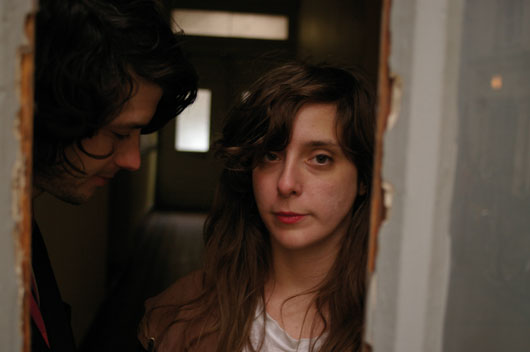
It’s not through insular or radically experimental music, necessarily, but via melancholic-pop comfort food—understated yet baroque, ethereal yet immediate. Catchy, even. Call it “dream pop” if you must; this Beach House is indeed a surreal locale. Legrand sings like she’s in a twilight fog—organs wash, keys twinkle as distant stars, submerged drum machines deliver the duo’s unwaveringly languid rhythms. ?Teen Dream, Beach House’s third full-length, is due at the end of January. Their first for Sub Pop, it sets a new high-water mark—their biggest exposure, highest level of production values, and most realized, honed effort yet. “I think our old stuff is really one-dimensional,” offers multi-instrumentalist Alex Scally in a late-fall interview at the duo’s Baltimore warehouse practice space. “We liked it that way, but we were outgrowing it and were really not wanting to play music like that anymore. As we were writing new songs, it was like, ‘This this is the right feeling.’ We were able to make it this multicolor giant feeling.”
LAYING THE FOUNDATION Perhaps what makes it most remarkable is that Teen Dream marks the third re-imagining of the Beach House sound. In 2006, the band debuted with a self-titled record on Carpark. The album was recorded over two days in Scally’s basement, and it radiates a certain lo-fi-ness, but something much different than the dirty crunch that’s turned a value into a genre in recent years. Rather, it’s an alluring simplicity of sounds and formula, and the sense that whatever is happening in the music is happening at the bottom of a shallow reflecting pool.
The sound was unexpected, and unexpectedly efficient—music from a duo that obviously didn’t need to be anything more than a duo. Legrand’s voice—a Nico-like instrument that lays itself into your headspace like the trace of a cool, gentle finger, replete with its chill—needs little to complement. Slide guitar on the first record, mainly, haunting and delicate, and lyrics that make love (and would-be love) seem like the only thing there is in the world, beckoning in soft tones “hold your hand on me.”
Two years later, the duo released Devotion, also on Carpark. With standouts like “Gila,” “You Came to Me,” and “Heart of Chambers,” the band clarified its vision. Legrand’s voice pushed out of the mix even further, and became both a heavy ballast and arching support for everything else Scally put into the songs, adding even more keys and organ, filling in open spaces with funereal wash. The songs were less about love than places—”Gila,” “Home Again,” “Turtle Island”—within the context of love (or vice versa), in melodies shaped not just for indie pop, but that could fly for straight-up drive-time pop (if that drive time involved a moonlit desert).
“Heart of Chambers”
“It’s really easy to do what you’ve done before,” says Scally. “Sometimes people do it because they don’t know what else to do, how to go forward.” And Beach House does so at the risk of losing fans at each phase of the band’s progression. The things about the earlier records that warmed people to Beach House—do-it-yourself production values and an oddball kind of minimalism and chill—may, to the band, be seen as old limits, but to listeners, they might be hallmarks of a certain beloved sound. It’s the risk any artist takes moving forward but, for a band as singular as Beach House, it seems amplified.
“A lot of the writing on Teen Dream is expanding the same sort of equation [as Devotion and Beach House], but challenging ourselves to build a more fantastical landscape,” says Legrand. “See how far you can push things, make crazier colors.” A fine example, “Used to Be,” saw release last year as a 7-inch, paired with 2006’s “Apple Orchard.” The mournful organ of the original is swapped for piano—turning the tone temperature up on the song by an important degree—and the ending, which originally deconstructed the song into the same metronomic drum pattern that it begins with, is embellished, and even hopeful.
“It wasn’t that we were unhappy with the first version,” explains Legrand. “It was the belief that there were things in the song that were warm and emotional and could be stronger.”
“That song was a huge trial for us,” Scally adds. “When we first made it, we made it in two days. It sounds like a demo, the original. We had to make this song part of the musical world we’re in now, or scratch it. We really loved the song but thought it was going to be left behind. We were hating it forever.”
?AN UPSCALE REMODEL One of the larger upsides to joining up with Sub Pop was recording money. (“We didn’t want to leave Carpark because we love [label manager] Todd [Hyman] and love working with such a small label,” Scally says.) Not only did that mean working with producer Chris Coady (of TV on the Radio, !!!, and Yeah Yeah Yeahs fame), but it meant isolation and time to get the record exactly right. “[It meant] getting to a place that doesn’t feel claustrophobic, for me personally,” says Legrand. “It helped for the album to, like, be all there was [around us],” adds Scally.
And it was for 25 days in Woodstock, New York, leaving us another record that is radically different than its kin. Teen Dream is, to hear the band tell it, the realization of an aesthetic that the duo’s been attempting for two albums, and falling short of. “We were able to get the sound going through minds,” says Scally. Which is lush and hi-fi, less ethereal, and more “rock band”: the mix is cleaner, which is a powerful change in the Beach House universe; there are live drums, washes of actual human cymbal, and Victoria Legrand’s vocals are more on a pedestal than they’ve ever been—less gazing and more diva.
“Zebra”
“I was always really inspired by Victoria’s singing,” says Scally. “She’s always had the power, but this record really displays [it]. I feel like my job in the band is to ornament her voice, find ways to surround[it]. I found it was just [with] every song she would create these melodies and everything would take off. Everything would keep building up into these giant [musical] towers. ? “The [songs] always change once you start singing,” he says to Legrand. “It’s always a reaction to the voice that drives it. We would never be able to arrange a song until the voice, its melody, and style were there.” ? “[It’s] a melody that just appeared,” replies LeGrand. “Like, [floating] at the edge of a beach.”
A quick Q+A with Pete Hahn, the creative director of one of our favorite retailers, Turntable Lab, on the site’s recent foray into selling digital music.
XLR8R: How important for you was establishing the digital side of Turntable Lab, and why? Pete Hahn: Being in the music business for 10 years, we’ve learned that it’s important to react to change quickly. Although we are record heads at heart, we saw the digital change coming around 2004 when DJ equipment companies started to incorporate MP3 compatibility. At that point, we knew it was important to get digital downloads on the site to keep our business evolving and growing. Our first digital service, launched in 2006, was like a foothold. We knew we could do it better, and the new site is that idea coming true.
How do you guys distinguish yourselves from Bleep, Beatport, and all the other digital retailers? That’s easy. We still operate our digital site like a traditional record store, so we filter, edit, and review all the releases on the site. We’ll even go “virtual digging,” going through labels’ back catalogs looking for a particular single. With today’s technology, it’s easy to have a digital store that puts up 1000 releases each week. We have that capability, but we choose to do the extra work for our customer. For example, we maintain a daily-arrivals section, and one day we might focus on funk, the other on dubstep and new school beats, all with reviews and editorial charts.
How big is the catalog? Approximately 20,000 tracks and growing quickly.
Is it all new stuff, or back catalog, too? It’s about 50/50. As a music fan, one of the great joys of running a digital site is getting access to a label’s back catalog. We recently received Warp’s catalog, which is over 300 releases. There’s some great old stuff we haven’t seen in years, like releases from Polygon Window, Boards of Canada, early Prefuse 73, Squarepusher, The Sabres of Paradise, and others.
Is it easy for independent artists to sell through? Yes. We deal with artists and labels directly if they have a decent-sized catalog. However, if they only have a couple releases, we recommend going through a digital aggregator, which is like a modern-day version of the record distributor. Aggregators handle all the pesky paperwork and accounting.
What special features does the site have? The best feature is definitely the selection—that’s what sets us apart. Other features include editorial from the extended Lab family, everyone from Mad Decent to Stones Throw. The integrated Lab radio show is great, because if you hear a track you like, you can purchase it right there. Also, we think the ability to purchase digital credits is very useful. It makes buying music even easier and you can save money.
How do you see the store expanding? Apart from growing the digital catalog, what we are really excited about are the connections between our three sites (physical site, digital site, blog). With music burning out so rapidly these days, we think the Lab is a great place to slow things down. You can go read the interview on the blog, listen to the tracks on the digital site, then go buy the shirt on the physical site.
Are you looking to showcase a particular style of music? If you are familiar with the Lab, you know that we don’t have a particular style focus. One day it may be Afro-funk, the next it might be Baltimore DJ edits. That is not going to change with the digital site.
Are you planing on doing any special projects (ie. limited-edition stuff, exclusives, or compilations)? Turntable Lab DJ bags, iPhone app, blog 2.0, and more releases on Turntable Lab Editions/Money Studies are in the works.
The UK’s 10-20 cuts straight to the chase on its new track, “majik.” Within five seconds, a fully formed beat jumps into the forefront, flanked by ephemeral sonics and swirling bits of electronic soundscape, and doesn’t quit, save for a few seconds of intermittent reprieve, until the song’s seven minutes are up. “majik” could be mistaken for an early-’00s Autechre cut, or something from maximalist producer Clark’s catalog, though it manages to maintain a clustered aesthetic all its own. The track is taken off the forthcoming Mountain EP, the third in 10-20’s four-part geographically conceptual Landform series.
Almost a decade and a half after its first release, !K7‘s DJ-KiCKS series is being treated to less of a typcial DJ mix and more of a music history lesson, courtesy of DFA mainstay Juan MacLean. The disco and house-obsessed artist took the six months before recording his contribution to DJ-KiCKS debating the relevance of the craft in 2010, and came to the conclusion that he would rather delve into his roots in dance music. What follows is a 72-minute long love-letter to the sweaty, throbbing ages of house, featuring the likes of Ian Breno, Armando, and Theo Parrish, and put together—live—using nothing but two turntables, a couple of filters, and tape delay. Of his mix, MacLean said, “It’s easy to be self-indulgent and stay cool and make the proper moves. It’s also easy to just play hit after hit, which most people do. But to somehow wrestle with those two things and emerge with something that considers both, seems more interesting.” MacLean’s DJ-KiCKS will be available April 27.