Future-soul songstress Muhsinah gets the full Flying Lotus production treatment on “Lose My Fuse,” a shuffling slice filled with wobbling beats, disembodied vocals, and some truly bizarre flourishes, like sexual pantings and little whistles. Just as the track gets going, it literally loses its fuse, morphing into an almost pastoral vocal landscape. Similarities to J*Davey aside, this is another bit of leftfield R&B sure to make its way into speakers all over.
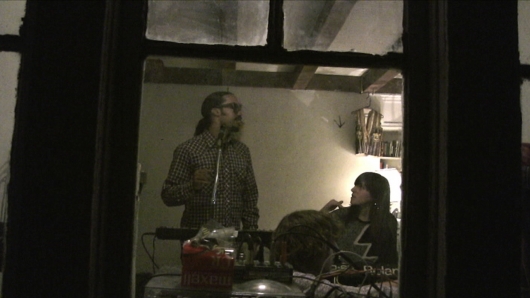
For the latest installment of our XLR8R TV series Tune in an Afternoon, we traveled to Los Angeles and paired the unique talents of Dam-Funk and Nite Jewel. If you haven’t done so already, go here and watch the duo craft some creepy synth-funk over the course of an afternoon at Nite Jewel’s house. Then make sure to download “Am I Gonna Make It,” the first of what will hopefully be many Nite Funk collaborations to come.
Two distinct LA flavors that taste great together!
A few weeks back when we were sitting around fantasizing who in Los Angeles we’d want to collaborate for our recurring series, Tune in an Afternoon, we pretty quickly came up with Dam-Funk and Nite Jewel. When we contacted them, it turned out they were fans of each other and had been looking for an excuse to collaborate. It was decided that Nite Jewel would produce and that their favorite store, LA’s Future Music, would serve as the afternoon’s launching pad. From there, things just got creepy.
Be sure to download their song, “Am I Gonna Make It,” here.
While minimal techno may have died in a storm of rote blips and clicks set against 4/4 kicks, some of the genre’s better practitioners haven’t given up the ghost, and Pantha Du Prince is a member of this small coterie. With a penchant for melancholic chord progressions, small rifts, and icy sonic landscapes, “The Splendour” is a slice of deep techno that keeps some minimalist aesthetic alive, but eschews the genre’s microscopic tendencies in favor of a dichotomy between smaller aural gestures and grander, more lush synth sweeps. Like a more detail-obsessed Lawrence, Pantha Du Prince is sure to remain at the top of the minimal field with his next full-length, Black Noise, which arrives on February 9 of next year.
New York’s Bisco Smith definitely knows how to spit, with an intelligent flow similar to Aesop Rock’s early work. It is safe to say, though, that Blockhead‘s remix improves on the stuttering beats of the original, instead placing Smith’s rhymes over a more traditional, yet more hype, late-’90s sound, replete with triumphant brass loops and low-slung, heavy bass. These are “freshwater flows,” but Blockhead knows how to make them work in the most proper way.
On his debut for the Type label, Mark Richter (a.k.a. Black to Comm) departs dramatically from the more organic, drone-based recordings that his fans are used to hearing. Instead, Alphabet 1968 relies much more on the interplay of discrete percussive elements, evident on the frantic pulsing of “Houdini Rites” and the homemade gamelan mysticism of “Musik Für Alle.” Though Richter maintains his found-sound, sample-based approach to composition, especially on album closer “Hotel Friend,” the more heady dirges that he is known for are presented in bits, as on the organ-swollen “Traum GmbH” and the foreboding deepness of “Void.” The effort is much appreciated—one can get sick of drones after a while—but it’s not certain that Richter’s fans will be quite as enthralled with his departure.
When Uproot Andy rolls out the names of rhythms, he savors them deliberately, like a hoodoo priest chews on a root: kuduro, bullerengue, cumbia. And like a root doctor, it’s from the mixing of these ethnically diverse musical styles that Andy Gillis draws power. It’s a hoodoo he’s practiced as a DJ, as co-founder of New York City’s digi-global party Que Bajo?!, and as a producer for the ZZK and Bersa Discos labels. And now, along with Que Bajo?! cohort Geko Jones, he’s faced the most post-modern of DJ tasks: taking their global sounds to cumbia’s ancestral homeland.
“The crowd might’ve been surprised to hear us play this folkloric music from their own country,” says Andy, on the phone from Bogotá, Colombia. “But we’re not playing traditional Colombian music—I don’t feel weird playing the stuff that I’ve remixed here. [The fact is] Colombia’s one of the least popular places for cumbias right now—at least amongst young people, in the city, almost no one plays it.”
One of the brightest music stories of the young 21st century is the burgeoning renaissance of globalized electronic music. From hip-hop’s plundering of bhangra, to the explosion of Balkan beat, baile funk, and the current cumbia revival, the past decade has seen a surge of interest in ethnic rhythms. And at the forefront stand artists such as Uproot Andy, who see each genre less as a scene to join, and more as a color to add to their palette—creating the world’s first post-geographic ‘folk’ music.
“El Botellón”
“A lot of the scenes that we fold into this [music]—something like baile funk or kuduro—they exist on their own [geographically],” says Gillis. “At a Rio baile party, they would not play cumbia. These things are still local popular musics. People talking about ‘global bass’ are interested in all of those things, mixing those elements. On this [Que Bajo?!] tour of the US, we’ve seen there are openings [for this music] all over the place—not connected geographically, but via the internet.”
The first “opening” Uproot Andy discovered was New York’s Bulgarian bar, Mehanata, and its chaotic world-music parties. A curious record collector, Gillis fell right into Mehanata’s anything-goes aesthetic. It’s nothing new for New York City’s generations of musical mixology. But in today’s blogosphere-dominated global music world, dissemination that might once have taken years occurred overnight.
“[The difference is] temporal,” says Gillis. “If I say, ‘Oh, I’ve heard of this genre, let’s see what it sounds like,’ I can just do it. I’ve felt like an ethno-musicologist—an academically unsound one, because I only use the parts I like.”
As he prepares his first album-length project—after a slew of remixes for cumbia-, baile funk-, and other genre artists—and finishes up his first tour of the US and South America, Uproot Andy stands ready to enter the next decade in a distinctly exciting position. Along with his Dutty Artz and Que Bajo?! colleagues, and an international assortment of artists and DJs, Uproot Andy is on the cusp of a new musical scene—before it’s even got a proper name. “As a composer, finding a new rhythm is like an artist with a new medium to work in,” he says. “All the things that have influenced me have been genres—so I was jealous, a year or two ago, when I felt like I was doing something that wasn’t a ‘scene,’ wasn’t gonna have a name. But that’s changing.”????????
Uproot Andy plays the second anniversary of Tormenta Tropical this Saturday, December 12, in San Francisco.
Ku Bo‘s Latin-flavored “Su Manita” gets punched up a few notches by Daniel Haaksman, who not only speeds the track’s BPM to 145, but also adds enough intense electro melodies, elided vocal snips, and percussive flourishes to make any club go absolutely insane. Taken from the Ku Bo Remixes EP, which comes out today.
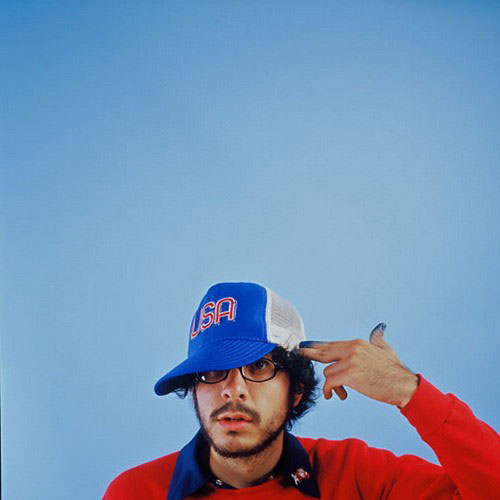
Cheeky Bay Area expat Yoni Wolf pays a visit to XLR8R’s Inbox this week. The lead man of indie-rock outfit WHY? touches himself at work, remembers the Olsen twins’ humble beginnings, gets stabbed while moshing, and misses San Francisco. WHY?’s Eskimo Snow is out now on Anticon.
XLR8R: What are you listening to right now? Yoni Wolf: I am listening to an as-of-yet unreleased album by my friend Austin Brown and enjoying it quite a lot.
What’s the weirdest story you have ever heard about yourself? I once read in a music periodical (to remain nameless) that I am “former studio auxiliary percussionist for Hoobastank and Rusted Root.” Excuse me?! I’m like, Then where’s my royalties, bitch!?
What band did you want to be in when you were 15? Rusted Root.
Worst live show experience? Getting stabbed in the hand in the mosh pit at Warped Tour. It took me more than a minute to figure out whose blood it was.
Favorite city in which to play? San Francisco; Anacortes, WA.
Favorite studio toy? Dis dick. I like to touch myself while I work.
What is one thing you couldn’t live without (excluding the obvious essentials, i.e. air, water, etc.)? My Dictaphone, tofu.
What is your favorite item of clothing? Red-hoodie/red-and-blue-flannel-combination layered top.
If you could revive any dead musician to spend the afternoon with, who would you choose, and WHY? The Olsen twins. I liked when Michelle would say, “You got it, dude!”
For what did you always get in trouble when you were little? Sexual assault.
With which other artist would you most like to work next? The cast of It’s Always Sunny in Philadelphia, MF DOOM, Bonnie Prince Billy.
What’s the last thing you read? What Is the What by Dave Eggers.
Complete this sentence: In the future… …where we’re going, we won’t need roads!
Stupidest thing you’ve done in the last 12 months? Moved away from the Bay area.
Only a total genius nutcase like Dan Deacon could remix a remix and get away with it. Baltimore’s most infamous party-starter makes GZA‘s take on Salvador Santana into a synth-drenched, vocoder-laced piece of hypnotism that almost begs the listener to smoke some heady weed and put it on repeat. With high-frequency whirs and GZA’s voice panning throughout the track, it is difficult to even conjure the idea of the original, which was elegantly produced by The Hood Internet.