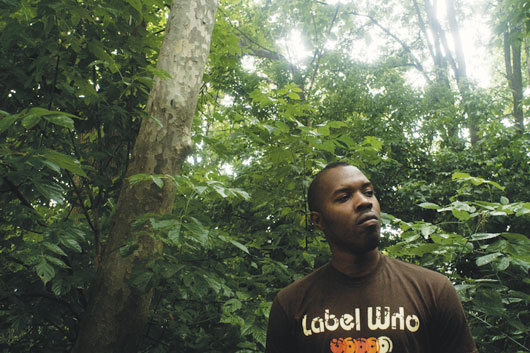
Producer/MC Jneiro Jarel prefers not to call any one city his own. Not wanting to fall into hip-hop’s territorial obsession, Jarel is more concerned with pushing his various leftfield projects forward than claiming certain area codes. “The thing about me, I always brought my vibe anywhere that I go,” he explains. “That’s why you can’t really put a finger on where I’m from. I call it a Viberian vibe—this is my own world.”?
While mentally chilling in the sonic utopia of Viberia, Jneiro now physically lives in L.A. The recent move out west from his longtime residence in Philly was made partially to be in closer proximity to his friends and collaborators Flying Lotus, Daedelus, and others from L.A.’s bubbling beat community. With Jarel, though, no move is permanent. “I’m in Cali for a minute, but I’m still Philly, though. You know how it is—I’m everywhere.”
After growing up across the country, Jarel began sharpening his MC skills in Houston and then moved on to Atlanta, back to his hometown of NYC, and then to Philly in 2004. And it was there that he ultimately began to make noise as a MC and producer. Thanks to a push from Philly selector Rich Medina, Jneiro opted not to let his financial troubles on the East Coast get the best of him. “I was gonna go to Texas and then eventually come back to New York, but I went to Philly, met King Britt, met Bahamadia, and hung out with all these Philly legends.”
Living in PA amongst established greats, though, Jarel didn’t follow in anyone’s footsteps. Instead, he began letting loose in the studio, and recording projects under different aliases like Dr. Who Dat? But in 2007 he pushed his creativity a step further with his debut as Shape of Broad Minds, a group made up of four of his aliases and one actual rhymer, Jawwaad. Approaching this project from so many angles allowed for a raw assortment of cosmic boom-bap, jazzy broken beats, and a little Brazilian funk.
Jarel made no less of an impression on his collaboration with Goodie Mob MC Kuhjo, called Willie Isz. The duo’s 2009 debut, Georgiavania, evoked listeners to re-think their impressions of Jarel and Khujo with this self-dubbed “digestible but still different” LP.
Staying in tune with his rapidly shifting sonic vision, his recent collaborations include remixes for DOOM, a song with Dave Sitek from TV on the Radio, and tracks with fellow shape-shifting act Blu. No matter the locale, Jarel strives to not repeat himself. “I’m all about reinventing for my own personal stimulation [and] for my audience,” he says. “I feel like a lot of my audience gets that now.”
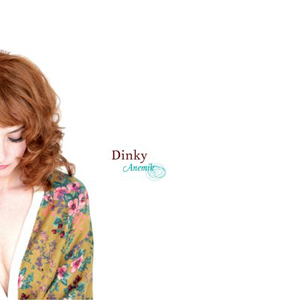
Ignore the title—the blood isn’t weak here. Suave microhouse rhythms, fluid synth riffs, and rackety percussive hits flow through the heart of this album by Chilean-Berliner Dinky (a.k.a. Alejandra Iglesias). She has a great habit of losing her vocals in the machine—exhibit A is “Skyped,” where her vowels splinter and dissipate into a mess of polyrhythms. Other trips down the rabbit hole include the psychedelic bebop jaunt “Westoid Feat Updates,” and the Neubauten-like industrial grind of “Fadik.” Despite a few uninspired synth instrumentals, Iglesias’ courage in tossing in abrupt twists and clangs into her rhythms is quite welcome in a time when stale and, well, anemic minimal records keep piling up in shops and MP3 players.
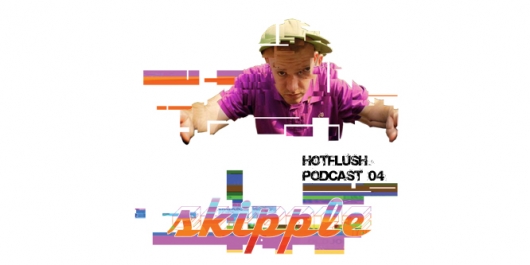
White-hot London imprint Hotflush Recordings—home to next-level artists like Joy Orbison, Scuba, Untold, and Mount Kimbie—has dropped a blazing new podcast courtesy of SubFm DJ Skipple. Although they prefer to keep the tracklist secret, capable trainspotters will recognize new and unreleased tunes from the likes of Joy Orbison, Scuba, and Pangea alongside some choice 2-step classics. Those who enjoy all the weirdness happening on the fringes of dubstep, particularly where it’s mingling with garage and UK funky (as documented in our current cover story) should definitely give this one a listen.
Skipple’s Hotflush Podcast 04 can be downloaded here.
OK, let’s get this straight. New-school synth-funkers Chromeo get remixed by UK dubstep wizard Skream, who transforms their track into a G-funk slow-jam? Um… yeah, we’re sold.
Phillin’ It: For years, Philadelphia has been shrugged off as New York’s little brother—a place where displaced Brooklynites went in search of cheaper rents, bigger spaces, and a touch less ‘tude. But what’s emerged over the years is far more than simply a sixth borough. So for this year’s special City Issue, we dug around the Fishtown, Northern Liberties, Chinatown, and every other little enclave we could find to bring you the best that Brotherly Love has to offer. Check back every few days for a new feature from the east coast’s newest hotbed.
There’s a level of deep listening where “being influenced by” doesn’t ?quite come into play. It’s very near the surface of the music that Philadelphian Wes Eisold has been releasing for just over a year, with the occasional help of friends, under the moniker Cold Cave. A near-delirious jumble of pop gestures embedded in dusty-circuit synths and mids-heavy drum machines, Cold Cave’s first proper full-length, Love Comes Close (released on Eisold’s own Heartworm Press imprint), might recall EBM or dark wave at moments, but its prerogative is less about a particular sound than a whole structure of feeling. As Eisold puts it, “What I wanted to make was an ode or memorial to the music I’ve spent years dancing to alone in a bedroom.” It figures, then, that former Xiu Xiu member Caralee McElroy—a singer and musician well versed in bringing out the dancefloor potential of bedrooms—contributes to many of the tracks here.
More often than not, the soundtrack for Eisold’s bedroom dancing was Brian Eno’s “Here Come the Warm Jets,” and he singles out Eno’s debut album of the same name as a bridge between the structured world of hardcore and experimentation with audio processing and recording itself. As the vocalist of now-defunct post-hardcore units Some Girls and Give Up the Ghost, Eisold sees Cold Cave as a departure from his previous projects in that his writing and recording process are one and the same, involving more improvisation and more responsibility for the final product: “I record everything and end up using a lot of the mistakes I become fond of,” Eisold says, echoing Eno’s Oblique Strategies dictum to “honor thy mistake as a hidden intention.” While Love Comes Close is undeniably more of a pop album than the noisier singles collection Cremations (Hospital Productions, 2009), the tracks behind Eisold’s and McElroy’s singing writhe and threaten to devolve into the protean tone exploration of early electronic music.
Comparing Cold Cave to the musicians they fleetingly resemble—OMD, Front 242, Chris & Cosey—is something like taking dream symbols literally. Each of the bands mentioned had their own subcultural corona in the pre-internet era, a net of references that orbited around them and described a whole way of being in the world. If there’s a dreamy quality to Cold Cave’s music, it’s in the way it creates spaces we seem to recognize. Eisold has recalled in previous interviews how, as a child, a family friend described to him that the black-clad kids at the mall were Smiths fans. Peering into such portals is what guides Cold Cave, a project that Eisold describes as an attempt to “give back in the present to what has given so much to me in the past.” In doing so, Cold Cave manages to come up with something more vital than irony or earnestness alone could muster.
Chicago’s shape-shifting trio A Lull creates a vast sound far more massive than the sum of its parts. Their beat-heavy brand of post-rock relies equally on instrumental rhythms as it does melodic vocal percussion, a fact showcased fluidly on the XLR8R exclusive “Weapons For War.” Ripped from their current sessions for next year’s forthcoming debut album, Confetti, A Lull’s song inhales as much as it exhales—trading in swirling electronics and tribal beats for acoustic rhythms and harmonized vocal hooks as it breathes.
Part Netherlands and part Colorado, the elusive Brim Liski is a collective of underground producers who remain “happily depressed.” Their collective output sounds something like M83 covering Depeche Mode remixing a Three 6 Mafia beat, and “Fight” is a great example of the group’s ability to balance a head-nodding beat with poignant atmospherics and hushed vocal work.
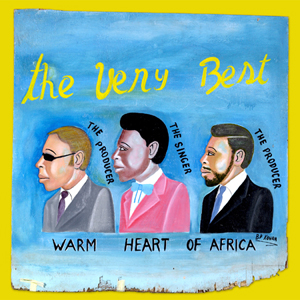
The Very Best may have been born in a London furniture store, but the music casts an obvious eye toward Africa. Combining the beatmaking prowess of Radioclit with the unique vocal stylings of Malawian singer Esau Mwamwaya, the project leans heavily on the West’s romanticized version of African pop music and occasionally strays toward Lion King territory (“Yalira,” “Angonde,” and especially the title track, featuring an unfortunate guest appearance from Vampire Weekend frontman Ezra Koenig), but the propulsive pop of songs like “Nsokoto” and “Kada Manja” is strong enough to dash any visions of animated jungle creatures. “Chalo” and “Mfumu” are equally infectious, although the radio-ready ’80s synths certainly wont help Mwamwaya escape his reputation as the “African Phil Collins.”
Words and reporting by Jefferson Petrey and Ken Taylor
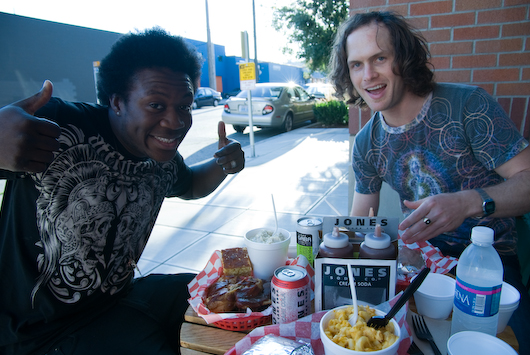
Last week’s Decibel Festival, the sixth installment of the electronic music gathering, held from September 24 til the 27, saw the XLR8R crew working overtime and double duty on the streets of Seattle, hitting up events from sun down til sun up and then some, and dropping in with producers Lusine and Pezzner for an upcoming episode of XLR8R TV. In fact, before we could even settle in to the city’s idyllic environs, we were already chowing on BBQ with Benga and Christopher Willits. (Yes, BBQ in Seattle—not half bad!) The rest of the weekend was a bit of a blur, but with the help of Seattle-based scribe Jefferson Petrey, we’ve done our best to piece it all back together.
Benga and Christopher Willits
Thursday September 24 After gathering our wits and our passes, we first hit up Thursday’s Ghostly International opening party at the Seattle Art Museum, where folks like Michna, Lusine, and Clark Warner warmed the just-easing-into-it crowd in the front room, while Tycho, The Sight Below, and Lissom wowed those in the auditorium with audio-visual treats.
Back up the hill at Neumo’s, Rod Modell and Stephen Hitchell of Echospace drifted into the mix from far-flung sonic horizons on a buoyant mix of analog hardware and digital editing, producing headily atmospheric, humid, dub-heavy sounds with deep bass and roots-informed pointillist techno rhythms. They left Mad Professor with quite an act to follow, and by many accounts, the legendary dub master didn’t quite make good. He delivered a set of relatively predictable dubbed-out beats and mic chat, even calling one female fan on stage to sing a few clumsy lines, but he still failed to set the crowd on fire.
Mad Professor
As we jumped between Neumo’s and Sole Repair (conveniently steps across the street), we caught quick glimpses of Mikael Stavostrand and Derek Plaslaiko playing to a very thick and sweaty crowd, before tying up the evening with Dubstep prince Benga, who did manage to both set the patchouli-scented masses on fire and get their nostrils wobbling with some ridiculously heavy and loud bass.
Benga
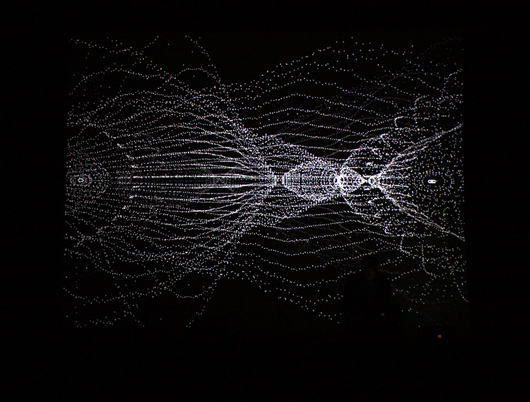
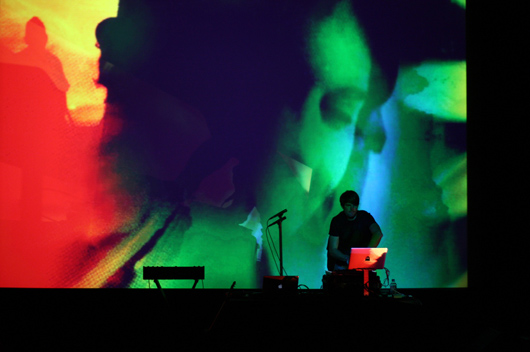
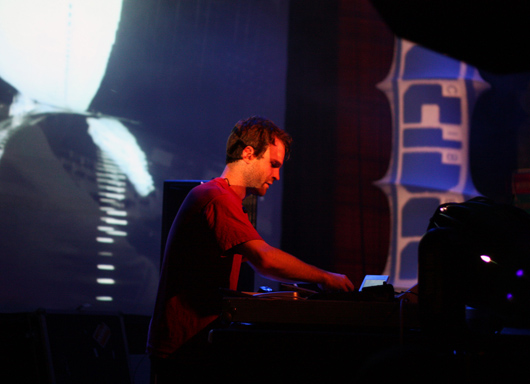
Friday September 25 While Ken was out riding the Sound Transit light-rail system and grabbing found sounds with Lusine and Pezzner, Jefferson was holding it down at the Optical 1: Immersion audio/visual event, where Decibel had smartly attempted to bridge the gulf between headphone music, the concert theater, the art gallery, and the club. Type artist William Fowler-Collins, his feet strewn with effects pedals, guitar strung over his shoulder and laptop on table, ushered in quiet tones, feedback, and ominous extended drones as a soundtrack to abstract video narratives on the Cold War and the Nuclear Arms Race. Frank Bretschneider‘s set that followed was a stunning contrast of hi-resolution audio-responsive digital geometry that leapt from the screen in precise time with his hyper-dynamic musique concrete textures, rhythm patterns, and silence used to employ the starkest of musical punctuation. This almost shocking visceral immersion from Bretschneider was followed by Christopher Willits putting in a significantly more restrained set than fans of his 2008 Ghostly international release might have expected. Reduced to just a pallette of tones, snippets of melody, and minute rhythmic pitter-patters sourced from guitar, his take on the night’s theme of immersion was matched with a visual element: consciousness moving through nature, whether under California’s redwoods, out on the open sea, or following trails of green pushing up through the urban scape.
Frank Bretschneider’s a/v performance
Over on Capitol Hill, minimal legend Rob Hood offered a stark contrast to the night’s Optical proceedings by pummeling the early-evening crowd with some powerful techno. At the neighboring Sole Repair, not quite as packed as the night before, we caught an equally energetic set by [a]pendics.shuffle before jumping back and forth to witness Wighnomy Brothers taking the Neumo’s crowd to town with their hefty house and techno mix. From there, it was off to the far-flung Church of Bass (our vote for worst club name on the west coast), where XLR8R friends Qzen and Clark Warner took late-night revelers into the wee hours. A bit worse for wear, and with two nights ahead of us still, the idea of pacing ourselves trumped the reported great early-morning sets by Drumcell and Bruno Pronsato.
Wighnomy Brothers
Saturday September 26 We kicked off Saturday with Optical 2: Beauty in Binary, where a subtle, quiet-ish female-heavy bill saw early performances by The Dead Texan’s Christina Vantzou and Seattle’s own Iller Aint. Tokyo-to-New York-and-back-again transplant Sawako, mirroring her real-time visual work, spread a tapestry of the thinnest fibers of melody throughout the space, and punctuated them with vocal wisps and the miniature pop structures.
Truckasaurus
We stopped in to Chop Suey for a nice bit of four-man electro-IDM from Truckasaurus before landing at Neumo’s (what seemed to be ground zero for DB’s many events) just in time to finally get some sit-down time with XLR8R celeb blogger and Radio One queen Mary Anne Hobbs (who was documenting her US travels for us over the course of the last few weeks) in the green room downstairs. Back up those stairs Daedelus absolutely slayed the crowd with his mutton chops, sweat-soaked Victorian get-up, and monome controller. When the former XLR8R cover star mashed up Dorian Concept’s “Trilingual Dance Sexperience” and Bobby Caldwell’s ’80s soul classic “What You Won’t Do For Love,” it felt like the room was gonna lift off. Faced with the sufficient challenge of following that one up, Mary Anne Hobbs still managed to get the crowd eating out of her flailing hands, and held them much more tightly than dubstep diplomat Mala, who seemed to lose a bit of the momentum with a set that was a touch too dark for the ready-to-party gatherers.
Daedelus
Eschewing another crosstown cab ride to Church of Bass, we opted for the nearer-by Electric Tea Garden after-party, where local crew From 0-1 (Sone, Cyan Wave, John Massey) held down the decks with a perfect blend of heady, peak-hour techno. Itinerant reporter Brandon Ivers tells us, though, that across the way was the place to be, where Move D and Martyn took full advantage of those prime 4 a.m. and 6 a.m. slots, when inhibitions are long gone and hallucinogens are in full effect.
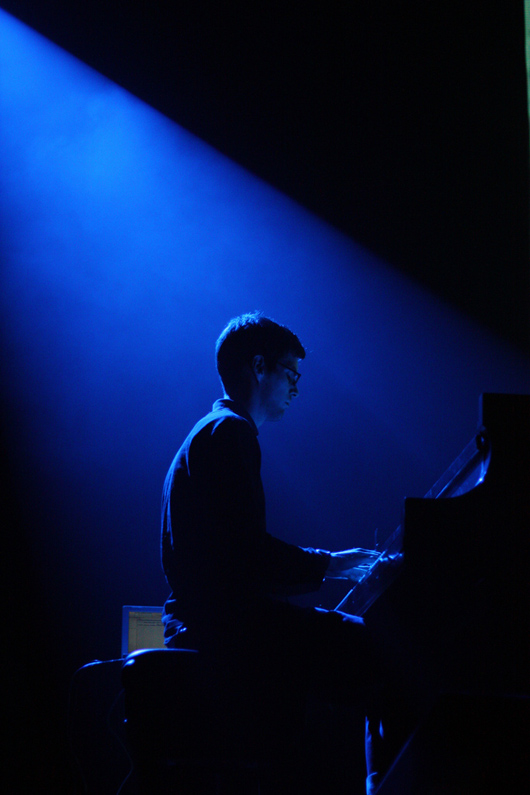
Sunday September 27 At Sunday’s Optical 3: Ameritronica, Portland’s Keith Kenniff (better known for his elaborate and gorgeous multi-instrumental electronic and classical intersections as Helios) performed under his piano-specific moniker, Goldmund. All muted tonalities, Erik Satie-esque keyboard play, and diminished, elegiac melodies, his time at the grand piano was brief and perfect in its expressive succinctness.
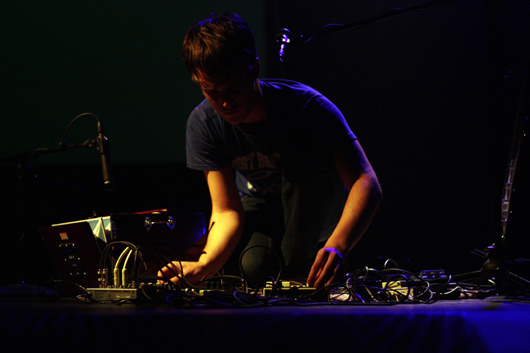
Kranky’s Benoit Pioulard, set up amongst a circle of microphones, effects pedals, guitar, and accordion, strummed out the quiet, restrained psych-folk tunes he’s made his own in the past few years. One of Decibel’s highlights came in the midst of the following set, as the New York duo Mountains (a.k.a. Koen Holtkamp and Brendon Anderegg) rolled through a flowing mass constructed from guitar, effects, electronics, non-musical objects, and sampled organ tones, and launched into a blindingly gorgeous Americana-style Indian raga.
Later in the evening, Tim Exile, taking a page from fellow Warp Records compatriot Jamie Lidell, turned his stage show one of all improv’d, MC’d mania and hyperactive MIDI-controller tweekery. Throwing himself into the dancefloor with a remote joystick to control his onstage electronics, Exile danced through the audience, spastically firing off missiles of beats and screaming, shredded synth lines.
Surprisingly upping the ante, Klang Elektronik stalwarts and German techno-hijinksers Alter Ego took the stage, immediately adopting the most potent weapons in the rock n’ roll arsenal—the riff and the hook—and realizing their single-minded agenda to make post-shuffle techno seriously, seriously rock. With Alter Ego’s distortion, feedback, and the hook—those powerful body-activating gestures so honed over decades of rock n’ roll—now taken out on the town for some twisted, technicolor, hyper-geometric, janky techno workouts, the audience could not resist. It’s no wonder their biggest, most globally played single and the festival’s closing note, was “Rocker” in its most tweeked, unhinged, blasting glory. Rocking they did. Us? We were leveled by a euphoric, elated, and exhausted sense of finality… possibly with the low-lit illumination of that kindled anticipation for Decibel 2010 already unconsciously in mind.