Phoenix Wolfgang Amadeus Phoenix

It’s not hard to like Phoenix. The French quartet has spent the better part of the last decade making one infectiously sunny pop-rock tune after another. Wolfgang Amadeus Phoenix is their fourth album, and it doesn’t find the band undertaking any radical reinventions of their sound. Produced by Philippe Zdar of Cassius, the record perhaps features a little more electronic sheen than usual (“Rome”), but for the most part, Phoenix does what they do best—craft breezy pop songs with just a hint of funk to get your hips shaking. The toe-tapping disco-pop of “Lisztomania” and the fuzzy bounce of “1901” rank among the band’s best work, and will undoubtedly be stuck on repeat on many an iPod this summer.

TBC: Teknopolis – 10 Years of MUTEK

As the MUTEK festival turns 10, it sheds its highbrow image for a diverse balance.

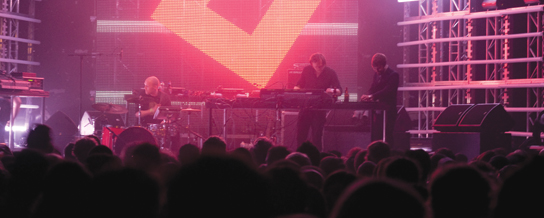
Over the course of its 10 years in existence, Montreal’s MUTEK festival has asserted itself as North America’s preeminent annual event for electronic music experimentation and collaboration. Whether it’s setting up an operating room for Matmos to fully perform A Chance to Cut is a Chance to Cure or hosting the monumental debut of Narod Niki (the eight-man techno live performance boasting the likes of Richie Hawtin, Monolake, Daniel Bell, and Luciano), MUTEK has not-so-quietly set the stage for other festivals like Decibel and Communikey to humbly follow in its footsteps. On the eve of MUTEK’s 10th anniversary, we spoke with founder Alain Mongeau about its philosophy and its impact.

XLR8R: What do you think MUTEK has achieved that no other festival in North America (or of its sort) has?

Alain Mongeau: The thing is, there aren’t so many festivals dedicated to electronic music in North America. Actually, when we started in 2000, we were pretty much alone—Detroit’s DEMF was created at about the same time, and Decibel, admittedly modeled after MUTEK, started a few years later.

One of the characteristics that was always different was the fact that the festival features like 98% of live acts, and only a random DJ here and there. By doing so, we wanted to put the focus on the creative process and on the artists themselves, trying to inject some form of recognition and credibility to their field of work. So the party factor wasn’t the main drive of the festival, it was more an attempt to keep the creative force at work in the early rave and techno years alive, inviting it to evolve also.

Our initial goal was also to establish a bridge with the rest of the world. Already then there was a sense that things were much more happening abroad, in Europe, and we wanted to reach out and connect by bringing some of the action back over on this continent. And for this same reason, the first MUTEK was done with an awareness that our target audience wasn’t only to be found in Montreal, but everywhere in North America. And that hypothesis proved to be right, as year after year, people from all across the continent have been converging on Montreal for MUTEK, the festival becoming, for many, a sort of yearly pilgrimage.

One of MUTEK’s successes is that it seems that just about everyone who’s dealt with the festival, be it as an artist or a festivalgoer, have developed a strong sense of attachment and identification with it. And I can’t really explain why; it somehow still remains a mystery for me. There’s probably a series of factors: a good seen of timing, the fact that we’re based in Montreal and that the city itself is quite unique, especially in a North American context (being predominantly French speaking, it carries a European touch), or maybe we’ve just been playing our cards right, maintaining a clear editorial line, with high standards of quality.

In any case a strong sense of community has developed around MUTEK that has helped us a lot in our determination to continue. And we’ve continuously been on the drive to expand our reach out of the continent, putting a lot of effort in branching out towards Latin America, doing consistent fieldwork in Chile, Mexico, Argentina, and Brazil, since 2003. We’ve been quite active on the international front, with some presence on about all continents (we even did a tour in China a few years ago), and that internationalism has become an intrinsic aspect of MUTEK. It’s like we’ve been casting our nets a bit everywhere, inviting people to converge on Montreal for our yearly event, the matrix of things, and it’s working well, as 54% of the festival’s public came from out of town in 2008.

Was MUTEK modeled after any other festival?

Not directly. It was inspired by a few things: the Interference Festival that took place in Berlin in 1994, for instance, which is the first time that I went to a techno event that focused on musicians instead of DJs. I started organizing festivals in 1995. My first try at it was an electronic art festival (I was program chair of ISEA 95 Montreal). Then I became involved with the Montreal Festival of New Cinema and New Media (FCMM), where being in charge of the New Media section allowed me to try different experiments that actually prepared the ground for MUTEK. During my first year at the FCMM, in 1997, I created a Media Lounge, and among other things we did a networked event in real time with SONAR, thus establishing a kind of connection with what the Barcelona festival was developing in its early years.

At what point did you discover there was a need for MUTEK?

My first draft for the MUTEK festival was made (on paper) in 1997, the same year that I started doing the Media Lounge with the FCMM. That first edition of the Media Lounge was magical, revealing the embryo of a community, because it brought together a lot of people that were all working in relative isolation in Montreal. A lot of it was driven by multimedia art and electronic music, which weren’t a natural fit within the context of a film festival like the FCMM. But I continued pushing things, continuing with the Media Lounge in ’98 and ’99, until the opportunity for putting MUTEK on the table showed up, when the Ex-Centris complex opened its doors. During the launch of Ex-Centris in June ’99, I presented a four-day event called LOGIN0.0, which turned out to be a sort of beta version of the MUTEK festival, with artists such as Pole and Porter Ricks performing. The rest is history.

What’s happened philosophically to MUTEK over its 10 years?

I think the festival remained pretty consistent in its approach over the years. The main thing that we tried to avoid was to be pigeonholed, while also trying to broaden progressively the reach of the festival. When we started, we made a point of positioning the festival with a pretty sharp focus, which made it feel very serious, something that helped distinguish its content from what was being associated with club culture. We wanted to be taken seriously, and I think that we managed so well that we actually ended up scaring people off. So part of MUTEK’s karma has always been to fight this image of a highbrow event and to somehow reprogram its faith through reaching a kind of balance in diversity. But at the roots, the festival remains the same in its quest for creative talent, for tracking the mutations and evolutions of the field of electronic music and digital creativity.

How have you seen it grow?

The festival grew very quickly, exponentially, over the course of its first five years. Then it hit a kind of ceiling—actually it’s more that it reached a point of equilibrium, but at the time it felt like a radical hit, because things slowed down for a year or two and we ended up with a big deficit. There were 24 hours in September of 2006 where I really believed the adventure was over. But people in and around the team, namely the Board of Administrators, decided that we should fight back and continue, as it’s apparently totally normal for an organization to run into such difficulties once in a while. So, guided by everyone’s faith, we proceeded with questioning all aspects of our actions, reassessing the festival’s raison d’être, its drive. We started to reach out and connect more with our immediate environment, proceeded to get rid of our debts progressively (my credit cards are just about empty now), and over the last two years we’ve been targeting our 10th anniversary as an opportunity to push the festival to the next level. So, as such, MUTEK_10 will celebrate the end of a cycle while also launching the beginning of a new era.

MUTEK was often tagged as being avant garde-ish, ahead of its time—at least within the North American context. But we now feel that our surroundings are much more in sync with what we’re about. We certainly still have to fight about certain things, but we have less explaining to do, as we feel we’re more accepted, even cherished. For instance, just this week (March 24), Tourism Montreal designated MUTEK its regional winner of the 2009 Québec Tourism Awards in the category of Festivals and Tourism Events, which says a lot about the festival’s progress and recognition. So, all in all, running into difficulties seems to be part of the maturing process.

Are there things you would have done differently if given a chance to go back to its early years?

Not really. The only thing maybe would’ve of been to start MUTEK earlier than 2000, when I first thought about it in 1997. I think the general state of the world was more favorable to launch an event then than in the 2000s. MUTEK had it rough pretty much all the way financially. On the other hand, maybe it’s better when you can’t take anything for granted, as it keeps you on your toes, forcing you to revisit your deep motivations all the time.

Do you think MUTEK has influenced/inspired other festivals of its kind in North America? How so?

Well, MUTEK has inspired many people and festivals all across North America and South America, as we still have seeds in Mexico, Argentina, and Chile, where MUTEK-related events continue taking place on a regular basis (the MUTEK.MX festival in Mexico celebrated its fifth edition last October). In North America, festivals like Seattle’s Decibel and Boulder’s Communikey were launched mentioning the MUTEK example specifically. New York’s Minitek festival last year had some quite obvious references (the end result being very different however). And just last month the Forward festival in Washington also drew some parallels with us. How are they influenced? Hard to say for me, even if I did visit Decibel and Communikey. I think that just the fact that we manage to pull off something like MUTEK year after year is an inspiration in itself. I also believe that the dedication and craftsmanship that we put into the festival sets an example. We believe in leadership and were always very cautious about managing our image—or else how can you wish to draw partners, funders, and festivalgoers? And for us to see other festivals emerge and evolve was also thrilling and in turn a source of inspiration. It brought us out of isolation, feeling that we could relate to others moving along the same lines. We’re all very busy and festivals end up having different personalities, but over the years a real sense of community has evolved. We’re still getting to know each other, but I’m sure that we have an interesting future ahead of us, where collaborations and exchanges will become more and more a reality. For instance, last year, MUTEK hosted a meeting of festivals that led to the creation of a new network called the ICAS—International Cities for Advanced Sound and related arts. The official inaugural meeting of the ICAS will be taking place during MUTEK_10, in May. I put a lot of hope and idealism in this network, which is bringing together festivals from all over the planet for the cross-pollination of ideas and projects. Who’s influencing who now? It’s become more of a mutual process.

What’s been the most important thing to remember or think about when overseeing a festival of this size for 10 years?

First of all, you can’t rest on your laurels. It’s all about remaining open and alert to what’s happening, looking ahead, avoiding nostalgia, etc… I think the worst feeling is bitterness, so when at times you feel you’re loosing control or are entering slippery grounds, you have to see it as a good thing, as a factor of change and transformation. Hum, this might seem a bit esoteric… What I’m trying to say is that basically, you have to keep faith in yourself, you have to remain grounded and connected to your interests. Again everyone around me is working hard, but at the end of the day we don’t feel empty, because we feel that everything we deal with is constructive. We’ve always been moving ahead, I have hardly ever felt we were regressing, and nobody can take that away from us. All in all, you have to be very patient, and a little zen, knowing and believe that things always fall in place in due time…

How has Montreal been central to MUTEK’s growth?

There’s a real blend there. I remember that, when we started, I was a bit jealous of a festival like Sonar that had Barcelona as its background. I mean, who can compete with Barcelona’s climate and beaches and the whole of Europe at reach? But after a while we began realizing that Montreal also had its own personality and specific interest in the North American context, its history and dual-language situation making it special and unique itself. And when you start thinking like this, the list goes on and on: people are friendly here, cultural life is thriving, it’s very multicultural, life remains cheap, the bohemian factor is high, etc. So coming to MUTEK is also discovering an interesting city for visitors. We started to tap into that connection more and more over the years, and it’s been serving us well, with more and more support coming from the regional and provincial tourism bodies. Again, it has been a long process, but it’s quite rewarding because we feel that we belong to the city now, with the city, and in return we feel that more and more people are proud of what MUTEK represents and has achieved. We even came to act as ambassadors of the city or the province of Quebec on some occasions.

Could MUTEK have happened elsewhere or at a different time? How might it have been different?

Maybe, but it would probably be quite different. I think MUTEK is what it is now because so many things contributed to shape it. Again, if there’s one thing that I’ll never underline enough, it’s that MUTEK made it so far mainly because of the sheer renewed dedication of people who have been in the project and come back year after year for more. And after 10 years, we have an extended family of people (including the artists themselves) who still feel related to the festival, who care for it, who help spread the word and continue wanting to participate and contribute whenever possible.

Heliocentrics & Mulatu Astatke Inspiration Information

Teaming up with vibraphone legend Mulatu Astatke, this is only the second album from The Heliocentrics since their fantastic 2007 debut Out There. The snake-charmed nuances of Astatke’s native Ethiopian music take a welcome melodic lead on this record, but Malcolm Catto’s beastly drumming still clearly provides the foundation—the “Soul Pride” beat homage “Addis Black Widow” cracks snares that sound recorded in a 50-mile-deep bomb shelter. Yet there’s more than cavernous tension here, as the opening guitar lick of “Blue Nile” is as sublime as The Heliocentrics have ever been. The approach can seem reverential at times, but it’s hard to think of anyone else still finding worthy gaps to explore between hard funk and jazz.

Free Cock Rock Disco Compilation

New monstrosities are coming from Jason Forrest’s Cock Rock Disco imprint these days, in the form of Monsters of Cock Rock Disco, and we don’t need to look much farther than this compilation’s tracklisting (below) to see how the release lives up to its name.

Monsters of Cock Rock Disco is the label’s first sampler in three years, following The Cock Rock Disco 2006 Free Compilation, which included the likes of Food for Animals, Duran Duran Duran, Drumcorps, and others.

A few older names crop up on the new release (the aforementioned Duran Duran Duran and Food for Animals among them), but Monsters also showcases tracks from newcomers like Captain Ahab and Otto Von Shirach.

The release is available for free at the CRD site, but for those who want to make a donation to the label and also grab a higher-quality version of the comp (320 kps MP3s), Monsters is also going for $9.99 on iTunes.

Monsters:
01 Captain Ahab – “Feel Anymore”
02 Assdroids – “Do These Diapers Make Me Look Fat?”
03 Vorpal – “Downtime”
04 Duran Duran Duran – “Year of the Cock”
05 Nero’s Day at Disneyland – “Stately, Wrong”
06 Next Life – “The Meat Office”
07 Desper – “Basics Sessions”
08 Dev/Null – “Rage Template”
09 Food for Animals – “Summer Jam (Ricky Rabbit Remix)”
10 Terminal 11 – “In Love with You”
11 Stunt Rock – “An Itemized List Found on My Website, Detailing Reasons Why 95% of Musicians on this Compilation have No Artistic Integrity, Pander to their Audience, Incessantly Glad-Hand their Peers, Act Self-Important, and Have Issues with Their Race and Sexuality”
12 Otto Von Shirach – “Satanic Unicorn Orgy”
13 DJ Donna Summer – “Chicken Dance”

Pictured: DJ Donna Summer (a.k.a. Jason Forrest).

Trentemøller “Vamp (Live Edit)”

Trentemøller‘s latest offering, Harbour Boat Trips, is no album, but rather, a carefully mixed compilation that includes everyone from Two Lone Swordsmen to Grouper, along with a live edit of one of his own tracks. This version of “Vamp” includes a rolling, gurgling bassline, sharp snares, and the ever-present set of clicks and bleeps found in much of the Danish producer’s work.

Harbour Boat Trips is out now.

Trentemoller – Vamp (LiveEdit)

Thunderheist “Nothing 2 Step 2”

In case you haven’t yet heard the sounds of Thunderheist, here’s another offering from the Canadian duo. Their ’80s-inspired self-titled debut dropped earlier this year and includes the original of this track, which also appears in single format with remixes by Trevor Loveys and Idiotproof. We have the latter for you right here.

Thunderheist – Nothing 2 Step 2 (Idiotproof Remix)

Black Moth Super Rainbow Eating Us

Touted as the first fully hi-fi BMSR album, Eating Us keeps the Pennsylvania band’s fuzzy psychedelia intact. Produced by David Fridmann (the only producer that frontman Tobacco would work with), the album is another collection of sunny pop tunes adorned with twinkling electronics, vintage synths, delicately strummed guitar melodies, and sweetly inhuman vocals (delivered via vocoder). While the music certainly owes a debt to the past work of bands like Air and Lemon Jelly, that doesn’t make the zoned-out pop of “Born on a Day the Sun Didn’t Rise,” the wonky noodling of “Tooth Decay,” or the banjo-meets-’70s-planetarium-soundtrack vibe of “American Face Dust” any less enjoyable. Eating Us may not be stuffed with surprises, but it’s a fine effort.

What You Talkin’ Bout, Willits? Part 11

Further adventures in controlling Jitter video with Ableton Live.

Guitarist and electronic musician Christopher Willits continues his monthly series from SoundArts studio. In this episode, he expands on what he began last episode: integrating video footage with live performance using Ableton Live and Max/MSP/Jitter.

Tune in once a month as Christopher shows us some of the ways he produces his own music, as well as the many cool things you can do with recording software. According to Christopher, “I simply want to excite people’s imaginations and creative processes so they can more easily create the sounds and music and art they love.”

Q & A: The Field

With its uniquely dreamy-but-propulsive style, Axel Willner’s From Here We Go Sublime was a game-changer when it dropped in 2007. The soft-spoken Swede, who was then working days in a liquor store, fashioned his own distinct style out of spliced rhythms and looped vocals built over gauzy, ambient atmospherics. Widely acclaimed for its innovation, the record introduced him to a world audience and breathed new life into his label, Kompakt. Now, with the weight of increased expectations on his shoulders, Willner (a.k.a. The Field) looks to follow-up that album’s success with his latest release Yesterday and Today (released last week on Kompakt). The album grounds Willner’s signature style in more earthly textures—it’s warmer and more organic-sounding but just as thrilling as its predecessor. We sat down with Willner to talk about what went into the creation of Yesterday and Today.

XLR8R: From Here We Go Sublime was met with pretty wide acclaim. Has your life changed a lot since then?

Axel Willner: Yeah, it’s been quite a big change. I decided to quit my daytime job, and I’m just making music full-time right now. And I moved from Stockholm to Berlin. But the actual fact of playing often and making music often is the biggest change, really.

And you toured a bunch following the album. At what point did you start thinking about the new record and actually recording it?

I was more or less touring until September of last year. And then we recorded [the album] in November. But there was a lot of pre-production. I invited some of the guys who play with me live to a deserted old school on a small island about one-and-a-half hours outside of Stockholm. Some friends of ours own this old school there, and we thought it would be a perfect place to record. Just to make it as easy and fun for ourselves to do it. We stayed there for a week and just recorded all night and all day, and just had a very good time. People came and people left, it was more of a “come over for dinner and some wine” kind of thing. It was very easygoing and without a lot of structure, very loose.

Did it take just that one week to record the whole album?

To do the actual arrangements and record it, yeah, but as I said there was also a lot of pre-production of loops and stuff. But the actual thing happened more or less on this island.

Obviously, your profile increased after Sublime; more people know about you and your music. Was there more pressure on you making Yesterday and Today?

Of course. It’s a hard thing to do, in a way because I was really not expecting From Here We Go Sublime to be received the way it was. I was very surprised. So making the new one was harder at first to start but when I finally got going, it was more or less normal. But, of course, you never know, so you’re a little bit—not anxious, but—curious about how it will be received this time around.

Did you have specific ideas going into it about how you wanted the record to sound or how you wanted it to be different from Sublime?

Yeah, I did. Of course, I thought it would be nice to develop the sound a little bit. And that started before the actual recording. The whole last year I’d been playing with two friends—live drums, live bass, keyboards, and no computer anymore, instead of samplers. We moved away from the laptop as much as we could, even though The Field is very loop-based music, in a way. So, still, in the production I was using the same old program that I have been from the beginning, but I still wanted to have this new depth to it with live musicians. I think that’s a big change and it’s more organic and warm-sounding. It’s the same, but different, if you know what I mean.

Yeah, there almost seems to be more of a disco or Krautrock element at play here. What sort of sounds were you thinking about incorporating this time around?

First of all, I got back to actual hardware. And started collecting more analog stuff, so that’s also why it has more of an organic feel, or maybe a disco or Kraut touch to it in some ways. Also more of the sort of free jamming between the musicians and me adds to that. But, of course, I’ve been going back to a lot of Kraut music and I’ve always liked disco and that stuff, too, so maybe that came through as well. But, to be perfectly honest, I was a little bit tired with the techno scene, and I wanted to do another kind of music in a way. Still the same—but a fusion, I guess.

I know you were involved with some traditional rock bands and influenced by punk music growing up. When did you first start getting into techno and ambient stuff?

Probably when Warp was the most interesting stuff you could find. It’s still a very good label, of course, though I don’t check it out as much as I used to. It was in the ’90s—around ’96—when I first started to open up to more electronic music. Even though for as long as I can remember, I’ve always been attracted to it. But when you were a 13-year-old teenager and you were punk, you weren’t really allowed to listen to that stuff, even though I always found it very interesting. But since my late teens I’ve been into so many different kinds of music, and I choose not to say no to anything. I like all kinds of music, so maybe that’s also why the album is pulling from so many pieces of so many different influences.

What kind of stuff are you into right now?

I’ve been listening to a lot of ’80s music, actually. And also a lot of Kraut still. The latest record I bought was Simple Minds’ Empires and Dance. But I’m still very much into ambient and drone, but all kinds of things. It really depends on my mood, day-to-day.

People talk a lot about a Wolfgang Voigt/Gas influence in your work. Since he sort of set the precedent for ambient techno, how do you build on it as someone who came after?

Yeah, for me, there’s nothing really than can be better than that. He really got it. But of course I’m very influenced by all the stuff, all the different monikers he’s done over the years. I guess you can incorporate the techniques in a way, some of the atmospheres—still different but of course heavily influenced. But I don’t want to compare my own work to his, because I wouldn’t be happy. I’m just honored that people can draw parallels. It’s nice that people hear similarities.

Do you get together with all the other Kompakt folks or are you guys just loosely tied through email and phone?

No, no, I spend a lot of time in Cologne. Especially now that I live in Berlin, it’s easier to go there. It’s a really good connection with everyone. They’re all very caring and into it, looking out for each other, and just really good company. As far as a label, it couldn’t be a better fit, if I should be perfectly honest.

Yesterday and Today has more of a spaced-out quality—less tracks but longer ones. Is that something you set out to do or did it just happen that way?

It just turned that way, really. Mostly because of the live jamming to it. And I always liked longer tracks, so it was just a natural change, I guess.

It almost reminds me, structurally at least, of the last Lindstrøm record, where there’s only a few songs but lots of space to really delve into them.

Yeah, I agree. The Lindstrøm album, Where You Go I Go Too, is also a very, very nice album. I like that type of thing: When one side is one track, or one side is half the track, and when you’re done you flip it.

How did you link up with John Stanier from Battles (who lends drums to the title track)?

I met him around the world, in a way, playing with Battles at the same venues and festivals and stuff. We just became friends and talked about maybe making something together. Then last summer we had a small jam session that we recorded, then I made something out of it. We’ve been talking for awhile about just trying to make something happen.

And there are vocals on some of the songs. How did that come about?

We were just sitting having dinner and listening to music, this one song (“Everybody’s Got to Learn Sometime”) came on, and we said, “Why not make a cover of this one?” and so we did. That one has actual lead vocals; on the other one (“Yesterday and Today”) the vocals are more like in the background, more atmospheric. You can’t really tell right away if it’s singing or if it’s a keyboard, synthesizer, or whatever. So that one has more of an atmospheric kind of feeling to it. But yeah, that was the first time I ever recorded vocals, even though it wasn’t me who sang, but it was a fun thing to do.

I know you’ve done a fair amount of remixes. Do you ever imagine you’d want to do more traditional production stuff, like producing other artists’ albums?

Actually, I got that question pretty recently and I said yes. But it’s more or less a track or two. It’s for a Swedish artist called Markus Krunegård, which is more sort of pop stuff. But I’m really open to that sort of thing, and it sounds very intriguing to make something like that.

I wanted to ask you about your album sleeves. The design’s stayed pretty much the same over the years. What’s the idea behind that?

Yeah, for as long as I can remember, when I started to release, not only with The Field but also before when I had my own small little label, just doing CD-R-type stuff, it was the same kind of thing. So it was just a matter of changing the color of the sleeve or the actual writing—it’s my handwriting. It just kept on going for all these years, so I just wanted to keep it up. It would be a shame to break it now. Even though a lot of things are different, I wanted to keep the sleeves as they are.

The Black Dog Further Vexations

Here, The Black Dog—Ken Downie and Richard and Martin Dust—contrast the worldwide thrill of festival tours with a paranoid response to Britain’s surveillance culture. “Dada Mindstab” accelerates on ratcheting percussion and wobbly bass while sonar beeps and dimly heard chants evoke authorities at the door. The leaping major keys and 909 hi-hats of “CCTV Nation” urge fist-in-the-air dancing, even as the title insists that the physical freedom of rave culture is as long gone as the days of boarding airplanes without doffing one’s shoes. The three-part “Northern Electronic Soul” moves from icy arpeggios to soaring, interlocked pads and back down again in a lament for hopes yet to be dashed.

Page 2710 of 3781
1 2,708 2,709 2,710 2,711 2,712 3,781