A quick chat with Vaselines’ singer-guitarist Eugene Kelly on reissuing Enter the Vaselines, the band’s reunion tour, and what “Monster Pussy” is all about.
XLR8R: Looking back to Glasgow during the late ’80s, how would you describe the music scene at the time and what bands were you particularly close with?
Eugene Kelly: With the Glasgow music scene, there wasn’t anything much going on. It wasn’t very exciting and there was no underground scene really. During the ’80s in Glasgow, venue-wise, there were mostly large places. There were no places for new bands to play. Then Orange Juice came along and Postcard Records happened in the early ’80s, and that seemed to inspire a lot of people to form bands and gave them the idea that they could release their own records. I think from that The Pastels kind of sprung and then from that there was so much happening with like Aztec Camera and us and the BMX Bandits. That was just the beginning of what it was like for us. You had to hire your own venue. If you went into some place and gave them a tape and said, “Can we play here?” they would laugh at you. You had to go to a bar and play two 45-minute sets. No one had that many songs. People were just starting out.
Any memorable shows that stick out?
I think an early show I remember seeing in Glasgow was with The Pastels. That was quite inspiring for us because their music was quite simple and it made you think “Well, you could do this, you could play something this easy.” There were no massive rock guitar solos or music you thought was going to be impossible to learn. It just seemed instant and immediate and it made me think that I would be able to be in a band.
It kind of sounds like the same thing that was going on over here at the time. It also seems like bands like Orange Juice and Aztec Camera and the Postcard Records deal was a good foundation for the bands that were to come like yourselves and The Pastels.
Yeah, I remember I was just leaving school, and thinking, “What am I going to do next?” and just thought, “Well, I’m going to try and learn guitar and make music. With all these great bands happening here at the onset of the ’80s, you could go see them or pass them in the street and it took away the mystique from it as far as something I could possibly do myself.
When you first started the band, how did you view yourselves as musicians? Did you have any sort of training beforehand?
We were totally self-taught, and Frances couldn’t really play the guitar. About a couple of years before we formed the band, I taught Frances some chords and then she took some lessons. But we had very rudimentary skills. We could play four, five, or six chords. We didn’t know anything fancy. I think we felt, “Well, we can’t really be in anyone else’s band. We’re probably not good enough so it makes more sense to form your own band and start writing your own songs and being in control of it.” Not be paranoid that everyone thinks that you’re the weak link in some other band.
How did Frances and yourself get together, and what do you think you saw that made you want to play in a band with her?
I used to see Frances on the bus to school. We went to separate, same-sex schools, so we were kind of starved of our female company. I met her at a party once and just got to chatting and we became friends. She was already in a band called The Pretty Flowers and I was forming a band called The Famous Monsters. Both of those bands ended quite early and I just felt we weren’t good enough to be in anyone else’s band, so it was pretty much just, “Let’s do something together and write songs together.” As soon as we started writing songs, I knew we had something because I had written songs for the band I had been in previously and they were not very good. As we wrote Vaselines’ songs, I felt, “Well, these are songs I feel quite confident about playing live and presenting to people,” and before I just felt the songs were a bit cliché.
Do you feel like people were receptive to what you were doing in any way?
People like Stephen Pastel straightway when we gave him a tape of some songs, he was receptive and was quite excited about putting it out on his record label and getting us to play shows live. I think audiences took awhile to work out what we were doing because it was a duo and both of us were singing and we played with a backing track. I think audiences weren’t quite sure what to make of us at first.
Do you see Stephen having an influence on The Vaselines in any other way?
He did, because he took us into the studio and helped record the first two singles and kind of directed them. I think he just saw something in us and wanted to draw the performance out of us and get it on tape. Everything you hear on there is us, but he just wanted to make sure what we were playing live was on the record. I think the only song he kind of really produced and made different to what we were expecting was “You Think You’re a Man.” I think he never really invented our sound our anything; he just tried to make sure it was focused. He also protected us from studio engineers because it was the first time we had been in a studio and a lot people in that position just kind of treated the band terribly and want to get the session over with because they’d think you couldn’t play or were talentless.
What about what you wrote about in your songs?
I just think it was about us and our lives and things we found amusing and situations we were in. Like with the song “Monster Pussy,” I was rehearsing that today and it kind of went right back into my head to what it was inspired by because the drummer who’s rehearsing with us was asking me about the song. Frances had a cat and it was pretty wild and it could run under the floorboards and it had hid away for about a week and we had to tease it out with some food. I remember picking up a guitar and instantly writing a song about it because that’s what happened quite a lot. We never sat down and said, “Let’s write a song about this particular subject.” It just kind of popped into our heads from something that had happened to us or made us laugh.
Do you think that’s why you covered the Divine song?
Yeah, because we were big fans of Divine and his music and also his movies, like the John Waters films. That song had been kicking about for over a year, and we’d been aware of it and we played an acoustic version of it and when we came to make the record, Stephen Pastel said, “Let’s do a version of that and let’s make it like high-energy disco and a bit odd.”
I’ve never heard the original version of it, but I feel like out of all your songs put together on the compilation, it definitely stands out from the others.
Yeah, it’s definitely a bit electronic and has a drum machine on it. I think on the original, there was a whole verse that we never used. I think we just sing the chorus over and over again. So whoever wrote it was probably quite pissed off that we only used half of their song.
When the Sub Pop release came out in ’92 and while Nirvana was playing your songs, did you ever feel like you wanted to capitalize on that at the time and get back together?
I think it was too soon for us to get back together. Both of us were doing different things. I had started another band called Captain America and then changed the name to Eugenius. We had a record deal and Frances was in another band as well, so I think we just had to leave and let it lie for quite a while. I don’t think it was something Frances wanted to go back to. I think she was quite happy to move on from The Vaselines from that point and just get on with some other stuff. I think it was only 20 years later that we both can look back on it fondly and say, “Well maybe we’d done something quite good there and people seem to like it and there’s an audience for us now.” It’s kind of easier for us to play now because there’s 20 years’ worth of people waiting to see us. But back then, the thought of getting back together and going on the road didn’t seem like it was going to be that exciting. Even with Nirvana recording our songs it’s still gonna be small and people might not even turn up. Now it’s a lot easier because there seems to be a guarantee wherever we play that there will be some kind of audience.
Do you remember the first time you heard Nirvana playing the recorded versions of “Son of a Gun” or “Molly’s Lips,” or even the Unplugged gig? Do you remember what you were thinking the first time you heard those?
I first time I heard “Son of a Gun” and “Molly’s Lip’s,” I think I was in Japan. I was playing with a band called the BMX Bandits and somebody gave me a bootleg copy of the radio sessions. I probably didn’t get to play it until I came home, but I remember being excited about the fact that our songs kind of had a second life and were being recorded by a band that we’d hardly met. I remember I’d heard Nirvana do “Jesus Wants Me For a Sunbeam” on the Unplugged show. It was about a couple of months after [Kurt Cobain] died and it was quite eerie. I had a real strange sensation and a cold shiver down my spine and my hair stood up on the back of my neck. It was really bizarre and I was watching it with a guy named Ian Beveridge who engineered the second Vaselines’ single, but also went on to work with Nirvana doing their monitors. I just remember it was a really bizarre experience hearing my song, especially with Kurt being dead. I found it a wee bit freaky.
So how did the whole idea of reuniting now come together?
It was only about a year ago, Frances phoned me and said her sister was organizing a charity night, and if we both wanted to play solo shows with maybe a couple acoustic Vaselines songs. I suggested we get a band behind us and play a proper Vaselines show on electric guitars and she was into it. So we just had a couple of rehearsals with the guys in Belle & Sebastian, and they were such good fun and the audience was great. We had been offered the Sub Pop Festival as well but said no, we couldn’t do it. After the charity show we said, “Well, let’s try and make that happen.” Luckily Frances could do it so we came over and played two shows in New York and then the Sub Pop 20 Festival. We just felt that there’s an audience there for us now who like us and before it was always about the struggle to try and get an audience or get them to even enjoy the show, so we thought, “Let’s kind of see what happens and let’s just do some more shows.” I mean there’s no great big plan to come back and start recording or go on tour forever; we’re just going to do things here and there whenever we feel like it. There’s just not much else going on in our lives musically because we’d both done solo records and I was thinking, “What’s the next step for me?” I wasn’t really sure what I was gonna do and I wasn’t sure if it was gonna be music and then The Vaselines thing kind of just landed in my lap and it’s just been great. It’s given us something to do. The fact that we’re just doing it at the same time as the re-issue is just coincidental. It’s not been some kind of reunion just because we have a record in the shops. Everything we do just kind of happens by chance. I think this reissue had been planned before we even thought about getting back together.
It seems like a lot of the bands from back in the day like yourselves, or My Bloody Valentine or Slint or The Pixies, garnered much more respect after the fact then when they were together.
Well, that’s the difference between them and us. When they were together in the ’80s and ’90s, they were pretty successful. The Pixies could sell out a massive venue in Glasgow of five or six thousand and My Bloody Valentine could play massive venues in Glasgow. We were pretty obscure. We could barely fill a room of 50 people and the difference now is that it’s given us a chance to play bigger venues and there’s an audience there now waiting for us that wasn’t there in the past. Now they’re pretty into what we’re doing, where before there was a lot of friction between us and the audience with a few hecklers and the occasional thing getting thrown at us just because we were quite snotty, quite young, and quite cocky. Now we’re a bit more mature. The audience now is waiting there to get entertained and that’s a great thing to know when you know you don’t have to fight to get yourselves across.
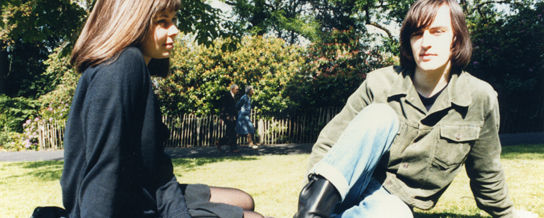
Photo by Stephen McRobbie.