The problem with humor these days is that you’re always supposed to get it. What’s worse: If you’re smart enough, even if you don’t get it, you can make up elaborate reasons for why you do. You can describe a video of a German guy repeatedly plunging his head in a bucket of water as being “surreal,” “absurd,” or “ironic.” But most of the time, that’s just a candy-assed way of saying I have no idea what the fuck that means.
And then there’s guys like French producer Quentin Dupieux (a.k.a. Mr. Oizo, pronounced WAH-zoh, like the French word for “bird”), who scramble the difference between jokes you get and jokes you don’t get into something much more… surreal. A filmmaker and musician, Dupieux’s humor can be escapist, subversive, and potentially pointless all at the same time. Not that his third album, Lambs Anger, is anything close to an academic exercise, although even cheesy, fake saxophones and gratuitous Hoovers are subversive when you think about how uptight and rule-driven dance music producers can be…
Flat Eric’s Trip
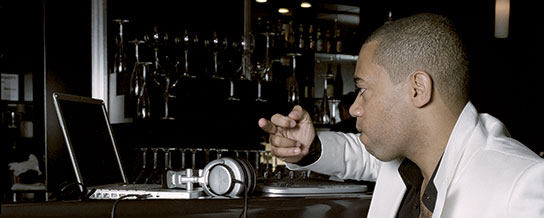
Quentin Dupieux has at least one solid reason for being a complex, difficult character: He’s a one-hit wonder with a body of work that far surpasses his one hit. If VH-1 ever ends up doing a “Where Are They Now: ’90s Rave” segment, they’d be remiss not to mention Dupieux’s first hit as Mr. Oizo, 1999’s “Flat Beat.” As dance music classics go, it’s a big one: a milestone for the squelchy, farty bassline, and bedroom-produced minimalist charm. Aside from being a good track (and one that holds up nearly 10 years later), “Flat Beat” was also an award-winning commercial–one that Dupieux also wrote, directed, and puppeteered.
Dupieux’s commercial, which advertised Levi’s Sta-Prest jeans, was memorable for a yellow sock puppet named Flat Eric*, whose main shtick was personifying the squelches and wobbles of a Korg MS-20 synthesizer. He also happened to be incredibly cute.
“Right after ‘Flat Beat’ was the most confusing time for me,” recalls Dupieux via phone from his Paris studio. “It was only my first step in electronic music, and it went way too big. So I had a lot of pressure after it, which is why I did Analog Worms Attack–I was angry, in a way. I wanted to prove to everybody that I was not just the guy that did this commercial with a stupid soundtrack.”
Dupieux locked himself in the studio for two straight months, working constantly on what became his first full-length album. Released on Laurent Garnier’s F-Communications label in 1999, Analog Worms Attack’s overtly gritty production was the odd link between French house and a parallel-world, wonky version of instrumental hip-hop. It may not have had the worldwide success that “Flat Beat” did, but Analog Worms still ended up being wildly influential.
“‘Flat Beat’ took two hours in an afternoon–it wasn’t an important moment,” admits Dupieux. “So I tried to create and it was unconscious I think, but I tried to create an important moment [with Analog Worms]. I was totally obsessed with the record, totally focused. And I gave too much of myself. When I was finished, it was hard to find energy or even new ideas. So I did nothing.”
During Dupieux’s period of musical inactivity, he decided to refocus on his filmmaking persona. One of the results, 2001’s Nonfilm, bore all the hallmarks of shell-shocked creativity: Its non-plot was perhaps the very definition of a joke you’re not supposed to get.
The Andalusian Dog
“I have a weird approach to Quentin’s film side,” says Ed Banger label boss, Pedro Winter. “I didn’t like his first film, Nonfilm, but I want to watch it again–only assholes don’t change their mind. That movie was maybe too free for a young guy like me who likes organized stuff.”
The central idea of Nonfilm, which revolves around an actor accidentally shooting and killing a film’s tech crew (and then opting to continue filming the movie without a camera or script), is similar in execution to Luis Buñuel and Salvador Dali’s infamous 1928 film, Un Chien Andalou. Noted to be the first low-budget short film, Andalou gave birth to Buñuel’s oft-cited concept that “no idea or image that might lend itself to a rational explanation of any kind would be accepted.” At the very least, it’s an aesthetic that Dupieux continues to share–the cover of Lambs Anger playfully recreates the infamous eyeball-razor scene from Un Chien Andalou.
“I realized that when you’re creating stuff, you’re always being influenced,” says Dupieux. “You cannot help it–you have to be influenced, even from some stuff that you don’t like. So I decided to choose the [influences] instead of being passive. And that’s why I might make some references, so I can distort them and change them.”
Six years later, Dupieux followed Nonfilm with 2007’s Steak, a slightly more straightforward movie about the newest teen rage: extreme facelifts. Featuring acting and musical cameos from Ed Banger labelmates SebastiAn and Sébastien Tellier (the latter of which also appeared in Nonfilm), Steak has a soundtrack that’s easier to find than the movie itself.
“You can’t find Steak,” says Dupieux. “The producer doesn’t care about the movie anymore–he was just interested in the French release. I’m the only one that has a subtitled version. So unless I do a hit movie one day, they will not put it out in the States or anywhere else. It’s hard–the movie is too strange, and I’m not known as a director away from home. But I’m quite confident that one day it will be available everywhere.”
He’s Angry
Of course, Dupieux never completely ditched music over the course of his cinematic pursuits. In fact, he followed up Analog Worms with an even more bizarre album: 2005’s Moustache (Half a Scissor). Employing a hyper-compressed technoid production style that sometimes borders on unlistenable, the album was a fuck-off to F-Comm’s puritanical tendencies. (It’s worth noting that Dupieux brings a fuck-off attitude to more than just his productions, and has been caught flipping the bird at clubgoers during his DJ sets.) Rather than embrace the label’s safe vision of funk, soul, and hip-hop, Dupieux opted for a sort of nightmarish electro vibe that had more in common with crunk’s artificial clatter.
“I don’t think it was a very good period for a bit there,” says Dupieux. “To me, the good period started when I did ‘Ready to Uff’ for Uffie. That was the next step I was waiting for–working with vocals in a different way, using the computer differently. It was the beginning of something new for me, and I still feel like I’m in that period.”
Dupieux’s new Oizo output on Ed Banger is, in many ways, a happy meeting between the pop aspects of “Flat Beat” and the radically bizarre material of Moustache. Ditching his analog gear set-up in favor of a Macintosh G5, his tracks on Lambs Anger, notably the arpeggiated house freak-out “Z,” are cleaner and more defined than before, not so much leaning on distortion in the literal sense, but rather taking the idea and applying it as a concept. Like on the disco cut-up “Jo,” which, despite being Dupieux’s poppiest production, still has a maladjusted awkwardness, the groove punctuated by out-of-place clicks and overstated schmaltz. Or “Positif,” which features cut-up robo-vocals that say “you are animals” and “you are sheep,” both insults apparently directed at the audience (perhaps a reference to the title?). Yet it’s not clear in either line who is actually the speaker–the computer or Dupieux.
“I’m not trying to have my own little secrets,” offers Dupieux, when quizzed on his production. “For example, ‘Z’ was totally made with factory sounds that come with Logic. I was discovering every preset. And I tried to use sounds that you’d never use for electronic music… like the shit saxophone or the shit piano or the shit flute, which is good because they are good instruments. The sound itself is good, not to mention it’s very funny to play with them. And they aren’t electronic at all–they’re samples from real life.”
Birdhouse in Your Soul
It might be strange to think of a corny, sampled saxophone as subversive, but bending connotations is one of Dupieux’s greatest strengths. His humor, which seems to pervade everything he does, is more dark comedy than wacky pratfall–not always funny ha-ha, but certainly nodding towards some strange truth, however personal it may be.
“For a long time, I was trying to be someone different than myself,” says Dupieux. “But now, I think I totally accept who I am–good traits and problems. I’m not trying to do things that I cannot do. And I know I’m very pretentious about who I am. I’ve been doing what I’ve been doing since I was 15, and I think I’m getting better and better. I’m not bullshitting the audience. When I don’t feel like doing music, I’m not doing it just to put out a record.”
And whether or not people regard tracks like “Bruce Willis Is Dead” as being anything more than nonsense is beside the point. It’s the intention that counts–the fact that supposedly stupid dance music can be still be expressive and pretentious and maybe even have a tortured soul without being drained of fun and all the things that make you want to dance to it.
“The important thing is always to have the right spirit,” says Dupieux. “I don’t think that I’m a good musician; I’m not really talented with music. I don’t even know how to play the keyboard. I’m just searching–like a kid! But I think the important thing is my spirit, that’s where I’m getting the good stuff. It’s not from skill.”
*Flat Eric was based on an earlier puppet design of Dupieux’s called “Stephane,” who appears in the video for Mr. Oizo’s “M-SEQ.” It is, coincidently, this video that landed Dupieux the gig with Levi’s.
Video: “Postif”
MP3: “Gay Dentists (JFK Edit)”
The Toughest Cut
Sebastien Tellier on Dupieux’s cinematic anomaly, Steak.
Even in France, Quentin Dupieux’s second film, Steak, is considered a bizarre failure. Loosely based around a psychiatric patient named Blaise and his quest for acceptance with the Chivers, a gang of red jacket-wearing, post-facelift milk drinkers, the story is said to be just as incomprehensible with or without the aid of understanding French. However, Francophiles and Ed Banger completists may still appreciate Steak for the cameos from Sebastien Tellier, Kavinsky, and SebastiAn, who show up in roles like wheelchair-bound car thieves (of course!).
“Quentin works hard to make his life simple and easy,” says Tellier. “Therefore he likes to invent problems in his creations, and gets pleasure from those invented situations. [Like on] Nonfilm, he would write the day’s scene in a pickup truck during breakfast, so every day would be a surprise. I guess similar people should be able to understand [Dupieux’s] movies, but there are few of those people in the world.”
Tellier recently appeared on the French talk show OnN’est Pas Couché (translation: “we’re not asleep yet”) and was taken to task for his involvement in Steak, which host Laurent Ruquier referred to as “shit.” But Tellier held his ground, explaining (roughly translated), “Steak was not shit; it just wasn’t a mainstream kind of humor. It doesn’t make any sense–it’s absurd. It’s anything… There were no references to buying or selling or this or that, which I liked.”