In the film Xiu Xiu: The Sent Down Girl, a smart, innocent 15-year-old is sent away from her home in the Chinese city of Chengdu to apprentice as a horse herder during Mao Tse-Tung’s Cultural Revolution. Despite her certainty that she’ll probably never see her family again, Xiu Xiu holds out hope, only to be repeatedly raped by low-ranking officials who make empty promises to help her return home.
Suffice it to say, it all ends in tears, not unlike a great deal of the music made by Xiu Xiu, the Oakland, California band and brainchild of singer/guitarist Jamie Stewart. For the past six years, Stewart has managed to render the feelings of this abused titular character into ultra-personal discordant symphonies, whispered paeans to dead relatives, and political calls-to-arms that are as danceable and epic as they are incendiary.
But Stewart need not simply relate to a “character”–each and every one of his stories is real, and whether they’re backed by an 808 beat or a gamelan orchestra, they breathe with honesty, discomfort, and (lately) redemption, issuing a challenge to the indie rock world to cut itself free from the chains of irony, in-jokes, and being quirky for quirkiness’ sake.
I Luv the Valley, Oh!
Stewart was born into the musical excesses of 1970s Southern California; his uncle John played in The Kingston Trio and wrote The Monkees’ “Daydream Believer,” and his dad, Michael, a session musician and songwriter, produced hits for Ahmad Jamal and Billy Joel’s Piano Man.
“[My dad] was physically at home when I was a kid, but we didn’t really hang out,” the 35-year-old Stewart offers this afternoon from his kitchen in Oakland’s famously rough-and-tumble Fruitvale neighborhood, where he serves his bandmate Caralee McElroy and me jasmine tea, nuts, and sliced fruit. “I think the fact that I fell asleep on the studio floor, as opposed to the couch, was a pretty good indication of what was going on,” he says as he lets out a laugh.
Contrary to the impression one might get from his records, Stewart laughs often. In the face of the demons he’s battled in his personal life, he’s remarkably forthcoming, characterizing his parents’ relationship as “really fucked, but in this sort of permanent-bond fucked kind of way.”
In the ’90s, the family moved from the San Fernando Valley to the Bay Area, where his dad worked as an engineer on MIDI software and early versions of Pro Tools; bit by bit, living in the suburbs began to play a large role in who Stewart would become artistically.
“There seemed to be an entirely different mentality there,” he says of Palo Alto. “It was kind of the first bougie place that I’d ever been. And it was really apparent there, much more so than in the Valley, which is this bizarre combination of ultra-wealth and ultra-poverty.”
At that time, Stewart played bass in local dub and Motown cover bands, intending to follow in his dad’s footsteps as a session musician.
“I just didn’t really know a whole lot else,” says Stewart. “For some reason, I largely sort of missed indie rock and punk. I really listened to everything else. The concept of DIY-ness didn’t really come to me until a lot later. Like, I was listening to Otis Redding and Sade in high school… but alongside Bauhaus and The Cure.”
Let the Music Play
Stewart’s disparate musical interests all awkwardly coalesced in his short-lived project, The Indestructible Beat of Palo Alto–a musical byproduct of his love for Tom Waits, an Indestructible Beat of Soweto compilation that his mom gave him, and his being fired from three bands in one week, one of them for being bisexual. From IBOPA’s ashes would rise Ten In the Swear Jar, where the skeleton of Xiu Xiu’s sound began to take shape alongside Xiu Xiu co-founder (now ex-member) Cory McCulloch.
The major turning point was still to come, though, at a dance club in San Jose on Christmas night. “I was just dancing alone and I realized how desperate and serious and uninhibited all the [’80s freestyle dance] songs were,” says Stewart emphatically. “Like, every single one is just, ‘Oh my god! I’m so upset! You don’t love me anymore!’ They’re all incredibly straightforward. And [there ’s] no shyness about how emotional everybody who was singing was actually feeling. But, at the same time, it had a cool dance beat… That night I wrote what ended up being the first Xiu Xiu song [“Jennifer Lopez”], which was about that exact feeling.”
Stewart and McCulloch drafted a rough mandate for how Xiu Xiu’s sound would evolve. “We sat down and were like, ‘Okay, we wanna make records that are made from these five influences, and we want to play from this specific place internally, and we want the lyrics to be about this,” he offers sincerely. The manifesto was thus: The songs were always to be “about real things that are either happening to the people in the band, or people who are close to us, or in politics.” They would play them as honestly as possible. And they would incorporate elements of gay dance music, late-’70s/early-’80s British goth pop, Asian percussion, modern classical music, and atonal noise.
Policy of Truth
What they ended up crafting for their debut, Knife Play (5 Rue Christine), and five subsequent albums, was an open diary where Stewart’s quivering vocals (which can carom between whispers and wails in a matter of bars) melded with rock guitars, icy drum machines, electronics, and percussion that intentionally disrupted the songs instead of driving them forward. The tracks broach topics like AIDS, suicide, addiction, all manner of abuse, and pretty much every other societal ill you can think of, often while bearing friends’ or relatives’ proper names and airing their dirty laundry.
“It didn’t use to be much of an issue until [2004’s] Fabulous Muscles came out,” Stewart explains. “There’s a song on there that my mother and my sister just flipped about.” The song in question is a spare, organ-and-horn-assisted ditty called “Nieces Pieces,” where Stewart achingly croons gut-punching lines like “I can’t wait to tell you/Your grandpa made your mommy play stripper/While your uncle watched.”
“Sometimes the truth hurts,” McElroy interjects. “And there are certain things that–not just with family but with other people–they don’t wanna have to think about again.”
And so goes much of the band’s back catalog, a collection of shelved (often shitty) moments in time, rendered with painstaking realism for the members’ therapeutic purposes and only occasionally revisited in visceral onstage catharses and prodding interviews. (And sometimes not even then. When pressed to recall the most harrowing moments of his life that he’s turned into music, Stewart goes quiet, revealing only that one of them made it onto his latest opus, Women as Lovers.)
Yet Women as Lovers’ first song, “I Do What I Want When I Want,” suggests that things are a tad rosier in the House of Stewart these days. “It’s about somebody who I told myself I shouldn’t be in a relationship with,” he explains, “and basically going, ‘Well, fuck it. Go for it,’ and actually having things turn out wonderfully.” Listeners might also notice the song’s lighter, tinkly vibes and the entire album’s baby steps away from disorienting feedback and breakdowns.
All in the Family
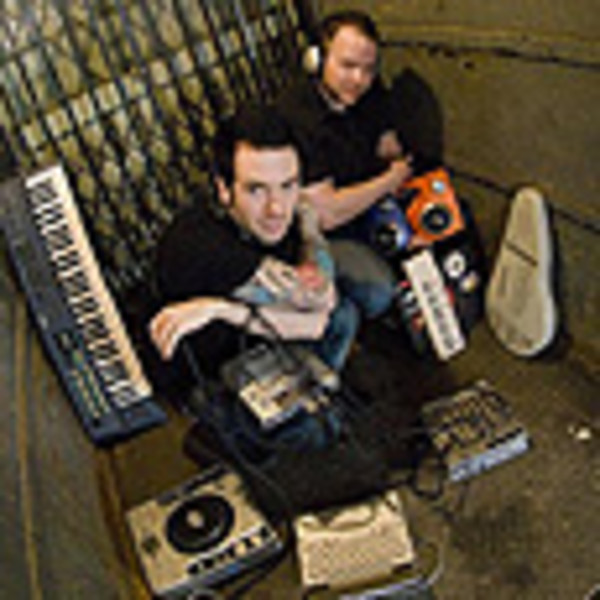
Xiu Xiu’s family bonds spread far and wide, extending to longtime collaborators and now full-time fixtures, drummer/percussionist Ches Smith and bassist Devin Hoff. But it’s the bond between Stewart and McElroy, Stewart’s first cousin on his mom’s side, that’s instantly noticeable. The pair didn’t know each other as children but their relationship flourished when Stewart moved to Seattle following his father’s suicide in 2002.
McElroy was only 19 when she began touring to support Fabulous Muscles, and has since contributed mostly keys and vocals to La Forêt, The Air Force, and Women as Lovers. Along the way, she’s proven to be much more than just a performer in a band: though Stewart has come this far on his own, one gets the idea that now he might not be able to do it without her. She’s his trusted confidante and teammate–and, if the song title “Little Panda McElroy” is any indicator, probably his muse.
“Me and Jamie have been through an incredible amount of stuff in our life: with each other, with being in a band that tours relentlessly, not having stable lives financially or not stable emotionally because we’re both totally nuts… but I’m still sitting here,” she laughs.
She’s only half-joking about the “nuts” part, and it’s something that Stewart has been accused of being in the past. Since the beginning, Xiu Xiu has had an intensely polarizing effect on the indie rock scene at large. The band’s fans spend hours on message boards, decoding Stewart’s discomforting, private-gone-public lyrics; his naysayers heckle him at shows. Stories of him getting fellated onstage by drag queen Vaginal Davis and snapping nude pics of an impoverished Vietnamese hustler for the cover of A Promise are just cannon fodder for his detractors, especially when paired with his penchant for heart-on-sleeve melodrama–stuff that would make a lot of folks cringe.
“There are clearly some Xiu Xiu lyrics that are just like, ‘Gah-awd!,” Stewart admits, chuckling, “but I mean at that moment, that’s what was going on–and because I know at that moment it was genuine, I don’t ever feel jive about it… People can take it or leave it, I don’t give a fuck. No one in the band does. We really genuinely hope someone gets something from it, and if it’s not for them,” he says, cracking up, “then they can fucking listen to Animal Collective.”
Xiu Xiu Audio Interview
Listen to Ken Taylor’s full interview with Jamie Stewart and Caralee McElroy.
Part 1
Part 2
The Song Doesn’t Remain the Same:
Three essential Xiu Xiu cover songs for your next slumber party.
“Under Pressure” from Women as LoversKill Rock Stars
A centerpiece of the new album, “Under Pressure” features Stewart trading verses with McElroy and Angels of Light’s Michael Gira in a redux of one of pop music’s greatest duets. “I asked [Gira], someone I admire tremendously, to be a part of this song that was made by two people [Freddie Mercury and David Bowie] who completely changed my life,” Stewart comments.
“Fast Car” from A Promise5 Rue Christine
It’s a wonder that Tracy Chapman’s original ever made it to pop radio, considering its subject matter. Stewart’s version takes liberty with the lyrics, changing the “dad” character’s affliction from “the bottle” to “prescription drugs,” and bringing a verge-of-a-nervous-breakdown immediacy to the song with his inimitable hushed falsetto.
“Don’t Cha,” from Tu Mi Piaci EP Acuarela
Unlike the Pussycat Dolls’ approach, there’s no attempt here to try to make this Tori Alamaze cover sexier. Stewart takes his distorted, hazed-over vocals into Marilyn Manson territory, with skronk-jazz elements and tortured drum machines providing the backbeat. When he asks, “Don’t cha wish your girlfriend was a freak like me,” he actually means it.
Xiu Xiu Interview Pt 1
Xiu Xiu Interview Pt 2