Palm Pictures Announces Release of Scratch vs. Freestyle

Fans of hip-hop will doubtless know Doug Pray’s Scratch and Kevin Fitzgerald’s Freestyle: The Art Of Rhyme. The former is a documentary paying tribute to the art of DJing and features Afrika Bambaataa, Mix Master Mike, Cut Chemist, Dj Shadow, Rob Swift, Z-Trip, Jurassic 5, and dozens more. Freestyle focuses on the task of the emcee, with an equally impressive cast that includes Notorious B.I.G., Mos Def, Aceyalone, Divine Styler, Tupac Shakur, and others. Both films have become something like classics since their release, and essential elements of a true hip-hop head’s library.

Taking that into consideration Palm Pictures has packaged both these films together and included a third disc that includes 298 minutes of bonus features that cover DIY DJ lessons, battles, deleted scenes director’s commentary, and more. Now all we need is Pray’s recent film Infamy in the package and our picture of hip-hop culture will be complete.

Scratch vs. Freestyle is out November 7 on Palm Pictures.

!K7 Celebrates Its 21st Birthday

What started as a production company making punk rock vids for Nick Cave and Mudhoney has now turned into the home for internationally known music artists like Herbert, Kruder & Dorfmeister, Dani Siciliano, and others, along with the addition of two other labels, hip-hop/urban imprint Rapster and the brand new indie-rock based Ever Records. The label’s 10-year old DJ Kicks series has won tons of acclaim and featured everyone from Tiga to Nightmares on Wax, and is usually a safe bet for a good mix of tunes. Join !K7 cohorts next week in celebrating all this plus 21 years of business. For Londoners, there’s a few parties to attend. For the rest of you, stay tuned and in the meantime pick up the latest releases from the label. k7.comTuesday, October 14, 2006Rapster Records: Kings Of Photo Exhibition Launch Music By Mr Thing, Norman Jay, and Peter Adarwah Phonica Records, 51 Poland St., London FREE, runs through November 28 Wednesday, October 15, 2006Ever Records Music By Cortney Tidwell, Cyann & Ben The Luminaire, 311 High Rd, London £7, TicketsThursday, October 16, 2006!K7 Records Music By Matthew Herbert, Henrik Schwarz Koko, 1A Camden High St, London £17, Tickets

Patric Catani & Gina D’orio

Ec8or’s song title “Discriminate Against the Next Fashionsucker You Meet (It’s a Raver)” caught my eye when I first read about them a decade ago. Ec8or, comprised of Patric Catani and Gina D’Orio, were soldiers in digital hardcore’s shock battalion, Germans bombarding the mid-’90s post-techno underground with subsonic breakbeats, the shrapnel of heavy metal guitars, and ear-piercing, riot-inciting vocals. Soon after the release of We Can All Be Rich in America (on Beastie Boy Mike D’s Grand Royal label), the DHR scene imploded under its never-stated-but-always-implied maxim “Too fast to live, too young to die.” Catani proceeded to create a soundtrack for an imaginary ’80s videogame called Flex Busterman and produce music for rapping puppets known as Puppetmastaz; he’s currently releasing a blender-splat of cartoon music, noisecore, and Amiga techno as Candie Hank. Meanwhile, D’Orio played Patty Hearst in a musical by Stereo Total’s Brezel Göring and continues to radically reinterpret the notion of the girl group as one half of cult favorites Cobra Killer. XLR8R asked the two about their digital hardcore days and their surreal, ghetto-tech-goes-to-school project, A*Class.

XLR8R: How did Ec8or form?

Patric Catani: We formed Ec8or when I came to Berlin. I came from Cologne and there definitely was a lot of stuff to catch up with in Berlin. All of our music represents a political idea. I personally also see my work in a Dadaistic way and think there are many ways to express a political attitude. I can’t imagine looping that old Amen break over and over like a hamster in a wheel just because there is something for it that you call a “market.”

Gina D’Orio: We started playing in our first bands, [rehearsing] everyday, doing gigs, playing ’60s garage-punk stuff, playing the Amiga 500–it went on like this. Later, it became Ec8or. That’s what we did and still do. It comes straight from our hearts. It’s about pushing the popular music [to] a different level, where you can transport more critical consciousness in collaboration with different people: writers, people who do movies, journalists. It’s about making honest songs with a certain amount of depth; songs [that] become the daily hit [in 2006], not clichéd stories that belong [in] medieval [times]. People awake if entertainment becomes information; with people who are awake, we can aim for a better society. Popular music has an enormous influence, especially on young people who are still developing, so we have a lot of responsibility. These “hitmakers” pretend they don’t have to have responsibility. They are liars; they are moralistic gangsters. If you describe life honestly [in] your music, how you really see it, [that] might be as the fans see it too–we are one [with] them; we understand them better than those briefcase-carriers who strangle themselves with their own ties.

What were Ec8or’s best moments?

PC: The twinkles, the bass, the lights, and the cherry blossoms.

GD: The cars, the clouds, and those moments when you think while watching the birds go by.

How has Berlin’s electronic scene changed in the past decade?

PC: It’s different and I would not say it’s better. It’s much more difficult to make a last-minute party. If you stick posters in certain streets they are gone in 20 minutes. I think the nice, naïve touch [that] Berlin had 10 years ago is gone. I want to stay a music fan; I also do radio shows from time to time where I just play new, unknown, weirdo music from all over the world. I don’t want to turn into that “professional” music sportsman. You find a lot of them in Berlin these days. It’s good to have a nice base and friends to make crazy shit with. Certain stuff appears also in a bigger context. With the Puppetmastaz, we are quite successful in different parts of Europe and what I earn with that goes back into my other projects. That’s the way I like to work because it’s good to have hair, it’s good to have money, and it’s good to have sex.

GD: Berlin is dead. It’s over… Berlin is worth a trip. Berlin stays Berlin. All is right. All wrong.

How would you describe the A*Class sound and performances?

PC: A*class is a black-humored, poisoned needle dealing with problems caused by the ignorance and twisted morality of the Western world. It [doesn ‘t only] pick on America, but America definitely deserves to have a main part in there. It takes the Detroit and Chicago booty bounce sound, but transforms it into something “productive,” “positive,” and “useful” without dirty language. It explains why a good person should know about the Elbow Law, and gives you good hints [about how] to fuck other people over. You’ll have the perfect learning motivator with songs like “I Don’t Like the Prom” or “Let’s Read a Book.” [It’s] intellectual booty house only for the headstrong. Chances are good that (the upcoming album) will be released by the Church of Scientology, or on the German label Trikont. [The performance] is a booty-shakin’ PowerPoint presentation–overhead projector scratching and all. It’s an exciting stimulation and enlargement of certain brain cells. We have wild read-alongs, where you can feel your inside powers rise up with a bang.

GD: It’s psychedelic. It’s a satire… It’s booty house.

Apparat In The Studio

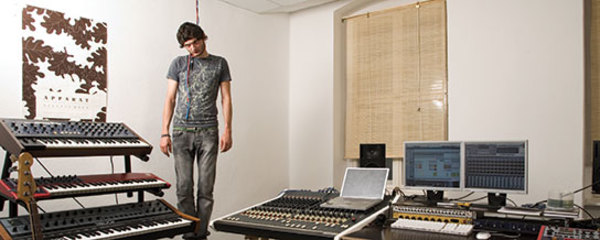
“I can’t switch off in Berlin. I always feel like there’s work to be done,” admits Sascha Ring (a.k.a. Apparat) after a four-day production binge. “I completely forget what to do outside of the studio.” Not unlike the city in which he works, Ring’s own success has grown exponentially since his full-length Duplex appeared on Shitkatapult in 2003. Since then, collaborations with BPitch Control owner Ellen Allien resulted in this year’s Orchestra of Bubbles, an album praised on both sides of the dance/rock divide for finding middle ground between floor-focused techno and the quirky IDM of Apparat’s past. Yet despite all these notches in his production belt, Ring started out as a drummer, and he’s careful to envision the laptop as an instrument, especially when playing live. Here’s a look into the complex machinations behind techno’s newest tastemaker.

XLR8R: I heard you wrote your own Max/MSP tool for playing live. How does it work?

SR: The [patch] I wrote is very well assigned to the controller we use, so in the end it’s some kind of digital mixer with lots of effects for each channel. There’s not a lot of buttons on the mixer, but you can select channels and you have endless knobs, [so] you have a lot of control. I’ve used this thing for, like, four years, and now I can play it like a guitar.

You’ve been using the same patch for four years?

Yeah. I mean, it’s developing, but I don’t really have time to take it much further. But to be honest, I don’t really have many ideas of what I could change. Really, the only reason I did it was because there was no Ableton available when I started playing live. So I had to figure out a way to do what I needed, and I met Kit Clayton and all these guys and was completely stoked by the way they played. It was just one computer and one controller, and I was begging them to [show me how they did it]. Eventually they just gave me their patch, and I started learning how [Max] worked. But at some point, I decided… I don’t [expletive] understand this. So I had to program it myself. And it’s pretty messy.

Are you putting a lot of thought into what you’re doing on stage?

When Ellen and I first started talking about playing live, we wanted to do something special. It’s always kind of boring at festivals to watch people play just on laptops. But it turned out it wasn’t that easy. So we still have a lot of computer stuff going on, but we’re dancing and Ellen is singing. We’re trying to be entertaining! And if the set goes bad, or there’s six people there…after 10 beers…you start dancing again.

You don’t seem to get trapped staring at the screen when you play.

In the end, it’s important to look like you’re doing something. I designed my setup with a Kaoss Pad and a drum computer that I can tweak, which forces me to move around. But it’s funny… a key moment was when I played this show and I couldn’t put the mixer near me, [so] I had to keep running over to it. I realized it wasn’t really so bad because if you don’t have everything near you, you have to move.

When you’re back in the studio, do you prefer working with other people?

I’d been making music on my own for my whole life, and then Ellen came along and said, “Let’s work on stuff together,” and it was kind of hard. But I started recording different instruments and I had to deal with people. I had to learn how to speak about music. At some point, I just felt ready to do it, and I called Ellen again. I was really happy to leave the [solitary] nerd thing behind.

What’s your secret to finishing tracks?

It took me a long time to figure out when I was destroying something. I don’t think I do that anymore. You just learn to notice, very quickly, when you’re going down the wrong path. But for me, a second opinion is the main key for not destroying tracks. I have that now with Ellen, since we work on so much stuff together. And now, I feel kind of lonely in the studio without her.

New At INCITE Online, Oct. 10

If you would like to receive weekly updates on our FREE downloads, subscribe to the XLR8R Podcast. iTunes 4.9 or higher recommended.

Mathhead – “Dream Tigers” begins calmly, then explodes into a series of shattered amens and acid drops that, upon listening to, seem equivalent to being pounded against the side of a wall several times before slipping into blissful, half-consciousness.

Skatebård – On his first album, the crooning, off-kilter dance rhythms are married with synths that hint at pop without completely crossing into the genre, and minute to minute of each track remains unpredictable throughout the album.

Sofalofa – Reminiscent of early Plaid or Four Tet, , Bathysphere and Deep-Water Recordings founder Chris Cousin’s music makes for glitchy ambience packed with found sounds, subtle breaks, plinking pianos.

Honycut – Quannum Records newcomers Bart Davenport, RV Salters, and Tony Sevener drum up 12 tracks of haunting vocals, looming strings, and catchy guitar riffs on their album The Day I Turned To Glass.

Josef K – They were largely ignored in the early 1980s when they were making music, so thank Domino Records, who unearthed their music and threw together a 22-track compilation called Entomology that showcases their post-punk sound.

CMJ Music Marathon Panels Announced

Every fall New York looks forward to the CMJ Music Marathon, one of the longest running music events ever, with a selection of performances, panels, and discussions that take place over the course of five days. The 26th year promises to be just as packed with musical info and personalities as the previous ones, and as usual, one of the best parts of the event is the selection of panels available to CMJ attendees. Artists and industry figures from every genre show up to discuss the latest issues in music or reminisce about past musical happenings.

This year, all panels will take place at the Tower Records store in Lincoln Center, at the corner of Broadway and West 66th. Highlights include:

Tuesday, October 31

Acting Up: Music Activism 2006: What happens when artists become politicians? Ask Chuck D, Steve Earle, and others about the price they pay artistically for taking a stand politically.

Wednesday, November 1

Ozzfest 10th Anniversary Reunion: With the metal scene undergoing resuscitation, panelists share memories of the famed festival, from those experiences covered on MTV to those completely hidden from the media.

Digial Domination: The Guru’s Guide To Music’s Latest High-Tech Media: Music tech experts from companies like Napster and MP3.com explore the possibilities and questions about digital media as the new medium for the century.

Thursday, November 2

CBGB: The Ultimate Reunion: Hilly Kristal, founder of the legendary club, is joined by others in this look back at how CBGB changed lives, a particularly charged topic seeing as the club is set to close its doors on October 31, 2006.

Friday, November 3

Lollapalooza 15th Anniversary Reunion: It’s a year for reunions and reminiscing, and here’s another one. The famous festival’s secrets and memories are discussed, and the panel is joined by none other than Parliament/Funkadleic leader George Clinton.

Saturday, November 4

Battle of the DJs and Remixers: Who’s Hot and Who’s Not: To DJs and remixers present their work and talk about the mission behind the music. The audience chooses who they like best.

With over 100 panels, we can’t possible list them all, so check the marathon’s website to see the full lineup.

Stay tuned for more CMJ news during the month of October.
cmj.com

Mistah FAB Creates Skateboard Wheel

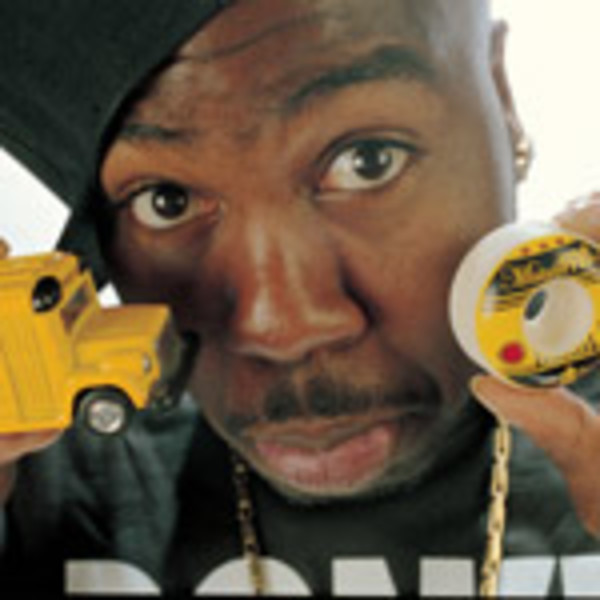
Hubba Wheels, makers of, um, wheels (specifically skateboard wheels), has teamed up with rapper Mistah FAB to make the Yellow Bus skateboard wheel. The first collaboration of its kind and based on FAB’s Yellow Bus radio, the wheel features the back of a school bus and Mistah FAB’s name etched across the top. Although the wheels were released to Northern California skate shops last month, rumor has it that availability will be expanding to other parts of the country, so keep your eyes peeled.

myspace.com/hubbawheels

Page 3304 of 3781
1 3,302 3,303 3,304 3,305 3,306 3,781