
My Life feat. Aloe Blacc
Bluebird
One Time For Your Mind feat. Gift Of Gab
Lantern
New Videos At xlr8r.com
More visual stimulation from your favorite XLR8R-approved artists and labels. Go to our Videos Section to peep ’em.
Spank Rock “Rick Rubin” (Ninja Tune)
Airborn Audio “Inside The Globe” (Ninja Tune)
One Self “Bluebird” (Ninja Tune)
Substance Abuse “Night On The Town” (Threshold)
Van She “Kelly” (Modular)
Roc C “My Life” (Stones Throw)
Motion Man & Kutmasta Kurt “One Time For Your Mind feat. Gift Of Gab” (Threshold)
Clogs “Lantern” (Brassland)
Spank Rock’s “Rick Rubin
Bitter Bastard on XLR8R Letters
From mangled postcards to maniacal fans, BJ “Bitter” Bastard lets you in on the most popular types of letters that XLR8R has received over the years.
1. “You are grossly overusing the word ‘chanteuse,’ ‘techno,’ ‘dancefloor,’ etc.”
Every issue we grossly overuse one word. It just happens. Music critics have a nerd-collective consciousness that causes them to all use the same complex adjective or obscure music reference in the same month. Past issues have included an inappropriate number of references to Gang of Four and Aphex Twin, and overuse of words like “arpeggiating,” “post-punk,” “ominous,” and “minimal.” But the award for most overused word goes to…”deep!”
2. “Stop dissing Soul Slinger. He is the best.”
A few times in the ’90s we referenced the suspect mixing of NYC drum & bass DJ Soul Slinger. Well, that man has some serious fans, many of whom are ready to kick our ass in defense of their goggled rave superhero. We ain’t scared–we have a kung fu black belt on staff, fueled by death metal and Sparks Plus.
3. “Send me back issues…to Croatia.”
One day maybe we’ll get some crazy corporate sponsor who will let us spend $19 a pop sending copies of our March 1997 issue to some grad student in Zanzibar writing a paper on The Orb. In the meantime, just subscribe so you don’t miss out, or read our back issues online at xlr8r.com. [It’s our mag, we’ll shamelessly plug if we want to. – Ed.]
4. Mangled letters and voicemails
A significant portion of our readers have shitty mailmen, crappy cell phones, and/or write us letters when they are very, very high. These amuse us, so keep ’em coming.
5. “My INCITE CD is broken.”
Into each life, a malicious mail deliverer must fall. It happened to us too, right after we bought a collection of porcelain frog figurines on Ebay. Sorry, brah.
6. “Thank you for not putting Daft Punk on the cover, making fun of Paul Oakenfold, and not sucking.”
You are welcome.
7. “Why don’t you cover our scene in Sacramento, Dublin, St. Louis, etc.?”
XLR8R contributors come from all corners of the globe and we even have special gnomes traveling as far away as Iceland and Japan to get you the latest. But we’re not, like, God or Santa–we can’t be everywhere at once. Rest assured, we’ll eventually find out if there’s something going on in your town, or just write us and tell us all about it.
8. Letters from ravers in prison.
Lots of people are too busy organizing their iTunes to write us, but those caught up in the U.S. penal system have nothing but free time. We love receiving their letters, but find it perplexing that half of them are about how rad a piece of music-making gear is that’s not even out yet. Respect to the behind-bars massive!
9. “Why don’t you cover trance or progressive house anymore? It’s the bomb.”
Some years ago we decided that if we really don’t like something, we shouldn’t cover it, no matter how many people care about it. We just can’t rightfully introduce you to crap. This entry will, of course, generate a bunch more letters hating on us. And now that trance stands a tiny chance of actually getting good again, we may have to eat these words.
10. “Bitter Bastard is a hater and should die.”
Some of you are still hung up on the PLUR concept, but don’t harsh on BJ “Bitter” Bastard for putting in print what we heard you whispering to your friend at the party when you thought no one was listening. And with all the time we spend loving on everyone in the features and reviews, we deserve a little cleansing hate session now and again. Deal with it, hippies.
Shirts So Good: Five of the Finest
It’s easy to knock off a few good t-shirt designs–hell, even Urban Outfitters has managed it once or twice–but it’s hard to keep on rocking. Coming out with fresh looks for human billboards means keeping two laps ahead of the pack while staying true to your vision. It means knowing that certain things are never out of style if done right. It entails making clever entendres and cultural references, while steering clear of straight-up rip-offs. And–at the end of grueling hours of silkscreening and mouse pushing and inventory–it demands staying true to who you are while giving the hardcore t-shirt fiends what they want. Here are five companies–at home and abroad–that are weathering the tee storm with flavor and finesse.
UARM
If you want to sport Reas’ pneumatic babes, Neck Face’s jagged monsters, or Bäst’s head-fuck Xerox treatments of world leaders on your chest, then New York brand UARM has got something for you. Then again, their in-house Black Label designs–which include a clever Roxy Music rip and the rather ubiquitous “Dre & Easy & Cube & Ren” design–don’t slouch either.
The company, conceived by Ulrik Trojaborg, debuted in spring 2003 with licensed designs from Ryan McGinness, Mark Gonzales, and Jean-Michel Basquiat, aiming to make the name of the brand less important than the artists featured. Currently, the day-to-day ops are run by 27-year-old upstart Bret Pittman, who is also responsible for curating offshoot label Video Epic, a line of large-print horror movie-themed shirts strictly for the hardcore. We cornered Pittman in the midst of silkscreening some Huskmitnavn jawns and asked him to tell us more.
Vivian Host
XLR8R: Has anything changed in the t-shirt game since you started?
Bret Pittman: There’s a lot more competition, a lot more small, one- and two-man ‘basement’ operations. I guess word got out that all you need is a MySpace page and a few graphics and you have a company.
What is the concept behind the UARM Black Label offshoot?
Black Label is our way of putting out designs that don’t have a famous name attached to them. It’s the product of us constantly joking around in the office that ‘We should do a such-and-such shirt,’ or ‘We should ask Ryan to draw this,’ or ‘Wouldn’t it be funny if…’ It’s really just a catch-all for good designs that less[er]-known people surrounding us (including ourselves) come up with.
Tell us a funny story about one of the artists you’ve worked with for UARM.
I know Mark Gonzales has so many legends surrounding him, but even his text messages are funny. He’ll just text Ulrik things like “If I see one more fat person laughing and having a good time, I’m gonna gain weight” out of the blue.
If you could get anyone living or dead to make a t-shirt for you who would it be?
If I could get anyone, I would not limit it to artists–I’d pick random people like Richard Pryor, Andre Benjamin, Bill Murray, Lil’ Wayne, and Latrell Sprewell (circa ’99)!
What is your favorite fashion trend of the last couple years?
An ankle-length white tee with Reno 911 short-shorts and stilettos.
What are your least favorites?
Way too many skulls, deer antlers, gold chains, and stupid quotes from Napoleon Dynamite on t-shirts.
Do you foresee interest in designer t-shirts reaching critical mass?
All the attention on t-shirt companies is a byproduct of the entire world dressing more casually. It’s acceptable to wear a t-shirt pretty much anywhere these days. That means people are buying more t-shirts in general, designer or not. It turns out about 90% of them are bad, but that’s another problem… In places like New York City and Tokyo, the “cool guy t-shirt contest” is saturated and I can understand how people might be over it. But in the rest of the world, there are still a ton of unfortunate souls wearing shirts that say “Fuck Me I’m Irish” or “Beer: It’s not just for breakfast anymore” and shit like that, so there’s still a ways to go.
(page 2 of 5)
Rockers NYC
In the last four years, Sean Reveron and Marcus Burrowes’ subversive Rockers NYC brand has touched on influences from DC hardcore to esoteric Lou Reed-isms to the leafy green. But even though all their designs have that crucial “fuck off” flair, it’s all peace and love at their L.E.S. headquarters, where the two put their brains together to figure out what aspects of Jamaican, punk, metal, or some other culture they want to put you up on next. With designs like these, you can only imagine what the Rockers NYC soundsystem must sound like.
Nat Thomson
XLR8R: The “War Pigs Die!” slogan shirt you released as a one-off is clearly politically charged. What role do politics play in Rockers NYC?
Marcus: We like to show our political views in what we do.
Sean: With “War Pigs Die!” we wanted to get that slogan out there. We’re not trying to stand on a pulpit though, or bash people over the head. But, I mean, there’s a war going on! It’s like protest songs–protest with fashion so people know where you stand. Big up to consumerism–it’s there; we live in this capitalist society–but maybe protest and consumerism can join to bring down the capitalist shit that’s holding things back.
Where do you guys see yourselves in terms of fashion and the fashion industry?
Sean: Put it this way: We love art; we’re creative people, man. It’s like, if we cook a meal, we create. If we DJ or write music, we create. It’s all about creating and the t-shirt just happens to be the canvas. This isn’t something we chose; it chose us. We’re just expressing ourselves, whatever medium it is. I don’t want to say we’re just fashion designers; we’re more than that–we’re human beings who want to create and give something to the world.
Marcus: We respect a lot of fashion designers, but we don’t really respect certain aspects of the fashion industry. We’re not down with air kisses.
Any favorite shirts out of your summer collection?
Sean: I love the “Animosity” design–it’s this black metal logo saying “animosity,” clashed with a Native American chief. Also, our boy Arik Roper, who’s done record covers for Sleep and High on Fire, created this design of a stoner druid that’s dope. One of my favorites for summer is “Bloodsport,” which uses a photo of Bounty Killer taken by one of our friends, Martei Korley. We took it and created this clashing of a horror film and the dancehall warrior. Very ill.
What influence does NYC have on Rockers NYC?
Sean: Living in the L.E.S. [is] inspirational. We’re surrounded by painters, photographers, designers, bums, degenerates, wierdos, Rastas, Dominicans–you get this energy and you just gotta do it. It’s New York City. Some environments don’t do that.
(page 3 of 5)
Schwipe
Schwipe’s name sounds like a cross between “swipe” and Wayne’s World exclamation “Schwing!”–a perfect case of onomatopoeia for the way their designs (at once funny and hard-as-fuck) will make you feel. First they upped the t-shirt drama with slogans like “Islam is OK!” and “H.A.B.I.T. Kills” before moving on to crazed-all-over prints (gigantic rats, day-glo skeleton bones, lime-green paint splatters) to be sported by only discerning savages and the most intelligent of juvenile delinquents.
“Inspired by the threat of the deadly Y2K bug in 1999 and impending doom that was the end of the 20th century, we felt the only way to combat this civilization-ending dilemma was to release a collection of t-shirts,” reads the cryptic email transmission from Times and Mishox (a.k.a. graphic designers Tim Everist and Misa Glisovic) when I ask them about the origins of Schwipe. The Melbourne, Australia-based dudes do all the designs themselves–with some help from their “man in Sydney,” Dmote–and say they are inspired by “not having to work for someone else, people appreciating what we do by buying our stuff and wearing it, and grapes.” (We’re not sure if they’re referring to the actual fruit or sacks of weed, but neither would surprise us.)
Past collections have included Brain (“an adventure in neurological surgery”), Good God (which “took heed from the many Almighties above”), and The Savages Are Loose (“loosely inspired by voodoo”), and current themes like New World Order (based on “extraterrestrial Satanic conspiracy theory”) and A Touch of Class (“For lovers only”) are no less brain-tingling.
The crew rates fellow streetwear agitators Tonite, Visvim, The Serps, and aNYthing among their favorites, and are heavily inspired by ’80s skate, as I found out when I asked them about their top t-shirt designs of all time. (Mishox likes Vision’s “cop badge posse tee,” while Times says his “It ain’t where ya from, it’s where ya at” Stüssy shirt has “more holes than cotton.) Apparently, ’80s skate has also returned the favor: Beinghunted reports spotting skate legend Tony Alva wearing their “Ketamine Is a Drug For Horses” t-shirt. Radical!
Vivian Host
(page 4 of 5)
King Stampede
When we asked about King Stampede’s tripfest-meets-hip-hop aesthetic, co-creator Pete Leonard laid it out to us like this: “The balancing point for us is the Grateful Dead, going way back. Nick [Langella, his co-founder and the hip-hop half of the operation] and I met through skating in ’91 [or] ’92, the Fresh Jive era, with pants mopping up the floor and Ned’s Atomic Dustbin and raving. But that period was the point where we both hit the Grateful Dead. Collectively, we have about 1,000 shows combined under our belt. We’d listen to Stretch and Bobbito while driving to shows though.”
Ten years and, like, a million live tapes later, the two started King Stampede in 2004; they have since opened an online outpost (at boundlessny.com) and their own shop on Roebling Street in Williamsburg, Brooklyn. Over four seasons, the brand has found good fortune in the boutique scene, due to a palette of influences that ventures beyond the Wu-Tang-and-sneakers streetwear safety pen and into a world where Lauren Hutton trips on acid while The Boredoms play the Hacienda…or something like that. (Movies are an influence too, but only the psychedelic ones.)
While hip-hop is deep in King Stampede’s blood, during our interview Leonard stopped to ponder the state of the scene in 2006. “World Famous Supreme Team and K-Rob & Ramellzee, that was pretty much it–the creative pinnacle [of hip-hop]. I just watched Wild Style and was like ‘What the fuck happened to things?’ But at the same time, it’s just Bizzy B and Fab 5 throwing money around, rolling joints, and trying to get girls undressed, so it’s the same as it ever was.”
This type of critical but appreciative eye towards rap culture, and a broad gang of influences, pushed the brand’s last season ahead of the pack. “This summer season in particular [was] light and dark; a little drama, a little comedy,” says Leonard. “A lot of the input is what kind of music we’re listening to, recreating or putting twists on music influences. We’re trying to build a story here, of course, but also have some fun with it.”
Nat Thomson
(page 5 of 5)
Answer
DIY fashion is fucking fantastic, but that means you have to tolerate a lot of 17-year-olds and adult babies giving it a shot, too. Charting their own thoughtful course through the t-shirt seas, the dudes at UK brand Answer have become one of streetwear’s saving graces. Over the past four years, Emmet Keane and former Mo’ Wax designer Will Bankhead have cut the fat–or, more precisely, the corny attitude–out of the tee scene, presenting lean and focused seasons that regularly feature a “who’s who” of thoroughly non-sucky (not to mention Tokyo-approved) co-conspirators. Now famous for their willingness to not rip off their favorite artists, the brand has put in x-amount of hours getting personal faves (like Vaughn Bode and Daniel Johnston) in on the action. Sounds like an answer to me.
Nat Thomson
XLR8R: Explain Answer’s approach to artists and licensing in a scene that’s a bit grey about the whole thing.
For us, it’s a case of wanting to use the work of artists whose work we like, whether it’s friends of ours or artists that we track down and negotiate a deal with. A lot of people rip off artists’ work without bothering to try and get permission, but surely it’s better to work with the artists and license the work you use; it validates the end product and, you know, you can actually work with people you admire and respect, maybe even introduce them to a new audience.
What can we expect from Answer over the next couple seasons?
Ben Drury has done two designs for us, and we’ve licensed some stuff from Bill Blake of SF-based Skatezine. Sk8thing from A Bathing Ape has just done a couple of designs for us, and we’ve just also licensed some stuff from photographer Peter Beste. For the fall we have some jackets coming, which are pretty amazing. We don’t really follow the seasons like other labels; we bring our stuff out ad hoc when we feel like it, which is commercially probably the worst thing, but if you put yourself under seasonal pressure then it takes a lot of the fun away from what you’re doing.
Any favorite designs thus far?
Definitely Ed Gill’s “Smurf,” Will’s “Camel Slices,” and his forthcoming “Death Metal Mask,” Winston Smith’s “Force Fed War,” Daniel Johnston’s “Weirdly Sad,” and all the Vaughn Bode ones. With everything that we’ve done, we only put out designs that we really like and believe in, even if nobody else out there feels the same.
Any artists that you would like to work with?
There are too many to list. We’re trying to track down quite a few people right now, but working with the designers we regularly work with–Ben Drury, Ed Gill, Fergadelic, Chris Love, Rob Dukes–has always been amazing. Their talent is just so out there–next-level stuff. Very few people can come close to them.
Couch: Indie Outback
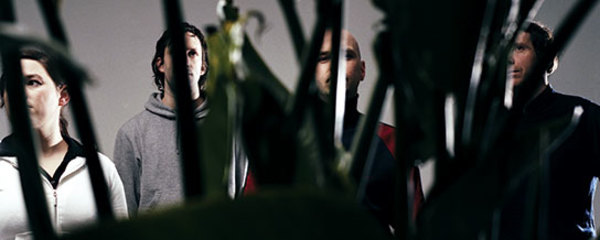
Munich, Germany’s Couch makes dense yet delicate instrumental rock that reminds me of late-summer coffee-fueled urban quests in search of a gorgeous yet imaginary goth waif. The humid air and desirous undercurrent are a perfect match for the strummed guitars and moody electronics of Couch’s new album, Figur 5 (Morr Music), a record as bittersweet as my romantic pursuits.
Together 11 years–and comprised of Michael Heilrath (bass), Thomas Geltinger (drums), Stefanie Böhm (keyboards), and Jürgen Söder (guitar)–Couch’s sound is wistful and unhurried. This attitude could have to do with the band’s homebase in Munich, a city whose relaxed feeling is a far cry from the manic energy of trendy Berlin, where Morr Music is based. Munich is a city full of beer gardens, where people sit outside beneath huge trees at wooden tables drinking tall pilsners and Hefeweizen in the shadow of the Austrian mountains. “We kind of prefer the outback to the place in the middle where everything is supposed to happen,” remarks Söder of their surroundings.
A comfortable environment and their camaraderie with acts from the nearby Weilheim music scene (which includes Notwist, Lali Puna, Ms. John Soda, Console) has shaped Couch’s simmering, complex, indie-electro brew (think My Bloody Valentine guitar riffs with clicky IDM drum programming). Like neighboring bands, Couch mixes indie rock and hardcore influences with electronic music, jazz, and pop, creating music that’s amorphous and malleable, unrushed but sonically urgent, in the vein of classic sonic experimentalists Big Black, Bailter Space, Spacemen 3, and Mogwai. The group is also touched by the members’ history in the music industry: Söder has worked for Munich electronic labels Disko B, Chicks on Speed, and Gomma, and other bandmates have toiled in everything from music distribution to record mastering to label relations.
Figur 5, the group’s fifth album, is the sum of all these influences. It was laid down over two years and culled from 30 original tracks down to nine. Songs like “Alles Sagt Ja” (“Everything Says Yes”) are crisply recorded, with each sound–guitar, synth, drums, electronics–surfacing and submerging in an aural ocean. “We mostly use computers to build the songs,” says Söder of their recording process. “There might be something of a programming aesthetic remaining in the songs even if we end up playing them rock-band style.”
Figur 5 reveals something new with every listen, an attitude reflected in Söder’s current multifaceted playlist, which includes Mocky, Morrissey, Gnarls Barkley, Console, and Gonzales. “I am really bad at top-five lists,” he admits. “We work around so much music every day–new stuff coming our way from so many directions–[that] lists are hard to form… 90 percent of our time is taken over by music.”
ESPO: The Powers That Be

“I have a thing for pigeons, it’s no mystery,” offers Stephen Powers (alias ESPO) by phone, when I ask him why he adorned our 100th issue cover with a phalanx of the world’s dirtiest birds. “Pigeons are urban dwellers, they’re the lowest common denominators, and yet they’re amazing animals that can fly 600 miles in a day and they’ll live off of anything. I love the fact that they’re so hated and despised but they run things.”
Pigeons somehow seem an apt spirit animal for the 38-year-old Powers, whose graffiti background has evolved into a body of iconographic work obsessed with urban truths, the underdog, and the search for meaning in this hard-knock life. Raised in Philly on a steady diet of soup, sandwiches, and spraypaint, Powers relocated to New York in August 1994. “The official answer I gave at the time was that I wanted to have a front row seat when the world was going into the toilet,” he says of the move, in actuality prompted by wearing out his welcome with the Brick City police force.
Throughout the ’90s, Powers committed his charisma and off-the-cuff sense of humor to paper, running the magazine On the Go–an experience that taught the former champion liar “not to promise anything, deliver what you say you will, and tell the truth”–and penning 1999’s seminal graffiti tome The Art of Getting Over. Since the dawning of the ’00s, ESPO’s personality-filled lettering has transcended the streets, appearing at NYC’s Deitch Projects gallery and the Venice Biennale. His recent time has been devoted to repainting Coney Island and making insane yellow plastic raincoats for the likes of Juelz Santana and UK grime MCs Jammer and Skepta.
“Don’t predict the future, report the news,” says the charismatic Powers when I ask him what his current motto is. “Everybody likes to talk about what they’re going to do. Discuss what you’ve done, or keep your mouth shut until you’ve finished something.” Never without a stance, Powers has an interesting list of idols that includes painter Henri Matisse, author J.D. Salinger, and Bob Dylan. “You can like Picasso because he was a master painter and technically really outrageous, but Matisse wasn’t bothered about that stuff,” he explains. “He just kept making beautiful things. Salinger was a total jerk and yet he was a devout believer in faith and love and humanity. And Dylan, in his way, did the simplest thing and made it seem so complex. I think that’s the trick. You do simple things and they get complex on their own.”
