
Addictive TV: Habitual Visuals
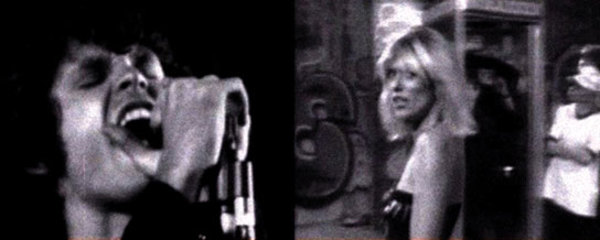
Pioneering digital rights organizations like Creative Commons and the Electronic Frontier Foundation are probably drooling over the possibilities that have opened up thanks to the work of audio/visual artists like Addictive TV. Light years beyond the gallery realm of masters like Bill Viola, this British collective’s collages do more than question typical art concepts-they’re on the vanguard of changing copyright laws and ideas of media ownership. But despite the bootlegged nature of their work, Addictive TV is finding exposure and acceptance in the most unlikely of places-the corporate world. Their brilliant clip, Rapture Riders-a mash-up of the videos for Blondie’s “Rapture” and The Doors’ “Riders on the Storm”-was directed exclusively for EMI.
Melding elements of graphic design with a sound designer’s sensibility and a taste for eye-catching celluloid booty, these mixmasters and musicians create something otherworldly and all-encompassing from behind their Kraftwerk-style wall of synth- and video-modules. And don’t think for a second that their art must remain locked away in a gallery; they’ve also crafted clips for club kings and queens like Matthew Dear, Derrick Carter, and Ellen Allien.
Addictive TV ups the ante at a time when the networks and large production companies are highly litigious. Yet the BBC has opened their archives to the stalwart TV terrorists, inviting them to judge an amateur video-mixing contest, Superstar VJs, and suggesting that, in the world of artistic ownership, things are about to change.
Deanna Templeton: Life from SoCal
It’s impossible to discuss Deanna Templeton without mentioning her husband of 15 years, pro skater and Toy Machine founder Ed Templeton. Despite the couple’s successful marriage and frequent collaborations, however, her gradual rise to prominence is no mere extension of her husband’s notoriety. From her teen years spent in the L.A. punk scene (where she appeared in music videos for the likes of the Red Hot Chili Peppers, Dokken, and Megadeth) to her thought-provoking photography, Templeton is a poster child of unbridled sincerity. A devout vegan for 15 years, she would rather sip smoothies with Ed at their Huntington Beach home than embrace the party-hard lifestyle commonly associated with pro skateboarding. “We’re kind of nerdy,” she admits. “We don’t go to parties or anything like that.”
Templeton became interested in photography in the mid-’80s, when she and a high school friend would sneak into punk shows and take photos of the bands. In 1998, she began to take the subject more seriously and has since exhibited her work throughout North America and Europe. Recently, she completed a photo project for the 20th anniversary of Sole Technologies (which encompasses the Etnies, És, and Emerica skate brands), as well as the third installment of her Blue Kitten zine, a collection of personal photography intended to “share a part of [her] life that makes [her] really happy.”
Much of her exhibited work has documented people who flock to professional skateboarders for autographs. Portraying both the excitement and blatant insecurity that unfolds, her work raises serious questions about objectification without dehumanizing her subjects. However, Deanna does not try to make her statements too weighty. Adopting a “shoot first, think later” mentality, she uses her camera as a tool for understanding the culture that surrounds her.
XLR8R: When did skateboarding first catch your interest?
Deanna Templeton: When I was a kid I used to skateboard with my brother–we both had Bonsai boards with urethane wheels. We would just skate around our neighborhood. It was more of a pastime. Then, when I was 18, Ed caught my interest, and he just happened to be a skateboarder.
What prompted you to start photographing girls at skateboarding events?
Well, it’s not just girls. I photograph guys as well. It’s too long of a story of how it first started, but the reason I shoot them is because I’m still exploring the different dynamics that go on with the signings. Like, if a female goes to get an autograph, the places on their bodies are used kind of sexually; [they ’re] hoping that they might stick out among the rest of the girls. And then it seems like when a guy gets an autograph, it’s just pure messing with the guy. I mean they’ll have writing all over their faces, obscenities on their butt. The two are so different. I’m not judging either group; I’m just trying to understand. Especially when you think about [the fact] that most of the markers are Sharpies and they’re supposed to be permanent.
Have you ever felt frustrated by the experiences your husband has had with girls idolizing him?
Just twice that I can think of. Once, a girl pushed me out of the way to get up next to him. Being young at the time, I pushed her back. Another time, a girl came up to me and asked if it was okay if he signed her boobs. I just looked at her and said, “Sure, and then he could fuck you in the bushes later!” I guess I should be happy that she was considerate enough to ask.
How did these experiences change the way you view skateboarding?
It really hasn’t changed my view at all on skateboarding. I mean, this is the least crazy thing that could happen in skateboarding. In France, I witnessed a young girl come up to a pro skater that Ed and I were talking to and offer him a blow job for his shoes, so writing your name on a training bra or some cleavage seems pretty mild. I do have to say, though, I’ve been traveling to Europe now for the last 15 years and I’m not sure if I’ve seen any kid really get their bodies signed, or in Japan for that matter.
Skate culture is deeply immersed in consumerism and advertising. Would you have any problems with using your work with an ad campaign?
Not if it was something I felt really passionate about. Like if Planned Parenthood wanted to use a photo, then I’d probably be okay [with it], or if some non-violent animal rights group wanted to use a photo. I’m not sure if my photos have mass-consumer appeal.
What other photographers or artists do you see dominating in their field right now?
Ashley Macomber! Lauren Greenfield! I get a lot of people who email from my Blue Kitten booklets and they usually include their websites, which all have been amazing.
What equipment do you use?
My favorite camera is my Mamiya 6, then my Leica M6 (it’s taken me a while to acquire this one, but I sold quite a few photos to a museum, which enabled me to afford one finally). Then I have a Mamiya 7, a Fujifilm 6×4.5, an Olympus XA, an Olympus Pen half-frame, and a Contax T3. And I still have the Yashica T4 and Canon AE-1 that my mom and husband gave to me. As for developing, I have A & I [Color Lab] in L.A. develop all my film. I had a terrible accident when I was learning how to develop film; I messed up the chemicals when I was developing a roll of film that I shot of a friend of mine that [had] just passed away. I’ve never trusted myself after that. I usually print all my own photos at home in our darkroom.
Do you think photography has the power to change society?
Yes. Just look at war photography! Look at any photojournalist. And if no one’s changing from that, then there’s always fashion photography. It has (and probably will for a long time) been dictating what women change to look like.
What does the future hold for you?
Hopefully to keep on breathing, learning, sharing, and caring.
Woman
People Under The Stairs
Since 1998, the duo known as People Under the Stairs has been purveying down-to-earth hip-hop ideal for backyard barbeques and cruising down the avenue. For Thes One and Double K, it’s always been more about banging out the funk than bending your mind with rhymes. But things change, even for PUTS.
On their fourth album, Stepfather, longtime fans will be happy to find Thes and Double K upholding their trademark party-rocking flavor-most notably on the virtual house party, “Jamboree Pt. 1.” The duo has also decided to take a close look at themselves and society, making many of these songs their most thoughtful ever. “I thank Thes for that one,” Double K says of Stepfather‘s reflective verses. “You leave it up to me, we’d be talking about partying the whole album, but we had to get some other stuff up in there, man.”
Though still adolescent b-boys at heart, these two Angelenos are pushing 3 and rightfully want to get their inner thoughts on wax. From paying respect to their families for raising them right (“Days Like This”) to reexamining good relationships they let go sour (“More Than You Know”), PUTS leaves very few stones unturned. They haven’t gone soft, though. As Thes explains, “It’s one of those things where we’ll be outside talking about some shit like what we’re talking about on those songs, and then we’ll go into the studio and this time at least have the balls to be like, ”You know what? Fuck it. We were just talking about this outside, about people’s grandparents or whatever-let”s talk about this [on the record].”’
As a result, not a single song sounds forced-listening to the record is like eavesdropping on a conversation on the porch one laidback summer night. Of course, porch talk isn’t always that deep. One of the most heartfelt new tracks, “Eat Street,” is about going on missions to find the best grub in L.A. and beyond. “That’s the realist shit we ever made-ever,” Thes says, without a hint of hesitation. “Dudes talk about, ‘Yo’ made this song about the drug game and that’s the real shit,’ but for People Under The Stairs, ”Eat Street” is the real shit. That’s as real as it gets, like, ‘Where we gonna eat?'”
“We always trying to find a spot,” confirms Double K.
Check the Technique
When they’re not on the hunt for good eats, Thes and Double K can often be found searching for that perfect beat. Albums like O.S.T. and Questions in the Form of An Answer demonstrated the duo’s love and respect for Golden Age hip-hop with lo-fi production and tons of dusty loops from another era; the sounds of these records were created on what some would consider outdated equipment (including the E-Mu SP-12 drum machine). But just as they decided to expand upon their lyrical content on Stepfather, PUTS updated their beat-making style as well.
“You listen to the old albums, it was a lot of jazz loops and guitars,” says Double K. “This one [has] a heavy funk attitude; [there ‘s] more synthesizer-type stuff. [It’s] still within what we’re doing, just the instruments have changed.”
Thes, who handles the bulk of the production, definitely wasn’t trying to duplicate previous efforts, even though he has publicly denounced hip-hop producers’ use of keyboards in the past. “Neither Mike (Double K) nor I are going to get in the studio and try and make another O.S.T.,” he says. “It’d be dumb to try and come with ”Montego Slay 2” and ”Acid Raindrops 2.” I know everyone loves those songs, but every record, we gotta try and make something a little bit different, but still us.”
Despite the addition of synths and the like, Stepfather includes an abundance of vintage jams. Hell, Double K even has a song called “Letter To The Old School,” which sounds like it was recorded in 1983, with siren sound effects blaring in the background. Just because they have increased their arsenal of equipment doesn’t mean you’re going to see Thes making beats exclusively on Pro Tools or Double K scratching on CD turntables any time soon. They are still artists of (mostly) traditional means.
In fact, Thes is particularly disgusted by beatmakers who think technology is going to make them sound fresh. “If you make your whole song in Pro Tools, your song is going to sound a certain way,” says Thes. “And that might not even be a bad thing, but it’s like every damn song I hear, I can tell if it was recorded on a computer. And it may be crispy and it may hit and whatever [but] I don’t give a shit if your song knocks, whatever that means. The shit’s got no flavor-it’s got no character. I’d rather have Double K and [me] freestyling over a tape loop because it’s got character, like, ‘Oh damn, it sounds like it was recorded in a club.'”
“It’s never what you’re using, it’s who’s using it,” confirms Double K. “Everything has to have some soul in it and computers don’t have soul, neither do drum machines-you have to have it.”
Bros Before Pros
Whether refusing to partake in certain technological advances or ignoring whatever style of rhyme might be hot at the moment, these People are practically living in their own hip-hop bubble. Last year, Double K appeared on Breakestra’s Hit The Floor album and Thes assisted Giant Panda in producing and recording their debut album, Fly School Reunion, but the duo has almost never indulged in guest appearances or collaborations. They couldn’t care less about extracurricular activities; at the risk of looking like loners, they prefer to keep it in the family-or not do it at all.
“As far as [working with] Giant Panda goes, I realized that a bunch of hip-hop dudes lived, like, two blocks away from me at my old house on Cambridge [Street],” says Thes. “[It was] just one of those natural things where it’s like, first you’re homies, everyone’s drinking beer on the porch, and the next thing you know, you’re making a record.”
“Everyone knows we don’t email people verses and get hot rappers to guest appear on our records,” he continues. “If you’re not hanging out getting drunk with us, you ain’t on the record. And even after that, you probably won’t be on the record…unless you’re George Clinton.”
Put Your Quarters Up
Life isn’t all about eats and beats for PUTS…it’s also about arcade games.
“Pretty much any Atari game from the ’80s was something I dumped a lot of quarters into at the donut shop and/or the liquor store,” admits Thes. “Videogames are definitely a part of us,” agrees Double K. Thes’ garage is already filling up with the arcade games he and Double K grew up playing after school. And he doesn’t see an end in sight. “I either got it or I’m trying to get it,” boasts Thes, whose hobby is restoring vintage arcade games. Here are just a few of his favorites:
Marble Madness: “It was designed by a 13-year-old kid. It’s got that ’80s-whiz-kid flavor.”
KLAX: “It’s a slept-on puzzle game from, like, ’89.”
Super Sprint: “That’s a great one for drunk driving. I think Double K probably prefers Arkanoid because of the mothership in the beginning.” [Double K laughs]
Street Fighter 2: “It’s a classic homie battle game. There’s mad stories about Street Fighter. Even now, if we go into the club and we see Street Fighter, there go People Under The Stairs. All you’re gonna hear is, ‘Aww shit!’ The quarters are gonna come flying out.”
Dabrye
Cover artist Dabrye comes with Two/Three, an icy-cool head-nodder that leaks its inner workings slowly and carefully. While Dabrye offers a soulful lovesong to the future, Gnarls Barkley comes with St. Elsewhere, an album that is lush and loud and drenched in sweat. More featured hip-hop artists include AG, The Streets, People Under the Stairs, and Mr. Dead, Nobody, as well as the striking photography work of Deanna Templeton.
The Loving Sounds Of Static
Playing House
Delphi Collective’s Favorite Things

San Francisco’s Delphi Collective adds a humble touch of class to an over-hyped design world. In the past four years, Matt Irving’s company (which encompasses a t-shirt line, an online portal, and a design house) has logged some serious coups, including the Nike Hunter Dunk, board graphics for Stereo, and a shoe and signature series of boards for Element. Irving is also involved in Umbrella Market, an online shop for one-of-a-kind items by Jeremy Fish, Mars-1, and others. This summer, look for a new line of Delphi tees, collaborative hats with Kangol, and art shows with Don Pendleton and Todd Francis. Right now, check Irving’s must-haves.
1. Optimus Keyboard
Leave it to the Russians to create something nobody else has thought of but everyone can use (like borscht). Word is that this keyboard (by Moscow’s Art Lebedev Studio) will allow you to sync up to all major programs, and have key commands right at your fingertips. It’ll be like a Gold’s Gym for your hands!
2. JP Helmets
I bought one of these helmets off eBay but have no real purpose for it. I don’t own a scooter or a motorbike. Regardless, I’m wearing it as I write these reviews. Safety first. If you own a Vespa, you should get one of these for your girlfriend. She’ll love it and it’ll make you feel like you’re straight out of Quadrophenia.
3. Crownfarmer/Stacks Catastrophe T-shirt
I love this t-shirt, designed by my friends Michael and Laura Leon from Stacks for my other friend, Crownfarmer‘s Bob Kronbauer. Nothing is better than wearing a shirt that your friends designed, especially when you chose to pay full price for it because you like it so much.
Islands Return to the Sea
Nick Diamonds and J’aime Tambeur used to be two-thirds of The Unicorns, the Canadian bubblegum-psych band that drenched pop music in acid and sang spook songs about ghosts. But with The ‘Corns disbanded, Diamonds and Tambeur have reconvened under the name Islands and called in a few Montreal-based buddies the indie kids might recognize (Richard Reed Parry and Regine Chassagne of The Arcade Fire and Spencer Krug of Wolf Parade, just to name a few). The result is an immediately accessible, immediately endearing debut. Basically, Return to the Sea is the album that would have followed The Unicorns’ Who Will Cut Our Hair When You’re Gone if the original trio stretched their artistic arms. In its 11 tracks of epic pop, Return is a near seamless ride through weird-world hip-hop megalomania, symphonic extravagance, tiki-torch whimsy, and so, so much else. Bottom line is you won‘t have a better time in 2006.
