These six impressive upbeat broken dance tracks make for a hearty EP. “Hint” gets raw and rude with buzzing-hornet fonky analog bass stabs and ‘nuff scattered percussion. Blink and you‘ll miss the wicked Afro-soul/funk cut “Got A Pulse.” A-class music!
Veronica Lipgloss & The Evil Eyes
What’s love got to do with music? In the case of Veronica Lipgloss and the Evil Eyes, the primal urgency of love is articulated via their mystical and sometimes absurd performances. A cut above the plethora of mediocre indie-glam bands, Lipgloss takes the heat of early ’80s and ’90s goth and projects it into their own unique homage to kindred spirits like Lydia Lunch, Siouxsie And The Banshees and The Slits.
VLEE’s debut full-length, The Witch’s Dagger, on Sonny Kay’s Gold Standard Laboratories, takes the occult and twists it around in ways that mark the band as an isolated reservoir in a desert of Birthday Party-mimicking enthusiasts. “I feel the most prolific after I have experienced magical moments in life that are unordinary,” says singer/bassist Rhani Remedes. “Life’s weird turns and psychic events are the most inspiring to me.”
Few bands are as obsessed with clairvoyant phenomena as Lipgloss. After passing drummer Andrew Netboy in the street, vocalist Remedes instantly recognized his unique energy and asked him if he’d like to work with the now-forming circle. The other half of the band consists of youthful guitarist/saxophonist James Caperton, synth/bassist Krispy and an entourage of debauched dancers. “When I met everyone in the band, it was very mythical and spiritual,” states Remedes. “I think that that’s a big connection we all share. We all met each other through a sort of sixth sense.”
Having toured with Gravy Train!!! and shared the stage with acts like Lesbians on Ecstasy, Veronica Lipgloss and the Evil Eyes pride themselves on their live show. Surrounded by a harem of dancers, with the crowd encouraged to bleed to the beat while the band detoxes the woes of the world, their performances give new meaning to the term cathartic. Remedes herself has a unique description of their live aesthetic: “A dancer in neon green short-shorts doing leg push-ups on the sweaty, dirty floor. Someone breaking their heel after doing some crazy dance move that requires flipping around. Cathartic dancing. Head-throwing. Some sort of whirlwind and glitter.” Expect nothing short of divine intervention.
The DJ Project: Beats and Business
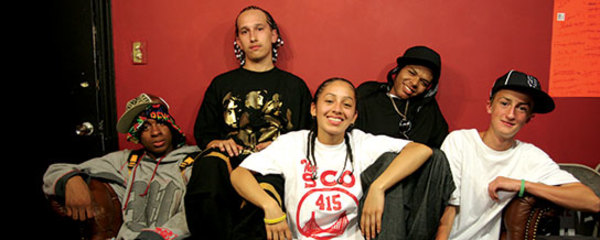
Six-foot-seven Jeff Feinman looks he should be on the basketball court teaching kids to drive the lane and dunk instead of programming beats. But since 2000, geared up in b-boy baggy jeans and tilted Kangol hat, Feinman has been sequestered in the basement of Horizons Unlimited (located at 440 Potrero Street in San Francisco’s Mission district), guiding youth to fulfill their music dreams.
It sounds almost too good to be true: The DJ Project is a free music studio available to low-income teens kids and young adults five days a week. During their quarterly 12-week-long cycles, program founder Feinman and graduates of the program teach young men and women how to use music programs like Reason, ProTools and Peak, as well as record vocals in a sound booth. Additionally, students learn DJ skills, write business proposals to fund CDs and explore the legal aspects of a career in music.
“It’s an after-school arts program related to hip-hop culture,” explains Feinman. “[The kids] work start to finish, from conceptualization to the finished project, learning how to sell records and the business in the process. We also teach kids how to work collaboratively, how to present yourself; we do professional development and performance training.”
SF City Hall and other community groups have commended the DJ Project for its professional approach and success at keeping kids away from gang activity. The students themselves live anywhere from just down the block to public housing projects, group homes and homeless shelters. Five years and counting, the Project has expanded to four Bay Area facilities-two in San Francisco, two in Oakland. The latter two programs have played a role in diffusing the territorialism and violence between different Oakland ‘hoods.
“We get everyone,” says Feinman, “from gangbangers who want to turn their life around and rap about their transformation to thugs and bling-bling kids to backpackers and nerdy beatmakers who never come out of their rooms but want to interact with other kids.” Serving mainly youth 15-26 years of age, Feinman also makes it clear he’s trying to reach out especially to women, in order to “make a safe space for them to come and create.”
On a typical day, program graduate Juan Guillermo, 21, is helping overdub Young Mic’s (Michael Arevalo) hip-hop track using ProTools. The excited MC rushes in and out of the vocal booth barking commands like a seasoned vet to his fellow student engineers: “Turn up the volume! I can’t hear myself. I gotta get this down right!” A few feet away, in front of a glowing eMac, Jabulani, 18, puts the finishing touches on a beat he just made, as fellow students practice freestyle rhymes aloud and make comments on the productions at hand. It gets sweaty and claustrophobic in the 10 x 20 foot low-ceilinged studio, but it’s the kind of controlled, directed creative flow that’s allowed graduates to produce no less than 15 CDs worth of original tracks in five years.
While the DJ Project’s output is strong, the equipment takes a beating. Oxygen8 keyboards and headphones constantly need replacing, the eMacs need upgrades and there are never enough scratch cartridges. But the kids also learn that it’s up to them to attract their own investment capitol.
“Currently we’re incubating a CD and DVD-duplication business, and we’re going to launch that in January,” says Feinman of their expanding projects. “We’re writing business plans, learning about targeted markets and competitive advantages and writing PowerPoint presentations. I’m into the whole hip-hop entrepreneurism, so I’m also looking for spin-off businesses that don’t require a lot of start-up capitol; [things] that are fairly easy to run yet are related to music.”
Bay Area artists including DJ Zeph, Azeem, DJ Quest, Zion-I, J-Boogie and Blackalicious have come through to give talks. The artists have sparked the students’ interest in learning about the business of recording careers.
Feinman envisions internships as a means of giving his graduates other insights into the music business as a whole. “I want these kids to get internships at a studio, at a label, a magazine, a radio station, so they’re exposed to other things other than just being behind the mic.” But he’s realistic about what the DJ Project can achieve in the long run. “I”m not saying we can necessarily increase their job prospects, but we connect them to something positive.”
Midaircondo: Folky Threads
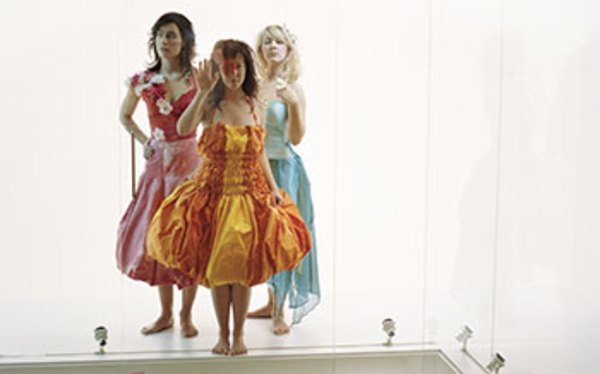
In 2002, Swedish musicians and longtime friends Malin Dahlström, Lisen Rylander and Lisa Nordström began formulating the idea for Midaircondo, a potent blend of electronic and acoustic improvisation. The scene could have been straight from a holiday greeting card.
“We met at my house in the middle of winter,” says Dahlström, “and it was quite funny because we were actually just planning to have some kind of knitting session and make big sweaters. We were in the kitchen and I was making some kind of cake, and we just started talking about all our different bands and what we wanted to do. It suddenly occurred to us that we should be doing music together.”
While there’s nothing sappy or sentimental about Midaircondo, it was still a fitting genesis for the band. Not because of antiquated gender associations between women and domestic duties, but because the intricate, delicate beauty of Shopping for Images, the trio’s Type Records debut, could have only come from a group so close to and comfortable with one another. “I think we listen a lot to each other,” offers Dahlström, “so if someone starts playing you have to immediately relate to that.”
Performing with an array of electronic equipment and live instruments-including woodwinds, saxophones and a piano-the three musicians appear to exert a gravitational pull on each other as they play, creating ebbing and flowing currents of noise. Songs slowly coalesce, including the pastoral piano piece “Serenade,” the exuberant “Perfect Spot” and the jumpy “Could You Please Stop,” which rides an acoustic bassline and tense synthesizers. Recorded by prolific Swedish glitch electronic producer Andreas Tilliander, Shopping For Images is a testament to the band’s stated goal of finding new and unexpected ways to create and present music.
It’s also not limited to the aural realm. When performing, the group manually manipulates projected visuals live-one of the highlights of their performance this year at Barcelona’s Sonar Festival. “You have five senses and you always use them,” explains Dahlström. “So if you come to a place or venue you’re always going to experience the room, whether you think about it or not. We want to utilize that.”
El Michels Affair: Heaps of Blue-Eye
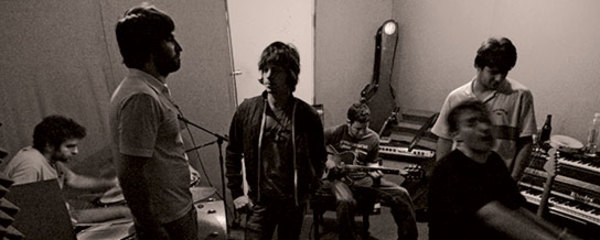
At the popular NYC nightspot S.O.B.’s, a classic hip-hop moment is underway. Wu-Tang disciple Raekwon is spitting his greatest hits and misses over live, funk-laden interpretations of RZA’s soundscapes by funk/soul band El Michels Affair. With the sinewy funk stew cooking on stage, you’d swear they were sho’ nuff old school vets. But unless you’re hip to the scene, the group’s racial composition might jar you. “When Raekwon walked in [rehearsal], he was a little shocked,” recalls Truth & Soul Records co-founder/ engineer Jeff Silverman. “People assume they’re old records.” Co-founder/ saxophonist Leon “El” Michels has a similar account. “This journalist heard the [Mighty Imperials] record and thought we were a group of 60-year-old black dudes. Then he came to our show and was like, ‘I don’t know about this.'”
Comprised of a loose collective of musicians, El Michels Affair is but one of their many noms de plume-the group is the intersection of members of The Expressions, Bama & The Family, Cosmic Force, Bronx River Pkwy, The Mighty Imperials and JD & The Evil’s Dynamite Band. And like it or not, these 20-something white kids are waxing poetic all over your preconceived notions of soul. “Half of Booker T. & the MG’s was white,” cites drummer/bassist Nick Movshon. “The Atlantic Records session guys too.”
While they can’t claim Muscle Shoals lineage, they are indeed third generation throwback soul heirs. Confused? Check the family tree. In 1997, soul aficionados Phillip Lehman and Gabriel Roth formed Desco Records, pioneering the trend of reissuing obscure soul tracks. Fast forward to 2000-Roth and Lehman split to form Daptone Records (Sharon Jones & the Dap Kings) and Soul Fire (Lee Fields), respectively. In 2002, Lehman makes his exodus from the business; his pupils become beneficiaries of his musical estate.
Taking a cue from pre-blaxploitation film Putney Swope, Lehman’s pupils dub their budding branch of the tree Truth & Soul. And parallel to the film’s plot, Truth & Soul’s mission was to shake up the system. “We wanted to cover everything and work with other people, not just put out soul music,” says Silverman. “With Soul Fire, the way Philip ran things was very militant.” But with recent guests at their Williamsburg digs in the form of Masters at Work’s Kenny “Dope” Gonzales, Fatman Scoop and Lauryn Hill, it’s evident that the changing of the guard involves remixing the funky precedent.
Strum
Jo Jackson: Positively Negative Art
Jo Jackson paints icons. Giant hollow-eyed skulls. Silhouettes of couples fucking. Massive outlines of the United States and China. What do these things all have in common? Cold-hearted menace. Hiding underneath the paintings’ façades of straightforwardness and candy colors lies a raging battle between the way things seem to be and the way they really are. Though Jackson’s work looks strikingly graphic from far away, up close her brush strokes are jagged. Everything is flat and two-dimensional and lifeless-not a trace of 3D or shadow in sight. And why is there a video animation of a globe that only has the US on it, rotating around and around?
Jackson’s work confronts our perception of popular symbols, albeit in a weird, non-threatening way. The same thing happens when you talk to her. I reached her at home in Portland, Oregon, where she recently moved with her husband, the artist Chris Johanson, and Raisin, a dog so small and poorly genetically engineered that it has to wear a sweater at all times. She was soft-spoken and nice to a fault, and it wasn’t until the hour-long conversation was over that I realized how profound and sometimes disturbing the topics were. We lurched from discussing Jackson’s distaste for her childhood in Columbia, Maryland, to her formative years as a young artist in San Francisco in the late ’90s. Along the way, I learned that she is preoccupied with the boundaries between the fake and the real; that she used to be obsessed with drawing crosses (because it wasn’t allowed); and that she likes to listen to TV shows about rape, murder and incest on the radio while she works. “The sitcoms are too dark, though,” she confesses. “They’re too scary. Real family life portrayed in that way gives me the willies.”
XLR8R: When you reflect back on the time you spent in San Francisco, how do you feel it shaped you?
Jo Jackson: It was such a rad place to be a young artist. I think that it was particularly awesome because almost everybody was doing something or making something. I lived in D.C. before that and it felt like you had to prove that you had the right to be creative, whereas in San Francisco it’s just every freak making things Lite Brite sculptures or whatever.
People have quantified that time you were painting in San Francisco-alongside people like Chris Johanson and Barry McGee-as such a ”scene.”
I never felt a part of a scene the way it was talked about from the outside. I was never mentioned as a Mission School person. Most of the people I thought of as my little scene were people that hung out at the Adobe Bookstore.
It seems like Adobe Bookstore, where you worked in San Francisco, has nurtured so many artists.
That place is really rad. The foundational people that hang out there are disenfranchised intellectuals-super politically and historically informed people that are not going for any earthly reward. It makes it a really safe place to rest yourself. You get the feeling that just hanging out and thinking is plenty and it really opens life up. It’s really scary to be making [art] and putting your stuff out there all the time-if you take the winning and losing out of it, it makes it really nice.
Can you mention any things that have directly inspired a painting of yours?
There’s an autobiography of Beverly Sills called Bubbles. She’s a Republican opera singer, and it seems like the whole book is a giant lie-in the way that little kids, when they write journals, say things like, ”Today, I was the most popular girl in school.” That is really inspiring and is making me think a lot right now. I think I might be feeling weirdly interested in identity art again-the yuckiest art in the world. [Identity art] is the way art was in the ’90s-it’s a lot about ”Who I am and what my place is and being a woman” or being whatever. It really seemed really tedious and terrible at the time, but now it seems really funny.
So you’re not interested in making identity art as much as you are in making art that comments on it?
Maybe. It seems like a lot of times in culture right now we look at something ironically or make art about it ironically-like fake abstract art or that kind of fake gnome music people were making a while ago. But then a few years later, that turns out to be what you really like. I think [my interest in identity art] is a slightly ironic doorway, but maybe that’s what I’m really interested in sincerely right now.
Do you purposely set out to explore themes that are totally different from your personal life and experience?
It’s weird that all the details would be so opposite, but that maybe I would find this weird core in there-something that unites all of us. [In Bubbles], I think that’s there in the lying. It just gave me a really personal feeling to tell the story of your life and to bullshit it. I relate to that immediately. [Laughs] One of my deepest senses is that most people are pretty much the same as each other.
Part of what’s so striking about your paintings is that they look precise.
I like to have a sort of fake control. I like to cut the icons out and make them fit on top of the painting instead of them melding into the painting. [When you look at my paintings] in print, they look really clear but when you see them in person they are messy and there’s a lot of struggle to keep things in their lines and you can see the bumps and the rips. So I think a big part of it is that struggle to be precise, which calls precision and perfection out as a lie.
When you were a kid what was your ideal of beautiful and perfect?
Well, now I really do have a role model in this guy that hangs out at Adobe. He’s a chess player named Steve. He lives really super cheaply and he’s super smart; he has an amazing mind that remembers all the books he’s ever read and he’s not struggling for anything. Maybe not struggling is really the ticket to a certain kind of beauty.
How do you feel about Ryan McGinness and Geoff McFetridge? All three of you seem to have a similar interest in iconography and a bright color palette, but they seem to come more from a graphic design perspective.
I really like Geoff McFetridge’s work a lot. I think it’s so…nice. (What a great adjective!) I mean, it’s sooo comforting and sort of preppy-like public library advertisements from the ’70s. It just seems really wholesome to me, and I really like that. I don’t feel like my art is like his art or Ryan’s; I wouldn’t mind if it was more. Ryan’s work seems a lot about the perfection of his body whereas my work is this gross struggle against my body, which refuses to be obedient and refuses to be precise. He makes these things that slip into each other really effortlessly and cleanly and everything knows where it is. Geoff’s art seems so much about the ease of making the right mark just happen. It doesn’t seem to struggle very hard with itself-it just seems to talk. But it must feel really weird to make something that well. I can hardly make a left turn!
When did you incorporate video into your show?
My first video was four years ago and I made it in Flash. Now I think I’m going to make animation using 16mm. I always wanted [my stuff] to be in motion and the first time I saw it move I fully cried. I never really watched TV growing up but I”m really psyched on animation. It’s so fake and imitates life a little more than a drawing does-it really thrills me.
Giant Panda: Purists Aiming High
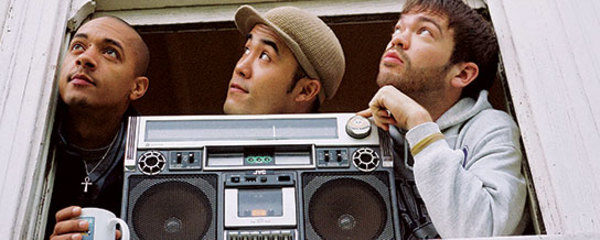
LA-based trio Giant Panda’s name alone is peculiar enough to turn heads. Yet as random as it sounds, there is a meaning behind one of the oddest monikers in hip-hop. “It fits us literally, being black and white and from Asia,” explains MC/co-producer Newman. “And I feel like we”re bringing something that”s rare or endangered to the table.”
Like the elusive giant panda bear of China, this multiracial crew (Newman, MC/producer Chikaramanga and MC Maanumental) is somewhat of a rarity in their own territory. With sample-driven singles like “With It,” Giant Panda has helped keep the roots of hip-hop alive without falling into an old school rut. “I think it’s really easy to be a purist but yet still make forward-thinking music,” says Newman. “The fundamentals of it shouldn’t be the gimmick-they should just be means that you’re using to get to another end.”
What began as dorm room beat-making sessions between friends quickly grew into a sound cohesive enough to catch the ears of Pete Rock and Marley Marl-both of whom gave radio play to Giant Panda’s first single, “’88 Remix.” It was their move into LA (from suburban Pomona, CA, and Seattle respectively) that initially helped solidify their potential as a group. Here, they met neighbor Thes One from People Under The Stairs, who assisted the crew in recording “’88 Remix,” and who ultimately took them under his wing. “Having somebody who was already established seeing what we were trying to do and being into it gave us more confidence like, ‘Okay, we can do this,'” says Newman.
This year, under Chikara’s own Tres records, Giant Panda released their debut, Fly School Reunion. From the humorous, high BPM energy of “Racist” to the chill, melodic vibes of “With It,” this album gave fans a proper display of their slightly off-kilter brand of party-starting hip-hop. As Maanumental says of the album’s release, “It kind of validates what we’ve been doing up to this point.”
While Giant Panda has caught the attention of plenty of true school heads, they plan to extend their reach by using more accessible hooks that anyone could recognize. “Fly School Reunion is trying to reunite people that are in the know of what we”re talking about-old school stuff like the ’90s-but I want to make something that my little cousins can sing,” says Maanumental.
Birdy Nam Nam In The Studio
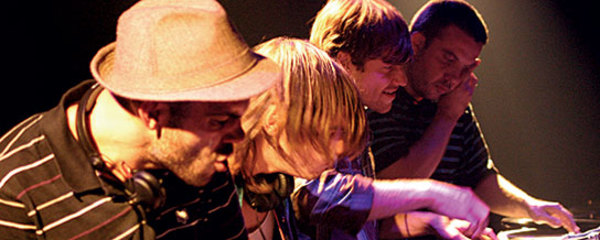
Turntablism has shared a close relationship with avant-garde jazz, classical and experimental music, as deejays have tweaked decks to create expansive compositions that are far from the instrument’s hip-hop battle roots. Artists continue to expand the repertoire, from DJ Quest’s Live Human band to DJ Radar transcribing scratch notation for orchestras, to turntable experimentalists like Janek Schaefer and Christian Marclay. Add to this continuum four funky weirdos from France: Crazy B, DJ Pone, DJ Need and Little Mike are champion battle deejays who flip the script as Birdy Nam Nam. BNN’s compositions draw on France’s long history of 20th century classical music, from the work of Claude Debussy and Erik Satie straight through to modern electronic mischief-maker Pierre Henry. The quartet reconfigures beautiful, pastoral music snippets into the realm of turntablism, yet they’re still awesome beat jugglers, and their shows balance creativity with rock-the-party antics. With their self-titled debut album (on Kif) finally released and about to do major damage, the foursome sat down to share their live and studio methodologies.
XLR8R: What role does each member play when you perform? Is one DJ a “bass” and another just scratches?
Birdy Nam Nam: We usually switch off different roles, but Mike is doing the drums most of the time. Mike and Need are maybe playing more solos but there are no established rules.
What brand of turntables do you use?
We use Numark TTX. We need this model because of the pitch (+/-50) and it’s perfect to play short notes as we do. Even if Technics MK2 is the preference for many DJs, we cannot play BNN’s tracks with it because of those technical aspects.
Do you use CD turntables as well?
We use the Numark CDX but we don’t manipulate it like vinyl. We just use it because we can only play four channels at the same time, so we have to play sequences on CD.
Do you use it for live shows?
We just use four turntables and a CD player to play sequences that we can’t play live. For the moment, we don’t use any machines but we don’t know what will happen in the future. We started composing tracks with some musicians, then did a few live shows with them and it was really exciting.
What is the craziest thing that has happened at a Birdy Nam Nam show?
Nothing really crazy. In Miami, we played in really bad conditions. We thought that Americans were professional in everything they do but we never played in worse conditions than in Miami. Mike threw his record into the crowd because he was really mad.
Where does your name come from?
We were part of another crew of DJs called Scratch Aktion Hiro. We won the ITF World Team championship in 2000. Then the crew split but the four of us wanted to keep working together. We had to find a name [for ourselves] when representing France in the DMC World Final in 2002. While watching The Party by Blake Edwards, we loved this name and simply decided to perform as Birdy Nam Nam.
What other types of French art inspire you? Duchamp, Ravel, Gainsbourg?
We all love Gainsbourg, he did so many different things, he never had any restriction or limit. We all have very different influences. Some of us like French singers or composers but they are not really an inspiration in what we do.
Who is the most stylish member of BNN?
Little Mike is the most fashionable because he is young and he’s still looking for his own style. He looks like a Nirvana fan with long hair and a rock & roll attitude.
Do you have groupies at your shows?
We recently realized that there are many girls at our shows. It’s true that some of them act like groupies after the show. But we want to be [as big as] The Beatles, so we’ll have to wait a little bit!