Colossus: Honorary Oakland Funk

Back in 2002, the Bay Area became home to a 6’8″ Londoner named Charlie Tate, one half of the veteran jazzfunk/drum&bass duo King Kooba and former bass player with Neneh Cherry’s band. After four King Kooba albums for Second Skin and Om Records, Tate settled into the Oakland lifestyle like a soft couch. He started the laid-back weekly club night Slow Gin with Om’s PR man Gunnar Hissam (a.k.a. The Trout) and began cultivating friendships with old time blues players, new school MCs, and the fine folks at Kingman’s Lucky Lounge near Oakland’s Lake Merritt district.

“At one of my Slow Gin evenings there was an impromptu open mic session where I met emcees Regi B and Delphi,” says Tate, who has since relocated back to the UK. “Also around this same time I was producing the first Colossus tracks and making contacts with people such as [emcee /singers] Capitol A and Azeem. Before I knew it, my idea of harnessing some of the Bay Area’s favorite artists in one colossal package was on.”

After returning to London in 2004 and recording some tracks with Rodney Smith (a.k.a. Roots Manuva), the Colossus debut West Oaktown was finally complete–or so we thought. For Tate, it still wasn’t enough: “I decided to remix the entire record… I’m not sure why–it just seemed like a good idea at the time. [But now] you get two records for the price of one! For no other reason than that I wanted to!”

Lucky for us. Disc one (also available on double vinyl) is a jazzed out excursion reminiscent of those lazy, stoney Thursday nights at Slow Gin. Disc two is geared towards the clubs–or at the very least a sweaty pub on a busy night out. The first 12″ features two of the most jumping tracks–”The Tribute” and “Thripney Bits”–remixed by J-Boogie, Strange Fruit Project, and DJ Zeph. And after years of support gigs with legends such as James Brown and Roy Ayers, Tate is forming the Colossus band, with Tate himself on bass, cats on drums, Rhodes and turntables, and MCs Azeem, Delphi, Regi B, and Capitol A. Expect a tour of the US later this summer with possible European dates toward the end of the year–a big 2005 for the big man from London with a head full of Oaktown funk.

Scare Tactics

Adult. tell if they are onto a goth revival or pulling skeletons out of their closet. We also talk to Norwegian disko artists making the hottest thing since fog machines and laser rays. Director Chris Cunningham explains his work ethic, laptop artist Jason Forrest talks noise with producer Hank Shocklee, and K-Swift reigns queen of Baltimore club music. Also featured: ice cream and batty riders in Jamaica, Andrew Pommier, MC Turbulence, Kele Le Roc, and much more.

Battles: Don’t Do the Math

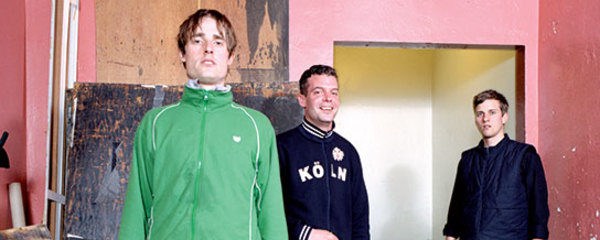
Battles pencils in rock and roll so pristine and mathematically precise that a slight breeze might shatter it. Each guitar note, microtone, and beat is fixed like leaves on a tree branch that break off and continue the music as they skitter down the sidewalk. Just don’t call the New York quartet “math rock.”

“Is it fair to call a chef salad with a multitude of ingredients ‘lettuce?'” quips guitarist Tyondai Braxton. Battles does not play songs as much as they concoct loops, with three guitars blurting their simple parts into a grand argument. The instrumental band’s excursions range from mechanical trance-rock to noise-loop experiments that flow like amniotic fluid in the womb.

“The effect of it all could still add up to something that was complicated, but I wanted the phrases to be simple,” guitarist Ian Williams says. “From what I read about the band, people don’t always see it that way, but what you aim for and what you are aren’t always the same thing.”

Battles, originally christened Abomination Restitution, formed in New York in 2002 when solo guitarist Braxton bounced ideas off of Williams (of Storm & Stress and Don Caballero fame). Guitarist David Konopka (Lynx), and heavyweight champion drummer John Stanier (Helmet, Tomahawk) later figured in. “The thing is [that] everyone in the band has a strong musical background already, so as far as that is concerned, we all knew the ingredients,” Braxton details. “It was just a matter of rehearsing and writing to see what would sift to the bottom.”

Earlier this year, Battles toured the States with Scott Herren (Prefuse 73), who later joined them for an encore at the Sonar Festival in Barcelona. Braxton mentioned that Herren defended his honor at a Florida gig by throwing his sandwich and a fist at a drunk who tried to strangle Braxton. The poor victim later counter-attacked a UK heckler who hated on his The Fall shirt. “Well, we’re a seminal British band and if you’re from Britain, you should be kissing my ass right now,” Braxton recalled lying.

As for Battles’ more peaceful side, their record covers typically strike the eye with simple, wordless photographs of pastoral fields and trees, heightening the band’s mystique. “The photos are really beautiful and that is the statement in itself,” Braxton said. “There is a sense of neutrality in the way we build our music and [we] wanted that same sense with our visuals. It lends itself to multiple interpretations.”

AlterNet: Sense And Nonesense

In the aftermath of the 2004 election, countless scribes have performed autopsies on the Democratic body politic–unfortunately they’ve emerged with a message that’s about as coherent as John Kerry’s vision for a New America. AlterNet‘s Start Making Sense:Turning the Lessons of Election 2004 Into Winning Progressive Politics (softcover; Chelsea Green Publishing, $12), edited by Don Hazen and Lakshmi Chaudhry, attempts to better address the myopia that has blindsided Democrats and progressives alike.

Taking a more pragmatic approach than the majority of post-2004 election books, Start Making Sense compiles interviews and essays from some of the brightest minds in the progressive camp. AlterNet bills itself as an “infomediary;” since 1998, it has served as a warehouse where one can find articles from the alternative press as well as valuable resources for grassroots organizing.

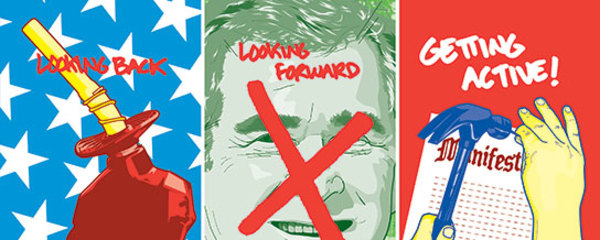
The book is organized into three sections–”Looking Back,” “Looking Forward,” and “Getting Active”–and includes analysis from people like Naomi Klein, Thomas Frank, and MoveOn.org co-founder Wes Boyd, among others. Take the example of Adam Werbach who, at 23, became the youngest president of the Sierra Club and who co-founded the Apollo Alliance, an organization devoted to ending US dependence on foreign oil. After the election, Werbach composed a November 3rd thesis and, in homage to Martin Luther, nailed his manifesto of grievances to the door of the Democratic National Committee headquarters in Washington D.C. As he states: “When the Senate Democratic leader is defeated while spending $16 million to get the majority of 500,000 votes, the problem is not a lack of funding or effort.”

While the book includes diverse perspectives, a common theme is that the Democrats have little chance of success if they continue to pursue their current poll-driven, top-down managerial strategy–a strategy that has little connection to the Democrats’ historically grassroots base and offers nothing in terms of vision other than an anti-Bush platform.

A typical critique comes from commentator and California gubernatorial candidate Arianna Huffington. She argues that Kerry and his advisors drove his operation “straight over the edge of the Grand Canyon” by abandoning the tough language he used early in the campaign, when lambasting those “Benedict Arnold corporations” who outsource labor and hide their profits in tax shelters overseas. She believes that a cautious strategy designed to appease Wall Street and not alienate “swing voters” is a prescription for failure.

While Kerry’s capitulation is cause for despair, what sets Start Making Sense apart is its inclusion of activist success stories. Markos Moulitsas Zúniga, a child refugee survivor from war-torn El Salvador and US Army vet, helped jumpstart the blogging revolution with DailyKos.com, a meeting site for activists who have helped organize against behemoths like the Sinclair Broadcast Group’nc. On the eve of the election, Sinclair ordered its numerous television stations to air an anti-Kerry documentary. By targeting the station’s advertisers, the bloggers forced the station to produce a more balanced documentary.

Start Making Sense makes it clear that the 2004 election has provided progressives with a mandate to get actively involved in changing the direction of the country. Whether it’s lobbying for voter machine reform, participating in the anti-war movement or starting your own activist organization, now is the time for a creative re-envisioning of possibilities. The book’s last section provides provocative suggestions on how to accomplish this.

Start Making Sense concludes with Barack Obama’s impassioned speech at the Democratic convention. In the address, he says: “It is that fundamental belief-I am my brother’s keeper, I am my sister’s keeper-that makes this country work.”

Adult: Hearts of Darkness

Adult. once said they made uncomfortable music. How fitting then, that I have just taken them to the most uncomfortable place on earth: New York’s Museum of Sex. And now I’m standing next to Adam Lee Miller, Nicola Kuperus, and their new bandmate–Tamion 12-inch guitarist Sam Consiglio–in a darkened room punctuated by canned male laughter and smacking sex sounds. Nicola and I are paused next to a screen flickering with an image of two men jacking each other off, while I feign interest in the accompanying text about this history of pornography. After what seems like an eternity–but is only really a minute and a half–Sam darts over and breaks the silence. “All I hear over here is shame,” he says pointedly, waving his hand toward the video.

I thought this place would have appropriately weird curiosities like shrunken pygmy penises in jars or the world’s first dildo, but the overall feel is of a sleazy adult bookstore–the exhibits include a re-creation of a gay man’s entertainment center from the ’80s (complete with lube and hair remover), a sex chair controllable via the internet, a porn flick called New Wave Hooker, and lots and lots of naked shlongs. I’m half expecting Adam or Nicola–who have written songs bemoaning “touching things touched by others”–to bolt to the bathroom for a bout of obsessive-compulsive handwashing.

Nonetheless, all three gamely proceed through the museum, pausing the longest in front of Real Doll, a life-sized sexual aid designed to look and feel like a real woman. As all four of us take turns feeling on a pair of breasts made out of lifelike silicone, Adam explains that Nicola once considered buying a Real Doll for her photographs–elaborately staged Hitchcockian tableaus that grace the covers of their Ersatz Audio singles–but declined when she found out the nearly $7,000 price tag. “Looking at it up close they have all these seams and stuff,” he muses. “It’s good we didn’t buy one.”

Catchers In The Wry
It appears Adult. has loosened up a lot in eight years. In their early days, Adam and Nicola (Sam was added to the line-up last year) came across as two chillingly clinical, at times angry, electro robots, an image reinforced by tense live shows and stark, blank-eyed press photos. When you meet them in person, you realize the photos aren’t a shtick–with their penchant for all-black outfits, angular hair, and stop-start sentences, the members of Adult. are like the weird kids at some record store in the late ’80s, the kind who used to slip Dead Kennedys records into the Debbie Gibson sleeves. As you’d expect, they are also much nicer and more personable than robots.

Initially, the couple–art school grads who met in Detroit in 1997–served up dystopian takes on Kraftwerk’s shiny future on singles like “Dispassionate Furniture” and “Nausea”; these themes that continued through 2001’s Resuscitation (a collection of early singles) and 2003’s Anxiety Always. Though their April mini-album D.U.M.E. and their new full-length, Gimmie Trouble (to be released on Chicago indie label Thrill Jockey), still find them soundtracking the anomie of the 2000s with wry, dark humor, they’ve become more outgoing in approach. There’s just a lot more to Adult. these days–more band members, more guitars, more angst, and more of Nicola’s Siouxsie & The Banshees-inspired caterwauling above analog voodoo beats and angular post-punk rhythms. Those expecting them to save electro again might be sorely disappointed–parts of both records are suited for dancing…in goth clubs–but fans of the band’s singular aesthetic will find plenty here that is quintessentially Adult.

“The one thing we’ve always had across the board is we take our own personal flaws–things like anxiety and social awkwardness–and sing about them,” says Adam when we finally duck out of the museum, through the monsoon-like New York rain and into an East Village café. “I think that’s why people identify with us. I mean, nobody really gets up on stage and is like (sings) “I’m socially awkward”…but we do. [The difference is that on our previous albums] you had the person who is like ‘I’m awkward quiet’ and now you have the person who’s like ‘I’m so nervous. Oh my god. Oh my god.’ And you listen to the album–the lyrics are like bah-bah-bah and the bass never stops and it’s this nervous energy–it’s still the same theme, just released in a different way.”

Troubled Times
Adult.’s newfound desire to tear down the barrier created by vocoders and monolithic synth lines is no doubt a reflection of the events of the last two years. Following the release of Anxiety Always on their own label, Ersatz Audio, they embarked on a grueling tour (20 shows in 26 days) and, despite actually being from Detroit, found themselves having to fend off the “electroclash” label. Nicola and Adam, who are married, bought a historic old house and built an attic studio in it where they would record Gimmie Trouble. Perhaps most surprisingly, they decided to divide the creative brain of Adult. into threes by working with guitarist Sam, who adds a rogue element of flamboyance to the pair’s at times austere framework (what one Russian journalist dubbed “librarian chic”). “I’ve never worked with anybody whose music was a more direct reflection of their personality than these two, that’s for sure,” says Sam.

By all accounts, the process of making Gimmie Trouble was intense. “We calculated that we worked every day from January 2nd to April 4th, except for five days,” explains Adam of the band’s restrictive recording schedule. “The first song we wrote was ‘Scare Up the Birds’ and it came out immediately. Then we had an 11-day dry spell–you’re talking 10-12 hours a day where you’re just coming up with like, a sketch, a little doodle.”

“And then I drank coffee and it happened,” says Nicola, laughing. “I mean, I’ve never been in any other band so I have no perspective. I assume most people don’t just get together [like we do] and go, ‘Okay, we have a blank piece of paper here. Let’s fill it up.'”

On prior albums, Nicola and Adam would go through and clean the house before recording, giving themselves a sort of pristine mental slate. That became impossible on Gimmie Trouble, as they were living in a place that Adam calls “totally destroyed.” Instead, the three worked out tensions by watching Curb Your Enthusiasm and Strangers With Candy and playing endless games of racquetball in an impromptu court they created. (“I would just like to state that I don’t like jockiness and when we played racquetball it was not, like, real,” Adam is quick to mention. “Yeah,” concurs Nicola, “it was actually more like trying to inflict pain on anyone but yourself.”)

Voodoo You
Somewhere along the line, an album coalesced and was mixed in the two weeks Adult. had scheduled in between US and European tours for their six-track mini-album D.U.M.E.. Nicola says that D.U.M.E.–whose stand out tracks include a Christian Death-ish remix of “Don’t Talk” and the catchy death dirge “Hold Your Breath” (“Hold your breath now/for a long time/hold your breath now/for a lifetime”)–was intended as a way for audiences to catch up to their new sound. “It had been a long time since we had had a release and it was a way to kind of foreshadow that the times, they were a changin’,” she explains. “As for the goth club you hear,” adds Adam, “we were very conscious of that, thus the very over-the-top cover art and the name of it–Death Unto My Enemies. It’s from a voodoo candle. As soon as we collect all our enemies, we’ll light the candle and they’ll die.” He pauses with a sly smile. “We’re still working out the list though.”

Though they don’t name names, most of the content on both records is a sharp poke in the eye to their outspoken critics; Gimmie Trouble is both a mission statement and a description of what they’ve endured as they’ve tried to move away from their electro pigeonhole. “People are sometimes unhappy with change,” sighs Nicola. “They forget that as an artist you don’t want to repeat yourself–you want to grow and you want to discover what else is in there. ‘Gimme Trouble‘ was written [based] on an email where some guy was like ‘You just really need to stay focused on dance music and electronic stuff and your roots. You need to get rid of the guitar and the bass.'”

“I was a punk kid who started in 1985 playing bass, so that would be my roots,” says Adam, frowning. “Besides that, there was bass on Resuscitation and guitar on Anxiety Always. You get these people who want you to sound like when they first heard you. What they don’t remember is that they liked us because we didn’t sound like everything else.”

“Adult. was such a good idea when it started,” Sam recalls. “It was like, look we’re not a rock band. Nicola wasn’t going to shout at you like she was in a rock band. But there’s a singer, so it was obvious [they] weren’t a techno band either. [They] were nothing.”

“I think our intent has always been to not be a part of anything,” explains Nicola. “We’ve always worked really hard to kind of not really know what we’re doing. And then everybody’s always like ‘You sound like an ’80s band, you sound so retro.’ A lot of it is because we’re using keyboards from that time, but are you listening to them in the context of now and what we’re trying to do with them? We’re trying to pick up where it stopped and continue on. I think a lot of times people forget that.”


Little Brother: Major League

It’s 6 p.m. and Midtown is gridlocked with commuters trying to escape from New York. As office lights dim and commercial properties empty, the business of music doesn’t cease, not at 1290 Avenue of the Americas. I’m in the Atlantic Records building about to meet up with North Carolina’s hip-hop trio Little Brother. Back in the 1950s, before the building formerly known as the Sperry-Rand was erected, the block was lined with jazz hot spots and Rat Pack haunts like Toots Shors, where Marilyn Monroe sightings weren’t uncommon and, over drinks, the Yanks and Sox owners actually swapped Joe DiMaggio and Ted Williams for a day.

What do sauced-up baseball owners and data-processing manufacturers have to do with Little Brother and the price of hip-hop in China? Well, like major league baseball, Atlantic Records is in the business of selling hits, and with their new recording contract, Little Brother can say good-bye to ABB Records because they’ve just been traded to the majors. And as for Sperry-Rand, well they made calculators, the kind Atlantic’s numbermen love and will have at the ready for the release of Little Brother’s second record, Minstrel Show, this fall.

Twenty-eight flights up, I’m escorted through the frosty glass doors and greeted by Big Doh, the group’s manager and de facto big brother. Not as menacing as Suge Knight, or even Led Zeppelin’s Peter Grant, you can still tell that behind the warm smile is a guy ready to do anything and everything for Little Brother. “This is Big Pooh,” he says introducing me to the baby-faced rapper, followed by his partner in rhyme Phonte and DJ/producer 9th Wonder. I’m compelled to find out what it’s like being on Atlantic’s legendary roster, with players that are the titans of black music from the Stax/Volt dudes to…Ray! “The day I met Ahmet Ertegun I didn’t know what to say,” Phonte admits. “It still amazes me that we’re a part of a label with such a rich history of black music.”

Game Tight
Roaming the halls in search of an interview spot, the guys only stall to say goodnight to one of the more attractive female employees, but for the most part, even as we enter a bonafide boardroom, they’re talking about the meeting they just had. “Just a little parent-teacher conference,” 9th Wonder tells me with benign sarcasm. When I ask him who’s the parent and who’s the teacher, he scratches his head quizzically. “[The label is] used to babysitting artists,” he explains, “and they have a hard time when they see an artist that knows exactly what they want to do and where they want to go.” Is there trouble in paradise already? “It’s no big deal,” reassures Pooh, “we just had to tell the label that we’re not worried about what the single is, and we’re not interested in following any trends. They bought us for us, and even if the shiny suit era of hip-hop came back [à la Mase] we’re not going to do it.” “I compare it to going out with a girl,” Phonte sets up. “You say, ‘You’re incredible baby, but if you would only lose, like, 20 pounds.’”

You may be thinking the boys waived their “integrity” rights when they signed the devil’s contract, but Phonte (or Tay, as he’s called) insists that the indie world isn’t any better. “Even indie labels have a problem with artists who’ve got their own agenda, and we took a look at the whole [DIY] thing, but we never really wanted to be champions of the underground anyway.” They fit the bill pretty well, though. They originally got signed after posting a demo they produced in their dorm room (Pooh gives a shout out to “308, NC State! North Hall!”) on ?uestlove’s Okayplayer.com; Bay area indie ABB loved it and issued it as LB’s debut. And when LB rapped, people took notice–The Listening was one of the most anticipated releases of 2003.

Projects Blowed
In free agent fashion, the boys made a separate four album deal with Colorado Rockies short stop (more baseball?) Desi Relaford’s Six Hole Records, which has released music from other members of their Justus League crew (L.E.G.A.C.Y., Away Team) as well as solo albums from Pooh and 9th Wonder (Sleeper and Dream Merchant V.1, respectively). Pooh’s release showed off a strong solo voice, while 9th Wonder’s productions–which often fetishize Pete Rock’s take on soul–hold up no matter who spits on the track, a skill which led him to produce beats for TheBlack Album (after which Jay-Z recommended him to produce a track for Destiny’s Child).

Little Brother is prolific. Capable of dropping multiple projects at any time, you can see how they could be too much for any one label to handle. Phonte also has a side project (an internet collaboration) with Dutch producer Nicolay called Foreign Exchange (their Connected album was issued by BBE last year), while LB just released their “mixtape,” Chitlin’ Circuit 1.5, on Fast Life/Koch. Some feel the artist mixtape is passé, but Phonte defends the collection of unreleased and side-tracks, calling it a “stopgap between releases.” “Just something to keep the fans at bay,” confirms Pooh. But let’s not underestimate the content of CC 1.5; deep within guest appearances by Kanye West and Big Daddy Kane lay some of the most urgent and concise lyrics Little Brother has to offer. The title alone refers to the frustration of playing “rinky-dink clubs,” says Phonte, and on “Yo Yo” he raps, “I can’t fuck with no coffee houses…I’m about to kick some Trick Daddy!” The tao of Big Pooh seems to be the perfect balance of “indie hustle and major muscle,” but it appears both camps ain’t getting it, and the lyrics show signs of resentment. “People were like, ‘They’re conscious,’ comparing us to Common,” Phonte laments. “I’m saying, don’t put us in a box. There’s no tellin’ what we’ll do…we can listen to crunk if we want!”

Different Strokes
Little Brother isn’t too hard to figure out, according to Pooh. “If you actually listen to the words, you will know us before you meet us,” he reveals. “Writing is our therapy. We put so much of our lives on the record, some of us more than others.” “Yup,” Phonte confirms. “All my failed relationships, everything goes in.” Sibling rivalry isn’t one of their problems; they’ve already agreed that their audience benefits from any personal and stylistic differences they have. Pooh explains: “I bring the street side, not shooing niggas and selling drugs, but in the boom bap beat. Tay likes to do a lot of melodies and sometimes I’m like, ‘I’m tired of all that singing shit!’ But that’s just our differences as emcees.”

Pooh had another thorn in his side as well, for as close as he and Phonte are, it still hurt when people pitted the two against each other. “I heard people saying I wasn’t as good as Phonte,” says Pooh. “I always compared it to being Scottie Pippin playing with Michael Jordan. For a while Pippin ain’t get the credit he deserved, but that’s because he was playing with the greatest muthafucka to ever play the game, so of course he’s gonna get overlooked.” Phonte insists that their yin and yang “makes for a better group,” because they’ve got a screamer and a whisperer (or singer). “I think with this record, they’ll appreciate Pooh for Pooh,” he suggests. “I was playing the record for one of my boys the other day and he said, ‘Yo this is y’all’s Low End Theory.’ That was the A Tribe Called Quest record where Phife got all his props, and my friend was like, ‘If niggas ain’t feelin Pooh after this? [They’re crazy.]’”

Sound of Now
As a producer, 9th Wonder is in the catbird’s seat–he gets to stretch his computer wizardry (with layers of lost R&B) while capturing two wordsmiths. “A lot of these artists coming out don’t have the chops to pull off a song without clichés, but we don’t have to worry about that,” he says proudly. “Only a few groups could pull off rhyming to my production on Minstrel Show, and they’re all from early ’90s.”

“It’s a natural maturity, man,” Pooh concludes. “We completed The Listening on March 13, 2002, and it’s muthafuckin’ June 2005, so of course we’ve advanced production-wise. We’ve been around the world, you know what I’m saying? So niggas been through a lot and we got a lot to talk about!”

State of Grace
These Wolfpack alumni rep Cacalac lovely.

If you want to understand Little Brother then you should take a ride across I-40 to Raleigh/Durham, as North Carolina is practically another member of the act. “Our lyrics have small little hints that only a North Carolinian would know,” reveals Phonte. “Like in ‘Love Jones,’ I say ‘I’m playing for big stakes not some Angus Barn.’ Too bad I’m a vegetarian now,” he jokes, “but that’s the best steakhouse, and now that I can afford to eat there I can’t go!”

But don’t confuse NC State with the dirty dirty South. “We’re below the Mason-Dixon Line,” says Pooh, “but we’re not really the South. We’ve got four ACC schools here so it’s a melting pot of north and south.” They’re not as booty-club oriented as their neighbors but, as 9th Wonder tells us, “we’ve got other things on our record.” They rap about E House, Morrison, and Hinton James, or as Phonte quips, “the Holy Trinity, emphasis on ‘ho.’” Phonte endorses the Cats Cradle and the Local 506 as the hip-hop venues to check out. “You can always catch an open mic night or what not.”

The guys also spend a lot of time with their Justus League (a crew of about 18), not to be confused with their A&R/management team Hall Of Justus; a few J-Leaguers belong to the Hall of Justus, including L.E.G.A.C.Y. (“a words man,” says Pooh) and the The Away Team, who are “a Gangstarr combination of a dope producer and MC.” But the LBs aren’t the only ones who can carry some weight in the state, as Phonte knows, namechecking “21st Records, Redout Entertainment, Bloc Farm, and the Butta Team,” and even Petey Pablo, whose “Blow Ya Whistle” is making some noise behind them. “I don’t really consider those cats as competition,” he says with confidence. “We’re all working to shine some light on our state, so it’s all family, y’know.”

Page 3448 of 3781
1 3,446 3,447 3,448 3,449 3,450 3,781