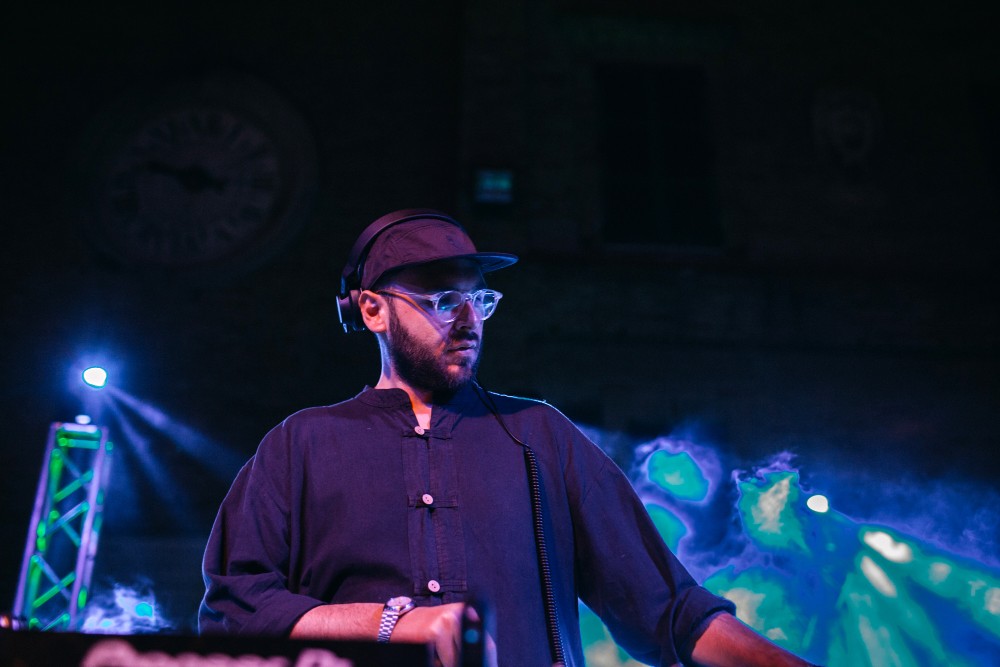
It’s difficult to imagine the electronic scene today without the considered productions of Alexander Berg (more commonly known as Dorisburg). The Swedish native, along with several of his fellow countrymen, has helped to bring house and techno with depth and feeling back to the fore. With numerous releases on the likes of Aniara, Bossmusik and Abdulla Rashim’s Northern Electronics, the crisp, precise sounds of Dorisburg have been unmissable over the past few years. Hearing anything from his ever-expanding back-catalog and you understand; it’s all about atmosphere.
The Swede first made a name for himself as a mysterious melody maker with studio collaborator Nils Krogh (a.k.a. Arkajo), under the banner of Genius of Time. The duo are still pushing the project forward, with their most recent release, Kepler 186f, arriving on Aniara last year; however, Berg has been turning as many heads with his solo work. And rightly so—even in his darkest musical moments, Dorisburg is able to conjure an unusual warmth across the board in his productions.
As his international touring schedule heats up, taking his live show everywhere from Berghain to New York’s Output, it seems like Dorisburg has found his moment. We spoke to Berg in Los Angeles during across the U.S., in the thick of it all—to find out the secrets of his success and discuss what goes on inside his studio.
Alexander Berg will be performing live alongside Nils Krogh (a.k.a. Arkajo), as Genius of Time at this year’s Into The Factory event, taking place from August 10 to 12 at Stora Vika, an abandoned cement factory in the south of Sweden. More information and tickets can be found here.
How long have you been making music, and how has the way you produce changed over the years?
I started playing around with music from an early age, around eight. Both my parents were professional musicians so there were always instruments around the house and I was always playing with them. It’s hard to say exactly when I started making music with some kind of goal because it just happened really slowly.
Can you remember when you produced your first track?
How do you define a track? I remember that I used to record stuff from a toy synthesizer on a four-track cassette tape—but does that count as producing a track? We then got a computer in the family and I began using software—but these programs were so simple at this time that you couldn’t really load samples or anything. They just played back general MIDI notes, so I was making music on this software but I couldn’t tweak any sounds or anything—I had a very basic palette. However, I used this software to compose songs, and so the stuff I was making then was not so cool. I remember listening to cool music on the radio and thinking, “How do these guys make these sounds?”
Do you remember when you first began to gravitate towards electronic music and also start to focus on a certain sound?
I actually got into underground dance music quite early, mostly from listening to the radio. There were certain tracks that I loved that gave me a certain feeling, and I just knew that I liked that kind of music—but I didn’t really have any access to any information about it. So I could hear some cool songs but I remember it was frustrating because I didn’t know how to know any more about them. The internet was available but I didn’t use it to look up information. It wasn’t like today when everyone has a Soundcloud page, for example. I started going to local record stores with a list of names of artists that I had heard on the radio—and that was the start. When I was around 18, I started putting on nights, mainly to begin playing the music that I was into.
Were there many record stores selling this music in your hometown?
Yeh, there were—but I started visiting them a little later. I think I was about 13 when I first went to a record store but I had no idea how it worked then. I found it a bit daunting. I had a strong interest in electronic music even at this age but it certainly took me a while to understand how it all worked.
Were the records you were playing back then of a similar sound aesthetic to your sound today?
Yes. I still listen to my earliest records today. There are always trends and sometimes you go into different styles, but there is definitely like a core thread through everything that I have collected and all that I play today. When I was younger, I would have liked many of the records that I play and produce today.
“A lot of artists in different fields are trying to express certain feelings— just they use different mediums.”
What is this common thread? Can you describe it?
It’s an emotion or a feeling—but I cannot describe this. That’s why I communicate it through music. There are artists who can communicate it through words but they are writers and poets. A lot of artists in different fields are trying to express certain feelings— just they use different mediums.
You worked several jobs before music became your full-time endeavor. When did you begin phasing these other jobs out?
I began phasing out my day job as I began earning more money from music. I think it was around the age of 24 or 25 that I stopped all other jobs. Even outside of Genius of Time and Dorisburg, I have been doing lots of other things—like parties and mix-downs. None of them would have been able to support me one hundred percent, but together they allow me to live.
Did you find that working a full-time job inhibited your creativity and progress in the studio?
Not really. I had one full-time job that was actually a creative position—making jingles for websites—and that was the job that prevented me from doing my own music. However, I also had a full-time job as a janitor, doing outdoor maintenance, and that was totally compatible with making music because I didn’t have to invest my ideas into the work. So I could go to the studio after work and still be fresh in my mind to make music.
You moved back to Stockholm in December 2014 because you were offered a studio space in Södermalm, a trendy central district. Was there something special about this studio?
It was more because of the community of artists that were around the space. I realized how important it is for my motivation and inspiration to have a social aspect when it comes to my studio. I was often hanging out at these studios when I was visiting Stockholm before the move because some of my artist friends have spaces there. It was a meeting point when I was in town, and this was exactly what I was missing. I needed a place where I felt it was worthwhile to stay even when I didn’t come up with any musical ideas. For me, that was very important. In contrast, my previous studio—in Gothenberg—was shared which meant that I always had to be there by myself, and so it felt awful when I had a bad day because I didn’t meet anyone or make any good music.
“…..often I can be in the zone and stay until everyone has left the studio—but as soon as I know that everyone is gone I feel the need to leave because I begin to feel isolated.”
Having people in the same building must also be an inspiration, too.
Definitely. And it also keeps you there longer. Sometimes just going for a quick coffee with someone for 10 minutes can be enough to keep you at the studio for a few more hours. It’s also to do with isolation: often I can be in the zone and stay until everyone has left the studio—but as soon as I know that everyone is gone I feel the need to leave because I begin to feel isolated.
Do you go to the studio every day, even if you haven’t got an idea in your head?
Not every day. But I am trying to find a better way of combining touring with making music in the studio because both of them are important to me. I certainly could not be constantly on tour because I need to make music. It can be hard to find the inspiration to go to the studio after touring because I need a few days to get into a creative mindset—and then I begin to feel really low. I also find that how my gigs go really affects my mood, and even if I have a really good show I can feel low when I get back home because I can’t get back into a routine. In contrast, I can sometimes have these creative rushes after touring. My mood is like a rollercoaster and this really affects my progress in the studio.
How do you find the motivation to go the studio when you’re feeling low?
Sometimes I don’t. I find it hard to do anything at all, but that’s why it helps to be in an environment that you like, and also break the task into small chunks. It can feel like a mountain to climb when you have to finish something, but simplifying it can certainly help.
One thing that strikes me about your work is the diversity: you’re able to produce melody-driven, upbeat work like your earlier stuff on Aniara Recordings, and also darker material such as that on Northern Electronics. Do you think your mood affects the music that you make?
I’m sure it does but I am not sure exactly how. The thing is that I make so much music that I don’t release so this variety has always existed. I have always done this range of music but I just select the few tracks here and there that I want to release. I think the variety is more a result of what is filtered out rather than my moods.
But I also think this variety would not have been possible without the influence of other people. When I was younger, there was a part of my interest in music that was something very personal that I didn’t share with others. Being older I’m blessed with being able to share this interest with like minded people and a lot of the initial inspiration and motivation is a result of these relationships, I think. So, for example, a release I make on Aniara will surely have drawn a lot of inspiration from hanging out with the Aniara family or discussing ideas with Fabian, who is the label manager. Having different outlets for different areas of my range is also what makes it possible to show that range, and all those relationships play an important role in making that happen
“Whenever that happens in the process of making a track I know it instantly—I recognize straight away the elements that are going to make up the track. I might change the beats or whatever else, but the core will never change too much.”
How do you determine whether a track is going to be released or not?
I am always looking for something simple that also has a lot of content. It doesn’t have the be the hook of the track, it can just be the vibe or atmosphere. Whenever that happens in the process of making a track I know it instantly—I recognize straight away the elements that are going to make up the track. I might change the beats or whatever else, but the core will never change too much.
How quickly do these key elements come about?
It depends. Sometimes you can start a track with these key elements and sometimes it happens later—and then you realize that you can put everything in the trash and then make a beat to support this new core.
Do you have an instant affinity to this track when you find it?
Yes. It’s not something I have to analyze. When you get that element to work, I know it straight away. It’s then not a matter to fine-tune it; you can do that with the supporting elements, but with the strong elements it’s not so important to ensure they are mixed correctly or anything.
How much time do you give a sketch before you decide whether it’s something you want to develop or put to one side?
Never more than a day. I normally don’t return to a sketch on day two unless I have this excitement about one or more of the key elements. But sometimes do I revisit old sketches and I find something new that I didn’t spot straight away.
You split your creative process into two stages: “the initial creative outpour,” which is fun and free-flowing, and the later legwork, which is “tedious and time-consuming.” Do tracks only reach the second stage when you have this excitement about them?
Exactly. But I still save everything on a hard drive.
“My music gets better when I don’t analyse—and this is something I am always working on. You lose something when you begin analysing—there’s something that gets lost, though it’s hard to define.”
How much of this creative process is based on instinct and how much on conscious analysis?
My music gets better when I don’t analyse—and this is something I am always working on. I don’t want to be trying to make something work; instead, I try to always just play around with stuff and just make sounds rather instead of constantly judging if the music is good or bad. You lose something when you begin analysing—there’s something that gets lost, though it’s hard to define.
It can’t be easy to notanalyze a track—it’s what the brain naturally tries to do.
It is extremely hard to do. But I’ve just had so many situations where I’ve impeded the production process by analysis. Everything has sounded amazing but then I’ve lost the flow because I started to analyse—I began to question whether it really sounded amazing.
Once those thoughts happen, is this when you have to stop—or are you able to push them away?
I am able to push them away and keep going, partly because I’ve understood this process. But there is a danger in this because if you try too hard to keep on going then you can actually destroy the essence of the original idea.
This must be a very frustrating process.
It can be. But you have to also realize that not every track you make is going to be released. Don’t be anxious if a track isn’t perfect. Sometimes working hard to sculpt a track—using hi-hats, reverb or whatever—can be a valuable learning process, so it’s rarely time wasted. That’s how you improve.
You talk about this “creative outpour”—stage one of your process. What triggers these?
It’s hard to say. However, if it has been a long time since I last had a creative outpour then I often find that it is because I have a lot of other stuff going on in my life and I have to accept that this is not a good time for me to do music—so I have to sort out the other stuff before I can create again. This can be things like paying bills, cleaning the apartment or other things like that. I also try to avoid being in a position where I have deadlines because this can inhibit creativity. I have to reach a certain point before I am comfortable setting a deadline. Sometimes I will have lots of studio work that needs to be done but I will also have lots of ideas, so I have to leave time open for this—to ensure I can take advantage of these creative spurts when they come.
Are these track sketches often pre-conceived or are they always the result of spontaneous jamming?
More often than not, I will have a basic idea. This is what makes me inspired to go to the studio. However, as soon as I begin working this original idea will evolve.
“I will think to myself what the soundtrack would be like for this scenario—and this image can inspire me to go into the studio and begin working on a soundtrack. This can start the creative outpour.”
You’ve said previously that these tracks often start with a vision. How does this happen?
Sometimes I can just be joking around with friends and I will think of a scenario. What if the moon was this shape, for example? These always come from interactions with people; they don’t come to me when I am just sitting around. From here, I will think to myself what the soundtrack would be like for this scenario—and this image can inspire me to go into the studio and begin working on a soundtrack. This can start the creative outpour.
How long after this “creative outpour” will you then move to stage two—the mixing, etc?
I don’t really know because my workflow is often interrupted by going to play. It’s certainly good to have some time in between the stages so you can return to the sketch with a little bit less emotion. Sometimes you can be too excited when you’re working on a track and then you don’t look at it objectively, and I also find it easier to determine the existence of this core element when I revisit a track after some time. Sometimes a few days can be enough but I don’t have a set rule.
I read somewhere that you don’t change your setup too much because you think this makes it hard to develop your skills. Have you had a constant setup for several years now?
I don’t have a huge studio with loads of equipment. I sometimes buy something new every now and then I have to get really close to it. I use each piece of equipment to its full capacity, treating each one as it’s own instrument that I must really master.
But do you find that buying new gear inspires you a lot?
Yes, it does—because this really puts you back into this childish mindset where you just start playing around with stuff, like I mentioned. It would be cool if you could always have this childish mindset actually. I always record everything for the weeks after a get some new gear because it’s during this period that these happy accidents occur.
But purchasing new gear can also lead to some challenges because when you have an idea you often can’t execute it when you don’t know how to use the new synth or whatever. So whenever I have a specific idea that I wish to execute, I will always start on a piece of gear that I know well; on alternative occasions, I totally enjoy playing around with something new just to see what happens and let that exploration lead the way.
So it’s a continual balancing process of making sure you know your setup, but also introducing new gear when you feel necessary—when you want to enter this childish mindset.
I suppose, but it’s not so clearly thought out like this.
What are they key pieces that you’ve always had an affinity to?
The Monomachine was a really important synthesizer for me because I bought it when it came out. I learned a lot about synthesis and how to create sounds with this machine. Now I don’t use it because it’s broken. Also, the Juno 106 because my brother had one—and so that was always available for me to mess around with. It has basic functions but if you really understand it then you can easily move on to other more advanced synthesizers. Nowadays, it’s a little different. Before I recorded the album I got the Music Easel, which was the key instrument in that record. That pretty much made the album.
Even though the Easel is not particularly versatile.
It’s certainly not—but it has a really strong character. You cannot do much with it but you can do a lot with what it does.
“I like machines that are not very versatile. I prefer machines with a strong personality or character.”
Do you like machines with versatility?
Not at all. I like machines that are not very versatile. I prefer machines with a strong personality or character.
What were the other key pieces of gear for the album?
An 808 drum machine—I think every kick drum on the whole album is made through this machine. The album was quite melodic and the 808 works well because it sounds good without taking too much attention. I wanted the focus to be on melody so the beats had to be quite simple. Alternatively, if I make tracks without melody I will look for more interesting drum programming.
How were you sequencing the Music Easel and the drum machine?
The drum machine has its own sequencer that I used. The Easel is interesting because it has its own five-step sequencer but it also accepts MIDI. This means you can sequence it from Ableton, for example. And this also means that you can have one sequence going on the Easel and one sequence going from the computer which can give you really interesting patterns. I used that technique a lot for the album, where I had several sequences controlling the same sound.
What’s your main DAW?
I use Ableton for recording. I find it much easier for synchronizing external machines. However, when I mix a song I like to work in Logic. I think this is perhaps linked to these two stages we discussed; Ableton for jamming and Logic for when I leave the playground. It’s like moving to a new chapter.
For the album, was the idea always to produce a full-length?
No. At first, I wanted to produce an EP and then I realized that I had a bunch of other material from around the same time that felt connected to what I had made. I simply suggested an album because it felt like the right thing to do.
Your live setup seems to change quite frequently. Why is this?
Yes, I change my setup every now and then—I usually like to change it up after I’ve used the same setup for a while. It’s a good way of evolving and learning. For example, if I return to a city to play for a second time, that is usually a good reason to prepare something fresh—both content-wise and technically, too.
Right now is one of those moments when I have just built a new set from scratch for a recent show, so I spent a lot of time thinking about different possibilities, leading up to a point where I was ready to practice.
What do you look for in a setup?
I want a setup that allows me to recreate sounds that I have recorded in the studio and also make news things happen in the process. I also have to keep in mind that I must be able to travel with it. But the most important thing for me is that I give myself sufficient time to prepare and practice. If I set 80-100 hours aside to prepare then I am pretty confident that I can perform well with whatever gear I choose, either a big hardware setup or something a lot more simple. The amount of time and effort I put into my performance is the priority, and I see it as not just an investment for one show: it’s an investment for all shows that come. These intense periods of rehearsing are probably when I develop the most.
You never seem to use computers in your live sets. Why? And what do you use instead?
I think computers are great musical instruments and I use them a lot when I produce and record. But I’ve chosen not to use them in my live sets and one reason for this is they remind me too much of everyday life. It feels like an object from the working life at the office that I prefer to keep off stage. So the key components for me for a hardware performance are a sampler sequencer and a drum machine. So I will use that to create the backbone of my music in the live set and then I usually add something more that I can improvise more freely on. For my last show, I went with a second drum machine and a couple of effects that I program on the fly without pre-made patterns. I find improvising on drum machines to be really fun in the live situation and a good way of being in control of the intensity/energy and flow of the set. That is to me more interesting than playing melodies and stuff live—I’m more like a conductor over my machines rather than trying to play everything that is happening live. And having two drum machines makes it possible for more complex patterns and rhythms, and I really like this way of performing.