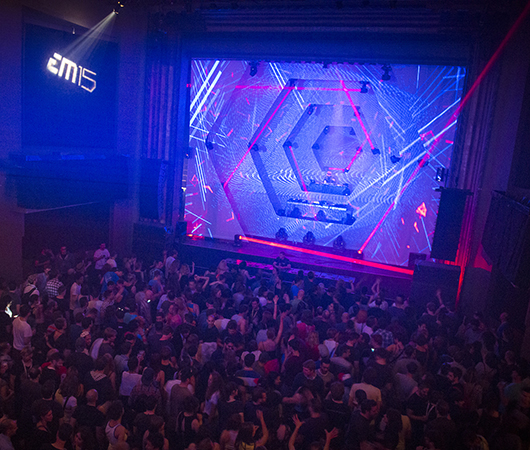
For the past several years, XLR8R has repeatedly declared its affinity for the MUTEK family of festivals. Whether we’re attending the flagship edition in Montreal or one of its spin-offs in another country, MUTEK has proven time and again that it’s one of the finest festival organizations on the planet, at least for those with an interest in forward-thinking electronic and experimental sounds. (It’s worth noting that digital art and technology buffs also attend in droves and have plenty to enjoy at the festival.) Given that, we were once again excited to return to Montreal last week, as MUTEK was celebrating its 15th anniversary with an extra-large affair. In fact, this time around, it wasn’t even called MUTEK, as the festival had joined forces with another long-running Montreal event, the more experimentally inclined Elektra, to present something new—EM15. Headquarted in Montreal’s Museé d’Art Contemporain (Contemporary Art Museum), this year’s festivities were arguably bigger than ever; at the same time, most of the week’s events still managed to maintain a decidedly intimate feel. After 15 years, it’s pretty clear that MUTEK’s organizers know what they’re doing, and in honor of their efforts, we’ve catalogued the 15 best bits from the week gone by.
1. Montreal (at least in the summertime) is glorious.
Technically, EM15 probably can’t take credit for the various merits of its host city, but being in Montreal was an absolutely intrinsic part of the festival experience. Where most festivals these days pen thousands of attendees into sprawling spaces, often on the outskirts of a city or in the middle of nowhere, EM15 took place right in the center of downtown Montreal. (The majority of the festivities were at the Museé d’Art Contemporain, but EM15’s other venues were all just a short walk away.) Furthermore, while the week’s schedule had a large volume of artists and activities on offer, the fact that EM15 was spread over six days and nights often meant that attendees had plenty of down time, and that freedom to pop in and out meant that skipping one particular show or set—or even a handful of them—didn’t leave one feeling like they had missed out on a significant chunk of the festival.
More importantly, one could argue that the only people who truly “missed out” on something during EM15 were those who didn’t take the time to explore Montreal. Granted, the weather wasn’t exactly cooperating early in the week, but as the sun slowly emerged and eventually kept on shining, Montreal’s gleaming appeal became more and more apparent. Basically, whether one is leisurely hanging out in a cafe, biking through a sunny park, or gorging on a late-night poutine, it’s hard not to fall in love with the place. Somehow, Montreal manages to be pretty, relaxed, welcoming, fashionable, modern, and full of good food, all without the air of pretension that often permeates cultural hotspots. And while the city would have been like this whether EM15 was happening or not, it speaks to Montreal’s unique character that a relatively niche festival like MUTEK could thrive here for so long.
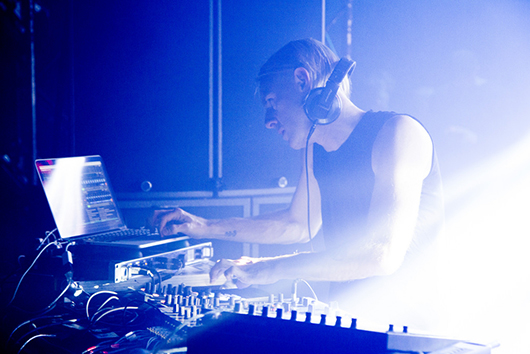
Richie Hawtin
2. Many of the week’s “big” names were just okay. It didn’t matter.
For the average person, or even the average music fan, the EM15 line-up didn’t feature much in the way of star power. Although more than 100 acts took part, only a handful of truly “big” names stood out, including Richie Hawtin, Ricardo Villalobos, and Matthew Dear (who performed as Audion). And on the whole, these guys all did, well, pretty much exactly what we expected.
Hawtin actually performed twice, beginning on Wednesday with one of his free outdoor dotUP shows. Put on in collaboration with Red Bull Music Academy on the esplanade next to the Museé d’Art Contemporain, the late afternoon/early evening event was certainly packed, but Hawtin’s minimal approach honestly sounded a bit flat and lifeless in the open air. However, he fared better the next night, when he brought a version of his Ibiza-based ENTER. club night to Montreal’s long-running Métropolis theater, which actually played host to several of EM15’s bigger shows throughout the week. Though he programmed a diverse line-up across two rooms that also included TM404, Marc Houle, and the ambient stylings of his brother Matthew, Hawtin himself was clearly the main attraction, and his stripped-down techno aesthetic felt more lively on the booming Métropolis soundsystem. Even the visuals, which centered around ENTER.’s ubiquitous dot logo, were engaging. The night wasn’t heavy on “wow” moments, but Hawtin still came to EM15 and did what he does; those in attendance ate it up.
The same could be said for Ricardo Villalobos, who also performed twice, albeit in two drastically different ways. Thursday found him teaming up with Max Loderbauer for one of the festival’s audio-visual A/Visions shows; we actually missed that performance—though we were told it was rather ambient and explorative in nature—but we did manage to catch a bit of Villalobos on Saturday night, when he headlined a Métropolis show of his own. The theater’s main dancefloor was absolutely stuffed when he went on, and while we can’t say that we enjoyed his on-stage preening or his predilection for endlessly looping bits of techno, the crowd appeared thrilled with just about everything he did. It seems that this sort of DJ worship has become fairly standard when Villalobos is involved, and though his set may not have been one of our personal highlights, we have little doubt that plenty of punters went home raving about how amazing he was.
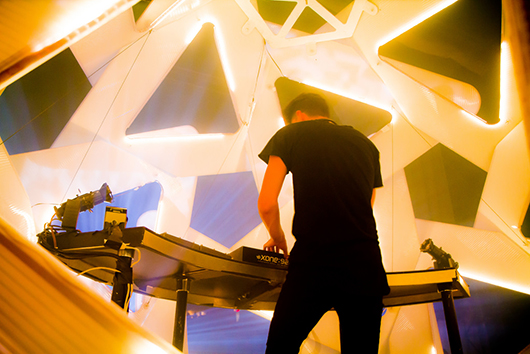
Audion: SUBVERTICL (photos by Diego Cupolo)
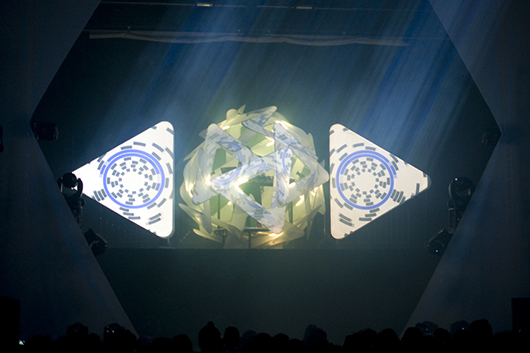
In contrast, it didn’t seem that the Canadian premiere of Matthew Dear’s new SUBVERTICL show as Audion left many people particularly happy. Featuring a video-mapped, geometric stage design that was put together by the same team behind Amon Tobin’s much-hyped ISAM show, SUBVERTICL didn’t feel particularly innovative; if anything, it looked more like Dear’s attempt at making something palatable for the EDM festival generation. Even the music felt like generic, big-room techno, as opposed to the raw, snarling sounds that made Audion such an exciting project when it first appeared a decade ago.
At this point, it might be easy to infer that we were disappointed in the top tier of EM15’s line-up. In all honesty though, all of these artists were absolutely fine; perhaps we wanted something better from Audion, but on the whole, none of these acts were offensively bad. In essence, they all did exactly what they were expected to do. Even if their sounds or shows weren’t the most innovative, engaging, or entertaining, the wider appeal of these acts undoubtedly played a role in enabling the festival organizers to fill the week with all sorts of cutting-edge programming. If a few hours of festival techno was the price for making that happen, we were more than happy to pay the cost.
3. We were worried about Nicolas Jaar’s five-hour set, but we were wrong. He was absolutely triumphant.
Heading into EM15, Nicolas Jaar was another one of the festival’s major acts, but the announcement that he would be putting together a special five-hour, improvised set to close out the festival on Sunday night at the Museé d’Art Contemporain left us concerned. Few artists would have the courage—some might say the ego—to take on a performance of that length, yet Jaar has long been someone who strives to create something unique. His EM15 performance was billed as a continuation of his From Scratch series, in which he creates elongated and entirely improvised sets with the assistance of several collaborators; leading up to the festival, the concept was intriguing, but the danger of Jaar conjuring up something that was ultimately a giant exercise in self-indulgence felt very real.
However, as it turned out, we were wrong. Very wrong. Arriving about halfway through his five-hour session—and apparently missing a rather noodly beginning—we found Jaar and his team perched on a stage in the center of the Nocturne room, playing in the round. Jaar himself operated an Ableton set-up, a turntable (which he often used to sample and loop records on the fly), and some other devices, and he was primarily assisted on stage by a multi-instrumentalist who hopped between piano, synth, and saxophone, along with a large array of FX pedals. Also on stage was what appeared to be a sound engineer, as was Dutch audiovisual artist Tarik Barri, who directed a dazzling array of swirling imagery around the room, though his work was primarily projected onto a large screen that was suspended from the ceiling over the stage. A female vocalist also floated in and out of the proceedings, and Jaar crew was rounded out by a contemporary dancer, who intermittently did her thing on another stage at the far end of the room.
While the dancer perhaps felt somewhat superfluous, that was truly our only gripe with Jaar’s performance, as the two-and-a-half hours we witnessed were absolutely spellbinding. The set didn’t feature proper “songs” per se, but it did unfold in movements; often stretching for 20 or 30 minutes in length, they usually began with a patch of ambient noise or a sample looped from Jaar’s stack of vinyl. From there, the young artist and his compatriots would gradually build upon the track, layering additional sounds and swelling the intensity levels. Eventually, bits of percussion would enter the mix, and once a proper 4/4 kick was added to the sprawling, bubbling mass of sound, the room—which, it should be noted, was limited to only a couple of hundred people—would explode in elation. Throughout it all, Jaar kept his cool, calmly directing traffic and masterfully applying the concept of tension and release. Furthermore, he touched on countless genres over the course of the performance, and seemed equally comfortable with them all; his take on acid-laced techno was just as engrossing as his jazzy, saxophone-laden soundtrack music. Admittedly, people have been singing Jaar’s praises for years now, and his interest in improvised music is nothing new either, but EM15 was nonetheless a place where one could easily see that Jaar had truly come into his own. On Sunday night, he was confident, he had a focused vision, and, most importantly, he offered up some very fine music.
Ben Frost (photo by Caroline Hayeur)
4. Ben Frost was the second-best thing we saw all week.
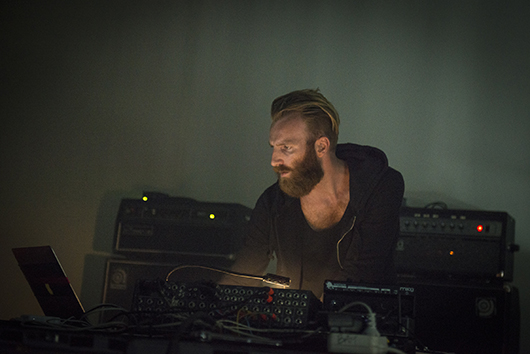
Up until Sunday night, we were telling everyone that Australian-born, Iceland-based Ben Frost‘s show was the best thing we saw all week. In the end, Nicolas Jaar swooped in at the last minute to grab the top spot, but we should be clear that there was absolutely nothing wrong with Frost’s headlining set on Thursday night’s Nocturne bill at the Museé d’Art Contemporain. Fresh off the release of his new album, A U R O R A, Frost actually delivered what was easily one of the most intense—and riveting—performances of the week. Flanked by two drummers on either end of the stage, he unleashed a brawny, percussion-heavy assault that married his fuzzy melodics with a sort of heavy-metal aesthetic; amazingly, it worked. Without being too reductive, the show was something like Lightning Bolt crossed with Tim Hecker; equally punishing and soothing, the music was also incredibly loud, which only added to the power of the performance. There was something restorative about being enveloped by Frost’s sonic storm, and when the show came to an end in the early hours of Friday morning, it was apparent that much of the crowd left the room feeling absolutely invigorated.
Tim Hecker (photo by Caroline Hayeur)
5. Napping has never sounded so good.
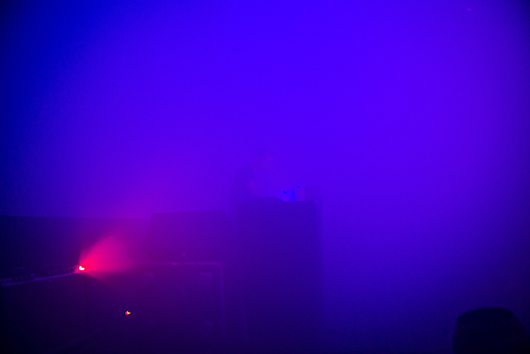
Throughout the week, a certain phrase—or some version of it—could be heard from attendees again and again: “I fell asleep.” Normally, this would be a terrible sign for a festival, as putting people to sleep is rarely touted as an indicator of success. But in the case of EM15, most of the people who mentioned this phenomenon were absolutely delighted, as many of the week’s performances were specifically designed to be thoughtful, serene experiences. During the first few days of the festival, the Salle BWR at the Museé d’Art Contemporain was ground zero for these sedate sounds, beginning with Tim Hecker‘s “Fog Works” performances on Tuesday night. The Montreal native and noted noise manipulator has long been a MUTEK regular, so it came as little surprise that he was tapped to anchor EM15’s opening night with two shows. However, his methods were anything but the usual, as “Fog Works” proved to be a quite literal title; Hecker actually filled the Salle BWR with fog, to the point where those in attendance could only see a few feet in front of their faces. Hecker himself was completely obscured, and only some sparse lights, which varied in intensity over the course of the show, added any sort of visual stimulation. Given that, most attendees simply sat or laid down on the floor, and subsequently allowed Hecker’s waves of sound to wash over them. Being in that room was akin to being in some kind of sensory deprivation chamber, and as the show proceeded, it was easy to feel separated from one’s own body. As such, nodding off—and even hallucinating a bit—was par for the course, and the effects were only heightened by the music’s absorptive nature. In truth, “Fog Works” was less a concert and more of an “experience,” though that was truly nothing to complain about.
Less immersive but similarly enjoyable were a couple of performances the following night in the Salle BWR. We caught the tail end of Brooklyn’s Jonas Reinhardt, who presented his recent album Ganymeade and its accompanying experimental film. The room was once again filled with patient listeners sprawled out across the floor, and the soft, distortion-laced soundscapes lulled the crowd into a blissful state. The number of catatonic festivalgoers only increased when Neel came on next, as the Italian producer dialed things down further while delivering an expansive ambient set. All across the room, eyes grew heavy and people made themselves cozy as he played, but the rapturous applause at the completion of his set indicated that nobody was unhappy with the evening’s somnambulant vibe.
Jonas Reinhardt (photo by Caroline Hayeur)
6. Breakcore might be back, and Lee Bannon could be its king.
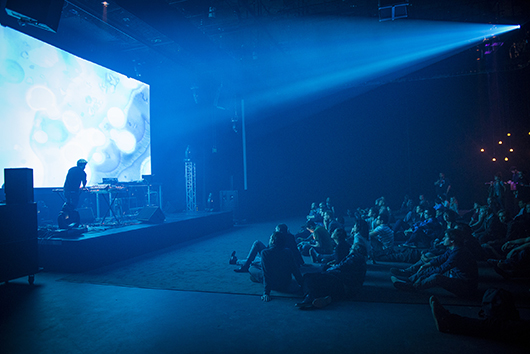
XLR8R has devoted a lot of attention to Lee Bannon over the past year, much of it commenting on the Brooklyn producer’s prowess with old-school jungle and drum & bass rhythms. However, after seeing Bannon perform on Saturday night at the Museé d’Art Contemporain, another genre descriptor came to mind: breakcore. Make no mistake, jungle and drum & bass are both key elements of Bannon’s sound, but watching him play brought to mind the late-’90s/early-’00s heyday of Kid606. Whether it’s the highly sample-intensive nature of the music being presented—as far as we can tell, Bannon was looping classic drum & bass riffs, not creating his own—or the music’s glitchy, stop-and-start presentation, the performance felt a lot more like Tigerbeat6 than Metalheadz. This felt especially true when Bannon irreverently dropped in his own takes on old-school anthems like Aphex Twin’s “Windowlicker” and Adam F’s “Circles.” Nevertheless, this observation isn’t meant as a critique; in truth, there was something absolutely refreshing about Bannon and his hyperactive jungle rhythms. After a week full of well-mannered techno and thoughtful experimental fare, his raucous sounds provided a genuine change of pace, and it was hard not to notice that more than a few people in the crowds threw up their gun hands in response.
Shackleton (photo by Caroline Hayeur)
7. Nobody sounds like Shackleton. This is a good thing.
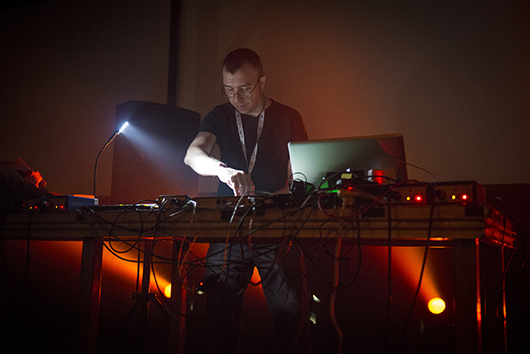
Following the recent cancellation of his US tour dates due to visa issues, it was a relief that Shackleton was still able to cross the Atlantic and come perform at EM15. Headlining Wednesday night’s Nocturne bill at the Museé d’Art Contemporain, Shackleton offered up his usual routine, which is increasingly becoming impossible to describe. In recent years, the Skull Disco co-founder has gradually forged a uniquely hybrid sound; although he’s undoubtedly informed by the UK bass continuum, there’s a sort of tribal, even tropical, bent to his rhythms, which have also become more and more unorthodox. When combined with his preference for dark and ominous sounds, Shackleton’s music is something wholly unique. All of these elements were on display at EM15, and though it would be hard to describe what he presented as strictly dance music, the room was unquestionably peppered with adventurous souls who still attempted to dance and flail along. The only drawback was that the Nocturne room could have used a bit more bass weight—this was a problem throughout the week and one of the only repeated complaints about the venue—but the music itself was excellent nonetheless.
Space Dimension Controller (photo by Diego Cupolo)
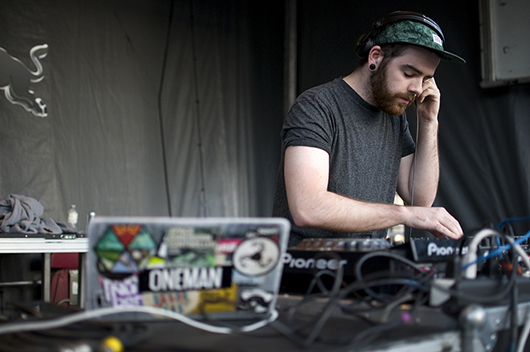
8. Space Dimension Controller was a highly enjoyable surprise.
MUTEK has long had a tradition of leaving a few slots open for surprise guests, and EM15 was no different, as the closing slot at Saturday afternoon/evening’s Expérience 3 event—which ran from 2 to 10 p.m. in the esplanade next to the Museé d’Art Contemporain—was left unannounced until the last minute, at which point Belfast producer Space Dimension Controller showed up to deliver an incredibly fun and light-hearted DJ set. Spinning for two-and-a-half hours, he moved through disco, house, electro, and all of the upbeat areas in between, perking up the crowd considerably in the process. It’s not that those in attendance weren’t having a good time before he arrived; in fact, Montreal’s own Prison Garde, who performed with the assistance of Ango (a regular contributor to the project), presented an impressive live set of melody-streaked house earlier in the afternoon. Still, EM15 had generally been a pretty heady affair up until that point. As such, by the time Saturday had arrived, it was truly invigorating to hear someone drop in with a DJ set that featured a few feelgood anthems that everyone knew. Whether he was playing Todd Terje, Prince, or something from deeper in his crates, Space Dimension Controller was exactly what we needed before another night of serious beats.
Lucrecia Dalt (photo by Diego Cupolo)
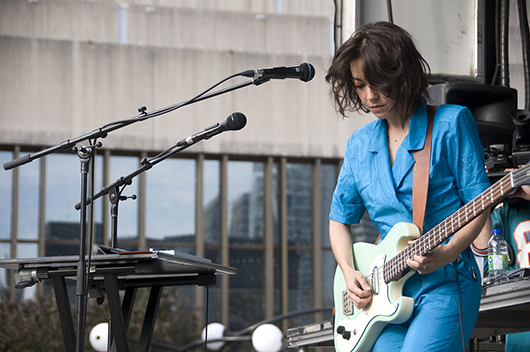
9. Lucrecia Dalt was weird and wonderful.
Throughout the week, EM15 and Red Bull Music Academy teamed up for the Expérience series, which presented free shows each afternoon on the esplanade next to the Museé d’Art Contemporain. As mentioned above, the series played host to Space Dimension Controller and Prison Garde on Saturday—JTC was also on that bill—but a number of talented acts graced the stage earlier in the week. Standout sets included the plinking beatwork of Japan’s Yosi Horikawa and the propulsive sounds of Austrian trio Elektro Guzzi, which ostensibly makes live techno with a traditional bass-drums-guitar rock set-up, but the series’ real revelation was Lucrecia Dalt. The Colombian-born, Berlin-based artist likely would have been served better by a darker, more intimate venue, but her delicate, avant-garde stylings still managed to shine in Thursday’s late-afternoon sun. Armed with a bass and a small array of noise-creating devices, not to mention her subtle, breathy vocals, Dalt’s set presented an engaging counterpoint to a week full of producers stoically perched behind their gear. It’s not that she was playing pop songs, but she did occasionally tread upon pop structures, only to quickly retreat back into an airy sonic expanse. Her music looped and twisted for nearly an hour, bringing to mind shades of artists like Grouper, Julia Holter, and Julianna Barwick, but Dalt’s music was arguably weirder and more unconventional—it was certainly less linear and less tied to traditional notions of songwriting. Comparisons aside, it was an excellent session of music, and one that has us excited to see what Dalt has in store for us in the months and years ahead.
Voices from the Lake (photo by Diego Cupolo)
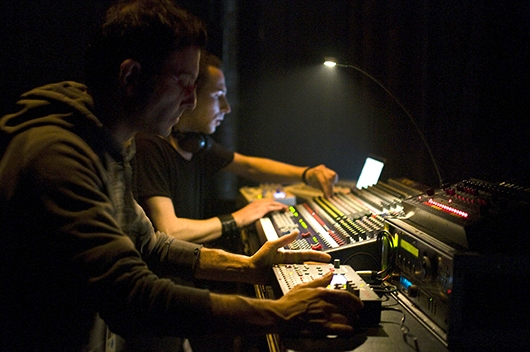
10. Despite some technical snags, Voices from the Lake’s trippy techno sounded great.
Voices from the Lake was tasked with opening up Friday’s festivites at Métropolis, which had filled up especially early that night. The Italian duo of Donato Dozzy and Neel is still riding high off its self-titled LP from 2012, not to mention its recent single for The Bunker New York, and there was a palatable level of anticipation amongst EM15 attendees to see the pair in action. At first, some technical issues threatened to derail the party, as the visibly upset duo actually had to stop the music entirely about 45 minutes into the proceedings. However, from that point on, things went smoothly as the pair set about unspooling its washy, loosely psychedelic techno over the course of the next hour. With two veteran acts at the helm, the sound quality alone was impressive, as was the enveloping nature of the music. As it turned out, it was arguably the night’s best set, and our only regret was that it came to an end before midnight.
Heatsick (photo by Caroline Hayeur)
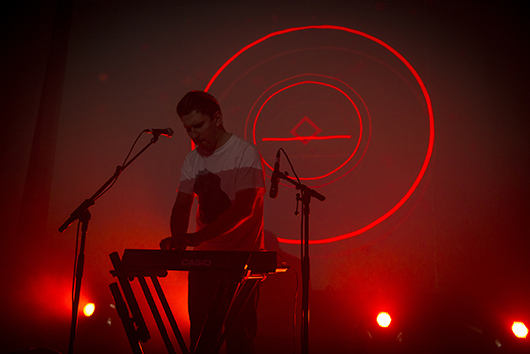
11. Heatsick can do amazing things with an old Casio.
Later on Friday night, the Nocturne line-up at the Museé d’Art Contemporain was headlined by Heatsick. The Berlin-based PAN affiliate is known for his rudimentary set-up, and sure enough, he came to EM15 with just an old Casio keyboard and a few pedals. It would be easy for a project like this to delve into kitsch and general silliness, but Heatsick’s set showed a real depth and artistic vision that transcended his limited tools. Though many of the individual sounds were cheap or thin, his knack for live assembly and composition resulted in a session of genuinely compelling house music. Interestingly enough, the vibe was somewhat tropical, probably because he relied upon the Casio’s built-in “samba” setting or some other vaguely Latin sound palette that often came standard in those devices. Furthermore, it was all characterized by a sort of loose swing, likely due to the fact that so much of it was being played by hand; regardless, it lent the music a sort of free-flowing spirit, and kept the dancefloor moving.
Prison Garde (photo by Diego Cupolo)
12. Iron Galaxy’s first live show was impressive.
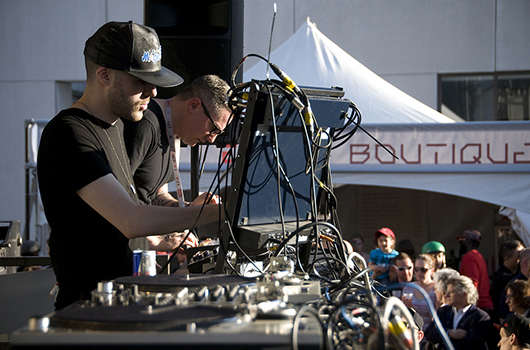
Low-key producer Iron Galaxy has been on our radar for some time as one of Montreal’s hidden talents—he was the subject of one of our Bubblin’ Up profiles last year—and Saturday night found the project debuting its live show for the very first time. Producer Adam Hodgins was at the helm, but he enlisted fellow Montreal artists Dave Shaw and Francis Latreille to help him man the small fleet of gear on stage at Métropolis. With only an hour to perform and a room that was slow to fill up, the trio’s show initially faced a daunting atmosphere, but Iron Galaxy rose to the challenge, presenting a melodic, synth-driven brand of house—with occasional forays into techno and electro—that sounded great. The trio looked—and sounded—at home on the big stage, and the set brought to mind fellow Montrealer Jacques Greene’s debut live set at MUTEK a few years ago. That was one of our favorite performances back in 2011, and this one was similarly superb.
JTC (photo by Diego Cupolo)
13. Piknic Electronik has exploded.
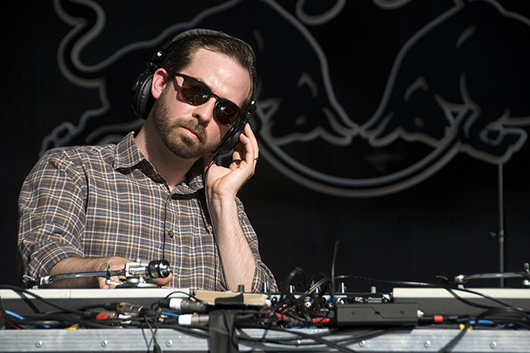
Each year, one of MUTEK’s highlights is Piknic Electronik, a Sunday afternoon, open-air party that takes place on Montreal’s Parc Jean-Drapeau. In truth, Piknic Elektronik is a weekly series that happens every Sunday during the summer in Montreal, but the MUTEK edition always features an especially high-quality line-up curated by the festival’s organizers. EM15 kept the Piknic Electronik tradition alive this year, and presented DJ sets from the likes of Donato Dozzy, Move D (who had also performed the night before alongside Juju & Jordash as Magic Mountain High), Ricardo Villalobos, dubstep veteran Pinch (who had also performed on Saturday night at the festival), and others. Many of the artists even seemed to tailor their music to fit the vibe of a sunny Montreal afternoon, which meant that the Piknic soundtrack was, as always, just about perfect.
Still, there was something noticeably different about the EM15 Piknic—it was insanely crowded. Apparently, the 2014 season of Piknic has been greeted with sudden spike in popularity, and attendance has skyrocketed. While this meant that the party was especially popping, it also resulted in some unexpected growing pains, including some absurdly long lines and what could only be described as a worrisome number of “party bros” (and whatever the female equivalent of a “party bro” is called) in the crowd. Let’s put it this way—never before has a MUTEK-related event been attended by so many musclehead dudes in fluorescent tank tops. That being said, we should be clear that regardless of the higher-than-usual “bro” quotient at this year’s Piknic, it was undoubtedly a fun afternoon and one of the festival’s highlights. Sure, there may have been more squealing girls and cheeseball dudes in the audience than we expected, but they ultimately did little to detract from the high-quality tunes and the park’s idyllic surroundings.
Archie Pelago (photo by Caroline Hayeur)
14. EM15 presented a real abundance of quality acts.
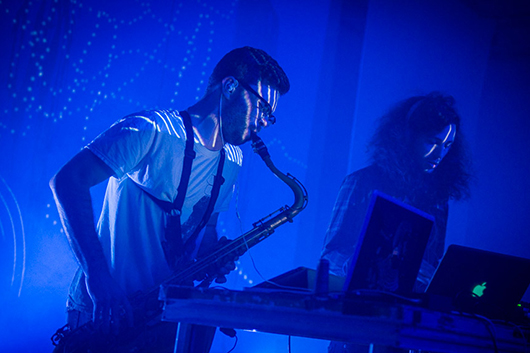
Although we won’t go into detail about each and every set we witnessed throughout the week, the collection of artists assembled for EM15 was rather impressive to behold, especially now that the festival has concluded. Apart from the folks we’ve already mentioned, the festivities included performances from Oneohtrix Point Never, Archie Pelago, Holly Herndon, Max Cooper, Egyptrixx, Marc Houle, Kangding Ray, Mike Shannon, Robert Henke, Rashad Becker, Tom Trago, The Mole, and literally dozens of others. EM15 may not have been for everyone, but there’s no denying that those names alone offer quite a variety of sounds—at least within the electronic spectrum—and the festival deserves a lot of credit for bringing them all together in a remarkably cohesive fashion.
15. At EM15, even the most elaborate festivities felt personal.
After six days and nights at a festival, it would be normal to feel absolutely exhausted, but as we sit now, we honestly feel just fine, and that’s a credit to EM15’s organizers. On the whole, this year’s festivities were incredibly large in scope; even if one discounts all of the lectures, panel discussions, exhibitions, and daytime performances, there were several evenings when EM15 had four or five different rooms going simultaneously across multiple venues. At the same time, apart from the surprisingly stuffed Piknic Elektronik and Saturday night’s Ricardo Villalobos set at Métropolis, the festival felt rather, well, relaxed. And no, that’s not a clever way of saying that EM15 wasn’t well attended; on the contrary, even the week’s lower-profile events seemed to attract a decent crowd. It’s just that the crowds were never larger than they needed to be; more importantly, they were by and large populated by died-in-the-wool fans of the music being presented.
After 15 years in the game, the MUTEK organizers know their audience, and it’s safe to assume that their partners from Elektra know theirs. As such, EM15 was planned in such a way that attendees would not only be entertained, but would be able to experience the week’s plethora of music and activities in a way that was both comfortable and optimized presentation without sacrificing comfort. MUTEK has always put a premium on production, even when doing so is expensive or impractical. As such, the sound at EM15 was generally excellent. As expected, the visual element was always attended to as well, whether it was lighting or stage design or something more elaborate. EM15 wasn’t about making money, or putting on an ostentatious event; it was painstakingly designed to present an authentic, singular experience for those in attendance, and in that sense, the festival was an unqualified success.