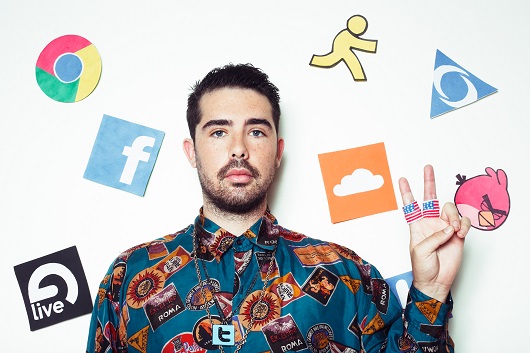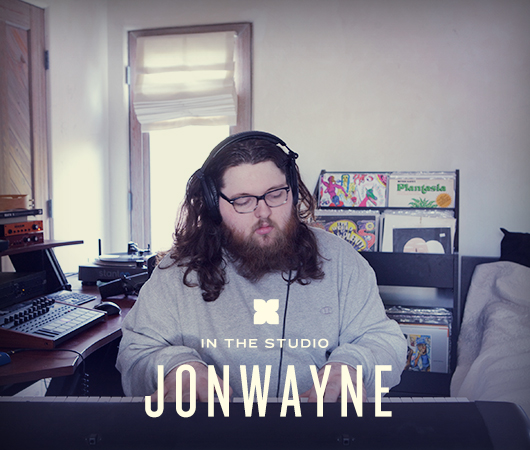

Hailed as one of Low End Theory’s second generation of producers, Jonwayne has proven himself to be a multifaceted talent over the past few years, gaining recognition as a beatmaker with records like 2011’s Bowser and, more recently, demonstrating his skills as an MC across his three-part Cassette mixtape series for Stones Throw. Earlier this month, Jonwayne’s proper debut rap album—the appropriately titled Rap Album One—landed via the label, marking the latest chapter in the SoCal native’s prolific and increasingly unique path as an artist. Catching him in his bedroom studio just off a fall tour alongside Mount Kimbie (the tour bus for which still had some of his gear on it, explaining why his studio is currently without monitors), we chatted with the young producer and outspoken FL Studio user about working on his album at Stones Throw’s in-house studio, mixing with Daddy Kev, and the importance of being comfortable in one’s own creative space.


Your current studio space is in your house in La Habra, but you worked on most of Rap Album One at a studio you helped put together at the Stones Throw office. What was the reason for that?
I started working at the label office to utilize their space and regain my momentum in terms of recording. At that point, recording at home was not an ideal situation, so I slowly built a studio in the office and was making the record as we were assembling the studio together. It was an experimental process in terms of trying to keep things consistent, and it actually wasn’t the best situation. Some of the songs were recorded during the more primal stages of the studio, so they sounded much different than what I was working on towards the end of the process.
What kind of consistency issues did you come across?
When we started in one of the rooms, it was just too big, so the acoustics were really off. There was a lot of stuff hanging on the walls—stuff with plastic and things like that—which wasn’t good because there were a lot of refracting substances, so recording vocals in that room was pretty difficult. Then we moved into a smaller room, and put in an acoustic treatment halfway through the record, so the vocal takes from that point on were a lot cleaner and nicer.


Was there something in particular that you found helpful about not working from your bedroom?
Yeah, that was something I really hadn’t been able to do until that point. I think just being in a certain room changes the vibe completely. It’s the relationship you have with a room that makes you come up with certain types of music. There’s an energy that you settle into and which makes you part of it, and that definitely has an effect on what you make.
You and Daddy Kev mixed the record together. How did that come about?
The record was done [being recorded] and I went to him—he had been out of town for a while, so I didn’t expect him to do anything with it—but I knew that he knew people in the business, so I said, “Hey man, I’m having trouble mixing this record, if you know anybody that could work with me on it, that’d be great.” He actually offered to help me with it, and I of course definitely took him up on that.


Did you guys work on it together at the Stones Throw studio?
We actually mixed the record at Cosmic Zoo, a studio he opened above his offices in LA. I sat down with him over the course of a couple months and brought him the naked stems of the record, and then we worked to piece the record back together again the way I had heard it [in my head]. So, I had to sit there and give him a lot of direction. The nature of how we worked together was a really smooth process—he always knew what I was talking about and I was always able to get my thoughts across to him. That is really what makes a good engineer: a person who is able to take someone else’s vision and know how to apply and achieve it in a practical way.
How did you approach mixing the vocals on the record?
The way that the vocals were recorded and the beats were made, we decided to have a lot of presence and dryness to the vocals, which is not necessarily something that is done in a lot of rap records. But we wanted the vocals to be sort of the sonic centerpiece of the album and we wanted them to be as present as the drums and bass would normally be. To do that, we left a lot of the mids in the vocal—it just helped them maintain that presence.


Was that sound the result of a decision you both made or something the nature of the sounds you recorded sort of led to?
That’s how the tracks sounded when I brought them to him, and I wanted to keep that vibe, so we ended up keeping that same sonic idea, but doing it with his gear—which is much better than mine.
Was that a good learning process, watching and helping Daddy Kev mix your record?
Yeah, I mean, I’m always learning from Kev. He’s taught me a lot over the years, and he’s a sound nerd like I am, so when he’s around somebody who is actually eager to learn the process and gain some knowledge, he is always excited to share. Every time I’m working with him, I learn something.


When did you first start using FL Studio, and is it still the main software you work with?
When I got Fruity Loops, it was sort of the entry point for people who wanted to fuck around and make beats. Initially, when I first got FL, I don’t think there was Ableton—or at least, if there was, it wasn’t very widely known or hadn’t reached the stage of usability that it has now. I’ve just always used FL, and—for better or worse—I’ve stuck with it and learned the entire program like the back of my hand and now it just doesn’t make much sense for me to go to another program. I’m sure if I spent as much time in Reason or Cubase or Logic or Ableton, I’d feel that same way about those programs, but it seems funny that a lot of producers now are sort of “coming out” as FL Studio users. There are people that have always repped that shit; I think Hudson Mohawke has always repped it, and Rustie—there are a lot of key producers that have always used it. Especially with trap production—I know Lex Luger uses Fruity Loops, and a lot of his production style stems from the way FL Studio is put together in terms of the grid and the speedy side tricks that you can use in the program. That really helped build the sound for that kind of music, so I think a lot of people are starting to get into FL now because of that, which is cool. I’ve been trying to get people to use FL forever—the more the merrier.
It seems a lot of people have the impression that FL is mostly used to make beats, but you use it as a full-fledged DAW to record, sample, mix, and everything?
Everything I do, I do in FL—record vocals, put together mixes, master tracks—it does everything I need to do. It’s like a clean slate. It’s pretty wide open, as far as what it is capable of.


You use the 404 extensively live. Is it also a big part of your production process?
I use it live, just because I don’t really need to do anything to the backing tracks on stage, and it’s very portable and I can carry it with me. It’s proven itself to be very convenient, time and time again. I actually don’t really use it in the studio anymore unless I’m trying to change the pace. Even then, I don’t use it in conjunction with FL Studio. I use it if I need a more portable set-up or if I just have a bunch of records on me, or sometimes I’ll record something onto my phone and then sample that into the 404. But it’s really just a fun alternative for me now, rather than something I use seriously anymore. I still make a lot of cool beats on it, but I don’t really put them out because I want to be careful about not oversaturating or overindulging people that want to listen to my music—I don’t want to drown them in the things I’m putting out. So I have a lot of music in reserve that’s made in alternative ways, and maybe it will come out, maybe it won’t.
Does that approach apply to most of the hardware in your studio—using the pieces as a means to spark ideas, which you then record and manipulate on the computer?
A lot of the hardware stuff I use in conjunction with FL. I sometimes program drums on the MPC, or chop up a sample on the MPC because it feels more natural. It’s all there because I like to approach every song differently, so whatever strikes inspiration, I’ll use. I really don’t have a method.


After finishing Rap Album One and moving your studio into this room, have there been any particular pieces of gear or themes in your music that you’ve gravitated towards?
Well, when I first moved in here, I made the third mixtape, [Cassette 3,] and I made that in about a month in this room. I feel a lot of positive and creative energy in this room, and when I get the chance to work in here, there aren’t really any blocks; it’s a very unadulterated [workflow]. I make a lot of beats in here, kind of bare-bones stuff. I imagine I’ll have to go somewhere else if I want to flesh something out, because the way I work in this room is that I’ll have so many ideas that I’ll start something and then pretty quickly jump to something else. I haven’t really fleshed out too many songs in here at this point.
Still, it’s fair to say that a lot of your music is not necessarily bare bones, but definitely efficient and to the point. Is that something you consciously work towards while making beats, maintaining a sort of minimal aesthetic?
Well, I always work on something until it’s done, and sometimes maybe that’s only three or four elements. To me, some of the best music consists of only three, four, or five elements, and I really try to pick elements that are going to work and stand up for themselves. I feel like as long as you choose your parts carefully, they’ll do their job and you don’t need any leftover stuff. I feel like a lot of people aren’t confident in what they are putting into their music, so they try to hide that by putting 99 different things into a song. There are definitely a lot of people that can do that successfully too, but the way I’ve gone about it over the years, I just seem to end up making things that are more minimal.

When you work on new beats, are you always producing with a vocal in mind?
Most of the music I make nowadays is for vocals. The notion of making instrumental music doesn’t entice me anymore. Maybe it will in the future, but at this point right now, it doesn’t. I’m really not making stuff just to play out. I’m making beats to utilize in my own music, which is very vocally based at this point. That’s just kind of where I’m at.