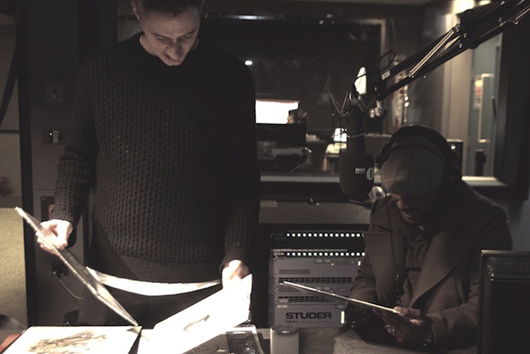
Iconic LA beatmaker Madlib appeared on Benji B’s BBC Radio 1 program last night, during which he talked with the host about his Quasimoto alter ego, his friend and collaborator J Dilla, what’s next up for his Madvillain project with DOOM, and more. The producer also dropped an hour-long mix of dusty beats, unreleased cuts, and rarities “you will never hear again.” For a limited time, Madlib’s special mix can be streamed via the BBC player embedded below, under which the SoundCloud player for his interview is also available. All of the images, audio, and info from Benji B’s time spent in the studio with Madlib can be found here.
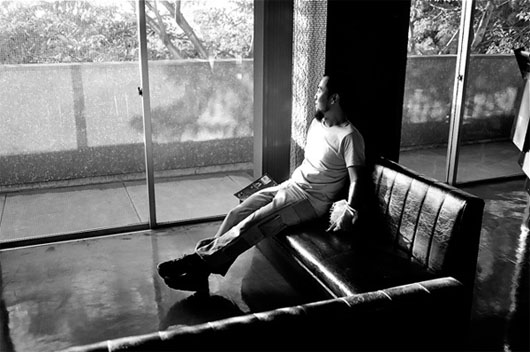
The dizzyingly active PAN label has announced plans to close out its prolific 2013 run with two new LPs, one from Japanese experimenter NHK’Koyxen (pictured above) and Athenian sound collagist Jar Moff. Both landing on December 15, NHK’Koyxen will deliver the third and final installment in his ongoing Dance Classics series, while Moff’s Financial Glam LP will serve as a follow up to his Commercial Mouth album that was released via PAN earlier in the year. Based on their descriptions, these two records could not be more different, as NHK’Koyxen’s Dance Classics Vol. III is said to “[focus] more on bass/base electronics, music for the dancefloor and/or altered state reflection.” On the other hand, Moff’s sophomore record is intended as a reflection on the current flux and tension present in the artist’s home city of Athens, using “intricately composed collage works, constructed from hundreds of archived samples” to explore this theme across two elongated compositions. Before both records close out PAN’s year halfway through next month, their respective artwork and tracklists are included below.
LA techno aficionado Silent Servant (a.k.a. Juan Mendez) has a new single on the way as part of the Jealous God series, an ongoing project jointly curated by his fellow ex-Sandwell District affiliates. The third edition of Jealous God will feature Mendez’s “Lust Abandon” track (originally only available on a limited cassette release), a never-before-released remix of the tune by forward-thinking London producer Powell, and an eclectic mix CD by Boston’s DJ Ning Nong. Previews of the two productions set to appear on Jealous God 03 when it drops on November 20 can be found below. (via Juno Plus)
Over the past few years, Matthewdavid’s Leaving Records label has come to be characterized not only by the hazy, at times psychedelic quality of its releases, but also by its ability to incorporate a growing number of unclassifiable genres into its tape-rendered catalog. With that in mind, the label’s latest release from somewhat mysterious producer/vocalist Jitwam feels right at home. EP track “Rightaboutnow” serves as a fine showcase for Jitwam’s refracted take on soul, using a slouching beat made of sharp-cut samples, subtle guitars, and re-pitched hiss to serve as the bed for the man’s helium-lifted falsetto vocals. Landing somewhere between the sound of Gonjasufi and just the kind of intriguing weirdness which keeps Leaving Records a consistently intriguing outlet, Jitwam’s eccentric TJD001 EP is available now as a cassette and on limited vinyl direct from Jitwam’s own The Jazz Diaries imprint, here.
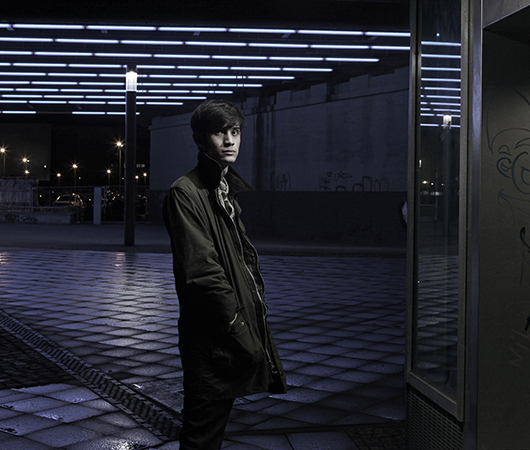
Much like its title implies, “Flash Alert” popped up out of seemingly nowhere late yesterday as the brand-new collaboration from Night Slugs co-owner L-Vis 1990 (pictured above) and Barcelona up-and-comer Sinjin Hawke. The tune itself is an intricately detailed, churning slice of hyperreal club music, but what’s equally captivating and potentially more surreal are the impeccably rendered visuals which come with the music. Following soon after the release of Sinjin Hawke’s collaboration with Morri$, this is the latest piece to appear under the Fractal Fantasy banner, with visual artist Cyberlight once again providing the glossy, CGI video. L-Vis 1990 & Sinjin Hawke’s “Flash Alert”—which premiered over on Dis—can be experienced below.
XLR8R Couldn't find the embed function for type: "vimeo" and source: "<iframe src="//player.vimeo.com/video/79264470?title=0&byline=0&portrait=0&color=ffffff" width="530" height="298" frameborder="0" webkitallowfullscreen="" mozallowfullscreen="" allowfullscreen=""></iframe>".
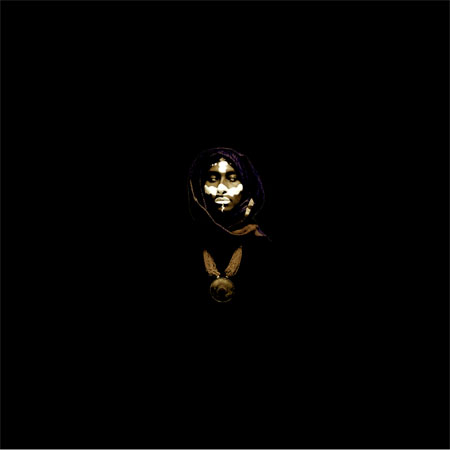
Software—the Mexican Summer imprint founded by Daniel Lopatin (a.k.a. Oneohtrix Point Never)—has announced a new addition to its roster, Denver-based tunesmith Thug Entrancer, who will release his Death After Life LP for the label early next year. Shaping minimal cuts of step-sequenced acid and experimental electronics using purely analog means, Thug Entrancer coaxes dark, primordial sounds from his gear with only a few choice elements at hand. The artwork and tracklist for Death After Life can be perused below, along with a stream of album cut “Death After Life IV”; the LP’s official release is set for February 11, 2014.
1. Death After Life I 2. Death After Life II 3. Death After Life III 4. Death After Life IV 5. Death After Life V 6. Death After Life VI 7. Death After Life VII 8. Death After Life VIII 9. Ready To Live Pt. 1 (Bonus Track) 10. Ready To Live Pt. 2 (Bonus Track)
Though he’s only released a handful of 12″s, Objekt (a.k.a. TJ Hertz) is an artist who’s garnered an impressive level of respect over the past few years, particularly amongst his peers. On the one hand, this is due to the fact that the Berlin-based techno producer makes great tunes; his self-titled, white-label releases caused quite a stir when they dropped in 2011, and 2012’s “Cactus” b/w “Porcupine” record for the venerable Hessle Audio admirably flipped dubstep on its head while offering something truly unique. Still, the strength of Objekt’s music goes beyond his ability to innovate; his tracks also sound impeccable. Some of this engineering prowess can undoubtedly be linked to his time working at Native Instuments as a developer/programmer, but it’s also clear that Hertz employs an intense level of attention to detail. Next week, he’ll be releasing Objekt #3, a two-track outing that marks the reignition of his white-label series. As expected, the tunes sound great, so we figured that we’d ask Hertz to share a bit of his production knowledge with our audience. What follows are five nuanced, practical, and thorough pieces of advice that should help make any producer’s tunes sound better.
Monitoring level makes a difference.
Everything sounds better loud. There are a number of legitimate reasons for this—the frequency response of your ear changes depending on the listening volume, as well as the dynamic response (your auditory system acts almost like a compressor at high volumes)—but a common result is that producers tend to monitor louder and louder over the course of a session, thinking their track is sounding better and better, or they cut out the bullshit and monitor at an earsplitting volume from the very beginning. While it is important to know how your productions will sound at different volume levels (especially if you’re producing music destined for club play), listening at a relatively low volume is a far, far more critical test of how your mixdown is sounding than seeing how hard it bangs when you turn it up. Just about anything will bang if you turn it up. I’ve noticed that late-night sessions at a punishing volume (which I’m totally feeling at the time) tend to be the ones where I’ll revisit the project the next day and think it sounds like total shit. The bottom line is that it’s very easy to subconsciously compensate for a track sounding “not quite there” by turning up the volume, and in my opinion, this is a bad practice to get into.
Be strict when it comes to gain staging.
Sensible gain staging—setting an appropriate signal level at each point in the signal chain—is very important, but there are two separate issues here. The first is that it’s very important to maintain the same perceived level at every point in an FX chain. Put simply, when you bypass any plug-in, the perceived volume level should remain the same. This relates to my point about monitoring volume above and is critically important because it’s the only way you can fairly assess whether the effect/compressor/EQ you just inserted is really improving the sound of the channel, or whether it’s just making it louder. If, for example, when you bypass the compressor, the perceived volume drops by 6 dB (or even 1 dB—it makes a difference), then of course you’ll think your kick sounds more banging when it’s compressed. But if you set the output level of your compressor properly, you might realize that actually the compression is squashing all the life out of the input signal, and the only reason it sounded “better” was because the compressor was boosting the output volume.
The second thing is that in general it’s a good idea to run your DAW’s signal chain at around -12 to 0 dB (pre-fader). There’s a ton of misinformation out there about why this is the case—digital clipping, for example, is not really something you have to worry about in any modern DAW as long as you’re not clipping the outputs or inputs of your audio interface. Nonetheless, it’s still good practice to keep your signal levels modest, largely because it keeps your session tidier and allows you to better see where you’re at on the meters (which are most informative when they’re not redlining, duh). The same principle applies to analog mixers too (although there’s a tradeoff here against raising the noise floor, so usually you’d run the meters hotter on an analog desk). Moreover, certain mixers behave differently when it comes to soloing channels—my Tascam, for example, bypasses the master fader when a solo is active, meaning that if you’re running all the channels too hot and compensating by pulling the master fader down, then you get an artificially loud level when you want to audition a particular channel. To me, that’s one more reason to keep the master fader at 0 dB while keeping all the channels at sensible levels.
Never start tweaking without having an A/B comparison ready.
We’ve all been there: you decide that your drums need some reworking and set about trying to make them punchier and fatter and happier and more productive or whatever. At first you know what to do—the kick needs a little more attack, the snare is too thin, whatever, so you fix that. And lo, now the kick doth cut and the snare doth punch. But then you keep tweaking. And tweaking. And three hours later, you’ve changed pretty much every parameter in every FX chain and you think everything probably (might?) sounds better than when you started, but you’re not sure. So you listen to your last bounce and lo and behold, it turns out you’ve made it sound worse than before. Or, worse still, you didn’t Save As before you started tweaking, and now you don’t even remember how it sounded before at all.
Adjusting mixdowns like this is an incremental process and it’s incredibly difficult to keep sight of where you started and where you want to go when you’re listening to the same sound for literally hours on end. It’s therefore incredibly important, whenever you embark on such a tweaking odyssey, to save a new version of your project, bounce the track (or better still, the solo part) how it currently sounds, load this bounced track into a dry channel in your DAW (careful not to have it running through any plugins on the master bus) and constantly A/B between your new version and the old by soloing the old bounce (at the exact same perceived level, of course—make sure your master level is at 0 dB!). I try to follow this rule religiously when making mixdown adjustments and almost always regret it when I don’t.
Treat your room.
If you ever get the chance to attend a mastering session of one of your own tracks at a reputable mastering studio, do it. Chances are, you’ll hear a ton of obscure frequency peaks and nasties within your mixdown that you never heard at home. Part of this is of course due to the €30000 that the mastering house probably spent on its monitors, but the monitors are actually less important than you might think. Listening to music in a properly acoustically treated room is like looking at a painting wearing the right glasses for the first time: you see things clearly that were simply a blur before. Better monitors can help, but only in the sense that they give you a finer brush with which to paint—a fine brush is no use if you can’t see what you’re painting.
The mixdown is the least important part.
While there is a lot of merit in taking pains to make sure your mixdown is as perfect as can be—especially if you’re producing music for big soundsystems—a tight mixdown will never rescue a mediocre track. I would go so far as to say that the mixdown itself is the least important part of the production process; given great ideas, melodies, arrangement, instrumentation, and flow, a few out-of-whack levels and frequencies won’t actually cripple the end result all that much. If you’re tweaking a mix for hours and struggling to get things sounding right, consider that it might not be the mixdown itself at fault. Don’t be afraid to replace or discard channels or elements that don’t quite fit, no matter how long you spent getting them to where they are.
This Is It Forever—a label helmed by Gavin Miller of the Manchester-based Ghosting Season duo—is set to drop a new EP from Jermainesoul, a somewhat sporadically releasing producer hailing from the UK’s West Midlands. The beginning of “Time Waits,” the title track off Jermainesoul’s forthcoming record (out on November 18), is a bit deceiving. It kicks off in hyper-fast, Autechre-indebted territory as its opening bars fuse together a set of rapid-fire kicks and revolving melodic sequences, but it’s not long before gritty electric piano chords and warmly overdriven pads begin to seep into view, wrapping themselves around the existing jittery patterns to give “Time Waits” a welcome soul-burnt touch.
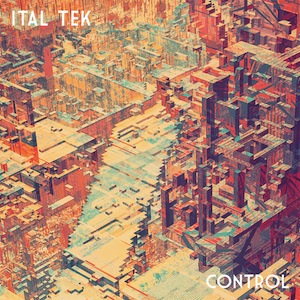
Over the past five years, Planet Mu regular Ital Tek (a.k.a. Alan Myson) has dabbled in genres ranging from bass music to horror-soundtrack-indebted house. Since 2011’s Gonga EP, however, his infatuation with the rapid-fire rhythms of drum & bass have generally been his primary mode of sonic expression. Last year’s Nebula Dance saw the Brighton, UK-based producer fully delving into footwork and jungle, and his new “mini-album,” Control, is a chance to poke at those sounds’ edges. Throughout the EP’s eight tracks, Myson combines 160-bpm percussion and ambient textures while crafting a sleek, 25-minute listening experience. Nevertheless, despite his history of dynamism, Control is more of a refinement than a revolution.
Control is a deceptively dense, often beautiful collection of tracks. The format is a nice vehicle for Ital Tek’s now-unified aesthetic, and no single cut wears out its welcome. The record bursts out of the gate with “Fireflies.” Driven by a tumbling breakbeat and haunted vocal samples, it’s one of the more high-energy tracks on the release. Though the tempo drops for a few bars, it snaps back before the listener can catch their breath. Control‘s title track is a footwork-inspired number with aggressive drum pad work and rubbery synths. It’s the closest Ital Tek gets to club territory on the EP, as the music generally appears to be more concerned with chilly atmospherics than danceability. “Zero” is a prime example, as it employs woozy synths and crystalline chimes while taking a welcome detour toward ambient composition. The standout cut, however, is “Violet,” whose subtle shifts in tone are a pleasure to behold. The track has a new-age quality to it that makes for a transportive and soothing listen, even as its synths are backed by unrelenting snares.
Control does bear traces of footwork, but Ital Tek uses its touchstones and rhythmic architecture to paint a dreamy picture that ultimately transcends the genre. In truth, the EP has more in common with Machinedrum’s recent outings than Chicago-style juke—at least tonally—to the point where comparing Ital Tek to someone like his occasional labelmate DJ Rashad seems a bit silly. While Rashad’s work is full of heavy-hitting left turns and chopped samples, Ital Tek takes potentially anxious elements and smooths them over. Furthermore, his combination of clinical beats and human vocal samples coalesces into a sort of sci-fi quality that never wavers, and it’s fun to hear footwork elements enmesh so easily with Ital Tek’s futurist vision. While Control doesn’t bring many new ideas to the table, it manages to further distill the elements that Myson has been playing with, assembling them in a format that’s compelling from top to bottom. Put simply, Control is a slick exercise that lives up to its title.
Vancouver-based producer Connect_icut creates experimental sound collages that harness glitchy texture and seemingly endless drones for modern compositional aims. “Port Shale”—taken from the artist’s forthcoming LP for Aagoo’s REV. Lab series, Crows & Kittiwakes Wheel & Come Again (out on December 4)—builds on a strobing sample refrain that whirrs along as ripples of piercing feedback ebb and flow at varying depths. Without conventional rhythms or a percussive foundation, Connect_icut’s hypnotic refrain assumes rhythmic duties for the distorted shapes to follow and weave around, resulting in a deliberate piece that keeps to its peculiar logic.