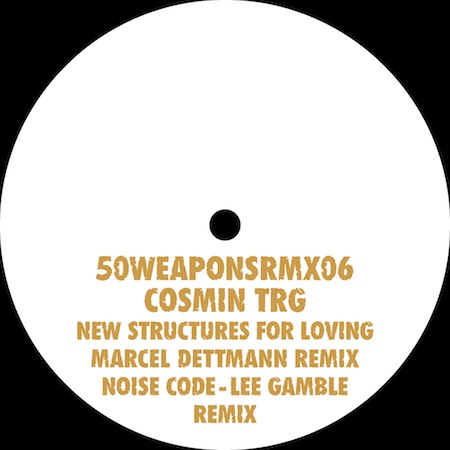
Following his XLR8Rpodcast and the solid Gordian LP from earlier this year, Berlin-based DJ/producer Cosmin TRG has announced that he’ll soon release a 12″ of remixes via Modeselektor’s 50Weapons imprint. The two-track record is set to feature a bubbling version of “New Structures For Loving” by veteran technoist Marcel Dettmann, who recently announced his own sophomore album for Ostgut Ton, with PAN affiliate Lee Gamble‘s Detroit-inspired take on “Noise Code” occupying the b-side. Before Cosmin TRG’s remix 12″ arrives on September 27, its a-side cut can be previewed below.
Last week, XLR8R was invited (along with a crew of 15 other international journalists, radio hosts, and promoters) to attend a seven-day tour of Germany put together by the country’s Initiative Musik organization. A sort of week-long, crash-course introduction to Germany’s contemporary cultural and musical movements, the trip stopped off in Cologne, Düsseldorf, Berlin, and Hamburg—four of the country’s major metropolitan centers—with the aim of giving the program’s participants an overview of those cities’ cultural climates while also illuminating pockets of underground scenes less familiar to those who live beyond Germany’s border. After a week’s worth of cultural absorption, discussion, and—let’s be honest here—a lot of German beer, XLR8R left with a new appreciation and understanding of Germany’s cultural and musical landscape; with the aid of hindsight, reflection, and a few days to recover from our jetlag, we’ve distilled our experiences down to the five most poignant realizations we had during our seven days in Germany.
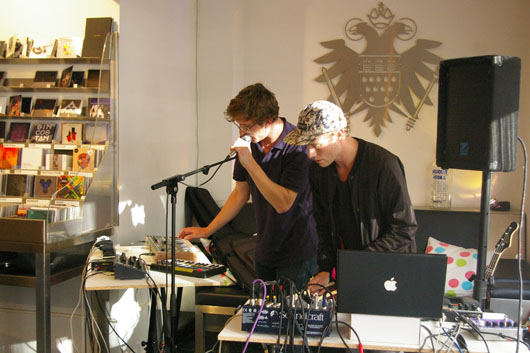
Coma performing at Kompakt
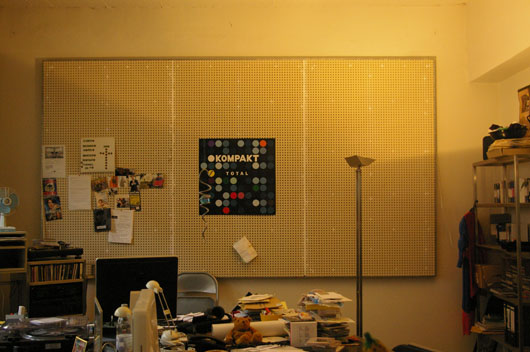
Kompakt is a model of what independent record labels can accomplish. The tour’s first stop was in Cologne (alternately spelled “Köln” in its native language), Germany’s fourth-largest city and a hub for professional and commercial media organizations, most notably RTL, the country’s largest private broadcaster. Over the past few decades, the city has also proven to be a successful breeding ground for art and music, not the least of which has seen Cologne serve as home to the legendary Kompakt record label. In the midst of celebrating its 20th anniversary, Kompakt is an imprint that has diligently built a substantial catalog and reputation in the techno and electronic-music world despite its humble beginnings as simply a record store (originally under the name Delirium).
On the day of our visit, Kompakt co-owner Reinhard Voigt gave us a tour of the label’s current brick-and-mortar facility—a building which now incorporates a record store, the label’s and agency’s offices, physical media storage facilities (i.e. records and CDs), and a number of production studios. Furthermore, the top floor of Kompakt HQ is almost entirely dedicated to being a space to enjoy a meal or conversation with coworkers and visitors, boasting a full kitchen and chefs preparing meals during the weekdays. Clearly, an emphasis on creating a “community” or “family” within the label has been a major focus, and by housing many of the company’s arms under one roof, a constant crossing of ideas and duties is possible.
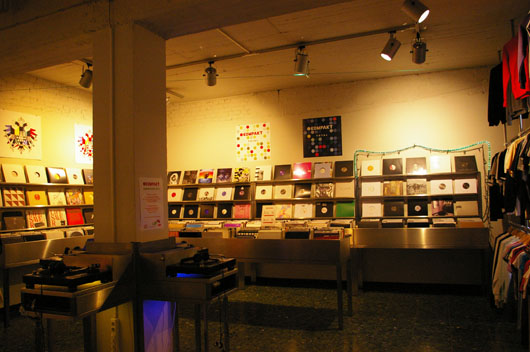
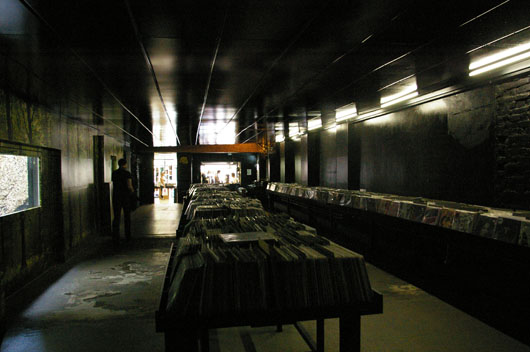
Top: Kompakt’s record store; Bottom: Kompakt’s office
Similar to the design aesthetic that has marked Kompakt’s records over the years, the imprint’s facilities also emphasize a clean and crisp design. The record store in particular is bright and inviting while also being incredibly spacious—much more so than the usual cramped-between-the-crates vinyl shop—and impeccably organized. In seeing what Kompakt has built with its success, one is able to find clues as to what has likely led to it. Two decades after its founding, and with some incredibly pioneering and successful records in its catalog, Kompakt is still very much an organization that recognizes the importance of the people who make it up. Whether its the artists who make the music, the staff that helps accomplish the necessary tasks, or the customers and fans who support the imprint, all are given a comfortable and enjoyable space to exist within the facility. All in all, Kompakt’s Cologne headquarters serve as an inspiring holy ground for those who have grown up with the label or simply watched it become a staple for international electronic music over the years.
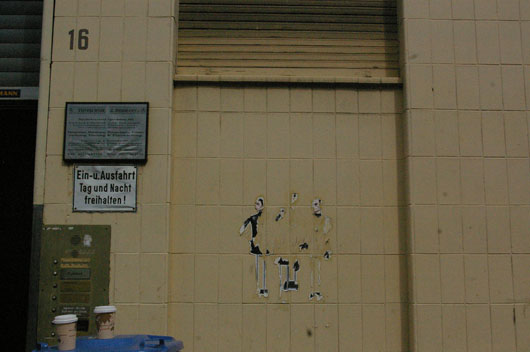
Düsseldorf’s music scene should not go overlooked. The capital city of Germany’s North Rhine-Westphalia state, Düsseldorf, is widely known for its contributions to the fine-art world, thanks in large part to the city’s renowned Kunstakademie Düsseldorf arts academy. In the field of modern music though, Düsseldorf is likely best known for being the place where pioneering electronic outfit Kraftwerk formed and, later, Krautrock innovators Neu! (a group, for those who aren’t aware, formed by musicians Klaus Dinger and Michael Rother after their split from Kraftwerk in the early ’70s). As such, our tour of the city began outside what was Kraftwerk’s Kling Klang studios. Located in one of the bleaker parts of the city, all that currently commemorates Kling Klang is a deteriorating wheatpaste image of the quartet, apparently placed onto the dusty yellow wall by a renegade street artist.
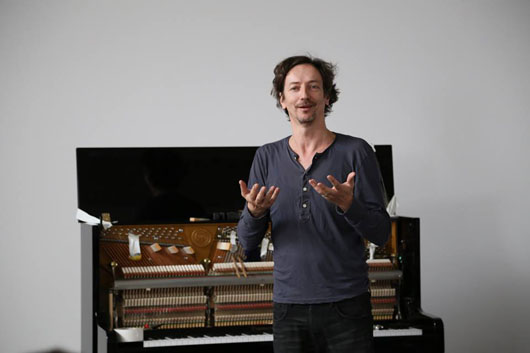
Top: The outside of Kling Klang Studio; Bottom: Hauschka (photo by Jinesop Lee)
In the end, this is not a complete loss, as Kraftwerk, and Neu! for that matter, are certainly not outfits which have gone underappreciated in the long run. But the looming stature of these groups may currently overshadow the new wave of creative music coming from Düsseldorf. Led by the work of adventurous pianist and producer Hauschka, the city’s emerging crop of musical endeavors partially prides itself on bucking the more predictable dancefloor trends of its German counterparts, namely Cologne and Berlin. Gathered in Salon des Amateurs (referred to by our tour guide, an extensively knowledgeable hometown journalist, as the “living room” of the city’s scene) on a Tuesday night, much of Düsseldorf’s music community accompanied us touring journalists for a performance by a local duo consisting of veteran electronic musician Stefan Schneider and percussionist Sven Kacirek and a particularly adventurous DJ set which soundtracked the many informal introductions of the night. Our particular conversations led us to discover the music of Krautrock-indebted, synth-obsessed trio Stabil Elite, micro-piano manipulators Grandbrothers, and local labels such as the vinyl-only Themes for Great Cities and the longstanding Level imprint. Is there a musical revolution brewing is Düsseldorf? No, probably not, but there is surely a wealth of quality, adventurous music that deserves a closer look.
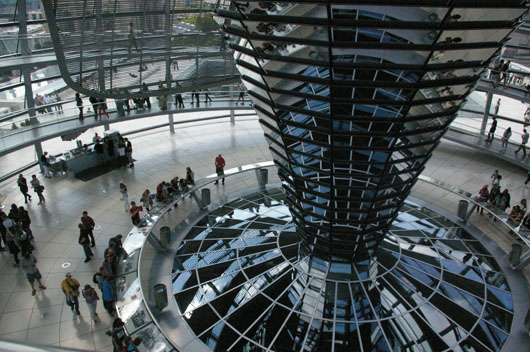
The inside of the German Reichstag building
Berlin is thriving. Our German tour only allowed for two days in Berlin, a city whose reputation as a bustling haven of music and culture has been spreading far and wide for some time now. In truth, 48 hours is not nearly enough time to come anywhere close to grasping the entire scope of Germany’s capital city and its overflow of clubs, creative outlets, and immense history. Still, it seems safe to say that Berlin is a modern metropolis that is culturally thriving on a scale unparalleled by most current cities. Of course, Berlin’s club scene has been regarded as one of the highest quality; venues such as Berghain/Panorama Bar, Tresor, Weekend, and Watergate have gained international notoriety, but there is also a seemingly endless amount of clubs whose reputations may not reach as far but who similarly strive to present well-curated programs and unique atmospheres. When compared with the status quo in the US, the regulations surrounding alcohol consumption, noise, and opening and closing times placed on these clubs are refreshingly lax, and when combined with the amount of options one has in terms of nightlife, it makes Berlin an unbelievably rewarding playground for those seeking genuine quality in their clubbing experiences.
But Berlin’s club scene is not the only thing worth noting, as many of the city’s other facets are equally thriving. Beyond clubs and dance music, the entire Berlin music industry appears to be growing exponentially, and the amount of street art and public projects underway suggest the same for the city’s visual-art scene as well. During our limited time in Berlin, what really stuck out to us was this idea that any empty building, vacant lot, or underused parcel of space could become, well, just about anything else. As we jaunted around Berlin’s Kreuzberg neighborhood—one of the “hipper” parts of town, though not one currently immune to the growing reach of gentrification—we visited the Paloma Bar and Schneiders Laden gear store, each of which had been opened inside what was formerly a rundown housing project. There was also the Festaal Krezbuerg club and event space (sadly, now severely damaged due to a recent fire), which repurposed an old Turkish music hall, and Club XXXX, an open-air venue that was recently opened along a thin strip of land next to the Spree River and populated with artsy furniture pieces and intriguingly inviting corners. These places were all different, but what tied them together was the notion that one’s vision is the only limitation to turning a forgotten space into something new and exciting.
Top and Middle: Inside Schneiders Laden; Bottom: Spacehall record shop
Needless to say, our sampling of Berlin was a small one, but the time we spent there nonetheless still left us with the overpowering impression that the German capital is flourishing at the moment, especially when one considers the plethora of historical buildings, the city’s breathtaking parks, and its active urban landscape, which comes hand in hand with the limitless amount of art and music happening on the ground.
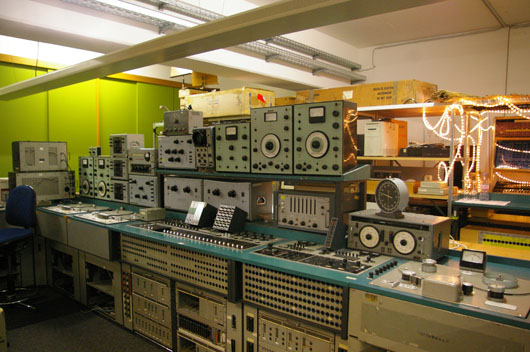
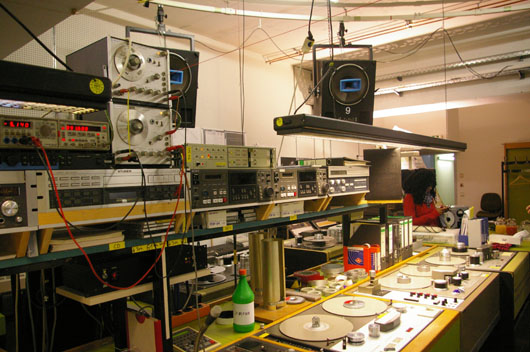
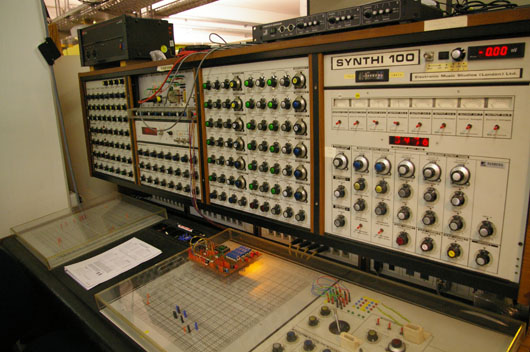
Germany’s electronic music history is worth preserving. Throughout our tour, we had a few opportunities to learn about a number of the historical places and outfits which contributed to the early formative days of German electronic music. The most impressive example was in Cologne, where we visited the Studio für elektronische Musik, a reassembled sound studio that was originally put together in 1953 for Westdeutscher Rundfunk (a.k.a. WDR, the West German Broadcasting Corporation). The place also served as one of the first laboratories for electronic-music production, utilizing tape machines, basic oscillators, and, later, early synthesizers to create electronic compositions. Originally started by Werner Meyer-Eppler, Robert Beyer, and Herbert Eimert, the Studio für elektronische Musik was later used by pioneering composers such as Karlheinz Stockhausen and Gottfried Michael Koenig. Today, the studio has been moved out of its original location to the outskirts of Cologne; most of its equipment is in working order, and we were lucky enough to see a presentation of how the various tape machines and pieces of equipment were used during the facility’s existence to create some of the earliest forms of electronic music.
Inside the Studio für elektronische Musik
While the studio is currently mostly operational, one does wonder if the skills needed to operate and maintain such a place are being passed on to a younger generation. Sure, the techniques used then may be antiquated now—especially in comparison to today’s computer production programs—but there does seem to be a certain value in keeping places like Studio für elektronische Musik available to visit and possibly even use in the future. Given the rapidness with which electronic music evolves, preserving some of the anchors representing its earliest stages is likely a cause worth supporting.
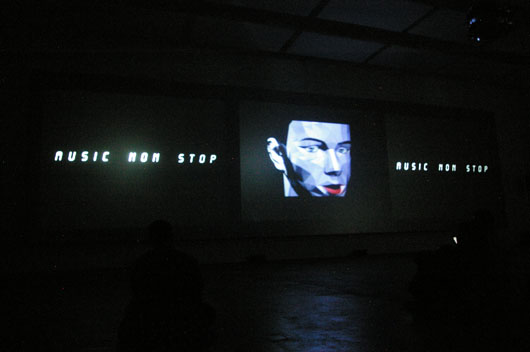
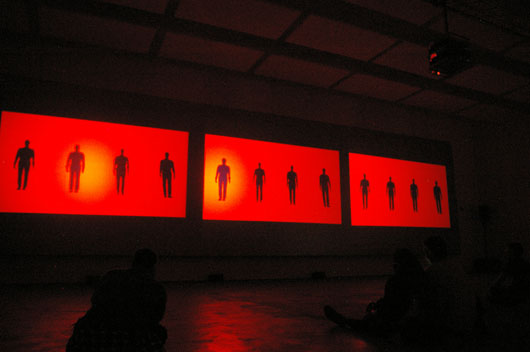
Kraftwerk’s ‘1 2 3 4 5 6 7 8’
Kraftwerk’s 3-D video exhibition is actually pretty amazing. On our final morning in Berlin, the group was invited to watch Kraftwerk’s 3-D video installation, 1 2 3 4 6 7 8, currently housed at the Sprüth Magers gallery. The 90-minute piece—whose title references the eight original albums which make up the group’s retrospective box set The Catalogue—has been adapted from its recent handful of live performances in order to be shown now in this new, more intimate context. While we sat on the floor of the gallery, an array of images flashed across three screens that took up the entire opposite wall; the mixture of animated design graphics and computer-rendered characters and movement accompanyied eight songs perfectly. While the video installation wasn’t without its expectedly cheesy moments (especially the segment for “Autobahn”), being able to experience Kraftwerk’s music in that setting proved unexpectedly enjoyable and entertaining, while also providing a platform to again appreciate the impact of the pioneering outfit’s work on basically the entire spectrum of modern music. Really, it’s hard to think of a group whose music and image better suits a 3-D video installation. 1 2 3 4 6 7 8‘s run at Sprüth Magers is up at the end of this month, but hopefully it will begin making its way around the globe soon.
Brooklyn resident Roberto Carlos Lange has always been something of a shapeshifter. He has released several records of his own carefree and delicate electronic productions, partnered with Julianna Barwick for their collaborative OMBRE project, and worked with fellow restless beatmaker Guillermo Scott Herren (a.k.a. Prefuse 73) in Savath y Savalas. For his upcoming Island Universe Story Two EP, which will be released under the Helado Negro alias on August 27, Lange focuses on his own creative process rather than setting out to achieve any specific goal, describing its creation as one of compiling daily recordings. “Detroit,” a mid-tempo track from the upcoming record, rides a skipping bass melody and playful vocal coos into a soothing, sensual limbo. The song never feels rushed or desperate—almost as if it’s discovering its own structure concurrently with the listener. Furthermore, Lange will be taking Helado Negro out on the road for a tour this fall, the full dates of which can be found after the jump.
Skeptical listeners should be forgiven for pigeonholing South London Ordnance as a UK bass guy. Granted, he is a UK bass guy, but He Do the Police in Different Voices, his latest mini-LP, finds him leaning toward some of his country’s luminary leftfield artists for remix support: Chris Carter, Optimo’s JD Twitch, and a newer face in Factory Floor‘s Nik Colk Void, whose fawned-over band seems predestined to join their ranks. Moreover, the producer brings in help from acts closer to his own genre in the form of Brolin and Femme En Fourrure. Overall, the tracks vary in success, but there is enough variety present to appease practically any contemporary DJ.
On “Black Acre,” with Brolin, South London Ordnance displays his typically pristine sound design, and the rhythm hits straight and rigid. Brolin’s wispy vocal is somewhat swamped by its power, but its dubby undercurrent and four-note pizzicato melody go a long way in furthering its sense of drama anyway. Chris Carter’s remix accentuates the track’s dub aspects, doing away with the vocal and arranging its remaining parts into a murky stepper. What it loses in strict form, it makes up for in its sense of dread. “Modular Splash” doesn’t appear here in its original form, but it’s subject to two remix treatments. Nik Colk Void’s take is almost aggressively minimal; structurally little more than an arpeggio, it’s cut with jarring blasts of interference and eventually ends up developing something resembling a kick drum. JD Twitch’s remix, meanwhile, initially focuses on a malleable bassline; its halted rhythm and stuttering vocal blur together and take the track in a more confusing direction entirely. It’s not exactly aimless, but one can get lost pretty easily. “Floating World” is the best of the originals here. Its elements aren’t particularly unique, but its momentum is smartly deployed, pushing forward even as the mix is intercut with coarse distractions; its thundering, precision-tooled churn reminds of a more rigid Szare. “System” doesn’t fare so well, as its clanking parts, splintery arpeggio, and vocal moans don’t have quite the same exuberance. “Obsidian,” composed with Femme En Fourrure, seems like it might be an atmospheric piece at first, with its smothered pads recalling any number of ambient house productions. It soon moves into bigger rooms, though, with a squeaky main melody bouncing atop a rigid, metallic framework. The EP’s eclectic remixers may endear him to a new set of fans, but South London Ordnance has yet to show much of their influence in his own music.
Following the release of its debut EP last year, Paraguayan DJ/production trio LPZ will return to Brussels Body Work imprint on August 26 to release its five-track Think for Yourself EP. Taken from that record, “Without You” sees the South American outfit recalling the sounds of mid-’90s house, building a groove with classic drum machines, sparse vocal samples, and a powerfully evolving bassline. Even on a cursory listen, it’s quite clear that LPZ has lured its tune away from the sunny, subtropical climate of its home, opting instead to conjure images of South London’s bleak, moonlit streets.
For this edition of Trainwreck, we spoke to NYC DJ/producer Brenmar. He’s been relentlessly touring for the past few years, and has presumably grown accustomed to hopping around from place to place, but on occasion, he still finds himself in dire straits. Here, he details an unnerving travel situation, one fraught with tedious pilot announcements of stormy weather, low jet fuel, an emergency landing, and a down-to-the-wire race to make his first DJ gig in Atlanta, soundtracked by small-town country-music radio.
So I had a show—this happened maybe two-and-a-half, three years ago. It was the first time I was playing Atlanta. The party was called Sloppy Seconds, at a venue called Drunken Unicorn. Really dope party, super fun. It was my first time, and they kind of made a big deal out of it. They were promoting it and had made up this crazy flyer for it—it was gonna be a good show. And this was Atlanta—I love Atlanta music and was excited to go play there for the first time. I had a show in San Francisco the night before, a Friday. So I played San Francisco, the show was cool, and I left the next day to fly out to Atlanta. I had a layover, so I was flying from SF to another city—I think it was Jackson, Mississippi—before going to Atlanta. And I’m already flying from the West Coast to the East Coast—I’m losing hours, basically. So I’m on the flight, everything’s good, whatever, it’s chill. Then at one point the pilot gets on the intercom and announces that there’s bad weather wherever the layover is, and that we’re running a little low on fuel, so we have to kind of chill in the air. So we pull over in—I wanna say it was Knoxville, Tennessee—it was pretty close to Atlanta, but it wasn’t Atlanta. So we pull into Knoxville, and already I’m cutting it kind of close; I was supposed to play at midnight in Atlanta, and I think by then it was 8 p.m. I’m getting a little worried, because not only do we not know how long we’re going to be in Knoxville, but even if I leave Knoxville anytime soon, I’m going to the layover city, I’m not going to Atlanta.
So we’re on the runway for maybe like an hour and a half. It’s definitely past eight, and I start freaking out. I’m texting my booking agent like, “Yo, I’m stuck on the runway here.” And even if we do leave anytime soon, I’m gonna end up stuck in whatever little city the layover is in, because I’m not going to get into that city until after 10, and it’s a small city—I doubt they’re going to have a flight past 10 p.m. going into Atlanta. So we’re trying to figure it out. I’m texting the promoter too trying to let him know the situation. At one point, [the pilot] gets on the mic, because we were on the runway for a while, and I think by law you have to give the option to get off the plane. So they say, “Okay, if anyone wants to get off the plane now you can, but you can’t get back on.” So I’m stuck there and I’m stressing because the show was a big deal, they were promoting it, and I really wanted to play. Plus, I was going to lose money if I didn’t play too, so not only do I miss out on a fun party, but I’m actually going in the red for it.
So I start doing a little math with my booking agent, and he tells me that if I rent a car I can drive from Knoxville to Atlanta, but it’s going to take me three to three-and-a-half hours. So that’s option A, what’s option B? Wait here, and then fly into the other layover city, and then definitely not be able to make it. If I fly into this layover city then I’m probably going to be stuck in this random little town overnight. So I get off the plane and just run to rent a car. Luckily they have a car available. I didn’t even know necessarily if they were going to have any cars to rent, or if I was going to be able to rent any cars at that hour, because it was kind of late and it was fucking Knoxville—a small little city. I don’t specifically remember what kind of car I rented—I know it was all white. It was kind of a weird one; I opted for the cheapest one.
So I call the promoter and I’m like, “Yo, I’m thinking about driving out to the venue.” And he was like, “That would be amazing. We’ll pay for it if you want to do it.” But you know, he wasn’t pressuring me to do it, because it was a three-hour drive, I had just gotten off of a plane, all this shit. I was stressing the whole time. So I rent the car, and the first thing that I notice is that the auxiliary input on the car doesn’t work, so I’m stuck with the radio. I had to buy a car phone charger at some point just to keep my phone alive, just because that was giving me directions to get to Atlanta. I was going to use [the charger] to at least play some music or something, but I couldn’t even manage that. So I was stuck with shitty country music, or just random talk radio, for three hours—I was just racing. I stopped at Subway, was like eating a Subway sandwich while I was racing down the road. My mom calls me, she’s like, “Where are you?” I’m like, “Driving from Knoxville to Atlanta,” and she’s like, “Why?!”
I was updating the promoter as I was going—”Okay, I’m two hours away… hour and a half away”—my phone is literally telling me how long it’s going to take me to get there. But I make it! I get to the fucking venue, I make it to Georgia, I get to Atlanta. I don’t make it there until about 12:50 a.m., and I was supposed to play at 12. So they had Daniel Disaster (from Heroes x Villains), who was going to close the party—he’s like ATL native, he knows the party, he was going to shut it down. I was kind of the new kid on the block. But by default, I ended up closing the party. When I walk into the venue, they’re on the mic, kind of updating the crowd a little bit too—they had been like, “Brenmar’s an hour away!” or whatever. But finally I get there and get up on stage, and people are just handing me bottles of vodka and blunts in the club. I’m just like, taking tokes and I take a couple sips and I get on and I do my thing and shut it down. It was super fun; the show was great. But it was definitely the most effort I’ve ever put into trying to make that set.
And then that was it. I had to be out the next day, and I still had the car, so it was kind of cool, I was driving around ATL and shit. So I made it, I played, I got to play an hour, everyone was into it, and the show was cool. It was stressful, but it was also really nice to get it out. I made it safe and sound, no crazy shit, no speeding tickets.
I’ve been back to that party a couple times, and it’s always been really fun.
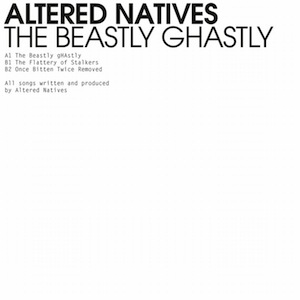
UK house mainstay Altered Natives is set to release a new EP via Manchester imprint Hoya:Hoya next month, marking the first new music we’ve heard from the DJ/producer since last year’s Tenement Yard Vol. 3. Called The Beastly Ghastly, the three-track EP’s a-side is allegedly a “completely unapologetic club banger,” while the two tracks on the flipside offer more experimental fare. The Beastly Ghastly is set to drop as a 12″ on September 9 and digitally on September 16, but before then, the artwork and tracklist is included below.
1. The Beastly gHAstly 2. The Flattery of Stalkers 3. Once Bitten Twice Removed
We haven’t heard so much as a remix from Montreal artist d’Eon this year, but the Hippos in Tanks affiliate broke his silence today when he dropped the fourth Music for Keyboards mixtape as a free download. Named Blackout, the latest volume of d’Eon’s ongoing series—he issued a few of them last year—is described as “music for when electronic sounds will only be imagined and not heard,” or fantasies of “instruments in the physical world.” The whole thing can be downloaded here and streamed via the player below. (via The FADER)
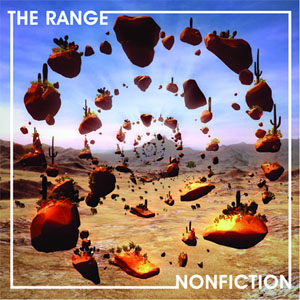
James Hinton (a.k.a. The Range) is a budding talent whose warped, hybridized productions have appeared on our site a handful of times in recent memory. Now, the Rhode Island-based producer has announced the forthcoming release of his debut LP, Nonfiction, which will land this fall via Donky Pitch. The 11-track album is said to further define The Range’s “uniquely crafted musical outlook; a sound that takes in ethereal classical instruments, tough intricate percussion, and thick bass and packs them with melody and emotion.” Before the record sees an official release on October 14, its artwork and tracklist are included below, along with a brief teaser video.
01 Loftmane 02 Everything But 03 The One 04 Jamie 05 Seneca 06 FM Myth 07 Hamiltonian 08 Postie 09 Sad Song 10 Telescope 11 Metal Swing
In its original form, Fryars‘ “Cool Like Me” is a smooth piece of disco-flecked electronic-pop, but in the hands of garage pioneer Todd Edwards, the song is transformed into a considerably more lively affair. Delivering both a traditional remix and a “Dub Remix” of the tune (the latter of which we are offering here), Edwards infuses “Cool Like Me” with an array of jumpy, neon synths and structurally sound house rhythms, yielding a production that is true to its source material and better suited for late-night dancefloors.