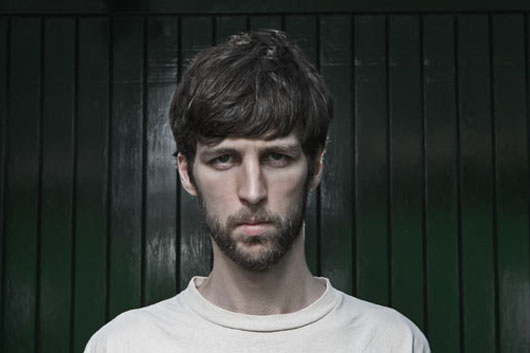
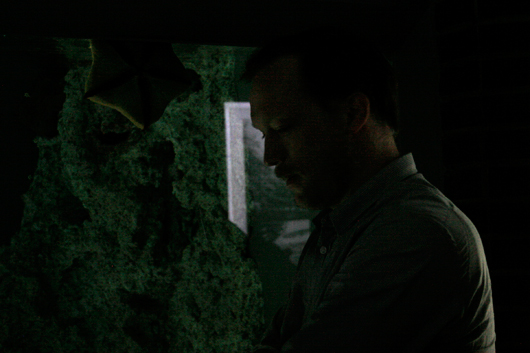
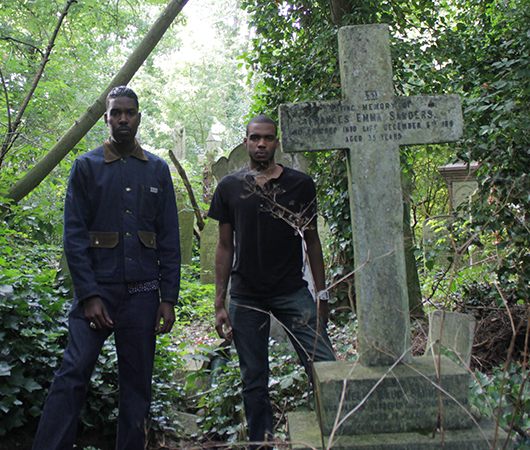
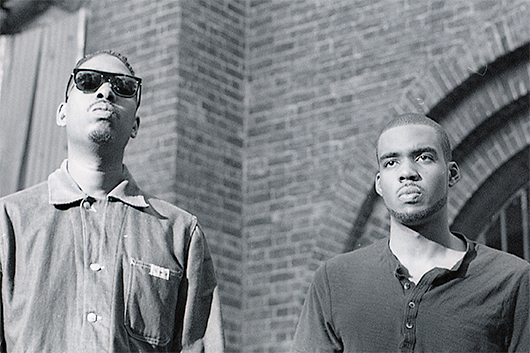
Technically, “Fuckin’ Evil” is the correct way to pronounce FunkinEvil, the collaborative project that connects London and Detroit via producers FunkinEven (a.k.a. Steven Julien) and Kyle Hall. It’s an appropriately explicit moniker for a duo whose output has so far strayed towards the meaner side of modern house. Last year marked the project’s debut with “Night” b/w “Dusk,” a two-track single made up of dirty hardware jams tuned for the late-night underground crowd. This week, the project is releasing the follow-up, “Ignorant” b/w “In the Grid,” a four-track effort that finds the two young producers jumping back into that world. For this installment of B2B, XLR8R contacted the two producers and got them to open up about collaboration, creative processes, and the appeal of nearly trainwrecking while DJing.
XLR8R: How did the FunkinEvil collaboration come about?
Steven Julien: Well, I met Kyle through Sam [Floating Points], and his crew I guess. Because Kyle was friends with Sam before.
Kyle Hall: I met you at the party, at the Deviation party.
SJ: Yeah, but beforehand Sam was talking about you, and Sam was talking about me to you and stuff. And you were into my music and I was into yours. You bought some of my records, right?
KH: Yup, yup. [We met] in a basement or something.
SJ: Yeah! And I was like, “Is that Kyle Hall?” and you was like, “Is that FunkinEven?” and we was like, “Yeah, cool.” And I had a record in my hand at the time, it was “She’s Acid.”
KH: And I was like, “Gimme that shit! This shit’s hot!”
SJ: And then I gave him the record. And I guess the time after that you came to London and you wanted somewhere to crash. I was like, “Crash at my place and we can just hang.” And we did. And then our friendship just grew from that—having barbeques on my rooftop, eating chicken and stuff. And then staying over and eventually we just made music together naturally, as you do.
What’s your creative process when you’re working together?
KH: A little bit different for me because we usually collaborate in [Steven’s] studio. The first time we collaborated, it wasn’t in either of our studios—it was over at our friend Alex’s house. And he just got his MPC and he was like, “Can you show me some stuff on there? You know, you guys both use the MPC.” We started messing around with something and he got around to recording it.
SJ: And we ended up making “Night.” That was the beginning of “Night” and we took the parts and I edited it at my house and gave it a little tweak in the mix, and Kyle said it was cool. And then when we released it and [it was later that] we made “Dusk.”
KH: We were playing [“Night”] for a good few months before it got released. And then we made the other side. That’s how we do it, you know? I think every time we collaborate, it’s still the same general interactions and set-up and process. Like, he hops on the percussion and I’ll hop on a keyboard. And then we’ll just kind of work from there and trade off and it’s all kind of made live anyway.
SJ: It’s always made live in one take or two takes. We glue it together, mix it, and that’s it. Like “Dusk” in particular, that was a long process.
KH: Yeah, that was a lot of trading back and forth of parts and stuff… It first started off as this fun jam session and this whole darkness dusk-’til-dawn thing came afterwards.
What’s the editing process like on something like that?
SJ: Well, that’s my forte… I’m quite experienced editing and arranging tracks. I use Logic; Logic really helps me accomplish that. It’s not really hard, it’s just a matter of having everything sit right. But because most of the stuff is done live, the process is there already.
KH: It’s already there how we want it already.
SJ: It’s just tightening it up.
KH: Yeah, because if the track is wack, there’s no point messing with it anymore.
SJ: It’s there already. So it’s just the icing on the cake really. Just to get it, it’s not much to be thought about.
You guys must have a lot of unfinished material then?
KH: Yeah, we’ve got a few others for sure. There could be some future material.
Does collaborating change your outlook when making music individually?
KH: Uh, I think so with me.
SJ: Yeah, sometimes I make things and I think, “I wonder if Kyle will like this bit.”
KH: Yeah, likewise. And something that we may have done while working together, I might try back at home. Like, I ended up buying that keyboard after we made “Dusk.” I bought that, the DW.
SJ: Yeah, the Korg DW-8000, which is an ’80s polyphonic FM synth. It’s a digital synth that sounds sweet when Kyle plays it! So he decided to buy one for himself.
KH: And that’s what I did, took me a minute though. I got it though. Same thing with the Juno.
SJ: Yep! And yeah, I got a Juno-60 and he bought one too.
KH: Yup, yup. And I’ve been using that on a lot of stuff now too… Anything I do with anybody—it kind of adds something that’s not in my studio repertoire.
SJ: I’m just saying it’s always a learning process no matter what you do.
KH: Always. He might do something in his studio, and I’ll take that same technique or motif and apply it to a different piece of gear, and I’ll get a different outcome. So, for me, it’s kind of like an artistic tradeoff. Like, some methods of how I do stuff—like how I chop up drums, it’s different from how Steve chops up drums. Or how I choose to synchronize my machines as opposed to how he synchronizes his gear. It’s innate learning because we’re different people so we have different preferences in how we do things. So you’re able to take on techniques you wouldn’t otherwise.
SJ: Exactly.
You guys also DJ together as well?
SJ: Yeah, but it’s not like a regular thing.
KH: It’s not a regular act, but we’ve done a few.
How does that work out for you guys? Do you do back to back or individual sets?
SJ: Mostly sets.
KH: Sets.This last one we didn’t play back to back. Playing together is more about vibing off what you heard the last person play. So if he was playing a certain way then it might influence my selections too. But also, we have some of the same music and be into the same things while we’re collaborating—so we get by through bringing complementary elements.
SJ: 60 percent of our sets, we’re going to play the same music. And the other 40 is our individual take on things.
KH: Yeah, it’s the same kind of music, but a different perspective.
SJ: And when we’re playing a proper back-to-back set, we’re vibing each other. We’re like, “Oh shit! I’ve got this new shit to play!”
Does that feedback into your production work as well?
KH: Yeah, it’ll indicate to me the kind of sounds that he’s into producing at that time. He might be into raw shit one minute and then kinda go more into a laidback boogie-disco feel. And then he’d be like, “Okay, let’s lay down some smooth chords. I’m feeling this kind of bassline today.” So, to me it feels pretty relative. Anything either of us is playing is going to influence what we’re musically trying to record.
To go back to the DJ thing, what do you think makes up good DJing?
SJ: Well, what bores me is a set with the same energy [all] the way through and with everything so perfect. I dunno man, I think that’s so boring.
KH: Yeah, he goes straight to what he don’t like. That’s what you think of first, “Well, everything but these things that suck.”
SJ: Yeah, someone with a vibe and a feeling. Not having to concentrate on a laptop screen. Someone vibing out their set and having as good a time as the crowd. Er, this whole beatmatching thing. Sometimes it’s good—not necessarily to trainwreck as such—but it’s good when it can go off any second, and you’re there in real time catching the beat and shit. That’s live. That’s a live element of DJing as opposed to, “Ah shit, you might as well have just hit play on a mixtape you did in your bedroom.”
KH: Yeah, kinda like Jeff Mills. He’s got three of those records and he’s switching back and forth. He’s got three of those motherfuckers.
SJ: You’re DJing like you’re playing a live instrument. That’s using a mixer like a live instrument or a piece of hardware like a drum machine.
KH: Yeah, manipulating that shit is sweet!
SJ: That’s what DJing should be about, but I’m not going to mention names.
KH: I will. [laughs] Fuck him, fuck her, fuck his sister!
SJ: That’s what DJing is about. I never rehearse at home. Half an hour before I go, I pick the records or burn the CDs and just go. And whatever happens at the show happens.
KH: Yeah, just burn the CDs. I’ve been more spontaneous with the music I bring digitally. It’s like, “Nah, I want to have something new this time. Three CDs—let’s go.” Spontaneity and that factor makes it cool too, less planned out.
SJ: And the crowd sees that, that’s what they enjoy, you know?
KH: It’s a stronger reaction when they see you’re surprised too. Like, “Aw yeah, this shit is in!” And you’re right with ’em. That’s what makes it fun. Sets can get monotonous at a certain point, they can get boring. It’s just like, you go through the motions after a while if you know everything you’re playing. It’s good to just trade things in and out.
What constitutes a good party from an artist’s perspective?
KH: A good party is a good soundsystem. That’s my first thing.
SJ: Number one, good soundsystem.
KH: But there are good parties without good soundsystems, but there has to be a certain element of outside charm. There has to be something particular to it.
SJ: If it doesn’t have a good soundsystem, it has to be like a 70 or 100 people max capacity. If you’re going to have a big room with a shit soundsystem, that party is going to be wack no matter what you do. If it’s a shit soundsystem, it has to be a shit bar somewhere in Europe or some shit or wherever with just like 70 people drinking, having a good time. It’s a vibe.
KH: Vibe, that’s the difference. It’s either got the vibe or the soundsystem. Like good soundsystem or good vibe and an okay soundsystem. But it’s gotta be something.
You guys make pretty raw music, what do you think of the current move towards more abrasive forms in house?
SJ: We make raw music but we make sweet music at the same time. Like “Dusk” is sweet. It’s the shit you listen to at dusk or dawn, it’s a beautiful thing. I dunno, on our next release there’s a double a-side and there’s a song called “In the Grid,” and that’s sweet as hell. It’s not always rough: it’s rough with the smooth. There are always two sides to everyone. It’s not raw all the time—we have a nice side and an evil side and a good side.
And then the name. Why FunkinEvil?
KH: It was like KMFH and FunkinEven. It’s really FuckinEven. This shit is raw and has a certain edge to it, so it’s evil. So really, it’s FuckinEvil, but I didn’t want to be so vulgar. So we wrote FunkinEvil. But you pronounce it FuckinEvil.
SJ: Yeah, that’s the real way to say it.
KH: FuckinEvil.