Witness, the weekly party in Scotland’s capital city of Edinburgh, is still going strong, and is celebrating this week with the release of its second free EP. Featuring a diverse group of new talent, the EP resides mostly in the 130-140 bpm range and is, unsurprisingly, engineered for the dancefloor. Atticus Jacks‘ “Potential” track is a particularly wound-up slice of energetic house which splits the difference between Addison Groove and Jacques Greene. A tight kick drum pattern and some offset cymbals intersect with a syncopated cowbell throughout the production—eventually, a thick bassline fills out the remaining frequencies and samples of a preacher pair with a smattering of resonant arpeggios to reach a very deserved climax. The rest of the Witness crew’s EP can be downloaded for free, after the jump.
Stood next to recent waves of pounding, rugged techno, Peter Van Hoesen‘s productions only seem more poised with time. Of course, the Belgian producer doesn’t actually feature on any of the three 12″s in the Receiver series, on which six of his peers contribute remixes of tracks from last year’s Perceiver album. Still, even the lesser pieces here have something of Van Hoesen’s style; on his tracks, influences from Michigan and European minimalism rub shoulders with coarse rhythms, placed into a kind of throbbing, specifically Low Countries framework (the producer has spoken at length about the influence of Belgian new beat on his work). Van Hoesen enacts a fine balance between the studio and the warehouse, and this gives the Receiver contributors—who represent some of nuanced techno’s finest—a lot to work with.
The first edition pairs Sigha and Donato Dozzy. Sigha’s remix of “Attack on the Reality Principle” is tightly wound; a randomized metal stab pattern cuts through steady kicks and groaning noise, giving an impression of development when really it’s just maneuvering about the space. On the flip, Dozzy gives “Attribute 39” a beatless makeover. Spoiler alert: it’s the best track of the entire series. The Italian producer lends it a sublime, soaring quality that’s comparable with the best shoegaze records, and its total transformation exemplifies the possibilities of thinking outside the rigid techno box. On part two, SCB lets his progressive tendencies take hold of the bassline on “Seven, Green and Black.” While rattling percussion keeps the piece slightly trippy, it has a clear build-and-release formula with bigger floors in mind. Ø [Phase]‘s remix of “To Alter a Vector” is similarly functional, but more minimalist, inserting overdriven synthesizer into a sticky, hammering rhythm. Part three is neither as pretty as the first nor as functional as the second, but its remixes offer idiosyncrasy to compensate. In Marcel Fengler‘s hands, “Inspection in Solitude” becomes quite cranky; presenting a contrast to the industrial iron of many of the artists here, the track’s frantically modulating elements take on the aura of bright plastic. It’s still a factory, but maybe a toy factory. Dozzy associate Neel caps off the series with a sterling, spacious take on “Objects from the Past.” Amid a generally foggy backdrop, the producer deploys needling, delayed stabs, which drift, trancelike, about the mix. In tracing their movement, one gets a good idea of why such tracks were once called “headfuck techno.” A year on, Van Hoesen’s material is still very much ripe for interpretation.
My East-Ford Soul is the chosen moniker of a currently anonymous newcomer to the London production scene. Having recently relocated from the south of the UK to the country’s capital city, the fresh artist is short on information, but with tracks like “Circumduct”—the man’s self-released debut single (artwork above)—in his arsenal, it may not be such a bad idea to just let the music speak for itself. During his production, My East-Ford Soul places delicate melodies atop a crisply swung, garage-indebted beat, filling the stereo field out with gushy layers of reverberant chords. No word yet on what else may be down the line for this budding talent, but, for now, “Circumduct” should give us plenty to sink our teeth into.
Sampha is likely best known as SBTRKT’s stagemate and—for all intents and purposes—being a guest star on the masked producer’s 2011 breakout self-titled LP. In addition, the London vocalist/producer has successfully partnered with Jessie Ware, served as half of Short Stories alongside Koreless, and has even worked with Canadian mega-rapper Drake. In the wake of all of these high-profile collaborations, Sampha has been left with a tall task while stepping out on his own. Dual is his debut solo EP, and though it may not exactly be a triumph, its two brief sketches and four complete tracks go a long way toward establishing Sampha as a unique talent outside the shadows of his past partnerships.
A solo Sampha record surely has been imminent for some time, especially following the success of SBTRKT’s debut LP and the months of well-received touring that followed. Those who had hoped or anticipated that the resulting effort would resemble some sort of SBTRKT 2.0 will be disappointed by this EP. That said, this divergence actually serves Sampha well; on Dual, he sounds uninterested in attempting to link to any of his past projects, even sounding like a producer who’s still in search of his own individual stamp. While this proves to be refreshing, it does leave the EP without a strong sense of cohesiveness beyond Sampha’s propensity for rich chord progressions and—of course—the familiar sound of his dense harmonic vocal layers. The record’s demo-like sketches, “Demons” and “Hesitant Oath,” are odd, albeit brief, sidesteps, while the piano-kissed swirl of “Beneath the Tree” and almost entirely acapella closer “Can’t Get Close” are pleasant, ornate productions that nonetheless feel lacking.
Where Dual truly hits its stride is on “Without” and “Indecision,” two songs that effortlessly tap into the sort of potent honesty and irresistible melodic structures which made songs like SBTRKT’s “Hold On” and Sampha’s Jessie Ware collaboration, “Valentine,” such memorable listens. Still, these productions are entirely Sampha’s own, with the former taking shape as a percussion-filled excursion into woozy R&B, and the latter as a drumless, piano-drenched ode to correcting mistakes—a song which remains buoyant thanks to the bouncing rhythm of its soulful chords and the EP’s most entrancing refrain, “Let it all work out.”
Dual may have its hiccups, but there’s little question that Sampha’s talents are indeed worthwhile, even when they’re being presented on their own.
Kieran Hebden (a.k.a. Four Tet) has remixed the title track from Canadian indie band Diana‘s forthcoming debut album for Jagjaguwar, Perpetual Surrender, and is offering his production as a free download. Hebden’s extended version, which clocks in at just over seven minutes, expertly places a skittish beat underneath chopped-up vocals, before allowing the untouched vocal track from Diana’s singer Carmen Elle to emerge in the track’s second half. Four Tet’s remix is available to stream and download—for the price of an email address—below.
Earlier today, we posted a video of Detroit-based producer Shigeto performing a live version his new “Detroit Part 1” single, filmed as part of Into the Woods‘ Car Sick series. Now, another track from the artist’s forthcomingNo Better Time Than Now LP has been made available to stream in full. “Olivia” stands as a nice contrast to the more involved, ambling “Detroit Part 1,” as it instead worms its way into the listener’s subconscious through blissful, soft-focus ambient soundscapes. Before No Better Time Than Now drops on August 20 via Ghostly, “Olivia” can be heard below.
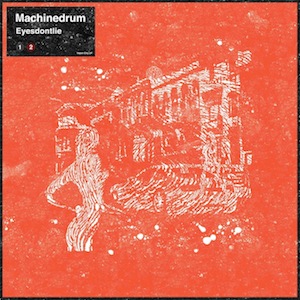
In retrospect, with its creative blend of footwork rhythms, atmospheric synths, and broken jungle beats, Room(s), the 2011 album from Travis Stewart (a.k.a Machinedrum), was something of a breakthrough moment. Not only did it act as a refreshed statement of intent from Stewart, but its higher tempos and classic-rave-minded undertones went some way towards setting the tone for much of the underground dance music that would follow in the subsequent two years. Since its release, these key characteristics have become relatively common fare; the rough-edged sounds of hardcore are having an undoubtable nostalgic resurgence, and juke and jungle rhythms continue to crop up in clubs with increasing frequency. As such, having recently signed a four-album deal with Ninja Tune, there’s extra pressure on Stewart to follow up on his successes with some sort of progression. “Eyesdontlie” is the first taste of his forthcoming Vapor City LP, and it doesn’t disappoint, as both the title cut and the b-side build on the cinematic quality of Room(s) whilst being quite possibly deeper and more ambitious than anything we’ve heard from Stewart to date.
In its own understated sort of way, “Eyesdontlie” is something of a banger. It eases off the pace of Stewart’s previous LP ever so slightly, eschewing some of the footwork skittishness in favor of a rolling, continuous workout of throbbing jungle breaks. Furthermore, the track has a sort of ethereal quality, thanks to its slow washes of atmospheric synth and the endlessly looping, pitched-down vocal hook that wanders in and out of the grasp of a constantly shifting filter. Beneath the formant layers though, Stewart propels the composition with a devastatingly simple, relentless bassline and oddly anthemic snatches of muffled, dub-like vocals. The result is like trying to revisit the mood of some like classic rave, only the whole thing has been filtered through the haziness of sleep-deprived memories; “Eyesdontlie” wonderfully captures the point where dance-music nostalgia blends into a single unspecific wash of atmosphere and adrenaline.
Non-album b-side “Body Touch” finds Stewart on a slightly dubbier tip. Similar to its a-side counterpart, the track is built around a looped vocal, but the beat here is considerably more spacious and swaggering. Delayed snares and offbeat synth chords give the whole thing more of a swung, half-time feel, leaving space for a dense backdrop of low-end atmospherics and a slowly unfolding patchwork of melodic synth arpeggios and R&B backing vocals. Overall, it’s a more downbeat and pensive take on the formula, though it’s not lacking in energy. Needless to say, both tracks bode very well for Stewart’s more substantial forthcoming release.
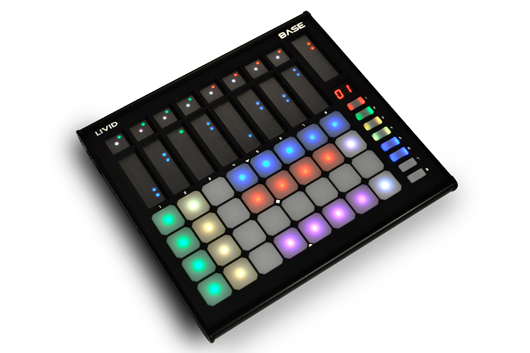
Hot on the heels of Ableton’s Push controller (which we reviewed back in April) comes Livid Instruments‘ Base, the newest design from the boutique, Austin-based shop. Push provides a rather interesting point of comparison: The two pieces of hardware have much in common physically, while the underlying philosophy has anything but. Where Push was designed to work in a particular way with a specific piece of software, Base is largely what you make of it, a more generic blank slate that’s willing to accommodate a host of varied approaches.
How It Looks
Dressed up in all matte black with grids of RGB LED buttons, Base and Push look like they come from the same gene pool at first glance. This correspondence is more than skin deep, too, as Base feels exceptionally sturdy in much the same way as its German counterpart, perhaps even more so; housed in a solid aluminum chassis, the machine has a weight and solidity to it that inspires confidence and sets it firmly into the higher-end of MIDI-gear construction. The top of the unit is lined with rubberized plastic, which frames the 32 drum pads, nine ribbon controllers, and eight smaller function buttons—with metal siding and no moving parts whatsoever, it feels extremely durable. The matte finish is fingerprint-proof, and, overall, the care and quality of Livid’s handiwork is evident (like all Livid controllers, Base is built at Livid’s factory in Austin).
How It Works
The pads feel great (and quite similar to Push’s pads), but what makes Base special—beyond its design and build sensibilities—is the ability to combine control of the pressure-sensitive buttons with the responsive ribbon controllers. The immediacy of playing these touch strips as faders and filters feels significantly different from doing so with standard sliders, and the embedded LEDs within each make sure that the communication flows in both directions (this is aided by the touch buttons above each of the main eight ribbon controllers, which have embedded LEDs as well). These vertical, virtual faders can send note-on and -off values (with velocity), allowing for quite unique forms of musical expression.
The Livid mapping software is relatively straightforward, and setting up Base as something tailored to a specific workflow is easy enough. In order to get Base up and running as quickly as possible with, say, Ableton, there are presets that allow you to do so: The bank buttons switch the pad functionality between drums, clip triggering, and instruments, while the faders easily swap between mix, sends, and device parameter controllers.
The Bottom Line
Livid hasn’t reinvented the wheel here. Rather, they’ve made an expressive, finely crafted, flexible instrument that will play nicely with any software currently on the market. It’s yet another variation on the grid-style MIDI controller, and in this sense, has plenty of competition; between Push, Maschine, monome, Launchpad, and now Base (among many others), this sort of devices now comes in an incredible variety of shapes and sizes. Now, the only tricky part for producers will be finding the right one to match with their own unique creative process.
We first learned of Phoebe Kiddo‘s forthcoming Artefacts of Broken Dreams LP when the Berlin resident dropped word of it back in June along with her free, introductory EP, Tripping on the Wake of Goodbyes. Now, Kiddo has offered the first taste of her fast-approaching debut album with the ghostly “When the Soul Lies Down.” Steeped in atmosphere, the track buries itself under thick sheets of warbling chords; only the subtle skitter of its reverb-laden hats and claps and some brief bits of tasteful vocal adornments manage to rise above the tune’s soupy core. Kiddo’s Artefacts of Broken Dreams will see its official release on September 24 via the Anenon-helmed Non Projects label, but before the record drops, its artwork and tracklist can be peeped after the jump. (via Ad Hoc)
01 Jupiter Jazz 02 This Is How I Would Die 03 Chasing Dreams 04 Initiation 05 Into Solitude 06 When the Soul Lies Down 07 In All This Grace 08 I Tell You I’m Leaving 09 Half Hearts Must Be Forsaken 10 Inevitable Diaspora Of Clouds
Since 2010, the Bristol-based label Livity Sound—jointly run by Tom Ford (a.k.a. Peverelist), Joe Cowton (a.k.a. Kowton), and Craig Stennett (a.k.a. Asusu)—has operated as an outlet for grimy, techno-infused white label 12″s from the three producers. And the label has just announced plans to release a two-disc album which compiles the six Livity Sound 12″s, along with Pev & Kowton’s XLR8R Pick’d “Raw Code” b/w “Junked” single for Hessle Audio and four entirely new tracks from different iterations of the trio. Simply titled Livity Sound, the so-called debut album from the Bristolian crew will mark the first time that any of the label’s material has been made available digitally. According to the press release, Livity Sound’s founding impulse was to release “a raw and exploratory strain of UK techno, rooted in dub methods and soundsystem culture,” a statement that can be explored in full when the two CDs drop on October 21. In the meantime, the artwork and tracklist for Livity Sound can be found below.