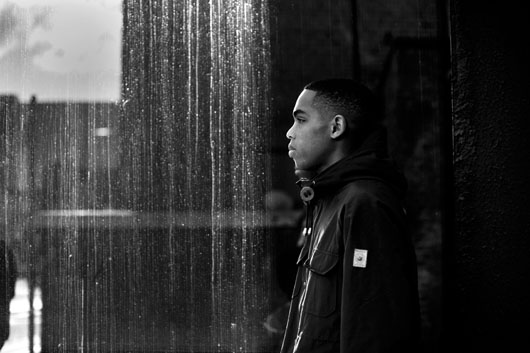
On his forthcoming Darsk EP, London’s Last Japan once again seems keen to show that he is not a one-sided producer, touching on thick grime beats, shuffling bass, and a few points in between during the course of his five-track effort. The appropriately titled “Float” closes the EP in a decidedly space-age fashion, matching reverb-soaked melodies and percussion with a set of rich, droning chords, and just enough resonating sub-bass to keep the track equally appropriate for dancefloor play and late-night smoke sessions. A full stream of Last Japan’s Darsk EP can be heard after the jump before the record officially drops on July 15.
The self-titled debut album by jet-setting DJ/producer Nina Kraviz dropped over a year ago now, but a brand-new video for its spacious and wispy “Fire” tune has just surfaced. Directed by Yuliya Skya, the clip’s deep-orange and blood-red imagery was shot in the Mojave desert “with Mars in mind,” and is said to explore the “unique relationship…between a finite being and the infinite.” And all of this is going on while Kraviz whispers and coos strange passages about fire over her practically inaudible ambient music. The whole piece can be seen below
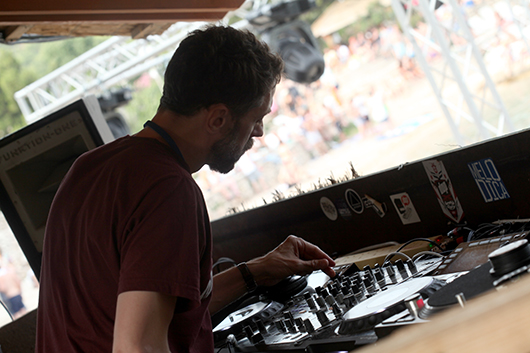
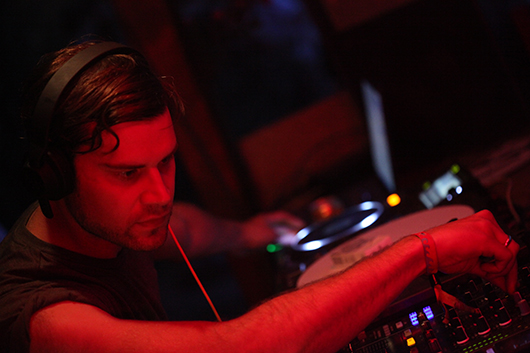
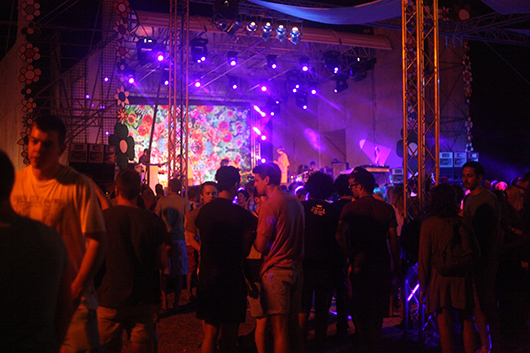
Last week, XLR8R made a trip to the coast of Croatia, specifically the relaxed seaside village of Tisno. While there, we soaked up some sun, hung out on the beach, hopped on some boats, ate some seafood, made some new friends, and, oh yes, went to The Garden Festival. It may seem odd that the festival, which featured scores of DJs and live acts, wouldn’t get top billing during our recounting of the long weekend, but that was the whole idea of Garden—the music was more of a backdrop than an all-out spectacle. Amazingly, this year’s festival hasn’t even ended yet, as it’s scheduled to wrap up on Wednesday night. We may not have been able to stay for the entire affair, but after four days and nights, a few things certainly stuck out in our memory, which we’ve detailed in an effort to share a bit of the Garden experience.
The vibe at Garden was incredibly relaxed. This was a good thing.
Tisno is not a big place. Normally home to about 3000 people, it’s quite literally a charming and picturesque little village on the Adriatic Sea. The summer sun is plentiful, and the town is surrounded by clear blue water, beautiful views, and a network of small islands that dots the landscape. Simply put, it’s a holiday destination, albeit one that hasn’t been grossly overrun with crass commercialism. People come to Tisno to relax, and the place seems more than happy to oblige. Given that, one might expect a large-scale music festival to disrupt the laid-back spirit of the town, but Garden actually fits right in.
Part of the reason is that Garden isn’t actually all that big. Even though the festival runs for an almost unbelievable eight days and nights, less than 3000 people attend each year. As such, being on the festival site—which is conveniently located just a short walk from the center of town—was never an uncomfortable or stressful experience. Also known as “The Garden,” the festival locale almost has the air of a family vacation park; there’s a restaurant on site, plenty of green grass, lots of trees, a small beach area, and plenty of room to maneuver. Granted, the environment feels a tad manicured, but being at The Garden Festival is an undeniably pleasant experience, particularly for those looking to unwind.
As one might expect, this is all by design. Although Croatia in recent years has become a sort of festival hotspot—there are now something like 20 major festivals during the summer months—Garden has been operating for eight years. And while many of these other festivals take a “bigger is better” approach and slap together as many “name” acts as possible to attract eyes—and income—Garden’s organizers have a different vision. The festival was the first of its kind in Croatia, and though the promoters are not natives (three are from the UK, one is from the US), they have resided in the country for approximately a decade. As such, it’s not surprising that they have created something which fits naturally into the local landscape. It certainly appears that they’re doing something right, as other festival organizations are already following their lead; this summer, “The Garden” site in Tisno will actually play host to five consecutive festivals. The Garden is first, but will be followed by Electric Elephant, Soundwave, SuncéBeat, and Stop Making Sense.
There was plenty of quality music at Garden, but it was almost an afterthought.
It may seem odd that the music wouldn’t get top billing at a festival, but that was truly the case at Garden. Make no mistake, there was a lot of solid music on offer—the Garden line-up featured more than 120 DJs and live acts, and each day, there were at least two or three stages going at all times, not to mention multiple boat parties. On top of that, after midnight the festivities would shift over to the (relatively) nearby Barbarellas Discotheque, a superb open-air venue which stayed open until dawn and actually hosted much of the festival’s top talent.
Yet even with this abundance of options, being at Garden rarely felt like an intensely musical event. The soundsystems almost invariably sounded great—especially on the Main Stage and Beach Stage—but the various stages and locales were never overcrowded, even during the festival’s most anticipated performances. But it was more than that—whether we were chilling by the beach, hanging out at the club, or cruising around the Adriatic on a boat for a few hours, the music often seemed more like an accompaniment than the primary focus of our activities. That’s not meant as a critique; our time at Garden was absolutely enjoyable, but it was also something noticeably different than the in-your-face experience offered by many of today’s festivals.
Psychemagik at the Beach Stage
Of course, the line-up itself had something to do with all this. Looking over the roster of acts tapped for Garden, it’s clear that the organizers had a very specific booking vision. There weren’t many big-name headliners, and the vast majority of the music at Garden was house and disco, although some bits of funk, soul, boogie, and R&B also colored the proceedings. Within those worlds, the curation actually went quite deep—record-digger types and DJs’ DJs littered the bill, and it was interesting how many of the acts were long-running residents from UK club nights or niche producers who had only put out a handful of well-loved but relatively obscure records. One the whole, the Garden line-up often seemed more like an expanded network of friends (and friends of friends) than than a precisely curated festival.
Tech-house and disco make a lot more sense by the sea when the sun is blazing.
As music-oriented entities, XLR8R and Garden are admittedly a bit different. While our publication generally focuses on unearthing and documenting the latest sounds and genres from across the electronic spectrum, Garden’s organizers simply know what they like and prefer to stand pat and wave the flag for the sounds that they love. We’re not saying that one approach is better than the other, but it’s fair to say that the Garden line-up wasn’t especially forward. Again, we’re not saying that the bill didn’t include plenty of credible acts, but more abrasive, experimental, urban, and—some might say—inventive sounds like techno, dubstep, garage, grime, bass music, jungle, abstract beats, etc. were almost entirely excluded from the festival. Even the house on offer was of a particular style—those seeking raw Chicago sounds or even proper deep house likely would have left disappointed.
Main Stage
At its essence, Garden’s curation focused on a very specific lineage of dance music, one that could be traced from funk and soul through disco and the subsequent styles of house that continued to pull heavily from those genres. As such, the festival had a relatively narrow sound palette—organic drums, soulful vocals, and rubbery basslines dominated the soundtrack. Basically, there was a lot of rare groove, disco, and Hot Creations-style tech-house happening. And if we were at home, or in a club, or even a different sort of festival environment, it would be easy to describe these sounds as… unadventurous, to say the least.
However, in the context of Garden, this music was entirely appropriate. While people undoubtedly came to the festival to dance and party, they also came to soak up the sun, spend some time at the beach, hang out with their friends, and enjoy a break from their regular lives. There were a number DJs and music heads in the audience, but most of the people at the festival were clearly in Croatia for a sunny getaway. Given that, the festival’s soundtrack made perfect sense; after all, there’s a sort of collective familiarity with the sounds of funk, disco, and certain kinds of house. As such, even when DJs were digging deep in their crates—which they often did—enjoying the music didn’t require a harsh learning curve or additional context. Just about everyone can understand a disco groove, and in a relaxed, unpretentious atmosphere like Garden, even the cool kids (ourselves included) stopped scratching our beards and got into the spirit.
By festival standards, the crowd was incredibly well behaved.
We realize that starting any sentence about group behavior with the phrase “by festival standards” is setting a remarkably low bar, but a big part of what made Garden a pleasant experience was its crowd. Before our arrival in Tisno, we honestly weren’t quite sure what to expect. Given all the talk of Croatia as the “new Ibiza,” we were definitely prepared for the possibility of finding ourselves in the middle of some “British lads on holiday” nightmare.
As it turned out, we were right… and wrong. The crowd at Garden was heavily British, and there were definitely a sizable contingent of young people on holiday. Pasty skin, terrible sunburns, mildly alarming intoxication, hideous sunglasses, bad tattoos, and body glitter were all in abundance, and plenty of of kids definitely came to Croatia primarily in hopes of getting smashed and partying. However, even factoring all of that in… it wasn’t that bad. In fact, it wasn’t bad at all. Part of this could be directly traced back to how much space there was at Garden. Simply put, we never felt trapped or surrounded by insufferable behavior; every once in awhile, something dodgy would go down, but avoiding it was as simple as walking in any direction for all of 10 seconds and finding a new spot to hang out or watch a performance. Garden was roomy—and comfortable—and that allowed everyone at the festival to have fun as they saw fit.
Other factors played a part in Garden’s good vibes. Although the crowd was certainly young, it wasn’t overly young; there were plenty of festivalgoers who were in their late 20s, 30s, or even older, and these more mature folks certainly helped to keep the proceedings relatively sane. The music also played a role; we might call out poke fun at disco for not being the most cutting-edge genre, but it’s also not a sound that generally incites young louts to go apeshit and get rowdy.
Chez Damier has still got it.
After arriving in Croatia on Thursday night, Chicago house veteran Chez Damier was one of the first artists we saw. Headlining Thursday night’s party at Barbarellas, he put his 20-plus years of experience to good use, pulling heavily from the ’80s and ’90s house canon while dropping one soulful vocal anthem after another. The music was uplifting, the dancefloor was bustling, and it was a pleasure to see that Damier hadn’t lost his touch. In retrospect, it was actually one of the weekend’s more refreshing performances; during our four days at Garden, we heard plenty of soulful music, but there wasn’t a lot of soulful house music. Damier filled that void nicely, and we would have been thrilled to see more DJs in his mold over the course of the festival.
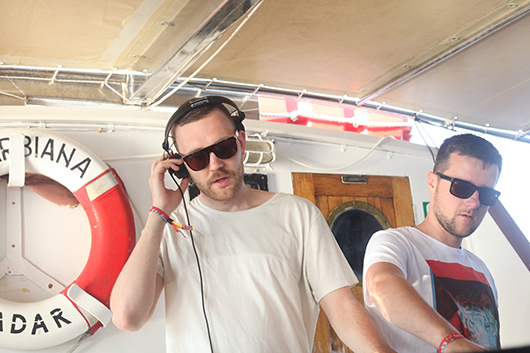
Catz N Dogz spinning at a boat party
A bunch of New York nu-disco guys came together at Garden—and it was fun to watch.
A strong crew of nu-disco DJs peppered the Garden bill, including Tim Sweeney, Eric Duncan, Justin Vandervolgen and Lee Douglas, and though they all played separately at various times throughout the festival—Vandervolgen’s and Douglas’ joint DJ set as TBD on Sunday night at the Beach Stage was particularly good—they all came together on Friday night at Barbarellas—along with Portuguese DJ/producer Tiago—for a Beats in Space party and an epic B2B session. While these artists are all known for their disco proclivities, much of the night actually centered around a chugging style of house, although Tiago kept tossing in curveballs—Dorian Concept’s “Trilingual Dance Sexperience” was certainly a surprise. Although many of these guys live relatively close to one another (or used to) and probably cross paths on a regular basis, it was clear how much they reveled in getting the chance to all hang out and play together. With the DJs switching off every few songs, the booth was full of smiles, and that enthusiasm carried out onto the dancefloor, which stayed full throughout the evening.
Krystal Klear and Floating Points both delivered the goods.
Krystal Klear and Floating Points are both artists who regularly appear on XLR8R, and they were paired up for two separate Resident Advisor parties on Saturday at Garden. First up was an afternoon boat party, which found the two DJs divvying up a four-hour cruise around the Adriatic, and they met up again after midnight in the Barbarellas DJ booth, where each man did a two-hour set.
Keen readers might remember that we weren’t especially thrilled with Krystal Klear’s set at Sónar in Barcelona last month, but his performances at Garden were much better. Anyone who’s heard the Manchester-based artist’s productions knows that he has a real pop streak, and while that might have gotten the better of him at Sónar, this time his DJing nicely walked the line between deep cuts and established hits, as he strung together feelgood sets that incorporated bits of house, boogie, disco, and R&B. On the boat, his selections dipped further into vintage territory, while his nighttime session found him delving further into house. Beyond that, his mixing was on point and his smart use of effects and EQs added a little extra drama to the flow of the music. Most importantly, in both locales, he delivered sets that were unquestionably fun and upbeat, and when he did pull out a pop smash or two, the effect—and the audience response—was especially strong.
As for Floating Points, the guy is just flat-out talented. Known for his digging prowess, he showed up with a bag of records—and an E & S mixer—and proceeded to put together ace sets of funk, soul, disco, and house. During the boat party, he even managed to mix in some samba without losing the dancefloor. His set went down smoothly on the water, and though he employed many of the same excellent selections at Barbarellas, his music may have been a bit too groovy for a Saturday-night crowd that was hungry for some late-night raving. It didn’t help matters that Thugfucker was impatiently waiting in the wings and hovering behind Floating Points during a significant chunk of his set. Of course, once the American-Icelandic duo came on and immediately began dropping a goon-friendly assortment of bland, Ibiza-ready tech-house, the quality of the music dropped in a hurry and we quickly called it a night.
Metro Area’s live show has rounded into form nicely.
Metro Area is another act that ran into some problems at Sónar last month—the latter portion of the group’s set in Barcelona was marred by technical problems—so we welcomed the chance to see the long-running NYC duo once again at Garden. On Saturday evening, the pair worked its way through an hour-long live set on the Main Stage that was thankfully without incident; in fact, Metro Area sounded great. Although some of its tracks are now a decade old (or older), the duo’s unique blend of house, disco, and electro has held up well, and songs like “Miura” elicited a rapturous response from the Garden crowd. The music was clean, the delivery was smooth, and the 60-minute set quite honestly went by in a flash.
Space Dimension Controller (at a boat party)
Space Dimension Controller’s live show was the weirdest set of the festival… and we loved it.
Belfast-based oddball Space Dimension Controller played live on the Main Stage on Sunday night, and his set was undoubtedly one of the festival’s most adventurous. As it happened, it was also one of its most enjoyable. Over the course of an hour, he rolled out an infectious array of silly/sexy electro and electro-funk, tweaky acid, floaty pop, and stompy techno, performing the entire show in character as Mr. 8040—the titular Space Dimension Controller from the elaborate backstory that accompanies the project. The musical variety was more than welcome, especially after four days of mostly disco and tech-house, and though we certainly enjoyed the Detroit flavor and extra low-end heft, even better was the fact that Space Dimension Controller himself looked like he was having such a good time. Based on the enthusiastic crowd response, it was apparent that the audience was having a ball right along with him.
Garden was full of pleasant surprises.
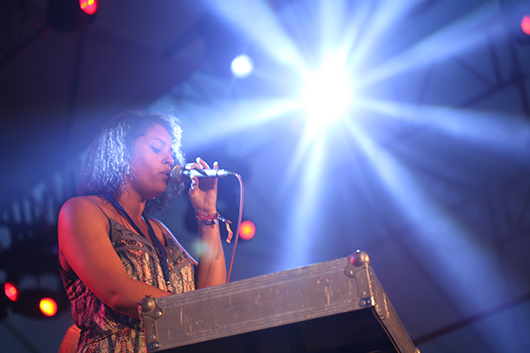
With more than 120 artists scattered over so many days, it would have been impossible for anyone to see everything at Garden, but we nevertheless did our best to check out as many acts as possible. While some were unremarkable, a few artists unexpectedly caught our attention, either by being surprisingly good or simply doing something we didn’t anticipate. London duo Land of Light performed on Friday evening for a sparse crowd, but those in attendance at the Main Stage were treated to a live set of truly excellent Balearic sounds. The addition of live guitar really added something special to the music, which at times recalled the work of Studio or even someone like Tycho, albeit with a more propulsive rhythm. Outboxx also performed live on the Main Stage on Friday, and while the Bristol duo’s live house constructions were certainly serviceable and compared favorably with its recent album, the music really jumped a level when vocalist Naomi Jeremy hopped on the mic. The girl could clearly sing, and added some extra dynamism to the proceedings. Moving forward, it would be an excellent idea for Outboxx to incorporate her into the picture as much as possible.
Naomi Jeremy (performing with Outboxx)
Yet perhaps the festival’s biggest surprise was Maurice Fulton, not because he was good (for the record, he was good, and we definitely expected that), but because of what he played. Of course, entering into a Maurice Fulton set with any sort of expectation is always a risky idea, as the man has proven himself capable of delivering quality DJ sets that delve into nearly every corner of the electronic spectrum. Still, we never anticipated that he would show up and deliver a two-hour party set that primarily revolved around disco and funk jams. Whether it was intentional or not, Fulton wound up fitting right in with the general vibe of Garden, and it’s unlikely that anyone would have bet on that before the festival started.
Next year, we’re staying longer.
As we mentioned at the top, the 2013 edition of The Garden Festival is still happening, as its parties are slated to continue through Wednesday night. Unfortunately though, our schedule only permitted staying through Monday morning, which meant missing sets from the likes of Axel Boman, Bicep, Idjut Boys, Theo Parrish, Danny Krivit, and Genius of Time, not to mention a Wednesday afternoon party on a private island with Joakim and Permanent Vacation. Somehow, this Monday through Wednesday in Tisno, Croatia is going to feature more stacked line-ups than just about anywhere else on the planet. Kudos to The Garden Festival for ending things on a high note, and shame on us for ducking out early. After having such a good time on the days we were at Garden, it’s not a mistake we’ll be making again.
Chicago’s footwork sound has proven malleable for a host of producers worldwide, but apart from long-running niche crews in France and Japan, it’s difficult to think of a producer outside of Chicago who has wholeheartedly embraced it. Some may cite artists such as Om Unit and Addison Groove, but these beatmakers, wary of treading on the scene’s blueprints, have taken its elements and tempo into new zones. And as interesting as they are, these “slowfast” experiments—as they’ve occasionally been dubbed—usually discard footwork’s cut-and-paste, disorientating qualities, and rarely manage the same mercurial energy. There are many reasons why these producers make the alterations they do, but operating at a remove from inner-city Chicago surely plays a part. However, there are exceptions to this tendency. Lil Jabba grew up between Australia, Paris, and New York, and now splits his time between Brooklyn and Baltimore; still, the producer is invested in a very Chicagoan take on footwork, so much so that he has become affiliated with that city’s marquee Teklife crew.
Even so, Scales, Lil Jabba’s debut album, promises a crossover point. It is orchestrated to a degree that obfuscates the genre’s roots—as wild as some of DJ Rashad’s arrangements are, for example, one can usually hear the ghetto house poking through. Luckily, Lil Jabba balances this by making sure that his tracks are not over-thought. Moments of calculation are rare, as patterns repeatedly splinter into confusing wormholes and grooves are never allowed to ride out. The drums sound more or less like they’re out of the box, and the melodies are smeared on in a loose, psychedelic way. That jumble might be a little off-putting at first, especially for those accustomed to cleaner takes on footwork (or, indeed, “slowfast”) but it undeniably signifies a teeming undergrowth. Lil Jabba is clearly a city kid, but he has spoken in interviews about being influenced by nature, and a certain feral sensibility is present here. He rarely references the rap lyrics and battle cries of the Chicago scene; on “Gorgon,” there is a small sample about “running the show” and some stray gunshots pepper the composition, but they don’t pervade the track, and for the most part, Jabba keeps his meanings elusive. Moreover, he tends toward using his own sounds. There seem to be a few samples, but they are not the easily recognizable sort one would usually notice on a Chicago record. There is a part on “Maven” that recalls Minnie Ripperton’s “Loving You,” but it is largely distorted beyond recognition. The dreamy, old-Hollywood strings of “Red Current,” meanwhile, are counterbalanced—or overpowered—by mechanical bleeps. Like an earthbound version of Young Smoke’s The Space Zone, Scales is a record about mutating the machine itself, rather than mutating preexisting music.
Operating under this premise, Lil Jabba is able to incorporate a variety of moods while retaining footwork’s signature stumble. The drums on “Cavern” have an almost tribal roll, while a wispy, asthmatic flute (or synth voice) wheezes on top. On “Raiders,” he employs what sounds like a zurna, and couples it with a persistently battering rhythm and dramatic horns, which operate on a lower register. As a result, he is able to conjure the ubiquitous battle track without the use of a “call to war” vocal. Closer “Serum” constructs a woozy, UK-esque synth framework on top of grumbling bass, while its jittery toms, snares, and rimshots patter like droplets on glass. It remains to be seen how well these tracks fit into actual footwork sets, but one gets the sense it doesn’t matter too much to Jabba. What is evident, however, is that the producer has found in footwork a medium for beguilingly dense collage. Rather than airbrushing out the genre’s rawness, Jabba seems to revel in magnifying it, and this is a welcome approach.
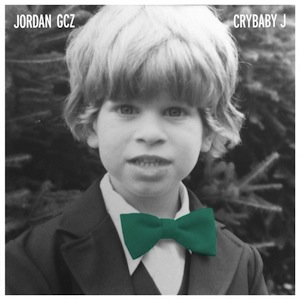
On last year’s Techno Primitivism LP, Juju & Jordash‘s music felt like a world unto itself. As such, its detour into accessibility was “Track David Would Play,” a dismissively titled number that jokingly referenced Move D. There’s a queasy edge to the pair’s constantly evolving jams—they reference techno/house tropes and classic hardware, yet the results usually feel like something broadcast from a proximal dimension. That unpredictable drift is preserved on Jordan “Jordash” Czamanski’s first solo 12″ as Jordan GCZ, which is also the debut release on his Off Minor label. “Crybaby J” invokes deep house as an excuse to slip away on jammy tangents, especially a scene-stealing wah-wah synth line that gives the track its name. The drums’ shuffle is tense against reassuring synth pads, but when that flanging solo makes its appearances—full of “Maggot Brain” and On the Corner–type import—it practically blots everything else out. The oscillating focus creates a time-dilating effect, slowing down during the lead parts and speeding up until it unravels in wordless vocal harmonies and a starry-eyed music box.
The dub mix erases the synth solo, leaving behind eraser dust that preserves the original track as a quiet mulch of samples in the background. “Crybaby J (Dub Mix)”‘s even surface allows for a more linear, steady development, giving the same steady vibe of tightly controlled, accumulating momentum as Steffi’s recent Panorama Bar 05. Ping-ponging vocal samples like some Art of Noise record and an arpeggio upgraded to center stage give it an enthusiasm that keeps it from being too studied, though. The more expressive aspects of the a-side are turned inward, at least until he introduces a jazz-fusion bass solo—this time, it’s pitched somewhere between Jaco Pastorius and Squarepusher. Jordan GCZ only flirts with cheese, diverting that energy back into the tracks—the results are subtle, but his willingness to take risks in the first place is what makes this 12″ unique.
Based in Amsterdam and born in the Ivory Coast, Herve Sika (a.k.a. H-SIK) is the latest addition to the increasingly adventurous roster of Bristol-based label Black Acre. True to the imprint’s recent form, his first single—which follows a debut mini-album on Error Broadcast last year—is an eccentric mix of juke-indebted drum-machine workouts, jungle breaks, and epic film-score synths. It’s a combination that feels like shouldn’t work, yet it all comes together to form an enjoyable, if somewhat chaotic, two-track release.
At first, with its emphasis on huge, blown-out kick drums and chopped rap vocals, “Sonic Rage” isn’t a million miles away from the simplistic bombast of trap. However, the sheer weirdness of Sika’s arrangement, along with the jungle and juke-like drum breaks that pepper the track, elevate it well beyond the realm of big-room beatmaking. The early emphasis on bass is something of a red herring anyhow; as the track progresses, it evolves into dense patchwork of rapid-fire drum hits and tense synth lines, ultimately morphing into something much more akin to old-school rave music.
The slightly more spacious “No Promises” is the pick of the two though. Here, Sika builds on a slightly less erratic jungle rhythm, moving the emphasis away from the low end and toward an atmospheric backdrop of drawn-out synth pads and slow-motion vocals. A slightly dissonant wandering synth lead gives the track a cinematic quality, as the cheap, horn-like sounds emulate the pseudo grandeur of some low-budget sci-fi TV show theme tune. The effect provides a nice juxtaposition to the inherent energy of Sika’s fast-paced beats, resulting in a production with a pleasantly deceptive amount of depth to it.
Throughout the week, a whole lot of material gets posted here on XLR8R. And while we know—and love—that some hardcore readers will eagerly pour over every single news story, interview, podcast, video, and MP3 download that appears on the site, we also realize that for most people, it’s impossible to see everything, which means that some quality XLR8R content is likely to get missed in the hustle and bustle of everyone’s daily lives. In the interest of making it easier for everyone to catch up, every Friday we present The Lowdown, a weekly wrap-up of the top 10 tidbits from our site.
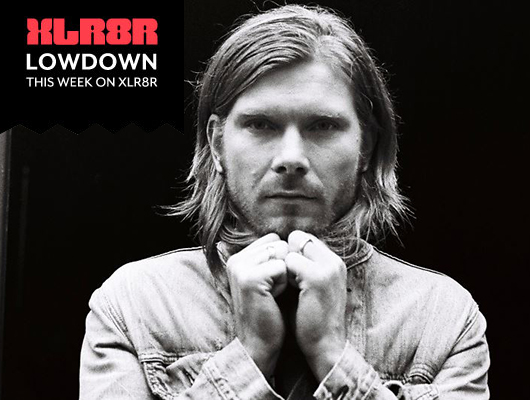
1. This week’s XLR8R podcast came courtesy of Berlin techno stalwart and long-running Berghain resident Marcel Dettmann (pictured above).
2. Fresh off the release of his new album, Matias Aguayo invited us to his production lair for the latest edition of From Studio to Stage, where he detailed his unique production methods and how he translates his music between the studio and live spheres.
3. Bristol beatmaker Addison Groove recently participated in FACT’s Against the Clock challenge; check the video that shows him building a beat in 10 minutes.
4. UK producer xxxy gave away a pair of free tunes via SoundCloud this week.
5. Following the recent release of his new LP, enigmatic producer Zomby has been in the news quite a bit, but his face-to-face interview with Pitchfork, which surfaced online this week, caused an especially large stir.
6. Richie Hawtin offered up a new mix of sorts for free download, the latest installment of his Fragments series.
7. The synth makers at Nord unveiled Beat 2 this week, an updated version of its drum-sequencing app for the iPad. Beat 2 is available for free download.
8. UK maestro Julio Bashmore revealed two bits of exciting news—a new single, “Duccy” (which is streaming online), and a forthcoming UK tour.
9. Prolific Brooklyn producer Brenmar continued his busy streak, sending along “Outta Sight!” for free download. The track is a collaboration with up-and-coming New Jersey act DJ Fade.
10. Also popular in our Downloads section this week was “92688,” a free offering from Leeds newcomer Viers.
An expanded version of the The Lowdown is also available via a weekly email newsletter. Those interested in an even more in-depth round-up of XLR8R content, including a complete listing of all the free downloads we’ve offered in the past seven days, should sign up by entering their email address below.
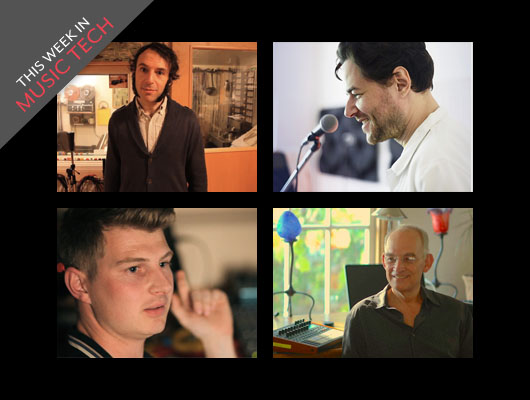
Though it may have been a short week for those of us residing Stateside, there was plenty to keep curious producers and gear nerds entertained. Again, we’ve rounded up the best bits from the past seven days in the latest This Week in Music Tech—checking out the studios of Matias Aguayo, Daedelus, and Archie Pelago, watching Addison Groove make a beat in under 10 minutes, checking out a free drum-sequencing iPad app from Nord, and learning the truth behind the legendary MPC swing from Roger Linn himself in the process.
In the second edition of our ongoing From Studio to Stage series of pictoral features and comprehensive interviews, we visited Matias Aguayo‘s Berlin studio to discuss how the longstanding electronic music innovator successfully navigates between production and live performance. The full article can be read here.
The latest tunesmith to take on FACT TV‘s Against the Clock challenge is UK producer Addison Groove, who pieces together a rather solid tune in just under 10 minutes while letting us watch the whole thing go down..
Earlier this week, Nord unveiled Beat 2, a free drum-sequencing iPad app made to work with the company’s Drum 2 synthesizer (as displayed in the video above). Thankfully, it can also be used with any MIDI-capable device. The new app is currently availible to download via iTunes.
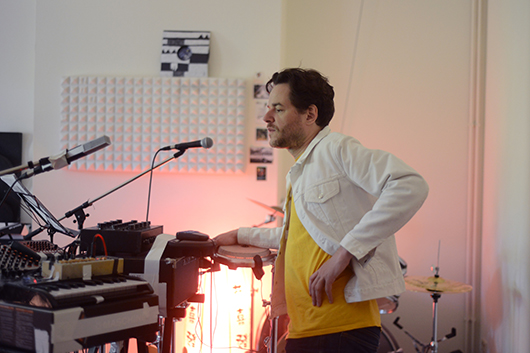
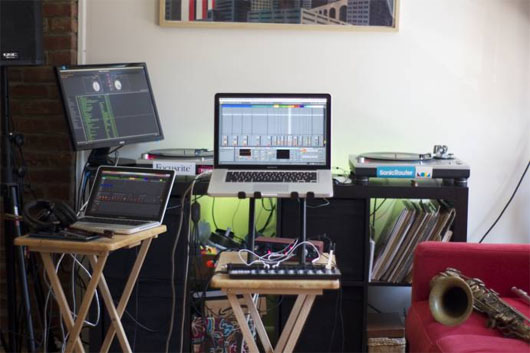
Following just behind its recent podcast for Resident Advisor, Archie Pelago offered a view of its Brooklyn studio/rehearsal space to Attack Magazine, highlighting the controllers, hardware, and acoustic instruments which contribute to the outfit’s unqiue sound. The full article can be read here.
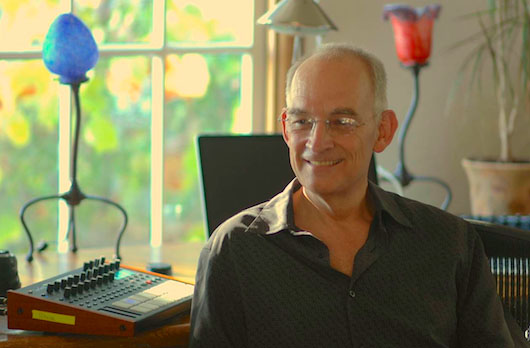
Though its title suggests that this video may have been filmed sometime last year, this brief tour of SoCal producer Daedelus‘ Culver City digs for Scion A/V just appeared on the internet this week. Old or new, the five-and-a-half minutes spent with the longstanding LA tunesmith proves to be an eye-opening experience.
Earlier this week, Attack Magazine set out to uncover the truth about the fabled swing impressed on drums programmed on an MPC, sharing an insightful exchange with the inventor of the legendary sampler himself, Roger Linn, who details what exactly makes the MPC’s swing do what it does. The full interview can be read here.
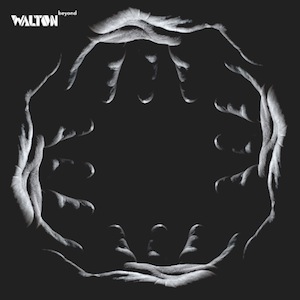
“The sound of yesterday, today, tomorrow, and beyond,” says a disembodied talking head during the eponymous, brief opener on Beyond, Manchester-based tunesmith Sam Walton‘s debut LP. It’s an appropriate summation of both the Hyperdub label and Walton’s output, as Hyperdub has continued to diversify its reach following the partial collapse of dubstep that helped bring forth its birth, and Walton has proven to be one of the imprint’s more reliable rising talents in recent years. Across a series of increasingly confident EPs that began in 2011, the young alchemist has taken elements of the grime he grew up on and fused them with various strands of bassline, UK funky, and Detroit techno. Beyond is the most recent—and most accomplished—product of that process.
Even before Beyond, Walton had proven capable of synthesizing multiple genres into a sound of his own. His drums are often mechanically indebted, his basslines are precise, and his synths are often warm and resonant. Granted, these characteristics are all mainstays of garage and grime, but what really makes Walton’s tunes stick out is their balance of seriousness and playfulness. Lead single “Frisbee” is a perfect example, its descending notes lapping against double-time chords and haunted vocals. It’s designed for the dancefloor, but also refuses to stay in one place, preferring instead to keep expanding outward, which lends a sense of the unexpected to the proceedings. Elsewhere, on the leering house of “Grit,” Walton pairs a childishly mischievous synth with a rolling, sinister bassline.
Beyond truly begins to shine towards the album’s center. “You & Me” and “Memories” are both dependant upon a balance of twitchy, rusty drums and moaning, down-pitched vocals—although “Memories” gains extra mileage through some adrenaline-fed synth work. Sandwiched between those two tunes is the album’s most crowd-pleasing duo, the call-and-response vocal interplay of “Love on the Dancefloor” and “Every Night.” The former jumps off the same starting point of “You & Me,” its industrial clatter meeting a sensual three-chord Rhodes stab; before long, the song’s grime rhythm transforms into a jazz-tinged bounce, the composition anchored by a whispered vocal sample teasing the listener to “make your move” before adding, “I’m gonna dance away my clothes off.” It’s good fun, but the LP’s real payoff is the lush “Every Night,” where synth horns take the vocal sample from “Love on the Dancefloor” and refit it into a midnight banger.
When the album was first unveiled, Walton stated that the he “wanted there to be a contrast between bright and dark” and added that he “didn’t want to stick to a specific genre either. Just a vibe.” He follows through on that goal towards the album’s close, stuffing both the LP’s ambient interludes and its more straightforward bassline and Detroit house numbers at Beyond‘s end. Most impressive is the patient four-to-the-floor of “Amazon,” which tastefully beds dueling synth patterns, intermingling the song’s soft pads and noir-inflected chords with whispered reiterations of samples from previous album cuts.
While Beyond bags nearly every stake it claims, not all the tunes nail their mark. “Can’t You See,” the b-side to last May’s “Baby” single, is a fair, anthemic tune in its own right, but its inclusion here deadens the forward momentum of the LP’s brilliant middle section. Closer “City of God” also falls a little short, its ambient half-step ending things on a lackluster note, especially following the two house tracks which proceed it. Still, these are minor quibbles; overall, Beyond comes across as the work of a solid young producer finding both his groove and edge.
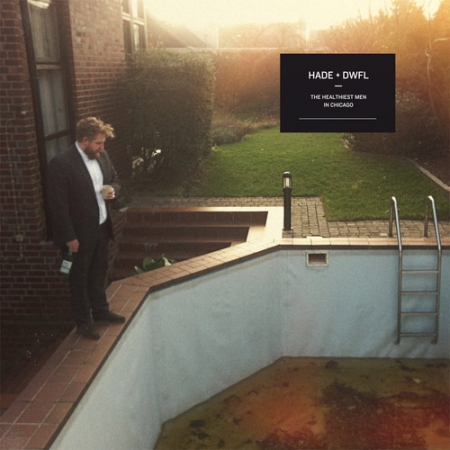
Cologne-based production duo HADE + DWFL has been working together on and off for some years under the name Ampersand. Switching to a new moniker, the two beatmakers are dropping their debut album this week via Melting Pot; called The Healthiest Man In Chicago, HADE + DWFL’s LP is joyously difficult to categorize, as it offers a mutant blend of footwork, Chicago house, and UK bass sounds. In contrast to the record’s very evidently juke-influenced title track—for which XLR8R premiered the video last month—”Talk Slow” pairs molten, syrupy production and slowed-down vocal samples with a beat scene-inspired synth sheen.