Though it was just last month when Belgian DJ/producer Locked Groove announced the formation of his eponymous record label, the busy artist already has a new single on the way via Tiga’s burgeoning Turbo imprint, a record which will pair his “Keep Thorough” tune from the label’s Miami Lifestyle compilation with remixes from Dutch duo Juju & Jordash and Montreal up-and-comer Iron Galaxy. Touted in a press release as “the most accessible and immediate track” in Locked Groove’s discography to date, “Keep Thorough” will be released with the accompanying reworks as a 12″ on June 17. Before then, the original version of Locked Groove’s tune can be streamed in the player below.
Underground Resistance alumni and UK-based techno veteran Rolando has announced that his next record will appear at the end of this month via Berlin outpost Ostgut Ton. The three-track D & N’s EP will be the DJ/producer’s second 12″ for the label, a record which will purportedly “solidify [Rolando’s] reputation as someone who is still pushing forward.” Before the release drops on May 27, previews of each track can be heard in the player below.
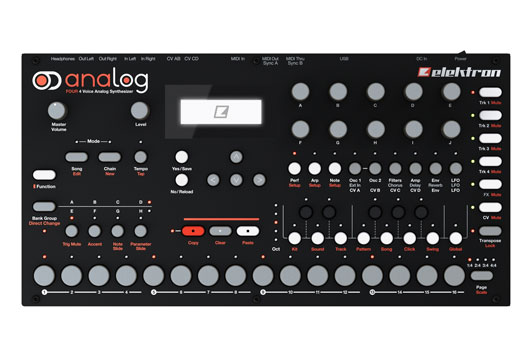
Swedish company Elektron has built up a cult following over the years with boutique instruments like the Machinedrum and Octatrack, and its innovative parameter locks and exacting controls have been ripped off by loads of plug-ins. However, Elektron’s latest offering, the Analog Four, is unlikely to be ripped off anytime soon, at least not by software developers. The Analog Four uses an analog signal path with digital controls, similar to a few classic Roland synths from the ’80s. It also crams together a surprising amount of CV outs, integrated effects, and performance-oriented knobs and buttons that tend to make hardware instantly fun. As such, the Analog Four attempts to capitalizes on all the things that software (still) isn’t very good at, while maintaining the sequencing and control that Elektron is famous for.
How It Looks
The Analog Four is housed in a black steel case that bears the stylish mark of Elektron’s collaborations with Swedish design company Acne. A number of grey, white, and red plastic buttons are stiff but playful, and do everything from selecting steps in a sequence to serving as a mini, one-octave keyboard. Its 12 rubberized knobs have a strong and authoritative stance, begging for dramatic twisting of filters and envelope parameters. Finally, a 122×32 LCD screen gives you a majority of the useful information needed to edit patches, dive through menus, and change settings of various types. Compared to Elektron’s other recent product, the Octrack, the Analog Four’s interface seems less complicated, despite the screen being smaller and its need for having manual at the ready while first navigating the thing.
How It Works
A good monosynth tends to be controlled by one knob for each function, which gives an immediacy that makes programming fun. By contrast, the Analog Four is far from a one-knob-per-function synth, but it’s still fun because of how the four monosynths tie into the sequencer. For example: If you make a new sound, you can audition it on the keyboard, or you can immediately start sequencing and sculpt the sound as you go. The latter style of working is nothing new to anyone that works with software sequencers, but the difference here is how easy it is to make evolving sequences using parameter locks. Almost every parameter on the Analog Four can be locked to a sequence step, allowing you to make subtle changes and/or play completely different patches per step.
Reserved to their own “tracks,” each of the four monosynths are dual oscillator with a sub that can be tuned to a fifth or up to two octaves below the primary pitch. The standard triangle, pulse, and sawtooth waveforms are present, and they all have variable width, which is somewhat unusual. There’s also some unusual oscillator modulation options, like soft and metal sync, which are great for adding unpredictability. The signal then routes into a four-pole low-pass filter that has a very familiar squelch at high resonance.
After the ladder filter, the signal passes through an overdrive circuit that has soft and hard clipping options. Extreme values dirty up the sound significantly, but volume is reduced quite a bit, which can be mitigated by using internal routing (neighbor tracks) to boost the volume. The advantage of this approach is that you can run your sound through an additional analog signal path, albeit at the cost of an oscillator on the next track. Finally, there’s a gentle multimode filter that is great for defining and cleaning up sounds, yet still capable of high resonance extremes.
Similar to Elektron’s Monomachine, the modulation section for each track is thorough, as it boasts two envelopes with several linear and exponential curves, in addition to two assignable LFOs with a multitude of shapes and repeat options. The LFOs are a particular standout, as they can be used for everything from pseudo-envelope work to fake sidechain effects.
How It Sounds
Without using any of Elektron’s parameter locks or advanced features, the sound of the Analog Four’s oscillators and filters are warm and almost soft, at least by Elektron standards. A lot of comparisons have been thrown around, but we’ve found it to be reminiscent of a brighter, edgier Roland Alpha Juno 2—which actually means surprisingly little since half of the “Elektron sound” comes from the sequencer and modulation.
The Analog Four is meant to be deep in a very performance-oriented way, so it’s hard to discuss its sound without considering all of the options and control at your disposal. For example, even the arpeggiators are essentially synth engines and mini-sequencers, capable of both ultra-fast speeds for video game-like effects and easily programmed rhythmic and pitch variation.
Likewise, the global effects section is surprisingly good and completely parameter lockable. Each track has individual sends to chorus, delay, and reverb, and you can parameter lock all of the effect settings as well—which is useful for tempo-matched reverb swells and oddball delay effects, among other things. The chorus is gritty and thick, and apparently good for making No U-Turn-style bass tones if you happen to be stuck in 1997.
The Bottom Line
The Analog Four is a clever hybrid of analog signal path and digital control, grabbing all of the best elements from both worlds. It’s not a jack-of-all-trades machine—there’s no poly mode (yet), and it can only sequence external gear via CV outs. But that might only be a problem if you wish that it could do everything; there’s so much power and variety crammed into the machine that can hardly be covered by the manual, let alone a review.
Veteran producer Jon Hopkins‘ original version of “Open Eye Signal” is one of those tunes that—at a blissful eight minutes in length—sits in a position where it is strong enough to stand on its own, yet it clearly also invites the possibility of making for some quality remixes. Enter reactivated beatsmith Nosaj Thing (pictured above). On his rework of the tune, the LA producer wisely does not attempt to scramble the original’s key elements—the coiling synthline, the reversed-heartbeat percussion, and the choir which shouts from every corner—but instead gives them a mysterious downtempo stamp. In rearranging the order in which Hopkins’ percussion and various stems were originally pieced together, Nosaj Thing reveals a nocturnal creeper of a tune that was apparently hiding in plain sight all along. The Open Eye Signal (Remixes) EP is out now via Domino with Nosaj Thing’s rework joined by additional efforts from Happa, Lord of the Isles, and Luke Abbott.
Believe it or not, XLR8R recently celebrated its 20th birthday. It’s not an occasion we’ve been hyping with lots of fanfare—perhaps we’re getting a bit shy about our advancing age—but we figured that we needed to do something to commemorate our two decades of existence. Ultimately, we decided to recognize the milestone via our podcast series. Granted, the weekly mixes are something that we’re already fairly excited about, but throughout the month of May, we’ll be taking things up a notch with a special set of 20th-anniversary podcasts, all of which have been assembled by influential veterans—artists whose work has risen above the trends and stood the test of time. First up, we have someone who’s a true original—Omar-S. For the past decade, the Detroit stalwart has been doing things decidedly his own way, turning out a steady stream of raw house sounds almost exclusively via his own FXHE label, the most recent being his freshly issued Thank You for Letting Me Be Myself LP. That said, the man has more than dark-and-dirty Motor City sounds up his sleeve, and on this exclusive mix, he’s gone a bit retro, piecing together an jovial session that leans heavily on upbeat house and electro from the ’80s and early ’90s. Admittedly, it’s a bit of a surprise, but learning to expect the unexpected is one of lessons we’ve learned time and again during our 20-year run.
01 Phyllis Nelson “I Like You” (Carrere) 02 Change “The End” (Warner Bros.) 03 Trey Lorenz “Photograph of Mary (Bass Hit Dub)” (Epic) 04 Grampa “She’s Crazy (Cyanide Mix)” (Movin’) 05 Proffessor Traxx “The Move Traxx” (Radikal Fear) 06 Housemaster Baldwin feat. Paris Grey “Don’t Leave Me (Mike’s Remix)” (Future Sound R&R) 07 Rickster “Night Moves (Radio Mix)” (Sound Pak) 08 The Reese Project “The Colour of Love” (Giant) 09 Candy J “Somethings They Never Change (Dub Train Mix)” (Hot Mix 5) 10 Alisha “All Night Passion” (Vanguard) 11 DJ Blend “DJ Blend Detroit” (FXHE) 12 Jamie Principle “Waiting on My Angel (Instrumental Dub-Mix)” (ZYX) 13 Yaz “Don’t Go (Re-Re-Mix)” (Mute) 14 Daniel Wang “Echo by Midnight” (Basenotic)
“Pico Union” is a track formally lost and perhaps forgotten by Los Angeles native Santiago Salazar—as he told us via email, “I just found this on a data disc while [doing some] spring cleaning.” And so we have “Pico Union,” a tune which Salazar named after the LA neighborhood in which he resided back in 1997, when the song was originally made. True to form, the decade-old cut is deliciously spacey, incorporating a string-like melody and tuned chords atop a bed of restless drum programming that moves in unexpected bursts but never loses hold of the song’s jagged groove. It all certainly makes for an intriguing cut, and one that serves as a welcome peek into the production past of the longtime Underground Resistance member.
With a label as central to the last decade of dubstep as Tectonic, there’s a temptation to frame its releases in terms of the genre’s chronology and merely view each new offering as something that’s looking ahead, glancing behind, or creating a parallel present. It’s the latter possibility which makes the fourth volume of the Tectonic Plates series such an exciting proposition. While the Bristol record hub has always delivered the goods, it does so with less hype and crossover potential at stake than many of its more fashionable counterparts. The imprint’s relatively low profile could perhaps be traced back to label boss Pinch and his ear for dense, overcast, techno-inflected sounds that hold true to dubstep’s darker, moodier roots. That said, there’s something a little more complicated at work on the label’s new compilation, Tectonic Plates Volume 4, which breaks up the imprint’s inherent darkness with a few rays of sunshine—namely, by putting an extra focus on artists who have loosely redirected what it means to be a part of its esteemed roster.
Distal might carry the highest profile of Tectonic’s recent breakthrough acts, and his giddy “Kerplunk”—a shiny rush of pots-and-pans percussion, shivering drum rolls, stuttery handclaps, truncated rave chords, and Hulk Hogan namedrops—is typical of the label’s brighter fare. Opening the volume, Jakes‘ contribution, “Rounds,” is a bit sneakier. Its Gregorian chords and distant, locomotive percussion feign at bleakness, but the bass hits and teasing builds provide enough of an upbeat undercurrent that the track’s wobbly, fist-pumping peak feels 175 degrees short of a 180. Guido‘s “State of Joy” should be self-explanatory, as squeaky synths and catchy electric piano melodies move things along like a summertime weekend afternoon—even its snares sound sunny. “Drum Boss,” Mumdance & Logos’ 808-detonating take on trap tropes, takes things one step further. Shotgun blasts are answered with dustings of magic-wand glitter, making for a war of attrition between macho posturing and unselfconscious cheer.
The heavy stuff still stands strong, though, no matter what form it takes. Detroit drum & bass futurist Sinistarr joins up with Seattle’s Texel for the off-kilter “Decibell,” a production which fuses the alarm-buzz aesthetic of classic Distance sides to a churning boogie shuffle that’s good for five minutes of anxious foot-tapping. Armour‘s “Skylark” blows Afro-Cuban grooves into a wall-sized portrait of a 1000-volt bassline flanked by laser-blast counter-rhythms. Pursuit Grooves‘ “Hard Beginnings” is a mournfully hard-pulsing cut where ghostly choirs and distant bells are knocked around in the air by floor-rumbling digital kicks. More traditional and dark dubstep tracks like Kryptic Minds‘ “Convoluted” and Steve Digital‘s “Larry Shite on the Night” round out the collection’s batch of classically minded crowd-pleasers.
It could be said that Tectonic Plates Volume 4 explores dubstep’s past, present, and future, and actually does fairly well on all fronts. After nearly a decade in the game, it appears that Tectonic’s actual place in the dubstep continuum is wherever—and whenever—it wants to be.
The solo project of Portuguese electronic musician Bruno Miguel (a.k.a. :papercutz) specializes in blissful, sun-drenched electronic pop. His latest offering, which comes as part of the Enchufada label’s Upper Cuts MP3 series, is a melodic number that layers pulsating synths and tropical drumwork over pounding low-end. The result, entitled “Storm Spirits,” is not far from the epic, cosmic disco of Lindstrøm or Prins Thomas; and like those producers, Miguel uses a distinctly analog-synth palette to achieve a masterful balance between gentle Balearic buoyancy and chilly, sinister undertones. “Storm Spirits” can be streamed via the player below, while the ongoing series’ other MP3 offerings can be heard here. The tracks released fortnightly as part of the Upper Cuts series will eventually see a release as a compilation.
Today sees the release of the Tsuka Origins EP (artwork above), a self-released collaborative effort from Canadian producers Deebs and TS?. “Part I.” serves as the two-track EP’s first cut, wrapping a dark assemblage of massive filtered samples around tuned kicks, skittering hats, and a snare that sounds like a cross between Zomby and Mobb Deep. The pair displays a nice sense for arrangement on “Part I.” too, building and releasing tension with exceptionally crisp movements. Both “Part I.” and its EP counterpart, “Part II.” can be downloaded for a “name your price” fee via Deebs’ Bandcamp.
Fledgling Brooklyn imprint Fifth Wall’s third release sees the record hub branching out beyond the work of label bosses Divvorce and Hound Scales for the first time, adding Scottish production duo Clouds to its roster with the Man Out of Dubs EP. It seems a logical fit: Clouds is one of the so-called “New Jack Techno” artists affiliated with Tiga’s Turbo label, and deals with a dark and oddly playful type of club music that has a lot in common with both of the Fifth Wall owners’ output.
Opener “Drone Function” quickly sets the tone. It’s a murky cut of warehouse techno built around the sort of crunchy, bass-laden kicks common in classic British Murder Boys records or Blawan’s recent tracks. Clouds’ added element of bombast outshines both of those artists, however, as it cloaks the track in a layer of wildly oscillating noise and gives the whole thing an enjoyably overblown instability. This combination of serious techno rhythms and over-the-top dynamics is a running theme throughout Man Out of Dubs. “Tropical Fuck” lives up to its ridiculous title thanks to a relentless rhythm carved out of a thick soup of mid-range percussive elements that seem to veer all over the place. There’s a seriously enjoyable groove at the heart of the track, though, and it keeps Clouds’ production grounded in the late-night spectrum of classic dancefloor fare.
But it’s the similarly high-energy “Phantom Female” that provides the EP’s most bombastic moment. Again, the track is rooted in the throbbing pulse of dark techno, but Clouds piles on harsh, overlapping FX which eventually engulf the beat, making for a noisy breakdown that feels peculiar and cartoonishly menacing. By comparison, “T-AO-192” is a relatively restrained affair, a more classically minded drum-machine workout set over a backdrop of ambient drones and filtered FX. An element of dynamic playfulness remains in the track, as the duo peppers its mix with surprising outbursts of metallic hi-hats and mystifying, pitched-down vocal lines.
Both Divvorce and Hound Scales supply appropriately brash and floor-focused remixes to round out the EP. The former of the two strips “Drone Function” of its dynamic chaos, recreating it as a piece of proper eyes-down techno infused with rhythmic reverb outbursts and a slow-building wash of delay. Hound Scales, meanwhile, coats “Tropical Fuck” in a thick layer of saturation, working it into a dense and distorted club track which eventually yields the spotlight to an otherworldly female vocal sample.
Man Out of Dubs is high-drama stuff, so much so that it could have easily come off sounding plain ridiculous. To its credit, though, Clouds pulls the whole thing off with enough skill and conviction to get away with its antics. The result is an EP that balances deadly serious grooves with a load of personality, all of which bodes well for whatever the pair releases next.