Andy Stott Luxury Problems

Manchester producer Andy Stott has built his reputation by crafting distinct and enveloping worlds through his music. The particular vehicle he’s depended on, a ghostly take on dub techno, has lent itself to showing off the nuanced textures and immaculate sonic details he is capable of assembling, creating productions that are less memorable for their specific musical qualities and more for the moods they invoke and the vivid places they transport the listener to. On Luxury Problems, Stott challenges himself to move further outside his production comfort zone, for the first time incorporating vocals (oddly enough, mostly from his one-time piano teacher Alison Skidmore) and a few other odds and ends for an LP that isn’t perfect, but is not without some truly transcendent moments.

Anyone who has been fortunate enough to see an Andy Stott live performance knows the man is a master at patiently building and breaking apart rhythmic and musical patterns. Luxury Problems highlights this honed skill set in plain sight, as the repeated intricacies and clever twists Stott utilizes in his productions are easier to identify when used to work Skidmore’s voice into layered processions of harmonized words and breathy phrases. With one exception—”Lost and Found,” which uneasily skips about while matching Stott’s more growling tones with an operatic vocal performance—the album contributions featuring Skidmore are the LP’s strongest. The opening “Numb” coalesces almost-whispered vocals into a beautifully orchestrated procession as subtle drones intensify underneath. When the slow and steady kick (we’re talking below 100 bpm here) finally sinks in, it makes for one of the best new examples of why Stott is considered in a class of his own—no one else sounds like this. Later on, the eight-plus-minute “Hatch the Plan” takes Skidmore’s voice in a different direction, as Stott infuses the churning production with just the right amount of pop sensibility. It sounds a little crazy, but the song really does work. And lastly, “Leaving” closes the album with a beatless composition pairing Skidmore’s soaring vocals (of course, again worked into various complementary layers) with a thick, poignant bassline for the record’s briefest, but possibly most immersive offering.

Still, only half of Luxury Problems chronicles Stott’s newfound fascination with his vocal collaborator, leaving room for the man’s more established instrumental fare on the record’s other four efforts. While “Sleepless” and “Expecting” are entrancing voyages into the darkest sides of Stott’s methodical, textured techno, “Luxury Problems” and “Up the Box” are appropriately more adventurous. The latter—which does eventually feature just a touch of vocals at its edges—somehow employs a lethargic, almost disco beat at its base, while the former reassembles classic D&B-style breaks into a five-minute rhythmic exercise that is simultaneously both tribal and dreamy.

In a sense, this LP is all over the map—Stott doesn’t hesitate to completely shift his stylistic aims from one track to the next. Still, there is an overall cohesion that runs through the record, in part due to its creator’s command over his dense sonic constructions, as well as his steadfast dedication to the chugging rhythms of slow-motion dub techno. Luxury Problems may not be as unbelievably mysterious and engrossing as his pair of 2011 EPs, We Stay Together and Passed Me By, but his craft is just as sharp here, and the results just as worthy of intense, continuous listening.
Murlo “Prism (Samename Remix)”

The Brussels-based Lowup collective has revealed its next release, an EP from UK producer Murlo titled Quartz, and sent over a remix of “Prism” by Samename. The producer pits a litany of bright, hooting noises against bulldog-like bass growls on his version of Murlo’s tune, the original production of which will be unleashed with the rest of Quartz on October 30 via Bandcamp, followed by a November 9 release on all major platforms.

Prism (Samename Remix)

Pangaea Release

Even for a label and an artist that have always been keen to push the boundaries of dance music, Release is an ambitious record. Billed as a double EP, the effort’s eight tracks don’t seek to move towards a more experimental dancefloor edge, but rather attempt to make something cohesive of its creator’s many influences, in particular the various underground styles that stem from the UK tradition of pirate radio and soundsystem music. Settling the differences between these classic sounds and the producer’s own affinity for crafting harrowing pieces of audio from the outer edges of techno and bass, Release is yet another worthwhile effort in Pangaea‘s relatively unpredictable run.

Of the three men behind Hessle Audio (the others being Pearson Sound and Ben UFO), it’s usually been safe to characterize Pangaea as the “noisy one.” In the past, his tunes have often indulged in more uncontrollable tones from the onset, or at least gradually morphed into grinding, crunchy dancefloor workouts in their closing minutes. However, on Release, it seems the producer has chosen to understate this side of his production, chiseling the grimier tones to fit within the myriad of rhythmic structures he’s chosen to explore. Sure, there’s still some dirt and grit to be heard in the textures, but rarely do they feel like they are about to boil over, and with the exception of the bizarrely alluring closing track, “Higher,” Release rarely takes on any sort of experimental slant. Although it’s a bit unexpected, this slight shift in his sonic palette works well over the course of the record.

Without a doubt, Pangaea hits on a number of fruitful ideas with Release‘s nostalgic hybrids—”Aware” laces a heavy-handed skip with a detuned, D&B-esque bassline and, eventually, layers of airy percussion; “Middleman” is not at all bashful about its dubstep roots, leaning heavy on the snare while bubbling atmospheres and refracted vocal chops swim around the beat; and the record’s shiniest prize, “Majestic 12,” rolls at a blistering 140-plus bpm, ever so slightly harkening back to UK hardcore as it forms into a shuffling, modern-day heater. Still, while much of Release may look backwards for inspiration, it does not sound as though it comes from another era of dance music; its solid structures, brilliant clarity, and impeccable attention to detail put it on par with the rest of the Hessle catalog, and further speaks to the expert craftsmanship Pangaea has honed over the span of his production career.

Unfortunately, there is one clunker to be found on Release, and—maybe even more unfortunately—it’s the opening tune, “Game.” Combining a choppy, UKG-indebted beat, Pangaea loops an ill-fitting Missy Elliott vocal sample atop the procession before adding a growling bassline to the song’s last two minutes. Ultimately, it doesn’t culminate into much, and even feels a bit unnecessary. Still, despite getting off on the wrong foot, Release is an impressive feat overall, one that offers up a handful of uniquely dancefloor-ready tracks while continuing to show that Pangaea and Hessle are not likely to fall behind the cutting edge of dance music anytime soon.

Watch Pinch and Blackdown Talk Labels, Collaboration, and More

FACT recently shared a two-part conversation between UK bass veterans Pinch and Blackdown in which the two shared thoughts on the morphing role of the record label, the process of collaboration, and the changing landscape of electronic music, while also touching on a bit of their own pasts within the London scene. Aside from briefly discussing his latest record with Dusk, Dasaflex, Martin “Blackdown” Clark and Pinch (who, it should be said, also recently dropped an LP collection of rarities, MIA 2006-2010) embark on a rather intelligent and balanced discussion on the pros and cons of modern dance music and where the future may be headed. You can watch both parts of the conversation below.

Pedro 123 “OH”

London-based DJ/producer Pedro 123 is back with his new OH EP for B.YRSLF Division. The record is simple and effective, featuring only one original tune and one remix from Paris-based artist Prince Jean. Featured here, Pedro 123’s title track is a mellow, half-time jam that boasts soft Rhodes and heavy percussion, which he tops with airy and sultry vocals. You can download the b-side of this EP, Prince Jean’s spacious and textural remix, at no cost, here.

OH

Cesar Merveille Unveils Debut LP with Visionquest’s Ryan Crosson

Ryan Crosson (pictured above), one of the four founding members of Detroit’s Visionquest, has teamed up with Berlin-based producer Cesar Merveille of the Cadenza crew on an upcoming released for his label, one which will stand as Visionquest’s first ever full-length artist album. The nine-track record promises to deliver “dance music for intellectuals” in the form of “sonic essays” that explore the outskirts of jazz, funk, pop, and beyond. Although Visionquest won’t unleash DRM until November 19, you can check out its artwork and tracklist below.

01. Nymphean
02. Pending (Feat. Arthur Simonini & Kate Simko)
03. Again & Again (Feat. Greg Paulus)
04. No Hassle
05. DRM
06. At the Seams (Feat. Banana Lazuli & Arthur Simonini)
07. Orca
08. Escale
09. The Day You Left

Model 500 “OFI (Debukas Remix)”

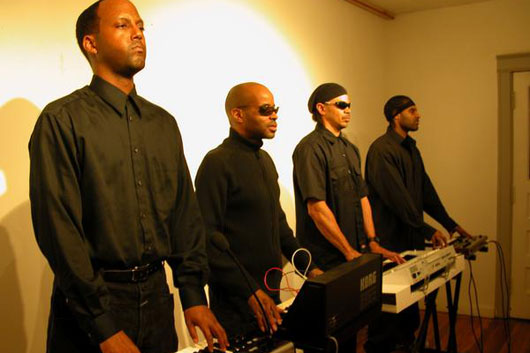
Detroit electro/techno quartet Model 500 (pictured above) is poised to drop OFI (Apollo Mixes), and is sharing an unreleased version of the single by Debukas ahead of the new record. Delving into the sounds of early Detroit, the Glasgow producer churned out a jacking house take on the group’s breakbeat-heavy, acid-leaning original. Smooth stabs commandeer the production, with a shuffling, high-pitched conga groove propelling the beat underneath it all. The official remixes from the likes of Synkro (check that one out here) and Sei A will be available on November 12 via R&S sublabel Apollo.

OFI (Debukas Mix)

Tom Trago “Rise Up” b/w “Sky High”

Vocals in dance music are the kind of thing that either make or break a track. In the case of Tom Trago‘s recent release on Rush Hour, the case is unfortunately the latter. This is something of an unexpected turn, as Trago’s discography includes “Use Me Again,” one of the better vocal cuts to surface in the past few years. Yet, while that song was anthemic and unique in its appropriation of disco house, his latest feels weirdly generic within the broader spectrum of the Dutch producer’s discography.

Introduced with a crack of lightning, “Rise Up (feat. Cinnaman)” opens in a way that seems familiar enough. Flanged hi-hats squeak across a house rhythm mixed up and made anxious by its unusual kick-drum placement. Stripped and spare, this 40-second intro might be the best section of the record—at the very least, it’s the most playable. “Now I wanna tell ya about a great love,” croons the entirely upfront and present voice of Cinnaman while the track’s tech-house bassline bounces around beneath occasional samples of erotic gasps. It quickly establishes an odd vibe that feels like something intended for Crosstown Rebels, only it’s been stripped of all moodiness; instead, it comes across as flat, happy, and ultimately bland. A battery of neon-hued stabs, seemingly cribbed from Massive’s preset library, does little to give the track definition. It’s not terrible, but it’s not particularly compelling or memorable either.

In contrast, the b-sides are unfortunately both all too memorable, thanks to a baffling vocal performance by San Proper. “Sky High (Vocal Dub)” and “Sky High (Original Demo Mix)” are very similar tracks, the only point of distinction being the looseness with which they tie San Proper’s vocal to another uninspired instrumental. A subdued rhythm, standard Moog bass, and wiggling pieces of melody create a basic structure for Proper to deliver off-key, ad-hoc lines like, “Am I high?/Your high/Ain’t nothing compared to my high” and “My high flies over your head/I’m blue and red.” On paper, it doesn’t read so bad—and this tune just might end up being an anthem for the Monday-morning crowd—but the song is stuck in an awkward place; it’s too slick to be outsider and too goofy to be serious.

Listen to Jamie xx’s Remix of Four Tet

Jamie xx (a.k.a. Jamie Smith) has given Four Tet‘s recent slow-burner “Lion” (taken from the XLR8R Pick’d Pink LP) the remix treatment, stripping the itchy beat and hulking low end down to a pause-filled and dark dubstep-leaning tune. He begins by deconstructing the original’s moody and reverb-heavy melody and sticking to a sparse aesthetic throughout the track. Uncharacteristically, there are no steel drums in Jamie xx’s version—rather, the bright maximalism of some of Smith’s earliersolowork work has been overshadowed by a quiet, contemplative gloominess more akin to the sound of his band’s latest album, Coexist. You can check it all out below.

Listen to Andy Stott’s ‘Luxury Problems’ LP

With his excellent performances at festivals like Moogfest and Decibel, Manchest producer Andy Stott has been captivating the attention of XLR8R quite a bit lately. We’re also entirely excited about his new album, Luxury Problems, which is out today via Modern Love; you can also stream it online now. If you head to NPR, Stott’s eight-track, 48-minute, mutated techno album is available to listen to in full. We highly suggest you give it a spin.

Page 1902 of 3781
1 1,900 1,901 1,902 1,903 1,904 3,781