If you’re still not sure what to be for Halloween, then this video may have your answer. UK house-and-garage maestro Hint has just debuted an adequately creepy video for his new tune with grime MC Profisee, “Watch The Media.” You may recognize the tune, as it originally appeared as part of Hint’s Daily Intake LP (which also featured a collaboration with garage veteran Zed Bias), though it’ll soon be released as part of the Daily Intake Remix EP on December 10 via Tru Thoughts, too. The video for “Watch the Media”— like Hint’s percussive-driven production work—is straight-forward and simple. Featuring eemingly ordinary UK citizens sternly posed against delicate, picturesque scenery, the piece grows increasingly menacing as the people stoicly rap along to with Profisee’s fiery verses with the help of an anonymous man, who is calmly operating one hell of an unsettling ventriloquist dummy mask.
Moogfest 2012: Nine Things We Loved and One That Needed Improvement
Taking place each year in the heart of Asheville, North Carolina, Moogfest has positioned itself as a unique destination festival. After all, Asheville is the hometown of Bob Moog, the revolutionary engineer who laid the groundwork for many of today’s modern synthesizers and, of course, the renowned Moog brand, meaning that there’s no better time to visit the city—a place many synth nerds and analog-obsessed producers consider a sort of sacred land—than the two-day festival. Of course, Moogfest is also a gathering that celebrates diversity and creativity in music, which is a big part of why we elected to make the pilgrimage ourselves last weekend. Here’s an accounting of what we saw.
Carl Craig
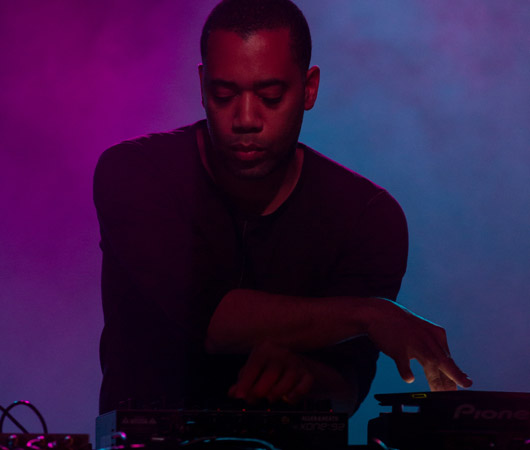
Without a doubt, Carl Craig (pictured at top) gave the most passionate performance we saw at all of Moogfest. As the final piece to a somewhat bizarre line-up that included Cold Cave and Death Grips (and was originally supposed to include Actress, who later cancelled all of his US dates due to Visa issues), Craig did what he does best, and filled the dancefloor with an impeccable mix of sumptuous techno. His two-hour set seemed to particularly favor rolling rhythms and slippery low end, much to the delight of the crowd that had gathered at the edge of downtown Asheville for one of the festival’s final events. And while the weekend had its share of dancefloor-oriented acts, this particular show perhaps represented the best culmination of elements: a proper club atmosphere (more on that later), a banging system, and a crowd that was ready to get down to some genuinely powerful techno. Behind the decks, Craig’s selection was ace, and to those of us out on the floor, it really seemed like he was having fun, a fact further demonstrated by his willingness to jump on the mic towards the end of his set and share some techno education—he proclaimed Derrick May’s “Strings of Life” to be the techno equivalent of “Amazing Grace.” Later, Craig closed his set with a bit of James Brown, an artist he credited as the “Father of Funk” while reminding us that there would have been no techno without that man.
Photo by Ruslan Tumash
Pantha Du Prince
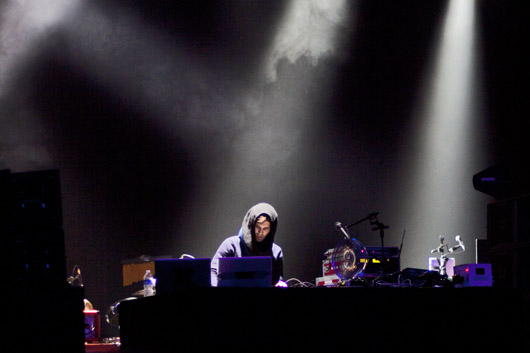
For the first 15 minutes of his set, Pantha Du Prince wove together a beatless combination of swirling ambience and sprightly electronics, one so heavenly that it almost seemed to invite those in the audience to sit on the floor, or at least close their eyes. With a laptop, some controllers, and a small fan (which he occasionally flicked in order to process the resulting clattering metallic noises) placed on the table in front of him, the Berlin producer brought many of his own productions to life, building the pieces together in patient phases that showcased the simplistic strength of his melodies and detail of his sound palette. It was hard to tell if Pantha du Prince was merely running through his set or, in fact, reacting to the audience, but his combination of inviting musicality and steady four-on-the-floor proved a winning combination for the 7 p.m. slot he had been given inside of the massive ExploreAsheville.com Arena. And although the floor was only maybe a quarter full (there were still a few hundred people though), by the time his hour-long set was coming to a close, no one within the gathering of costumed dancers really seemed to mind, maybe because they knew the latecomers had clearly missed out.
Andy Stott
Andy Stott‘s brand of dark, twisted techno was one Moogfest’s most cynical and challenging offerings, which is why it was bit strange to see the Manchester producer methodically build patterns behind his laptop at 8:30 p.m. while seated in the chairs of the Diana Wortham Theatre. Really, it seemed like Stott was incorrectly billed between electro-acoustic songstress Julia Holter and the noise-bliss improvisations of Tim Hecker and Daniel Lopatin, but the festival’s schedulers might have gotten a little lucky this time around, as the opportunity to sit down and take in Stott’s productions actually illuminated some aspects of his talents. In particular, his textures proved even more impressive with the extra attention that could be given to them, and the opportunity to take in his wall of sound while in a chair made it even more trance-inducing. Still, for those of us that were steadily sinking deeper into our “zone” thanks to Stott’s elongated constructions, there were just as many kids freaking out in their chairs, frantically bobbing their heads up and down and cheering Stott onward whenever he unleashed his massive, weighted kick drums.
Photo by Reggie Tidwell
Richie Hawtin
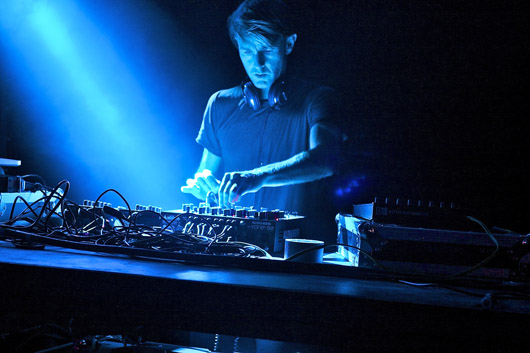
He has long been regarded as one of techno’s foremost figures, has DJed across the world for decades, and more recently curated one of Ibiza’s most forward-thinking clubs, but on Friday night, Richie Hawtin ended up at the ExploreAsheville.com Area in North Carolina, taking the stage about 45 minutes after Primus had done whatever it is they do. To say the least, the circumstances weren’t ideal for a Hawtin DJ set, but the Windsor native did his best to bring some respectable music back to the half-full arena, and with his unbelievable precision and uncompromising dedication to deep, deep techno, he won the crowd over in the span of two or three songs (admittedly, they were probably seven or eight minutes each). Similar to Craig, Hawtin seemed affixed on rolling rhythms, but unlike Craig, he coyly sprinkled refracted effects and processed soundscapes atop the piles of bass, yielding a remarkably three-dimensional sound experience that was warmly received by the drugged dancers and beard-stroking onlookers alike until they all became one united mass of moving bodies.
Disclosure
With the continuing unprecedented success of young UK outfit Disclosure, and the fact that this Moogfest appearance was only the group’s third show following its North American live debut a week earlier, the crowd already had a healthy buzz even before the London brothers took the stage Saturday night. Fortunately, watching the two make their brand of silky garage and house come to life proved to be a spectacle in itself, as they utilized a few tables of controllers, synths (appropriately enough, special Moog ones for this particular performance), two laptops, and a number of percussive instruments and drum pads to seamlessly add a live element to the enticing backing tracks. Playing synth lines, punching out drum patterns, triggering vocal samples, and even breaking out shakers, cowbells, and the like, the members of Disclosure were not ones to simply press buttons. In truth, the effort was likely only appreciated by half of the crowd, as the rest really didn’t care what was happening onstage as long as the pair pumped its catchy pop/club hybrids at a healthy volume. Not that further proof was necessary, but the outfit’s Moogfest appearance clearly continued the conversation that Disclosure has a special appeal that has tapped into a wider base than any other act of its ilk.
Photo by Joseph F. Carney III

Blondes
Watching New York duo Blondes set up its gear on the stage of the Asheville Music Hall made some of us in the crowd a little nervous. Even the members of Blondes themselves looked a little unsure if they had ended up on the right stage, following a set of lackluster beats from the opener and plugging in their various units as Nas played through the venue’s PA (ironically, as the rapper was performing up the street at the same time). But at almost the instant the pair’s set began, the room filled up, and with Blondes at the helm, one of the best dance parties of the entire weekend was quickly underway. This may have been in part due to the clear interaction the duo had with its music, twisting and turning knobs and flipping switches on the various sequencers, FX units, and mixer sprawled out on the tabletop, along with a Juno synth, which provided some spiraling arpeggio lines and thick chords throughout the night. Amongst the nest of cords that strung together the various pieces of hardware, Blondes put together one of Moogfest’s most rewarding sets, a flawless hour of deep, synth-obsessed techno that moved between ideas and rhythms with an expert touch and took the pair’s productions down occasionally unexpected paths.
Four Tet
Does anyone know exactly what Four Tet is doing on stage? At Moogfest, he appeared to be manipulating the same set-up which was seen on his recent Boiler Room session, with two laptops and an array of controllers at his fingertips. The London producer/DJ was another artist up against some rather peculiar circumstances, unraveling his melody-led, polyrhythmic tracks as the venue for his performance, the Thomas Wolfe Auditorium (adjacent to the aforementioned ExploreAsheville Arena), featured a mostly seated audience space. Aside from the 80-plus revelers in front of the seated area (but still barricaded a good 20 feet from the stage), the rest of the crowd was forced to stand and dance amongst the red velvet chairs and a cohesive dance party never really took hold. Still, Four Tet’s cacophony of tribal rhythms and engrossing melodic patterns were gorgeously displayed and did his extraordinary body of work justice.
“Dr. Bob’s Interactive Sonic Experience” by Scott W. Lee
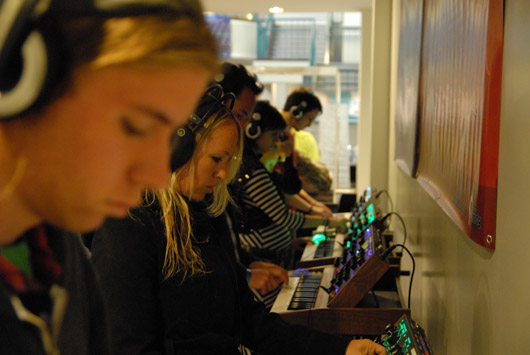
The Bob Moog Foundation
The non-profit founded in Bob Moog’s honor, the Bob Moog Foundation, hosted a series of panels and a few interactive experiences throughout the weekend, giving Moogfest attendees the rightful sense that we weren’t just there to listen to music and party, but also in some way to honor the legacy of Bob Moog by discussing and taking a moment to appreciate the visionary’s engineering foresight and his irreplaceable impact on modern musical creativity. The most tactical display of this effort came in the shape of “Dr. Bob’s Interactive Sonic Experience,” where visitors were encouraged to freely indulge in some exploratory knob-turning amongst a slew of Moog set-ups that paired Voyagers, Minitaurs, and Theremins alongside any number Moogerfooger pedals. Furthermore, multiple headphone setups could be used at most of the stations, so friends and strangers alike could share the riveting experience of turning raw voltage into sound. It was a disarmingly adventurous relief from the hum and buzz of the rest of the festival, and to talk with the foundation members who run similarly engaging programs in local schools was a warm thought to leave with.
Scheduling and Venues
Moogfest’s curators emphasize the diversity of the festival’s talent as one its major strengths, and in truth, that’s partially true. Due to the packaging of acts who wouldn’t normally share a bill, festivalgoers are likely to run into a band or performer they wouldn’t normally seek out, and, for the most part, are likely to be pleasantly surprised. For instance, Julia Holter‘s set, which preceded Andy Stott’s aforementioned performance, was unexpectedly breathtaking, and seeing a bill with Thomas Dolby and Four Tet or Disclosure and Prefuse 73 may have seemed a bit strange, but largely worked out great in the end. Nonetheless, there were two major stumbling blocks for Moogfest: the scheduling of acts and the limitation of venues in Asheville.
Both nights of the festival started at an astounding 7 p.m., sometimes jumping straight into dancefloor fare that would have been better suited for the later hours. Still, the more relevant scheduling issue was the amount of time between acts. Operated more like a rock show than an electronic festival, every showcase would place a 30- to 45-minute break between performances, which—while it did leave ample time for attendees to seek out other happenings—made it hard for a palpable sense of momentum to build in one place throughout the course of the night. Furthermore, this constant push and pull occasionally wasn’t helped by the venues in which the artists were booked. For instance, the Thomas Wolfe Auditorium was filled with row upon row of permanent seating, making it hard for everyone except those in the front “dancefloor area” to really get into the music. Similarly, the massive ExlporeAsheville.com Arena was a bizarre venue to see anything that could be considered “cutting-edge” music, a place that felt more like the pit of a sports arena than any sort of stimulating environment to take in creative music. But as one North Carolina native so simply put it, when doing a festival of this size in Asheville, you just have to work with what you’ve got.
Moog Factory by Glenn Jackson
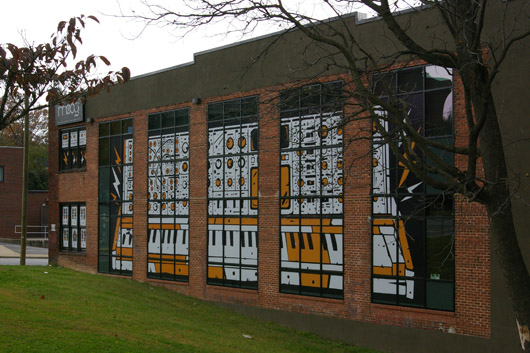
Asheville
Despite its lack of ideal venues (although, it should be pointed out that the Orange Peel was actually a great club), Asheville is a fun city. The downtown area—where the bulk of the festival took place—is easy to get around, and a plethora of delicious food options are on almost every corner. Furthermore, Asheville is a city that loves beer—never once were the choices of malt beverage simply limited to the generic domestic fare one might have expected. Truthfully, Asheville came across as a quirky town, one full of a wide range of friendly personalities, making for an atmosphere that pleasantly didn’t always feel like there was a festival happening, except for the occasional “Welcome Moogers” in a store window or the always full Moog headquarters situated just at the edge of downtown. It may not be a big city with the resources and energy of New York, Chicago, or even Seattle, but there is certainly something enticing about it, even if it is just Asheville’s place as the hometown of one of electronic music’s most pioneering figures. With a growing festival and a swelling local appreciation for creative music, Moogfest is likely to continue being a worthwhile destination for synth nerds and music lovers alike.
El Buho “Witches Brew”
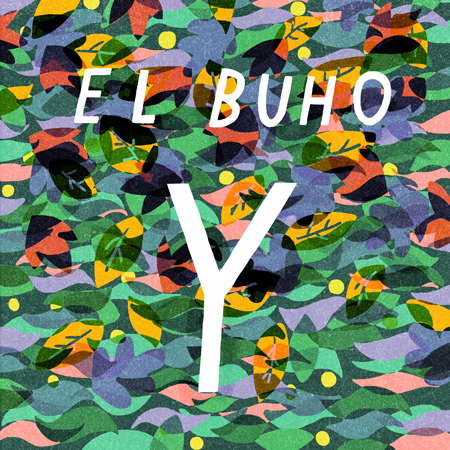
Although El Buho (a.k.a. Robin Perkins) was born in Northern England, he has been influenced by foreign lands, from Latin American sounds to the musical landscape of Amsterdam, the producer’s current home. The Dutch city’s rainy climate and many waterways inspired the main theme of his latest release, an EP titled Y, which also happens to be the word for “water” in Guarani and Tupi, the native languages in Paraguay and Brazil. Fledgling imprint Meles Meles shared El Buho’s record for free on its Facebook page today, and sent over one of the tracks as a teaser for the digital release. The sound of lapping water plays a starring role in “Witches Brew,” and the bass tones and yawning vocal samples seem to melt into the waves of sound and splashing beat work.
Jets Jets EP
Given their past form as individual artists, one could be forgiven for assuming that Jimmy Edgar‘s and Machinedrum‘s first collaborative release would be a much more colorful, in-your-face affair than it actually is. Both on record and as a performer, Edgar has long been known as an artist unafraid to indulge his playful side; he’s renowned for his love of mechanized, erotic funk and vintage R&B just as much as he is for his skills as a producer and DJ. Similarly, in the wake of last year’s excellent, footwork-informed LP, Room(s), Machinedrum’s live outings have become increasingly sweaty, high-tempo affairs that see the producer turning out a fast-paced mix of juke and old hardcore alongside impassioned live renditions of his own tunes. There was every chance then, that the long-time friends’ debut release as Jets could have turned out to be a head-spinning exercise in dance-music bombast, with each artist’s more eccentric leanings amplified by the presence of the other. Thankfully, it’s not. Instead, what we see with Jets is the less upfront, more skillful side of each producer—Machinedrum’s talent for intricate drum programming, Jimmy Edgar’s inner synth nerd—with results that transcend the sum of its parts.
That’s not to say that Jets is a totally straightforward affair though; across the course of four tracks, the pair manages to touch on a surprisingly broad range of influences with impressive subtlety. Opener “In Her City” matches the familiar hollow synth tones of the duo’s adopted Berlin home (both producers have settled in the city in recent years) with disjointed vocal syllables that wouldn’t sound out of place on a Todd Edwards record. It builds slowly, but the payoff comes in the form of simple, interlocking synth lines and scattered drum beats rather than a meaty drop. Meanwhile, “Sin Love With You” is a synth-heavy jam at hip-hop tempo. With its thick chords and quick vocal cuts, it’s also the closest the EP comes to showing signs of Edgar’s funk leanings.
The second half of the EP raises the pace a little; “Mue” indulges Machinedrum’s love of juke rhythms, reviving the quickfire drum machine patterns and heavily chopped vocals that characterised Room(s)‘ best moments with a thick arpeggiated synth piled on top. The release then reaches its energetic peak with closer “Lock Lock Key Key”—a dense mix of stop-start edits and joyous handclaps.
While it’s easy to link moments throughout the EP back to each producer’s solo work, it would be doing them an injustice to infer that Jets is simply a mash-up of the pair’s individual production traits. Wherever it’s possible to identify the input of one half of the duo, it’s also possible to hear the obvious—and more often than not, positive—influence of the other; Machinedrum’s hectic drum lines and vocal edits are given added weight thanks to the backbone of Edgar’s pristine production; Edgar’s metallic-sounding synths feel more organic thanks to Machinedrum’s atmospheric touch. There’s nothing that revolutionary about the final product—the EP features no track-of-the-year contenders or sub-genre-defining mash-ups of styles—but it would be hard to deny the appeal of these four exceptionally well-produced tunes. It’s certainly a good thing that these two artists are finally working together, and it’s difficult to shake the suspicion that, if the duo decides to take Jets on the road, a live show from the pair could prove to be pretty phenomenal.
Kidsuke “Wanju”
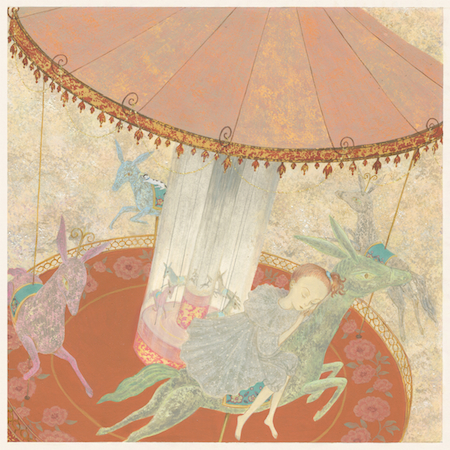
What happens when you mix the sound of the UK hip-hop with experimental glitch beats from Japan? Well, in this case, you get Kidsuke, the new collaborative project from the UK’s Kidkanevil and Japanese producer Daisuke Tanabe (both of who have appeared in XLR8R‘s Downloads feed before). The two artists are set to release the product of their collaboration in the form of a self-titled album via Project Mooncircle on November 5, but before then, we have a track that didn’t make it on Kidsuke (artwork above). “Wanju” is a predominately atmospheric composition that sounds as if it could be the soundtrack to your Cartesian theater as you reminisce about early childhood memories. But if you’re looking for some more full-fledged jams from the pair, you can stream a preview of Kidsuke’s double-LP before it drops, after the jump.
John Talabot & Pional “Braves”
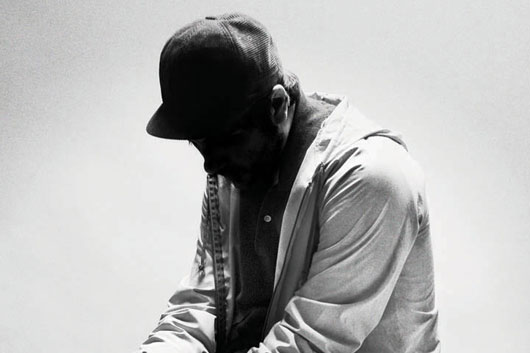
The Spanish artist behind what will undoubtedly go down as one of XLR8R‘s favorite albums of 2012, John Talabot has just posted an exclusive new track online, a collaboration with singer Pional called “Braves.” The upbeat, ethereal tune was written at the behest of Maratón Divina Pastora de Valencia, and is the 35-mile marathon’s official theme song. Apparently, John Talabot and Pional wrote their song from the perspective of the heart of an anonymous runner, building off of the marathon’s theme: “running is for the brave.”
Video Premiere: Martin Eden “Verions”
XLR8R Couldn't find the embed function for type: "vimeo" and source: "<iframe src="http://player.vimeo.com/video/51289644?badge=0" width="530" height="298" frameborder="0" webkitallowfullscreen="" mozallowfullscreen="" allowfullscreen=""></iframe>".
Matthew Cooper of Eluvium (a.k.a. Martin Eden) has just released the video for his new track “Verions.” Cooper, who initially caught our attention earlier this summer with “Worker” (which actually made our list of the Top 20 Downloads of July), has clearly been busy making new music. After dropping his self-titled 7″, he’s back with a full-length album called Dedicate Function, which is out now via Lefse. “Verions” is lifted off that release, and furthers the minimalistic and mellow vibes of “Worker.” Though the song may be a touch repetitive, the visuals add diversity and aptly complement the vibe. The footage—featuring both animated and live action shots of the world and the sky—fades and expands with the swellings of the synths in a kaleidoscopic fashion.
Heathered Pearls “Beach Shelter”

Brooklyn-based producer Jakub Alexander (a.k.a. Heathered Pearls) sent over one of the tracks from his forthcoming debut LP for Ghostly, Loyal. Driven only by soft pads and gentle white noise, “Beach Shelter” congeals within a hollow, atmospheric space rather than a solid beat. It’s a blanket of warm, calming tones that evoke sentimental moods, which is fitting given that the record was inspired by Alexander’s mother and aunt (who also adorn the artwork, above). Further explaining the creative process behind Loyal, he conceded, “I wanted to find a world that was built on repetition, erosion, and melody, because making these songs was about recreating soothing environments.” Look for the rest of Heathered Pearls’ Loyal when it drops on December 11.
Video: Tensnake “Mainline (feat. Syron)”
Breakout German DJ/producer Tensnake has just unveiled the video for his new “Mainline” single, which features a powerful vocal performance from singer Syron. The clip, much like the song, effortlessly evokes feel-good vibes in an old-school fashion. Similar to Kanye’s “Good Life” video, director Pondr‘s footage features colorful, ’80s-inspired animation over the top of Syron doing her thing while dancers groove around her, on top of her, and in the palm of her hand. Look for the single when it drops via Defected Records November 5.
This Week in Music Tech: Ableton Live 9 and Push Controller, Traktor Pro 2.6, and Electrix Tweaker
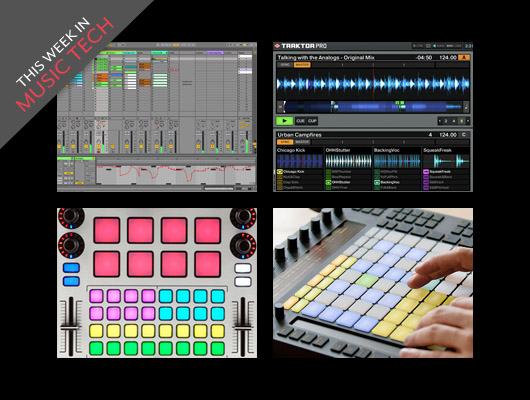
It almost goes without saying that the big news in the world of production gear this week was the official announcement from Ableton of the forthcoming Live 9 software and the company’s first venture into controller design, Push. Along with those details, we’ve gathered up a few other useful tidbits that we couldn’t let slip under the radar.
Ableton 9 is officially on its way, with a brand new controller to boot:
– Yesterday, Ableton officially announced that the next version of its renowned Live software is on its way. Out of the littany of new features said to come with Live 9, at the top of our list are the updated browser, revamped automation capabilities, the new Glue compressor (modeled after the stereo compressor from a classic British console), an improved EQ 8, a faster Max for Live (which will be included with the Live 9 Suite), and—perhaps most intriguingly—the ability to convert monophonic, polyphonic, and ryhtmic audio to MIDI data. You can check out a video showcasing some of Live 9’s new features below and head here to read up on all of the details before the software sees a release early next year.
– Alongside the Live 9 news, Ableton unveiled its first ever controller, Push. The sleek bus-powered unit is said to be a hybrid of hardware and software that is perfectly suited for creation within Live 9. With its 64 velocity- and pressure-sensitive pads, eight touch-sensitive encoders, and colorful LEDs combined with its slew of functions and modes, it looks like Push may be looking to find that controller sweet spot between the Monome, Launchpad, APCs, and the rest of the current crop of USB tools. Check out the demo video below, and get all the specs on Push here.
– Update: There is now an hour-long video of Ableton’s preview event in Berlin for Live 9 and Push for you diehards that just can’t get enough info on the forthcoming goodies; watch it below.
Traktor Pro 2.6 is now availible:
– Back when Native Instruments announced the details of its forthcoming mixer/controller hybrid, the Kontrol Z2, it also unveiled the Traktor Pro 2.6 update that included a new Flux Mode, 11 new Macro FX (essentially combinations of existing Traktor FX), and other various performance enhancements. Now, that software has been made available for existing Traktor Pro users to take advantage of these features before the Z2 hits the shelves. Current users are directed to download the free update via Native Instruments’ Service Center application.
Electrix releases a colorful controller:

– Although it officially saw a release earlier this month, we caught wind of this flashy performance controller from Electrix just this week, and couldn’t help but share. The Tweaker is said to work with Traktor, Ableton, and Serato out of the box, and also comes with an editor to help customize its use. Aside from the bright colors and videogame controller-esque design, the Tweaker also features four feet that lift it off the table top. We not entirely sure if any of that is actually useful or not, but it certainly lends itself to a second glance. You can check out the full details on the newly released unit here.
And, in case you missed them:
– Two reviews popped up on our site this week as we took a critical look at Novation’s latest synthesizer, the compact Mininova, and Vestax’s VCI-400 USB/MIDI DJ controller. Take a look and see what we thought of the two pieces.