Keith McMillen and the QuNeo

Curious about the recently released QuNeo controller, we talk with its creator to better understand the “3-D Multi-touch” surface.

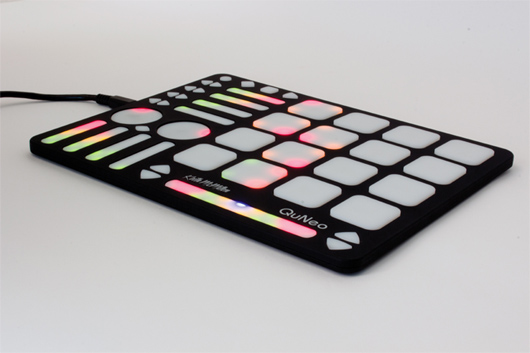
Much in the same way that the internet and our ever-increasing access to technology has changed the worlds of music industry and production, those very same factors have altered the playing field for designers and manufacturers of production equipment in recent years, giving a growing power and visibility to smaller companies with more radical visions. Keith McMillen Instruments is one such company, headed by the decades-experienced designer who gives the operation its namesake, a brand which has spent the past seven years creating new tools that enhance the ways composers, performers, producers, and DJs interact with their computers. The latest product to emerge from Keith McMillen and his small-but-knowledgable crew is the QuNeo, an extremely portable contoller that seeks a balance between ease of use, enhanced musical expression, and endless customization—all in a unit with the exact same dimensions as an iPad.

Back in January, the idea for the controller was first proposed via a Kickstarter fundraising effort that eventually received overwhelming support, raising over $165,000 from almost 700 initial backers. After some unexpected delays in the manufacturing process, the controller reached its supporters’ hands as well as the shelves of stores last month. Among its impressive features, the QuNeo in its current state boasts a 4×4 grid of ultra-responsive pads that send nuanced X-Y location and pressure messages, or can alternately be used in “Grid Mode” to be utilized as 64 separate triggers, with each corner of the pads supplying a unique MIDI note. A quick glance at the QuNeo reveals some really smart features: a single USB port for both power and communication, a number of velocity-sensitive rotary sensors and sliders, and a robust LED system capable of supplying in-depth visual feedback. But perhaps most important of all is the freedom the controller seeks to give its user, essentially allowing its handlers to completely customize and implement its various capabilities at a variety of programming levels. As such, the QuNeo represents an intriguing technological step, one that empowers DJs and producers to, in a certain capacity, become designers of their own musical instruments. We were intrigued, and so decided to visit McMillen at his Berkeley headquarters to get a better sense of the concept behind the QuNeo and what all he thinks we can do with his latest creation.

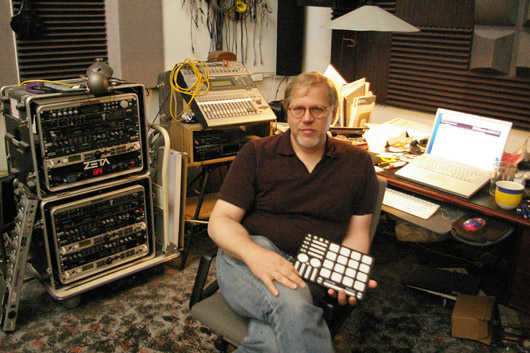
Keith McMillen in his Berkeley, CA workshop
XLR8R: What was the inspiration for the QuNeo?

Keith McMillen: I’ve always been interested in how musicians interact with computers, that’s what I’ve spent my whole life studying and working on, and being able to have a surface that was responsive, small, and gave a lot of visual feedback was a good challenge. I’ve seen other surfaces and even worked on them for other companies, and felt that I wanted something that was more instrument-like, something you could push and invest yourself into physically as well as mentally. [Over my career,] I’ve made a lot of advances with sensor materials. I developed a grip sensor for the K-Bow, and before that no one had made a cylindrical sensor that was responsive everywhere. So, I had a lot of experience with material sciences specific to sensors, and I felt [something like the QuNeo] could be done. That was July of last year.

Why was the size such an important factor in the unit’s development?

That’s true for everything I do. Having toured, if it can’t fit in my backpack and go in the overhead bin, it’s not coming with me. And the airlines have just made it so miserable for everyone, especially musicians. Considering we all get paid so much for what we do [laughs], it just seemed ridiculous to keep giving all the money we made to the airlines just to haul our gear around.

With your past products like the SoftStep, it seems there was a specific purpose in mind for the product. Did you have a similarly distinct vision for how the QuNeo could be used, or do you see it more as a blank slate?

It’s very open. Though, I think in a lot of ways, the QuNeo was easier to develop than the SoftStep—no one had produced a programmable, touch-sensitive foot controller, so there were no models out there [when I developed the SoftStep]. In that way, making the QuNeo was easier conceptually because there were examples out there; there are drum pads and clip launchers and decks, those were the analogs. We just wanted to take the best of what those devices gave musicians, improve upon it, and put it into something that was very portable and tough—and could light up like crazy.

How does the collaborative process work within the company? You have the initial idea and then everyone works together to accomplish it?

When the idea comes to the team, it’s pretty much all there. Everything it’s supposed to do is in place in the spec. For instance, there are a lot of LEDs on the QuNeo that run just off USB bus power, so I had to come up with a scheme to do that, and I worked a lot with Dan McAnulty on improving the hardware concepts—he was instrumental in getting that up to speed and working with me on the firmware. Then everyone in the software arm of the company had to develop the editor, and make sure it was usable and clear, as well as come up with scripts for Live, Traktor, and all those sorts of programs. Otherwise, if there was no starting point, it was going to be a nightmare for people.

The QuNeo takes a decent amount of self-tinkering to get started, but allows for a lot of freedom and customization. Do you think that is the direction controllers and electronic instruments should be going, allowing producers to completely edit and customize their own pieces of gear?

We are big on flexibility. However, if something is totally open, there is no starting point. By now, we’ve shipped thousands of these, and I’ve been surprised by the lack of people moaning about getting going with the QuNeo. We worked very hard so that no matter what program they are using, they can turn it on and it works in a way that allows them to get a response very quickly. From there, it’s important for people to then invest themselves into learning the rest of what’s possible. There’s the adage, “No threshold, no ceiling.” I really think that’s one of the hardest things to do in a design, to make it accessible to people immediately, yet they can spend a life with it and continue to learn and explore.

Do you guys have plans to create any sort of QuNeo user community for people to share the configurations they come up with?

Yes, we actually have a lot of plans. We are actually already working on version 1.2 of the software based on a lot of people’s requests, and eventually we’d like to put out a high-resolution version of the software, as well.

What do you mean by “high-resolution”?

Well, the present firmware supports MIDI devices which are 7-bit. We can do 12-bit and higher resolution, and I know there are people out there—maybe just academic types right now—who will want that, so we’re planning to put out a firmware version early next year that would give you extremely high resolution. I’ve put about 150 products on the market over the years, and you learn what not to do, because it hurts. With this product, we made sure we would be able to improve and adjust it in the future.

Do you think that sort of detail will eventually be the norm for electronic musicians?

Yes. As I said, I’m very interested in interfacing musicians with computers, but I’m also interested in enabling some sort of longevity. We’ve had 50 years of computers and music, and there really isn’t any repertoire. For me, that’s very frustrating, and that’s something I’d like to help solve. That’s something I always keep in mind, but realistically, products have to work for people without much grief. There are a lot of people making music now with controllers and launchers, and I wanted to not only satisfy their needs but also invite them to do more. There’s a lot that has been left out [of controllers] in terms of capabilities; everything is switches and pots, and they’ve been switches and pots for a long time. The ability to get pressure, X-Y, and do all the things humans want to do, like wiggle it [are missing]. You want to wiggle something and hear it, and you want to hear it right away. I think once you can satisfy those basic musical demands, a lot can happen.

Lastly, is there a particular vision or plan you see for the company and its products moving forward?

I’ve got literally a dozen new projects that are currently underway, with more to come. I think all of the products we’re developing will be similar to the QuNeo in that they will be intimate, flexible, surprising, and—most importantly—affordable.


Hi-Five: Bicep

Although Bicep is now garnering plenty of acclaim for its production work and newly minted label, the house-obsessed duo of Andy Ferguson and Matt McBriar first built its name on the pair’s crate-digging abilties. This talent has been most clearly been exhibited via the two Irishmen’s long-running Feel My Bicep blog, but has increasingly been on display via their unabashedly euphoric and often retro-flavored DJ sets. Given the now London-based pair’s penchant for unearthing old-school gems, we figured that the members of Bicep would be excellent candidates to participate in our ongoing High Five series. Fresh off a US tour—one which also included a stop at the famed Beats in Space radio show for a rare live set of completely unreleased material—the boys have put together a list of five tunes that they’ve tabbed as “vocal vices.”

Scottie Deep presents Daddy’s Moods “About You (Drama Mix)”

This one caused quite a stir on our FADER and Boiler Room mixes. It’s gone from $8 when we bought it four months ago to $150 on Discogs since the track ID was discovered! This is MK’s brother bringing the sizzle. For us, it sums up the that early-’90s sound perfectly. Supremely positive and summery, the track brings a smile to every floor it hits. Classic Rhodes keys and a vocal that gets stuck in your head. This is HOUSE!

Slam Slam “Move! (Dance All Night) (Slammin 12″)”

Big, big house track from back in 1991. Fans of Tony Humphries should know this one for sure, as it appeared on quite a few mixtapes from that early-’90s era. (The “Slammin” remix is actually by house legend David Morales.) The snare patterns in this totally kills it, and they’ve been matched with the perfect end-of-the-night vocal. This one rarely leaves the crate, it’s more super positive house music.

Stanton Warriors presents Zack Toms “Bring Me Down (Stanton Warriors Vocal Mix)”

Be it the tiniest back-room club or a full-capacity festival tent, when this bad boy goes off so do our tops! We’ve played this in clubs all over the world and it gets the same reaction everywhere. And… It’s Stanton Warriors!!! What?!?! The first drop causes pandemonium; proper, proper UK garage vibes first released in 1999.

Jill Scott “Love on a Rainy Day (Hard Vocal)”

Smoldering, soulful, shuffling house at its very best. It’s a perfect tune for the warm up! We have had to buy this on wax twice after warping our first copy. It’s actually a house interpretation of the Jill Scott and Mos Def classic “Love Rain.” Fans of Masters at Work and Mood II Swing are gonna be diggin’ this.

Bicep “Vision of Love”

This track is a tip of the cap to that carefree, positive ’90s vibe that we love so much. The funny thing is that it was actually created very early one Sunday morning around 7 a.m., when we were super hungover and probably not feeling the most positive. It may have been an attempt to cheer ourselves up! For us personally, as much as house music will evolve and develop, NOTHING beats a nice piano riff and some chopped-up vocals.

Bam Spacey “Dessa Bränder (CHLLNGR Remix)”

Earlier this year, Swedish producer Bam Spacey (pictured above) released a six-track EP of moody, and, yes, spacey dance music via New York’s Ceremony imprint. Now, five months after Land‘s release, Spacey has shared this remix of the EP track “Dessa Bränder” from a producer just as familiar with the depths of vast electronic sounds, CHLLNGR, who laces the swirling arpeggios and airy pads of the tune with a percussion-filled dub ryhthym. As luck would have it, a video for the original “Dessa Bränder” just dropped yesterday, which we’ve gone ahead and provided for your viewing pleasure after the jump.

Bam Spacey-Dessa Brander(CHLLNGR Remix)

XLR8R Couldn't find the embed function for type: "vimeo" and source: "<iframe src="http://player.vimeo.com/video/48601671?badge=0" width="530" height="298" frameborder="0" webkitallowfullscreen="" mozallowfullscreen="" allowfullscreen=""></iframe>".

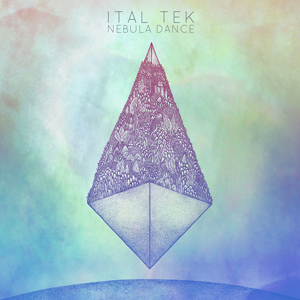
Ital Tek Nebula Dance

The third full-length from Ital Tek (a.k.a. Alan Myson) marks another shift in sound for the restless producer. In the past, the Brighton-based Atom River label boss has dabbled in Dilla-flavored hip-hop, hulking dubstep, and noise-leaning drum & bass, but the Nebula Dance LP finds him broadening his horizons once again. His latest is in line with other recent Planet Mu releases from the likes of Young Smoke and Traxman, as Ital Tek has immersed himself in footwork’s skittering rhythms and rapid tempos. His take involves glossy, precise production that results in pristinely crafted tracks where only rarely is a hair out of place.

The songs brim with neatly organized minutiae, the music’s precision showcasing Ital Tek’s attention to detail. Tracks like “In Motion” are teeming with a variety of twinkling percussive sounds that work like micro-melodies, but they’re all arranged in what feels like an exact order. Every element, from the surging synths to the husky monosyllabic vocal samples, is not only particularly placed, but meticulously sculpted and edited.

The drawback to this perfectionism is that the productions can come off a little sterile. On “Pixel Haze,” Ital Tek falls short of constructing a specific or humanizing mood, as the sense of wonder generated by the song’s sparkling synths and shimmering pads is undercut by the braying trance melodies that come in toward the end. Coupled with pixelated trills, the track lays digital sounds on thick, which can verge on alienating the listener.

Thankfully, Ital Tek has an ear for beauty that counteracts his penchant for highly robotic soundscapes. “Pixel Haze” is overlaid with sleek pads and moments of airy ambience, an aesthetic he expands upon with tracks like “Dusk Beat,” “Glokk,” and “Solar Sail.” Representing some of the most engaging and inviting work on Nebula Dance, these tracks use the producer’s detailed, precise production to compose blithe and occasionally dozy moods. “Dusk Beat” creates a sense of light, relaxed hypnotism from a lustrous palette of sounds that includes flickering synths, rapid-fire percussive bubbling, and gliding, angelic vocals. “Glokk” and “Solar Sail” are similarly astral and soothing, although they ground the pretty, delicate noises in a hum of low end.

Skating along on smooth sounds that seem almost effortless, these outer-galaxy footwork songs—along with the energy and aura they display—are Ital Tek’s strong suit. The tangible moods offered provide an entry point for listener engagement, which can be a struggle when the productions are otherwise so digitally pristine. The fluidity of the gliding synths, along with the spaced-out, ambient leaning cuts like “Discontinuum,” lend the album a sense of cohesion that makes Nebula Dance a gorgeous, lean-back listening experience.

Sin City Status “Plastic”

Brace yourselves, for “Plastic” by Amsterdam producers Sin City Status is a journey into heavy, low-frequency territory guided by little more than a single sampled word: “plastic.” On the one-off cut, which follows the pair’s recently released “The Clave” b/w “Cut Two” record for Party Guy, pure and pristine bass accompanies peppy handclaps and precise percussion elements taken from what seems like hip-hop and classic techno drum kits.

Plastic

Various Artists Tales from the Darkside

It’s a bit hard to believe that London’s Unknown to the Unknown got its start as a YouTube channel that functioned as a repository and showcase for little-known and forgotten tunes. Since its establishment a little more than a year ago, the label, run by Hot City’s DJ Haus, has since amassed a dense catalog of releases by an impressive roster that includes the likes of 5kinandbone5, Nightwave, Sinden, and Dubbel Dutch, among others. Now, UTTU has dropped Tales from the Darkside, a compilation of 12 “demented darkside bangers,” just in time for Halloween.

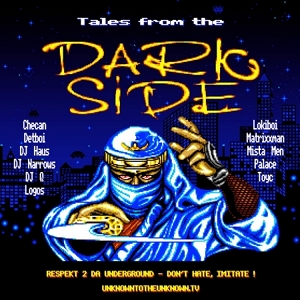
If there’s one element that all UTTU releases share, it’s the aesthetic that permeates the label’s album art—a blend of allusions to facets of ’80s, ’90s, and current pop culture coupled with font choices that test the very limits of legibility. Tales From The Darkside is no different in this respect; its cover, which sets a retro-looking video game ninja before a cityscape backdrop with subtly hidden allusions to arcade classic Space Invaders, showcases the unabashed reverence that the UTTU crew has for all things old school. The art isn’t just an attention-grabber though; the ninja, who aims his sword directly at the viewer, is a good indicator for the type of music that can be found on Tales from the Darkside—it’s bold, brash, and unafraid to get up in the listener’s face.

The album opens with UTTU newcomer LOGOS’ “Devils,” a melange of videogame sounds that’s as reminiscent of an arcade as the record’s cover art. The beat, made up of assorted weird blips, clicks, gunshots, and what sounds like camera shutters, is hard to get a read on—that is, until the malevolent, grime-influenced bass (which recalls Wiley’s eski sounds) puts things firmly in perspective with a hearty serving of low end. The last minute and a half of the track, however, plays host to a jarring yet interesting change as the banging percussion, blips, and bass throbs make way for blissed-out synths while continuing to churn underneath. Detboi and label head DJ Haus follow up with “Nightbreed,” a twisted garage-house jam that showcases a steady 4/4 beneath a warping synth lead, while South Yorks Militia comes in third with “Short Back & Sides,” a back-to-basics affair featuring skittering percussion, dirty “wubs,” and a plethora of samples that includes the requisite snippets of Jamaican dub and ’80s arcade effects (try spotting the Pacman sample buried deep in the mix). Following this is DJ Narrows‘ monolithic, old-school-dubstep-indebted “Android,” whose crunchy sub-bass and 2-step-influenced backbeat seem equally at home soundtracking club nights and videogame boss fights.

The compilation’s middle four tracks—TOYC‘s “Levy,” Lokiboi‘s “Pump It,” DJ Q‘s “More Than You,” and Mista Men‘s “Relentless”—form a strong core for the record as a whole, and probably best showcase the wide range of sounds UTTU has at its disposal. “Levy,” the rumpshaker of the bunch, starts off with an abundance of 808 sounds and claps before segueing into a genre-bending, percolating lead that’s equal parts UK funky and house. “Pump It” is exactly what we’ve come to expect from Lokiboi—heavy, shuffling house with ample amounts of swing. As an obscure sample intones the words “pump it,” the backbeat is punctuated every so often by percussive, metallic sounds. “More Than You” is an interesting genre bender, as well; its old-school 2-step sounds, dirty wubs, and sexy female sample may be familiar hallmarks of garage, but its organ sounds and touches of purple-toned synth squalls push the production just deep enough into foreign territory to make the track fresh and interesting. Label stalwarts Mista Men also put forth a strong effort with “Relentless,” a garage-house shuffler featuring understated bass and soulful R&B samples.

The last third of the album begins with Checan‘s “Killer Bee,” which plays host to the fusion of a delicate, music-box-like lead and the caustic low-end growls of a sweltering grime instrumental. Palace‘s remix of opener “Devils” manages to rein in some of the frenetic energy from LOGOS’ original, imbuing it with a lumbering, stomping beat while remaining faithful to its source material. The rest of this segment of the record, however, falters a bit in comparison. DJ Haus & Matrixxman‘s titular track, “Tales from the Darkside,” offers more of the same dirty, aggressive bass leads featured throughout the album. It isn’t bad in itself, but it seems to suffer in terms of placement; after a number of other shuffling garage-house tracks, it just seems a bit samey in comparison to the rest of the album. Bonus track “UFO” by DJ Narrows switches things up a bit, but not to particularly great effect; its beat, built around a stripped-down gallop, plods on underneath a bass lead that ventures a bit too far into mindless wobble territory.

All in all, however, the tracks on Tales from the Darkside are mostly good in and of themselves, but it seems as though they might have benefitted more from being released as individual singles instead of as features on a compilation. The sonic pallette for many tracks isn’t particularly diverse; most are built around a garage-meets-house formula that emphasizes low end—a sound that can quickly become a tad repetitive on a nearly hour-long release.

Throwing Snow to Self-Release New EP; Hear Title Track Now

UK bass mainstay Throwing Snow has announced the imminent arrival of his second EP of 2012, which will be released via his own Snowfall imprint. Aspera will follow producer Ross Tones’ solid Clamor EP on December 3 with four tracks boasting a “rough” aesthetic. Before Throwing Snow drops his label’s second release, you can check out the record’s tracklist and stream its title cut below.

1. Aspera
2. Melum
3. Lingerwell
4. Behest

Download Unreleased Tracks from Jacques Greene, Samoyed, Ango, and More

Jacques Greene‘s Vase imprint has decided to give away some music today, collecting five previously unreleased tracks from Samoyed, Ango, Zodiac, Arclight, and Greene himself for VSE07. With no real announcement or explanation as to why it appeared, the five-track EP popped up on the label’s site (and everyone’s respective Twitter feeds) just this morning as a free download. You can check the tracklist below and grab a copy of VSE07here.

01 Arclight “Obsidian”
02 Ango “Perfume”
03 Samoyed “Minnow”
04 Jacques Greene “Faded”
05 Zodiac “Points”

Unknown “#010”

Though a producer called Unknown has appeared on XLR8R numerous times in the past, word has it that the artist featured here is not the same one who dropped a remix for Winchester’s Tanka or this version of Korallreven’s “Sa Sa Samoa.” But a press release has informed us that this particular Unknown “still remains unknown, a person with a Hotmail account and a Youtube channel,” before going on about the “hype” and “speculation” apparently surrounding the unidentified artist’s mysterious persona (even going so far as bringing names like Burial, Four Tet, and Skrillex into the realm of possibility). Gratuitous mythos and hyperbole aside, “#010” holds up its end of the bargain by delivering hypnotizing vibes that wander from understated bass music and into jazzy territory. The sparse piano keys and lazy drum hits are perfectly capable of carrying out Unknown’s express purpose—to “let the music speak for itself”—if only the artist’s media campaign would actually let it. After grabbing the tune, keep an eye out for the producer’s upcoming four-track EP, aptly titled #001-#004 (artwork above), when it drops via Champion Sound on November 19. If you can’t wait that long, we’ve got a stream of the music for you after the jump.

010

Sasu Ripatti Readies New Album as Vladislav Delay

Finnish producer Sasu Ripatti, who has released music under many a guise— Luomo and Uusitalo, to name two—for going on two decades, will release his next full-length album as Vladislav Delay via Berlin label Raster-Noton next month. Following last year’s Vantaa LP, Kuopio is said to reflect Ripatti’s penchant for experimental, beat-driven electronic music, and “attempt to depict the Finnish landscape, as well as its isolated charm.” Kuopio will be released on November 26, but you can stream a medley of sounds from the album below (which are paired with visuals by AGF for Vladislav Delay’s upcoming live show), where you’ll also find the artwork and tracklist.

01. Vastaa
02. Hetkonen
03. Avanne
04. Kellute
05. Osottava
06. Kulkee
07. Marsila
08. Hitto
09. Kuuluuko

XLR8R Couldn't find the embed function for type: "vimeo" and source: "<iframe src="http://player.vimeo.com/video/52374816?title=0&amp;byline=0&amp;portrait=0&amp;badge=0" width="530" height="298" frameborder="0" webkitallowfullscreen="" mozallowfullscreen="" allowfullscreen=""></iframe>".
Page 1900 of 3781
1 1,898 1,899 1,900 1,901 1,902 3,781