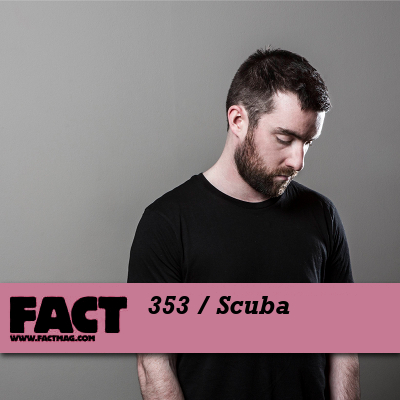
FACT has unveiled its latest mix, which comes courtesy of the Berlin-based Hotflush label boss and bold Twitter personality Scuba (a.k.a. Paul Rose). The DJ/producer made sure to highlight his imprint’s consistently strong output by including songs from Hotflush contributors like Sigha, Locked Groove, George FitzGerald, and Machinedrum—there’s even an unreleased tune from Hotflush alum Joy Orbison. Of course, Rose’s mix also contains new material from his work as Scuba and his techno alias SCB (both monikers which he’s used for XLR8Rpodcasts in years past). You can check out the tracklist and stream/download Scuba’s brand-new set in the player below. (via FACT)
1. Sigha – Suspension (Hotflush) 2. South London Ordnance – Revolver (Hotflush) 3. Locked Groove – Firefall (Hotflush) 4. Jessie Ware – No To Love (George FitzGerald remix) (PMR) 5. Dense & Pika – 31 (Hotflush) 6. Sigha – Puritan (Hotflush) 7. Locked Groove – Dream Within A Dream (Hotflush) 8. Duke Dumont – The Giver (Locked Groove remix) (Turbo) 9. Machinedrum – Part Of Me (Hotflush) 10. Scuba – Too Strong (Hotflush) 11. Dense & Pika – Crispy Duck (Hotflush) 12. George FitzGerald – Needs You (Hypercolour) 13. Machinedrum – Torso (Hotflush) 14. Scuba – Talk Torque 15. Sigha – Brood (Hotflush) 16. Scuba – Untitled (Hotflush) 17. Locked Groove – Lost (Hotflush) 18. SCB – Dissipate (Nonplus) 19. Joy Orbison – BRTHDTT! (Hinge Finger) 20. Locked Groove – Heartbreaker (Hotflush)
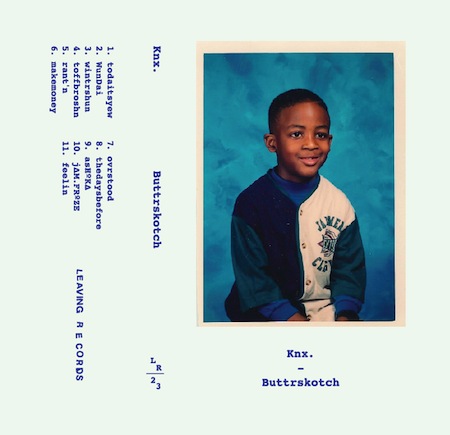
Given the latest trap craze, it seems increasingly uncommon to find young producers making unique, melodic hip-hop instrumentals. LA-based artist Knxwledge (a.k.a. Glen Boothe, Knx.) is one of those rare finds, and is set to drop his latest offering, called Buttrskotch, via Leaving Records. The release consists of 11 brief-but-soulful beats, much like “j?M.FRºZE,” which is driven by bright, swelling synths and borrowed sounds from old funk, soul, and jazz records, à la SoCal MPC masters Madlib and J Dilla. If you’re feeling “j?M.FRºZE,” be sure to look out for the rest of Boothe’s release when it drops tomorrow as a limited run of 200 cassettes.
Well, you’ve probably heard the original and seen the music video, so you’ll most likely also want to check out T. Williams‘ edit of Disclosure‘s new “Latch” single. Lifted from the supposedly forthcoming Latch The Remixes EP, this jittery, bouncing production doesn’t stray all that far from the Lawrence brothers’ original tune, but nonetheless offers a stripped-down bit of garage over which Sam Smith’s plaintive vocals work out those sticky hooks. You can hear it all in the player below.
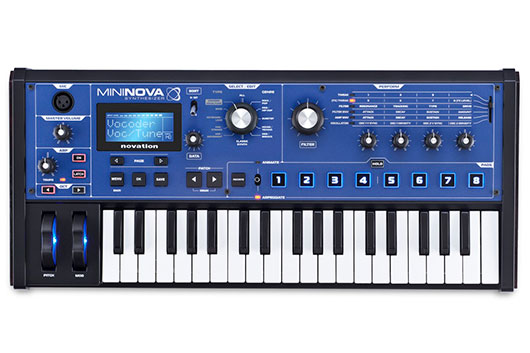
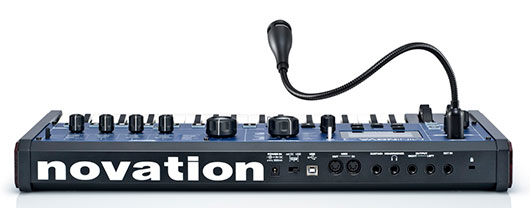
As even a cursory glance at the MiniNova will reveal, it’s a synth that’s been designed with immediacy in mind. Like Korg’s microKorg, it benefits from the relative simplicity of its interface: A clearly designed dashboard features dedicated controls for its genre patch selector, vocoder, and arpeggiator, as well as easy access to all variables and a dedicated filter knob. For added accessibility, eight big, chunky, rubberized buttons sit just above the keybed, which can toggle between arpeggiation and animation effects controls. Above this, there’s a matrix of editable parameters, with rotary dials and a slider to move between groups of four parameters each. It’s a smart idea, and better than the standard buttons used to cycle up or down through groups of different parameter.
And things get deep: Each patch can feature up to three oscillators, and 36 wavetables are also on offer, along with 14 different types of filters (two can be used for each patch). Add on top of that, there are six envelope generators, three LFOs, and 20 modulation slots for control parameters (along with five effects slots from an included seven effects), and there’s an incredible amount of depth for shaping sound. The MiniNova comes with 256 presets, along with space for 128 user patches (it’s actually compatible with patches for its big brother, the NovationUltraNova, which means there are tons of alternate patches readily available).
The on-board vocoder (the MiniNova ships with its own microphone) also includes something called VocalTune. This essentially lets your vocals to be tuned by playing melodies on the keyboard; it’s similar to standard vocoding, but pitch-shifts your voice while leaving it less processed by the machine. All in all, the vocoding and VocalTune features are incredibly fun, and add a great performance layer to the device.
The MiniNova can be powered either by an external power supply or via USB, and at roughly 22″ long by 10″ wide and 5.5 pounds, it’s an incredibly capable synth for its size and portability (though battery power would have been a nice option). There are perhaps unsurprising trade-offs, however, the first of which being that the MiniNova uses mini keys in order to squeeze 37 of them into its small frame (see: microKorg). Likewise, while deep and full of options and parameters, actually accessing some of its more advanced synth-editing capabilities involves a lot of menu-surfing. While the “genre wheel” is a pretty useful device, it’s also a bit too specific; rather than choosing between genres of music (including dubstep, house/techno, etc), it would have been nice to have these organized in to more descriptive, meaningful groupings.
Ultimately, the MiniNova feels like a more modern, more powerful imagining of the miniKorg, full of thoughtful touches like the ability to function as a plug-in inside your DAW of choice (by using a graphical editor). It’s an unquestionably powerful beast in a portable package at a solid price point, and yet another attractive option for producers—particularly those of the performance-oriented variety.
XLR8R has been hitting the festival circuit pretty hard in recent months, and that effort continued last week when we hopped a plane for the Netherlands to attend the 2012 edition of the Amsterdam Dance Event. Better known as ADE, the annual event—which first launched back in 1996—is not meant to be a music festival, even though a huge portion of the goings-on revolve around nightly showcases featuring scores of top-flight DJs and performers from around the globe. In actuality, ADE is a five-day electronic-music conference, a place where industry professionals come to network, make deals, evaluate talent and equipment, exchange ideas, and partake in all sorts of things that ultimately have little to do with hearing great music or attending wild events. All that said, ADE did feature some really amazing parties, many of which we’ve detailed in this write-up. Quite frankly, there was a lot to take in at ADE, as the conference schedule included more events and activities than any one person could even hope to attend. Having only made it to a handful ourselves, but still wanting to share the key points of our ADE experience, we’ve organized our thoughts about ADE into three self-explanatory categories: yays, nays, and okays.
Trouw, main room (by Marjolein Scheer)
Yay: Trouw
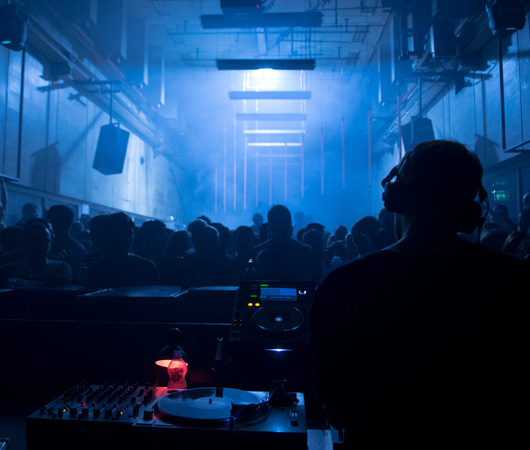
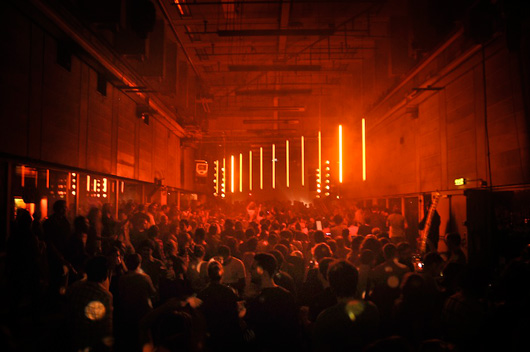
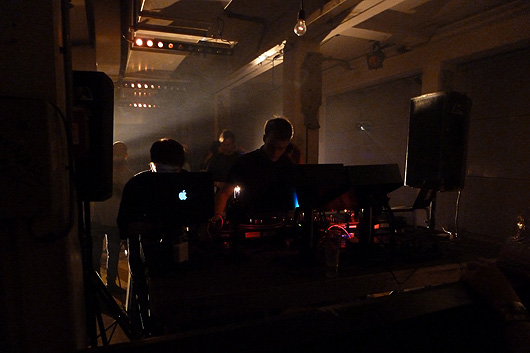
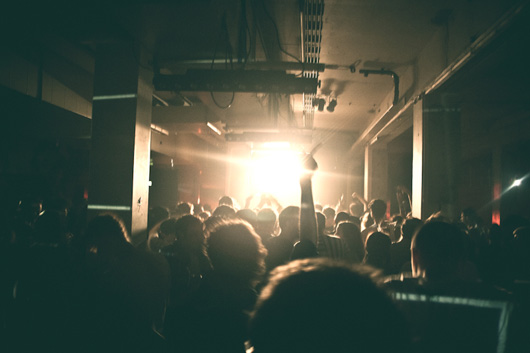
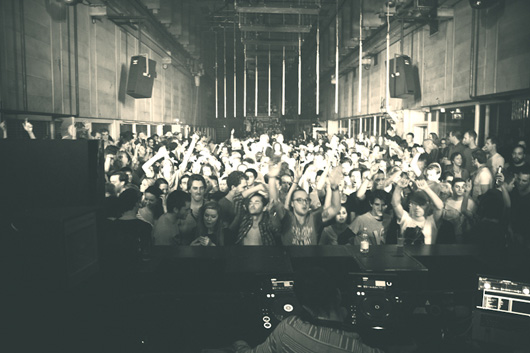
In all honesty, our review of ADE could have been titled, “XLR8R Goes to Trouw.” We found Amsterdam to be full of clubs, most of them equipped with quality soundsystems and having at least a passable vibe, but none of the ones we saw was in the same league as Trouw. Located outside the city center, the club was situated inside a former printing press; as such, it exuded the same sort of post-industrial charm as its like-minded counterparts in Berlin, including the mighty Berghain. In fairness, it may not be quite on that level—then again, what venue is?—but still, there was nothing to find fault with at Trouw. Upstairs is the main room, a long, rectangular behemoth with vaulted ceilings and booming sound. (Interestingly enough, the upstairs is also home to an upscale restaurant.) Downstairs is a smaller—although by no means small—room, and while its sound was slightly inferior to its upstairs counterpart, the space also had a sort of gritty basement vibe that was rather enjoyable. On the whole, Trouw appeared to offer everything a club should—it was dark, sweaty, and refreshingly free of bullshit. Night after night at ADE, some of the most interesting bills were happening at Trouw; the club’s staff clearly took—and continues to take—the curation of its line-ups seriously. It gave the impression of being a place where music comes first, which is why we kept coming back to Trouw again and again throughout the week. (Literally, we went there four nights in a row.)
DJ Harvey and Andrew Weatherall (by Marjolein Scheer)
Yay: DJ Harvey and Andrew Weatherall
Saturday night’s party at Trouw was actually something we originally planned to skip. After all, we had already been at the venue on Thursday and Friday, so a third night in a row seemed a bit excessive. Yet it ultimately proved impossible to ignore the lure of two DJ legends, DJ Harvey and Andrew Weatherall, doing an all-night, back-to-back set. The party was sponsored by Resident Advisor, and when we strolled in around 3 a.m., the dancefloor was absolutely rammed. More importantly, spirits were high, as the veteran pair served up a wonderful mix of disco and house that was alternately funky, Balearic, and euphoric. Dancers surrounded the DJ booth on all sides, most of them with giant smiles on their face, and when the lights came on at 5 a.m., it felt like things were ending far too early. Harvey and Weatherall likely could have keep that crowd moving well into the next day.
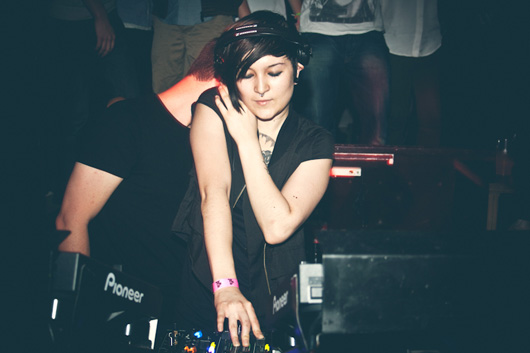
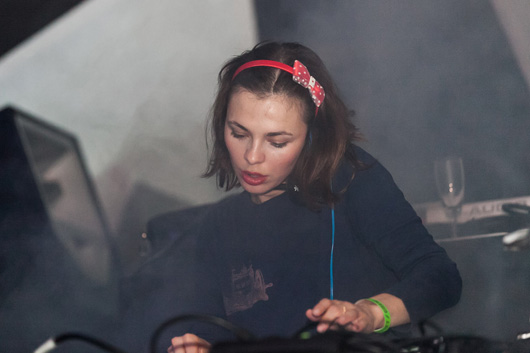
Maya Jane Coles (by Laura Andalou)
Nay: Industry dudes
Despite all the great talent at ADE, it’s important to remember that it’s not a festival. It’s actually an industry conference, something akin to US events like Miami’s Winter Music Conference, Austin’s South by Southwest, or New York’s CMJ Music Marathon. Because of that, though the nights may be filled with parties, the days are full of meetings, panel discussions, and workshops. Granted, these sorts of things happen at almost every large-scale event these days, but the “industry” feel of ADE is particularly hard to ignore. All week long, networking was happening en masse, as managers, booking agents, talent buyers, promoters, label owners, distributors, gear manufacturers, internet entrepreneurs, online retailers, journalists, and innumerable other music-industry middlemen descended upon the city. And while all these folks would undoubtedly pay lip service to the importance of “the music” if asked, it didn’t take a discerning eye to see that many of these dudes—and make no mistake, this group of attendees was overwhelmingly male—was more concerned with making money than facilitating great music or interesting art.
Obviously, XLR8R isn’t staffed by anarchists or socialists. We too are a business, sell ads on the site, and yes, make money. Nevertheless, there was something unseemly about seeing these men—many of whom undoubtedly got into the industry with good intentions—talking shop, trading figures, and essentially doing whatever they could to further commodify electronic music. For all the talk of EDM in the past year or so, there has been little examination of what’s driving it and who is making the decisions that are pushing certain (often questionable) artists and various (usually awful) strains of electronic music toward the mainstream. Well, we can say without question that a sizable portion of those responsible were in attendance at ADE. They were businessmen in music enthusiasts’ clothing, guys with mortgages to pay and bottom lines to worry about. We’re not saying they’re bad people—attending ADE isn’t akin to hanging out with investment bankers and oil men—but their ultimate motives had little to do with our own, which is why we generally stayed as far away as possible. Thankfully, ADE’s wealth of events and musical variety made that an easy task.
Tom Trago (by Lotte Koster)
Yay: Rush Hour, Clone, and Delsin
XLR8R has an unabashed affinity for Rush Hour, so it was nice to observe the famed record label and store operating on its own turf at ADE. Throughout the week, the intimate shop played host to in-store DJ sets from the likes of Ben UFO, Pearson Sound, Tom Trago, Pangaea, Dexter, Sadar Bahar, and several others. Apart from that, the Rush Hour crew also linked up with fellow Dutch imprints Clone and Delsin to put on some events. While the label trio’s installment of the Boiler Room on Friday afternoon was a bit of a letdown—largely because of the venue, which suffered from an overworked and underpowered soundsystem—the crews lived up to their reputations later that evening at Trouw, where they packed the house with essentially an all-Dutch line-up that included the likes of Conforce, A Made Up Sound, Dexter, Gerd, Tom Trago, Legowelt, and others. The place was packed, classic-sounding house, techno, and electro filled the air, and the artists performing all brought their “A” game.
Peter Van Hoesen at the Boiler Room
Okay: Boiler Room
The Boiler Room held three separate sessions during ADE, and while the troubles of the final installment brought down its average for the week, it’s rather hard to criticize the BR crew too harshly. When hosting its regular editions in London, Berlin, and LA, the Boiler Room has a lot more control over its environment. And though it’s encouraging to see the Boiler Room team hitting the road, the on-location episodes are ultimately a bit of a wild card. That said, it usually still works out. Wednesday’s episode took place in a gallery space just south of central Amsterdam, offering a cheerful afternoon soundtracked by increasingly energetic sets from Nina Kraviz, Dexter, Agoria, Peter Van Hoesen, and Cajmere. Van Hoesen was particularly good, weaving together a pumping techno set colored by plenty of melody and a few rave-minded selections, including Kink’s “Existence,” which prompted an explosion of enthusiasm from the crowd. Apparently, Thursday evening’s Boiler Room—hosted by the Innervisions label and featuring DJ sets from Dixon and Ame—was similarly lively, but we were unable to attend.
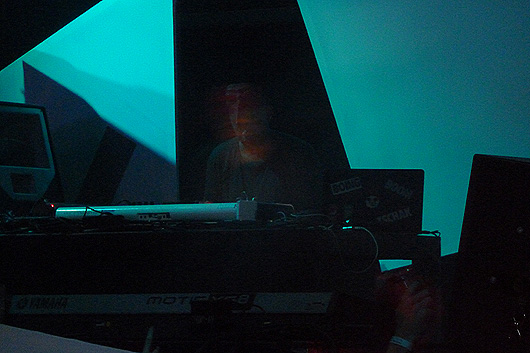
Simian Mobile Disco
Yay: Simian Mobile Disco
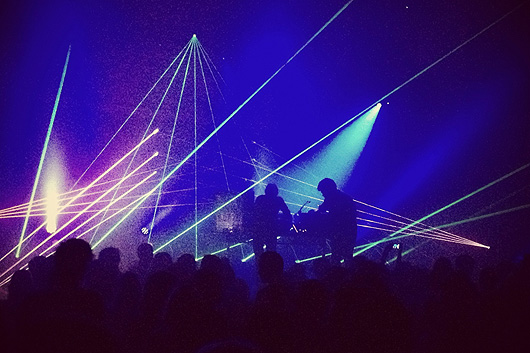
A year ago, the thought of attending, let alone praising, a Simian Mobile Disco show would have seemed laughable to XLR8R. That’s not meant as a slight to the UK duo, it’s just that we had sort of written them off as a more pop-inclined electronic act, one that had given up “serious” music in favor of a more commercial approach. Then came Unpatterns, the pair’s stellar LP from earlier this year and an effort which reestablished its producers as purveyors of quality techno. Curious how that spirit would translate to the Simian Mobile Disco live show, we caught the pair at an oddly early show on Thursday night at Paradiso. The set began at 9 p.m., but the mid-sized venue was already stuffed and thankfully, Simian Mobile Disco delivered the goods. Performing live with a fleet of gear, including a giant modular synth, the two men constructed one distinctively melodic techno track after another, occasionally dusting tunes with a little extra pop flair and mixing in some re-worked versions of a few older SMD cuts along the way. Flanked by clouds of fog and a stripped-down array of lazers, Simian Mobile Disco’s live show was, quite simply, great. While fans simply waiting to hear “Hustler” or the pair’s remix of “We Are Your Friends” might have left disappointed, those in search of something deeper—but still undeniably light and fun—went home happy.
Yay: Audio Culture
ADE 2012 had more than its share of praiseworthy figures, but Amsterdam’s Audio Culture crew might have taken home the week’s proverbial MVP award. Known for their support of emerging sounds and up-and-coming producers, the guys behind this club-night-turned-label were seemingly everywhere, assisting in the production of the Boiler Room throughout the week and capping things off with a showcase of their own on Saturday night. Taking place at Club Up, the smallish venue was stuffed to capacity early, as an impressive line-up that included South London Ordnance, Hackman, Presk, Tessela, GoldFFinch, and others served up a tasty combination of house, techno, garage, and bass music. The crowd was young (but not too young), the vibes were good, and the assortment of new talent on display was impressive. If labels like Rush Hour, Clone, and Delsin are The Netherlands’ old guard, the members of Audio Culture appear to have their finger on the pulse and are more than capably filling their roles as Amsterdam’s young guns. We’ll be intently watching the label and party continue to develop in the months and years ahead.
Carl Craig (by Shawn Reynaldo)
Yay: Carl Craig
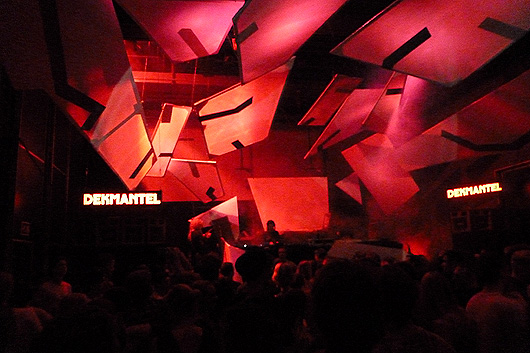
Detroit veteran Carl Craig has been touring his 69 live show all summer, and we finally got the chance to check it for ourselves at Wednesday night’s Dekmantel/Paramount Artists showcase. The bill at the spacious MC Theater was stacked, as the evening also featured sets from Nina Kraviz, Trus’me, Stacey Pullen, and Paul Woolford, but Craig was the biggest “name” on the line-up. Thankfully, his set lived up to expectations, as Craig—who was sporting a provocative, Eyes Wide Shut-esque mask—unfurled an hour of epic, melody-driven techno. Deep without being monotonous, he would periodically drop the beat altogether, indulging in lush, analog-sounding synth tones before bringing back the techno pulse and riling up the dancefloor all over again. At this point in his career, Craig knows what he’s doing and, more importantly, knows how to work a room. That’s exactly what he did at ADE.
Nina Kraviz (by Johan Vivié)
Okay: Nina Kraviz
People love to argue about Nina Kraviz, and that trend won’t be alleviated by her stops at ADE. On Wednesday, she warmed up the Boiler Room, although her early time slot (around 3 p.m.) and the room’s relatively mellow energy at that hour made judging her performance a tough task. That evening, she spun right before Carl Craig at the aforementioned Dekmantel/Paramount Artists party, and kept the room going with a set that largely consisted of hard, Berlin-style techno. It wasn’t bad, but it did feel a bit flat and definitely made us long for something deeper. Maybe its our imagination, but Kraviz appears to be moving away from the Underground Quality-style deep house that she originally made her name with, and we’re not entirely convinced that the change suits her. On the other hand, her ADE set was only 90 minutes, so perhaps she would have done a little more sonic exploring if she had had a longer timeframe at her disposal. Simply put, we’ve seen her play better, but we’re willing to give her the benefit of the doubt for now.
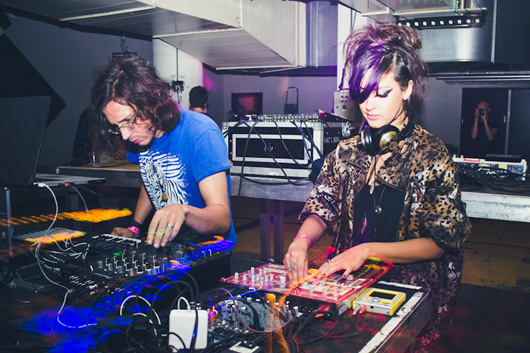
Legowelt & Xosar (by Lotte Koster)
Yay: Legowelt and Xosar
Over the past year, Dutch eccentric Legowelt has increasingly appeared with the shadowy Xosar at his side, the pair often touring together or collaborating under a number of different monikers. The two teamed up once again on Friday night at Trouw, performing live in the second room with an impressive assortment of gear. Even more impressive is that the duo managed to stand out on a line-up that was—as described earlier—overflowing with talent. Nevertheless, there was something particularly compelling about Legowelt’s and Xosar’s music, a melange of classic house and techno tropes with a clear preference for vintage drum sounds, simple—yet potent—rhythms, and thick washes of fuzzy synth melodies. Crafting sounds that were both propulsive and hypnotic, the duo built a tangible vibe over the course of an hour, an especially difficult task given that most, if not all, of the material was unknown to the audience.
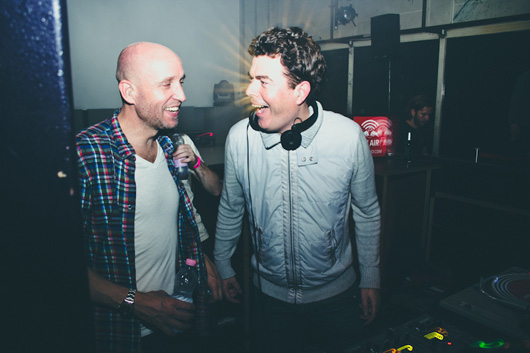
Serge and Gerd (by Lotte Koster)
Yay: Gerd
Another standout from the Rush Hour/Clone/Delsin party at Trouw was Gerd, who spun in the main room shortly after midnight. The man has been turning out classic-sounding cuts since the mid ’90s, but he’s been on a major roll as of late, dropping a number of high-profile remixes and finding himself increasingly namechecked by DJs from various corners of the dance-music spectrum. On this night, he clearly brought his wealth of experience to the table, putting together a set of stripped-down, no-frills house that consistently referenced the past without sounding cliché. Gerd is not a retro artist—he simply understands what was great about old-school New York and Chicago house and employs those elements in his own work. His DJ set at ADE may not have had lot of bells and whistles, or even a wealth of big tunes, but everything he played worked, and the crowd was more than pleased with the results.
Ben UFO and Pearson Sound (by Shawn Reynaldo)
Yay: Hessle Audio
One night earlier at Trouw, the three founders of Hessle Audio—Ben UFO, Pearson Sound, and Pangaea—came together for a special back-to-back session. Holding down the club’s second room for the entire night (while Maya Jane Coles and Jackmaster piloted the main room), the boys began slowly, clearly reveling in the chance to exhibit their musicological inclinations to the fullest. With seven hours at their disposal, the DJs moved through various bits of dubstep, garage, house, techno, and more, seemingly taking a particular delight in exploring the spaces between genres. And while all three have their specialties, they functioned incredibly well as a unit, working together toward building a larger whole. Not all DJs are equipped to handle this sort of assignment, but the Hessle Audio crew was at its best when given so much freedom to operate.
MC Theater (by Shawn Reynaldo)
Okay: Amsterdam
Amsterdam is cute—really cute. Between the canals and the fairy-tale architecture, it was hard to be bummed out by our surroundings in the Dutch capital. At the same time, it occasionally felt a little sleepy, even when the city was in the midst of a large-scale conference/festival like ADE. On the one hand, that was great, as attending ADE rarely felt like an unmanageable or overwhelming experience. Nevertheless, Amsterdam did lack some of the excitement and energy that the hustle-and-bustle of a larger city—or even a more concentrated one—might have brought to the table. The concentration issue was particularly important; although many clubs and the conference headquarters were clustered near the city center, many others were not, meaning that attending events often required either long walks or short cab rides. (There’s a reason that seemingly everyone in Amsterdam was scooting around on a bicycle. Having one would have helped immensely during ADE.) Nevertheless, getting around the city was never truly difficult; the city’s public transportation system was relatively easy to navigate and taxis, although moderately expensive, were plentiful, especially around clubs late at night.
Pleasant is a great word to describe Amsterdam—even with its chilly, intermittently rainy weather—and that sensation went a long way toward making ADE an enjoyable experience. People were friendly, and everyone spoke English (without giving anyone an attitude about it), which certainly made things easier for all the Americans, Brits, Germans, and other non-Dutch-speaking attendees. It’s also worth noting again that despite its relatively small size, Amsterdam has a wealth of clubs, making it well equipped to handle the week’s festivities. Even better, almost every club we visited had a soundsystem that would at least qualify as good, if not great. Unlike some other places (including most cities in the US), club owners in Amsterdam appeared to understand the importance of sound quality in the context of dance music. It really made everything better; even when the music went south, it at least wasn’t grating on our ears, and when the music was good, the ace systems made it sound great.
Trouw, downstairs (by Laura Andalou)
Despite all its positives, we can say that Amsterdam was lacking in one key area—food. Based on our (admittedly limited) observations, the city’s food culture had a ways to go. On-the-go options were virtually nonexistent, apart from a smattering of stands selling Belgian fries and/or waffles. Like any major European city, Amsterdam also had its share of mediocre doner kebab and pizza shops, but even those were lacking in number. More disappointingly, all these establishments seemed to close somewhat early, even in the most tourist-oriented and club-filled areas of the city. Not having food options for legions of intoxicated youngsters when they wander out of the club at four or five a.m. seemed like an odd choice to us, but that was what we found. On the other hand, maybe not eating a bunch of garbage food in the wee hours before going to bed is why the Dutch are, on the whole, a rather thin people. It certainly isn’t hurting them in that department. Speaking of the Dutch…
Nay: Dutch people are tall
There’s not really a lot more to say about this topic, and maybe it’s not fair to list this as a “nay,” but damn, we have never felt so short in our lives. Maybe it’s genetic, maybe it’s the food, but people are fucking tall in Amsterdam.
Jackmaster (by Laura Andalou)
Yay: Organization and Curation
Without question, ADE is a large event, one with a scale that exceeds most festivals and many music conferences. While outsiders often lump the various facets of electronic and dance music into a single nebulous category, it was clear throughout the week that ADE organizers recognized the complexity of this musical sphere, and did their best to cater to a wide swath of potentially interested participants. Day after day, the wealth of ADE-related options was simply dizzying. The sheer volume of panel discussions, workshops, roundtables, demonstrations, and, of course, parties was impressive. And while this made seeing even a fraction of everything and everyone we wanted to see impossible, it also enabled attendees to make their own experience. We might have grumbled about all the industry dudes who came to ADE, but we’re fairly certain that they enjoyed the chance to come to Amsterdam and “do business.” Each night, there were literally dozens of parties one could attend; even when 75% of the bills featured DJs we wouldn’t be caught dead listening to (yes, the ADE line-up included plenty of trance and tacky house), there were always multiple things we most definitely did want to check out, often times at venues that were on par with some of the best clubs in the world.
More importantly, even with all this activity, ADE ran like clockwork. It undoubtedly helps that the festival/conference is put on by a non-profit organization that gets plenty of government funding, but ADE took those resources, made an extensive plan, and followed it. Throughout the week, there was never a sensation that corners were being cut, problems were mounting, or important details were not being attended to. Shows ran on time. Schedules were followed. The ADE website and mobile app were relatively easy to navigate and, more importantly, easy to understand. Parties weren’t beset by technical issues. Local promoters were invited to participate and were given the freedom to do what they do, with minimal interference from the festival apparatus. Wherever we went, locals seemed happy about ADE, which is always a good sign.
Obviously, no one was going to like everything about ADE, but the conference/festival didn’t require or even expect that from its attendees. The event’s strength stemmed from its wealth of possibilities, which is likely why the 2012 edition was said to be the biggest ADE yet. In short, there was something at ADE for everyone, and it’s hard to find much fault in that.
New York-based DJ/producer Max McFerren recently released his “Hard Feeling” b/w “Tough Homme” record (artwork above) via Lamin Fofana‘s brand-new label, Sci-Fi & Fantasy. Though not featured on the record, “Woah Roles” recalls the kind of bouncy, old-school sounds that aptly sum up the vibe of the newcomer’s two-track release. Bright, snappy drums are propelled by classic piano stabs and shuffling percussion as the tune slowly but surely climaxes with an acid-leaning bassline that will surely stoke any house-inclined dancefloor. You can listen to both of the equally vintage-sounding tracks from McFerren’s 12″ after the jump.
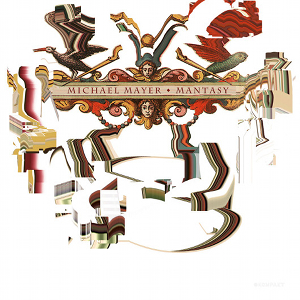
Michael Mayer‘s second album, Mantasy, is “a tribute to history’s great explorers, to characters obsessed with an idea, to totally wrong conceptions of the world.” It’s a bold concept that Mayer attempts to embody by filtering an eccentric sprawl of ideas through a diverse array of instrumentation and electronic-music stylings. Occasionally, things are knitted together to strike gold, as they are on playful dancefloor lament “Good Times.” However, more often than not, the tracks become shrouded in egotism and over-production and amount to little more than posturing.
Eight years removed from his debut full-length, Touch, Mayer seems to have worked and reworked his sophisticated ideas for Mantasy into submission. “Roses” is a great example of this. The track’s hypnotic vocal line, zig-zagging synths, and stabbing baseline are interesting ingredients, but once meshed together, they lack charm and effervescence. Other tracks are simply forgettable. The glockenspiel-crowned techno of “Rudi Is a Punk,” the sci-fi squelch of “Voight Kampf,” and the ambient interlude of “Baumhaus” all pass without quickening pulses or moving feet.
Whilst some tracks lack charisma, others grate. After being lulled into a false sense of security by the subtle and alluring ambience of the openening “Sully,” “Lamusetwa” shatters this elegant veneer with its sheer gaudiness; the song’s reverb-laden guitar line, set against chugging horns, cloys rather than entertains. Penultimate track “Neue Furche” is similarly trying, as it’s essentially a rigid composition of tired samples and ugly, distorted synths.
Sandwiched between this filler is one of the LP’s few saving graces. The driving Italo disco of “Mantasy” is focused and enchanting, its fizzy, layered synths propelling the listener towards the cosmos. Through his status as one of the heads of Kompakt Records, itself one the best respected electronic music labels in the world, not to mention his legendary sets and sharp remixes, there is an undeniable sense of expectation weighing on Mayer’s shoulders. Whilst he must be commended for his ambition, Mantasy is a patchy affair containing the good, the bad, and the downright ugly.
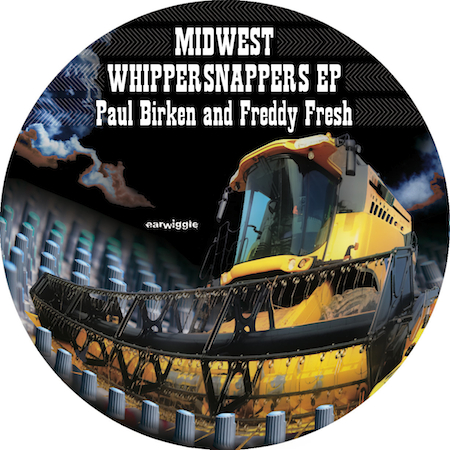
It’s been a while since we’ve seen the name of veteran DJ/producer and Howlin Records owner Freddy Fresh, but he’s apparently set to release a collaborative record with fellow Minnesotan electro/techno maestro Paul Birken. The seasoned pair has concocted two tracks together and one original production each to make up the four-track Midwest Whippersnappers EP. Digging deep into their roots of classic and extreme sounds, the record is an acid-fueled, analog time trip that includes Freddy Fresh’s “Years Back,” a cut which aptly sums up the upcoming EP with its hypnotic bassline propelled by the classic Amen break, delicate pads, and plenty of laser FX. You can check out more of Midwest Whippersnappers before it drops on November 26 via Ear Wiggle, after the jump.
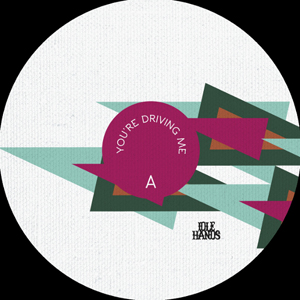
Since its debut in 2009, Chris Farrell’s Idle Hands—now a shop as well as a label—has become a hub of Bristol’s scene. Although Farrell has pulled producers from far afield (Kevin McPhee, for example, is from Toronto), the majority of its releases draw on a broken, bassy template which, while referencing everything from jungle and steroidal grime to Detroit techno and slow, Workshop-style house, seems peculiar to the city. Scant information exists on its latest signing, local act Rachael. But You’re Driving Me, the project’s first EP, falls in line with the label’s exploratory tendency.
There is an infectious sense of alchemy at work on its two tracks. The title piece pairs a squiggling, smothered, hollow line with a more subdued one that burrows just below the surface. The producer throws stray, misfiring harmonic lines and odd clusters of open hi-hats at this initial tangle, and the ensuing commotion is only temporarily abated by the insertion of smudgy pads and straight-ahead hi-hats. It’s akin to recent Bass Clef tracks in the way it places a jumble of untamable electricity atop a powerful, linear rhythmic grid. On the flip, “Kung Funk” finds the producer in similar territory—at least at first, as a jittery, tumbling rhythm is laced with tweaky Radiophonic interference and a wobbly, slightly off-kilter semblance of a bassline. Out of nowhere, the track undergoes a striking metamorphosis. Much of this early arrangement drops out, and a pointedly slinky, electro-funk bassline emerges alongside chilled, glassy chords. With this gesture, Rachael’s dorky tinkering blossoms into luxuriance. Although several unsteady bits are reintroduced, these romantic motifs are too strong to disappear into the mix, and they mark the track until its conclusion. It’s a sterling example of tease-and-release. One would hope its abrupt change signals that Rachael’s awkwardness has fallen away for good, as this type of idiosyncratic, nocturnal funk is clearly the producer’s strong suit.
Continuing with its series of North American events in New York and Los Angeles, UK live-music outpost Boiler Room has announced that its next SoCal jump off will be a full-on Body High extravaganza. Scheduled to perform are label co-owner Samo Sound Boy, Nashville newcomer Myrryrs, the elusive DJ Funeral, Jerome LOL‘s and Samo Sound Boy’s collaborative project DJ Dodger Stadium, LA local Floyd Campbell, and someone by the un-Googleable name of Delivery performing a “live TB-303 set.” The live broadcast will start at 7 p.m. PST on Tuesday, October 23.