A few weeks ago, we gave you a bonus cut ahead of the release of Volor Flex‘s Conspiracy EP (out this week via R&S imprint Apollo), and today, we bring you the Russian producer’s latest video, which was crafted for the sub-heavy tune “City Pressure.” The clip features many sleek-looking shots of a masked man driving through a city at night, until he pulls over and cracks out a laptop marked with the Apollo logo.
Kevin McPhee Readies New EP

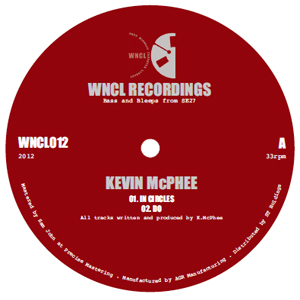
We haven’t heard much from Toronto’s Kevin McPhee since we profiled him in our Bubblin’ Up series, but today, we have news that the DJ/producer has been hard at work on a new release. His latest project, an EP for UK outpost WNCL, apparently finds the tunesmith “[getting] his clonk on,” and was inspired in part by rising techno producer Bobby Champs. McPhee’s four-track record, simply titled WNCL012, is due out on November 19. You can check out the artwork and tracklist before then, below.
A1. In Circles
A2. Do
B1. Pumpkin
B2. The Blind Whirring of Machinery
Listen to Vessel’s ‘Order of Noise’ LP

Though it was initially scheduled to drop on September 24, the debut LP by promising Bristolian artist Vessel (who was featured on XLR8R just last week) was pushed back to a mid-October release via Tri Angle. But worry not, because you can now stream Order of Noise in its entirety. Resident Advisor is hosting the exclusive premiere of producer Sebastian Gainsborough’s full-length offering of dub-driven and experimental techno, a record which—if you read our review of it—you’ll know we thoroughly enjoyed. You can listen to Order of Noise before it arrives next week, here.
Fulgeance “Wet”
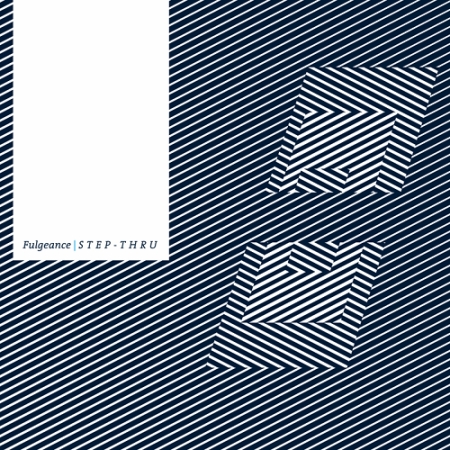
The French beatmaker Fulgeance is gearing up to release his latest LP, the solid Step Thru, which we reviewed just last week. And following the track we posted off of the producer’s Mini Club EP, we have “Wet,” one of Step Thru‘s handful of beat-driven cuts set to drop on October 15. While the production is cemented by smooth, punchy hip-hop drums and bright, electrifying synthesizers, there are darker undertones layered throughout. Fulgeance’s new track grows from a club-ready jam into something more complex through the use of mystical trance stabs, pitched-down vocal mumbles, and fleeting basslines.
Stream George FitzGerald’s New Remix EP, Featuring Gerry Read and Gerd
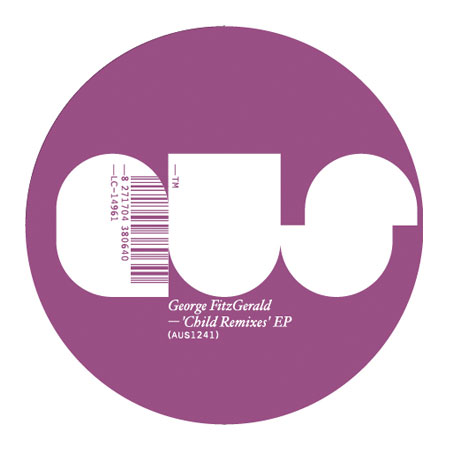
It was less than a month ago that we announced George FitzGerald’s forthcoming Child Remixes EP, and barely even a week since one of its three tracks appeared online. Now, we have the entire record—including both of veteran Dutch producer Gerd‘s jacking remixes of the title track (as Geeeman and NY Stomp) and Gerry Read‘s rough-and-tumble take on “Lights Out”—available to stream exclusively on XLR8R. You can give Child Remixes a spin before Aus drops it all on October 15, after the jump.
The XLR8R Music Player requires Adobe Flash Player version 9 or later. Click here to install.
Listen to the New Scuba Single
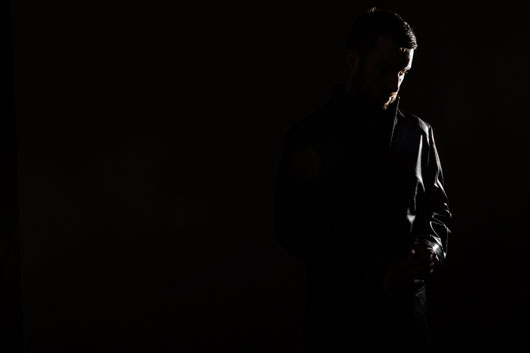
It was exactly four days ago when we discovered that Hotflush label boss Scuba was preparing to unveil both a new live show and a fresh single in the weeks to come. You still have to wait for the November 3 premiere of DJ/producer Paul Rose’s stage performance at the Shoreditch Warehouse in London, but you can listen to “Talk Torque” now. The ebullient tune—which, admittedly, reminds us quite a bit of the title track last year’s powerful, XLR8R Pick’d Adrenalin EP—was given its inaugural spin on Pete Tong’s Essential Selection yesterday, and can now be streamed via the player below. Look for Scuba’s “Talk Torque” single to drop digitally on October 29, with the limited-edition vinyl arriving on November 12.
MUTEK Mexico: 12 Things That Caught Our Attention
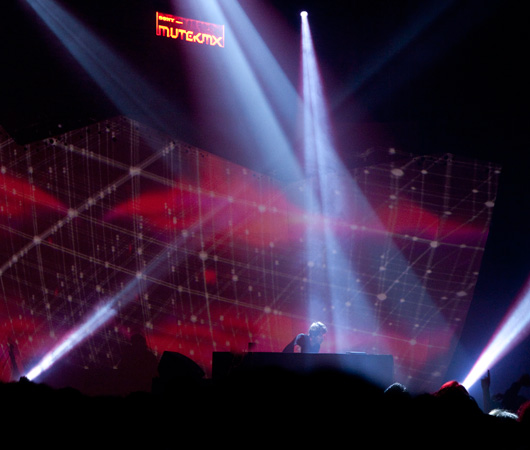
Despite being one of the largest cities in the world, Mexico City isn’t exactly a tourist destination. One just arrives, with no reliable expectations, in a city that consists of 24 million people. Coming to a music festival this way might be ideal: in an alien environment, an attendee can focus on the music with more awareness of their expectations, and, more importantly, when it’s better to let them go. This was one of the themes of this year’s MUTEK.MX—the Mexican edition of Montreal’s long-running MUTEK festival—as it oscillated between visually oriented music performances and packed dancefloors.
Also known as Distrito Federal, the gargantuan Mexican capital has hosted MUTEK.MX since 2003, but has kept a fairly low profile relative to international festivals like Sónar or Unsound. MUTEK.MX took a couple years off in the wake of the country’s 2008 economic collapse, but it seems to have bounced back quickly. This year’s edition was its most ambitious and, judging from the crowds alone, successful yet. Logistical and financial restrictions meant the line-up was not as dense as those featured at a festivals like Decibel or even at its parent entity, but MUTEK.MX traded volume for careful programming, plotting out venues and set times in a way that meant—on paper at least—sacrifices were nearly nonexistent. Giving festivalgoers a linear path to follow rather than a synchronous cluster of events also underlined MUTEK’s appeal; each night, intellectual programming faded seamlessly into curated club nights.
Holy Other
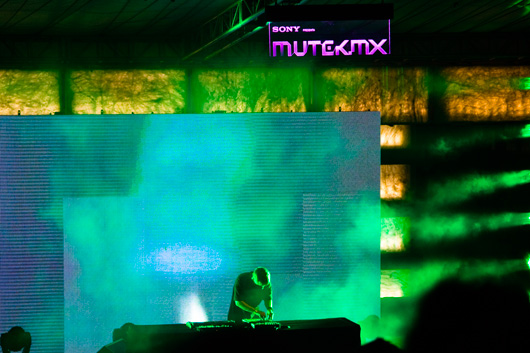
All of the festival’s events were admirably well attended, due in part to ticket prices being capped at 200 pesos ($15) and the fact that 60% of the programs—mostly the Intersección and Ciclo portions, dedicated to workshops, Q & As, and film screenings—were free. Most of the venues were at capacity—prior to our arrival, Holy Other opened the festival to an outdoor audience of 5,000—but the most popular events by far were the two dance-oriented Nocturnos. Still, those nights—which are detailed below—were just a fraction of what MUTEK.MX had to offer. Detailing everything would be an impossible and overly tedious task, so we’ve gone ahead and focused on 12 aspects of the festival that caught our attention.
1. Getting Around
Learning how to get around Mexico City was a major theme of the festival for the foreigners that made the trip. Addressing the city’s sprawl, most of the events took place within a few miles of each other, in the Centro Historico and Condesa/Roma neighborhoods. Staying in Roma, an up-and-coming neighborhood west of the city center, most of the events were a 30- to 40-minute walk away. The area offered a mix of beautifully crumbling and well-preserved colonial facades and more modern buildings, making the walk a good option for getting to the experimental, sit-down A/Vision shows, which began around 8 p.m. But as the late-night Nocturnos burrowed into the early morning, taxis were the best option for weary dancers, although a difficult one to figure out consistently, even for natives; as one resident described, it’s a “city of coincidence.” Hailing a cab is a crapshoot, as not all cars painted like taxis are legit or metered, leading to make-it-up-on-the-spot fares and, in one instance, a driver that ran out of gas halfway to the destination. It was better to find a taxi stand, which are thin on the ground and poorly marked, or simply call. D.F. is a very car-centric city, yet it lacks freeways. This means rush-hour traffic can be gnarly, and drivers pull some wacky moves to get people where they’re going. The city’s bus and metro systems are widely used and insanely cheap, but were somewhat intimidating to foreigners given Mexicans’ differing notions about personal space.
2. Border Community
Thursday’s sequencing of Border Community stalwarts Luke Abbott and Nathan Fake with Domino’s Jon Hopkins made natural sense, as their melodic, emotive takes on techno and IDM tropes are different facets of a shared sensibility, even though they result from very different approaches. Luke Abbott is something of a jovial mad scientist, as his inspired, hour-long Intersección presentation about his studio on Wednesday made clear. He discussed his modular-synth set-up and experimental creative process with good-natured self-deprecation, somehow making patching and control-voltage units sound decidedly straightforward. He also demonstrated how his latest EP’s title track, “Modern Driveway,” came into being, showing the working files in Ableton and tossing off the following Eno-esque quote: “I aim to create a situation in which something unexpected happens that I can take ownership of.” Nathan Fake’s Q&A the following day was less technical given the format, but in fielding some questions that may have suffered a bit in their on-the-spot translation, he described how it’s important for him to learn the equipment he uses inside and out rather than have a wide variety of gear—he’s essentially been using Cubase and the same VSTs to compose throughout his decade-long recording career. Both interactive sessions gave insight into the producers’ methods and suggested the ways their sound might develop on future releases.
Nathan Fake
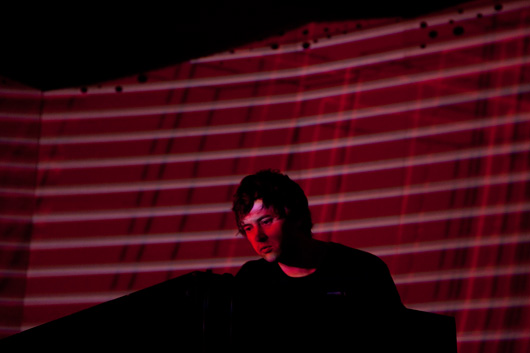
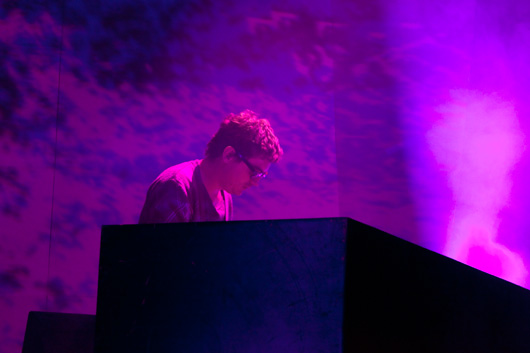
When they came together later Thursday, it was surprising to hear how floor-oriented their live sets were. Nathan Fake has played in the US supporting Four Tet, but it might have been Luke Abbott’s North American debut. Jon Hopkins is in the States fairly frequently, but he’s not generally known for the steady techno beats he displayed that night. For all three artists, the night was a unique opportunity to see them play the kinds of sets they might play in Europe and the UK on this continent, and MUTEK should be commended for scheduling them in a context where they’d be adapting their music to a more extroverted, crowd-moving style rather than replicating their albums. Playing against a concave backdrop that hosted projections and looked like a jagged eggshell, their sets bridged the gap from the A/Vision sequence that preceded them. Jon Hopkins’ solo material tends toward the chillout vibe of Opalescent or the more Ulrich Schnauss-ian electronica of Insides, but that stuff barely hinted at the kind of rhythmically solid, beat-driven set he played at the first Nocturno. It was interesting to hear the melodies that are usually the focal point of these guys’ music share the stage with pounding beats, particularly for a packed room of 2000 heaving bodies, a group that included a girl who was so pumped that she started pogoing in place for the better part of one of the sets and at least three couples slow-burn making out for 30 minutes at a clip. Even in the club, Border Community was for lovers.
3. Egyptrixx
After the Abbott/Fake/Hopkins bloc, the transition to Egyptrixx‘s harder-edged performance was shaky, mostly because his computer abruptly cut out four separate times right after he’d spent 15 minutes or so laying a solid foundation. By the time things got back on track, he had cycled through enough material that he was left playing tracks from his 2011 LP, Bible Eyes, mixed with an Audion track. As the sole Night Slugs representative at the festival, he might not have had the same backup as the other guys did, but his sound—all aluminum pinging and ultra-flat toms strung over huge kicks—went for the throat all the same. Bible Eyes‘ material made a lot of sense on a big system: the hyperlucid quality of the production and the way he used ruthlessly quantized sounds arrived at a kind of post-human funkiness that could have been improved with the material he skipped over when his computer crapped out.
Egyptrixx
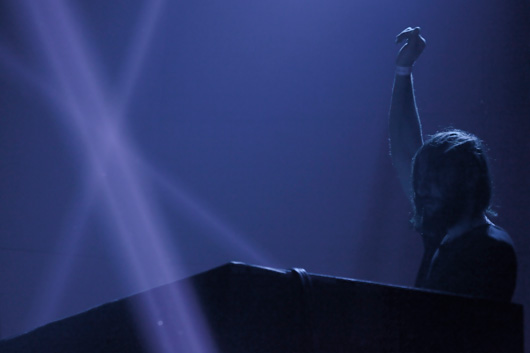
4. Scuba
Paul Rose (a.k.a. Scuba) picked up with an ambiguous, excitingly formless opening. Teasing out some of the more experimental background sounds that wended their way through Egyptrixx’s set, it was unclear at first if he was going to take things in a darker direction, but he settled after a few minutes on a calibrated kind of bass-music/house hybrid. With his recent output having ditched his dark and textured take on dubstep to instead reference big beat and rave, Scuba’s clearly not the kind to worry about what anyone else thinks, but then again, he’s also a professional. He delivered a highly serviceable dance set without detours, closing the night out with a string of fairly straight-ahead 4/4 thumpers that lacked a bit of, well, personality. Perhaps it’s representative of that scene’s general movement toward classic house and techno, but other flavors of the bass rainbow—a touch of garage, funky, or even the abandoned dubstep—would have livened things up.
5. Nocturno 2
The Casino Metropolitano, a venue in the well-maintained historic center of the city, housed DJ Harvey‘s much-anticipated Friday appearance. We’d heard the show was sold out, but only upon arriving realized what that meant in Mexico City terms: the sidewalk outside the club was utterly mobbed, such that getting through the crowd to check in was hopeless without inside help. DF’s population seemed to have unique ideas about queuing at clubs. The most popular events’ entrances were capped by a solid half-circle of people waiting to get called up to the guest list, trying to get the attention of someone who could help them. Once we’d managed to locate someone to literally pull us through the press of bodies, we caught the tail end of Pachanga Boys—a collaboration between Superpitcher and Rebolledo—whose generously melodic, swooning Kompakt sound was an immediate comfort.
DJ Harvey
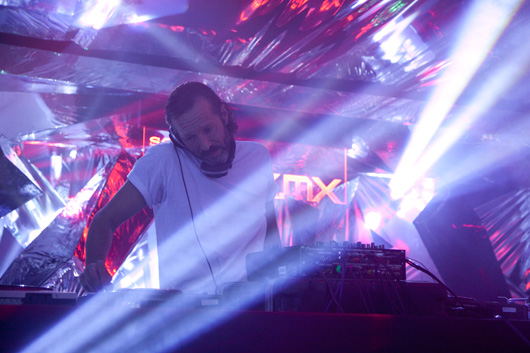
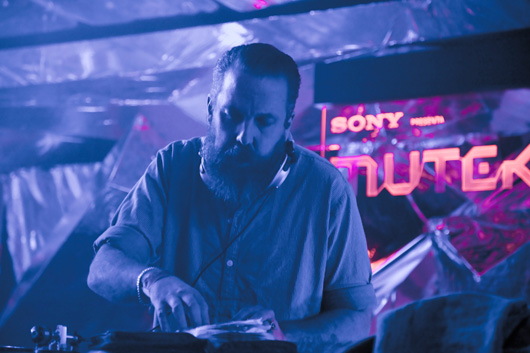
The floor was already packed, and only became denser for Matias Aguayo. He introduced himself with one of his goofy acapellas, which promptly segued into an airtight set of cumbía-inflected tech house that was the most memorable of the night to our ears. By the time Harvey took to the stage, the venue was so dense that the dancefloor had created its own tropical weather system, an atmosphere composed of cigarette smoke and sweat that seemed at least 10 degrees warmer than it was over by the life-saving windows. This kind of madness seemed too perfect for Harvey, but it did make it difficult to get a real bead on what he was playing, as navigating even the dancefloor’s periphery was a labor of at least a half-dozen muttered perdóns, to say nothing of trying to land a spot to dance or watch. As a result, we heard most of DJ Harvey’s set filtered through a thousand bodies, various walls, and drapes. After a few hours, it unspooled into relatively bare-bones rhythm tracks around 3:30 a.m., when Andrew Weatherall took over without anyone really noticing. We had missed his DJ set at an afterparty the night before, where he evidently played an excellent set of slower electro house, but his billed appearance didn’t do much more than pick up where Harvey left off.
6. Nils Frahm & Le Révélateur
The A/Vision section of the MUTEK program was perhaps its most ambitious, setting the experimental tone of the festival. The first night’s Nils Frahm performance got things off to a soft start, with his damp, soundtracky windowsill music joined by appropriately moody visuals from The Joshua Light Show. The crew’s liquid visuals hadn’t changed drastically from its psychedelic Fillmore East days, when the team was doing projections for the likes of Jefferson Airplane, but the dripping streaks of oil, which gradually formed into miniature, yet cavernous pink-and-cyan Valhallas, suited Frahm’s minimalism nicely. An unexpected surprise came next, from a Montreal duo called Le Révélateur. A kind of cyberpunk-kosmiche duo, it’s the new project from former Fly Pan Am guitarist Roger Tellier-Craig. The pair’s set morphed from a somewhat generic drone to a vigorous orgy of hyperreal arpeggios, as a chessboard in lurid, saturated VHS colors spun and melted behind them.
Laurel Halo
7. Sun Araw & Laurel Halo
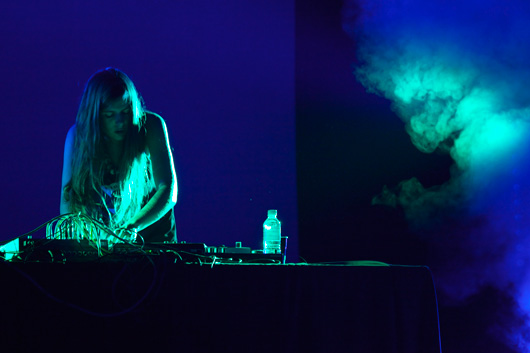
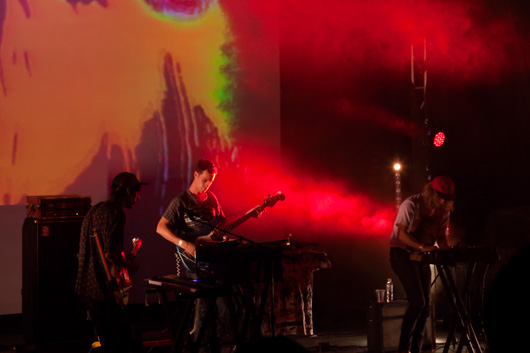
Teatro Fru Fru—a place akin to Twin Peaks’ red room, only if it had been transformed into a burlesque theater owned by a gangstery lady senator—was an ideal venue for the third A/Vision installment. Sun Araw, performing as a three-piece, played a muggy, dubbed-out set built around loops and ebullient electronics that left plenty of room for improvisation, including a taste of Albert Ayler-esque gutbucket shredding. There were flashes of structure too—one song, a slow skank with a clump of bass notes, was particularly memorable—and some incantatory vocal interjections from Cameron Stallones. While the outfit has evidently been playing as a band for some time, it still seemed to be operating somewhat under the logic of a one-man band. Watching Stallones play a bassline or disruptive, high-pitched synth line live, catch it as a loop, and move on in coordination with his bandmates suggested that they had the resources to dig even deeper into their compellingly weird take on dub, psych, and cosmic jazz. Laurel Halo was next, playing sans visuals, which was fine because the wraithlike way she swooped over her gear provided plenty of visual interest. Her set presented the raw materials of Quarantine in a new mix, moving between off-kilter ambient sections and beats that referenced hardcore techno at points. Her brief, reverb-laden live vocals made us eager to hear her unadorned voice as it appeared on that record, since she relied on samples for the demanding and raw acrobatics of “Carcass.” But the end result was still one of the festival’s most deeply absorbing segments.
8. Tim Hecker/Novi_sad & Ryuichi Kurokawa, Sirens
The final A/Vision performances wrapped things up on an epic scale, as MUTEK took over a laser dome and IMAX theater located in the Museo del Papalote. Tim Hecker played a squalling set in the Domo Digital that had index fingers stuffed ears within a few minutes. The recumbent, cushy seats were locked in a domeward orientation, which was less than optimal, as the venue failed to fire up the lasers. Whether it was prohibitively expensive, or Hecker was trying to steer clear of Dark Side of the Moon cliché, or simply monopolize all of the senses through sheer volume, it felt like one of the festival’s few missed opportunities. Every so often, his arctic-bunker sheets of distortion would part to let a small piano figure through, or a bassline missing a few notes would rumble up from underneath. Despite the intensity, the performance suggested that there’s a case to be made for Tim Hecker as a distant inheritor of Harold Budd: they both know which notes to suggest rather than play and when to let the processing do the talking, using unresolved tension to tip things forward.
The Joshua Light Show
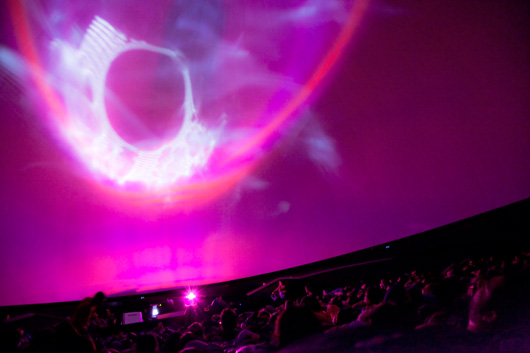
The crowd oozed over to the IMAX theater to see Sirens, a collaboration between the Greek sound designer Novi_sad and the Japanese visual artist Ryoichi Kurokawa. Not being familiar with Kurokawa’s work, we wondered if IMAX might be overkill. The first short film looked like layers of sidewalk chalk sliding over each other until the pre-processing source material was revealed as a photo of a crowd, set to music indebted to Alva Noto. The next film justified the expansive screen size: jittering cotton-candy and inkblot forms spun out of innumerable vectors would occasionally resolve into something recognizable—an eye, a giraffe, a reindeer—without offering any certainty that the viewer wasn’t just imagining shapes in clouds. The third film was easily one of the festival’s high-water marks, with fairly indescribable music to match. Pixels streamed over the screen like digital sand as the film oscillated, more clearly this time, between representation and abstraction. One second, the audience was looking at an hourglass and the next, a jaw-dropping vista of black-and-white humans moving in languid slow-motion as Novi_sad’s wrenching music billowed past in a mass of black tones. It felt like entering a Gerhard Richter or Francis Bacon painting, as the experience was terrifyingly serene in its disintegration. More impressive still was that they achieved this depth of feeling using what appeared to be simply footage taken walking through a crowd. That moment alone delivered fully on MUTEK’s mission statement: here was something genuinely new that was simultaneously a commentary on digital culture and a deeply affecting manifestation of it.
9. Circuito: Morgan Geist at Leonor
The Circuito, a concession to the overlapping events typical of many festivals, took place after the final A/Vision and Demdike Stare’s ill-fated—and evidently, final—live scoring of Jean Rollin’s titillating, nonsensical La Vampire Nue. (More on that later.) The idea was that, starting at midnight, one could circulate between DJ sets from the likes of Harvey, Guillaume & the Coutu Dumonts, Vincent Lemieux, Morgan Geist, and others. Conveniently, three of the four clubs were a few blocks away from each other, but upon arriving at M.N. Roy—a trendy, well-appointed club named for and located in the former home of the Indian radical of the same name—it quickly became clear that these would be some of the most difficult events to get into, even for those rolling with people who worked for MUTEK. To minimize hassles, we settled on Morgan Geist at another intimate, impressively built club called Leonor and piled into a four-seat cab, seven deep, for the ride over. It was a good move: immediately upon stepping onto the floor, we were moving. The intense door policy that kept us from entering until a volley of phone calls and cross-checks had been made also meant that the floor was relatively uncrowded, security guards ensured nobody smoked indoors, and air conditioners kept things crisp and sensible. It was all the better to enjoy Morgan Geist’s pristine set, one where he mixed old-school disco firecrackers and the sleek nu-disco he’s known for with a stray electro track and, transcendently, Storm Queen’s “Look Right Through.” It was a moment of dance nirvana—as much as we would have liked to circulate around and check out other sets, it was a relief to settle into another distinct space and experience within the context of the festival.
Andrew Weatherall
10. Ciclo & Clausura: Demdike Stare
After five days of unusually clear weather for the famously smoggy city, a flotilla of gray-brown clouds rolled in just as Demdike Stare was preparing to close out the festival on Sunday night, in the shadow of the Estela de Luz. As night fell, the quartz monolith’s thousands of panels lit up far into the turbulent sky and a huge, diverse crowd assembled itself on the steps leading down to the Centro de Cultural Digital, which formed a kind of makeshift amphitheater. The event was free, and numerous curious passers-by dropped in, including families with babies and young children.
Demdike Stare’s performance the day before had been plagued by an audio gremlin that a 90-minute soundcheck couldn’t resolve, but the duo soldiered through the performance despite the terrible sound quality. This was a shame, as the piece had changed substantially since its premiere in Oakland several months ago: scenes were reversed, repeated, and lingered on, and the dialogue was now included, even though it was rendered hardly audible by a cruchy buzz. The largely improvised music was promising too, although Demdike Stare seemed to play more quietly to avoid overloading the uncooperative PA. Nevertheless, several people walked out of the theater whistling or singing the melodic motif of the final stretch.
At the festival closing, those sound-quality issues were more than compensated for by the outdoor audio rig, which was punishingly loud, and a large screen displaying the duo’s own ’70s B-movie canon: scenes of gyrating satanic rites, Italians getting jumped by sexy, motorcycle-riding women and guys in masks, and intensely visaged men on psychotic bad trips. After an extended, rumbling intro with shades of the previous day’s Tim Hecker performance, the pair gradually introduced familiar material from its previous EPs, recreated live with Sean Canty sampling from a turntable. The rough-hewn energy rendered the familiar tracks more potent, climaxing with a devastating version of “Mnemosyne” and emphasizing the group’s road-forged transformation into a formidable live act. It was a tremendous finale for a festival that provided its artists unique opportunities and audiences, and found them rising to the occasion consistently.
Luke Abbott
11. Venues & Crowds
Mexico City is sprawling—flying in is like crossing over an inland sea made of streetlights, or, in Nathan Fake’s estimation, Sim City. MUTEK.MX cast the city in a flattering light by selecting venues that were appropriate for the events, and often packed with history, charm, and architectural detail, which meant that simply arriving for a show was an experience in its own right. Teatro Fru Fru was a surreal bit of gaudy glamor, while Casino Metropolitano was decked out in old-school, carved-wood paneling and an airy foyer topped by a cupola. The city also had its share of venues sporting interior design that could hold its own against global peers, such as the movie theater/restaurant Cine Tonalá, whose all-black interior was illuminated by the requisite Edison light bulbs. The contrast formed with a covered seating area walled in by raw concrete and weeping greenery made it feel fresh and inviting. As trendy as it was, it also seemed to work like a youth-oriented cultural center, despite being a far cry from the punky, worn-down feel of similar spaces in America. It was hard not to feel a bit of urban jealousy.
The people that filled these spaces brought an impressive amount of energy, too. Part of the reason for the festival’s crowds was certainly Mexico City’s population, but coupled with the MUTEK brand name and low ticket prices, there was a broad feeling of curiosity rather than artist-specific partisanship and snobbery. Granted, this is largely based on the fact that we can’t imagine Laurel Halo or Sun Araw playing to a receptive crowd of 600 at a typical US show or festival. Attendees were also very stylish: among women, there was a pronounced European feel: black pants, black blazer, and black heels was a notable look. Men, on the other hand, sported an inventive range of DIY high-and-tight haircuts and vintage eyeglasses, looking a bit more like aspiring intellectuals than hipsters. One young man had a luxurious Latin mohawky mullet that could only be a joy to shampoo. A few folks were wearing sunglasses at night. And despite all of the squeezing and jostling, there was a distinct lack of aggression or passive-aggressive vibes.
12. Food
Without question, the most-discussed topic when we ran into musicians during the festival wasn’t music but food, which was mindblowing even for native Californians. Popular, hip spots in Roma like Romita and El Parnita dished out relatively affordable world-class food that happened to be Mexican in comfortable, plant-adorned spaces. Mexican limes were a major protagonist in every food experience. Far from the dry, bitter variety up north, they were used indiscriminately in DF, packing a sweeter and satisfyingly metallic tang into everything from ceviche to micheladas. It was a struggle to find a decent cup of coffee, but this was not experienced as a lack with so much else to put in one’s face.
Sun Araw
Conclusion
It’s tempting to see this year’s MUTEK.MX as an international coming-out party. Certainly, it was the highest-profile and most robust line-up they’ve offered so far. But considering the festival’s success at integrating its events into civic life—making many of them broadly accessible, lines and crowding aside—it’s more accurate to describe it as an indigenous node of the growing MUTEK network, which has also included events in Argentina, Chile, Brazil, and Colombia. Like its parent festival, MUTEK.MX’s primary mission is to contribute to the city’s cultural life and to the global exchange around electronic music and visual culture. With plans to expand in the future while keeping venues at a reasonable size, it will inevitably become a destination for adventurous electronic-music fans who come from a culture of straight lines, carefully tended personal space, and sub-optimal Mexican food.
U “Sand Reckoner”
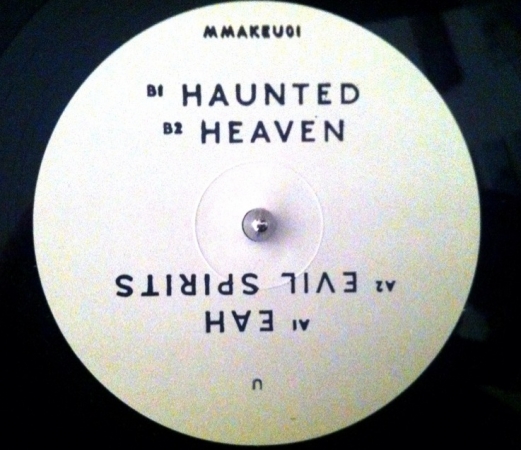
The elusive, up-and-coming producer known only as U is set to release his debut record (artwork above) via DJ/producer George FitzGerald‘s label, ManMakeMusic. Although this this track won’t be featured on that four-track EP, it serves as an equally fitting introduction to U and his music, which rests somewhere between the sounds of vintage b-movie horror and breakbeat-heavy rave music. “Sand Reckoner” is a fusion of similar sounds, which kicks off with eerie white noise and a half-time kick-and-hi-hat combo that caves into a breakbeat as a hypnotically arpeggiated synth is introduced into the mix. The ghostly melody is what gives “Sand Reckoner” its “horror movie” quality, as it sounds like a riff you might hear coming from a Dracula pinball machine circa 1986. Look for the rest of U’s 12″ when it drops on October 15.
Daphni Jiaolong
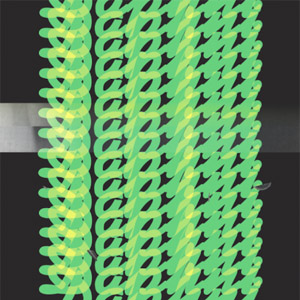
Fans of Dan Snaith’s Caribou project are not automatically going to be fans of Daphni, the man’s less-established handle under which he’s applied his talents to more eccentric, dancefloor-inspired tracks. Still, a lot of what makes Caribou so enjoyable—Snaith’s unique combinations of textures, penchant for unexpected grooves, and uncanny ability to absorb the listener into his productions—continue to serve as the foundation of his work on Jiaolong. Instead of refracted pop songs woven through electronics, Snaith brings the gurgled synths, lopsided loops, and clattering rhythms which usually lie at the bed of his work to the forefront, and the results are just as spellbinding.
Daphni is often referred to as Snaith’s “house project,” but that can be a bit misleading. Yes, all the songs on Jiaolong float around house tempos while utilizing recognizable dance-music patterns at the base of their structures (there’s plenty of four-on-the-floor to be heard here), but there is no mistaking these songs for something one would expect from any of house music’s current heavy hitters. In a sense, the LP is less “club music” and more “dance music,” as Snaith leaves his own unmistakable mark on every track, never hesitating to take an opportunity to venture into the weirder side of dancefloor-oriented music. Synths are often tweaked far beyond simple chords and melodies, looped samples appear in the blink of an eye and fall apart without notice, and even when the LP has its more straightforward moments, it still never reaches the sonic weight of bass music or the pristine sheen of modern house. This tendency towards the unexpected makes for a record that is admittedly less masterful and orchestrated than, say, Swim, but that’s because the desire here is for adventure, and Snaith proves to be a fine guide when it comes to these sorts of expeditions.
It’s not a stretch to say that starting a “dance project” in 2012 has become a bit trendy, but Daphni obviously can’t be written off as the work of a buzz-chasing newcomer. Snaith has always had a strong thread of dance music running through his productions (check Caribou’s 2001 debut LP, Start Breaking My Heart—originally released under the name Manitoba—for the earliest evidence of such), and Jiaolong proves that he’s no stranger to the subtler elements that make for a good dance track. For instance, the opening “Yes, I Know” builds in patient steps, leaving ample room in its intro for proper DJ mixing before dropping a horn-laden soul sample atop the established buzzing synth line (it all adds up to sound like a mellower version of Daft Punk’s “Burnin”). Alternately, songs like “Ye Ye” and “Ahora” find ways to dig deeper and deeper into their chugging rhythmic tunnels. There’s a natural, but somehow untraceable path to each track, and even when Snaith ventures off onto stranger tangents—such as the maniacal latter half of “Light,” the uneasy live instrumentation samplings of “Jiao,” or the hard-to-pin-down, boogie-indebted break of “Springs,” the listener is never fully thrown off course; Snaith rustles them just enough to make sure they’re paying attention.
For all its ability to fit the slightly bizarre and the genuinely unexpected into dance music—a format that can at times seem all too strict or even stale in the wrong hands—this album is still nothing if not fun. For those who listen to club music purely for the otherworldly sonics or the intensely thick low-end constructions (not that there’s anything wrong with that), this record may not have much to offer. But for those who seek out dancefloors in order to witness the unravelling of an electronic journey, this is one of only a handful albums this year to have delivered exactly that. Fewer still have done so with such distinctness.
Jah Warrior “African King Dub”
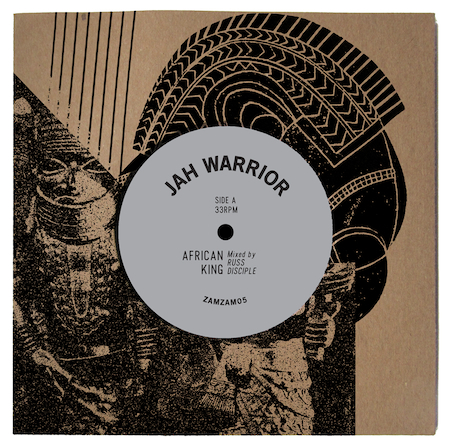
Arriving later this month as a limited-edition 7″ via Portland’s Zam Zam Sounds, African King is the latest record by UK roots and dub-reggae producer Jah Warrior (a.k.a. Steve Mosco). This b-side version of Mosco’s new track is a contemporary spin on classic dubwise sounds—boasting a solid four-on-the-floor with loads of delayed lasers and piano stabs drifting in the background as sharp and punchy percussion groove with the essential sub frequencies.