While we wait for Lukid‘s Lonely at the Top to appear on October 22, courtesy of Actress’ Werk Discs imprint, the producer has posted the video for “USSR,” a drifting cut taken from said LP. Composed of a freeform assemblage of bouncing pixels and colors that play off the perspiration on a person’s skin, the video is a solid match to Lukid’s album, which he’s described as “a complete mess and totally distorted” due to the haywire production methods that were used. To be sure, “USSR” is still a pleasant tune with an ambling bassline and mellowed vocal samples, all of which is respectably reminiscent of the calmer moments on Actress’ excellent R.I.P. album.
Pariah and Blawan Announce New EP as Karenn; Preview it Now
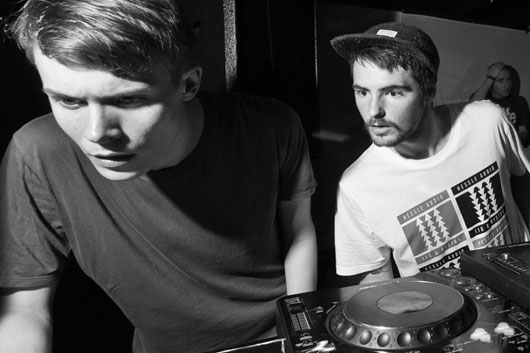
We’ve been excited about Karenn, the collaborative effort between London mainstays and R&S affiliates Pariah and Blawan, ever since we featured the duo last year in our Bubblin’ Up series. Now, the production outfit is set to follow its initial release with a six-track EP for its own She Works The Long Nights label. With track titles like “Nicotine Window Netting” and “A Room Full of Fuck All,” the EP, which is currently only known as SHEWORKS004 and will be released as a double-12″ package, is chock full of the kinds of chunky house, techno, and bass experiments fans have come to expect from each artist. Before the record is released “soon,” you can stream previews of each of its tracks, below.
Legowelt to Release LP via Clone
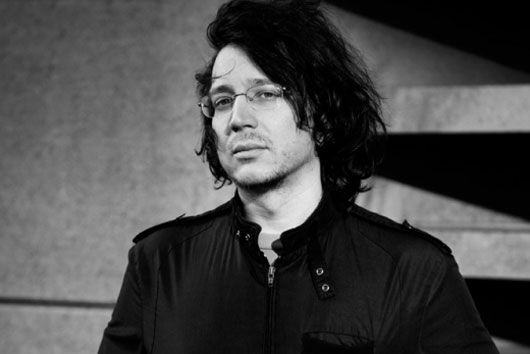
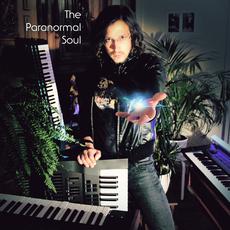
Longstanding techno producer Legowelt has just unveiled his next LP, a 12-track record called The Paranormal Soul, which will arrive next month via Clone. As FACT reports, the Dutch artist’s next offering “[mangles] the historical foundations of New York, Detroit, Chicago, and early UK rave, mixing it with seedy witchcraft rituals and deep space psychedelics for a boundless journey into techno mysticism.” You can check out the tracklist and artwork for Legowelt’s forthcoming LP below.
01. Danger In The Air
02. Clap Your Hands
03. Elements in Houz music
04. Rave Till Dawn
05. Sketches From Another City
06. Tigertrain
07. Transformation Of The Universe
08. Voice Of Triumph
09. I Only Move For U
10. Renegades Of A New Age
11. On a Cold Winter Day
12. To The Homeland
Elijah & Skilliam Drop Mix, Ready Butterz UK Tour
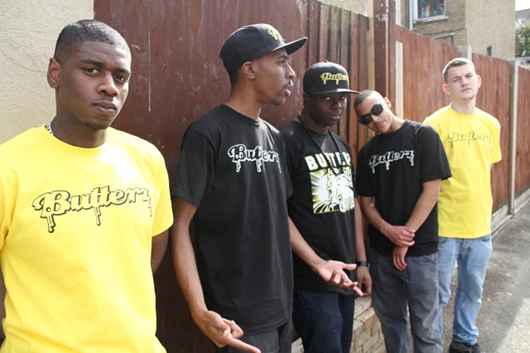
London calling: The Butterz crew (i.e. Elijah & Skilliam, Royal-T, and others) is setting out on a country-wide excursion, which has been dubbed the Black & Yellow Tour, this week, and has released a brand-new mix to celebrate. The Black and Yellow Tour Mix is a 35-minute studio mix by young grime duo Elijah & Skilliam, which arrives today without a tracklist, though we’re told cuts from TNGHT, Joker, P Money, Champion, and everyone involved with the tour are included. You can download the mix here or stream it below, where you can also check out Butterz’s tour schedule. Head over to Facebook for the full details.
XLR8R Couldn't find the embed function for type: "mixcloud" and source: "<embed src="//www.mixcloud.com/media/swf/player/mixcloudLoader.swf?feed=http%3A%2F%2Fwww.mixcloud.com%2Fbutterz%2Felijah-skilliam-black-yellow-tour-mix%2F&embed_uuid=7423fdde-e010-45f8-b563-40657bd7f7f1&stylecolor=&embed_type=widget_standard" type="application/x-shockwave-flash" wmode="opaque" allowscriptaccess="always" allowfullscreen="true" width="480" height="480">".
Oct. 5 — Bok Bok, Trim, Riko & Swindle — Club Life, Brighton
Oct. 16 — Trim, Royal-T — Dogma, Nottingham
Oct. 17 — Royal-T — Cellar Bar, Oxford
Nov. 9 — Bok Bok, D Double E, Trim, Royal-T — Plug, Sheffield
Nov. 10 — Terror Danjah, Royal-T, Swindle, Champion, DJ EZ, The Heatwave, D Double E, Skibadee, Hyper + — Cable, London
Nov. 15 — Swindle — Rotterdam Beats Festival
Nov. 16 — Swindle — Cellar Door, Exeter
*Elijah & Skilliam appear on all dates
Video: A Thousand Years “Their Technology”
XLR8R Couldn't find the embed function for type: "vimeo" and source: "<iframe src="http://player.vimeo.com/video/50665817" width="530" height="298" frameborder="0" webkitallowfullscreen="" mozallowfullscreen="" allowfullscreen=""></iframe>".
Today, we have the video for A Thousand Years‘ “Their Technology,” another cut from the artist born Zeké Africa’s recent Farmers in Fields of Stars EP (which also gave us one of our Top 20 Downloads of September, “Flying High”). “Their Technology” is as breezy as “Flying High,” but with added celestial vibes. The sound of airplanes hum in the background, while ethereal synth pads paint a pretty picture in the foreground. Bells, chimes, and woodblocks make for an elaborate house beat, which dances alongside sibilant sounds of mist and a peppy, complex melody. The video itself is made up of clips of time-lapse footage of flashing lights, starry skies, and many technological wonders, mostly borrowed from Vimeo, according to its maker.
Volta Cab “Make You Mine”

Russian producer Volta Cab, who you may remember from our premiere of his “Captain of Your Golden Galleon” tune last month, is back in action, this time offering up “Make You Mine,” his contribution to Top Billin’s forthcoming Bass & Bonez compilation. The track’s melodic layers play a lighthearted game of tug-of-war, as the low-octave tones pull you towards a nostalgia for the early rave music and the high-pitched synths bring to mind the soundtrack to scenes from Space Jam. Although, the sultry vocal samples that the producer born Konstantyn Isaew drops into the mix suggest he proabbly didn’t have animated basketball games on his mind when he was crafting “Make You Mine.” You can stream the rest of Bass & Bonez, which is out now, over on Bandcamp.
B2B: Robert Hood and John Tejada, Part Three
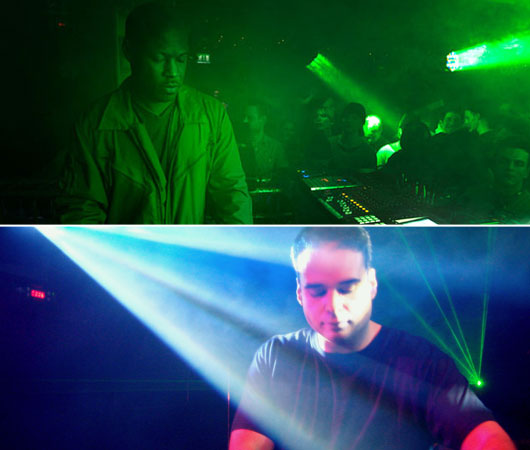
In the final segment of XLR8R‘s B2B session between Robert Hood and John Tejada—part one and part two went up earlier in the week—the artists take on the fast-evolving tools of electronic-music production and their hopes and thoughts for the electronic-music world moving forward.
XLR8R: Have the tools you use to produce changed over the years?
Robert Hood: I just evolve over time. I don’t like to stay comfortable for too long, I like to switch it up every now and then. But to me, it’s about what particular piece of equipment is going to identify with the way I produce music. Is it going to accent my sound in any way? Is it going to challenge me? I’m just not one of those guys that likes to pick up the latest technology just because it is. If it doesn’t grab me, if it doesn’t interest me, I tend to stay away from it and just pick up those little pieces of obscure equipment that not everyone is necessarily gravitating to.
John Tejada: I find myself coming full circle with it. I feel lucky that I got to start when there were no laptops or Ableton or computers that could handle plug-ins. I remember when I got a sampler and I was like, “Wow, I’ve got 12 seconds now!” [laughs] and that seems like such a lost thought. But so much of the records Rob and I were talking about earlier, that’s how those were created and it was making the most with what you had, which I think really lent itself to that magic. Limiting your limitations and actually having limitations is just not the same thing. I’ve gone from a hardware set-up to, of course, trying computer stuff because it was new and fun and interesting, but now I’ve come back to hardware-based instruments and sequencers after realizing, “Who’s stopping me from doing it this way?” That’s been my personal journey of not being too afraid to make things simpler and less layered because that is a lot of fun to me. We live in a time when popular sounds are layered and over-produced and a lot of them are great and a lot of them aren’t—which has all made it more difficult to stick to my guns—but I think I’ve reached a comfortable place where I can feel like I know how I’m going to do this because that’s what I’ve been developing for years, and if nobody likes it, then all right, that’s cool with me.
XLR8R: With that in mind, how would you like to see electronic music continue to evolve?
RH: It’s not about the machine, it’s about us squeezing the life out of that machine. Like John was saying before—those 808s, drum machines, synthesizers, samplers, and all that just tickled me to death. If we could could get that little-kid feeling back into it, that is what’s missing—where something is so fresh and so new and at the same time so scary and so challenging; somehow, [we need to] get that back into it. I think it’s going to have to be a future generation. It’s going to take some technology we just haven’t seen yet to get that other sound that we haven’t heard in order to get that feeling. I think we’ve done pretty much all we can do with what is available to us now, but at the same time, there is so much further we can go—we just have to get uncomfortable. We have to get out of this man-made compartment we built for ourselves and get outside of these boxes and really dream again—to defy gravity. Because in order to take ourselves to that other world, we have to learn to get out of this box.
JT: I totally agree, and it’s hard for me to put into words, but those stories about hearing Run DMC or Kraftwerk for the first time, are those even possible these days with these limitless options? I know for me, the hardest thing to do when I’m trying to better myself in the studio is to stop myself, because there is a sort of threshold where one more sound makes everything seem like you need a lot more sounds; but if you had just stopped where you were going to before, it seems really complete. And I can’t do this interview without saying that Rob was able to make a masterpiece out of a kick drum and one monosynth. There’s no one else that’s floored me in that way, hearing sounds that are perfectly matched and truly don’t need anything else. Those are the moments when you heard something and were like “Oh man!” I don’t know if it was simple but now, when you hear things so layered, you’re not really sure what you’re hearing—maybe that’s part of it. I can’t really put it into words, but I think essentially we’re striving for that same feeling. I don’t even care if I ever make it, I just want to hear it. I just want to hear things all the time that make me that happy and get me that inspired. Whether I can come anywhere close to making something that does that isn’t really the point, I just want to live in that inspiration.
RH: Yeah, that’s it. John just hit the nail on the head. Even if I don’t create it, I just want to be inspired by it. I just want to hear it. I appreciate what you said, John. I didn’t have any money, that’s all it was. [laughs] I had a $50 four-track, a borrowed DX-100, and I had just gotten a little money and bought a 909, and that’s all I had to work with—thank God for that. But that’s what I appreciate. It came out of desperation. We have too many options now. Where’s that desperate kid that’s sitting in his basement or his attic that’s going to spark a change in the world?
In the Studio: Hieroglyphic Being
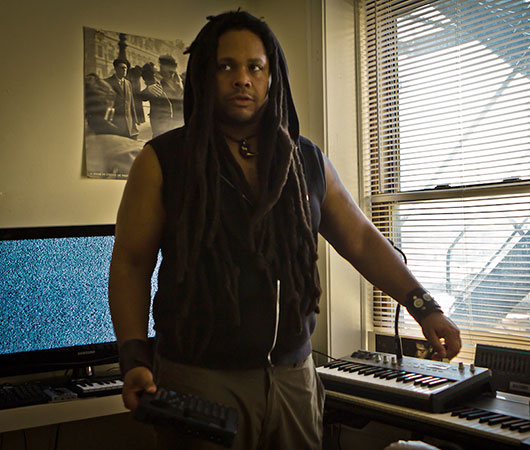
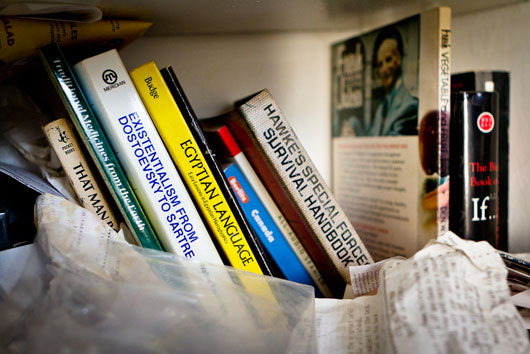
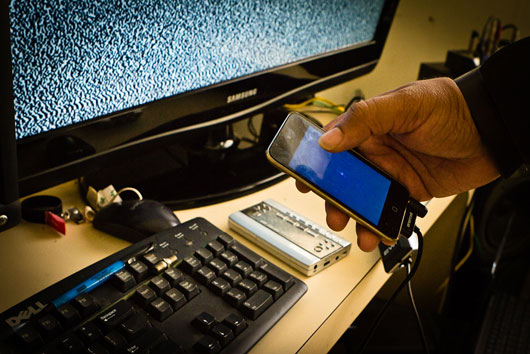
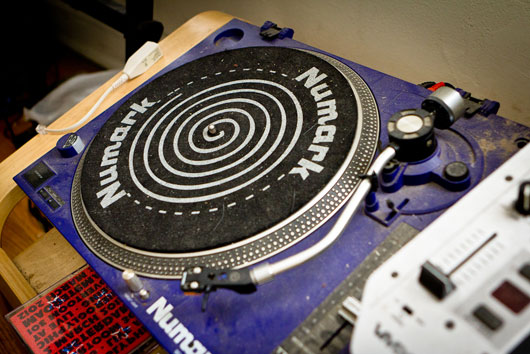
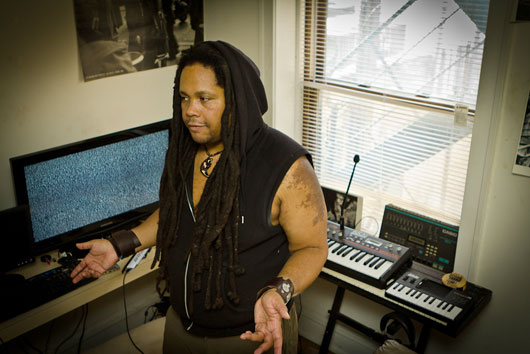
Jamal Moss is a minimalist. Not necessarily in the music he makes under his esoteric Hieroglyphic Being guise, but in the way he lives and works. Considering that he lives in his studio—or rather, that his studio is also his home—he keeps things simple. There’s a bed, a kitchen, a TV, and his gear. We visited his Evanston apartment/studio just north of Chicago, and noticed that this minimalism extends beyond furniture and decorations. It also applies to the equipment he uses to make his sprawling techno, house, ambient, and noise productions. Not one to chase after the latest studio toys, Moss’ set-up hasn’t evolved too much since he started making music in the ’90s, save for one glaring exception: his iPod Touch.
XLR8R: Considering your reputation for analog sounds, it’s surprising to find a computer in here.
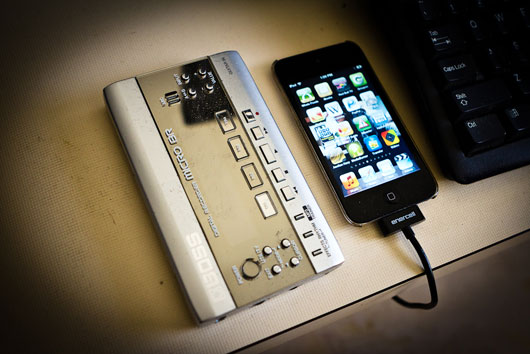
Hieroglyphic Being: When I want to send sound files to people who are interested in buying material, I’ll digitize it. My old VCR is busted, but I used to record to VHS tape, just, like, eight hours of analog sound. Then I would take it and put it to Minidisc. Just recently, I started putting it to this Boss Digital Recorder; it does four-track, 32-track, all that stuff. I’ll hook it up and start laying stuff into it. Usually what I do is practice all day and when I know what I want to do, I lay it down in real time. I’m not into that sequencing stuff and then messing around. I just practice it for a bit and then lay it in one take.
That’s how you work 100% of the time?
Until recently, it was half and half because I was still using my VCR. I slowly started changing over because people from labels were saying, “we like what you do,” but then they’d keep talking about the sound quality. I’m like, I do stuff to VCR. That’s been my thing for a long time. I couldn’t afford DATs and ADATs and CD burners. You gotta realize, you have VCRs that came out in the ’80s and early ’90s that were $600 or $700. Now, you can go to a resale shop and get them for $5. It’s the same thing as ADAT, but the ADAT just has all those compressors and all that new digital technology. So that’s all I use computers for, basically just to save stuff. I’ve got CD-Rs, Minidiscs, VHS tapes, and cassette tapes. I’m running out of space, so I have to go digital. I’ll get up, sit down, and write a couple of hours a day, and just lay stuff, dump it over [to a hard drive], then start over again.
Given your proximity to your work, are you writing new material daily?
Look around—I just roll out of bed and get to it.
Is there a particular machine that you start with?
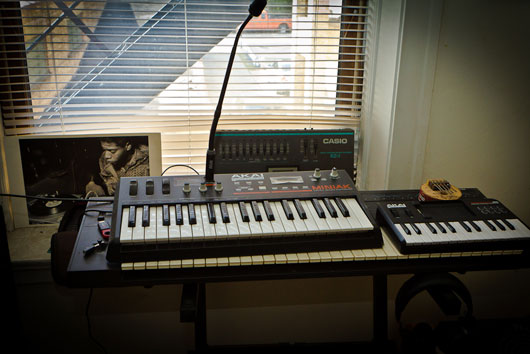
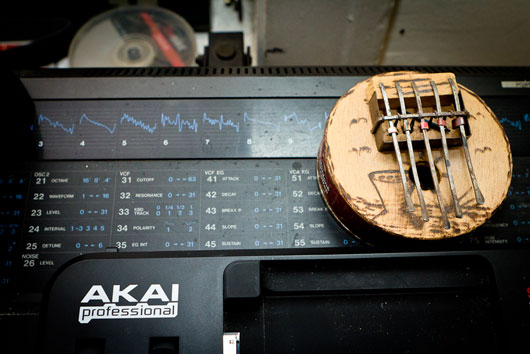
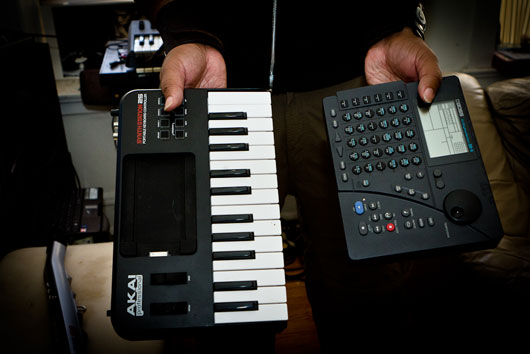
I build around patterns that I put on my [Boss Dr. Rhythm] DR-5 and then I’ll mess around with my Korg DW-8000. You can generate 303 sounds and everything with it because it has different patches. I’ll get some concepts and then I’ll say, “Okay, I need to find something closer to the sounds in [my Akai Mini-AK],” because sometimes [the Korg] glitches and pops. I need to get it repaired, so I found a machine that has some of the same sound generation. This Akai does it. It’s a professional vocoder, but it has a lot of other stuff in there as well. I also have this [Akai Synth Station 25], it’s a mini version of my other Akai. I’m not trying to take that on the road and get it broke, so I got this [Synth Station 25]. It can do all [the Mini-AK] can do, but I run it with my iPod [Touch]. This little thing is actually more powerful because of the iPod and all the apps you can get for it. People freak out when I go overseas because I bust it out with my drum machine, and they’re like, “Where’s the rest of it?”
Those two pieces are all you take on tour?
That’s it. I have analog and the whole digital thing and when I put them together, it’s nice. You’ve got to realize, you don’t need to bring out all your tubes and your compressors because the way the clubs are set up now, they already have all the top-of-the-line gear hooked up to the soundsystem. You can work with the sound engineer to get the sound atmospheres where you want them to be. You can get your fat bottom end. You can get your smooth, crisp highs, and your warm mid-range. For me, I feel comfortable with this.
Is the Akai thing a brand preference?
Everybody else has their thing, so I figured I had to find something else that people don’t like too much, that they see as a toy. People don’t see Akai as a brand that measures up to a Moog or a Korg or Roland products. Akai is down the totem pole, and I’m not at the top of the pole, so I’m going to work with the underdog.
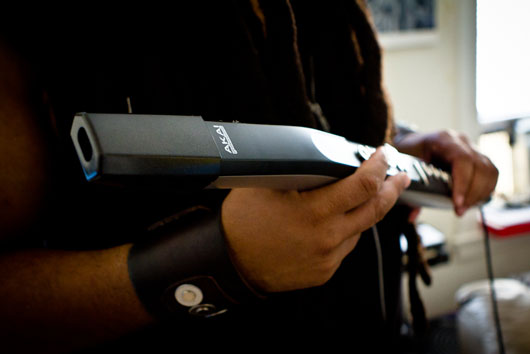
Tell us about your electric horn.
The EWI. Technically speaking, I can do a lot of wind instruments with this thing, but I can also hook it up to my keyboard and trigger sounds with it. I can sit there at a show and do a 303 with this. People say don’t be afraid, so I’m going to bust this out. I can’t just walk in with a laptop and be like, “Woo, look at me.”
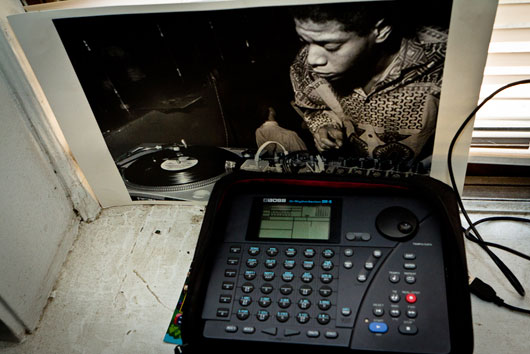
How long have you had that DR-5?
Since ’95. You know, people act weird towards me because they feel like I’m trying to be different and not fit in, but that’s how I’ve been all my life. I just do it my own way and this has 909, 808, 303 sounds. It’s got orchestra sounds; it’s like a band in a box.
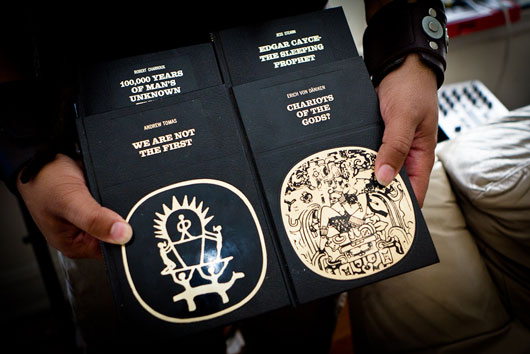
How much has your set-up changed since the ’90s?
I have the drum machine that Steve Poindexter’s “Work that Mutha Fucker” was made on. Before, I had an E-mu Drumulator, an Orbitron, and I had a Korg DDD-1, that was about it. When I feel like I’ve done enough with a certain unit, then I go a different direction and challenge myself. I don’t get it to prove to somebody that I have hot studio gear. I might not touch the DR-5 for a couple months because I’m focusing on this [Synth Station]. Or I might sit around and say, “I’m just going to work on some ambient soundscapes with the Korg.” It just depends on what I’m feeling at the moment. These are my therapists. So maybe this particular therapist can’t help me, but maybe that therapist can.
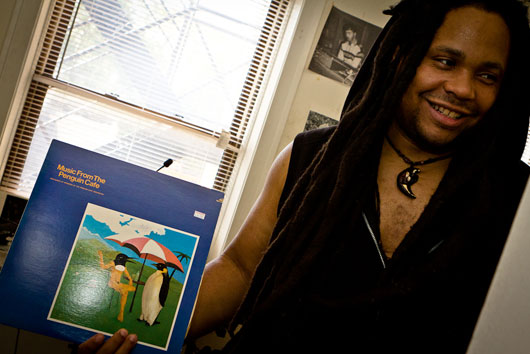
What have you been working on lately? There’s a lot of ambient stuff on your SoundCloud.
I’m going back to where I started: ambient soundscapes, industrial soundscapes, art noise. That’s what I’ve been gravitating to. I’ve been finding movie soundtracks lately, like Doctor Zhivago. If you want to do ambient stuff or static noise, soundtracks are good because of the timing, the tone, the texture, and the emotion. That’s what’s been inspiring me, and what you heard on my SoundCloud page, believe it or not, eight out of 10 of those tracks were done just through my iPod [Touch]—all just with my voice. There’s an app on there you can take and use your voice and change it to sound like synths or strings or whatever.
Can you tell us more about some of these apps?
I have NanoStudio, FunkBox… I have this other one, XENON, and then I’ve got a recorder if I want to get field recordings. I have so many of these apps that I’ve been geeking on—ImproVox is also one, it’s like a theremin. I’m giving all my secrets away, I’m going to have to switch up after this. You know cats be pissed off when they’re walking around with all their FX boxes and I walk up with an app.
How much collaboration do you find yourself doing?
For a lot of the projects that come out on my Mathematics label, I actually sit there and listen to tons of demos. The ones I think have potential, I will tell them what they need to do. A lot of artists on the label, I work with them. It’ll be months before a record comes out because I’m helping them go the direction they need to go. Sometimes I get tired because it takes away from me doing my thing.
Do you have any sort of musical philosophy that you’re trying to maintain?
I learned from Adonis, one of my mentors, [to not] go chasing what everybody else is doing. Just do what’s comfortable for you. You could go broke trying to get one piece of equipment, when you could be using that money to put out vinyl and get that stuff that [you] already have created out to the masses. Sometimes you don’t need to rush to get to certain things. If you’re chasing [one person in particular], that medium might work fine for them, but it might not be meant for you. At the end of the day, I do what I do to bring positivity through my art and help better the world. Creativity is the most positive thing I can do. This is my redemption.
Druid Cloak “Blessing of the Grove”
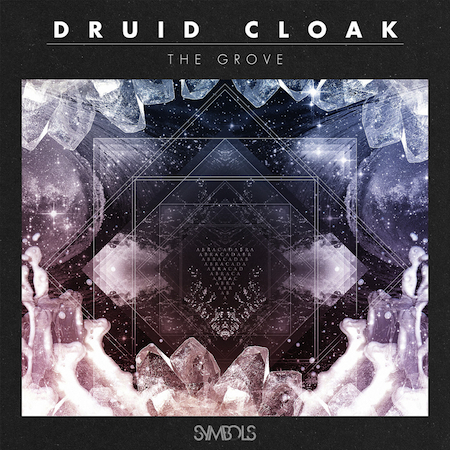
The elusive newcomer known only as Druid Cloak is set to release his debut record, The Grove EP, via Kastle‘s burgeoning Symbols label on October 9. Although he may be a mystery to most, the American artist has already garnered support from heavy hitters in the international bass scene—names such as Bambounou, Sepalcure, and Cedaa, among others. And for good reason, too; Druid Cloak’s sound is crisp, varied, vibey, and as fantastical as his moniker. As he puts it, the producer makes “what the earth tells [him to make],” a method which he displays a command over on EP cut “Blessing of the Grove.” Here, the futursitc sounds feel both organic and otherworldly as the track flows from a synth-heavy, half-time groove into a more bass-heavy, vocal-driven drop.
Tussle Tempest
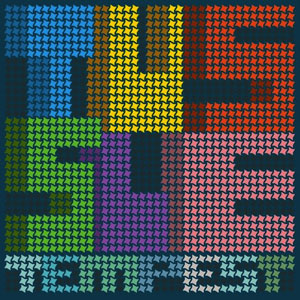
Tussle has made a long and respectable career out of refining the art of the jam. Across 12 years, six different incarnations, and 17 or so releases, the band—which always centers around leader Nathan Burazer, and currently features drummers Jonathan Holland and Kevin Woodruff with longtime bassist Tomo Yasuda—has maintained its focus on expansive, Kraut-inspired grooves that sound like carefully crafted instrumental pieces masquerading as freeform jam sessions. Early albums Kling Klang and Telescope Mind explored these ideas from a predominantly organic standpoint, utilizing the triple threat of two syncopated drum kits and a central bassline with subtle undercurrents of electronics filling in the blanks. Tussle pulled a switcheroo on everyone when it brought the undercurrents to the forefront on the comparably nebulous Cream Cuts, which effectively showcased the band’s updated vision of live, experimental dance music—even if it did tend to drift into unwieldy tangents of noise making. Four years later, Tempest finds the quartet delving deeper into that electronic realm, and—having honed the tunes with Optimo’s JD Twitch behind the boards and reached out to members of Liquid Liquid to collaborate—coming out the other side with what sounds like the destination Tussle has had its sights on all along.
The dubwise influence of Liquid Liquid seems to exist in just about all of Tussle’s material to date, but more so is JD’s presence felt throughout Tempest. From the clarity of the practically club-appropriate mixes to the rampant use of meaty 808 thumps, the Glaswegian producer’s fingerprints mark each of the nine tracks. Thankfully, he never overrides Tussle’s longstanding love for psychedelic sprawl or wonky melodic turns. In fact, he seems to bolster those elements while simultaneously whittling them into a more manageable dancefloor format. “Eye Context” is a great example of this, as it’s essentially a reimagining of the band’s 2003 single “Eye Contact.” Once a milieu of spacious grooves and atonal ephemera, the song has been transformed into a galactic party jam with lively patterns of handclaps and percussion, an array of wild sound effects, and more synth timbres than one could possibly catch on first listen. It may not be the best track on Tempest, but it is easily the most balanced between what could be rightly called “old” and “new” Tussle.
Despite heavy doses of cavernous electronics and drum-machine rhythms, opening tunes “Yume No Muri” and “Moondog” will probably be the most familiar to longtime fans, as they boast Yasuda’s rigidly funky bass riffs front and center with splashes of live drumming helping to carry the grooves. Fresher territory is uncovered during moments of “P44,” “Yellow Lighter,” and closer “Lightly Salted,” when the quartet puts down its trusty bass rig and dual drum kits in lieu of heavy beats and warped synth melodies. Tussle proves to be a talented bunch in this realm, too, and works out a handful of its reliably tripped-out, retro-futuristic dance jams with an arsenal of machines, samples, and—more likely than not—some pointers from the veteran Scottish producer. What’s more, the band now has the command of this organic/synthetic versatility in its toolbelt, often using it to find an ideal balance between highly finessed electronic soundscapes and bouts of raw, physical musicianship. As far as borderline jam bands go, it’s hard to think of a better place Tussle could be right now.