On top of this morning’s news that Mouse on Mars will release a new mini-album and tour North America this fall, the German duo has unveiled the video for “They Know Your Name,” one of the tracks from its most recent album, Parastrophics. The clip looks almost as if it was hand drawn, like an old movie you might have seen in a high school biology class. Bubbles and arrows cram their way through a geometric maze as the tune zaps and buzzes to the pace of the blobs’ movements. But the arrows single out one red circle from all the rest as being the apparent protagonist of the abstract piece. Last week, Mouse on Mars released “They Know Your Name” as a limited 7″ single and digital download, which includes a remix by Machinedrum (who we spoke to in today’s In the Studio feature).
Aaliyah feat. Drake “Enough Said (Shlohmo Remix)”
Even if you haven’t heard Shlohmo‘s remix of “Enough Said,” the posthumous Aaliyah track produced by Drake, you probably knew it was coming, and you probably know exactly what you’re in for. In trademark Shlohmo style (at least, it should be trademarked by now), both singers are screwed down, which muddies up Drake’s flow a little and contorts it into a sort of codeine-sipping robot voice. Compared to Shlohmo’s remix of “Crew Love” from earlier this year, Drake’s rap is a little more grating, and his vocals are screwed down even lower. However, both remixes share Shlohmo’s penchant for clicking beats and spectral energies—which is perhaps called for, considering the highly controversial resuscitation of Aaliyah’s vocal recordings for the original “Enough Said.”
Mouse on Mars to Drop New Mini-Album, Tour North America

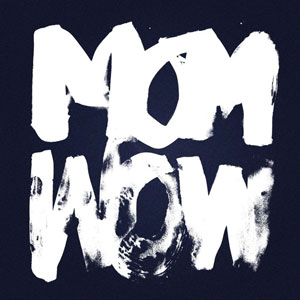
Veteran German electronic duo Mouse on Mars, who we spoke with about its lengthy history just as the Parastrophics LP dropped via Monkeytown early this year, has announced it will soon unveil another record, called WOW. Though it boasts 13 tracks, MOM’s forthcoming release is only 33 minutes long, and is denoted as a “mini-album” that, as Resident Advisor reports, will present “a ‘club-oriented counterpoint to Parastrophics,’ with excursions into acid and bass music among other styles.” Mouse on Mars will also embark on a North American tour this fall, following a few European shows and before its new record drops on November 2. You can check out those dates, along with the artwork and tracklist for WOW, below.
01. SOS
02. DOG
03. HYM
04. VAX
05. PUN
06. BSD
07. ACD
08. APE
09. CAN
10. ESO
11. SUN
12. WOC
13. CAT
Sat. Sep. 8 — Bucharest, RO @ de.kolectiv @ MNAC
Thu. Sep. 13 — Odense, DK @ Phono Festival
Fri. Sep. 14 – Malmö, SE @ Babel
Sat. Sep. 22 — Leipzig, DE @ Werk II @ 36..Jazztage
Fri. Sep. 28 – Stavanger, NO @ Numusic Festival
Fri. Oct. 5 — Braga, PT @ Semibreve Festival
Fri. Oct. 12 — Denver, CO @ Summit
Sun. Oct. 14 — Los Angeles, CA @ El Rey
Mon. Oct 15 — San Diego, CA @ Casbah
Tue. Oct. 16 — San Francisco, CA @ The Independent
Wed. Oct. 17 — Chicago, IL @ The Mayne Stage
Thu. Oct. 18 — Detroit, MI @ The Pike Room
Fri. Oct. 19 — Toronto, ON @ Lee’s Palace
Sat. Oct. 20 — Montreal, PQ @ Il Motore
Sun. Oct. 21 — Boston MA @ TT the Bear’s
Mon. Oct. 22 – New York, NY @ Santos Party House
Wed. Oct. 24 – Washington, DC @ U Street
Fri. Oct. 26 — Atlanta, GA @ Masquerade
Sat. Oct. 27 — Asheville, NC @ Moogfest
Sat. Nov. 3 – Istanbul, TR @ Babylon
Longwalkshortdock “You Berg (Knowing Looks Remix)”
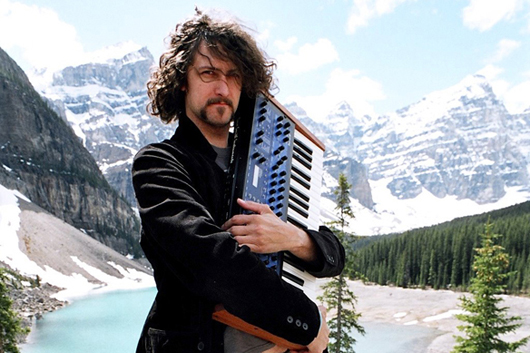
Picture this: In the year 2999, a robotic race of androids repeats the tragedy of the Titanic by striking an iceberg. As the ship sinks, the frigid water freezes the robots’ circuits, eliciting a sudden, almost human response from the metallic beings. That’s the story behind Longwalkshortdock‘s (pictured above) “You Berg” track, which comes as part of Canadian label King Deluxe’s ongoing 2999 project, in which beatmakers collaborate with visual artists to share vignettes from an Earth 987 years in the future. Now, King Deluxe has put out a remix album for “You Berg” that includes this glitchy reworking by Toronto beatsmith Knowing Looks. On his upbeat version, the producer adds an ominous, extremely low-pitched vocal sample to the mix, and also drops the icy guitar strums of Longwalkshortdock’s original tune front and center. You can nab the “You Berg” remix album when it drops on September 10.
Apparat Helms Latest Resident Advisor Mix

Berlin-based DJ/producer/musician Apparat (a.k.a. Sascha Ring) has composed the latest mix for Resident Advisor‘s podcast series, an effort he says will mark a shift in his outlook on life and music. Although the DJ set draws inspiration from downtempo and “depressing sounds,” like The Cure, Apparat told RA that he’ll “be a happy and optimistic person from now on. Forever.” His podcast incorporates what the producer called “good mood music” from the likes of Todd Terje and Pional, the latter of which collaborated with Spanish producer John Talabot on his debut album, Fin. According to the interview with Apparat, the artist’s interest in sunnier vibes was spurred by the experience of playing a show with John Talabot. You can read that interview, as well as hear the new podcast and check out its tracklist, here.
In the Studio: Machinedrum
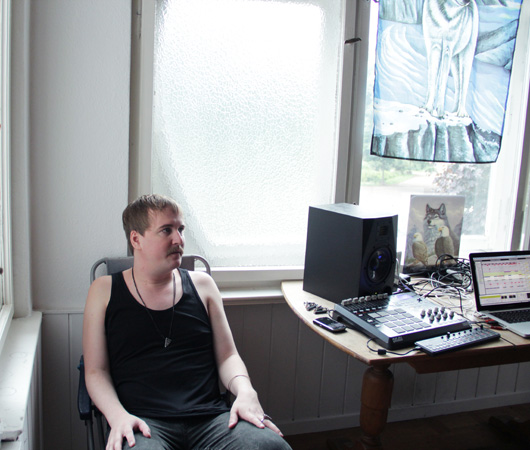
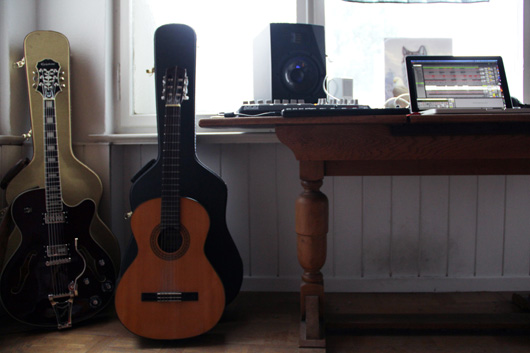
Travis Stewart is one busy dude. In recent years, it’s hard to think of another artist within the bass-music sphere who’s put out more releases, a feat made all the more impressive by the fact that Stewart also maintains a rigorous tour schedule that keeps him constantly hopping around the globe. Operating solo as Machinedrum and working as one half of Sepalcure (with partner Praveen Sharma), the American-born producer resides in Berlin and does much of his music making in a bedroom studio located in the city’s Kreuzberg district. Curious about his current production methods and how they’ve evolved over the years, we paid Stewart a visit earlier this summer, and somehow got him talking about the essential role that Weezer played in his musical coming of age.

XLR8R: When did you start producing?
Machinedrum: I was making electronic music when I was 12, 13. I didn’t even really know what producing was. I used mainly software, but I also played guitar and had some keyboards, almost exactly what I have now. But the software was very different, it was very old school, like Cakewalk and Impulse Tracker.
You mentioned playing guitar. Were you in bands?
Yeah. I grew up in a really small town in North Carolina, so a lot of the musicians that I was friends with weren’t necessarily into the same music that was into. I was getting really heavy into electronic music, and probably the most electronic music that my friends knew about was maybe Fatboy Slim, Chemical Brothers, Daft Punk, or something like that, which was fine, but I was really interested in making [that kind of music]. This is my roundabout way of telling you that I was in a Weezer cover band. [laughs] We covered Weezer, Smashing Pumpkins, Hum…
Were you recording any of that stuff?
No, we had some videotaped performances. We’d get to these points where I was like, “Guys, let’s try to write some songs,” and we would start to, it would be fun. I think we played some of them out, but everyone got really frustrated and it was like, “Let’s just stick to covers.” But I was also in the jazz band in high school. They already had a guitarist when I joined, so they needed a bassist. I had never really played bass before—my brother had. So I decided, “Why not?” and I ended up playing bass throughout high school, all four years. I was also playing marching snare in the marching band. I was in African ensemble, the community percussion ensemble that was based out of Lenoir-Rhyne college in Hickory, North Carolina. I was involved in a lot of different stuff, but not necessarily what I wanted to do. It was just whatever I could get.
Going back to your electronic-music production, you mentioned that you started with Cakewalk and Impulse Tracker. How has that evolved over the years?
The biggest part of the evolution has been the process and the understanding of how to get ideas out of my head. For the longest time, maybe 11 or 12 years, I only used Impulse Tracker, which is just a sample-based sequencer. It’s very limiting, but I kind of liked that. It was very hard to move on to other programs like Logic, because I felt like there were too many options in that kind of software. I think using Impulse Tracker for so long and just basically having everything primarily be sample based, which required me to build up a huge sample library and always be recording stuff—recording any sounds I heard, like field recordings, guitar, my friend’s synths, singing or whatever. I still work off that same sample library. I’ve been building it for ages now, I don’t even want to say how long. I use that same approach now with Ableton, which I’ve been using primarily for the past four years for production. I go into making songs, or starting a track, by going through my sample library and finding something interesting that inspires me.
Do you tend to start with a loop or beats or melodies? Do you have a set songwriting process?
It all depends on the mood. Sometimes I’m just feeling like making some ambient sort of song, so I’ll find field recordings and start adding little melodic things over that. Suddenly, I’ll start adding some pulsey bass or something. Eventually, I’ll say, “Now this needs a beat,” and I’ve totally gone way left of that ambient sort of direction. Other times, I’ll find some funny, ghettotech-sounding vocal sample and loop that over and over and throw a beat over it. It’s always changing, it just depends on the mood.
You definitely put out a lot of material. Are you a really fast producer?
I’ve become a lot faster in the past few years. I think a lot of it has to do with the discovery of the idea of externalizing the idea of genius—which I think anybody can really tap into—externalizing this creativity. Like, rather than putting pressure on myself to think that I have to pull out these ideas, all I feel like I’m responsible for is practicing and learning about my craft as much as possible so that when the ideas come—from wherever they come from; a lot of times, I have no idea what’s happening when I’m writing a song—I’m able to at least understand the idea and translate it into a track.
When you talk about learning your craft, are you referring to learning shortcuts in Ableton or making plugins?
It has to do with that, [but it’s also] collaborating with other people. A lot of times, you’ll learn so much, just through their own process using the same software. The beautiful thing about Ableton is that I feel like every single person that uses it has a different sort of approach. None of them are wrong, they’re all just unique. So, I’ve learned from that, and yeah, it’s exactly what you said, [learning] little shortcuts, different tricks. But also, learning tutorials, or even just studying music in general and the history of music—how a certain sound has gotten to this point, and who the originators are.
When you’re writing your music, sequencing and stuff, are you using MIDI controllers, the keyboard, or both?
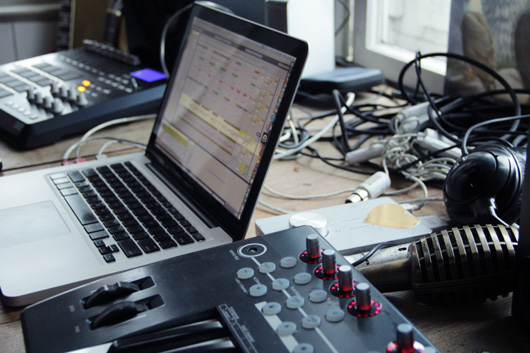
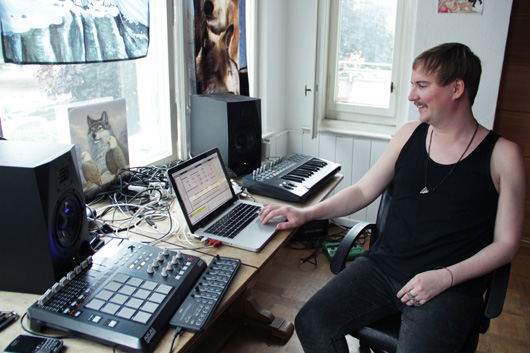
With all the traveling I’ve been doing the past couple of years, I’ve gotten really into just having my laptop, record arming a track, and tapping a beat on the computer keyboard. Even in Impulse Tracker, that was how you inputted a lot of the notes. I’ll find myself doing that, even if I’ve got my MIDI keyboard sitting right next to me. I switch it up a bit though.
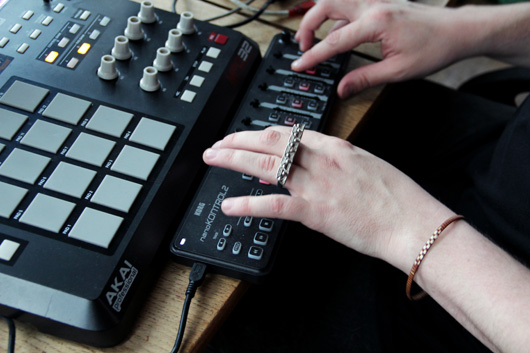
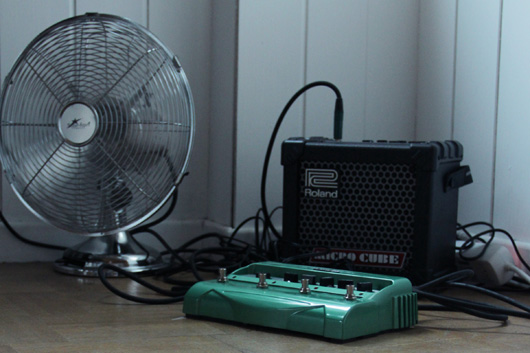
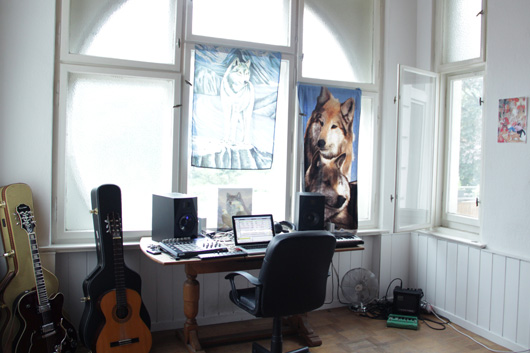
Looking at your setup, are the guitars the only items that aren’t digital?
Yeah, although I use microphones to record my voice, or tapping on the table, any sort of weird Foley sounds, stuff like that.
You have another project, Tstewart. Is that more of a band?
It’s a folk rocky, but also synth poppy sort of thing. It’s very lo-fi, shoegazey… sort of going back to a lot of my ’90s influences, stuff that I was really into. It’s something that I’ve always been working on, but the releases have been very limited. I put out a cassette tape last year on LuckyMe, and we’re supposedly going to be doing a digital release of that sometime soon.

Does Sepalcure have a different sort of production process than Machinedrum?
Not necessarily. We actually approach it very similarly, with the obvious advantage of having another person there. If anything, it’s the fastest project that I have. We are both very strong working within Ableton, and we’re both very strong instrumentalists. Praveen actually has an advantage over me. He has a lot of different analog synths. He has a Rhodes piano. He’s got a lot toys to play around with. It gives us a nice balance. One person is manning the computer while the other person is playing stuff. Then, once one person gets too computered out, we can switch it up. It keeps this really nice flow going.
Are you always in the same room when you’re making Sepalcure stuff?
Yeah, we decided that it has to be that way. It’s really important to us. The Fleur EP was the only time we didn’t do that. Of course we really like those tracks, but when we listen to them, we can hear who had a heavier influence on the track, whereas with our LP, we’ll listen to the songs and forget who did what. I think that feels nicer, more like a collaboration and less like a nerdy file swap.

Sepalcure generally has more organic/analog elements than Machinedrum. Is that something you purposefully don’t put into in your own music?
Not necessarily. I think it’s interesting that you’re coming to do this interview now, because I’m finally saving up enough money to build out the kind of studio that I would want. Praveen has been fortunate enough to acquire a lot of these analog bits that have definitely been influential on the sound of Sepalcure. But I still [have] the extensive sample libraries, and [I’m always] really adamant that if I’m at a friend’s studio, and they have a really cool synth that I like, I’ll try to record a bunch [of sounds] from it, as many as possible, so I can use it later. So [Machinedrum] still retains some sort of analog influence. It would still be nice to just have it in the room, of course. So, maybe come back in a year and we’ll see what [the studio looks] like.
Matthewdavid “All Night Long (Mary Jane Girls Cover)”
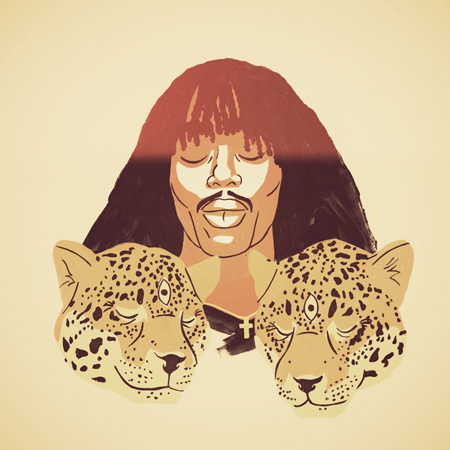
Just this past Thursday, Brainfeeder signee and Leaving Records boss Matthewdavid dropped a free EP titled Producers in 2012 Learn to Spread Love. The record is wholly inspired by music from the 1980s; in fact, its opener, “All Night Long,” is a loose cover of the sexy 1980s hit of the same name by soul group Mary Jane Girls (who were proteges of Rick James, who features on the EP’s cover art, pictured above). In his reinterpretation of the classic track, Matthewdavid does away with the peppy soul instrumental of the original, replacing it with a skittering, bass-heavy beat more suited for rattling speakers than acting as the soundtrack for a long night with a significant other (if you know what we mean). You can download the rest of the three-track EP over on Brainfeeder’s website, here.
Holy Other Held
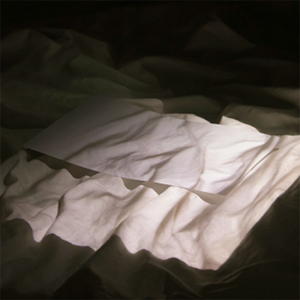
XLR8R‘s top pick for the Best Releases of 2011 was a five-song EP called With U, the first sizeable release issued by Manchester producer Holy Other. We also named him one of the year’s best new artists, and it should be obvious why: Holy Other arrived with an arguably unique sound and shrouded aesthetic which were fully formed and irresistable from the start. Even when the vitriol for “witch house” was hitting critical mass, critics and fans would always seem to grant the UK artist a pass, citing his tasteful use of poignant R&B and the fact that he sounded more like he was meticulously crafting slow-motion house music than banging out gothy rap beats. Holy Other had a good thing (some might say a great thing) going since day one, so its no real surprise that very little has changed on his debut LP for Tri Angle, Held.
Holy Other’s album is essentially the second manifestation of With U, complete with all of the extra detail and depth that a year’s time can allot a budding and unquestionably talented producer. His dark sonic underworlds now seem to quake with the vibrations of sub frequencies instead of merely rumbling with deep low end; his swaying rhythms thump and ring out with a newfound clarity; his beloved vocal samples appear to have multiplied, and now flit about from all angles like a choir of disembodied seraphs cooing their mangled songs. And everything sounds as if it were created and rendered in an isolation chamber. The glow of warm chords, the twinkle of chiming percussion, and the distant cries in album standout “Tense Past” seem to calmly bob and float atop of a syrupy bassline, as if it was all meant to help induce a kind of meditation. Following track “Impouring” does much of the same—albeit with a more spare sound pallette—and also features one of Holy Other’s latest tricks: tempo change. Whether gradually speeding things up or bringing the bpms down a handful of ticks, the producer uses these alterations as added emphasis for his already vibrant soundscapes. Like on the brilliant flip at the center of “Held,” Holy Other has the ability to merge two completely different moods with a seamless transition that can feel like an oddly euphoric drug comedown. As the swirl of glassy synths cradles the song during its descent, touchingly austere piano chords usher in “Held”‘s final moments and effectively solidify the moving production as the LP’s premier cut.
But the ultimate truth of the matter is that Held feels as if it is lacking… something. It’s admittedly difficult to pin down exactly what that “something” is, but what’s most apparent is that the almost palpable emotional undercurrent that ran throughout With U seems to have taken a backseat to the focus on production quality. While a song like “Past Tension” sounds brighter and relatively hopeful compared to the album’s predominantly sullen overtones, it pales in comparison to the dawn-hued rays of light—as heard on “With U” and “Feel Something”—that helped make Holy Other’s 2011 EP so captivating and fully realized. Thanks to some uplifting strings and lofty vocal harmonies, album closer “Nothing Here” does have a silver lining around its groaning, shadowy core, which is entirely rewarding at the start. But after a slow build up and a few minutes of riding out his plodding beat, Holy Other lets the incandescent motif simply stop and fade away. It sounds almost like he ran out of room on his hard drive, and had to cut off his track before it had a chance to completely resolve. Needless to say, it makes for an underwhelming close to an otherwise tenderly crafted and beautifully arranged debut album from a producer who has already proven his worth and will undoubtedly have plenty more bright moments in his future.
RaucherEcke “Gekko”
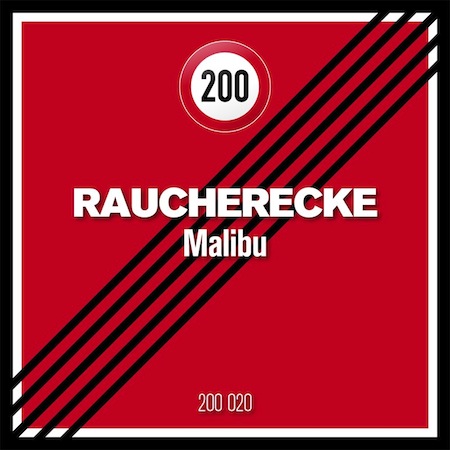
Cologne duo RaucherEcke has an EP set for release via hometown label 200 Records. From that upcoming release we’re given “Gekko,” a sunny techno track with uplifting melodies which eminate from an expansive bed of synths. The tune’s funky bassline billows underneath a galactic soundscape, helping to drive the momentum of RaucherEcke’s song and insert a bit of necessary deepness into the mix. Look for the production pair’s Malibu EP when it drops on October 1.
Coki Don’t Get It Twisted Vol. 2

The DMZ label often gets defined by Mala’s smokier, more introspective dubstep flavors, but his Digital Mystikz cohort Coki is really known to rough up the dance; his secret weapons are hypnotic synth patterns that can buzz around a dark warehouse like angry insects on a warpath. Like drum & bass producer Krust, Coki likes to hone in on a loop and then minutely twist it and turn it over and over. After a few minutes, your brain is in a vice grip… and it’s a feeling you either like or you don’t.
If you captured the first installment of Don’t Get It Twisted, unleashed in May of 2011, Volume 2 is more of the same: techy, modulated melodies endlessly warping over a landscape of crispy drums and Swamp Thing bass. It’s not quite minimal, but it is meditative, making for a serious head nod in the club or a descent into madness in the headphones. “Mid June Madness” is a crazy clown car spiraling out of control, causing little children to cry with its unhinged melody and menacing bass; it’s very reminiscent of a higher pitched version of Coki’s monster tune “Goblin.”
Despite the title, “Light Years” doesn’t let up the pressure, rocketing into the future on a spaceship made of skanking alien wobble and shot through with strange animal coos and screams, while “Onboard” teases with trance-inspired bits, which act as a momentary breather between more squealing and stuttering and squalling and steppin’. “Drop and Run” finishes off this wild ride with sad strings and stuttering, wide-mouthed bass—it’s like a soundtrack to Mickey Mouse’s funeral service if all the cartoons were dosed.
Don’t get it twisted, this music is twisted… and very demanding. It’s divine on the dancefloor but a bit overly pressurized for home consumption… unless you live in a madhouse, in which case, rave on.