Sun Glitters‘ “There” (from his split EP with Halls) has received the remix treatment from like-minded producer Stumbleine. The Bristol resident reels in the drama of Sun Glitters’ original a bit, and manages to soak the wistful piano, distant vocal samples, and lush pads in an even more watery substance, but not without a touch of warm R&B to make the rework a proper slow-motion head-nodder.
Accomplished guitarist, producer, and all-around sonic experimentalist Christopher Willits has announced a remix project/contest that makes available all the stems which went into the making of his 2010 LP, Tiger Flower Circle Sun, for any and all ambitious producers to use for their own creative endeavors. The 121 high-quality stems can be found here, along with full details as to what prizes one can receive if their remix is deemed worthy, including a package from Ableton and a Soundcloud Pro account. In addition, a few lucky remixes will be chosen to appear on comps from Ghostly and Willits’ own Overlap imprint. Remixers have until February of next year to send in their submissions, but considering the magnitude of audio to choose from and the quality of potential rewards for your endeavors, we imagine the sooner one gets started, the better.
Cartoon relics play out in layered slow motion during this clip for the title track from Oneohtrix Point Never‘s forthcoming LP, Replica. The Brooklyn-based synth/noise auteur born Daniel Lopatin will drop the new record on November 8 via his own Software imprint. You can check out another one of the album’s tracks, “Sleep Dealer,” here, and make sure to roll yourself a fat one before getting into the mesmerizing video above.
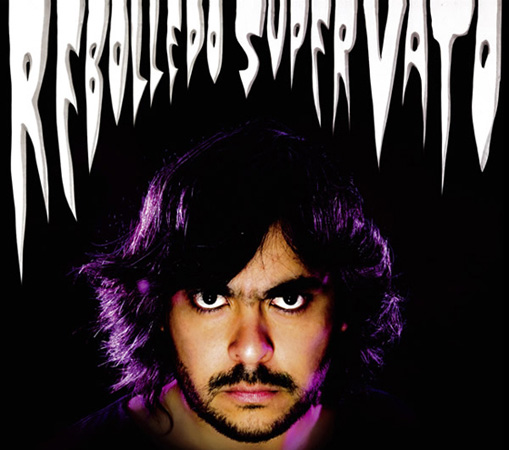
This may come as a bit of a surprise, but the joint Matias Aguayo- and Gary Pimiento-run Cómeme label has yet to put out a full-length in its two-plus years of existence. But all that’s about to change, with Mexican producer Rebolledo set to release a proper album on October 24, appropriately titled Super Vato (artwork above). “Canivalón” is the first cut to surface from the forthcoming LP, and one that seems to fit the Cómeme aesthetic perfectly, with its brooding techno low end, layers of percussion, and dizzying loops of Rebolledo’s (somewhat incomprehensible) vocals. The results are almost tribal, and even a little darker than what we’re used to hearing from Rebolledo, but it’s a welcome stretch of range, and one we’re hoping he has time to fully explore given the full-length format.
In recent weeks, Martyn and Modeselektor, both heavyweight electronic-music acts in their own right, brought new albums into the world, Ghost People and Monkeytown. Rather than simply picking their brains ourselves, we decided to get them talking to each other and see what would happen. As it turns out, Dutch producer Martyn (a.k.a. Martijn Deijkers, who now resides in the US) and German duo Modeselektor (a.k.a. Gernot Bronsert and Sebastian “Charlie” Szary) have known each other for years, and once they all got to talking, the veteran producers had a whole lot to say. (In all honesty, Gernot did the vast majority of the talking for the Modeselektor camp.) Over the course of a few hours, they tackled a wide variety of topics, including production techniques, the current state of clubbing, their respective musical histories, touring, their latest albums, the aims behind their respective record labels, and much more. Rather than significantly trimming down the conversation, each day this week we’ll be running another portion of the Martyn vs. Modeselektor discussion. Part one is below, and finds things kicking off with talk of record shopping and how music consumption continues to evolve, the storied Hard Wax shop in Berlin, and how Martyn’s and Modeselektor’s music is perceived by the world at large.
XLR8R: Both Martyn and Modeselektor are kind of seen as outsiders in your respective scenes. Whether Martyn, coming from dubstep, or Modeselektor coming from techno…
Gernot Bronsert: No, he’s coming from drum & bass! Martyn, I have one of your drum & bass records, I found it. I just cleaned up my record collection. Is that possible?
Martyn: Yeah. Was it good?
GB: It was cool, I like drum & bass.
XLR8R: So, how do you guys feel about being perceived as sort of operating within certain scenes but also being seen as the outsiders within those same scenes?
GB: I don’t think we are outsiders. Not at all. I think Martyn is for me one of the most important producers of the last five or six years, because he’s always looking for the way in between all the things. It’s about good dance music.
M: I think the press made it up, to be honest. For both of us, we just kind of follow our own path. We’re inspired by other music. We take influences from all different directions. It’s always the press afterwards that has to put us in a certain genre. And one time they called me dubstep, and then they called me house, and then they call me techno. They can do whatever they want, basically, but it’s not something that we come up with or it’s not that we actually choose to be outside of these genres. I don’t really think about genres in the first place.
GB: Exactly. I have the same opinion. But I think Modeselektor is maybe more varied because we make a lot of different things, like, tempo-wise. We do hip-hop and we make some really fast tunes. In the end, the thing we have in common is we don’t think too much about the whole bubble.
XLR8R: At this point, both Modeselektor and Martyn are known as established artists. Monkeytown is the third Modeselektor album and Ghost People is the second Martyn album. Does being a veteran artist affect the way you make music at all?
GB: At one point, you are not the newcomer anymore. When you start making music and a name and you make some good records, then you are the new guy. But I think it’s more important not to do what people expect from you. You should follow your own path and it’s very important that you go forward and work on yourself and your music. And that you grow with the times, because today, the electronic music scene is changing so quick and so fast because of the internet. When I look back, when a record came out, a techno record for example, let’s say a Maurizio or Basic Channel record, it was sometimes a hit for a year or two years or more. Today, it’s so fast and so quick and I don’t want to be part of this whole thing because it’s too fast for me. I don’t like it fast. Music-wise yes, but not life-wise and electronic-music-scene-wise. It’s about making timeless shit and I think we do kind of timeless music. And I think Martyn, he’s doing timeless music too, which is why I like his music. Love. Martyn, I wanted to say “love.”
M: I think that if we had been younger, then maybe when there was a new sound we would immediately jump on the new sound every time. But we’re a little bit older, and I think we can just take a step back, look at the new developments, and then pick what we like about it. But we don’t have to run with everything straightaway, like, “Oh my god, now it’s funky music, now it’s dubstep, now it’s post-dubstep.” Because we’re a little bit older, I do think our minds are made up a little bit more. And it just makes it easier for us to stay on our own route.
GB: I think we are more reflective. I think we learned to listen to music in a different way. Today, most of the kids are digital, they are listening to tunes on the computer, and the amount of information today is much bigger than 10 years ago. I spent what little money I had when I was young buying records and I played them so often. I think this vibe got lost.
M: Yeah, a little bit.
GB: You know what i’m talking about. You are a techno guy, I know you are a techno guy, I can hear this.
M: Do you know this book called Retromania by Simon Reynolds? I finished it last week. It’s kind of about this subject as well. They say younger people have so much more music that they have to go through to find good stuff. There are like a million tunes more than back in the day when you would just go to the record store. [When I was younger,] I was already happy if the guy at the counter would even talk to me. They would give me five records and I would choose from these five records. I would choose my favorite one, and that one is still in my collection. And now people go through hundreds of tunes in a day sometimes, so when you talk about a newer generation, they do have a lot more shit music to go through to find the good stuff. Then again, their taste in music can also be much more widespread. Now, you can meet a guy in the street and he’s like, “I’m into Angolan bongo house,” and maybe 10 years ago no one would know what that was because you would never find that stuff in a shop. It has advantages, but also disadvantages.
GB: But you went to record stores a lot, right?
M: Yeah yeah yeah.
GB: Do you have one particular one you went to?
M: There were a few, there were two big ones in Eindhoven I used to go to. One was very good at early Warp stuff, Autechre and Aphex Twin and all that sort of stuff. The other one sold to people who worked at discos, so it was a house and disco record store, where you see all those guys that have an account and they spend a couple of hundred of guilders per week on records. They would buy like 40 new records every time. Those were the two that I went to. Where did you go?
GB: To be honest, I just went to one record store in Berlin my whole life. I went to Hard Wax, I think I was there the first time when I was 14, and when I went into the store I just fell in love with it and I ended up working there, from 2001 to 2003. I didn’t make any money there because I spent all my money I made on records. So they paid me in records, and I worked there three or four days a week.
M: But everyone in Berlin worked at Hard Wax at some point.
GB: Everyone? Just a few guys, and they are all my friends. But I think everyone that worked at Hard Wax takes the spirit out of it, you know what I mean? When I started working at Hard Wax, I really learned to understand electronic music, it was like going to school. When I started working there the first time, I bought all the classics I had never heard before, music from before my time. I had all these teachers, they all gave me the essential stuff. They always said, “What, you don’t know this record? Man, that’s a must-have, you should listen to this,” even if it was just for the bass drum and the hi-hat.
Anyways, I think this traditional way of listening to or buying electronic music, or music in general, is a little bit lost, but Hard Wax is still existing and it’s doing better than it was two or three years ago. It’s crazy, people go there just to meet the right people and buy music. I honestly need to say that I got controlled by Hard Wax about my music collection. That’s crazy. I was depending on what they ordered for the store. That was a really interesting thing. And when I started working there, I was a part of it, I started ordering records as well. It was a nice experience. I think that changed me a lot. And that was for me one of the main influences I had, outside of making music—just living music. I think I live music. And Martyn too. I know this, I can hear this in his beats.
M: Yes. This true.
Click here for part two of B2B: Martyn and Modeselektor.
Despite having a fairly deep discography that reaches all the way back to 2004, this is really the first time T-Polar has appeared on our radar, and he pops up in the midst of readying a new EP, Apollo, set to drop on the Saigon imprint October 24. Although “Quarter” is not a track featured on said EP, the tune does show the kind of dark, house-infused bass music the Irish producer is turning out at this point in his career. Amongst the obvious bass-music touches (skittering drums, vocal chops, and smooth chords) there’s an undeniable vein of vintage rave and house to be found here, and it’s these elements that keep you slightly on your heels as to where the track will turn next. After giving “Quarter” a listen, you can also peep the borderline NSFW video for the forthcoming EP’s title track after the jump.
In case you needed any more proof that juke had moved far beyond its roots in the streets of Chicago, here we have an EP from a Houston native who’s now based in Boston while studying music at the renowned Berklee College of Music. Those who only champion juke of the utmost authentic origins may see this as a red flag, but a conversation about musical authenticity in the internet age is requires a much larger discussion, and should almost always be superseded by a simple question: Is the music good? In the case of Wheez-ie, it’s pretty good.
Wheez-ie’s brand of juke comes off as much more calculated than the tracks that defined the early days of the genre. His sounds are pristine and full, and his chops, although spastic, are clean and smooth. But the visceral propulsion that the sped-up beats and programmed rhythmic syncopation bring to juke is still there, and may be even more easy to pinpoint given the detailed sonic clarity. The EP-opening title track even goes so far as to introduce some real dynamics, taking the listener through a number of different sonic levels before ultimately landing back on a precisely revolving kick pattern and loads of tuned percussion. “Barefoot Billy” is about as simple as Keep Yer Chin Up gets, relying on a blistering block and clap pattern for almost a whole minute before introducing the half-hilarious/half-ridiculous vocal chops which, when put together, boil down to “I’m in the club and I ain’t got no shoes on.” The beat is stark and unrelentingly repetitive, but it is this that allows the focus to be on Wheez-ie’s tastefully intricate pilings of bells, clicks, and pops in super-detailed, hi-fidelity audio. His third original contribution to the EP, “House Ball,” throws a bit of acid-indebted synth work into the mix, resulting in an adventurous production, albeit one that ultimately doesn’t cut through with the same force as the EP’s two preceding tracks.
Truthfully though, the EP’s highlights come not from Wheez-ie himself, but instead from Frite Nite boss Salva and Detroit vet DJ Assualt. The former slows down and somehow fits even more rewarding low-end into “Keep Yer Chin Up,” truncating Wheez-ie’s blistering percussion to short spurts in between generous helping of space-age bass. Meanwhile, the latter’s rework of “Barefoot Billy” turns the tune into bizarrely intriguing slice of soulful house. Sure, it takes a while to sink in, but ultimately DJ Assault’s take proves to be the EP’s most memorable track, introducing some new and surprisingly hooky vocal melodies to the piece that border on being out of place, but after a few listens show themselves to be oddly brilliant.
Two of Scotland’s heaviest hitters, Neil Landstrumm (pictured left) and JD Twitch (pictured right), have announced the formation of a new collaborative project they’re calling Doubleheart. Both producers are veterans at this point, with Landstrumm’s discography including over a decade of releases for the likes of Peacefrog, Planet Mu, and Tresor, while Twitch has made his reputation as one of the men behind Glasgow’s legendary Optimo club night. Although the pair are said to have been collaborating on a weekly basis since 2010, there’s only one single, “Salsa” b/w “Ache,” slated for release so far. Unfortunately no audio has made it’s way out yet, but Doubleheart’s debut single is set to hit the streets November 27 via Instra:mental’s NonPlus+ imprint. (via FACT)
Arizona’s Yojimbo Billions is set to release his debut for the burgeoning Waaga imprint next month and has shared this cold, undulating cut from the forthcoming Our Bodies Are Machines LP (artwork above) before its release on November 15. Interaction between humans and machines seems to be a bit of a fascination for the young producer, a fact evident not only in his album’s title, but also in his brief biography (which goes so far as to claim he was visited by a robot who told him to make music) and, of course, in the way his productions come together. Combining some extensive musical training (including the study of musical theory in college) with his computer-based compositions, the Phoenix resident creates music that really only lightly bubbles at the surface, but, for those willing to pay attention, brims with detail and sophistication below.
Who doesn’t love a sizable helping of vintage arcade graphics and bouncing dance music? As we would’ve guessed, the party-starting DJ/producers at Dirtybird most definitely do. San Francisco tunesmiths Justin Martin and Ardalan delivered this totally silly, totally entertaining, ’80s/’90s-arcade-game-referencing music video, which is paired with the hyperactive “Lezgo” jam that dropped back in August. Kudos to director Luc Gut for going head to head with our favorite video of the year so far.