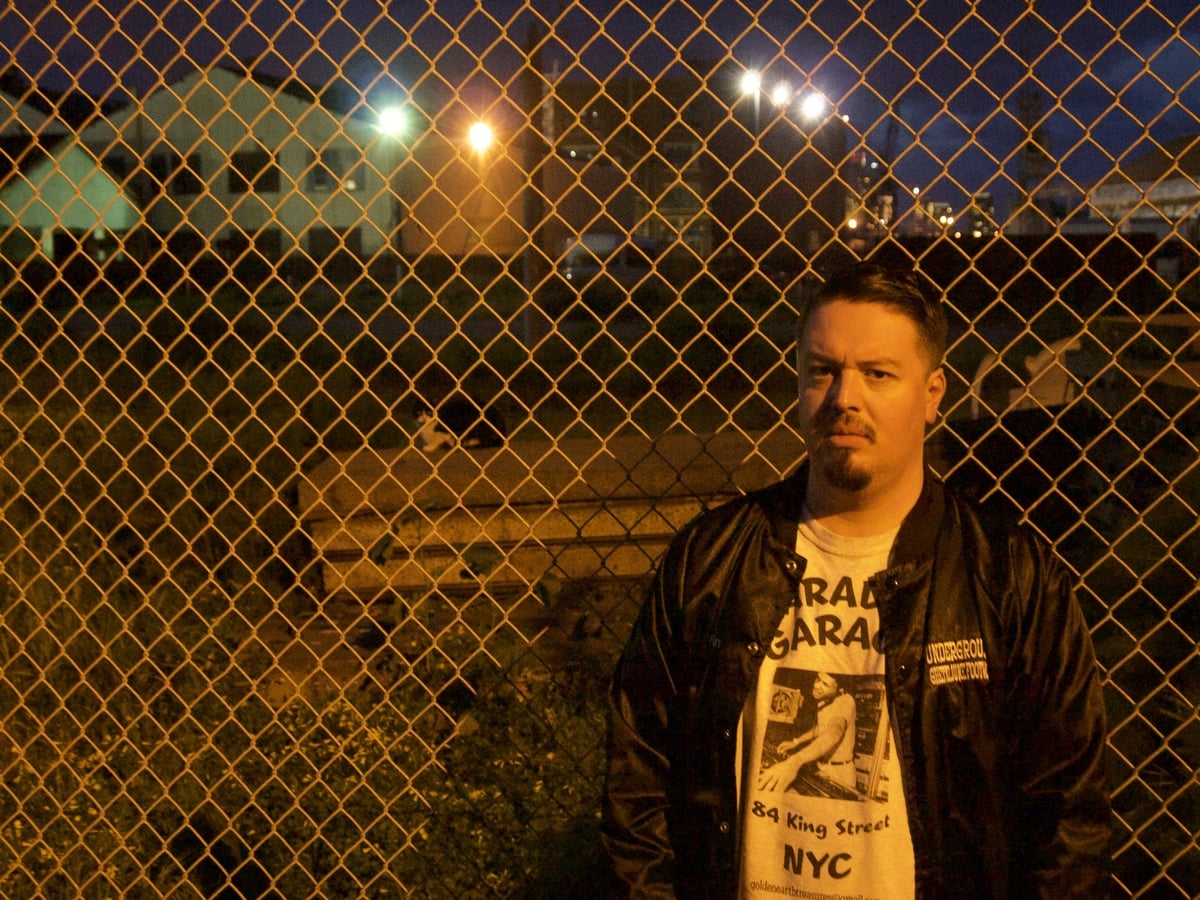
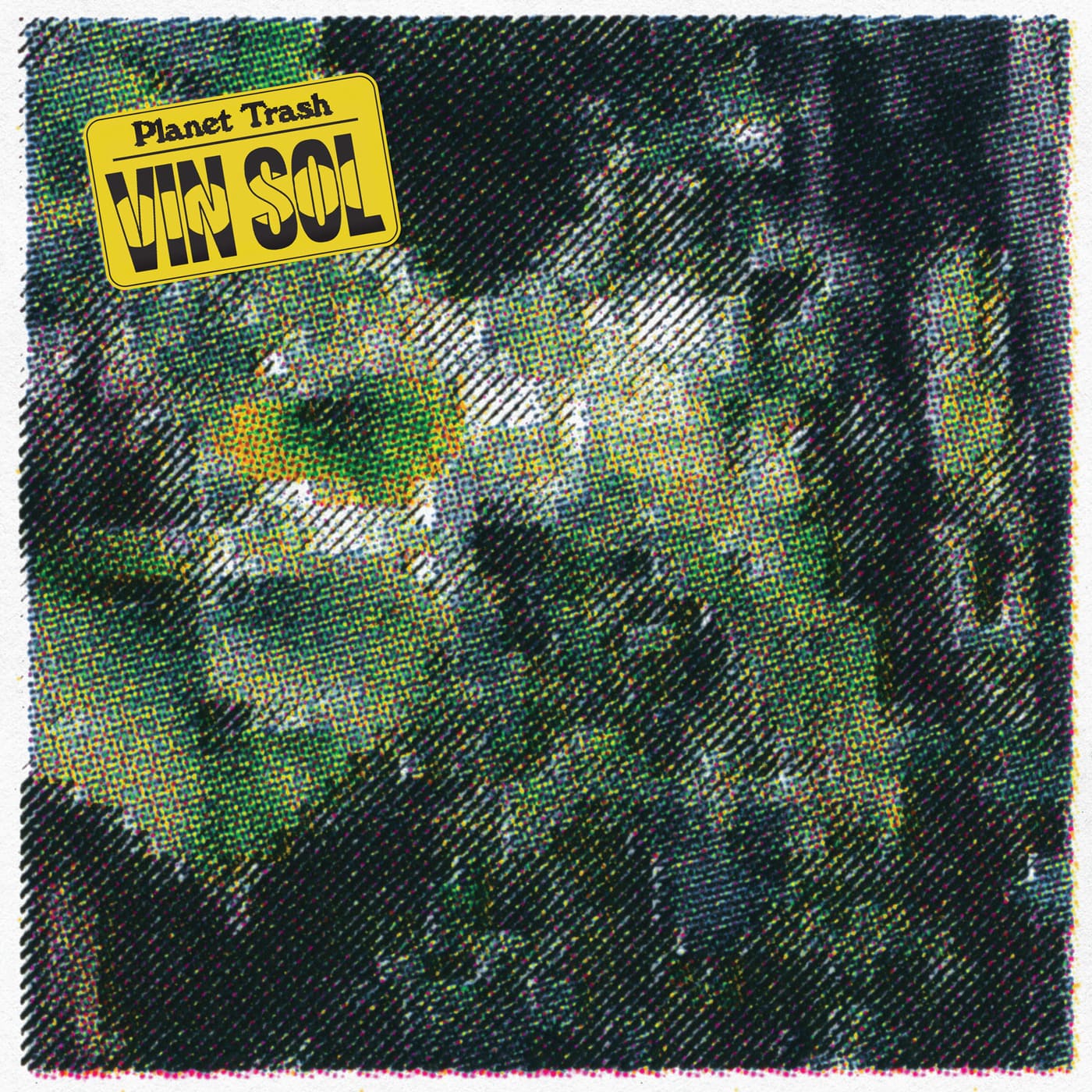
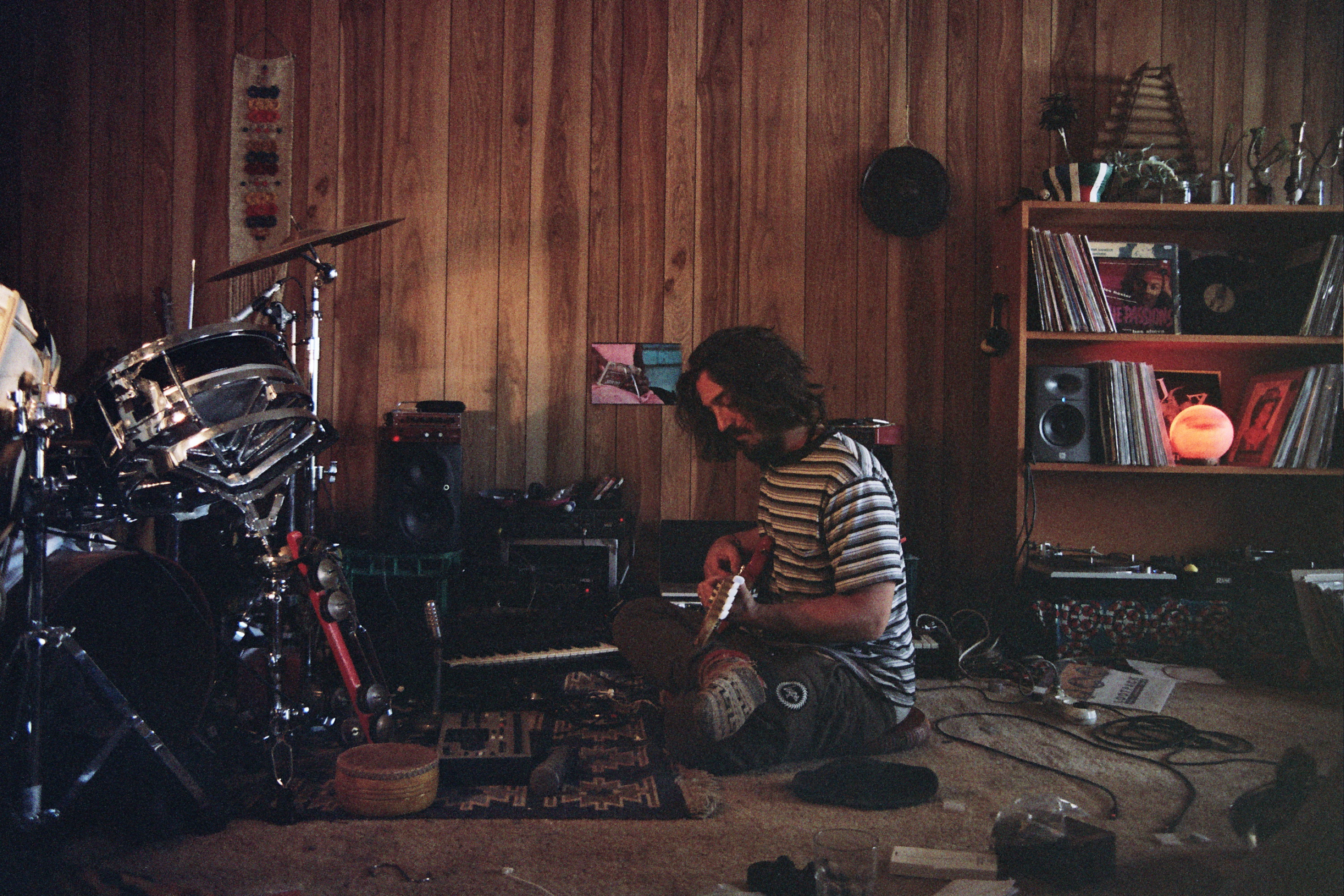
Dark Entries will release the debut album of San Francisco-based DJ-producer Vin Sol, titled Planet Trash, scheduled for May 17 release.
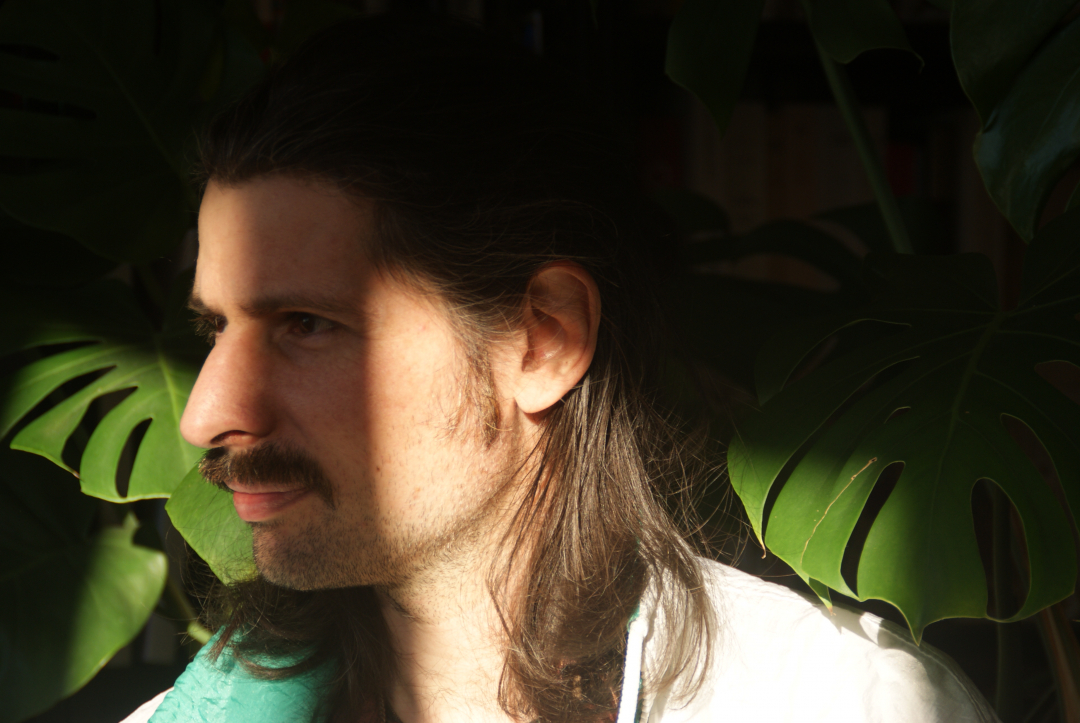
Vin Sol is a third-generation San Franciscan of Salvadorean descent with releases on Unknown to the Unknown, Clone, Delft, Honey Soundsystem, and Ultramajic.
Work on the album began in the winter of 2017 while taking a break from making club tracks, and it was then finished in the spring of 2018 in Berlin. It features a collaboration with Matrixxman as an homage to San Francisco musical institution Bottom of the Hill.
We’re told to expect 10 tracks with hints of the Latin freestyle and classic acid that informed Vin’s youth.
All songs have been mastered for vinyl by George Horn at Fantasy Studios in Berkeley. Each copy is housed in a jacket using photos by Vin Sol, and designed by Kevin McCaughey of Boot Boyz Biz. It includes a four-color giant newsprint fold-out poster and golden flexi disc.
Alex Menzies, artist name Alex Smoke, has long operated on the peripheries of club culture. Much like his work, which refuses to conform to dancefloor expectations, Menzies refuses to conform to those of the industry, opting to share the music he makes with minimal self-promotion. Musically speaking, absent are the big beats and dramatic breakdowns; favoured instead are subtle textures and atmospheres, creating a thick sonic mist that’s engulfing, stimulating, and participatory.
Over recent years, Menzies’ sound has steadily drifted into more ambient and experimental realms, and he now focuses much of his attention on scoring for television and media, where he has worked on various documentaries for the BBC and various other outlets, forming part of a growing number of contemporary musicians moving into scoring for picture. Only this month, after releasing his Ad Absurdum’ album on Huntleys & Palmers, he completed his first score proper, for Ninian Doff’s Boyz In The Wood, a lysergic comedy of teens, lords, guns, and the Highlands that recently premiered at SXSW. We’re told that the score is something like a traditional Hollywood orchestral score, except all the brass players have been spiked with LSD. In support of this, we dialed in Smoke to learn more about how scoring for picture compares with music production and performing, and how to go about making the switch.
My career so far is probably most obviously associated with music for clubs and albums that fall into the sort of club music for home listening. But for the last six years or so, I’ve been increasingly working in the field of music for picture, both for TV and more recently for film, too. This is not such an uncommon situation these days, with many highly trained and talented musicians having first started in contemporary music and then later stretching their legs and using their training to explore more expansive terrain. Recent examples include names like Mica Levi, Colin Stetson, and Jonny Greenwood, as well as electronic artists like OPN and Lustmord. It’s an exciting time for music for film, and also a time of change and consternation for many more established composers. Who the hell do we think we are? I am barely in a position to offer tips, but this is my experience, for those wishing to branch out into film and television scoring, or collectively writing for picture.
Getting the work
Let’s start with how to get the work in the first place.
With touring becoming increasingly competitive and the electronic music landscape more crowded than ever, it’s no wonder that many musicians are looking to music for picture to help fill the gaps in their income. Of course, the multitude of new artists making club music and touring is reflected in the vast number of new musicians making music for picture, so it is becoming increasingly competitive too, made all the more acute by the fact that software is driving down the price of entry and driving down the cost of the work as well.
If you are already known for making music then you may have an advantage as there is a chance that a director or an editor already knows and likes your work. This is what happened to me, when a friend who is an editor put me forward for my first BBC job.
Part of the battle is letting people know it’s what you want to do and that you can do it, so another tactic that I used myself was to score a film off my own back and put out my stall. Ultimately, I wasn’t thinking of it in those terms—I just wanted to score a silent film—but it serves the same purpose in alerting people to the fact that you have an interest in such things and can hopefully produce something of quality. The making of “Faust,” my first score, put me in a hole financially but it was very satisfying and has certainly opened a few doors.
There is also library music, which is a whole separate game, but it can work well for many artists who have a huge amount of unreleased music. You can hand over your unreleased works to a company that whacks them on a server and hopefully gets them placed on TV shows and adverts, although you should be well versed in the legalities and make sure you don’t get cornered in an exclusive deal which casts your music into a one-way server vacuum, never to be seen again. Make sure you either get money up front, so that the company has to put your music to work to recoup costs, or make the deal non-exclusive, maybe after a few months of exclusivity, so that you can exploit other avenues. For those interested in this kind of work, it is simply a case of looking up some library companies and sending them some music, and if they think it has what they need they’ll let you know.
Trailer music is yet another valid route for making money from music, but it is probably the toughest and least creatively stimulating of all. You work for no money up front, producing perhaps eight versions of something that is “amazing,” only to be told after two months of slog that it wasn’t actually amazing or perfect, but useless. BUT, and it’s a big one if you do place your trailer for a movie that hits cinemas you can make some very serious money. US$100,000 is not unusual but you’ll lose a lot to your agent, whom you will invariably need in this side of the business.
Some ideas to start with:
01. Practice writing to picture. In my case, I chose silent film as it has no dialogue in the way, but you can use anything.
02. Approach young film students and offer your services. There is no money but it could turn into other opportunities and provides useful experience.
03. Mention your intentions to friends, or on social media, without becoming tiresome. Plant the seed and be patient.
04. Speak to anyone you know who already works in this arena, even if not directly in the music field. As I said, my break came from an editor friend.
Leave your ego at the door
Compared to being a performing artist, whose sole responsibility is to turn up to gigs, perform music, and not get too hammered, working in film is a whole lot more professional. The focus is not on you at all because the film is the master. For many people coming to this world from the world of touring, I imagine this will be a great feeling of relief, and it certainly was for me. Others will also find it challenging, and struggle to adapt because being part of a huge team certainly puts you in your place.
When making music for yourself, your only responsibility is to your own conscience, but in film, you must answer to a number of people, many with different backgrounds to your own and with a different take on music. The director is first and foremost, as it’s their vision that you are working towards, but you have to be good at reading between the lines and offering suggestions that you can infer from what you are told, and by several people. People who haven’t studied music, or whose main input is visual, often describe music in different ways from a musician and it can be a struggle to join adjectives like “swervy,” ”robo,” or “mental” to sounds that genuinely fit the bill.
One of the main things I’ve had to get used to is having music turned down that I’ve thought is perfect for the job, and at first I couldn’t help but try to persuade the production company or director that I did indeed know better than all of them. Of course, you don’t, and you quickly learn that the consensus is what counts.
Another facet of this is knowing when the music has to sit in the background and when it has to draw more attention to itself. Some critics put themselves firmly on one or another side of this divide, claiming superiority for one approach over another, but I think it’s fair to say there’s a place for both. It’s about knowing when not to draw attention to your incredible talent. Ultimately though, being a sound and patient individual whose ego is under control makes you into a useful team member, especially in a business as stress-laden as this one, and by being accommodating you will make everyone else’s lives that bit easier. After it’s all finished and released, it’s nice to look at a product of craft and creation that isn’t a personal embodiment of anything, and lives on its own, divested of your ego.
Learn to be an individual
The music for picture industry, like the music industry in general, is becoming increasingly crowded and increasingly homogenized. And the challenge for any new entrant into this world is to set themselves apart from the crowd.
One of the things that has opened the field to more than just professional composers is the universal availability of software and instruments that can be used in film scoring, and we’ve all noticed a constant stream of articles in music mags relating to “how to write for strings” and “how to score a movie with just Tinkle Keys Pro.” This is all well and good, and some of the software is indeed amazing for creating a very professional result, with many top composers also falling back on tools that get fast results.
But the knock-on effect is that all too familiar result of ’taiko drums’ and ‘Hans Zimmer staccato strings,’ where everyone starts to use the same tools to create the same effects, especially in TV where the timescales can often be short. If you don’t know what I mean, watch “Pirates of the Caribbean” and recognize that the same musical elements have been featured in just about 80 percent of all action films and TV since. Or those uber-shitty sequenced auto-gate percussion things that appear all over “24” or Tony Scott movies. The irony is that Hans Zimmer himself uses a huge array of experimental approaches to scoring, but the plugins that recreate that sound are now what everyone else uses.
So if you want to be involved in making music for picture then it is of fundamental importance that you develop your own sound and your own approaches, and only make very limited or careful use of any plugin aimed at “media composers.” Or you can hammer them, update them every six months, and absolutely coin it, provided of course that you already have your foot in the door, and can live with yourself.
There is also the question of your musical background and your past experience and this is where you may well have a unique selling point. Many directors and producers are looking for a modern take and electronic artists for them represent something edgy and exciting, more-so probably than many of us realize. Providing you can fit into the other aspects of working for film, then this can stand you in good stead.
Learn to work fast
Talking of what else you’ll need in the business of writing for film or television, one thing that everyone needs is the ability to work insanely fast. This is probably less of an issue for many these days, as we’re already used to working quickly, but it deserves to be said.
The film I just worked on had a time limit of three weeks from start to finish for 59 cues, and that includes rejections, re-cuts, and last-minute alterations to fit with new editing decisions. Frankly at the start that is pretty terrifying, as you still don’t have the sound world created and don’t know what sounds the director is actually going to respond to. Usually, when you work on a film you’ll be greeted with a temp track, a temporary selection of guide music chosen by the director, and others, to run alongside the film, which is great but can itself be a thing of heavy intimidation. In my case, the temp was largely lifted from one of the most successful action scores of living memory, Alan Silvestri’s score for “Predator.” No pressure! None at all! I also got RSI after the first week which was REALLY worrying as I couldn’t do anything and I lost five days. But Youtube came to the rescue with a miracle massage and I never looked back (it’s here incidentally).
Create your sound world
When greeted with a new job, it can be highly intimidating, with so many creative decisions in front of you, so it is good to get the tone and style of the music fixed as soon as possible. This includes decisions such as what instruments to use, whether to go orchestral or electronic or a mixture, what ideas to lift from the film as creative cues, and whether there is any subtext to explore. So I think the most important thing, in this case, is getting the instrumentation and style fixed as to what you think works, and hope that the director responds well when they hear it in those first vital listening sessions.
In the case of the film I was working on, called ‘Boyz In The Wood’, the director was after the classic sound of Hollywood but mixed with something much odder and contemporary. It was clear that I’d be using a full orchestra for that Hollywood sheen, but on top of this, I needed instrumentation to suggest the wilder sides of the movie. There is a subtext of fox hunting in the film and at one stage some hunting bugles are used by the ‘baddies’ so it made sense to use the brass section as their identifier, meaning that every cue with them on screen would involve brass instruments in some form. And because the film is eccentric and the characters extreme, it also made sense to make those brass parts eccentric and extreme, involving a lot of experimental playing techniques and unusual tones. Once you’re up and running with an approach that works for you and the director, you can begin to enjoy the process and tell the story. The other main consideration, in this case, was making the score as ‘Hollywood’ and serious as possible to play against the knowing absurdities in the story.
Get to know your movies
You can’t really score for movies if you don’t know your movies. You have to learn what works in a particular scene, and you can do this by watching films because this isn’t anything especially studied or exact; rather you’ll get a sixth sense for what works in a given situation, and also how to segue into the next scene.
It’s amazing the power you have as a composer in creating a sense of emotion in a scene, and using this power effectively is one of the things that needs attention. It’s more likely you’ll be given an outline of what the director is after and then you just create a raft of cues that they can choose between to fit a particular scene. But getting the initial tone and instrumentation is again key to making the job achievable. For example, for the BBC’s “Order & Disorder,” the initial thoughts were for taking something quite ordered, in this case piano, which is nearly a cliché in itself in TV terms, and taking it into more contemporary disordered places by using prepared piano, ondes martenot, and a lot of noise. Once you have your instruments picked out, it’s amazing how quickly the ideas flow.
Flexibility is key
Another factor that’s highly relevant if you plan on making music for picture is your flexibility. This can be taken in several ways actually. Being flexible in your availability and times is also probably an important consideration in an industry that works to such tight timescales, as well as your musical flexibility. Although it is the latter that is most important. Being asked to create a mockup of a public information film from the ‘50s or a piece in the style of Vaughan Williams is not entirely unlikely, or you might be asked, like I was, for a comedic piece of music to accompany “a cow with afterbirth hanging out of her.” Not exactly in my comfort zone!
It’s a funny thing, because a few years ago I would have worried about such things but the more you do it the better you get at inhabiting a different mindset, and producing music to match.
I do think that it’s important to be passionate about the craft of scoring because otherwise, I don’t see how you’re going to make anything that really captures the imagination. I certainly have a much greater knowledge of film and film music than I do of electronic music, and I guess that’s part of the reason I always imagined I’d end up doing it. But I also don’t think it’s necessary to be overly intimidated by it, providing you have something to say. There are plenty of Hollywood composers out there, proudly writing score and conducting orchestras, whose music is the height of forgettable banality and ultimately it is the quality of the music that counts. And like anything, you learn as you go and get better all the time.
When SXM Festival ran its first edition in 2016, it dazzled party-goers with awe-inspiring locations and an easy-going, island-breeze lifestyle. The music, too, was on point, offering a lush array of house and techno strains fitting of the beach-side locales. The festival ran again in 2017, further expanding and honing its offering while cementing its name as a premier destination festival. Then, late in 2017, Hurricane Irma hit the Caribbean islands and the American Southeast, with Saint Martin right in its firing line. Irma destroyed 70% of the infrastructure on the Dutch side of the island and around 90% on the French side, and at least 11 people lost their lives. Needless to say, running a festival just months after destruction of this magnitude was a futile pursuit and the difficult decision was made to call the 2018 edition off. Instead, festival founders Julian Prince and Driss Skali shifted their focus to helping the island and its inhabitants recover via their Two Bunch Palms foundation.
This year, SXM Festival made its return, running from March 13 to 17 and hosting performances from some of the most respected and sought after artists in house, techno, and minimal, including Ricardo Villalobos, Zip, Sonja Moonear, SIT, Thugfucker, Shaun Reeves, M.A.N.D.Y., Francesca Lombardo, Fumiya Tanaka, Dewalta, and Lamache, to name a few. It was a five-day musical and visual treat and an immense comeback for both the festival and the island. It’s a satisfying feeling listening and dancing to your favorite DJs on the beach in the Carribean while knowing that every dollar you spend is helping the struggling Saint Martin economy and tourism industry. The festival also organized a day for artists and attendees to help restore damaged parts of the island.
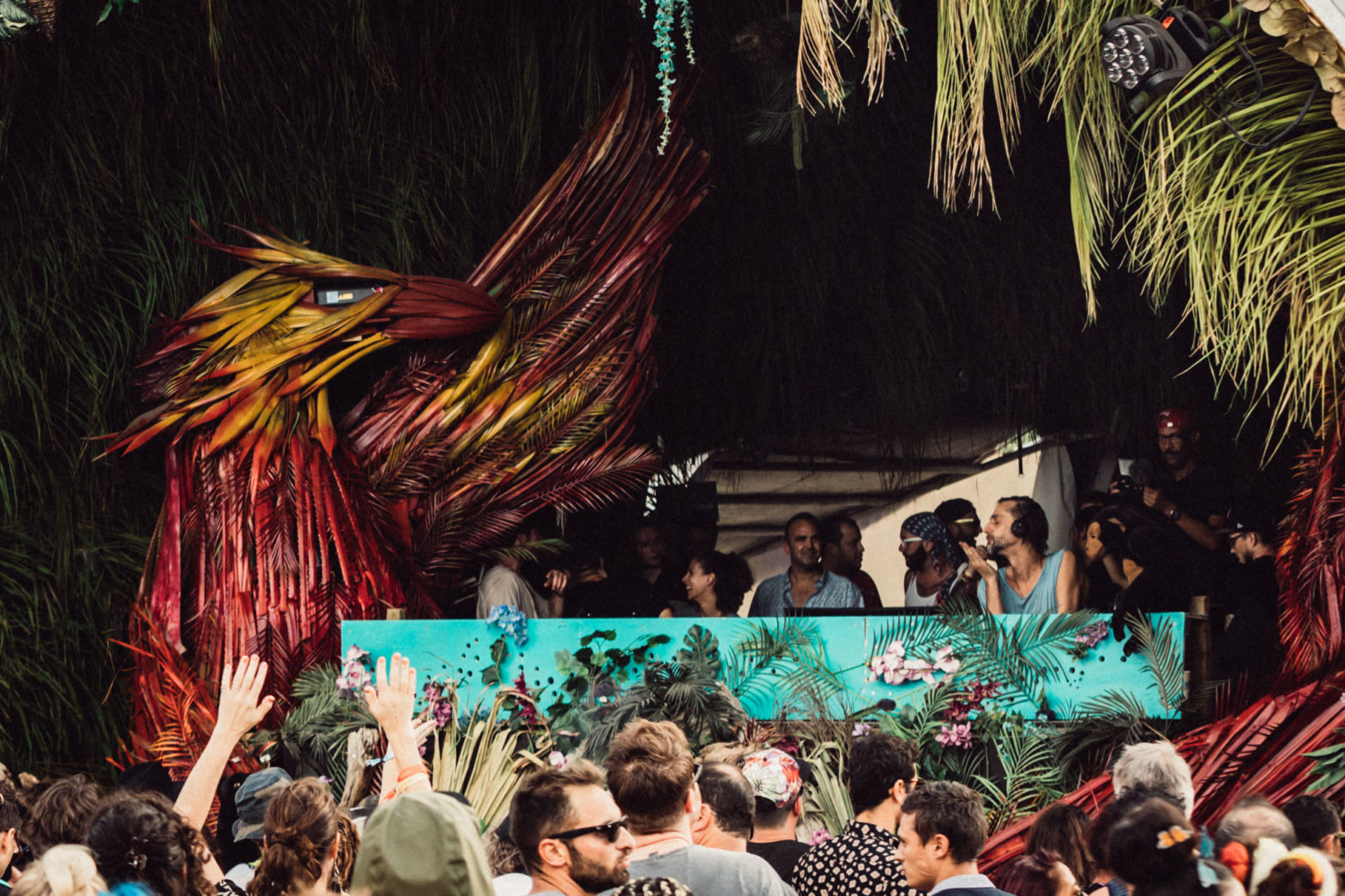
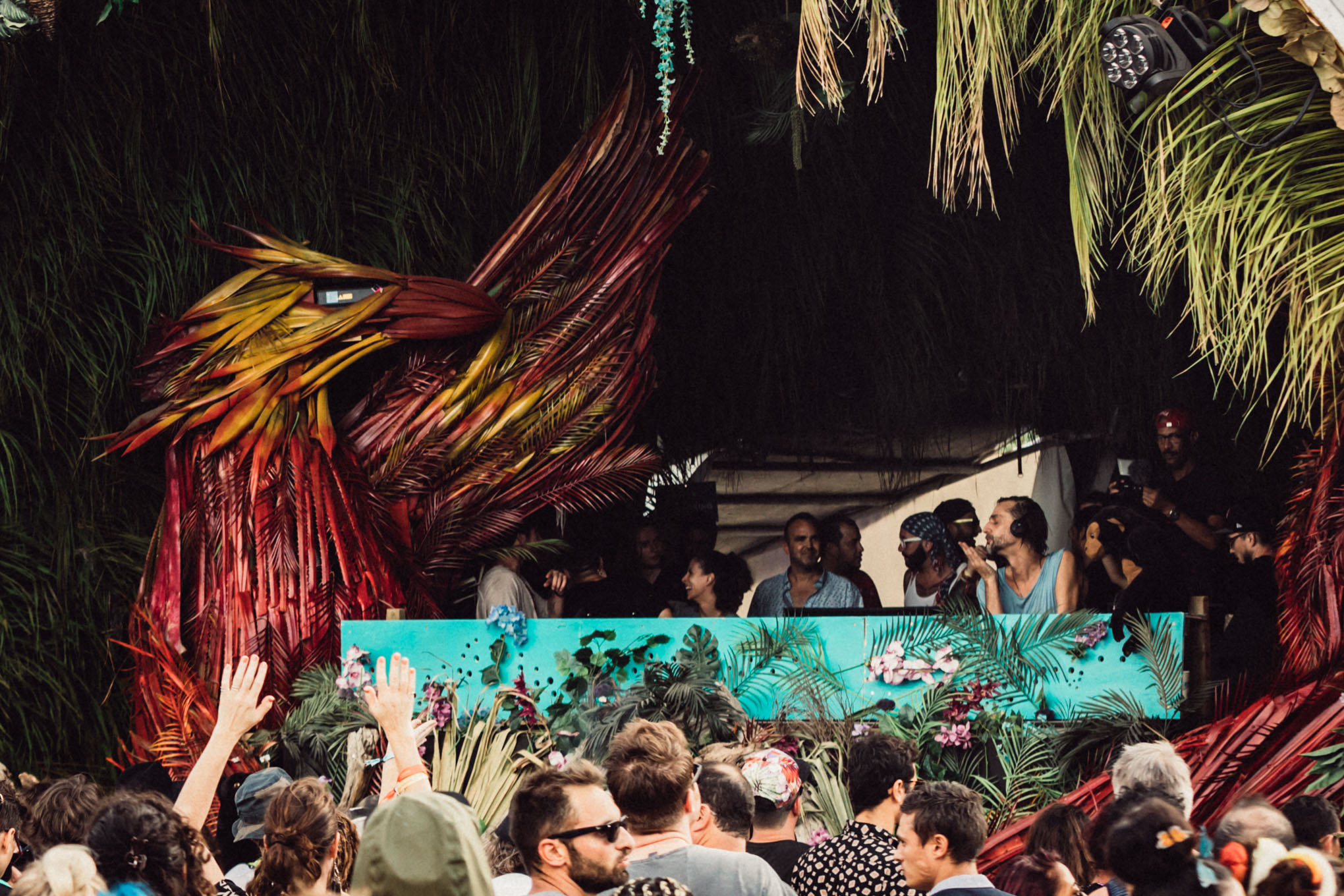
As soon as we arrived, a range of improvements and updates were immediately apparent. The aesthetics and management of the festival’s main Happy Bay site had been refurbished, with the walkways guided by intriguing art pieces and glowing structures, and the smaller stage being covered with what looked to be a canopy of driftwood. The Arc Stage was even more of an impressive sight to behold, with grass and flowers growing out of a colossal wooden structure, and a huge Aztec-style Mask to its side lit up in a vast array of colors. Both had immense soundsystems that held their own throughout, too.
An early musical highlight, on Thursday night, was the surprise b2b pairing of Molly and Francesca Lombardo. Although they operate as solo artists in slightly different scenes, the pair had unbelievable flow, rolling through insatiable grooves old and new, and closing with a Prince dance-off to rapturous response. Later that same night at Lotus, one of the festival’s two club-based locations, The Other Side hosted another two b2b pairings in Gescu and Sepp, and Lamache and Dana Ruh. We arrived as the former pair were dishing out deep, stripped back techno cuts to a packed floor, before the latter took charge with more percussive, wide-reaching club offerings, including the upcoming “Maiden 161” by Foster (a.k.a. Robin Ordell and Uri Gincel). At both the beach and club venues, the crowds were receptive, respectful, and welcoming—traits that would continue throughout the festival’s duration. It must be mentioned, however, that it was difficult and somewhat jarring to enter and enjoy a club venue after partying on a beach all day and evening.
Saturday and Sunday provided an almost non-stop, unmissable schedule that, for many attendees, led to a dancefloor marathon to the finish line. Early highlights on Saturday included, unsurprisingly, Fumiya Tanaka and Sonja Moonear. Fumiya’s two-hour set flowed perfectly into Moonear’s, and she took over from the Japanese artist’s more minimal-based output and built the atmosphere with a selection of driving deep house and techno grooves. The party was now very much in full force. Then came the incomparable one-two-punch scheduling of Zip and Ricard Villalobos—the latter of whom returned after a lackluster performance in 2017. Up first and scheduled to play during sunrise, Zip didn’t disappoint. After a somewhat shaky start where he could be seen noticeably working hard to get in the groove, he starting throwing down his typical old housey numbers that guided the vibe to a place of pure joy as the sun came up—we couldn’t think of a more idyllic location to see Zip doing what he does best. Finally, up came Ricardo Villalobos. Many attendees were highly skeptical of the booking after the aforementioned performance in 2017, but he closed out the Sunday morning in true Ricardo style, playing a full repertoire of tweaked-out techno tracks and locked grooves that ensured that everyone left the beach danced out. This year the festival also extended the times for its main offerings, with Saturday into Sunday morning now running to 11 a.m.
With just a little time to rest, on Sunday afternoon into night, XLR8R and Dailycid hosted the closing party on the beach stage at Happy Bay with a dexterous line up that included SIT, DeWalta, Digby, DJ W!LD, and WXC. As always with closing parties, unexpected magic happened and we witnessed a surprise b2b set by SIT’s Vlad Caia and DeWalta, which easily marked the highlight of the night. After their set on the Arc Stage, the Apollonia boys even made the trek down to the beach stage to dance and join in on the fun for the final few hours of what was a triumphant comeback for SXM.
As with most festivals in their infancy, SXM was not without its small pitfalls. On more than a few occasions we overheard complaints of infrequent shuttle busses causing grief with going to and from the events. Another issue we noticed, especially for a growing festival, was the competition between parties and venues. With the festival spread across its main beach site—which itself had two stages—and two clubs, there were some clashes and, at times, a splintered attendance and vibe.
These small gripes aside, it’s hard to think of a festival that has an underground lineup this good and that is surrounded by paradise in the Caribbean. We’re already looking forward to and planning next year.
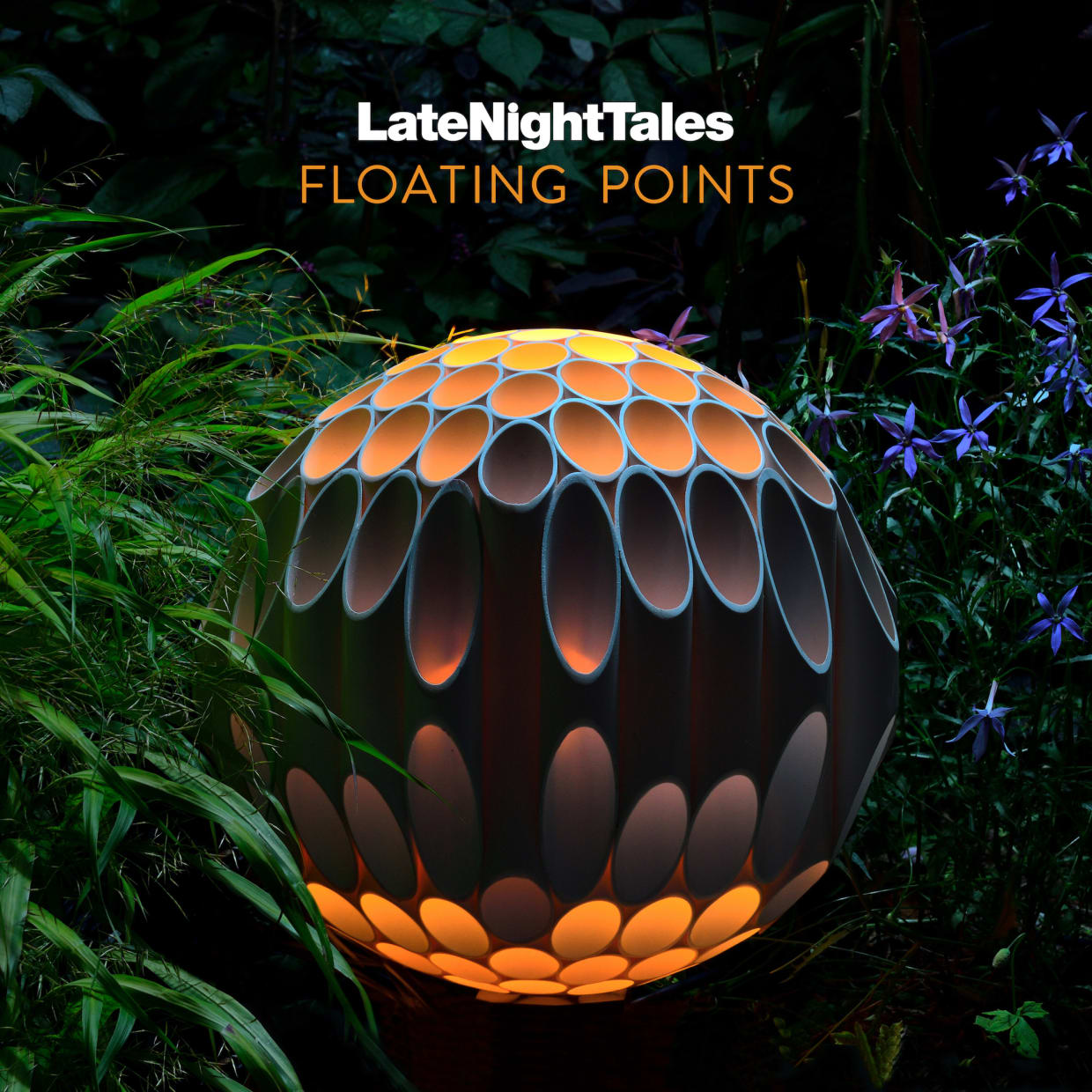
I once heard Floating Points DJ in bright sunshine and was disappointed: he played a forgettable mix of funk and disco that bore little resemblance to his production work. His best music is masterfully paced, transitioning effortlessly between the calm and the cacophonous, and it’s better suited to a patient listener than a raucous crowd. This sets him up perfectly for a Late Night Tales mix: the solitary, nocturnal headphones-wearer has always been the series’ target audience, and beneath the night sky’s warm blanket, FloPo—real name Sam Shepherd—feels at ease, crafting a soothing, drifting set that feels intimately connected with its listener.
Many of Shepherd’s shrewdest selections here are beatless—take Sarah Davachi’s “Untitled, live in Portland.” Sombre and almost dour, it’s not the sort of thing you’d put on to entertain guests, but in the right ears it’s deeply affecting, like just about anything Davachi does. As an opener—and exclusive to the mix—it crawls inside your consciousness, establishes a serious, contemplative mood, and shoos away any thoughts you had about going out tonight, or ever again.
There’s an indulgent loneliness to “Moments In Love” too, an excerpt from Kara-Lis Coverdale’s Grafts EP which Shepherd plays around 45 minutes later. Following two wonderful, spindly guitar tracks from obscure ‘70s space-rocker Alain Bellaïche, Coverdale’s composition offers nine minutes of somnambulant ringing that dissolve time into a meaningless goo. Like the Davachi track, “Moments In Love” is all about examining a single note from 360 different angles, like turning life’s problems over and over in your head while lying awake at night.
Yet the mix is by no means depressing. Among its long, ambient dirges are a number of warming soulful selections, the hallmark of any good LNT (Bonobo’s inclusion of Darondo’s “Didn’t I” sticks in the memory beautifully.) A standout here is “Glowin’” by The Rationals, a lesser known garage soul outfit hailing from 1960s Michigan who make Grizzly Bear sound like a tribute act. Their inclusion is surprising but smooth, and indicative of Shepherd’s love for digging deep.
Another strangely moving tune is Azimuth’s “The Tunnel,” which is sandwiched between Coverdale’s “Moments In Love” and Kaitlyn Aurelia Smith’s “Milk.” Not to be confused with Brazilian jazz-funkers Azymuth, Azimuth were a British band from the late 1970s who combined Norma Winstone’s smoky, pre-Sade voice with pianist John Taylor and trumpeter Kenny Wheeler (whose “Sweet Time Suite” is covered by Shepherd later on.) “The Tunnel” comprises those three elements sparsely and brilliantly, but is carried by a Tangerine Dream-y Moog line, a musical impression of floating out into space.
It feels a bit like it’s building up to something. Much like in, say “Kuiper,” Shepherd lulls us into a blissful vulnerability, the perfect state in which to be hit with both barrels. Instead he allows his listener to wallow, using first Aurelia Smith and then “Nimb#59” by Japanese improvisational wizard Toshimaru Nakamura to create a sleepy, unoppressive ambiance. It’s not quite as impactful as his own music, though it’s far from unpleasant.
Before you drift off, in comes Lauren Laverne with a reading of Emily Brontë’s “Ah! Why, Because The Dazzling Sun.” The poem is an ode to the nighttime and, like many of LNT’s customary bedtime stories (previously read by Alex Turner and Benedict Cumberbatch), it’s borderline twee. Laverne doesn’t quite match the croaky drawl of Lydia Lunch, whose reading on Badbadnotgood’s LNT made her sound as though she keeps Satan as a pet, but the poem’s celebration of darkness (“O Stars and Dreams and Gentle Night / O Night and Stars return! / And hide me from the hostile light / That does not warm, but burn”) fits snugly with the mix’s after-hour vibe.
Like every single track, the poem has been chosen with care and painstaking precision. And yes, that makes Shepherd a selector, free from the highly technical challenges of transitioning between songs. It means we’re free from critiquing his beatmatching ability, free from analysing the speed and timing of every knob turned, which if you ask me is closer to sport than art anyway. Instead we can focus on—and bask in—his excellent track selection.
Many of Shepherd’s choices are the product of hours spent listening to music, a penchant for the obscure which is to be applauded, but the true art of DJing, as Shepherd exhibits here, lies in making connections between records—not based on genre or bpm, but because together they create the desired mood, tell a particular story, paint a certain picture; whatever the metaphor, it’s a skill not just in playing music, but in listening to it.
Listening to music is why we’re all here, at a time when such a practice is in a state of change. If you, like many of us, can’t be bothered deciding what to listen to, you could do a lot worse than letting Shepherd choose for you. His LNT is a soothing, calming mix for music lovers and night owls, with a human touch that’s impossible to replicate.
Late Night Tales: Floating Points lands March 29, with pre-order here.
Tracklisting
01. Sarah Davachi “Untitled, live in Portland” (Excerpt) (Exclusive track)
02. Carlos Walker “Via Láctea”
03. The Rationals “Glowin’”
40. William S. Fischer “Chains”
05. Max Roach “Equipoise”
06. Bobby Wright “Blood Of An American”
07. Sweet & Innocent “Express Your Love”
08. Robert Vanderbilt & The Foundation of Souls “A Message Especially From God”
09. The Defaulters “Gentle Man”
10. Alain Bellaïche “Sun Blues”
11. Alain Bellaïche “Sea Fluorescent”
12. Kara-Lis Coverdale “Moments In Love” (Excerpt)
As announced, Daniel Avery will present a collection of B-sides and remixes of his sophomore LP, Song For Alpha, almost a year to the day after the album’s release. Across 23 tracks, Avery showcases cuts from the album’s writing and recording process and invites a number of his contemporaries to rework his original material.
Produced solely in Avery’s London studio, the lengthy recording process for Song For Alpha spanned some years as Avery continued to tour and collaborate as a producer. He was left with over 100 tracks, some of which were eventually distilled into the album. This new package also sees him share several others that arose from these sessions.
Meanwhile, the collected remixes span a spectrum of new and established names. Jon Hopkins, Actress, and Four Tet each contribute typically bold reinterpretations. Also included are reworks from Giant Swan, Manni Dee, Mor Elian, Inga Mauer, and Anastasia Kristensen, among others. You can see a full list here.
Of all these, it’s the “Time Marked Its Irregular Pulse In Her Eyes” remix by Avery’s friend and occasional DJ partner HAAi that really stands out, at nearly eight minutes in length, warping and morphing into different shapes and aesthetics. In advance of the remix LP’s April 5 release, stream HAAi’s remix in full below. Pre-order is available here.
Maxime Primault will debut on Shelter Press as Black Zone Magick Chant with Voyage Sacrifice.
We’re told that the LP sees the French shape-shifter swap the screwed alien dancehall of past outings in favor of miasmic subterranean ritual. Born of “a few very intense sessions, in altered states of consciousness,” the three sprawling compositions ooze in slow, smoke-choked darkness, awash with dungeon groans, molten bass, and distant demonic mumblings.
Primault aims to “delete time, or escape time” with the music. “It’s a mental journey. I handled the sacrifice; the voyage is yours,” he says.
The record follows Primault’s 2018 Black Zion Mystic Chant, an exploration of dub, dancehall, and screw music via Winged Sun Records as Black Zone Myth Chant.
Tracklisting
01. Lightless Mountain (11:23)
02. Incineration of Thoughts (10:39)
03. Where will we meet when our ashes are spread in the wind? / Crystal Monastery (22:19)
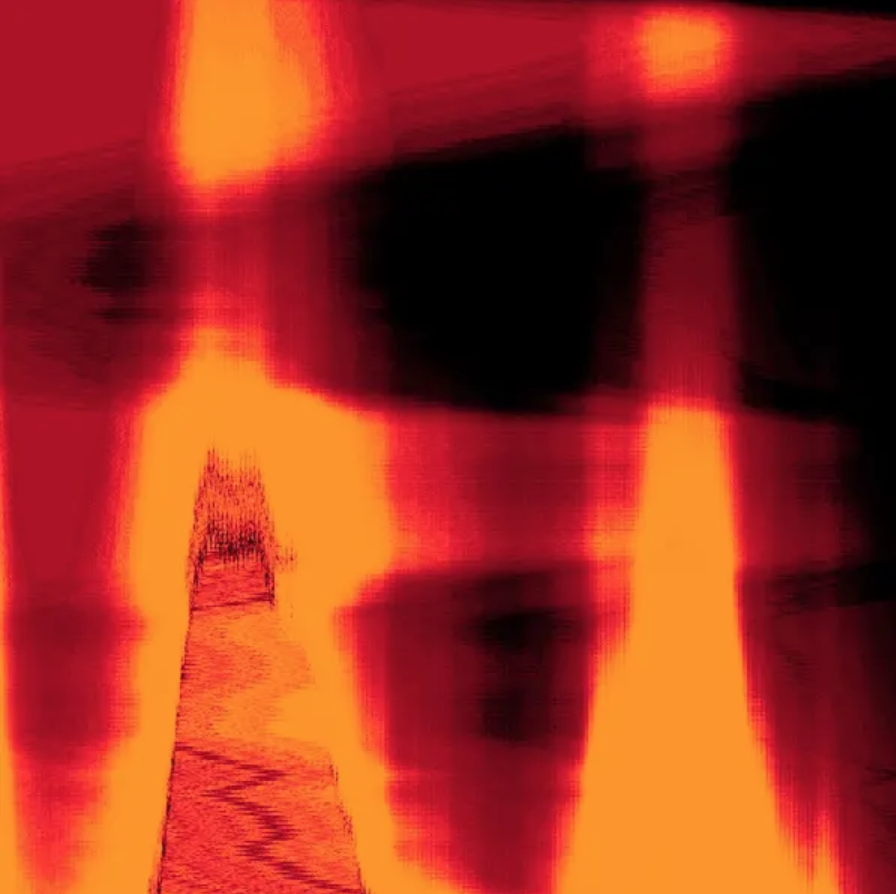
Voyage Sacrifice arrives on April 26, with cover art by José Maria Gonzalez below, alongside a stream of “Incineration of Thoughts.”
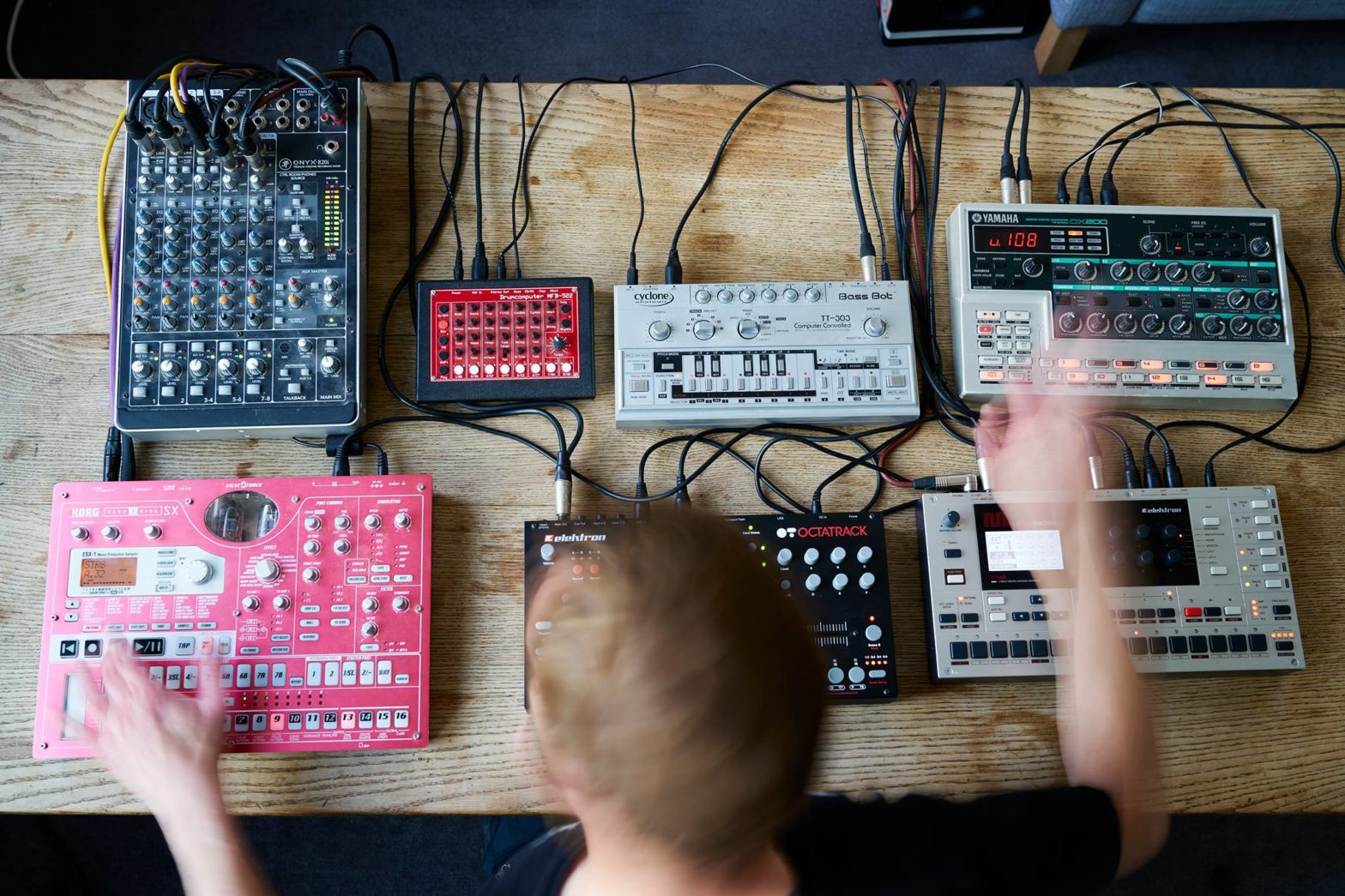
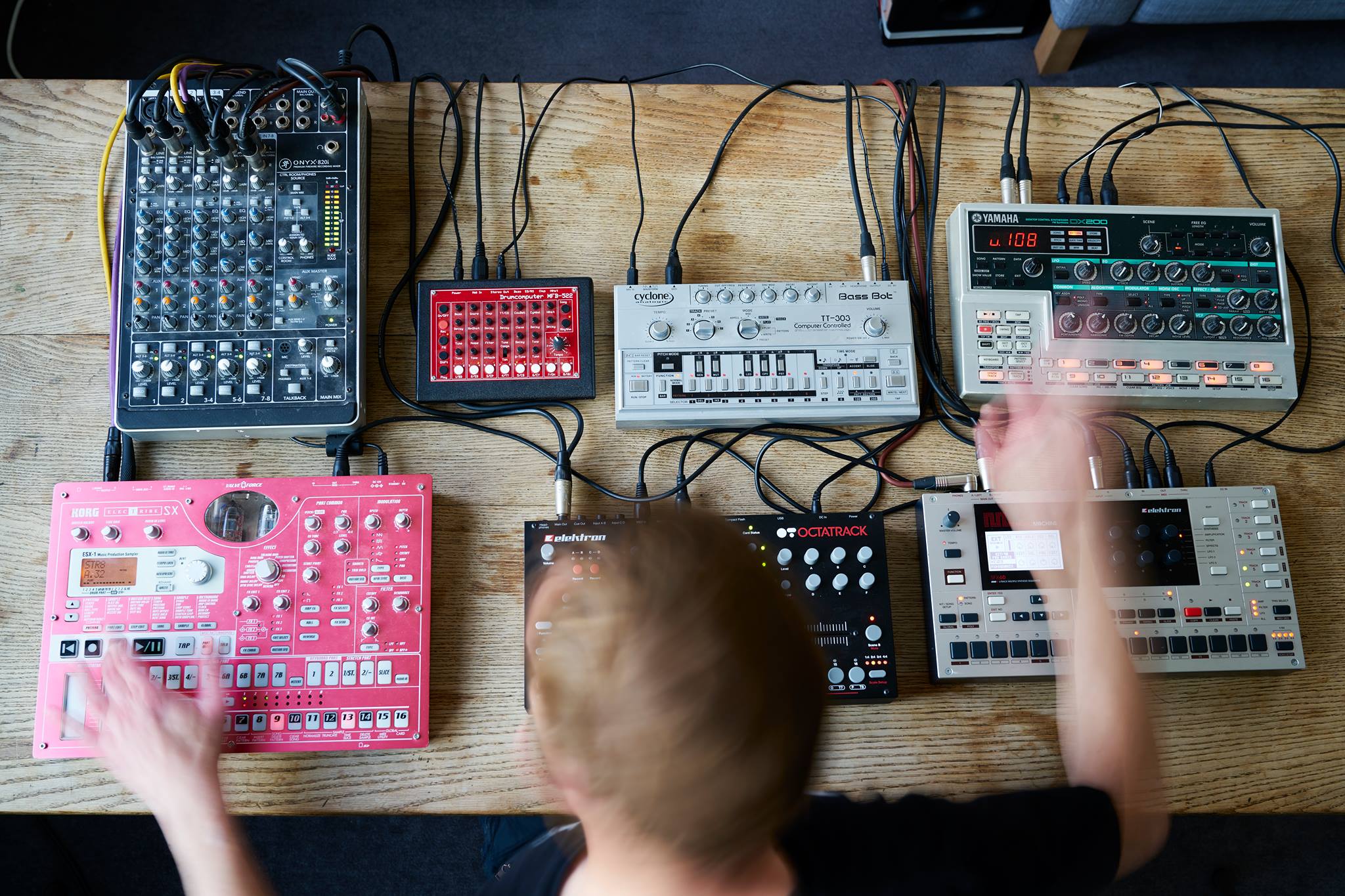
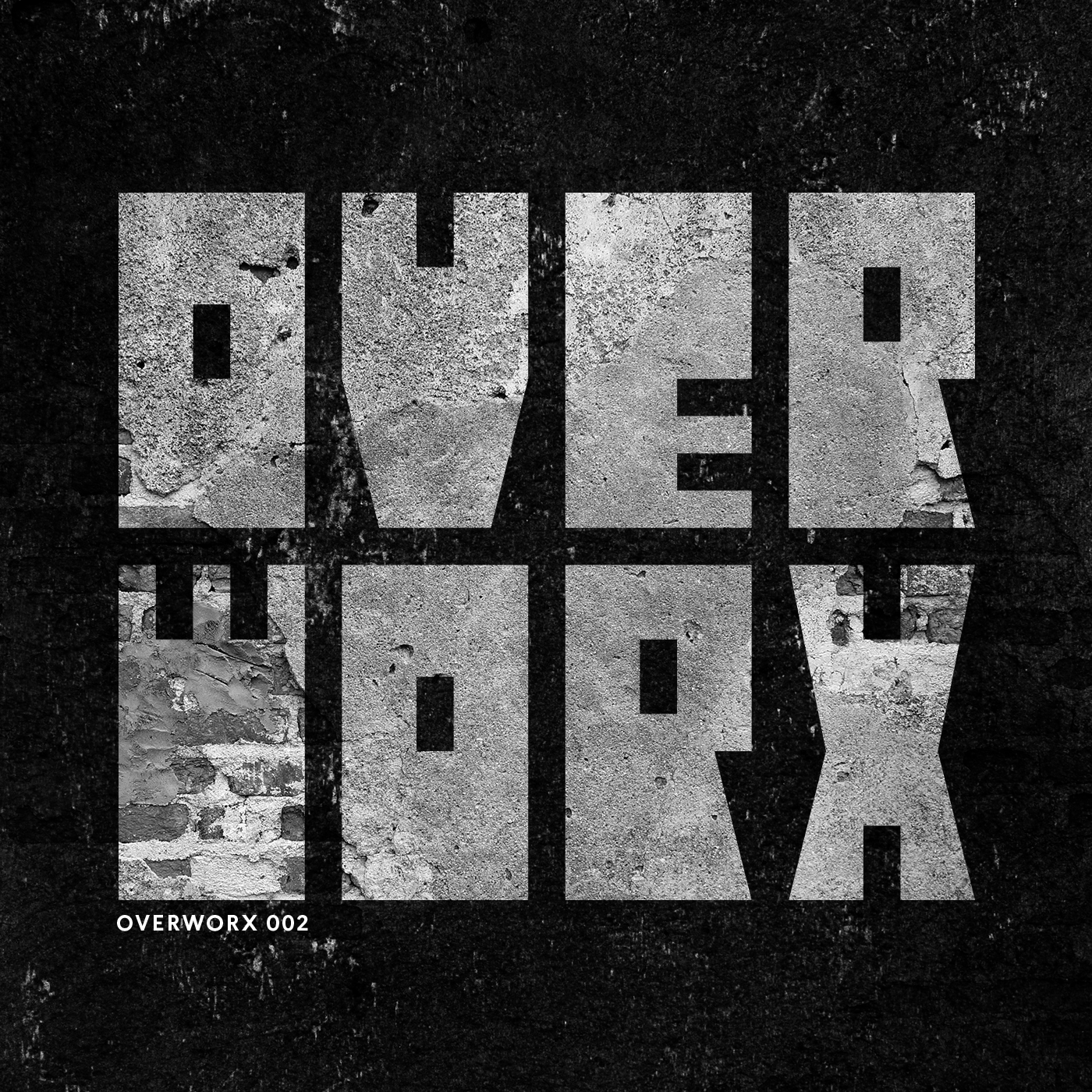
Ben Pest is set to return with the second release on his label, OverworX. The Bristol artist has been playing out live over the last year, and these tracks come directly out of these hardware sets. Side A features acid rave cut “Heroes Are Not Mine,” then side AA brings a bass-driven, LFO-inspired techno remix of Imogen’s “Katla,” which was first released on Mumdance’s Shared Meanings compilation. “Potty Mouth,” a digital bonus, is a shuddering electro crawler, while “Nins and Peedles” wiggles in its hefty groove helped along by a nice big dose of wobbly acid.
As per the first release on the label, it once again features a self-produced, self-released, and very limited 12” cut at 45rpm. The vinyl also ships with two digital bonus tracks and is available exclusively from his Bandcamp page.
Tracklisting:
A. OverworX “Heroes Are Not Mine”
AA. Imogen “Katla” (OverworX Remix)
Digital Bonus Tracks
1. OverworX “Potty Mouth”
2. OverworX “Nins and Peedles”
OverworX 002 lands April 5, with pre-order here and “Acid Rave” available to stream in full via the button below, or here for EU readers due to GDPR restrictions.
Ski Oakenfull has returned for another one of his acclaimed track deconstructions for Point Blank.
In the new video, Oakenfull deconstructs Adamski’s ’90s classic “Killer” (Feat. Seal), and invites Adamski himself to the studio for a brief chat on how he hooked up with Seal and some of the technical aspects of the track. Diving deep into the track and what makes up its magic, Oakenfull details how to recreate elements from the Roland TR-909, the Ensoniq SQ 80 synth, and the Yamaha RX120 Drum Machine, all of which were used in the original, as well as adding vocals by Valerie Etienne, which were recorded in Point Blank’s studio 5.
You can watch the video in full via the player below, with more on Point Blank and its courses here.
Brooklyn producer Justin Randel (a.k.a. Reaches) will drop his sophomore album, Wherever the Internet Goes, Sorrow Follows, via We Be Friends Records on March 29.
Fusing the experimental qualities of modern pop, house, and psychedelia, Randel’s music is wholly unique, framing introspective lyricism within hard-to-define sonic tapestries. The seven tracks on Wherever the Internet Goes, Sorrow Follows play with a range of emotions, from euphoria to sadness, and representing “the tragedies and triumphs of the world around him, friends lost and found, and the shared spirit of creativity.”
Ahead of the release later this week, Randel has shared the album’s latest single, “The World Has Seen It Before,” a warped, synth-heavy pop track, available to stream via the player below.
You can pre-order Wherever the Internet Goes, Sorrow Followshere.
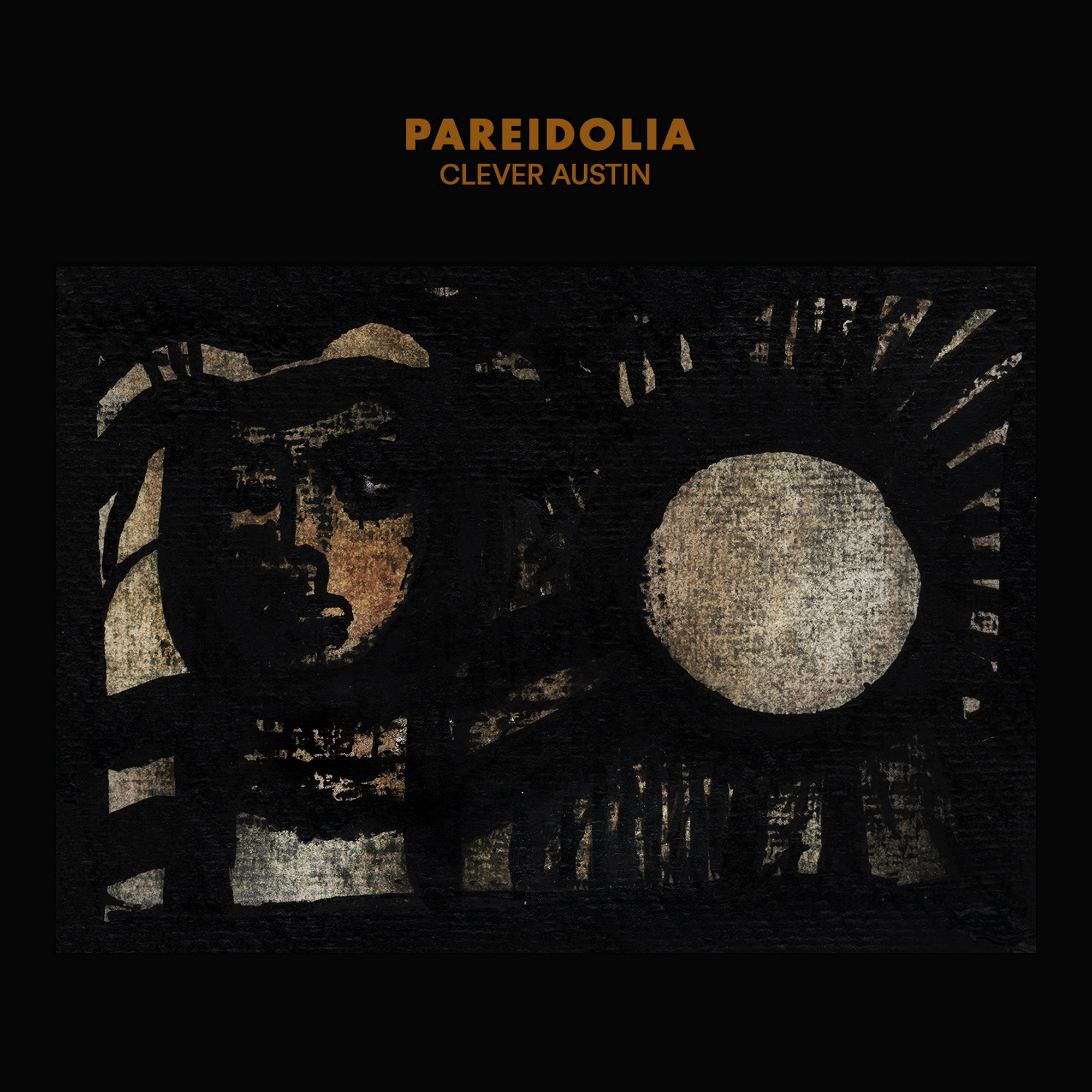
We’re told that the LP is a genre-bending sonic and emotive pilgrimage with virtuosic, percussive groove at its core. It was conceived via countless nights in Austin’s home studio and dreamily roams across 16 tracks which slowly unravel with the cinematic feel of a movie, all mixed and self-produced over a period of two years. It features Jon Bap, Georgia Anne Muldrow, Laneous, and CAZEAUX OSLO, plus a staggering amount of instrumentation from Alejandro Abapo (saxophone), Simon Mavin (upright piano), Jimmy Bowman (trombone), Taylor Crawford (frello), Tom Mansfield (electric guitar), and Paul Bender (acoustic guitar).
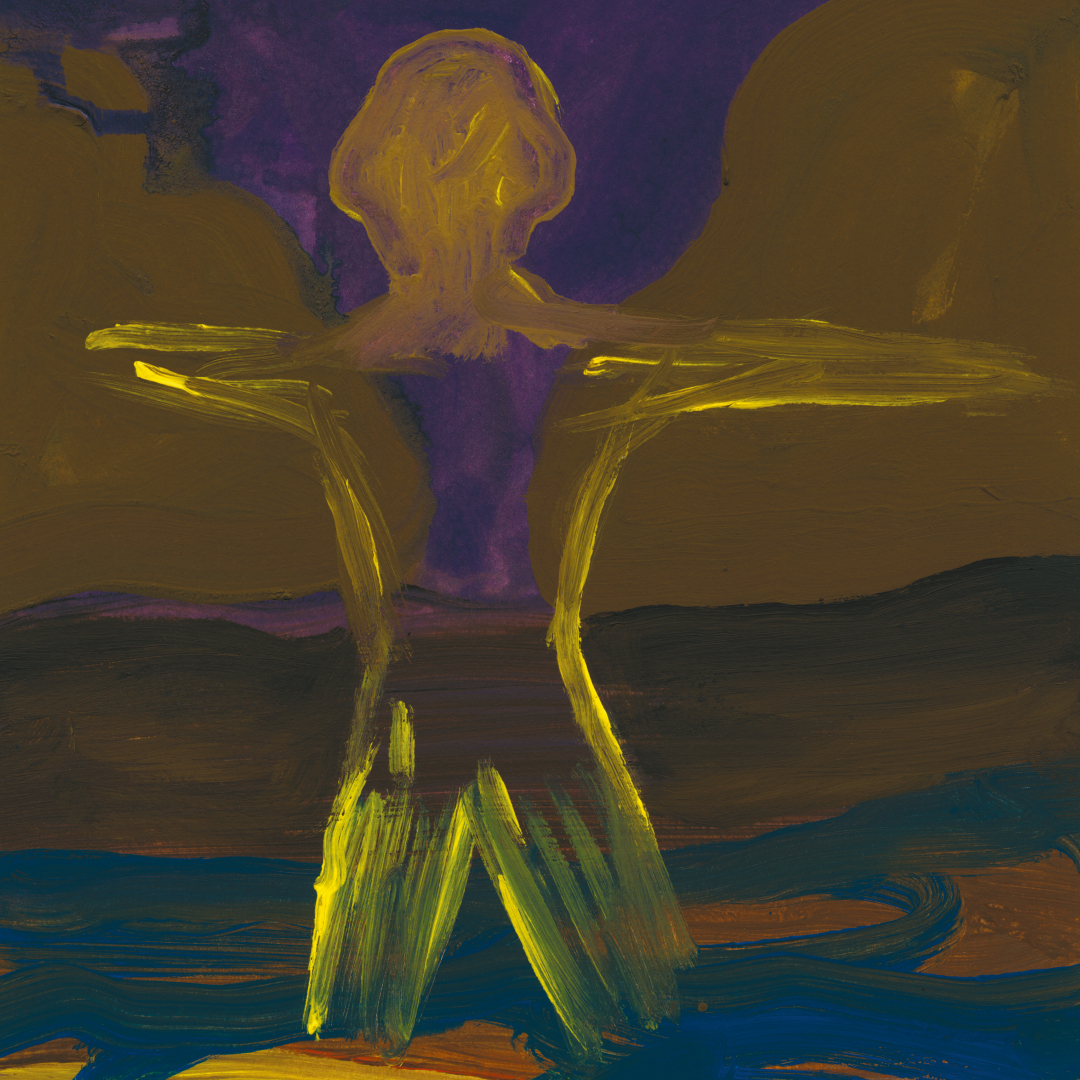
The painting used for the cover artwork was contributed by Clever Austin’s mother, Judi Moss.
Pareidolia LP is available now, with a stream available below and ordering options for the vinyl version here.
Tracklisting
01. Mist
02. Unipvich
03. Speckle
04. Blue Tongue (feat. Jon Bap)
05. Planet Viewing
06. Speckle Pt.2
07. Dime Head
08. Doves
09. Catapult (feat. Laneous)
10. Hedgehog
11. Mother Ship Strip (feat. CAZEAUX OSLO)
12. Ark
13. Higher Plains
14. You Are All You Need (feat. Georgia Anne Muldrow)