Surfs Up
New Music Videogames: Virtual DJ?
So your dreams of being a music-video choreographer or hot DJ/producer have been crushed by the reality of pushing papers around inside a tiny cubicle. Well, weekend warrior, that’s what these new videogames are for. Like Dance Dance Revolution, Dance Factory (Codemasters; PS2/$39.99) is a mat-based game where you high-step and booty bounce in time to the console’s predetermined dance steps. Built-in calorie counter aside, the real twist to Dance Factory is that it makes up a choreographed routine to any music you feed it-gabber obviously generates the crazed footwork of a squirrel on crack, while Sonic Youth is good for stoking an interpretive dance session. A party game if we’ve ever seen one.
Rather less exciting is Beatmania (Konami; PS2/$64.99), which bills itself as the “first DJ simulation” for the Playstation 2. Bundled with a purpose-made controller-a box with a miniature turntable and seven white keys-the object is to push the buttons and scratch on time with flashing lights on screen. You’re not allowed to make your own compositions-and the faux turntable only mimics one kind of scratch-but if your idea of fun is honing your hand-eye coordination to anonymously-produced epic trance songs, then who are we to stop you?
Freegums: South Florida’s Freshest
Freegums. The name brings to mind the gummy smile of a senior citizen with his dentures out, or a dish of brightly colored Chiclets. It’s actually the alias of 25-year-old Peruvian Alvaro Ilizarbe, who’s been causing havoc in the streets of Miami, Florida since he was exported from Lima at the age of nine. Flexing a loose, colorful style that incorporates claws, laughing hyenas, palm trees, and clever sayings, Ilizarbe’s graphic design work is a smart, tongue-in-cheek reflection of South Florida and its environs.
Ilizarbe works in the art department of ad agency Crispin Porter + Bogusky by day, but as night falls, this Aquarian dabbles in a multitude of projects. His most visible endeavor is a line of reversible t-shirts, a smart idea that might actually justify you rocking the same garment for two weeks straight. His most recent coup–during December 2005’s art expo Art Basel–found him and TypeStereo’s Mike Del Marmol operating as Fufi Fufi; the pair tooled around the city in an ice cream van stocked full of limited-edition wares from Hunter Gatherer, Grotesk, and Ben Loiz, among others. We interrupted Ilizarbe drawing “snakes with weird skin patterns” and asked him what’s good.
XLR8R: Where does the name Freegums come from?
Alvaro Ilizarbe: When I was in college, I needed to make money and so I started doing these big house parties. I needed a name to tie them all in, like Mr. Freegums Toilet Swamps and Mr. and Mrs. Freegums Dance-a-lot. That’s how I gave birth to the name.
What are your three favorite t-shirts in your closet?
The first is a Stop Police Brutality shirt I made years ago; it fits so good. It’s black with a crazy list of names on the inside, which makes people wanna read it. Then there’s a mint t-shirt sample from some blank-maker in Fresno. It fits nice, feels good, and is faded just right. The last is an Eagle Claw “Razor Sharp” promo shirt. I hate it when I remember a good shirt but don’t know where it is… It’s like my washing machine ate it.
What music do you listen to when you work?
Cash, Madlib, Fleetwood Mac, Daft Punk, Nas, The Wu Tanga Manga Clan, Prince (this guy is at the top of my list), Bloc Party. My favorite song these past few days is “X’s And O’s (Kisses And Hugs)” by David Allan Coe.
If you could collaborate with one other designer who would it be?
Herb Lubalin. That guy is amazing: his composition, great type treatment, great publications. Look him up–you’ll see why. I hope to leave a lot of great work like he did.
Tell us about the ice cream truck you did for Art Basel.
That was one of the best projects I’ve done. It was a lot of work and it was a lot of fun. I got no sleep for about two weeks and was in a pissy mood but in the end everything fell right into place. It started with a bigger group of people but we all couldn’t agree on a theme and it fell apart last minute. So Mike [Del Marmol of Typestereo] and I embarked on a mission. We went around to ice cream wholesalers and saw postings on the wall about trucks for sale. One came through and we gutted it out, cleaned it up, fine tuned the ’57 Chevy engine, put a couch in it with a touch of Astroturf, reached out to a lot of artists and made it happen. We met a lot of crazy out-of-towners and saw a lot of interesting people. Mike’s wife Cindy got Universal Studios to buy the truck from us to use for an upcoming movie version of Reno 911!: Miami. They blew up (the truck) over the Port of Miami. Fufi Fufi blowing up, kid!
What is your favorite spot in Miami?
Miami is such a beautiful place. It is home to the World’s Steepest Parking Lot Ramp. I like taking people there and just putting the car in neutral and riding down it. You should see their faces–it’s like they are on a rollercoaster for 1.5 seconds. Amazing. Going airboat riding is great too. There used to be a three-story treehouse right by the water and it was like a two-mile hike to get to it but after all the hurricanes it’s barely survived.
What qualities do you most value in other people?
When people look at you in the eye when talking, and shaking hands. Also, when people can be themselves and not worry about how they are being perceived.
What projects have you got coming up?
I’m working on patterned textiles and garments for 2007; in the planning stages of making an album with Sam Borkensen from Friends With You, and I have something going on for the Select Media festival in Chicago that Ed from Lumpen puts together with a lovely group of people.
Is the whole hand-drawn thing getting out of control?
Not really. Nothing will ever be as bad as how graffiti got, like the really bad “graffiti” fonts people use.
Can you talk about the inspirations behind some of your Freegums shirts?
My past line was centered around wildlife. I went to every public library in South Florida looking through hundreds of books and found a lot of good stuff. At times I find myself using Spanish words and working them into my designs, like Muelas Gratis. It stands for “free molars.” I was trying to say “free gums”–that would be “encillas gratis”–but after I had drawn it and everything, I was like, whatever, shit looks good. The infamous Freegums Claw shirt came from an early Saturday adventure a bunch of friends and I took to the Everglades. We went airboat riding like crazy rednecks and then walked around looking at alligators. I was mesmerized by their stubby feet; we named one of them “Club Foot.” When I got home, I was drawing one of them and I was like “Ohh shit! This would look great on a shirt coming out of your neck like ‘Arghhhhhhhh, I want you!”
Celluloid Records: Change The Beat
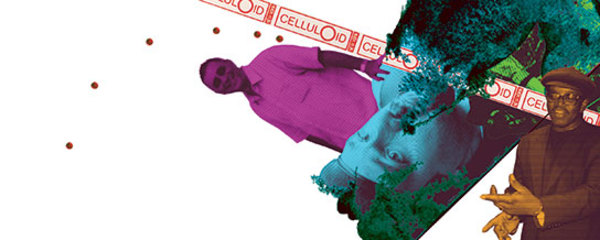
If you were to travel back in time to the early ’80s, you’d find a vastly different musical landscape. Though the disco era was in full swing and funk’s motherlode was still fertile, album-oriented rock ruled the roost. Alternative rock and electronic music were still in their fledgling stages, R&B had settled into a safe, comfortable groove, world music was the province of folk-loving hippies, and hip-hop had yet to explode across mainstream America’s consciousness.
It was against that canvas that Celluloid Records spray-painted its musical collages. Over its 16-year history, the label would release approximately 100 albums, about 700-800 songs. And though its biggest-selling single–Time Zone’s “World Destruction”–moved an impressive, but not earth-shattering, 70,000 units, all of the label’s avant-garde efforts proved to be a highly influential, if not seminal, factor on the socio-cultural-musical aesthetic that defined the ’90s and beyond.
“Our whole concept,” explains Celluloid’s CEO John Matarazzo, “was to be ahead of the curve. Not so far ahead that people were like, ‘That’s just weird, come back in 10 years,’ but ahead enough so that people were like, ‘Hey, that’s interesting, we didn’t think about that.'”
Enlisting eclectic hipster Bill Laswell as an in-house producer, Celluloid–which maintained offices in Paris and NYC–jumped into the urban music playground at a time when the Afro-futurism–as envisioned by Afrika Bambaataa & SoulSonic Force’s “Planet Rock”–had yet to be grounded by bling-bling materialism and ultraviolent gangsta clichés. The label put graffiti artists together with punk bands, electrified traditional African music, matched bilingual raps with futuristic electro-funk, and helped to establish sample-based music and turntablism as art forms. Though some of the now-defunct label’s catalog is available through digital download on eMusic and iTunes, two discs’ worth of definitive singles have resurfaced on German import Collision as The Celluloid Years.
The set begins with “Escapades of Futura 2000,” which featured The Clash backing Futura, the infamous aerosol abstractionist. Matarazzo says the song symbolized “the idea of blending things that you think just wouldn’t go together… it was special for us, because it represented where we thought things were gonna be going.” After subsequent Aerosmith-Run DMC and P.E.-Anthrax collaborations popularized the rap-rock concept, Matarazzo recalls, “All of a sudden, people were saying, ‘Yeah, that’s a cool idea.’ For me, that’s what really made it, the fact that we could influence people that way.”
Another influential single was Deadline’s “Makossa Rock,” a blueprint for the genre-bending multiculturalisms of today. With a wild, divergent groove built around a driving bassline and electronic snare hit–over which saxophones, trebly synths, syncopated percussion (from West African multi-instrumentalist Foday Musa Suso), bluesy harmonicas, and sampled soundbites swirl for a stamina-testing 10 minutes and 52 seconds–”Makossa Rock” sounded like the African diaspora itself, united through technology and rhythm. “We put people from all kinds of different genres on that record,” Matarazzo says. “That was one of the first records to come out at that time that was like a hybrid between pop music and traditional music from other countries.”
Further globally minded efforts followed; Cameroonian saxophonist Manu Dibango passed through Celluloid’s NYC studios long enough to record two albums and several 12″s. “Pata Piya” and “Abele Dance,” both included on The Celluloid Years, point the listener toward where world music is presently: clubby and electronic, yet still infused with traditional elements.
The ominous “World Destruction” brought together hip-hop legend Bambaataa (who also recorded “The Wildstyle” and “Zulu Groove” for the label) with punk icon John Lydon. “It was an experiment. We thought, ‘This might be cool, this might be a disaster,'” Matarazzo says. “But it worked out great.” The song’s mention of a fiery apocalypse seems especially ominous today. “At the time we put it out, it was kind of a warning. But now, people look at it and go, ‘Hey, it really happened.’ It’s amazing. After 9/11, it was just like, ‘Wow, it’s prophetic.'”
Prophetic in a different way was “Change the Beat,” featuring future Yo! MTV Raps host Fab 5 Freddy and French femme fatale B-Side. Their bilingual rhymes were innovative, but the song will always be remembered for its vocodered sample–“Ohh, this stuff is really fresh,” one of turntablism’s most-scratched phrases. “That was amazing,” Matarazzo says. “You just couldn’t stop it. That was all over the place.”
Today, Celluloid’s legacy echoes in clubs everywhere, yet Matarazzo insists he doesn’t have time to look back. “What’s gonna start happening is, we’re gonna see more and more fragmentation in music,” he says. “The Internet is making that really possible, because the distribution channels are starting to break wide open. The old idea of mass merchandising is kinda ancient history. I think it’s kind of dead. You’re not gonna have one artist you’re gonna sell to half a billion people. You’re gonna have hundreds of artists and you’re gonna sell to maybe 10 or 20, 000 people. And the real challenge is gonna be to find the ones who can really cross over and come into a broader market.”
Chances are, Matarazzo’s speculation is spot-on. After all, he’s already predicted the future once.
Jel In The Studio
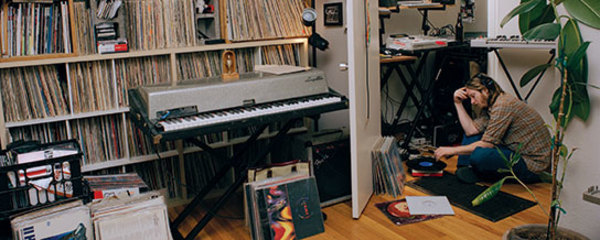
When you take a peek into Jel’s Oakland, CA studio, you come to realize that it really doesn’t take that much space to create some of the most textured, spatial, and exquisite instrumental hip-hop records of the last couple years. With albums like 10 Seconds (a reference to the extended sample time he achieved by speeding up records) and his latest, Soft Money (Anticon.), he’s becoming increasingly known for his drum sounds, whether they be lifted or programmed, but never played live. In high school, when the drum position had been filled by a brown-nosing jock, Jel (a.k.a. Jeffrey Logan) took up the coronet; with that (and the early purchase of the E-Mu SP1200 drum machine), he never looked back–at least not in the direction of a Pearl or Tama kit.
That SP1200, still the cornerstone of Jel’s arsenal, is now tucked away in a closet, one that serves as the play space for creating euphoric, pounding, hazy, and all-around engaging opuses like Soft Money. In the midst of mixing the new Subtle record, Jel gives XLR8R a quick tour of his killer coat rack.
XLR8R: What’s the basic setup of your studio?
Well, first of all, it’s a closet (laughs). We found a nice place for cheap, and it’s a big enough closet that I can fit all my shit in there and close it up. I just open the door and sit in the hallway and work. It’s pretty much my setup live: I have a laptop with Pro Tools [9.2.3], an M-Box, my MPC [2000 XL], my SP1200, my [Boss SP-303] Dr. Sample, a little delay pedal, a [Roland] VS880, and an Alesis Ion keyboard, which has glitches. Since I bought it I haven’t really used it for recording–it’s just sitting there waiting for me to fix it.
Does broken gear take on a life of its own that excites you, or are you quick to just throw it back onto the shelf?
With the instruments I use, drum machines will just glitch on you and freeze. There’s nothing really spectacular about it. If it was something that had some old radio tuner or four-track or something unique on it, then maybe…
How much do you process your drum sounds and other sources?
It depends on the feel of it; if I like how it sounds. I don’t really mind if the sound’s overused because I’m gonna chop it up and reprogram it anyway. When I chop up breaks, I just sit down with my record player and my MPC and I’ll just sample part for part; I’ll just find a break and take each individual hit and then just start playing with it live.
Are you against using sampling software on a computer?
I’m not “anti” anything really. I just make do with what I have. I’ve heard dope shit that kids have done on Fruity Loops, so I’m open to anything; it’s just usually what I’m comfortable with….
There’s a strong atmospheric rock sensibility to Soft Money. Where does that come from?
I think what you’re hearing is a lot of what Odd Nosdam added. He actually helped me mix the majority of the album, and added a bunch of ambient and drone kinda stuff. I can see My Bloody Valentine definitely being an influence on him.
What did the record sound like before you gave it to him to play with?
It was pretty much the same elements. When we sat down to mix it, we were thinking about having songs coming together properly and beginnings and ends of songs being cleaned up. Because a lot of my songs were just kinda… the meat was there but shit would change drastically just from us playing around with stuff.
Then you built in the transitions?
Yeah, we were sitting on different sequences of the album for a while, flipping them around a lot.
With all the collaboration that you and the other Anticon guys do, what’s your advice for maintaining Zen in the studio?
I don’t think there’s been any collaboration (except a couple) where we’ve been in the studio with the musicians. [Those collaborations] have been by mail, [online], and shit ’cause a lot of it is with people overseas. With Anticon, we’re at each other’s houses. But the one thing that we all have noticed that amazes us about meeting up with people and working with them is that it’s a kindred spirit thing. Like we meet people and become friends…. And if we hit it off as friends, then it’s usually like “Fuck it. Let’s do some music.”
Belong: New Orleans Mirrored
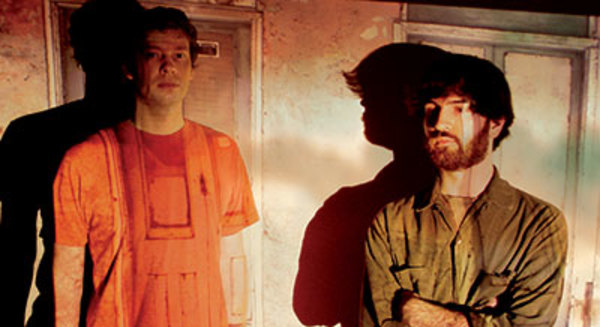
Though Michael Jones and Jason Mark (the duo known as Belong) finished their debut album, October Language (Car Park), a year before Hurricane Katrina hit, they can still hear parallels between the New Orleans of the aftermath and the record’s sprawling waves of guitar and synth noise, which often threaten to swallow the listener whole. “I agree [that] a fellow New Orleans person can listen to it and be affected [knowing it was] created by people who live in New Orleans,” Mark says.
In reality, it wasn’t too long ago that there were blue tarps covering nearly every damaged rooftop and FEMA trailers parked all over the New Orleans suburb where Jones and Mark record. The pair initially met through a mutual friend while hanging out at a bar. Mark (who also records as Turk Dietrich) is a seasoned electronic music producer who works with Telefon Tel Aviv’s Joshua Eustis in the group Benelli, while Jones is frank about his more minimal resume. “I was in a bunch of bands that never made it out of practice rooms,” he reveals. “Every band I was in always broke up.”
According to Jones, Belong’s early work was “a lot more noisy and dronier,” but the duo eventually added melodies and basic chord changes into the ether they created from digitally manipulated guitar, synths, and Mellotron flutes. Listening to October Language, one imagines sunlight cracking the sky and burning away the ice across the concrete. Jones recommends listening to the record, as one of his friends does, while watching a TV with bad reception. “[Listening to us] is like staring at a fractured old picture and trying to make sense out of it,” clarifies Mark. “You know that there is a pretty image there but it takes a little while to see [it].”
Belong left New Orleans for Atlanta by the time Katrina hit their home. “We thought we would be briefly there and then come home,” Mark explains. “But every day, it got worse and worse–we were in a complete daze; we couldn’t communicate well with each other. It was the weirdest week of my life.” He talks about traveling through the eastern part of the city a few weeks after the storm passed. “It was probably one of the eeriest things I’ve seen in my life,” he says, recalling the sight of a five-mile-long waterline.
Despite its New Orleans origins, Jones hopes listeners don’t consider October a Katrina-inspired album. “We’re making sad, but hopeful music,” Jones explains. Mark chimes in: “There is a degree of melancholy but with a light at the end of the tunnel.”
light park #2
8-Bit: Eight is Enough
8-bit music is something of a moving target, more of a movement than a genre. Even a name can’t be agreed upon–the closest to universally accepted terms are “chiptune,” “micromusic,” and “8-bit,” but new variants are being churned out every day, with varying degrees of cleverness (“bitpop,” “blip-hop,” etc.).
The most identifiable common element of the 8-bit scene is an aesthetic association with the sound and style of early console and home-computer videogames, but this form can take on different guises. Some producers fixate on the unembellished output of a single four-channel, 8-bit sound chip; others meticulously reconstruct 8-bit sounds using modern equipment. Some songs overly nod to game soundtracks; others are distant descendants, exploring game music’s textures but not its conventions.
Although the idiom’s practitioners approach this style from every direction imaginable, low-bit music is nothing new–its lineage parallels that of home computing, stretching back more than 20 years. The current micromusic mini-movement is actually a derivation of computer-game hacking; it claims roots in mid-’80s “crack intros,” where videogames were “modified” and animations, music, and codenames added to the intro screens–a nerd-world equivalent of graffiti. These embellishments became increasingly elaborate until the intros eclipsed the game as the object of interest, turning into standalone showcases of programming prowess called “demos.”
This impulse to push limits continues in today’s low-bit music. It has spurred the creation of homebrew programs, hardware, and techniques, making it possible to construct live, beat-driven tracks on an Atari 2600, control a Nintendo Entertainment System via MIDI, and turn a Game Boy into a portable, pocket-sized music workstation. And for all of the scene’s stylistic chaos, this moment is a rare snapshot of the healthiest time in a movement’s development–a free-for-all of diverse experimentation that can probably only happen in the absence of a definition. Joshua “Bit Shifter” Davis
Artificial Intelligence
It’s game on for Brazilian 8-Bit head Artificial.
You probably remember the days when your parents desperately asked you to turn down the volume of the TV while you were playing Nintendo. Judging from the kind of sound Kassin extracts from a simple Game Boy with his Artificial project, you can only imagine his mother suffered a lot more than the rest.
The idea behind Artificial is simple: to make music using Game Boy’s blips and beeps. Doing it is a little more complicated. Instead of turntables and a laptop, Kassin’s live PA consists of two Game Boys, a MicroKorg keyboard, and two delay pedals, all plugged to a four-channel board. This lo-fi approach comes as quite a switch for Kassin, a well-known Brazilian producer who has worked with Tropic·lia’s Caetano Veloso, Bebel Gilberto, and even Japanese pop stars.
All of Kassin’s gigs as Artificial are improvised, mixing pre-recorded beats with live effects to create a rough-sounding collision of electro, Miami bass, and breakbeat. Relying on heavy electronic drum sounds, some songs gravitate loosely towards house, while others could be a bed for hip-hop lyrics or point to new possibilities for baile funk.
In order to access the videogame soundbank, Kassin utilizes two specially made cartridges, which transform the toy into a synthesizer and a sequencer of 8-bit beats and noise. “I read about this LSDJ program that allowed you to program a Game Boy and I bought it online,” says Kassin. “When I talked about it to my partner, Berna Ceppas, I found out that he had just bought a similar one called Nanoloop.”
The technical limitations of such rudimentary tools are not a problem; rather, they fit perfectly with the music’s aesthetic. “Every time I feel limited by the programs, I just use something else,” says Kassin. “When I’m missing some chords, I use the keyboard. It’s the drums and the bass I like the most. I also use a laptop with some beats programmed in it, just in case–basically because the Game Boy has let me down a couple of times.”
The laptop came in handy during 2005’s Sónar festival, when his Game Boy failed. “It was great nonetheless,” recalls Kassin. “I programmed the show on the plane on the way to Spain. I had a great time at these concerts. The reactions were funny, because people didn’t expect me to sing in falsetto, for instance. And a lot of people danced.”
Released through his own label, Ping Pong Discos, Free U.S.A. captures some of this live action. An American citizen (his father is American), the idea for the record came during a trip to the United States. “I was on a US tour with my band, +2,” explains Kassin. “It was just before the war [in Iraq] had begun. In Minneapolis there were flags with “Free Iraq” written on them in front of every house. I thought this was such ignorance–comparable to the Nazis–that I recorded an album called Free U.S.A.”
Smack My Bit Up
Sacramento Band 8-bit Conquers the World with NES Beats and Ninja Stars.
Jay-Z’s “99 Problems” galloped to the tune of the Legend of Zelda theme before 8-bit took the floor. We were at Sacramento’s Old Ironsides club. The rappers of the group 8-bit were cloaked in fashionable radioactive suits and they were swigging beer. They had an iPod running their backing tracks. And they had charm.
One felt it in their choppy rhymes, which recalled Run-DMC. It was written across rapper Le-frost’s bespectacled face, which poked out of the cubbyhole of her helmet to lead a chuorus of “I’m grabbing my nuts.” It was distilled in catchy, fuzzy melodies and thunking beats, the kind that would be at home on any Nintendo game. Even after robots intoned “Suck my dick, bitch!” in the hook of one of their songs, the charm remained.
After the show, bandmate Robo-T asked Le-frost, “What is it that we make fun of about rap? “We make fun of ourselves,” she replied. “That’s basically it.”
Parked outside the club was the group’s cramped tour van. They bought it with Beck’s money–well, with the money they got from last year’s Ghettochip Malfunction remix of Beck’s “Hell Yes.” Beck’s brother happened to be an 8-bit fan, and the star’s manager gave them a call. The crew then laced the hip-hop original with a melody choked out of a dusty Game Boy cartridge, and found themselves in the company of Ad-Rock, Boards of Canada, and El-P on the Guerolito compilation.
8-bit was one of the more curious groups to emerge from the LA underground in the early ’00s. They began as a joke. Robo-T and his brother, Anti-Log, are Indiana transplants who moved to Highland Park, where they met Le-frost at a bowling alley. 8-bit first got the hang of sampling by yanking tunes and noises from NES classics like Mike Tyson’s Punch-Out, Rygar, the Zelda games, and Wizards and Warriors 2. “We just grew up with Nintendo and liked the way it sounded,” explains Robo-T. “We started out sampling it and putting beats on it to make our own music.”
He says that his group now produces the majority of their vintage sounds from scratch. True to the NES sound, the melodies and rhythms are usually repetitive, but attention grabbing. So, too, is 8-bit’s packaging. Their self-released CDs on their Ninja Star imprint are sometimes wrapped in handmade origami throwing stars.
As for their new record, The Chrome Album, a few 8-bit members describe it as “proggy” or hip-hop-meets-noise-rawkers Hella. “We’re trying to be the Rush of rap,” clarified Robo-T. Le-frost is counting on this approach being so successful that she’ll be able to buy a Bentley soon; the others are more pessimistic. “Whatever we do, we’ll have to do it quick because we’re going to die quickly,” Spacey-K said. Robo-T chimed in, “Yeah, I plan to be hanging from a rope in the next six months.” Cameron MacDonald
Heavy Artillery
8 Bit Weapon Decodes His Music-Making Set-Up.
LA’s Seth D. Sternberger bristles with more artillery than the dudes from Contra, his every piece of gear on par with the Spread or Laser Guns and not a lame Fire Ball in sight. Known in the burgeoning micromusic scene as 8-Bit Weapon, he’s been performing live and turning out material (both original tunes and Commodore 64 covers) since 2001. Intellivision Music launched their label with his EP and a remixed re-release of the limited-edition “Vaporware Soundtracks” is available for order from his website. The ever-excitable Sternberger is busy working on a score for the Disney short Catch 1up and a top-secret multi-platform game for Nokia, but took time to spec out his sound for us. Matt Earp
XLR8R: What’s your setup for playing live?
Seth Sternberger: I have a series of backing tracks running off a laptop as well as some MIDI sequences. Then I perform on a sandwich of a MicroKorg vocoder, a C64 computer running Music Machine, and a C128 computer running SID [Sound Interface Device] cart 1.0.
How do you process all that at once?
Primarily, I use a MIDI sequencer to control my 8-bit weapons, such as the MIDINES and the SIDstation. I sequence the Game Boys with LSDJ, a cart synth/sequencer combo for all Game Boys and I have an Atari 2600 that you can manually sync up to a handful of MIDI clock tempos. But it’s a lot more fun to lay down a rocking drum track off the Atari synth cart and get a fat lo-fi bassline, then record it into Acid. I also now have three new weapons that use Apple computers: the Apple IIe drum machine, using a “Drum Key” Card; the Apple II (or IIc/IIe) synth sampler; and the famous “Crap-O-Phone”–it’s a 2×4-looking orange controller that allows me to play an Apple II like a guitar!
Do you end up using certain 8-bit systems for certain parts of the music, like basslines?
The SID chip is the most dynamic audio chip ever to rock the microcomputer scene! Its digital/analog features allow it to be an incredibly versatile synthesizer. SID has great bass potential as well as amazing lead sounds and wild sound effects. It’s also great for chord arpeggios, especially with a nice low-pass filter sweep! The Game Boy has great bass too, the old grey one. It also has very distinct waves. The magical thing about the NES is the triangular wave bass! The most awesome micro-bass ever!
Are any of the instruments too delicate to leave the studio?
Yes, the SIDstation. It’s been through hell and back and I can’t bring myself to put a good friend like that in danger ever again.
Is there any piece of equipment universal to most performers in the scene?
The Little Sound DJ and Nanoloop carts for Game Boy, the Synthcart for the Atari 2600, and recently the MIDINES cart.
You seem able to make all your sounds with existing software and hardware. Is anyone doing hardcore computer hacking or modding?
gwEm made his own tracker for his Atari and my evil twin brother, FirestARTer of Germany, made his own SIDstation-like synth, a MIDI Game Boy interface device; he even made a C64 into a TB-303! My other buddy, Paul Slocum, makes his own software and hardware mods. Paul made the Synthcart for the Atari 2600 and the SID cart for the C64. He has also made a dot matrix printer synth! He is crazy!
Clubland’s Big Brother
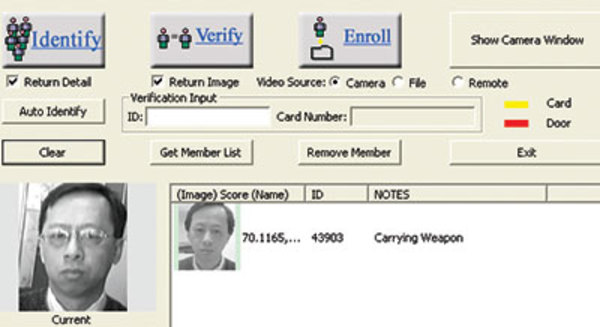
Anybody with a healthy nightlife has endured serious (and unnecessary) scrutiny while entering a club, whether it’s undergoing a popularity contest to pass through the velvet ropes or the rough security checks at crowded concerts. But a new security system being introduced this year adds a computerized–some would say creepy–edge to the typical screening process.
Enter BioBouncer, a state-of-the-art security system and “electronic face book,” according to Jeff Dussich, the founder of JAD Communications and Security, a New York-based company that’s developing and marketing the technology. A system of unobtrusive cameras that uses 2D and 3D facial-recognition technology to identify unwanted or troublesome customers, BioBouncer, which costs roughly $7500 (plus monthly licensing fees), is meant to be an electronic savior that helps high-traffic bars and clubs become safer and more secure.
Introduced in March at the Nightclub & Bar Tradeshow in Las Vegas–and currently undergoing trial runs at select clubs around the country–BioBouncer is a simple setup. A pair of video cameras scans and analyzes patrons and checks them against images in the club’s database of problem customers. These customers–who were kicked out for causing trouble or violating club policy–had their pictures captured by trigger cameras at the exits and added to the system’s database. When they try to re-enter the venue at a later date, BioBouncer picks their photo out of the database, alerts the owner and security personnel (via a computer screen or wireless message), and the real-life bouncers get to work. Dussich wouldn’t comment on when and where BioBouncer made its debut, but club owners from as far away as Germany, Italy, and New Zealand have all expressed interest.
Similar technology has found its way into airports and onto city streets (London is a known customer of such tech), all in the name of preventing terrorism. Even Chicago mayor Richard Daley has slated his interest in the club-watching technology. But do clubs, which already require ID, need more wired security? While it all sounds straightforward and safe, this kind of surveillance makes people nervous for a reason. Organizations like the American Civil Liberties Union have raised concerns about the technology in the past, citing the level of intrusiveness and high incidence of false identification as potential problems. Since BioBouncer allows clubs to link up their databases and share information, the possibility exists that one bad night could get you on a digital blacklist.
“Who decides what a bad infraction is?” asks Beth Givens, director of the Privacy Rights Clearinghouse, a non-profit consumer-advocacy organization. “Can you be bounced from a club for the wrong reasons? One of the things I would question is accuracy. Are they going to get a good enough photo of someone to get a good biometric template? I think there could be room for abuse here.”
Even Dussich admits the technology can trigger anxiety. “It raises privacy concerns immediately,” he said. “That’s why we’re trying to be proactive before it snowballs into some Big Brother fear that we know is looming out there. It’s not like I don’t understand our generation and I’m out to hatch an evil plan. I’m 24.”
Dussich is certainly ready with answers. The system has been tested in all types of lighting conditions and only collects photos, not names or other info. It’s not connected to national or government databases, so it won’t scan for criminal records. Most importantly, he stresses, it only stores data on “troublesome” customers. The program automatically deletes everyone else’s photos at the end of the night. Since human beings are making the final decision about kicking out customers, the system is more of a tool, not the final word.
Like any technology, biometrics won’t create a Big Brother-type scenario by itself: People must misuse it first. But do we really need to have our faces scanned at the places we go to to enjoy ourselves and escape? Has their been a rise in nightclub violence to warrant this type of security? Is the added efficiency of this system worth the invasion of privacy? “This system, to me, sounds like a solution in search of a problem,” says Givens.