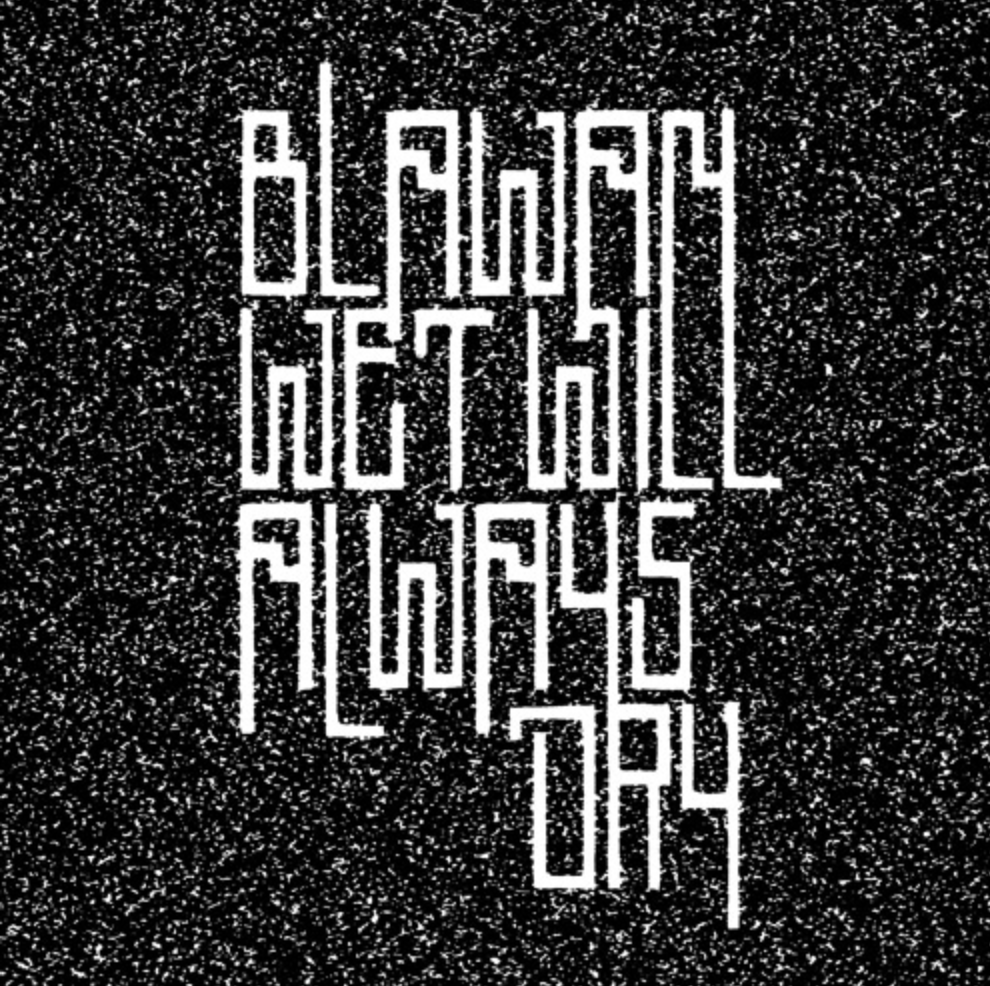
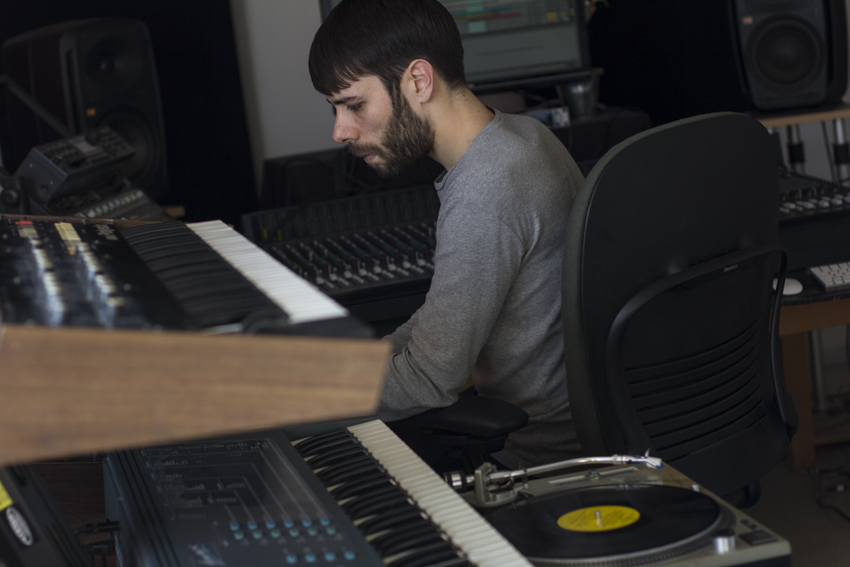
Jamie Roberts (a.k.a. Blawan) has revealed details of his debut album, Wet Will Always Dry, landing June 18 via his own Ternesc imprint.
The Berlin-based British DJ-producer has been one of the more notable artists to re-discover modular synthesis as a means for mining avant-garde rhythmic sounds, joining forces with Arthur Cayzer (a.k.a. Pariah) for the rough-edged, red-lining Karenn duo, also scoring collaborations with Surgeon and letting his excess energies spill over into equally intriguing aliases like Kilner and Bored Young Adults. His releasing history includes output on Hessle Audio, R&S, Hinge Finger, Black Sun, and Clone’s Basement Series, along with releases on Avian and Trilogy Tapes under his other aliases.
The album follows last year’s Nutrition EP which “represented a significant breakthrough in this area,” and provided the “green light” for a “more ambitious and colourful” full LP.
Californian producer Jennifer Lee (a.k.a TOKiMONSTA) has today announced Lune Rouge Remixed, slated for release April 6 via her own imprint, Young Art Records. The project sees a host of names provide their take on Lee’s 2017 Lune Rouge release.
The album features reworks from names including Sofi Tukker, Sam von Horn & Justin Jay, Alexander Lewis, Penthouse Penthouse, Japanese ambient producer Qrion, Brit Hugo Massien, emerging Canadian multi-instrumentalist Ouri, and Australia’s Plastic Plates. The album also features remixes from artists straddling multiple musical sub-genres, including boogie-funk musician Dâm-Funk, bass-music innovator Holly, Felix Cartal, and electronic R&B mainstay Kingdom.
Lune Rouge was released last October and marked TOKiMONSTA’s first album in four years.
Tracklisting
01. Thief (feat. SAINTS) [Penthouse Penthouse Remix] 02. Don’t Call Me (feat. Yuna) [Alexander Lewis Remix] 03. We Love (feat. MNDR) [Felix Cartal Remix] 04. I Wish I Could (feat. Selah Sue) [Sofi Tukker Remix] 05. Don’t Call Me (feat. Yuna) [DâM FunK Re-Freak] 06. NO WAY (feat. Isaiah Rashad, Joey Purp & Ambré) [Kingdom Remix] 07. Bibimbap (Holly Remix) 08. I Wish I Could (feat. Selah Sue) [Ouri Remix] 09. Don’t Call Me (feat. Yuna) [Hugo Messian Remix] 10. NO WAY (feat. Isaiah Rashad, Joey Purp & Ambré) [Sam von Horn & Justin Jay Remix] 11. We Love (feat. MNDR) [Qrion Remix] 12. Early To Dawn (feat. Selah Sue) [Plastic Plates Remix]
Lune Rouge Remixed LP will land on April 6 with “NO WAY” (feat. Isaiah Rashad, Joey Purp & Ambré) [Kingdom Remix] streaming in full above.
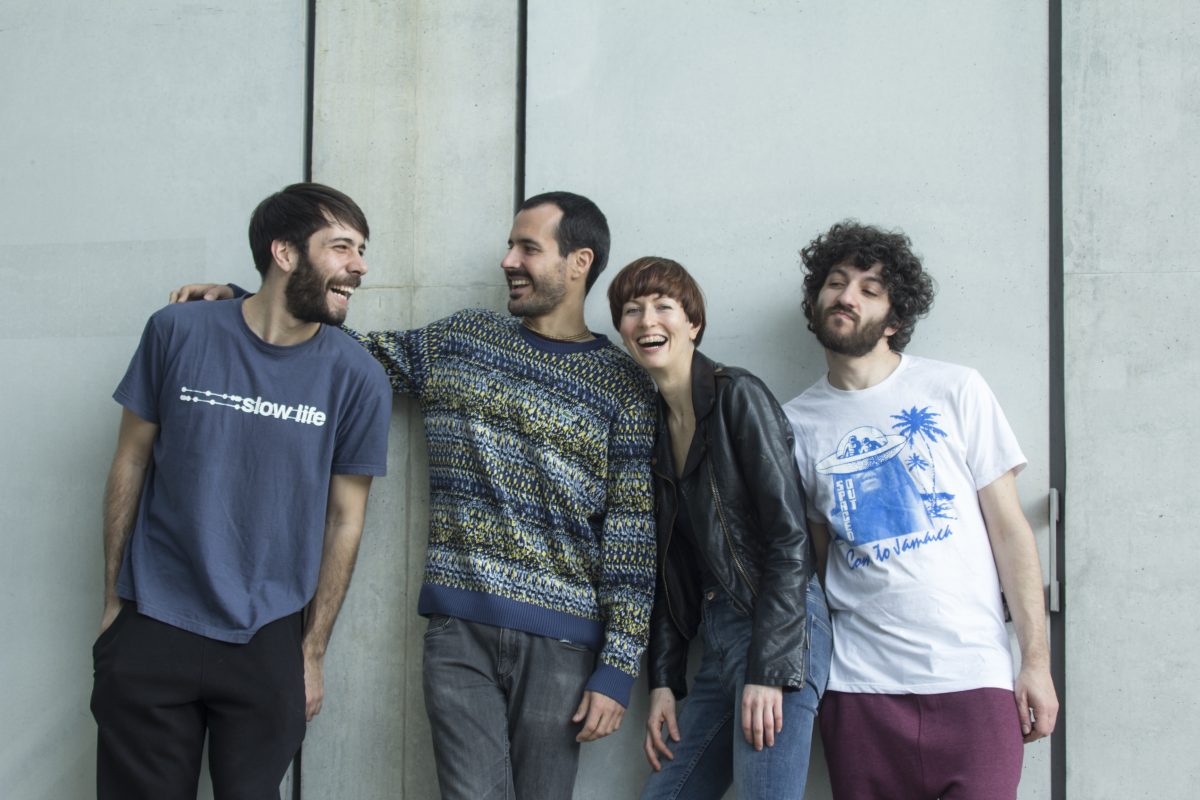
The old adage of power in numbers should not be downplayed when it comes to Berlin-based multidisciplinary project Slow Life. Made up of producer S. Moreira, a cast of diggers Cecilio, Dj Tree, and Laurine, and designer Santi Uribe, Slow Life’s magnetizing appeal is one drawn from the sum of its parts. The grounded success of the crew, too, can be charted to its one for all mentality; an ethos that places the project’s steady growth ahead of any personal fame—they’ve simply let their music and curation reach audiences in an organic way, resulting in a fan base that recognizes the quality in their meticulously sown output and hard-earned skills.
In 2013, when their mesmerizing sound was starting to captivate dancers via showcases at institutions such as Club der Visionaere and Hoppetosse, Slow Life launched their label arm with a string of 12”s from S. Moreira. Although the sole output of S. Moreira, the records were indicative of Slow Life’s sound—sultry, subtle, and hard-to-define cuts not tied to any one style or era. The cuts on those records, however, have a noticeable signature running throughout, and therein lies the group’s charm: by studying and mining from the entire musical spectrum, they’ve managed to develop a sound and style that is unmistakably Slow Life.
As the years have gone on, the label has opened its doors to a wider array of artists—Saverio Celestri, 100 HZ, Tim Jackiw, and Primary Perception, to name a few—but the bedrock of Slow Life has unwaveringly held strong. For our latest Artist Tips, we’ve enlisted Slow Life’s core group to offer tips on production, digging, and the power-in-numbers mindset that has led to their solid foothold in the electronic music scene.
Slow Life will host a showcase at Lisboa Electronica 2018, taking place from Wed, April 4 until Sunday, April 8 in Lisbon, with more information, including tickets and lineups, here.
S.Moreira (production)
Arrangement is Imperative
An “average” song can become a great song with a nice arrangement.
You should put the same amount of creativity into the arrangement of your tracks as you do with the creation of the “loop” or the key elements. Don’t be lazy—sometimes it takes a bit of time until you find the right flow, but in the end, it’s worth the time you spend. Succeeding with a nice arrangement will also solve problems at the mixdown stage. It’s much easier to mix a song when you have the right elements playing together at the right time, rather than trying to find space to fit all the elements when they are fighting against each other.
I think it’s really important to take risks with the arrangement. If you don’t have a nice arrangement idea to start with, try random things until a new idea pops out. You can play with the order of the elements in the track and how you introduce them, as well as transitions between different parts of the track. If you have a nice idea running, go for it until you find if it’s really working. If you get to a point where you think it doesn’t work, then try something else. Don’t get too attached to your original idea; instead, go with the flow and follow what the track is telling you. Use your instincts and intuition. You should check all the different combinations between the elements you have; you might find a group of sounds that create a particular groove or vibe that you didn’t think about before.
In this sense, you must try things that you never do, even if they seem too crazy or strange at first thought. It’s good to experiment. Be open-minded. Try unexpected changes; surprise the listener and be creative. Don’t be afraid to take risks, at the end what you want is to make something special and original, not something generic that’s been heard before.
Room Acoustics
It’s important to have the right acoustic treatment in your studio. I would say this is even more important than having good monitors and production equipment. It’s also imperative for bedroom and home studios, which are often situated in not the most ideal of positions.
When you have a nice sounding studio you can clearly hear what’s going on in your music; what is good, or what you need to fix. With the right room treatment, it will be easier to make decisions that will lead to a better overall sound in the track and you will find that your tracks sound as you want them to sound, regardless of the system or the room where you are listening.
A typical situation is when you finish a track in your non-acoustic-treated studio, and then you go to your friend’s studio to listen; most of the time, you’re going to be disappointed and your music won’t sound as it should be.
Take some time and do some research—try Googling “guide to acoustic room treatment,” for example—to find out what you can do to improve the sound acoustics in your studio. Your tracks will definitely sound better if you do this. This doesn’t have to be an expensive endeavor; you can save a lot of money if you build your own bass traps and absorbers—you can also buy them ready to go. Again, you can Google various methods of building your own and the materials you will need to buy are quite cheap.
It’s not a very exciting thing to spend your money and time on, but it’s going to lead to one of the biggest improvements to your sound. You won’t be disappointed.
Learn the Basics
This may seem obvious, but so many times I find a lot of experienced producers who don’t really know basic things like how to record audio, or keeping the right levels in your audio chain, the differences between real analog and digital signals, serial/parallel, mono/stereo, etc.
If you work with hardware, it is very important to learn the right way to connect all your machines. You need to know the right cables: mono and stereo, balanced and unbalanced, insert cables, etc. As boring as it might seem, it’s imperative to read the manuals of the machines you are using—they will usually tell you the best way to use, connect, and set up the machine for best performance. Things that many times seem to be too obvious to waste our time reading are really worth it in the end; you will always find useful information.
DJ Tree (digging)
Regularity is Key (but do more when you’re feeling really inspired)
As a record digger, it is crucial to get into a routine and perpetuate it, almost in an obsessive way—and you should do it for at least a couple of hours a day. It should become a habit. Time should ideally be split between online and physical digging, favouring the first option to make it easier to start the process. Since it is something that I can do for a really long time, when I feel that I am on a good path I usually push a little bit more and often get rewarded with nice finds. Always push that little bit further.
Build up Personal Taste and Develop a Knowledge That Goes Beyond the Momentary Hype
It’s also important to develop your own taste, which will lead you to search for some specific sounds—like a certain snare or rimshot from a specific drum machine, a specific “vibe” that goes throughout the records in your bag, or even a certain timbre from a certain period. I guess it takes a while to do that, and the best way of sharpening this skill is to listen to as much music as possible, record after record. That way you will understand which is your specific, favorite sound and by doing so you will make it your signature. You’ll then find records in this aesthetic rather than just following the hype.
Take Advantage of the Huge Amount of Information That We Now Have Access to
The big difference and key element that differentiates us from the previous generations of artists/diggers/producers etc. is, in my opinion, the huge amount of information that we are exposed to—thanks to the internet, mostly. Therefore, I believe that it is so important to get your hands on all the information you can get, such as samples, videos, MP3s, etc. and to master the very dense network of information that we have access to concerning artists, labels, genres, and the previously mentioned assets in the paragraph above.
Go Record Hunting Everywhere You Can
You should always be on the hunt for new finds, and not necessarily electronic music focused records—try flea markets, thrift stores, etc. Dig Through Your Own Collection Every Now and Then
There is no better feeling than to finding a B-side of a record that I regularly play, one that I might not have considered when I got the record in the first place. So my advice about this matter is to regularly go through your own collection to see if you might have missed some great stuff within the good stuff you already have under control—or if a shift in your taste might allow some tracks to present themselves that you would not even have considered playing until not so long ago.
Laurine & Cecilio (varied)
Create Your Own Personality [as a DJ]
We live in an era where almost everything has been said or already invented (in terms of music), so it’s not easy to find your own sound. It requires time, passion, honesty with oneself and, of course, inspiration. So seek inspiration, but don’t just copy what you see or hear, and, most importantly, don’t just follow the trends or hypes of the moment.
What will make your set special is not a certain track, but the meaning of it as a whole. So, it’s ok to play records that “everybody” does at some point, but don’t make them your key to success. Too many people are focusing on what top known DJs play, but to copy them won’t make you special.
Don’t Envy
We all suffer from a very common and poisonous habit: to envy. Force yourself not to! Be happy for other people’s success, even if your mind tells you it’s not fair, and just focus on your own success and progression. We live in an abundant world and there is space for everyone and their success is not prejudicial to yours.
Don’t Rush
Understand how to flow, and not just with the music, but in all the aspects of your life. Don’t push too hard for things to happen—but that doesn’t mean just sit on the couch either. It’s about moving your ass and putting in the hours, but not being obsessed; put all your effort into it, but also not be attached. Things need time, especially if you want them to last.
Strength in Numbers
Join forces with kindred spirits; with people who share your goals, principles, and have a similar taste in music.
The more different opinions you can get from trusted people around you will lead to discussions and will help you to make better choices and decisions. This will help in the development of your projects in general, but will be especially important as a filter for what you will release if you have a record label.
Also, being a group who also perform individually, means that there will be healthy competition. In our case, as a group of friends and DJs who share a lot of music, it will motivate the digging aspect: discovering the best tracks possible, maintaining a very high filter, and wanting to keep on surprising each other.
Don’t be Afraid of Crisis
Without crisis, there would be no evolution. Every great revolution in recent human history came after a major crisis. Embrace them, and make them your motivation. It’s often for us to feel like we don’t have enough good records (which basically is just bullshit in our minds) or just that we are bored of them. But instead of feeling sorry for yourself, just use it to put in more effort, to dig harder.
Take Care of Your Body
Your body is your temple. Take care of it and love yourself. By “love yourself,” I don’t mean to look cool or fashionable in the mirror, but to treat yourself right.
Many fellow DJs have very unhealthy habits while working—like it or not it is our job, and you are supposed to do it for the rest of your life, not just a wild period of your youth. We don’t consider drugs “evil,” they are medicine, but you can easily get sick by the unnecessary and prolonged use of these “medicines.” There is a strong social influence on the consumption of drugs in the nightlife scene. Consciously or unconsciously, many people fall into the trap of taking drugs as a way of socializing, a way to break insecurities, a way to feel accepted, but if you truly believe in your talent and aptitudes, the music will speak for itself.
Learn and Enjoy Making a Warm Up Set
Too many DJs nowadays, especially the younger ones, just enjoy and want to play the peak time sets. In our opinion, the warm-up is one of the most important and difficult aspects of a party, and would help to develop your understanding of the dancefloor, the build-up of a set, and the timing needed for certain tracks. Also, it will give you the possibility to play and enjoy music that you don’t play often. When properly done, the fellow main act and/or guest will really appreciate the job you’ve done.
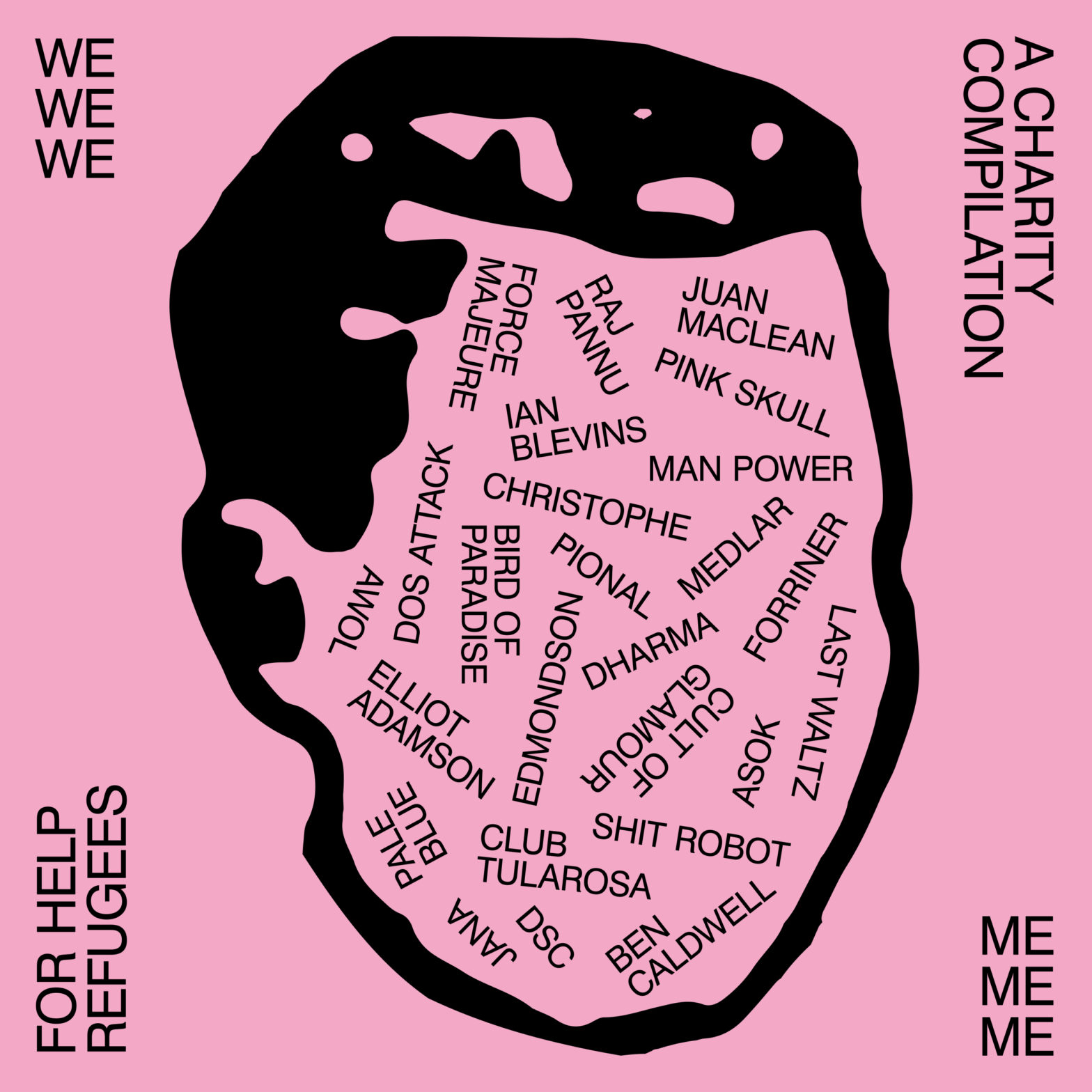
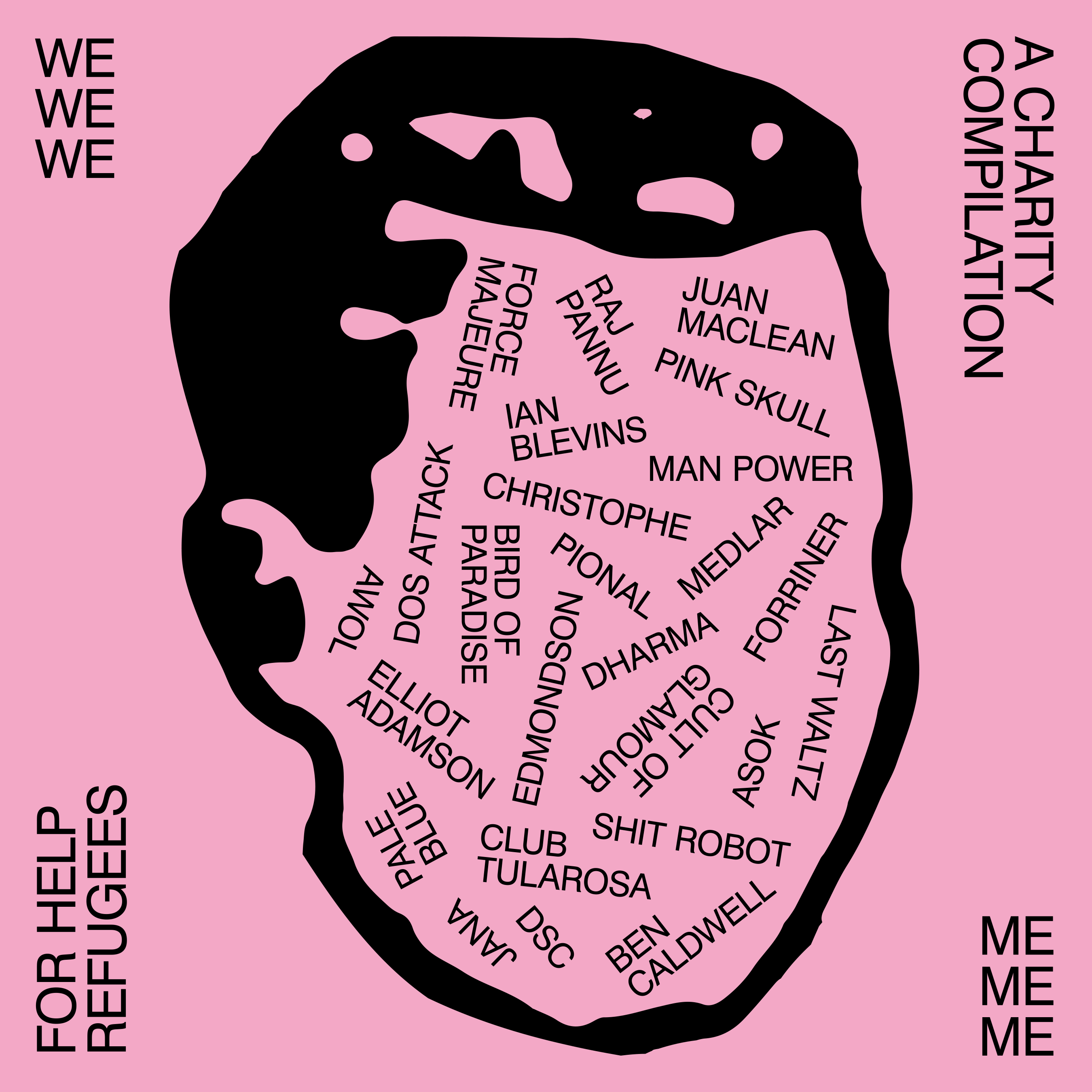
Man Power’s Me Me Me label will present a new compilation, We We We, which will see all profits donated to the vital Help Refugees charity. The release boasts 25 new and exclusive tracks from a wide range of artists both new and established including Pional, Juan Maclean, Shit Robot, Medlar, ASOK, Ian Blevins, and more. As well as the full album, two limited, vinyl-only samplers will also be released, with each featuring one exclusive track that is not available anywhere digitally.
The recipient of the album’s profits, Help Refugees, is the leading UK NGO in a new movement of humanitarian aid, helping to plug the gaps in services not provided to those displaced by war. The man behind the compilation’s concept is Man Power (a.k.a Geoff Kirkwood), known for his off-kilter mix of house, disco, ambient, and techno on labels like John Talabot’s Hivern Discs, ESP Institute, and Jennifer Cardini’s Correspondent.
Kirkwood says: “I have wanted to do a compilation of this nature for a long time. I’m incredibly lucky, as well as eternally grateful, to know so many talented artists who were willing to donate wonderful music towards this important cause.” The gratitude clearly flows both ways with Help Refugees director Philli Boyle saying, “We are so grateful to Man Power and to all the incredible artists who have shown solidarity with displaced people across the world.”
The full album is released exclusively via Bandcamp on May 4 in exchange for a “no minimum” donation to the charity, with the label asking people to please give generously. In advance of the release, you can grab Man Power’s “Functions” via the WeTransfer button below.
Tracklisting
01. Ian Blevins “Clouds” 02. Dharma “Amb22” 03. ASOK “Emotional Perception” 04. Pale Blue “Eyes” 05. Forriner “Sunshine in Bensham” 06. Jana “Leopard Eyes” (Fracture Mix) 07. Elliot Adamson “Found” 08. Last Waltz “I Are Dada” 09. Pink Skull “Indu” 10. Medlar “RSA” 11. Ben Caldwell “Ping Pong” 12. Dos Attack ‘Bolero of Fire” 13. Bird of Paradise “Vape for Christ” 14. Cult of Glamour “Inductive Logic” 15. Force Majeure “Future Dust” 16. Club Tularosa “Venturism” 17. Christophe “Winder” 18. Edmondson “Village” 19. Raj Pannu “Thek” 20. Desert Sound Colony “Clapping Rhythm is how you Hit Em” 21. Quantume Reach – Juan Maclean (feat Amy Douglas) 22. Pional “Night Charmer” 23. Man Power “Functions” 24. Shit Robot “Today I cried” 25. AWOL “25 55.003583, -1.444611”
The Welsh producer first appeared on the Gobstopper imprint in 2016 with the 2016 A.I.-influenced A History With Samus, before reappearing in early 2017 with Digital Botanics / Construct Conduct. He’s now set to release Rose Tinted Vision Implant, a debut album set in a “post-Ballard, post-Gibson, post-Miéville, alternate reality.”
We’re told that the album sees the Bath-based producer “creating a cutting-edge sonic world inspired by speculative fiction, time/reality shifting stories, and dystopian shit.” The entire record is structured around and expands upon his passion for the “future,” underpinning the music via an underlining narrative.
Odeko notes: “It’s a bit of a satire on corporate brands pushing these great products that everyone is obsessed but that are detrimental to both the world, and how we perceive reality. Our relationship with social media and tech could go down a dangerous path if we lose sight of things. I’m going quite far here for the sake of the concept, but things like VR, AR, the want for body tech, mixed with our desire to be connected, emotionally, digitally, physically, wirelessly could lead us to a world where everyone has implants or some kind of tech built into them.”
The record explores a “post-IDM, post-grime, post-ambient, post-glitch, post-retro-house, post-instrumental grime, take on electronic music.”
Next month, DJ Cream will release his Hustlin’ EP via his own Smile & Stay High imprint.
DJ, producer, and label owner DJ Cream has a long and storied history at the forefront of the vibrant Bologna dance scene and its Homequest crew, as well as releasing standout records on Bolo Represent, MoodyHouse Recordings, and, of course, Smile & Stay High.
His new EP, Hustlin’, is a perfect introduction to Cream’s sound for those uninitiated. The three tracks on the EP fuse classic samples and raw, dusty MPC grooves that are built purely for the dancefloor.
In support of the EP, Cream has offered up “In Your Way,” a feel-good house cut built from hazy chord and gritty percussion, as today’s XLR8R download, available via WeTransfer below.
Titled Exotic Worlds and Masterful Treasures, the album is set to be as wide-reaching as Stimulator Jones’ musical background, fusing his love of soul, rock, folk, country, jazz, blues, funk, reggae, rap, opera, and classical music into an intriguing mix.
Alongside the announcement, Stones Throw has shared two singles from the LP. The first, “Soon Never Comes,” can be streamed above and is the track that first connected Stimulator Jones to Peanut Butter Wolf and Stones Throw Records via Sofie’s November S.O.S. mixtape. The second, “Give My All,” a sultry soul cut, dropped last week and can be streamed below.
Australian DJ-producer and sound engineer Kris Baha heads up Power Station Records, a label that stemmed from a weekly club night he ran with brother Dan and Michael Delany in Melbourne, before relocating to Berlin three years ago. Recent releases have come from dane//close, Disrute, and piska power, while Baha also put out a solo EP in 2016. His later solo work has landed on CockTail d’Amore, Bahnsteig 23, and, most recently, Pinkman; while in collaboration with Dreems as Die Orangen, Baha tours live and also shared a full-length last year, titled Zest. Sonically speaking, his work leans towards industrial and wave—dark, deep, and twisted but not without a playful, energetic feel. To learn more about the sound and the key components behind it, XLR8R dialed in with Baha from his new Berlin home.
In addition to sharing his favorite pieces of studio kit, Baha has offered up an exclusive track “Dead To Romance” for download, available via WeTransfer at the bottom of the feature.
Kris Baha will be playing the Opium of the People showcase at Berlin’s Wilde Renate alongside Christopher Rau, Autarkic, Dreems & Von Party, and more. You can find more information here.
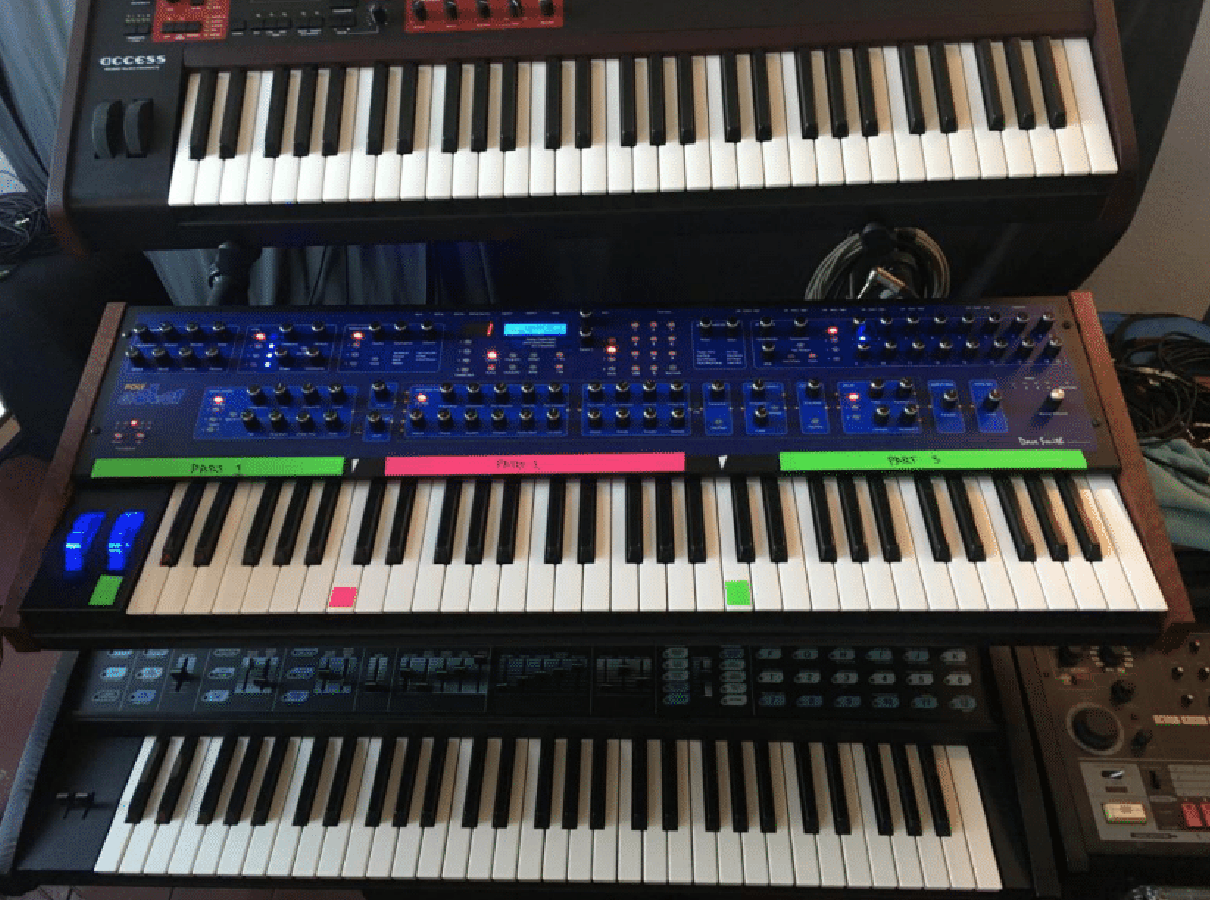
Dave Smith Poly Evolver
This is an essential piece for me, it was one of my first Poly synths I purchased in 2007. It always has a way of coming back into my music and I find that I am using it more than ever now—even in my live shows. For those out there that are unfamiliar with this synth, it’s the modern sound of a Prophet VS with two analog and two digital OSCs, a 1-step four-part sequencer, feedback overdrive, three delays with two feedback controls and one of them returning back into the filter section that unlocks a key to the infinite delay vortex.
The “barking dog” synth sounds in “Autora” are from the Poly Evolver sequencer running whilst playing with the release and assigning one of the sequencer tracks to the third envelope to play with the release further—this is also used for the lead lines on most of my music.
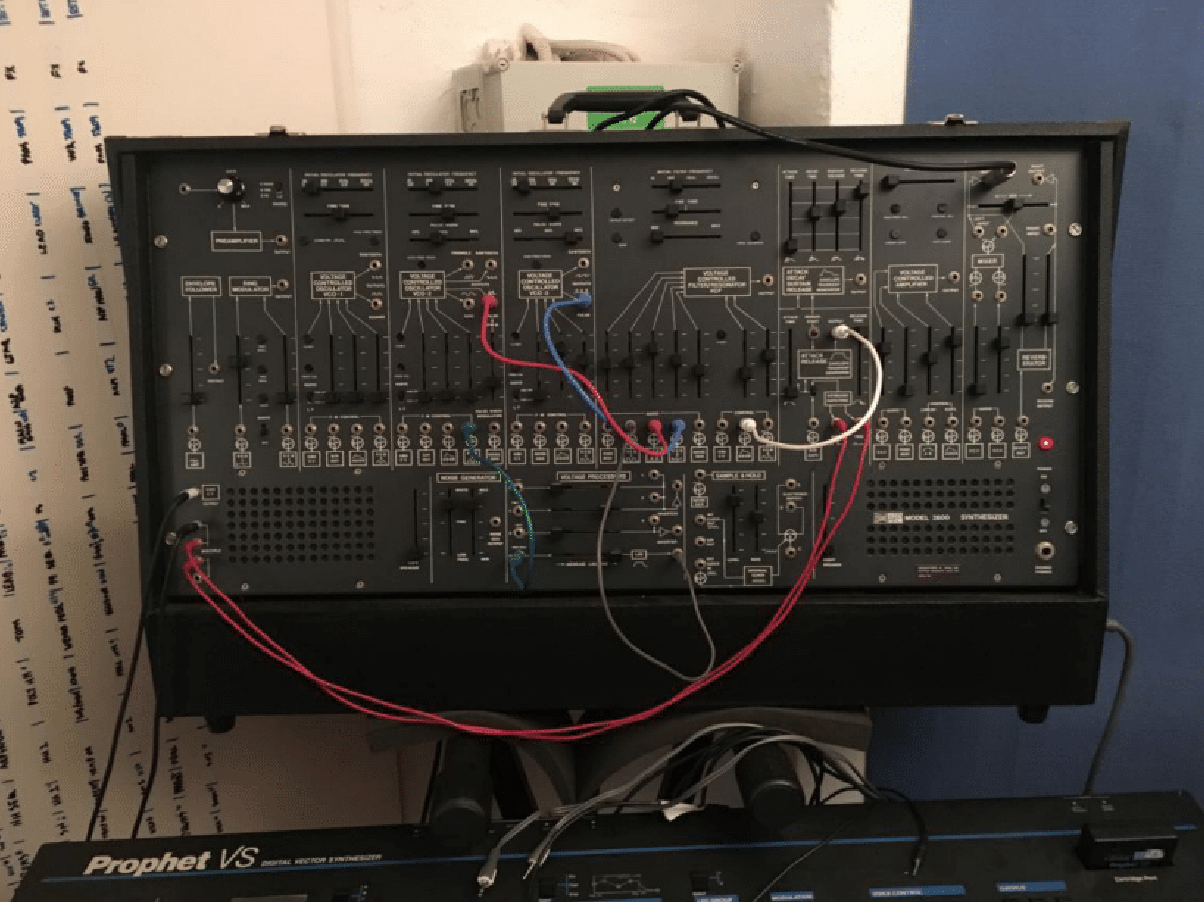
ARP 2600
I was lucky enough to get this really cheap a while back in an eBay Auction with no other bidders. I’d say that I use this a lot. I’ve made lots of tracks with it: the bass from “Autora,” the main sequence in “Notion of Dismay,” and the leads in “Flashback,” for example. This version is the Tonus model with an imitation of Robert Moog’s 4-pole “ladder” VCF (before the lawsuit from Moog). It has three oscillators, (almost) endless patching options, and a dual spring reverb tank.
Elektron Octatrack and Dave Smith Tempest
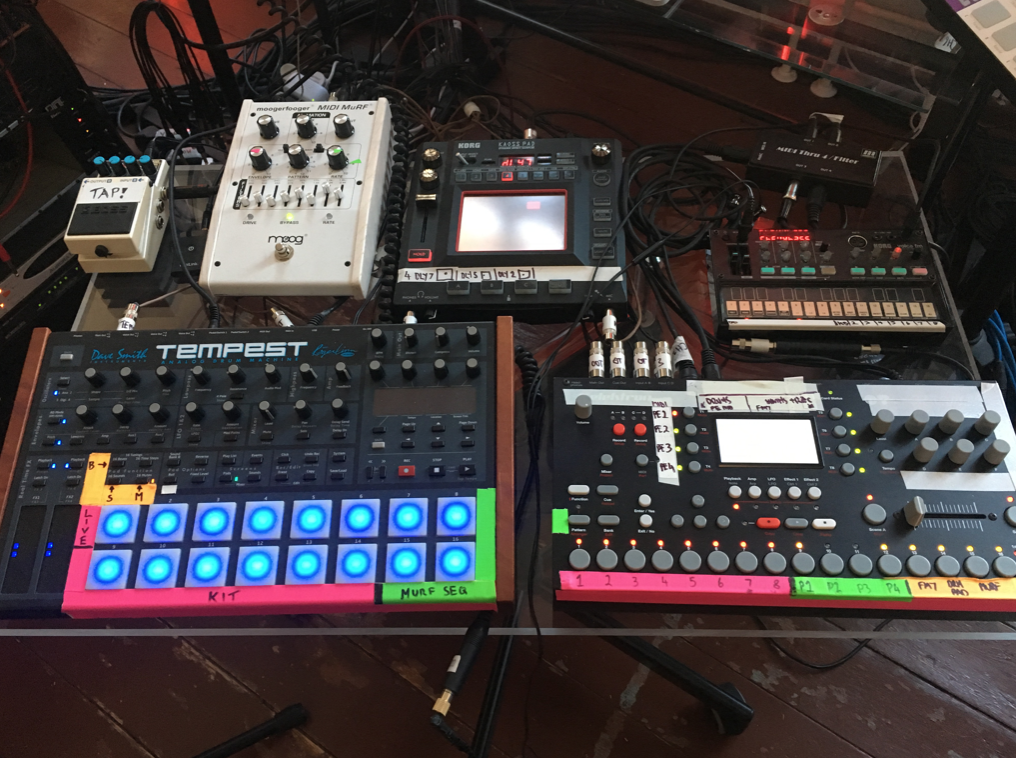
The Tempest is the main drum source for me. It really is much more than a drum machine though; it is a synthesizer at its core. You could create a whole song from it if you wanted. The recent updates have really taken it to its fullest potential with the onboard Arp and better programming functions. In tandem with the Octatrack, this is quite a powerful combination for studio and live performance, and is my main source of writing and jamming now. The Octatrack took a while to understand but now that I know its limitations and architecture, it really can create new, exciting ideas, which is what I’m always looking for.
Toft Audio Designs ATB 24
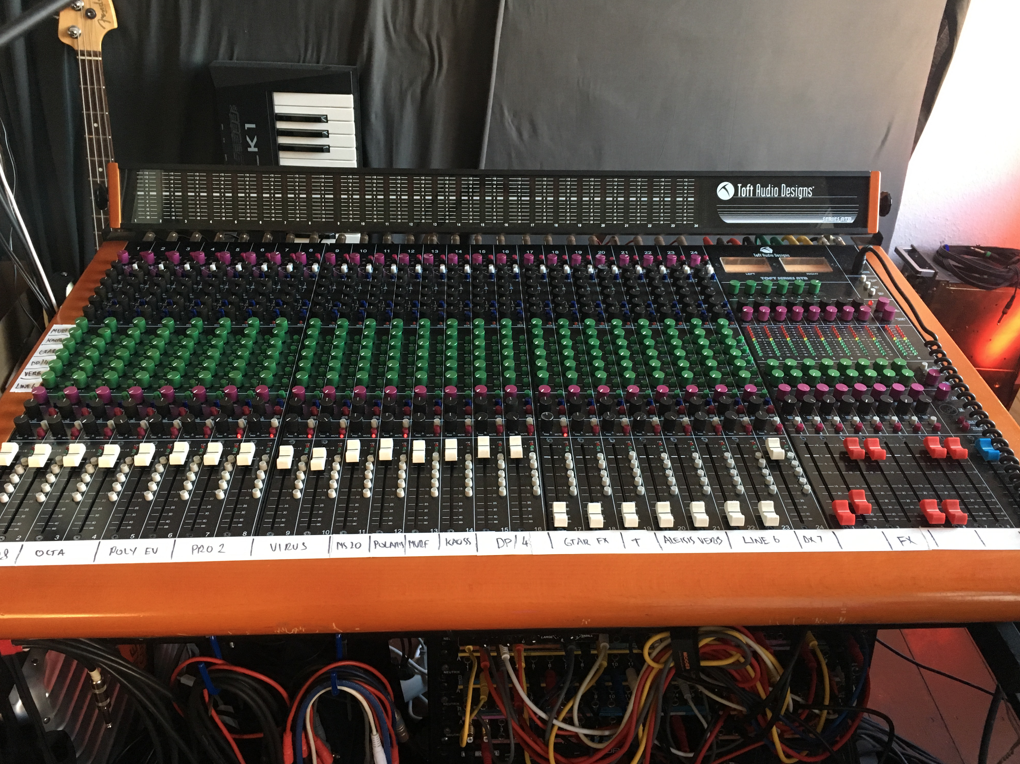
I’ve had this for about 10 or so years and again, it’s a big part of how I work as a songwriter, producer, and mix engineer. I generally jam live and multitrack so everything is going through this desk (or preamps to blend a sonic palate) before hitting my Lynx converters. This way I have a rough sketch of the track and all the parts as a multi-track. It’s a well-known desk now due to it being fully analog and a modern recreation of the original Trident (which my studio partner, Cosmo Vitelli, has). I’ve found it doesn’t exactly respond to how older analog desks would—for example, it doesn’t sound that great if you drive the Toft, as I feel the master starts to break up, especially in the low frequencies. Mixing at moderate levels and gain staging right gets it sounding great. The entire Autora EP was mixed on the Toft.
ZONE
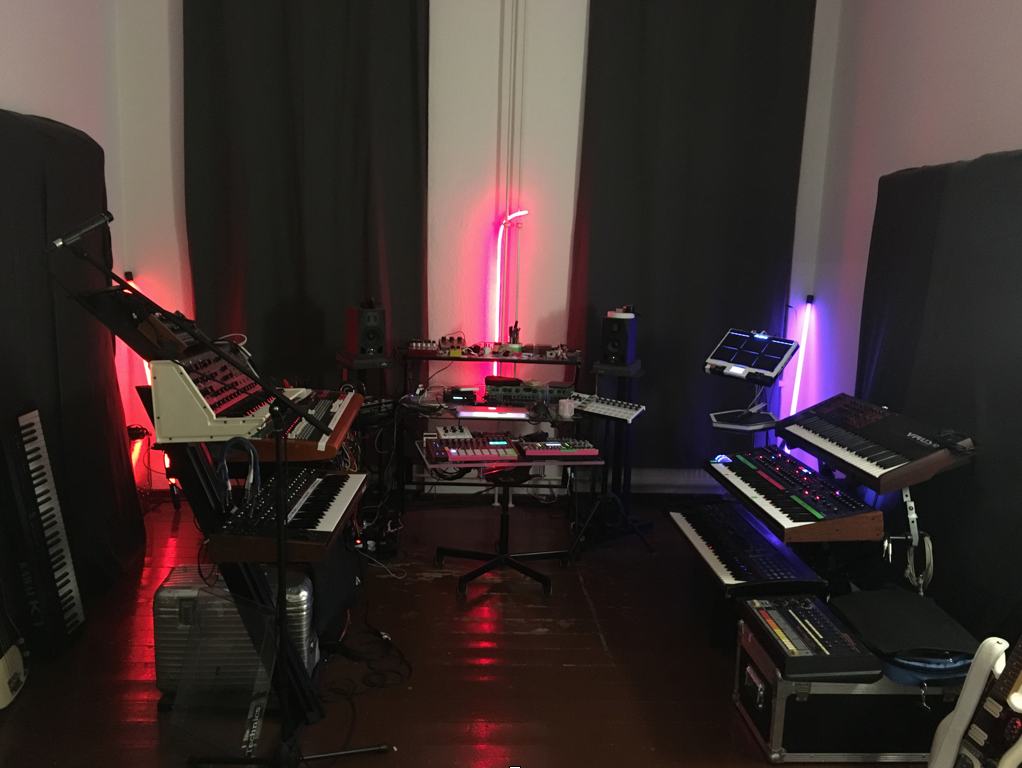
Being in an environment you can feed off visually really improves my productivity and general direction and inspirations. So, most of the compositions and ideas I have start here in this room.
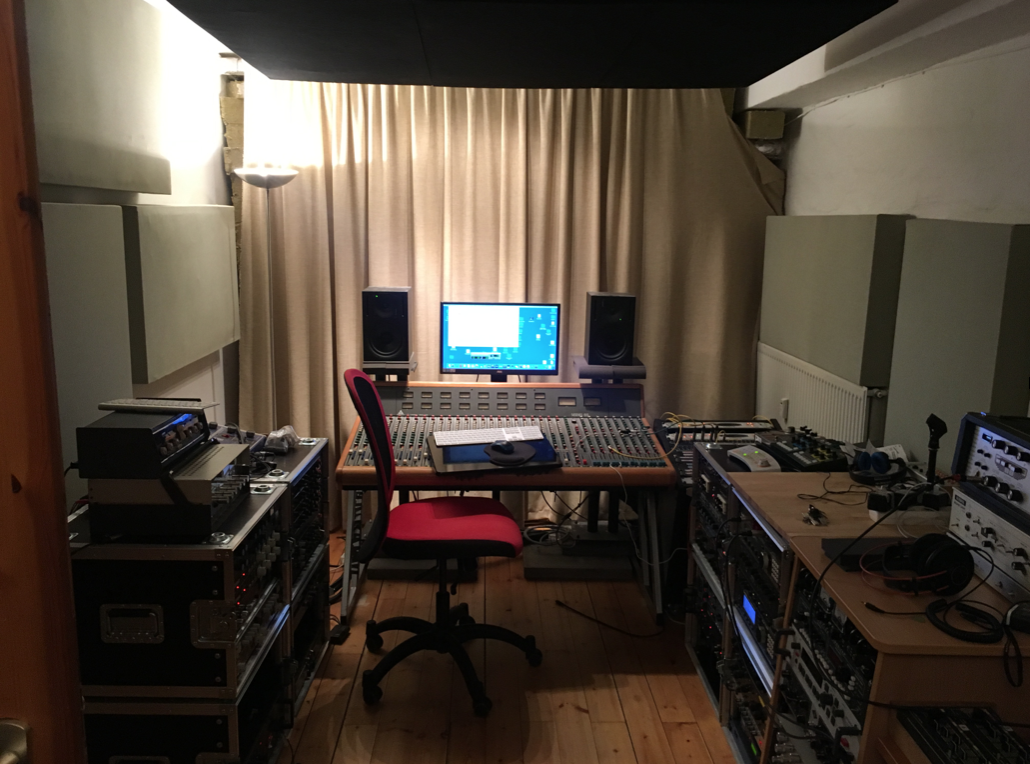
Everything is then finished up and mixed down the road at my studio I share with Cosmo Vitelli, which you can see above.
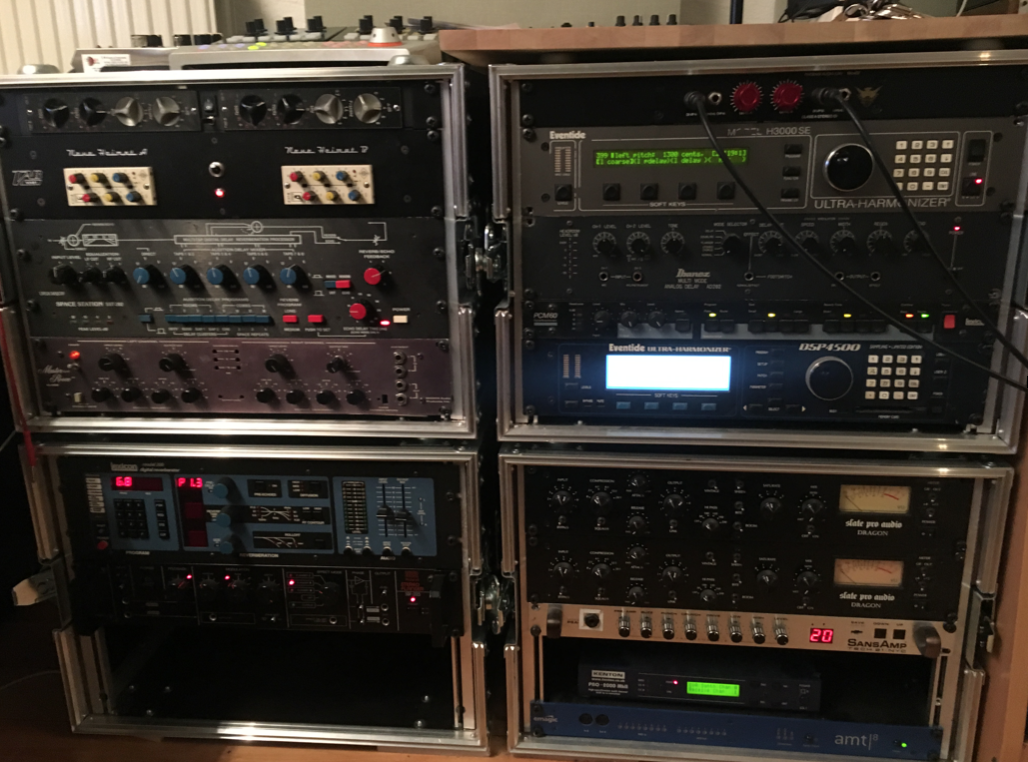
Outboard – H3000, LEX 200, and Preamps
I love effects, so the H3000 is generally featured on everything I do, as well as the LEX 200 Inverse Reverb.
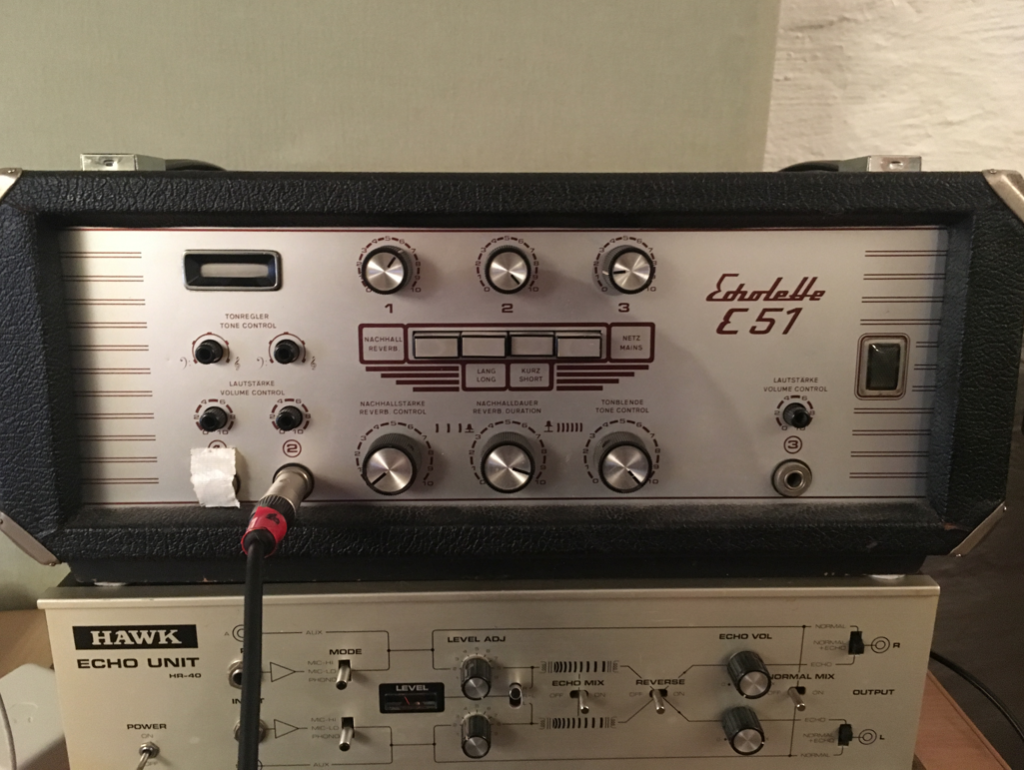
Echolette E51
Although these units sound way dirtier than Roland’s RE-201 Space Echo, and probably closer to the Watkins Copicat, I think the E51 is way more versatile. It has a three-head controllable tape machine with tube preamps in and out and delay bypass. I used it a lot for “Notion of Dismay,” running my vocals through it for dub outs etc. It’s still a relatively cheap machine here in Germany given its pre-Dynacord history.
Lastly
All that being said, I need to stress: you don’t need any of the above pieces to make great music. For me, this is what has helped me get out what I want to express and what I have found myself feeling comfortable with. I have bought and sold a lot of gear throughout the years, and I think once you are achieving results you never thought were possible with your setup (whatever it is) then you shouldn’t mess around with it too much until you are ready to push yourself to another tier sonically and musically.
Over the last few years, since first collaborating as Sergie Rezza in 2015, DJ Deep and Roman Poncet have continued a fruitful partnership that has seen them explore techno, house, micro-house, and more as Adventice, Fang, DeepTraum, and Slang. Sergie Rezza, however, is their most esoteric and experimental guise, operating in a hard-to-define space that fuses dub, ambient, bass, and techno into a mesmerizing concoction of electronics. Their new EP presents four cuts in this vein, from the shimmering synths on “Calé” to the soaring chords on closing cut, “Dacalé.”
In support of the forthcoming release, the duo have shared a mind-bending video for dubbed-out cut “Treehouse,” available to stream via the player above.
Golán is the alter ego of German artist Laurens A. Schmidt, who has been pursuing a more club-focused techno project while developing an ever deeper fascination with experimental music, ambient, and film scores. Drawing influence from his adopted homes Berlin and currently London, the 26-year-old has been “uncompromisingly trying to develop his own musical voice,” he explains.
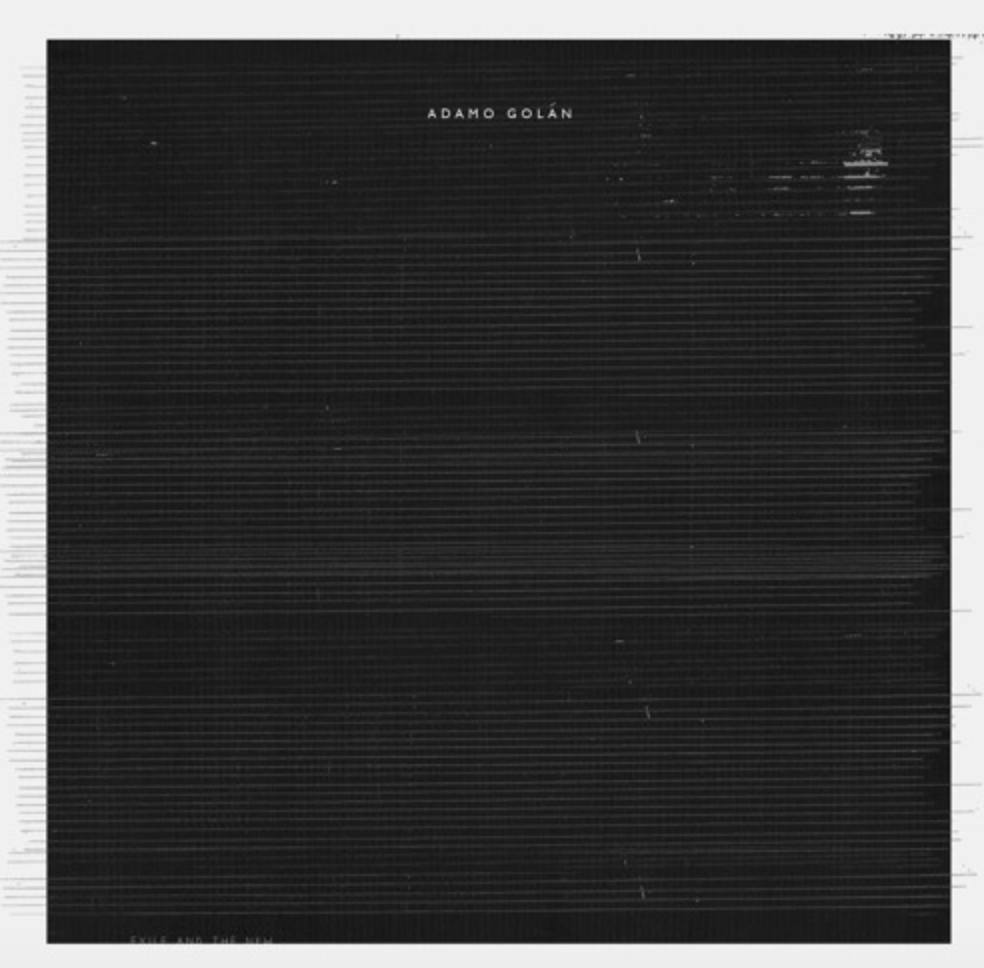
Exile And The New is said to “express this ongoing pursuit” and, being the first full-length and first ever release by Adamo Golán, marks the start of his most personal project to-date. We’re told that it “touches upon a diverse set of sceneries, moods, and emotions whilst a distinctive sound design gives the work a subtle framework and guiding thread.”
Tracklisting
A1. Fis A2. Just Friends A3. Replica B1. Exile And The New B2. Lie To Me B3. … Then Rely On Me B4. The Hungry Years
Exile And The New LP will land on April 27, with “Lie To Me” streaming in full below.