It would be fair to say that Travis Stewart is an XLR8R favorite. Just do a quick search on XLR8R for any one of his monikers—Machinedrum, Sepalcure (alongside Braille), or JETS (alongside Jimmy Edgar), to name just a few—and a multitude of results will pop up; from news posts to premieres, podcasts, and features. You could chalk this down to XLR8R and Stewart sharing a love and dedication to emerging sounds and styles with a forward-thinking ethos, or it could simply be that the music he creates resonates with our staff and readers.
Across these many monikers and the countless releases they’ve spawned, you’ll find everything from jarred footwork to shimmering house, bass-heavy hip-hop, and absolutely everything in between; but it’s via his work as Machinedrum, however, that we are arguably gifted his most stunning and singular pieces. Take Vapor City, for example, an album built from a collection of recurring dreams of a vivid metropolis known as Vapor City—just that concept alone spawned two albums, a handful of EPs, and a mind-bending live show complete with a live drummer. Vapor City‘s predecessor, Room(s), was also a groundbreaking milestone that put his name firmly at the top of the electronic music pile—it also received a perfect 5/5 on Resident Advisor.
Just one glance at his sprawling discography would make even the most competent of workhorses feel lazy. Stewart’s work rate and consistency in the studio is almost unparalleled, so XLR8R dialed up the man behind the monikers to give us seven detailed tips on studio efficiency.
Machinedrum will be performing alongside Stephan Bodzin, Ivy Lab, Fakear, Sam Gellaitry, tINI, Leon Vynehall, Guy J, Monolink, and Julia Gover at Lightning In A Bottle Festival, which takes place May 24-29 in Bradley, CA. You can grab tickets to LIB here.
Routine
When you are working with crazy short deadlines, it’s good to be as efficient with your time as possible. As much as I’d love to instantly be in the zone when I get in the studio it doesn’t always work out that way. One huge thing that I have learned is to have a daily routine that I follow. It doesn’t have to be strict but it does help to at least start your day the same way before even setting foot in the studio.
Try to start your day by waking up thankful for your life and everyone in it. I know this sounds silly but it really does help you get out on the right side of the bed. I start by being thankful I can breathe, see, hear, smell, walk, and talk. This grows from basic human functions that we take for granted to gratitude for my family, friends, health, home, and things that I have worked hard to earn. The worst habit to have when you wake up is to check your phone, get on social media, or read the news. Allow yourself to be the real you before jumping into the “real” world.
After waking up grateful I like to sit outside, weather permitting, and meditate. This can range from a full 15-30 minute meditation to a quick 3-5 minute breathing exercise in the sun—if meditating isn’t your thing you can read a book. The point is to stay away from your phone, computer, and TV until you’ve fully allowed yourself to wake up and get your mind in a peaceful place. After meditating, I like to enjoy a coffee and small breakfast, again preferably outside. Once I’ve gone through these simple steps, I will allow myself a good hour or so to check emails if necessary, just so I don’t have anything looming over me when it’s time to get to work. If you have the luxury of having a manager or assistant, or if your work isn’t based online, it’s good to just skip the email and internet part altogether and get straight into the studio. The world can wait for you most of the time, it’s best not to cloud your mind with too much noise before getting to work.
Environment
Having a tidy, vibey, and intuitive work environment is key to efficient work—if your studio is messy and chaotic, your work will reflect it. Start off by simply cleaning everything: get rid of clutter, dust off everything, wipe your screens down, take out the trash, and vacuum if you haven’t done that in a while. Now take a look around your studio. Do you have synths piled on synths that you haven’t used in months? If you don’t plan on using it today, get it out of the way. Find a good place to store all your equipment that doesn’t get used so it’s not in your face. I know it looks pretty and impresses your friends when they come over but we are trying to get some real work done here!
Having a more minimal setup will help the ideas flow more easily. This, of course, depends on your process, some people love jamming out on 10 pieces of synced gear to write tracks. However, most of the time, half of the synths and gadgets in a studio go unused for months or years at a time.
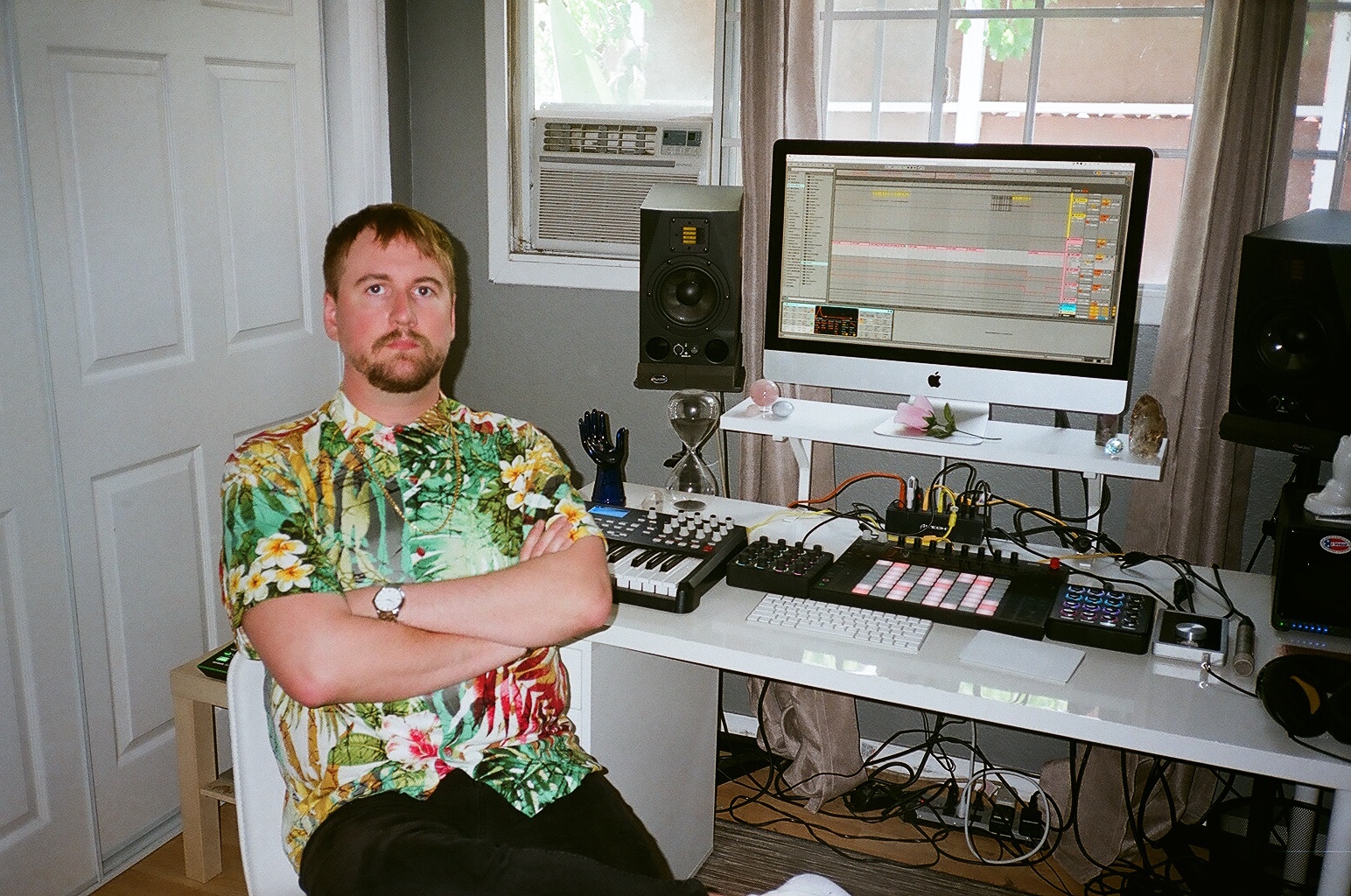
Once you have all your necessary tools laid out in front of you, it’s time to create a vibe. Get some cool lighting, I have a couple of the Phillips HUE bulbs in my studio that I can change the brightness and color straight from my phone creating instant vibes. Throw some meaningful items that inspire you on the walls and empty spaces where there is no equipment—without adding more clutter, of course. I have a picture of my wife and cats, some plants, some activated crystals, an hour glass, and a small altar with palo santo and sage like a true Californian. My wife framed my album covers and I’ve put those up in the studio to help motivate me. It’s easy to forget what you have accomplished and there is no shame in reminding yourself daily. These kinds of things make the studio space less cold and more inviting.
After cleaning and creating a vibe, it’s good to make sure you have an intuitive setup. For a lot of people this means having all your gear efficiently routed through whatever mixer you have and all your patches set up correctly so that you can start getting creative without having to stop in the middle of an idea so you can get an fx rack working or figure out why MIDI isn’t syncing with a synth etc. I personally don’t use a lot of outboard gear and do most of my producing on the computer in a DAW. I do a version of this “intuitive set up” by making a template in my DAW of choice, Ableton Live. That way, every time I start a new session, I have all my usual go to tools at my fingertips.
This template has all the drum, synth, vocal, and fx channels grouped with certain go to VST-I’s and other plugins already open and ready to go. For example, my kick group will have one channel already preloaded with a simple Max for Live kick-drum synth. The next channel in that group will be an empty MIDI channel that is getting its input signal from the Max for Live Kick channel. I can later add another kick sample to this channel. The idea is to have everything ready to go so you can get out rhythmic and melodic ideas as soon as they come to you instead of spending that precious time finding the “perfect” sample or patch. I also have the inputs in each group assigned to their respective inputs on my audio interface so that when I do want to use gear or record guitar it’s ready to go.
Play Time
Once you’ve gone through your morning routine and have made sure your studio is ready to go, it’s play time. If you’ve done your best to clear your mind, prepare your studio, and not distract yourself from the task at hand, it is much easier to get inspired. That being said, inspiration still doesn’t always come easily. Let’s say you have a two-day deadline to write a brand new song from scratch. You may be thinking, “I’ve just spent the past three hours being grateful, meditating, eating, cleaning, and setting up my studio. How does this get me closer to my goal?” It may seem like wasted time but trust me, it’s all worth it to make sure you get in the right headspace to do the best work you can do.
What is play time? This is where your work must start and you must start by having fun. Don’t think about the looming deadline or how much work you have ahead of you. If you’re not having fun then you’re doing it wrong. Start out by playing your instrument, the instrument you feel most comfortable with. I love starting off playing chord progressions on my fully weighted 88 key MIDI controller with just a simple piano patch. I’ll usually record as soon as I start playing, even if I don’t end up using any of it. You never know what’s going to happen, so it’s good to just leave it recording so you don’t miss anything.
After playing your instrument for a few minutes, you’ll start to activate your creative brain and this is when the fun really starts to happen. I usually have an 8 to 16 bar loop going and just start adding elements. I keep doing this without thinking about it too hard. Don’t spend time deciding what your synth patch is gonna sound like or why the clap doesn’t sound cool, just treat the moment like a dream that you’re witnessing play out in real time. If you don’t milk the moment for what it’s worth you’ll find yourself two or three hours into a session with just a drum beat and maybe a bassline if you’re lucky. Sure that beat might sound dope and the bass line face melting *cringe* but where do you go from there? You’ll find yourself and your ears exhausted and nothing more than a cool beat to claim. I consider a good sketch to be a solid 8 to 16 bar loop where I can mute and un-mute tracks as the loop is playing and have a decent amount of material to work with so I can start my arrangement.
Spend your time getting the sketch of what the song is meant to be as quickly as you can so that your original idea doesn’t fade. Think of it like you’re a painter sitting by a river and a beautiful ship is passing by. You want to capture it but it’s passing by so quickly. Instead of focusing on the people on the ship, the windows, the deck furniture, the color of the flags, and other small details, it’s probably better for you to get a good outline and sketch of the size of the ship and its larger features first. That way when the ship has passed you can start filling in the details later.
Break Time
Once you’ve got a good sketch going, it’s time to take a break. Taking breaks and stepping away from your work is essential to getting the best results. If you spend hours sitting there listening to the same loop over and over, chances are that you are probably going to burn out on the track quickly and it will result in an overworked sounding track. One way I remind myself to take breaks is by turning over my hourglass when I’ve started working. Yes, you can easily just set a timer on your computer or phone, but the aesthetic of seeing the sands of time falling somehow adds to the momentum of my process.
Your first break doesn’t have to be long, it can be anywhere from 5-15 minutes, just long enough to step out of the studio and do something different. You could eat a snack, check your email, read a book, take a walk, or anything else that makes you get out of the studio and stop thinking about the song for a moment. Eventually, you’ll need to take a longer break. I recommend doing something physical like running or walking so that you can get your blood flowing before getting back to work.
The main point of taking breaks is to give your ears and brain a rest. Chances are once you get back to work you’ll be more aware of things that need to be changed or even left alone. For example, let’s say there was one part of your track that was bothering you, a synth that was too loud or a part of the arrangement that felt too empty. Many times when you walk away from the track for a few minutes and come back to it, you’ll forget whatever was bothering you in the first place. Alternately, walking away from your track for a moment and coming back to it will reveal things that stick out like sore thumbs that you didn’t notice before.
Get Detailed
After you have a good sketch going and you’ve stepped away from your work for a short moment, it’s time to get detailed. Normally, what I do is take that loop that I’ve been working on and duplicate it multiple times. Now I’ve got two to three minutes of the same loop in front of me. This is where the arrangement starts. Think of it like a sculpture: you start off with a huge block and you need to chip away at it to make sure the whole thing takes its true form.
You don’t necessarily have to start off working on the arrangement sequentially. Instead of starting with the intro, you could work on the first “verse” or “main” section of the track. Figure out which parts of your loop need to stay in this section and which ones can go. Maybe that cool synth part you made doesn’t need to come in until later in the song. Play around with the parts of the song and keep chipping away as much as you can. As you listen back to your working arrangement you’ll notice certain parts go on for too long, or not long enough. Some parts may come in too abruptly and others don’t come in quick enough. Keep listening back to the whole arrangement as much as you can, changing things as soon as you hear things that stick out.
Once you have a decent arrangement going and feel like the track is starting to tell a story, the next step is to start focusing on smaller details. This is where you can feel free to swap out samples for better ones, tweak synth patches so they sound more interesting and evolving, get deeper into the mixing and EQing, add transitional moments between sections, and other more detailed production techniques like DSP or micro-editing.
Take Notes
When you feel like you’ve got your track nearly to the finish line it’s time again for another break. Once you’ve stepped away from the track for a few minutes to an hour, it’s time to take notes. I like to use Evernote because it saves my notes on all my devices. This comes in handy later when I’m listening to the track in the car or on my headphones while walking so I can just add to the notes wherever I’m at. Whatever your preferred method of note taking is, have it ready to go and start listening to the track from the top.
Try your hardest to not stop the track while it’s playing to change something—just write it all down. Don’t worry about writing out a detailed note, just write something short enough that when you read it later you’ll know what you meant. For example, if there’s something strange going on in your mix around bar 65 during the breakdown and before the 2nd verse, write down “65 breakdown needs work.” Other note examples could be “37 hi-hats up,” “133 bring in strings,” or “vox too loud overall.”
It’s good to listen back to the track one or two more times and double check that your notes are still valid and make sure you didn’t miss anything else. Now that you have a decent amount of things to work on, it’s good to start with the toughest note first. Don’t start with the smaller things first otherwise you may be burnt out by the time you get started on the more difficult changes that need to be made, it’s easier to tackle the smaller things at these times.
Once you’ve dealt with all the notes and you feel like your track doesn’t need any more changes, it’s a good time to bounce the track and start listening to it on different mediums. Listen to it in your car, your friend’s car, your home stereo, laptop speakers, earbuds, and any other sound sources you have access to and take notes of things that stick out on the different mediums. If something sticks out on your laptop speakers but sounds great on all the other mediums, write down in your notes “Laptop: snare too loud.”
Approach your mix again with all these new notes with a grain of salt. Don’t tailor your mix to only sound good on one medium. It’s very difficult sometimes to get a track sounding consistent on all mediums so just try to find a happy balance between the mediums without overworking the track.
Educate and Practice
When you don’t have a crazy deadline and have some free time to work in the studio but can’t seem to find inspiration, it’s a good idea to educate yourself and practice. I love watching tutorials on multiple subjects such as mixing techniques, plugins, and songwriting. I also enjoy watching interviews with producers and composers that I respect highly—there’s also a bunch of books out there that are also quite inspiring. I love reading about the history of certain genres of music to help give me perspective on what I do. After over 20 years of producing and writing music, I still find vast amounts of inspiration through learning.
In addition to learning as much as I can about what I love, it’s essential to practice. If you feel you’re not as efficient as you could be on guitar, for example, try practicing scales or learning new chord progressions. Even if you’re an electronic music producer, it’s very easy to find inspiration in acoustic instruments. A great song should still be great in it’s simplest form. You should be able to strip away all those fancy production elements to reveal a strong and memorable song at its core. This, of course, is different for certain genres like techno or other club music where it’s more about dancefloor function than songwriting strength. Personally, I think a great club track can simultaneously live in both of these worlds of songwriting and dancefloor functionality.
Hopefully, all of these steps will help you get your ideas out quicker and more efficiently. There will still be those days where no matter what you do you’ll still struggle to find that inspiring moment. When those days come it is your responsibility to stay positive, healthy, organized, rested, and constantly learning as much as you can. That way when the inspiration does come you know what to do with it.