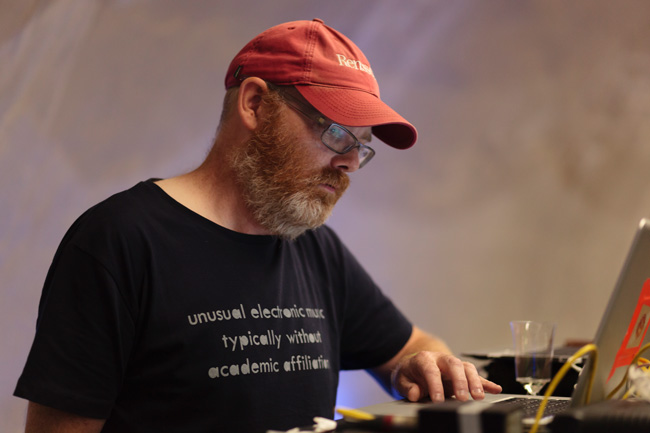
Mark Fell is much more than an electronic musician. Wander over to his artist home page and you’ll discover information on his writing, exhibitions/installations and several other things too—but it is his discography that is the most impressive. The Sheffield-based artist is perhaps best known for his work alongside Mat Steel as SND, a duo with a production catalog that boasts releases on Raster-Noton and Mille Plateaux, to name just a few. Add to that his work as a solo artist (including his Senate Focus Project that was founded in 2012) and other collaborative projects, all of which started in the late ’90s, and you have a lengthy and continually growing discography that takes some beating, one that already includes multiple full-lengths, 12″s, 7″s, remixes and mini-LPs. In 2009/2010 alone he released no less than four studio albums.
Indeed, given the importance of experience in producing your best work, it is difficult to think of too many producers who are better positioned to advise on finding your form in the studio. With this in mind, XLR8R asked Fell to sit down and delve into his wealth of knowledge to share his thoughts on what really works and what doesn’t when it comes to production. This is what he had to say.
“It’s good to be fixated by technology—and I clearly am. But that fixation should be in terms of how it behaves, not what it looks like on the shelf or how much you paid for it.”
Don’t worry about what technology you need. Use what you have
Don’t get hung up on trying to create the perfect studio environment—there isn’t one. I have known so many people who get fixated on what equipment they need or want, instead of using what they have. I also know people who spend more time perpetually rebuilding their studio rather than actually using it to make music. This is fine, of course, but I personally resist that habit.
Instead, my methodology is to focus on one or two specific bits of equipment and to explore them in detail. For any given project I usually assemble a collection of equipment and processes, and explore how they behave and interact. Rather than a universally perfect and utterly flexible studio setup, I opt for weird and peculiar.
Likewise, don’t worry about how good or bad your speakers are. I made my first few albums on a pair of second-hand bottom-of-the-range hi fi speakers that should really have been thrown away years before I acquired them. They cost me just £30 for the pair and I was massively overcharged by a desperate so-called friend. Over the years most listeners wrongly assumed that those early pieces had been made on expensive monitors, perhaps in some research institute. But the opposite was true: these tracks were made on crap speakers in the spare room of a social housing project, in a small town in the North of England. It’s comforting to know that a piece of work which won acclaim at ARS Electronica was made with such meagre resources, compared to several other submissions produced in some of the world’s most highly funded research centres.
Even these days I use a pair of reasonably cheap studio monitors or old hi fi speakers. In my experience, if you get your work sounding good in your studio, whatever the speakers are, a skilful mastering engineer will be able to make the final thing sound good too. So, basically, don’t become an equipment snob; use what you have. It’s good to be fixated by technology—and I clearly am. But that fixation should be in terms of how it behaves not what it looks like on the shelf or how much you paid for it.
“If a piece of music is not working, simply adding more and more components will not rescue it. Instead, I find it helps to be selective and subtractive, and to keep things as simple as possible.”
Be subtractive
I would advise against adding more and more elements to the equation—whether it’s technical (in terms of the studio) or aesthetic (in terms of the music). If a piece of music is not working, simply adding more and more components will not rescue it. Instead, I find it helps to be selective and subtractive, and to keep things as simple as possible. Obviously that’s my preferred way of working and leads to the kind of music I like, so it’s not going to suit everyone. But it’s amazing how little you need—equipment, processes, time, money, even musical materials themselves—to make a piece of music. I’m not sure if the urban myth that A Guy Called Gerald made “Voodoo Ray” while working at McDonald’s is true. But then again the tortoise didn’t actually beat the hare. The fact that they never ever raced is sort of inconsequential in most contexts.
Work hard…but not too hard
When I first started making electronic music it was fun, and massively better than almost anything else. I found playing around with synthesizers easy, enjoyable and mesmerizing. It was almost meditative. But as I pursued a career in electronic music production, I have unfortunately come to the conclusion that making music is actually very hard work; it is difficult, frustrating, exhausting, time consuming and definitely not fun!
For me there is a fun side to it: for example, I still enjoy messing around on a synthesizer or building max patches, and I can easily spend the whole night doing this. But this pleasurable side is almost totally outweighed by the difficulty of actually making work. My advice is this: face up to the fact that music making is mentally and physically demanding; it’s hard, not fun, and probably unhealthy. Because of this I recommend taking lots of breaks, doing housework, walking to the shops, eating good food and so on. Also, I find that it helps if I listen at a relatively quiet level, and to listen carefully. Your ears, like anything else, get tired if you use them too much.
“…a clear idea is only any use as a starting point; it is never a destination. It is what you uncover in the process of making a piece of music that makes it interesting. “
If you have a plan, don’t stick to it
For me making music fits into two different kinds of process: the first is wandering around and exploring; the second is making a route map for people to follow you on that journey (i.e. making a piece of music out of the things you have encountered).
Sometimes I start with a clear idea of where I want to go ( i.e. the kind of thing I want to make). And often this is a copy of a collection of things that I have heard elsewhere. But don’t get worried about not having a clear idea—and also don’t get worried if all you are doing is simply copying things. For me the way that descriptions of creative practices overemphasize things called “ideas” is really unhelpful; some of the best music has been made by people who had no ideas at all.
In my experience, a clear idea is only any use as a starting point; it is never a destination. It is what you uncover in the process of making a piece of music that makes it interesting. Often, in the process of making work it’s likely that you come up with something quite familiar, and for the music producer (as well as audiences), this can have an instant appeal.
A good example is an analog step sequencer triggering a synthesizer with variable filter cutoff with some form of synchronized delay. Let’s admit it: we have all done it, and probably enjoyed it. But for me the instant appeal of the familiar is perhaps less engaging than the ambivalent relationship to unfamiliar musical structures. So, I have this awareness that the familiar has a sort of gravitational pull which I try to avoid; instead, I try to be sensitive to the unfamiliar structures that I encounter while working with technologies and processes. I don’t think this is anything unique to what people call “experimental” music (I hate that term by the way). I hear this attitude of the unfamiliar in lots of “popular” musics, for example hip hop, footwork, and in the work of the many producers that I admire. A great example is “Acid Tracks” by Phuture: that particular usage of the TB303 to create such an odd asymmetrical pattern was quite unusual at the time. Furthermore, Phuture have made it clear that this type of musical structure wasn’t what they were aiming to do at all.
Don’t try to make a masterpiece
When I first started making music I thought that tracks had to be complicated with lots of different ingredients, levels of energy and sections. It took me a while to realize this was a problem. I remember spending about a year on one track that just kept getting worse and worse. My approach now is to make lots of related tracks that explore the same materials and processes, but each is a different outcome or combination of those materials and processes.
As someone who grew up (musically speaking) with techno (music), I think this is a very techno approach. For example, a 12” single that contains four related versions of the same thing. By this I don’t mean a 12” that contains the deep house mix, the psych-trance mix, the jungle mix; I mean a 12” that contains different versions of the same thing—different sketches of the same object. Around the mid-1990’s , Thomas Brinkmann, Mike Ink or the label Basic Channel seemed to encapsulate this methodology.
“In effect, your role becomes one of organizing bits of information in a grid like space, where you can see the beginning, middle and end, and all the layers running alongside one another. For me this way of thinking about music, interacting with it, engaging with it, was completely dead.”
Use the force
The ubiquity of the time line environment has been a big problem for me. Here I’m talking about the likes of Logic and Cubase that came about towards the end of the 1980s. At that time, the affordability of the Atari ST computer meant that such tools were within the reach of many non-professionals. This led to a proliferation of programming suites (a new term back then) and independent studios.
At that time, we (I mean me and most other small studios in Sheffield) all believed that this paradigm provided a sort of infinitely flexible way of working—a centralized computer controlling lots of modules with MIDI. But we were wrong.
Actually this system structures how you make music in a very specific sort of way, and it’s so present that it is almost invisible. This alone is not necessarily a problem, but for me I found that I simply could not make any kind of decent music using time line environments. With the benefit of several years hindsight, I think the problem is (and was) how those timeline systems structure time—how they position you as a composer outside the music. In effect, your role becomes one of organizing bits of information in a grid like space, where you can see the beginning, middle and end, and all the layers running alongside one another.
For me this way of thinking about music, interacting with it, engaging with it, was completely dead. And the music I made in it was also completely dead. By contrast, these days there are computer-based systems that don’t use the time line: the most famous example is the MAX programming environment. Also the proliferation of stand alone modules, synthesizers, effects units, pattern generating modules and so on give electronic musicians lots of alternatives to the very traditional score-based approach of the time line. If you are using a screen, turn it off and reach out with different forms of cognition (I’m not going to say feelings because I don’t buy into the head/heart dichotomy).
Find friends and mentors
Find some people you can trust and ask their advice lots about everything you do. Community is important, and like any other profession some form of peer support can be very helpful.
There’s no place like home
Don’t move to London or Berlin to further your career. It might work but it’s not worth it.
Be aware that the music industry is as corrupt and annoying as any other
As someone who makes “experimental” music but comes from a club music background, I often encounter prejudices about my history. For example, people often say that club music is just a functional device that exists to enable people to dance or have fun and socially interact, compared to something like contemporary classical music which is thought to have a more complex relationship to the listener.
I often find that the word “experimental” is used to divide the popular from the serious. But in my opinion, all music is “experimental.” For example, I think that Motown or hip hop are as innovative as anything coming from a research institute or music conservatoire. To paraphrase Martin Luther King Jr: “I hold these truths to be self-evident, that all music is created equal and equally creative.” But I don’t come across many online resources that give classical composers five or six tips for creating successful orchestral compositions. This isn’t because orchestral music is any more or less complex than club music; it is because the industry surrounding orchestral composition sells itself on the belief that classical music offers something of higher value—it penetrates the soul rather than the body; it is deeper in terms of its meaning rather than frequency content.
Of course this distinction is stupid, but unfortunately it exists. Working in the music industry has made me aware that one of its primary functions is to enforce ideas about aesthetic and thus social segregation, and to keep people in their culturally assigned boxes. Here I am remembering Nina Simone’s relative exclusion from a predominantly white classical music circuit in North America, or Stevie Wonder’s later, but equally controversial, exclusion from IRCAM (the Vatican City of electroacoustic music orthodoxy) on the grounds of his musical heritage.
The underlying narrative is that club music is crass and for chavs, while classical music is sublime and for the educated middle classes. Your task is to survive in this box without turning into a suicide bomber. Despite this, one should never forget that house music happened so that people could come together in an environment of safety, acceptance and mutual respect, under a banner of love, not of hate. So my final tip is this: VIOLENCE IS NEVER THE ANSWER.
__________
Mark Fell can be found playing at this year’s Terraforma Fesival just outside of Milan this weekend. More information can be found here.