Brussels-based producer Walrus presents his mysterious take on “Astre,” a track from Lawrence Le Doux. Both artists are key figures in the brussels underground electronic scene who have proven their worth on labels such as 9300 Records, Vlek Records, Thin Consolation, and Florklang Records. The track is taken from a recent release on Bepotel Records, which features four remixes by Walrus for a number of artists from Brussel’s underground scene.
His hazy remix is a stretched-out, deejay-friendly sonic carpet built around a staccato baseline and tropical percussion that breezes along without loosing the playfulness of Le Doux’s original. Real deep house with a lush swing.
You can download “Astre” (Walrus Remix) below via WeTransfer.
The latest signing to Radio Slave‘s UK-based label Rekids is South Korean artist Peggy Gou, delivering two quality grooves for her forthcoming EP, Art of War (II), accompanied by a remix from the L.I.E.S producer Terekke.
Art of War (II), which is set to drop on April 8, will be the Berlin-based Gou’s second EP for the label. Ahead of the release, Peggy Gou has graciously offered up the stimulating and trembling track “Jen High” as an XLR8R exclusive. You can stream the track in full below.
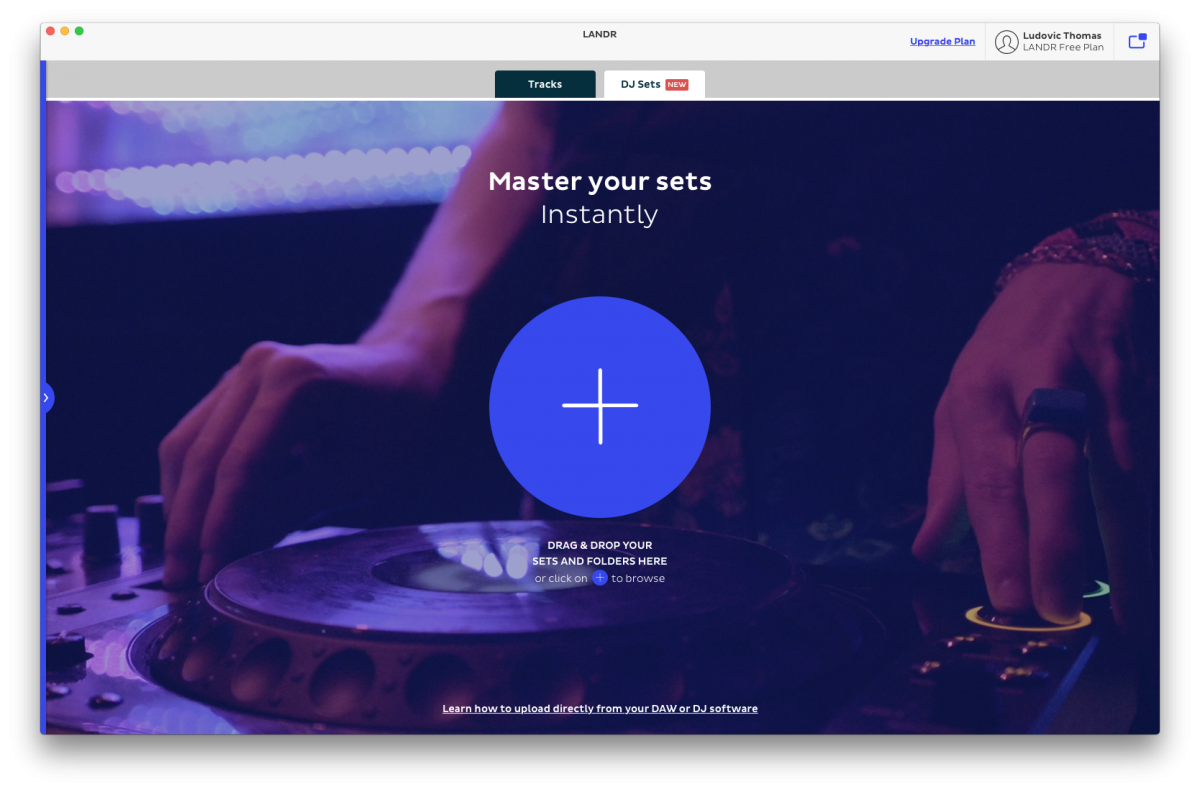
Cloud-based mastering service LANDR has just announced a new DJ-specific mastering engine.
The new extension will offer the same functionality as the existing platform, which includes metadata editing, DAW integration, file management, and cloud storage backup, but will also use a new algorithm designed specifically for mixes—which will reportedly optimize multiple tracks in a mix and enhance the overall sound while protecting the transitions, build ups, and breakdowns.
In addition to the announcement of the DJ engine, LANDR has also partnered with Native Instruments to make it possible to master the Stems format in the future.
You can test out the new DJ engine for free for two months by heading here.
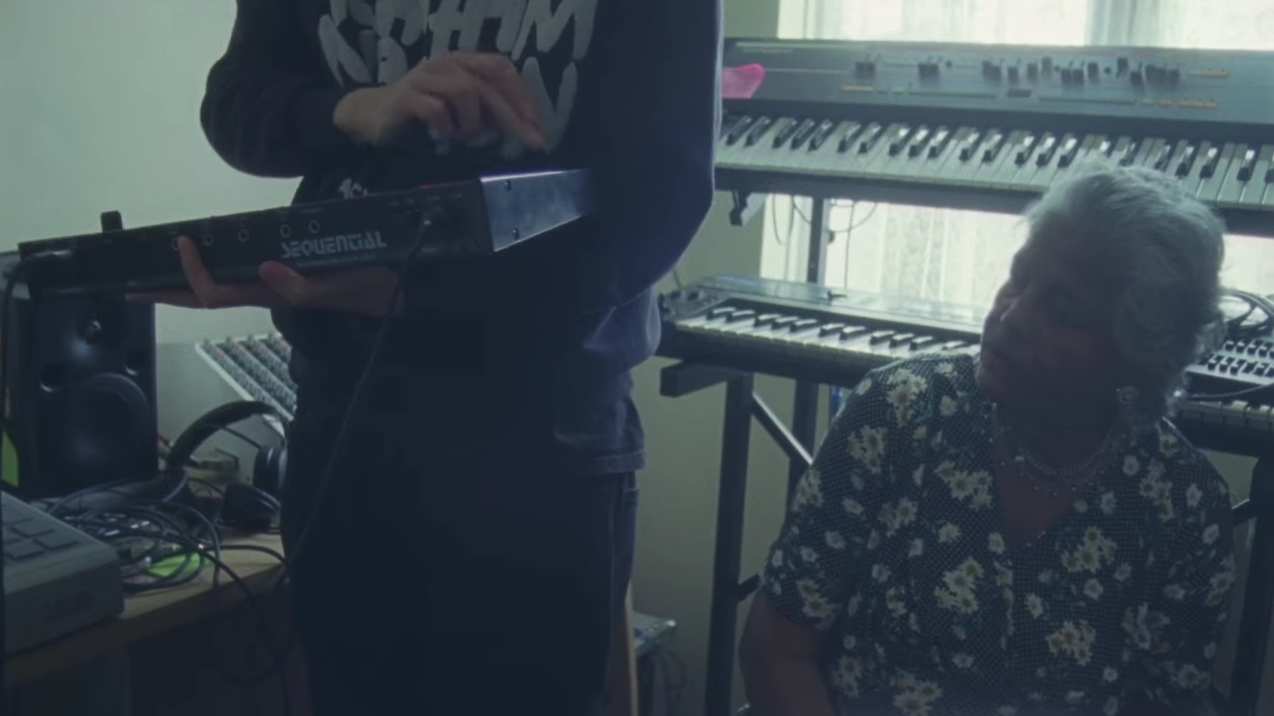
Following Gold Panda‘s announcement that he will be releasing his third full-length LP, Good Luck and Do Your Best, via City Slang on May 27, the globally cherished producer has shared his second LP cut today in the form of a music video. The intimate and personal video for the track “In My Car,” which stars the artist’s grandmother, was directed by Rob Brandon and filmed in Gold Panda’s hometown of Chelmsford in the UK.
In a statement, Gold Panda shed some light on the video:
“I asked Rob to just come and film us (my gran and I) being boring. But now, when I watch it back, it doesn’t seem mundane at all. It seems actually really nice and sweet. I was thinking about all this cool stuff we could do, slow-mo shots, what outfit I could wear, maybe an explosion and who could be in my crew. But real life is exciting enough; you just don’t see it when you’re in it.”
Following his immensely successful Half Of Where You Live LP on Ghostly International and a worldwide tour, Derwin Schlecker (a.k.a Gold Panda) and photographer Laura Lewis traveled to Japan with the intention of creating a sight and sound documentary. During their travels, Derwin had a sudden epiphany when a cabdriver in Hiroshima uttered the phrase “good luck and do your best” when dropping the pair off. The cabdrivers well wishes had given him a jumping off point for his music and set off a motion of events that inspired this internationally celebrated artist to create this warm, colorful, and highly anticipated release.
Check out Gold Panda’s tour schedule below.
Tour Dates Apr 1 – Norwich – Arts Centre May 19 – Rome – Spring Attitude Festival May 26 – Leeds – Brudenell Social Club May 28 – Amsterdam – Marktkantine May 30 – London – Tufnell Park Dome June 1 – New York – Bowery Ballroom June 2 – Los Angeles – Echoplex Juen 11 – London – Field Day Festival June 16 – Barcelona – Parc del Forum August 28 – Los Angeles – FYF
Grab some previously featured Gold Panda tracks on our downloads section:
Mick Wills and DJ Fett Burger have been enlisted to remix two cuts from Hunee‘s debut album from last year titled; Hunch Music. Hunee (a.k.a. Hun Choi,) is known to be an avid vinyl collector and was invited by Rush Hour to curate a retrospective of Soichi Terada‘s Far East Recordings, in early 2015. Both Hunch Music and Sounds From The Far East, were extremely well received, establishing Choi as a respected producer.
You can hear the two new cut previews on the player, below.
Tracklisting:
A Hunee – Hiding The Moon (Mick Wills Remix) B Hunee – Crossroads (DJ Fett Burger’s Boss Brian Computer Mix)
Hunch Music Remixes will land via Rush Hour in April 2016.
Romania’s electronic music scene has never attracted as much curiosity as it does in this day. It’s a well-documented story that we all know by now: Their Bucharest-centric bubble, characterized en masse by its minimal tendencies, slow-burning sets, and lengthy parties, was broken to an international audience by the Arpiar trio (Raresh, Rhadoo and Pedro) just over five years ago. With the passing of time, new faces have emerged, aided considerably by the publicity of that first wave who carved out a space in which the next generation could then begin to flourish.
One of those faces is Cristian-Ioan Munteanu (a.k.a. Cristi Cons), who has become something of a central figure in that more recent generation of musicians to emerge from Bucharest, alongside the likes of Dan Andrei, Cezar, Barac, and his partner in production Vlad Caia. Though his style is certainly informed by those who have come before him, Cons is impossible to box off as a minimal head—in fact, it should be noted that the common thread running through all of their stylings is growing evermore tenuous.
Raised in a household devoted to classical music, Cons was a late bloomer as far as electronics went. Graduating from Bucharest’s Music Academy, he was quick to trade in the cello in favour of a pair of Technics; however, it’s still an education that plays an omnipotent roll in his output today. Amphia—the label that he runs with Vlad Caia, which has thus far put out mostly their own productions, as well as some by different combinations of the Arpiar bunch —is devoted to the same sorts of melodic intricacies prevalent in chamber music, giving their releases a subtantial depth.
It seems that with this base, Cons is increasingly finding his feet on a global stage now. A recent collaboration with Berlin-based DeWalta, a catalog of EPs on the likes of Eklo and Dialegestai, and very regular gigs taking him across Europe and beyond, all seem indicative of a growing demand for his sound, as well as his readiness to step out from the shadows. XLR8R caught up with Cons to get the scoop on his history with music, the significance of Bucharest, and the turning tides of the Romanian scene.
Your roots actually lie in classical music, after you began playing the cello at seven years old. Has this background supported your success in electronic music? My parents are both musicians, so I was going to concerts when I was about three or four years old. They love classical music, and only listen to classical music. In some ways this was good, but it was also hard for me when I began to DJ because I felt the need to pick up so much information about electronic music. It wasn’t an easy crossover. We only had classical records at the house—apart from Queen, The Beatles and a few jazz records—so my only exposure to other genres was through television, like MTV, or things like that. I only got my first computer in the 10th grade because my parents didn’t want me to lose focus of my studies—and that was when I began downloading everything to see what I like.
Was the intention always for you to become a classical cellist? Yes. My parents both loved the cello and were super involved in my development, and everything that I have done. My mum was classmates with a really famous cellist—one of the most respected in Romania—who I worked with from about the age of nine or 10, until I finished university. She guided me all through my career because she felt I had potential. I went to competitions and won some prizes—and I definitely felt a connection to it. When you are playing an instrument, you can transmit your feelings to the audience, and I felt comfortable doing that with the cello. The problem was that I was always too emotional. I couldn’t play without calming pills. I used to take them a few hours before the show.
When did you first become exposed to electronic music? It was two years before I moved to Bucharest. My friend, Claudiu Stefan—who is now doing the artwork for the label I run with Vlad [Caia], Amphia— gave me one of the first sets I ever had on my computer. It was by Lemon8 at Krystal club. For me, it was something completely new—100 minutes of continuous music. It was really cool, so I asked him for some more. He then gave me a set of Rhadoo and Raresh recorded from a local radio station. Raresh was super young back then. I also had some stuff from DJ Kool and Raoul.
How did you first learn to DJ? It was also Claudiu. His brother had a club which started doing electronic parties in my hometown of Craiova. Claudiu was playing there and I went along to a couple of parties. I asked if he could teach me how to play and he did. I then began playing regularly at this club with him. We had about 50 people coming to the parties, so I got more and more into it.
Did you learn to beatmatch quite quickly? I think so. I learned on CDJs 100—not the 1000—so the pitch was not so exact. In my first two years of playing, it was a real luxury to play on the 1000s!
When did you buy your first turntables? In Bucharest. My father helped me with that. It’s very ironic because he promised to buy me a pair of turntables if I continued practising the cello.
Were you DJing quite frequently by the time you arrived in Bucharest? By the time I moved [to Bucharest], I really loved DJing. I wanted to get into it but I couldn’t find a flat in the city, so I moved into a sort of boarding school for sports students. I was living there alone without a computer, so I had no access to electronic music during my first year there. I had no gigs or anything. I then met some people who were into it. We became closer, and they helped me have my first gigs there.
“Back in Craiova I was frequently going to Krypton club, where Rhadoo was a monthly resident. One of the first times I saw him, he had just come back from Ibiza and had changed from progressive to minimal house. Some people didn’t like it, but I found it completely fascinating.”
What type of sound were you playing during these early years in Bucharest? My friends back then were into Detroit or deep house stuff, like Hed Kandi, Dimitri from Paris or Derrick May and Theo Parrish. I liked it but I didn’t feel like it was completely my thing. Back in Craiova I was frequently going to Krypton club, where Rhadoo was a monthly resident. One of the first times I saw him, he had just come back from Ibiza and had changed from progressive to minimal house. Some people didn’t like it, but I found it completely fascinating.
What were Raresh and Pedro playing then? Pedro was doing like something completely different. He was playing minimal, but he was also playing house stuff. He always had a very personal sound. Raresh was playing like this too, like always really energetic behind the decks.
Who were your first friends in the scene? I was friends with Dan Andrei because we come from the same city (Craiova). He had just signed with Arpiar when I moved to Bucharest. But the first person I became close with in the Bucharest scene was Cezar. He was playing regularly at Studio Martin club and Sunrise parties. He actually helped me buy my first records online, because I didn’t have a computer. I used to text him which records I wanted and he would order them for me!
How did you find bookings in Bucharest at that time? A friend of mine, Razvan, and I, first played a small show at this after-hours place called Silver. It was nothing extraordinary. We began playing there for free but the club was normally full so that was a big thing for us back then!
When did you begin producing? That was in 2007, during my second year of university. I told my Dad that I wanted to begin making music, and asked if he would help buy me another computer that had the necessary software. He gave me 400 bucks, and I took it into the shop and bought a computer. I began making music with my friend Razvan, but we were living far away so I was mostly doing music by myself. I then met Vlad [Caia] on MySpace. He was living in Norway at the time. I looked at his page and he had some deep house tunes. They were super good. Nobody in Romania was making that music at the time. I didn’t know exactly where he was from so I wrote to him in English. I told him I was from Bucharest. He actually answered back also in English—that’s the funny thing! I wrote back in Romanian and then we began speaking Romanian!
“You could say that Cezar was the one who vouched for me. That’s kind of how my career started.”
In 2009, you released on Arpiar’s Jurnal De Bord EP. How did that come about? Vlad [Caia] was producing a lot at the time and he helped me a lot with my first productions. I did some tracks, and the Arpiar one was one of my first ones. I sent the track to Dan Andrei and Cezar—and I later found out that Cezar gave the CD to Rhadoo when they were playing together. At an after-hours a few weeks later, Rhadoo began playing some of my tracks out. You could say that Cezar was the one who vouched for me. That’s kind of how my career started.
Did your relationship with Arpiar grow quite naturally from there? For a while I didn’t receive any feedback about my work. Then, at the end of the season, there was a closing party at La Mania club where Arpiar were playing. The most watched video from the whole event had my song in it. Razvan called me up telling me that Arpiar were playing my track—but I couldn’t watch it because I was on holiday and didn’t have a good computer at hand! After that, promotors began booking me because I was the guy whose tracks were being played out by Rhadoo and Raresh!
How did the track actually get signed? I was supposed to play a cello gig in a city called Brashov—I was still completely committed to my cello because I was still in my third year of university. To keep me practising, my parents didn’t tell me that the concert had been postponed! On the day I was supposed to be playing, Rhadoo called me and asked me if I wanted to release on Arpiar!
You’ve worked in many collaborative projects— SIT,Verico to name a few. Do you feel that your specific knowledge of classical music gives you a certain productional quality over other producers? I think it gives me a certain level of musical sense. But now I am taking courses with a jazz pianist because I realized I was so into classical music that my ear and brain became trained to do things in a particular way. After all these years I am now trying to get away from it—because in order to make electronic music you’ve got to realize that there are not so many rules. I call it “free music.” Studying at the Conservatory in Romania taught me a lot but it was exactly what it says: Everybody was super conservative. My teachers used to direct me from only one point of view—and this didn’t encourage you to be creative. I think this is bad for inspiration and creating good stuff.
How established were you in the scene by the time you graduated in 2010? I was still confused as to the next steps—so I decided to continue my studies. By that time, I had started playing with Pedro, which helped me a lot. I also began working more with Vlad on SIT tracks and we started sending them to the guys. They all gave us good feedback and said that Vlad and I should work more together. So, by 2012, when I finished my masters, I convinced Vlad to move back to Bucharest from Norway. He came back and we moved in together. That’s when electronic music really became a full-time thing.
Do you believe that your move to Bucharest strongly influenced the music that you play and produce today? Yes— moving there definitely made a difference.
It’s has often been said that Romanian techno all sounds very similar. Why do you think there is this misconception? Around 2009, the careers of Rhadoo, Raresh and Pedro kicked off and, when this happened, a lot of bedroom producers—such as myself, at the time—began making music with basic setups, using sample packs and VST’s. We all naturally developed a certain similar sound or style and, because of this, some people had this perception that Romanian music all sounds the same—and I think there is probably a little bit of this still going on now. Another factor could have been our influences that came mostly from minimal house producers such as Ricardo [Villalobos], Baby Ford or Rhadoo and Pedro who were among the first producers of the Romanian scene. It just took us a while to get used to all this before we could all begin exploring our own individual styles, and it was only after we learned the necessary skills that we began to show our individual personalities through the music that we produce and play. I think this has influenced how Romanian music developed.
Do you now feel that you’ve got a different style to other artists in the scene? When you are making music, you cannot be objective. Everybody tells me that I have, so I guess I do. There is a point of view that my productions are musical due to my classical training. Sometimes I am actually trying to make minimal music, but my brain is telling me that I have to add a melody somewhere!
Let’s talk about Bucharest. How much of a community is it? There’s definitely a lot of friendships and respect—but there are also some people you are more close to each other than others. It’s with these people that you share ideas and music. When you are young and trying to get people to notice you, it definitely matters who vouches for you.
“The success of Rhadoo, Raresh and Pedro has certainly increased interest in us—the second generation of producers. But it is now time for everyone to forge their own individual pathways.”
How fundamental do you feel that Arpiar’s success has been in yours? The success of Rhadoo, Raresh and Pedro has certainly increased interest in us—the second generation of producers. But it is now time for everyone to forge their own individual pathways. Sooner or later, after enjoying the support of your more successful colleagues, you have to find your own identity by taking chances. I read an article about Brancusi, a famous Romanian sculptor who once declined the opportunity to work with the most famous sculptor in Paris. He said that “only grass can grow in the shadow of an oak tree.” After a certain point, they need to let us go so we have time to begin working on our own. It’s different than just taking somebody by your side and showing them the way.
As you begin to travel internationally more frequently, do you find yourself having to adapt your style considerably—and has this exposure changed your sound? It is natural that external factors are going to influence you in some way. In a sense, my style is changing a lot depending on where I am playing, because I am putting out my trademark, but it is important that the people have a good time. Different people in different countries react differently, so I must learn to adapt. It’s nice, even for myself, to change because it’s interacting, at the end of the day.
Yeh, the Romanian style does not translate to every environment. I guess some people relate to it faster and others don’t.
Is it hard to adapt to the the set times, which are much shorter everywhere than in Romanian? I’ve had to adapt—but I think that is part of the experience process that you must go through in your career. At first, it was a bit difficult, going from playing five hours to playing just two. I think this challenge is a good thing—challenge is never a bad thing.
“This year I want to get some more synths, and maybe even look into modular.”
When it comes to your studio, where is it, and what set up do you have? My studio is in my house. It’s a hybrid between analog and digital. The first need that I ever felt was to have analog drums, so my first outboard gear was a drum machine. I now feel the need to buy synthesizers. I now have a Prophet 8 , and a Moog. I bought a older Roland which has a bit of that Vangelis sound but I didn’t use it that much. This year I want to get some more synths, and maybe even look into modular.
Do you guys all have a communal studio? Some of my colleagues, like Raresh and Praslea, have common studios. I used to have a common studio with Vlad but now we get together to work for SIT tracks, and also have separate studios.
How have your parents reacted to your career as a DJ- producer? For me, it was a nice surprise when I began to have interest from my Mum and Dad. I was living with them for a while a few years ago, and they told me that they like some of it. Even more recently, my Dad told me that he listened to the SIT album on YouTube, and he said that he liked some of them. He’s not a fan of minimal music but he said our music was quite melodic.
When it comes to your label, Amphia—it’s very much been a platform for you and Vlad. Do you intend to release a variety of other artists? The next releases are not our own. The initial idea of Amphia came when Vlad and I were experimenting a lot and wanted to release music that other labels would not put out. The first release was super experimental from my point of view. Now, we will release new artists that we appreciate and try to expand our label community.
Given your number of productions, and your recent album as SIT, do you intend to produce your own solo album soon? That’s the next project. It’s going to take some time because, right now, I am at the point where my studio is changing, so I want to take time to learn all the new gear that I am buying. I don’t want to rush things so my focus will be just to make music.
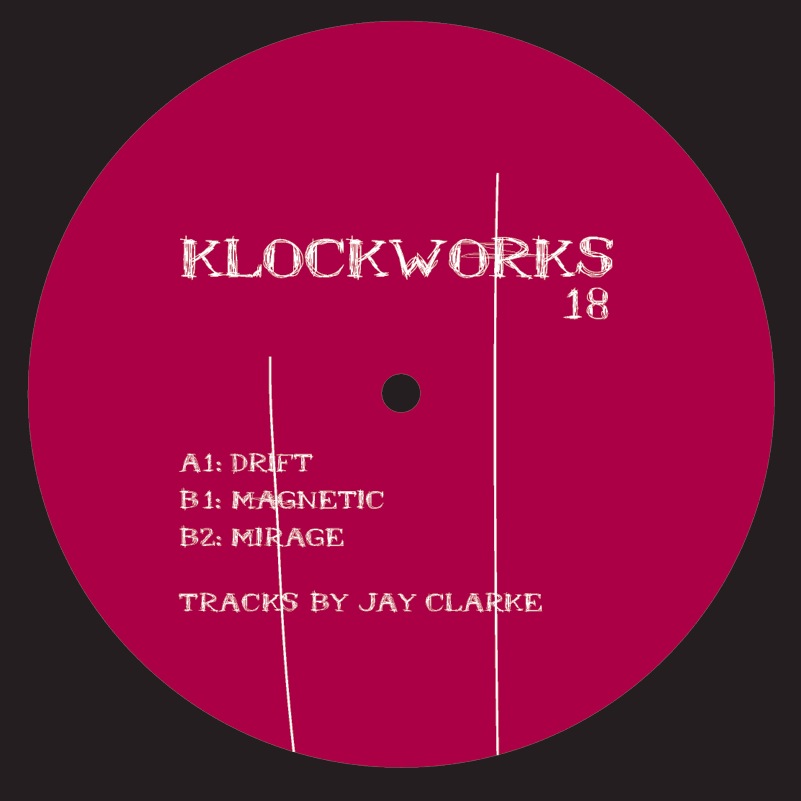
Young Londoner Jay Clarke is next up on Klockworks, with a three-tracker due out mid-April.
Clarke is famed for his residency at London club Village Underground, but is no stranger to production either, having already had a couple of releases on his own Blackaxon. He is next up on Ben Klock’s imprint, which has recently put out music by the likes of relative newcomers Etapp Kyle and Rod, as well as veterans Heiko Laux and Steve Rachmad. The forthcoming EP slots neatly into the label’s mesmeric techno aesthetic.
Klockworks 18 will be released April 15, and can be pre-ordered from the Klockworks store. Check out snippets below.
Modern Love stalwart Andy Stott has announced the release of a new full-length seeing release next month via the UK imprint. Entitled Too Many Voices, the new project succeeds Stott’s Faith in Strangers , his well received LP from 2014.
Alongside the news of the upcoming album, Stott has also shared a video for his first single, “Butterflies,” which you can watch on the player above.
Tracklisting:
01. Waiting For You 02. Butterflies 03. New Romantic 04. First Night Alone 05. Forgotten 06. Selfish 07. On My Mind 08. Over 09. Too Many Voices
Too Many Voices will land via Modern Love on April 22, 2016.
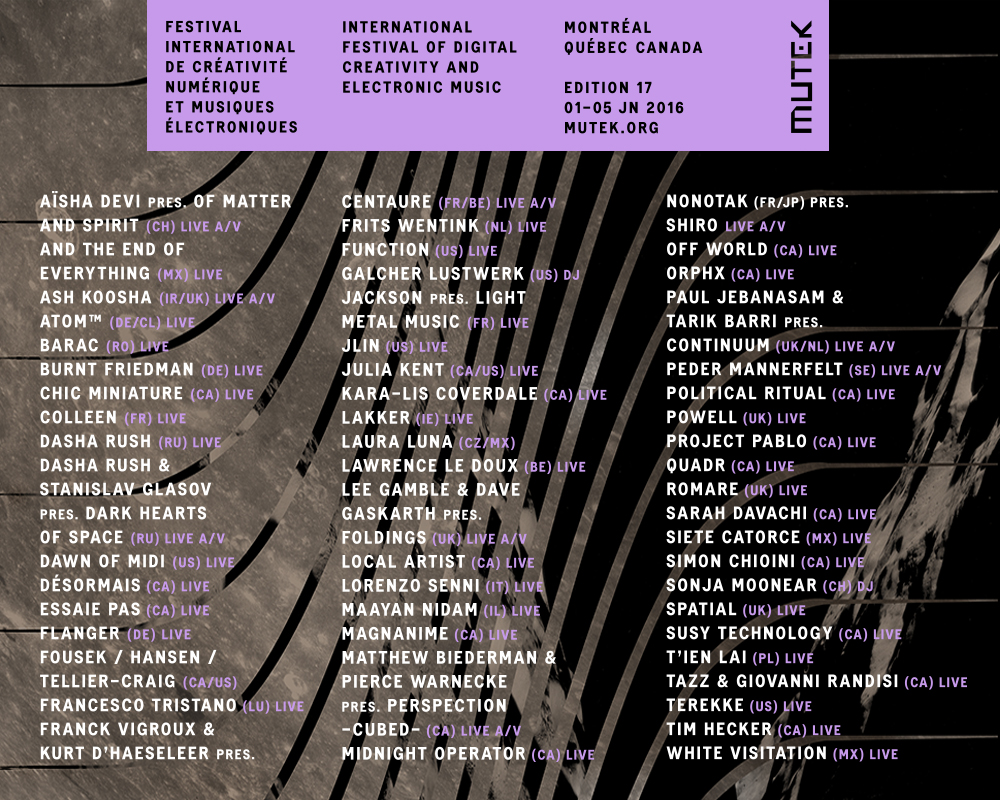
Mutek‘s Montréal edition has released a second batch of artists, who are set to grace the five-dayer in early June this year, across the Quartier des spectacles and the Musée d’art contemporain de Montréal.
Mutek was launched back in 1999, and has since been bringing forward thinking music to Montréal, as well as launching similar events in Mexico City and Barcelona. For the upcoming Canadian edition, the organisers have continued to collaborated with the European Union’s SHAPE project, providing a link direct to forward-thinking European artists, including Peder Mannerfelt (a.k.a. The Subliminal Kid), Lawrence Le Doux, Lorenzo Senni, and Warp Records’ Jackson.
You can buy tickets for the event here, or check out the full line up. One of the organisation’s key players, Vincent Lemieux, has put together a mix showcasing the most recent wave of artists, which you can stream below.
For its latest tutorial video, Point Blank invited Stefano Ritteri to its London studio to record live drums and various percussive elements for a new track. The Point Blank regular then takes the samples back to his studio to chop, mix, and treat them using Ableton Live, UAD and some other tips and tricks.
You can watch the video in full via the player above, with more info on Point Blank and its courses here.