Brunette Editions label-head, John Roberts, has announced the release of his next full-length landing this summer via his own imprint. Named Plum, it marks the artist’s third LP to date and succeeds the Orah EP, his newly founded label’s first release. Robert’s upcoming project was recorded in different studios across LA, New York and Berlin and took about two years to complete. A 30-minute film will be accompanying the album release and will be coming out sometime in August.
Vancouver duo Yu Su and Scott Johnson Gailey (a.k.a. You’re Me) land on 1080p with their forthcoming debut album seeing release via the imprint at the end of next month. Entitled Plant Cell Division, the LP was recorded on Salt Spring Island in British Columbia and focuses on, “dazed organics, muted hallucinogens and dub-dappeld ambience.” It marks the duo’s first collaborative project, with both artists having only previously worked on their individual projects, to date. Johnson Gailey is a member of the Juniper Systems band and Yu Su released her own solo cassette via fellow Vancouver label, Genero, earlier this year.
Plant Cell Division will be available in cassette and digital formats. Hear upcoming album cut “Applet W.” on the player, below.
Tracklisting:
01. Applet W. 02. Ilu 03. Oot Re Mi 04. Tabletalk 05. Lucidity 06. Loi 07. Walled Garden 08. Clear Panel 09. Soft Opening
Plant Cell Division will land via 1080p on April 29, 2016.
Speak to even the most seasoned recording engineer or music producer these days, and most will tell you that the often intensely heated Software vs. Hardware debates of yore are are essentially over. A quick perusal of even the most curmudgeonly online forms will turn up countless stories of engineers with racks of the most sought after EQs and compressors money can buy, none of which have been turned on in months, in favour of the near perfect software emulations and inherent total recall on offer from the likes of Universal Audio, Waves and Softtube.
Though perhaps slightly lesser known, another company that has most certainly earned its place at the top alongside those just mentioned, is Brainworx. The company initially came to prominence with a range of plug-ins featuring M/S, or Mid-Side processing, a feature that up until that point was to be found almost exclusively on expensive hardware units, in the world’s top mastering studios. While other companies have proven their skill at emulating individual equalizers or dynamics processors to near perfection, with the release of their bx_console, Brainworx has jumped into the hardware emulation game with serious gusto, going about the monumental task of emulating an entire Neve VXS Console.
Few names in the music technology business are as revered as Neve, and fewer still have the ability to cause otherwise introverted, social awkward studio nerds to spill forth a torrent of flowery pronouns on the mythical, orgasm-inducing properties of op-amps or hand wound transformers. Though the company’s original founder, Rupert Neve, brought his designs into the nearly affordable realm with the release of his Portico series some years ago, a full Neve console of even modest channel count will still set you back the equivalent of a brand new Mercedes with all the extras. The desks in question are renowned for their ability to make any mix running through them sound warmer, wider, and entirely more expensive, and that’s before any changes have been made to the individual channel settings . In electronic music circles particularly, there has been a great deal of focus on master buss processing in recent years, with Neve and a great many other companies offering up boxes which in theory offer the ability to impart some of this million dollar sheen on a mix, by running the final stereo mix through a single stage of dynamics, wide band equalization, and usually some tubes, or the aforementioned transformers strapped across the output for good measure. In truth, however, every channel of a full scale mixing console varies slightly on an individual component level, and the combination of these slight variations across the entire desk contributes significantly to the final sound. The amount by which these variations are deemed acceptable is known as manufacturing tolerance, and it’s by modelling these slight variations at a component level that Brainworx has set about capturing the sound and character of the desk as a whole.
Installation Brainworx is part of a consortium of companies which use a copy protection scheme under the plug-in Alliance banner, and installation involves registering on the site and entering a standard challenge response key from an in-app registration window (a process that will be familiar to anyone with even marginal experience with plug-ins). Registration keys for all products are also saved with your user profile for easy migration across multiple computers, and 14 day fully functional demos are available for what appears to be nearly every plug-in on the site. Once you’ve completed the installation process, the Brainworx plug-ins will be available from the plug-in folder specified during installation.
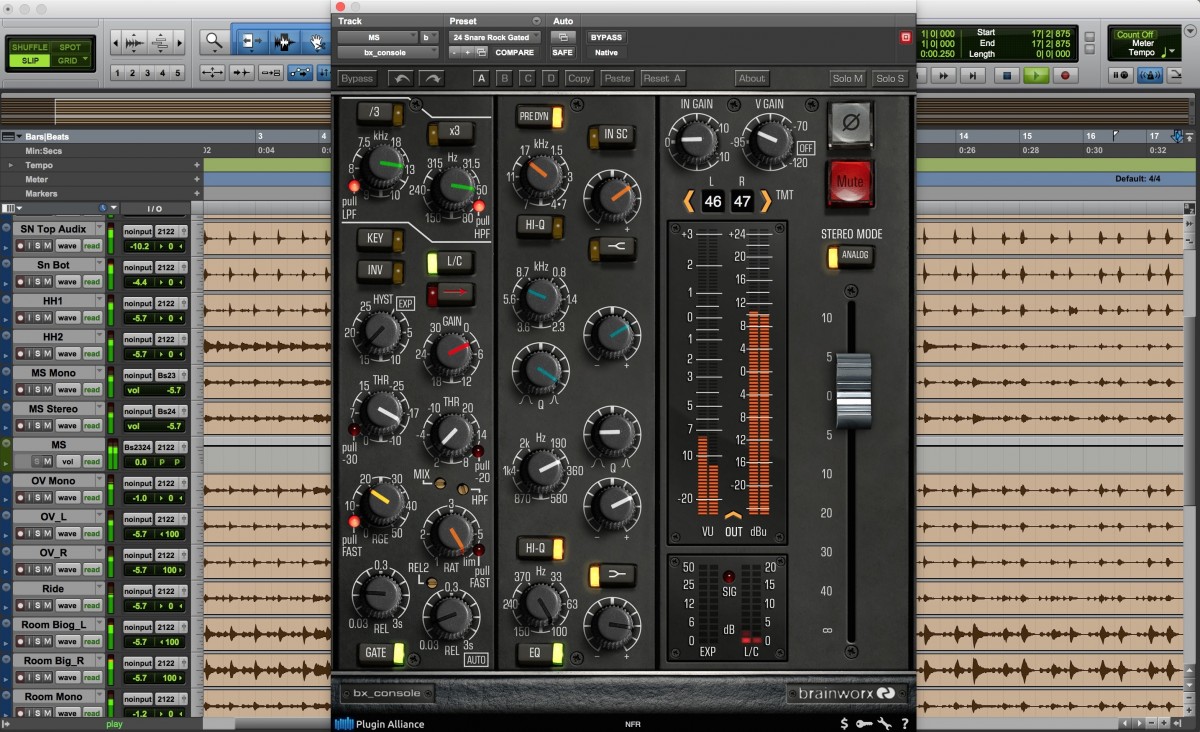
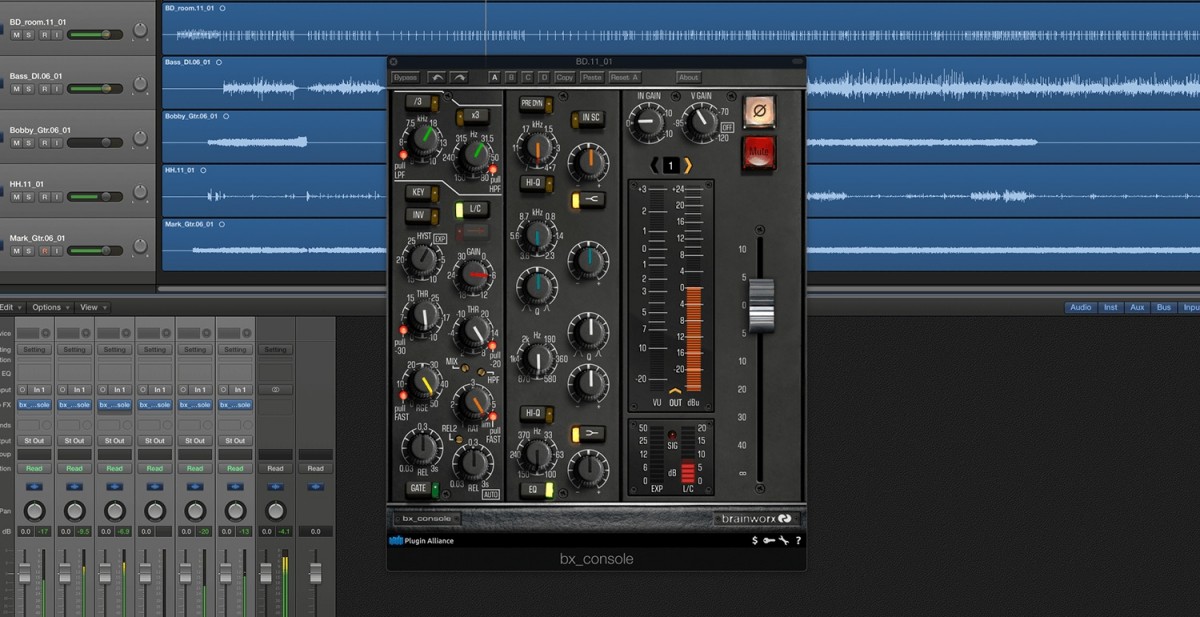
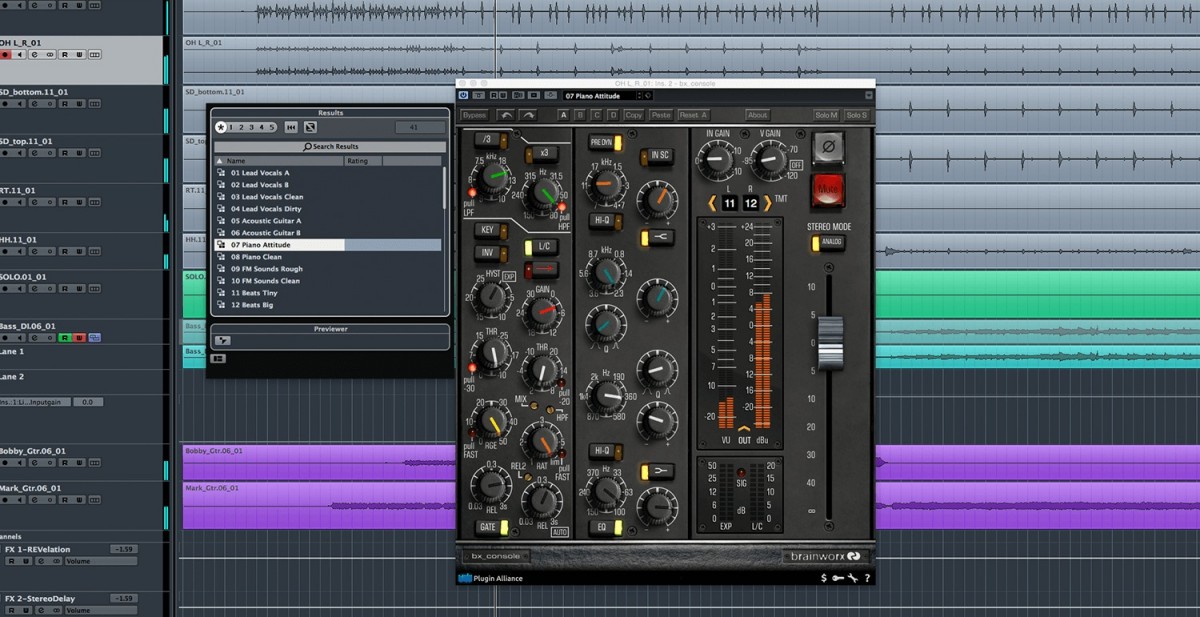
In Use Upon launching the plug-in for the first time you will be greeted with a photo-realistic interface, featuring all of the channel parameters of the Neve VXS console, plus a few key editions not found on the real hardware. Brainworx have done a good job laying out the controls in a logical left to right configuration, though with so many parameters so tightly packed into the interface, I found changing values of the knobs specifically to be a little finicky, often involving first clicking on the knob to select it, then clicking and holding a second time to make the required parameter change. With the vast majority of users working on larger screens at higher resolutions, I can’t help but think Brainworx could have been a little more generous with the interface size, thus providing a larger target area for each parameter. This is by no means a deal breaker however, and of course what little impediment to work flow this might create is done away with completely when using an external controller. Mapping the plug-in controls to my first generation Ableton Push controller made making adjustments smooth to the point that I could very nearly forget I was using a plug-in at all.
At the first stage of processing are a pair of high and low pass filters, a welcome edition in so far as they avoid the need to use the main EQ for the extremely common task of removing unwanted frequency content at the extreme top and bottom of the spectrum. In the default configuration these are followed by the dynamics section, including a gate and compressor/expander/limiter. Brainworx’ documentation speaks at great length of the character both processors impart, however my experience was that they fall more into the clean, “does was it says on the tin” variety of dynamics processors. This should by no means be seen as criticism of their quality, which should indeed be regarded as up there with the best in the business. They conquered every basic mixing issue and more complex corrective challenges I threw at them consistently and accurately. The gate does snappy and subtle with equal aplomb, and the compressor’s secondary release parameter allows for deadly accurate control of even the most unruly signals. For more extreme sound design applications that call for real filth and grit however, they’d be far from my first choice. The EQ section that follows is anything but average. Small cuts and boosts can be done with such transparency I had to use a spectrum analyzer to confirm they were actually happening. What’s more, even the most outrageously extreme boosts on any band of the EQ enhanced the signal with a depth and warmth that is certainly worthy of comparison to the hardware it aims to emulate. In comparing it to my go-to equalizers from competitors, I can safely say this truly deserves to be considered one of the best software equalizers currently on the market. Having the option to place it before or after the dynamics section, and even within the side chain circuit (though why anyone would want to waste such gorgeous filters on such a menial tasks is beyond me) only adds to the astounding range of sounds it is capable of.
“It’s fair to say that Brainworx’ quest to offer an equivalent of the aforementioned “wider, warmer, and entirely more expensive” magic Neve desks, which are so sought after today, can only be seen as a real success worthy of serious praise.”
The final stage of processing, however is where Brainworx’ tolerance modelling really reveals itself to be something truly special. As opposed to modelling the output stage of a single channel, all 72 channels of the desk in question have been modelled part by part. The fastest way to understand just what this means for your mix is to simply put an instance of bx_console on every channel, and select a different channel or pair of channels for each one. Select “analog” stereo mode to the top left of the volume fader, and turn up the “vgain” control to the right slightly, adding a low level of noise to each channel modelled after that produced by the actual desk. If you have access to a MIDI controller, map the on/off toggle button for each instance of the plug-in to a button or key on your keyboard. Switching back and forth between the processed and unprocessed signals is likely to leave even the most pessimistic hardware Luddites truly gobsmacked. The amazing results Brainworx has achieved here are made even more apparent once the EQ and dynamics come into play over multiple instances of the plug-in. The same settings on channel 11 and 12 produce audibly different results on channels 23 and 24, and so on. Though I didn’t have a chance to pop by the Skywalker Ranch over the course of this review process to check these results against the real console, it’s fair to say that Brainworx’ quest to offer an equivalent of the aforementioned “wider, warmer, and entirely more expensive” magic Neve desks, which are so sought after today, can only be seen as a real success worthy of serious praise.
Alternatives While many other companies make alternatives to the individual components on offer here, the only true plug-in alternative that offers all of it is Softtube’s Console 1, albeit with some key differences. The Console 1 model is based on the equally sought after SSL 4000 and 9000 series consoles, and as such offers a entirely different tonal character to Brainworx’ Neve emulation. Most importantly Console 1 comes with a dedicated hardware controller, with individual controls for each and every channel setting. This added work flow comes at an appropriately higher cost, though when considering the price of bx_console in combination with another controller such as the previously mention Ableton Push, the price difference becomes negligible. If you’re happy with a collection of gates, compressors and EQs, and are simply after the channel modelling and virtual “summing” magic on offer here, alternatives are available from Waves (NLS), Slate Digital (VCC), and Sknote (Stripbus).
Supported Operating Systems Mac OS X 10.6 through OSX 10.10 (No support currently for El Capitan) Windows 7 or 8 (NOTE: Worked on 10 for me flawlessly for this review) Pro Tools 10 or higher or any VST/VST3/AU-compatible host running on a supported operating system
System Requirements Display resolution: 1440 × 900px or 1280 × 960px or higher Memory: 2 GB RAM
The experimental Leeds-based band Vessels‘ full-length LP Dilate, which was released on the group’sLeaf imprint back in March of 2015, saw the five-piece outfit shedding their roots as a guitar-oriented endeavor in order to fully embrace their electronic side. A year later, Vessels is set to release a special edition of this celebrated album which will be available on a 180g double vinyl with download code with two bonus tracks. In addition to this, the new release includes remixes of the bonus single “4AM” from LV, Throwing Snow, Len Faki, and Drew Lustman (a.k.a Falty DL).
Before this stellar vinyl package becomes available to the public on April 1, we are offering up the Falty DL remix of “4AM” as today’s XLR8R download. Making use of his experimental jazz background, Lustman employs his steadfast, recognizable and uniquely stylized drum work over the various calming layers of horns and synth patterns that come together for a soft, euphoric piece that will put your mind at ease.
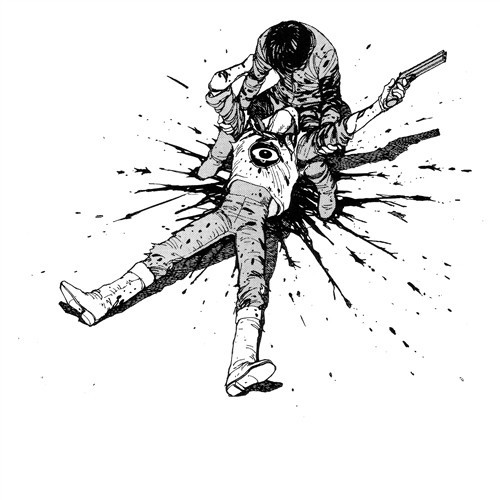
In 2015, Nathan Micay (a.k.a Bwana) told Resident Advisor that he playfully made a few edits based on dialogue from the 1988 Japanese anime Akira. Now a full year later, Micay has taken this idea and grown it into an LP titled Capsule’s Pride. Each track on the album features dialogue, music, and sound effects from the wildly influential manga blockbuster that has over the years amassed a cult-like following.
Berlin-based sound explorer Lucy will release his latest EP, Eat, Shop, Drink, Relax, via Samurai Horo on April 8.
Recorded to tape in Lucy’s Berlin studio, Eat, Shop, Drink, Relax is an almost unfathomable entanglement of intertwined synths and textures which endlessly wrap and unwind across the EP. The title of the EP refers to Lucy’s critical perspective on modern-day consumerism and the drive inherent in most humans to purchase “things.” The rest is left up to the listener and the hypnotic and highly atmospheric EP has more than enough depth and nuances to allow for countless listens and reflection.
With the EP set to arrive on April 8, XLR8R has been gifted EP cut “Shop” to stream in full. Like the rest of the EP, it’s a beautiful, tightly-woven piece of left-field electronics that truly hypnotizes across its near six-minute run. You can stream “Shop” in full via the player above, with the EP available for preorder here.
Fuck yeah, Los Angeles! FYF Festival has just announced the lineup of its 13th edition, set to take place on August 27 and 28 at Exposition Park in Los Angeles.
While the lineup boasts a plethora of various artists who represent a wide spectrum of genres, the acts that caught our attention include Air—who are performing in the US for the first time in five years—Floating Points, Gold Panda, Honey Soundsystem, The Black Madonna, Andy Stott, Gerd Janson, Bicep, Oneohtrix Point Never, and more.
FYF Fest General Admission weekend passes will be available for $199, with single day tickets available for $125 and weekend VIP passes available for $339. For all ticketing info, FAQ, and news, please visit FYFFest.com.
You can view the entire lineup in the list below.
FYF Fest 2016 Lineup (Alphabetical):
Air Alex G Andy Stott ANOHNI Beach House Bicep The Black Lips The Black Madonna Blood Orange Boogie Charles Bradley Chelsea Wolfe Corbin Denzel Curry DIIV Explosions in the Sky Father John Misty Floating Points Gerd Janson Gold Panda Grace Jones Grimes Head Wound City Honey Soundsystem Hop Along Hot Chip Jagwar Ma Julia Holter Julien Baker Junior Boys Kamaiyah Kelela Kendrick Lamar LCD Soundsystem Moby (DJ set) Museum of Love Oneohtrix Point Never Peter Bjorn and John Rae Sremmurd Saves The Day (performing ‘Stay What You Are’) Sheer Mag Shellac Tame Impala Todd Terje & The Olsens Ty Segall & The Muggers Uncle Acid and the Deadbeats Viet Cong Vince Staples Wild Nothing Wolf Parade Young Thug
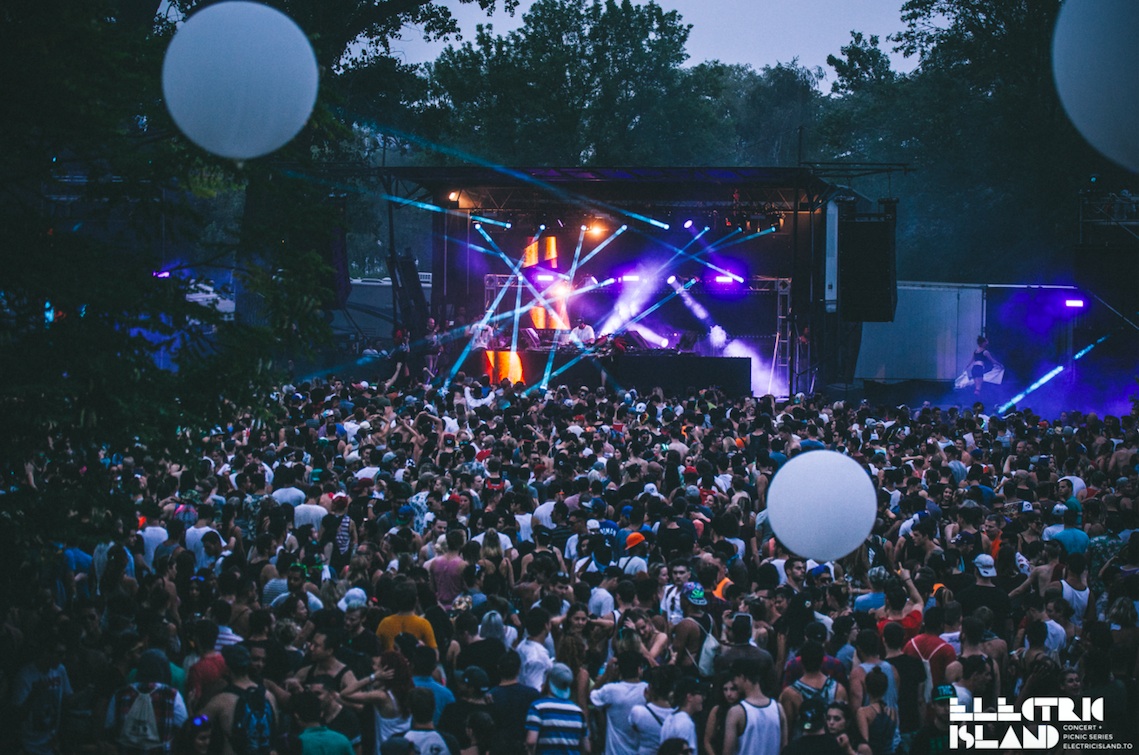
Details of the fourth season of Toronto’s Electric Island picnic and concert series have been released.
The Electric Island parties will take place at semi-regular intervals over the Summer at Hanlan’s Point, with the first event locked in for May 23, followed by events on July 1, August 1, and a two-dayer over Labor Day weekend (September 4-5).
Swedish producer Axel Willner (a.k.a The Field) is set to release his fifth full-length effort, The Follower, on frequent label home Kompakt on April 1. The Swedish producer is known for his gauzy loops and layers, although his most previous release, Cupid’s Head, found him experimenting with more muscular techno fare.
In the weeks leading up to the album release, Willner has shared a series of live performance recordings of his forthcoming album on SoundCloud, further building up the anticipation before the album’s official release. You can stream live performances of the title track, “Monte Verità,” and “Pink Sun” via XLR8R.
Ben Vedren has joined Pit Spector for the second time on the latter’s Prospector label, with the Prospector 3.2 EP, out today.
Prospector is the brainchild of Pierre Deniel (a.k.a. Pit Spector)—a conceptual label that seeks to bring production and performance together. Deniel has run a series of parties in Paris over the past couple of years, and before each invited a special guest to jam in his studio, the material from which is reproduced on stage, and then put on wax via the Prospector series. So far Vedren has partaken, as well as Dutchman San Proper, and Frenchman Guillaume Berroyer (better known as Ark).
Prospector 3.2 is the second EP in a two-part series, the first of which came out last September. It treads the line between house and techno, with a minimal character typical of both of them.
You can order the vinyl from Deejay.de, which comes with a Prospector party poster by Parisian street artist O’Clock. Check out snippets from Prospector 3.1below for a taste of what to expect.