Ableton have announced their latest technology, Link, which is available to all Ableton Live 9 users now as part of the beta programme.
Link aims to allow users to play together as a live band would, but without the need for a MIDI setup — instead, users can connect devices through their local wireless network, which will automatically sync the tempo of all the different participants. Ableton state that Link will soon be available in a growing number of iOS apps, which will allow connection between Live and iOS apps, or even just the iOS apps together (without the need for Live to be involved).
Users of Live can join the beta programme in order to try out Link now. Also, head over to the Ableton site to see which iOS apps are Link ready.
Items & Things label head, Marc Houle, has released a new quirky video for his fans titled: Fish Love.
Leaving his computer behind, the video features the Canadian artist inside his rarely seen studio, singing and jamming along with one of his friends. His dog, Kitty, also makes a small cameo appearance in the clip.
Check out Houle’s upcoming tour dates or watch the video above.
TOUR DATES:
20/11 | Stereo – Montreal, Canada 21/11 | Rum Runners – London, Canada 25/11 | TV – Detroit, USA 04/12 | Pacha Florianopolis – Florianopolis, Brazil 05/12 | TV – EDC Brazil – Sao Paulo, Brazil
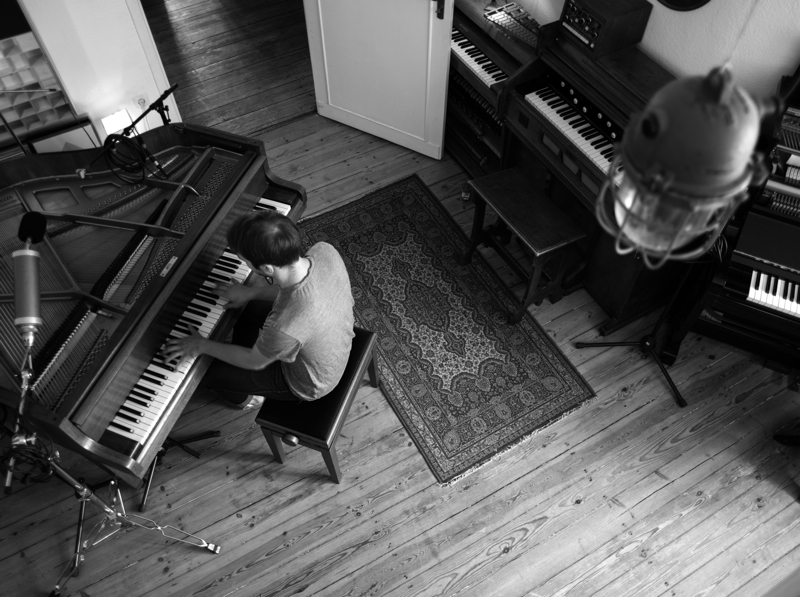
Shortly following news of a forthcoming album on R&S, Nils Frahm has unveiled another pending release. Screws Reworked sees fans and musicians reimagining material that first appeared on Frahm’s 2012 Screws LP. Frahm gave that album away in a gesture of thanks to fans and friends that supported him through an injury to his hand, and got a wave of audio and visual reinterpretations in response.
“Now is the time to thank you all for your numerous and beautiful contributions,” says Frahm. “In case you don’t find your track here, please don’t think it stands behind the others. This record means, in fact, that some of the most beautiful songs couldn’t be included as they simply weren’t ‘good neighbors’ and because there is only one rework for each of my original compositions. However all of you opened your hearts and minds and shared your uniqueness with us and I feel incredibly blessed by each and every single rework of Screws.”
Among the contributors are American composer Keith Kenniff (a.k.a. Helios), Bug Lover from Hamburg, and French artist Fred Yaddaden. Preview Screws Reworked below before it becomes available as a digital download via Erased Tapes on December 11. (via Resident Advisor)
01. Nils Frahm – You (Bug Lover Remix) 02. Nils Frahm – Do (Databoy78 Rework) 03. Nils Frahm – Re (Helios Rework) 04. Nils Frahm – Mi (Soul Channel Rework) 05. Nils Frahm – Fa (Fred Yaddaden Rework) 06. Nils Frahm – Sol (Ruhe Rework) 07. Nils Frahm – La (Sebastian Freij Rework) 08. Nils Frahm – Si (Plasma Rüby Rework) 09. Nils Frahm – Me (Analogue Dear Rework
Celebrated German imprint, Innervisions, has announced the release of a new Too Much Information remix EP, landing next month. This latest project will mark the label’s last release of 2015.
The two-tracker EP features a remix of the original Dele Sosimi Afrobeat title track on the A-side, by Nigerian/Swiss artist Laolu, and a ‘Rainy City Music Version’ on the B-side.
Too Much Information is due out on 12″ format via Innervisions on December 11, 2015.
TRACKLISTING:
A Sosimi Afrobeat Orchestra -Too Much Information (Laolu Remix – Edit) B Sosimi Afrobeat Orchestra -Too Much Information (Rainy City Music Version)
Stacey Pullen’s story is woven within the fantastical fabric of Detroit techno lore: The son of a Motown vocalist, Pullen was a second-wave protégé of Derrick May. He frequented the legendary Music Institute, hung around the building where Juan Atkins, Kevin Saunderson and May all had their studios, collaborated with Chez Damier, and got signed by a major label. Unfortunately, that record deal saw him hand over the rights to his own name for upwards of a decade, forcing him to record under pseudonyms. Frustrated by the restrictions, he remained mostly on the road and out of the studio for the duration.
With the contract now a few years expired—and a three-year-old at home—the Blackflag Recordings boss has a reinvigorated calling to create. In addition to an overall increase in output, his inspiration is especially evident on his two-disc mix compilation for the esteemed Balance series. Released earlier this month, it is his first in six years.
I caught your set at the recent Detroit Love party at Populux, as well as at the first hometown installment of that party back in March. In your mind, what defines Detroit love, as opposed to, say, Amsterdam love or Chicago love? It’s a movement. I wouldn’t be who I am if it wasn’t for Detroit. That’s why I’m still here. A lot of artists, they’ve got up and left because of various reasons or whatever. They felt like opportunity knocked in some other place. But for me, I’ve always stayed here; when I first started traveling I wanted to find out what was going on outside of Detroit, but the foundation always rooted me back here, which makes me the person I am today. I think that Detroit love is a movement, but it’s also a way of life. It’s who we are. It’s who are as artists [in] everything we do and everything we touch.
What does it mean to you to take Detroit Love and bring it to another city? My career has always been [to] travel as an ambassador of the city. I think it’s important to keep Detroit on people’s lips because we’ve always had that mysterious, meticulous attitude, being innovative, always keeping fresh. Chicago and Detroit, we have similarities. Chicago has house music and Detroit has techno music, but in Detroit we’ve kept that tradition going and kept the spirit of what we’ve done alive with how we brand ourselves as artists, as innovators, [as] individuals.
It’s not unusual for those who call Detroit home to experience polarizing feelings towards the city. There’s all this great stuff about it but it kind of beats you down sometimes. Can you relate to that at all? Yeah, yeah, yeah, there’s a love-hate relationship. Perfect example—I try not to cut on the news anymore, because every time I cut on the news it’s like something really negative. It can be from a local perspective or it can be from a national or international perspective. We’ve always had a black eye when it comes to the city on what it is and the economic status, social inequality, but I wouldn’t want to be from any place else but here. I know people who have moved to places like New York or LA. They will say “There’s no place like Detroit” as far as social, going out, music. They sort of miss that, because they miss the core values that we have—the spirit. One of the reasons [we are who] we are is because of the spirit.
It’s almost therapeutic when we tell people about the social issues that are going on in the city. Now it’s much better, but years ago I could tell a person, ‘The city’s not doing so well. We got the crisis, the blight, the bad stories.” One of the reasons why I still live here is because it gives me the balance with being on the road. I can come back home and be just a person from Detroit, and I reflect on that.
It’s grounding to come home? Exactly. I’m grounded. If I lived in a place like New York or London, I would constantly be focused on what other people are doing. But being home, I don’t have to think about doing anything. I just naturally gravitate to being at home and following who I am.
I used to live in Amsterdam for a bit, too. It was a good time for me to be in Amsterdam because I was a teacher, teaching Europeans about the Detroit sound, but I was also a student learning about what wasn’t coming to Detroit.
“Once you reach the bottom, there’s no place to go but up.”
Even with the Internet, there’s still this sense that, in Detroit, we’re in our own little bubble and there’s limited engagement with what else is happening. This is true. I think that is because we haven’t had many options until recently as far as us getting inspirations from any other place. I guess that we use ourselves as far as being inspired by one another to sort of pave the way to go forward. Once you reach the bottom, there’s no place to go but up. At one time that’s how it was here in Detroit. You have to search and look for new inspiration, new ideas, once you hit rock bottom. Once that happens, you’re sort of hungry for information, hungry for new inspiration, encouragement, and that makes you strive for even better, more intuitive ways to get where you’re trying to go.
So you think there was a point when the music here, or the artists, hit rock bottom, and started seeking inspiration elsewhere? Yeah, because we didn’t have management. We didn’t have a whole team of people. It was a do-it-yourself shop. We didn’t have any type of guidance whatsoever. We used what we knew growing up, and that wasn’t much as far as marketing- and business-wise.
When the new, tech-savvy, younger generation [hit , we] started realizing that we have the whole world at the palm of our hands. We realized it [was] time to step the game up a little. It’s time to strive for longevity. That’s always been my motto. Some people kind of prevailed and some people sort of got left behind. We in Detroit, we’re still stubborn on still wanting to think one way. It’s like Ford: He was like, “I’m doing it my way. I’m doing the cars my way, I don’t want to have any outside influence.” We are [the same way]. We don’t want to get any distractions.
;
Do you think that’s what happened with some of those guys that were really influential early on but didn’t garner the same amount of attention? I didn’t really say that. I just think that artists are like that. We get to a point where we don’t want to have any outside influence when it comes to other people saying who we should be. [laughs] A lot of the great artists were like that…everybody’s different. Some artists are still sufficient enough to where they’re happy with where they are. To each his own.
Is there a particular moment that you remember looking around Detroit and thinking ‘Man, things have changed?’ I go back into my old neighborhood [on the West side of Detroit] where I grew up, where I went to school. Sometimes I want to take that one person who has no clue on what Detroit really is, but they think they know, and take them on a couple of streets where I grew up. Until you see for yourself, and explain to that person, ‘This was once a thriving neighborhood’ and you see that now it looks like Iraq.
I remember I was driving down the street and I took a video as I was driving and I was kind of [narrating] my own documentary. ‘This was once this, we used to hang out at a friend’s house right here.’ It’s all gone, or it’s blighted, burnt up. It’s a culture shock. For me to say that I get culture shock coming home is a really bold statement. Because sometimes when people go out of the country they see that. But I come home and see that.
I also like going back over there occasionally, too, because it puts everything in perspective. I lived my life on airplanes. I live my life being on the road, or learning about [other] cultures, learning about the city wherever I go. Even if I’m there 24 hours, I get a tour and I try to learn as much as I can where I am, even if it’s [just] from the airport to the hotel. I always think about that when I go back into the neighborhood.
On the flipside of that, you can drive around downtown, or Midtown, and there are all these new restaurants and stores, they’re restoring run-down apartment buildings. So while the area you grew up in is unrecognizable because of blight, on the other side of the coin these other areas are unrecognizable because of development. That’s just how the system works, unfortunately. In order to bring new ideas in, sometimes you have to make sacrifices. And Detroit’s always been a small-town mentality where it’s been difficult for them to accept change. I’ve seen it happen in other cities, so I know what the potential is, but most of the people here, they don’t understand the potential. They think it’s always a conspiracy. I can’t say that it’s not, but I’ve seen it work in other cities, in other countries. It’s just a hard pill to swallow sometimes, change in general.
“You would knock on Derrick’s door, go up to his loft, and he would be there cooking pasta, taking a break from recording. And then Kevin would be next door working on a major Inner City project, going on tour with managers. And Juan would be in his studio watching Star Trek.“
I know back in the early days you spent a lot of time on ‘Techno Avenue,’ where Juan, Derrick and Kevin all had studios on different floors of the same building. What was that like? It was a constant flow of energy around there. You would knock on Derrick’s door, go up to his loft, and he would be there cooking pasta, taking a break from recording. And then Kevin would be next door working on a major Inner City project, going on tour with managers. And Juan would be in his studio watching Star Trek. [laughs] And then in back you would have Chez Damier getting in studio time when Kevin would go out of town, and that’s how we collaborated.
The Music Institute was open at that time, so on the weekends everyone was there because it was a great way to test out the new tracks that they just produced. I remember seeing Carl [Craig] and Derrick just leaving the studio to come to the club with a reel-to-reel in hand, fresh out of the studio. I remember sitting there thinking I wanted to be like that one day, a true artist coming in there wearing t-shirts and jeans. [laughs] No corporate life whatsoever. Being an entrepreneur, running their own thing. That was inspiration for me. And that’s what I saw around there. That’s what made me want to be included.
You had a contract with Virgin, and you lost the rights to your own name for a long time. What did that feel like to not be able to produce under your own name? It was like a bad marriage, but I learned from it. It was a time when I didn’t want to do anything but DJ. I didn’t want to go in the studio to make any music. That was the only thing that gave me any comfort in dealing with the situation. DJing was my expression outside of being in the studio. The only upside to knowing that they had the rights to my name was being able to record under pseudonyms, which has always been a big thing in Detroit. But it wasn’t the same, because once the industry started to change, you realize that your name is a commodity.
I had licensed [my label] Blackflag under that, as well. So here they are, they have my brand and my name. All I can do is go out and DJ, and do remixes here and there, and do tracks under different pseudonyms. From here on out I will remember that word, perpetuity. Perpetuity means forever, pretty much. [laughs] It was a good—It was an interesting experience. I can’t really say it was great. But it was an interesting experience because I would roll up to Virgin Records in the U.K., and this was the time that Lenny Kravitz was on the label, Janet Jackson, Spice Girls, Chemical Brothers. And here I am, this little black boy from Detroit coming up in there like, ‘Hey, this is my album! Come and take a listen!’
After it was over with, I think it was 2011, 2012 when everything reverted back to me, and that’s when I took it up to the next notch and sort of realized I got everything back. That was a big relief. I learned from that experience and had a new perspective.
Speaking of a new perspective, in a recent interview you squashed the digital-versus-vinyl debate succinctly. All you really said was “techno means technology,” which was great. Why do you think so many people still cling to vinyl and try to denounce digital DJing and production as being inferior? One of the reasons I think a lot of people are like that is because they still want to be true to how they learned, how they were inspired. We have purists, and purists are like that. They don’t want to stray from anything. They want to get the best from what they’ve known for all of their career, or all of their lives, and be collectors of the new sound but in an old school way. We kind of touched on that earlier, about those guys not wanting to expand their horizons when it came down to being artists or whatever.
For me, I’ve always been a person who has grasped more knowledge, more information, new ways of thinking, because I’ve always traveled a lot, so I’ve seen the influence of technology. And it’s good to see the generation shift when it comes to our world and our scene. It’s also people not understanding that you can use technology and still have…nobody’s going to take your inspiration away from you.
The new Balance compilation is your first in six years. I know you aimed to include tracks you love but can’t really play out in a club environment. Is that a different approach than the previous compilations you’ve released? DJ-Kicks was the first one, and I was inspired by what I heard on the radio here. We used to do a lot of physical editing on reel-to-reel. Get the razor blade out and the chalk and sort of the old school way of cutting and editing and pasting the tape back together. It was a cool way of putting mixes together because not many people other than us in Detroit were doing that, other than the film studios.
I’ve seen the generation change. I’ve seen how music has changed. [There’s] so much music out the market is saturated…and then you have the SoundCloud, Mixcloud market, where all you have to do is press enter and you have all the DJs who you ever want to hear. So what I wanted to do with Balance was kind of give it an eclectic side of what I have been inspired by with DJing.
“Now music is disposable. DJs are disposable. There’s nothing to grasp onto anymore to say ‘This is mine. This is what I created and I want to give it to you as a gesture.’”
With everything being so accessible now, do you feel that the compilation album is still a relevant format? That was another reason why I opted to do the mix compilation. I knew Balance was a little different when it came time for them to compile the tracks. From a marketing and business perspective for a label, I think SoundCloud and those sites have diminished the quality of mix compilations. In this day and age when anybody can be a DJ, all you have to do is [direct people] to your SoundCloud page so they can listen to the latest mix you have. It’s kind of diminished the marketing ability for mix compilations by big companies; you can press enter and you can download a set. It’s kind of tipped the validity away from the music as well, because now music is disposable. DJs are disposable. There’s nothing to grasp onto anymore to say ‘This is mine. This is what I created and I want to give it to you as a gesture.’
What did you make the mix on? I made sure that I had all the WAV files. [laughs] That was first and foremost. I did it on Traktor but I also used some outboard pieces in order to give a little warmth around it, so it won’t sound too robotic. Even though it got mastered digitally, I still used some pieces to sort of round off the edges.
Was there anything in particular that inspired you as you were working on it? I wanted to use a little bit more of Detroit music, but it didn’t work out. A couple of artists didn’t get back to me and a couple more artists are against the whole commercialism of putting their music out there. Then one [artist said] “Ok, let’s do it.” That was the track that I did wind up using.
Which track was that? That was E-Dancer, “Foundation.” And then at the same time, I wanted to show people my versatility when it came to what I like, and the things that I don’t get a chance to play. Oscar P’s “Reflections of You” was a Fela-inspired track, which is close to the African roots that inspired me when I first started making music.
The press release indicated that your daughter also inspired you. Did you feel like your sound evolved after having her? I wouldn’t say it evolved, but I think that being in the studio for the first time—because I have a home studio—I got a chance to really reflect and say ‘Wow, this is what it’s all about. Not only am I an artist but I’m leaving a legacy.” You really see that when you look in your daughter’s eyes.
Your dad was in a Motown group, so it’s passing that legacy down to another generation. Right, exactly. You realize you’ve got something to leave behind now. And when you know that, you sort of realize it’s not just about me anymore. I see that and it just kind of gave me the inspiration. This is the first time I’ve felt like this before. When I realized that it was powerful. Everything flows when you’re in love. That burden has lifted of wanting to be accepted because you know that love is there regardless, nonjudgmental. And when you have that, a lot of the spirits are lifted and you can think clearly. Your third eye is open.
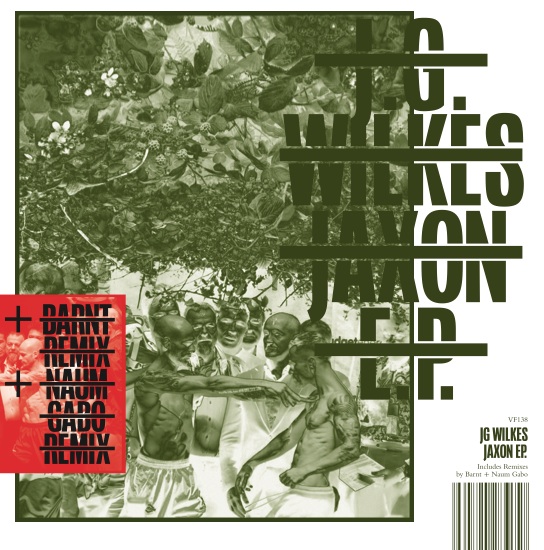
Best known as one half of the record-spinning, tune-producing, party-tossing twosome Optimo, Jonnie “J.G.” Wilkes has long been running riot through what could loosely be called “dance music.” His solo productions, however, have been a bit sporadic—at least, that was the case until last year, when the Vinyl Factory label pressed up his eight-track, wax-only mini-album German Pizza Party. If you know anything about Optimo, you probably realize that Wilkes is gleefully ignorant of genre and willfully drawn to weirdness—and that’s largely what you got with German Pizza Party, via tracks that varied in form from languid-yet-unsettling ambient to rib-rattling EBM. Now, for those outside of the vinyl-worshiping world, the label has thoughtfully compiled a few of that record’s cuts on the Jaxon EP, with added the bonus of a pair of wondrous remixes.
Anchored by an angular, machine-age percussion, the EP’s title track brandishes a syncopated buzz that sounds something like a Tesla coil that’s acquired a sense of funk; Barnt, on rerub duty, unsnarls the rhythms, burnishes the rough edges and injects a healthy dose of fluttering synths, with the result coming across as streamlined, fully-electronic version of a Harmonia tune. The beat-free “Bathing Beauty,” meanwhile, entices with alluring, glistening textures and a circular, lullaby-esque melody as a darker undercurrent of danger lurks below—occasionally manifesting itself though a few wildly dischordant orchestral bursts. The EP’s grand finale comes in the form of a remix of “Useful Tool” from Naum Gabo (the partnership of Wilkes and fellow Glaswegian James Savage)—the near-frenetic track feels like a dystopian version of HI-NRG, as if Bobby O was commissioned for the soundtrack of a new edition of Deus Ex. It’s a fitting capper for an oddball release, one that should easily garner the solo Wilkes a few more fans of eccentric electronics.
Monasterio—the revered Moscow club—will kick off its label arm on December 1 with Mona Series Part 1, a label compilation featuring cuts from Oliver Deutschmann, Recid, Anastasia Kristensen, and Unbalance.
Mona Series Part 1 aims to “represent a dimension of the club’s style,” from Oliver Deutschmann’s main room focused “The Chamber,” which focuses on searing synth lines and a steamrolling groove, to “BSC,” Anastasia Kristensen’s deep and dark modular masterclass, each track provides a glimpse into the underbelly of one of techno’s premiere clubs.
Ahead of the release, Monasterio has offered up Russian resident and XLR8R download alumni Unbalance‘s atmospheric journey “Revival” for an exclusive premiere. Using a machine-gun-like rhythm as the basis of the track, Unbalance proceeds to add layer upon layer of sci-fi synth lines and sparse, modulated textures into the mix for a dense and hypnotic journey.
You can stream “Revival” in full below, with Mona Series Part 1 arriving on December 1.
DGTL Festival—renowned for its line-ups, art and sustainability program—has announced the first names for its 2016 edition. The first release of artists contains a solid selection of DJ/producer talent and consolidated acts that have earned their stripes by exhibiting a myriad of different styles and musical colors. Topping the bill of this first release are Nina Kraviz, Agoria, Âme, Bobono, Job Jobse, Hot Since 82, Mano Le Tough and RØDHÅD.
Recent podcast alumni Matt Tolfrey‘s Leftroom label is celebrating 10 years in business with a label compilation, featuring cuts by the label head himself, who collaborates with Guti, Route 94, and Heartthrob, as well as tracks from Audiojack, Kate Simko, Chez Damier, and JD Twitch.
Tolfrey also teams up with fellow UK producer Kate Simko to rework her beautifully deep 2012 cut “Go On Then,” featuring Jem Cooke. Refitting the track into a slightly more modern sound, the pair beef up the bassline and push the percussion to the forefront, creating a dancefloor destroying update to the already apt original.
10 Years of Leftroom will be released on November 30, and in the meantime, you can stream Matt Tolfrey and Kate Simko’s remix of Simko and Jem Cooke’s “Go On Then” in full below.
Following the release of The Story About You (his first album,) Berlin producer Moomin, has revealed he has a new full-lentgh dropping early next year.
The house producer will return to Hamburg label, Smallville Records, with A Minor Thought. This will also mark Moomin’s first album in four years.
View the tracklisting or hear the album’s previews on the player below.
A Minor Thought is due out via Smallville Records early 2016.
TRACKLISTING: 01. 123 02. A Minor Thought 03. Loop No. 1 04. Morning Groove 05. Woman To Woman 06. Alone 07. Stotheh 08. Chemistry 09. Time To Reflect 10. You Neva Know 11. Unshape