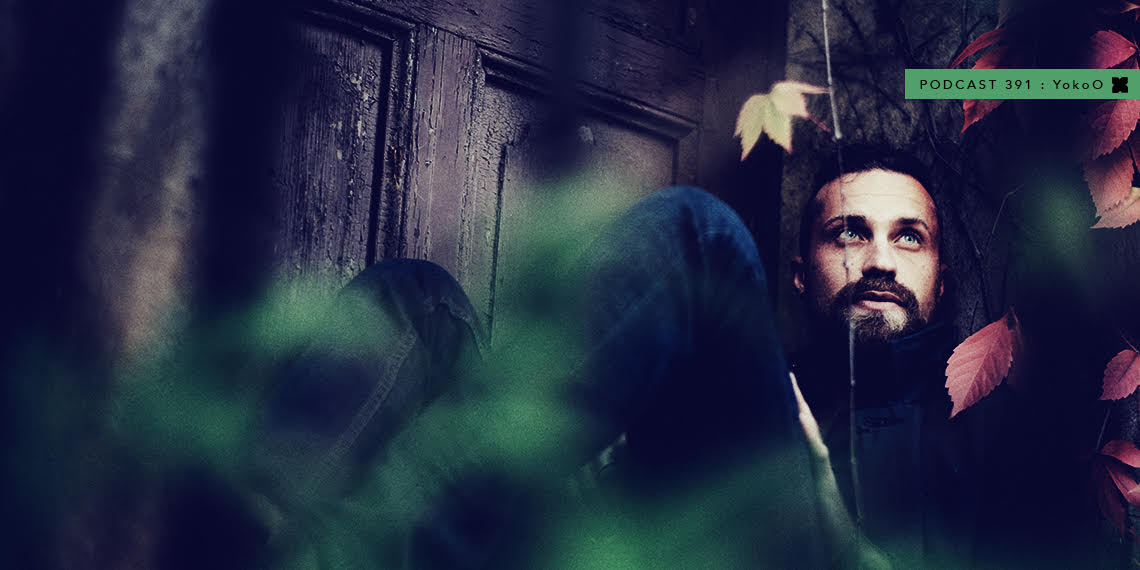
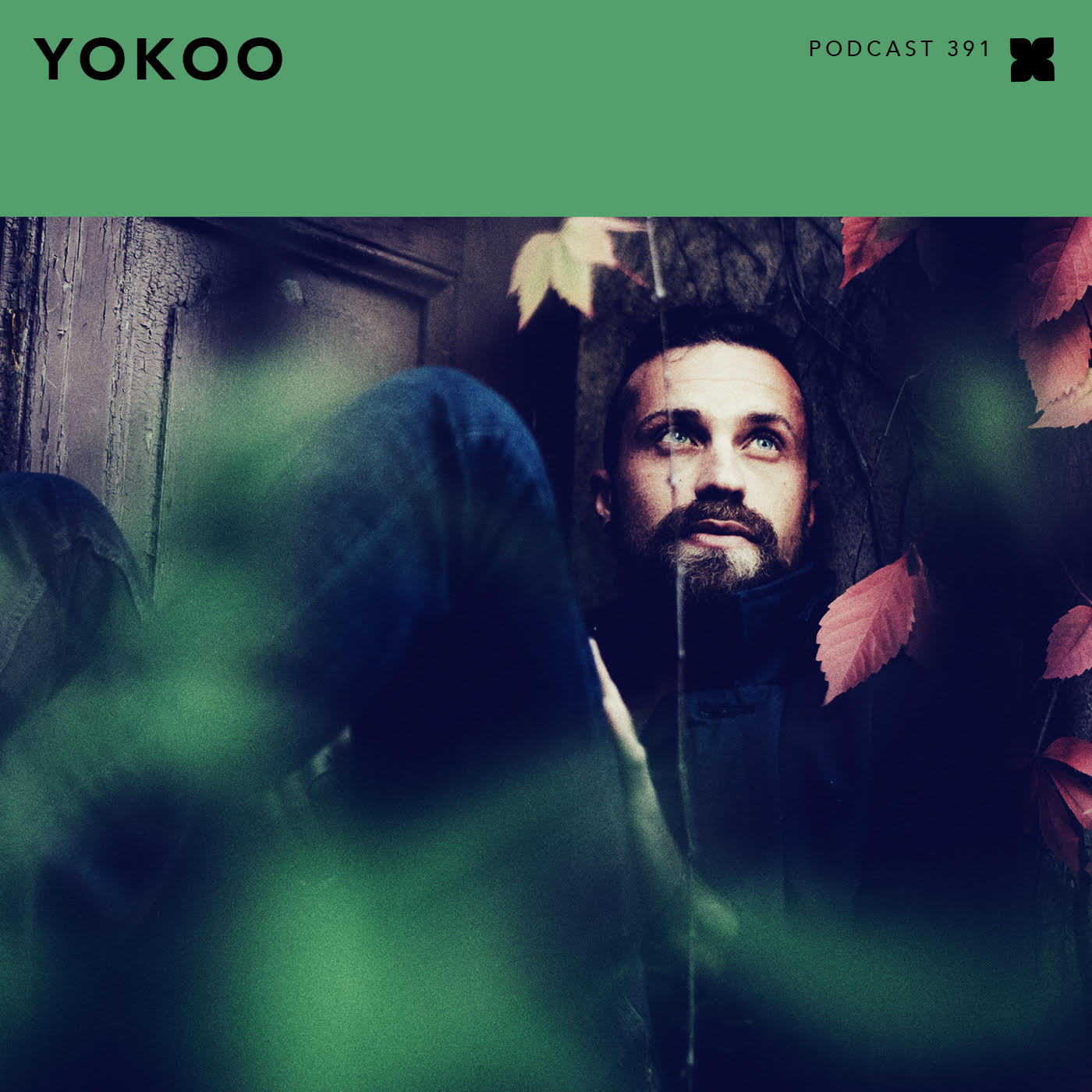
YokoO chats to Bruce Tantum about his XLR8R podcast.
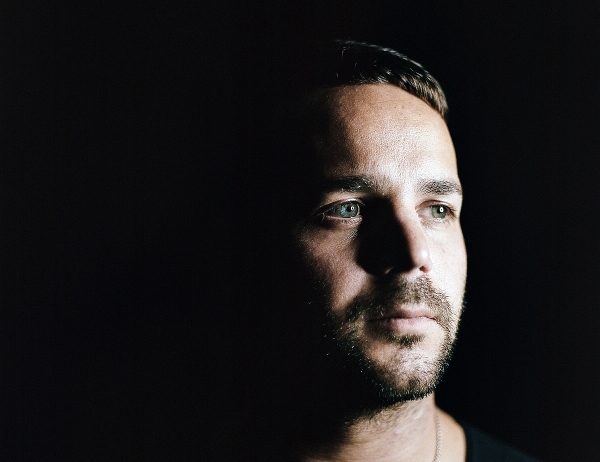
Students of deep house, at least those who do more than skim the surface of what the sound has to offer, know that the French-born, Berlin-based man known as YokoO is a talented purveyor of the four-to-the-floor arts, making and playing the kind of material that hits you right in the heart while moving the rest of your body to the dance floor. This podcast is one of the most scrumptious, gorgeous sets that XLR8R has run in recent months—which, consider we’ve hosted mixes from the likes of Laurent Garnier, Audiofly, Dance Spirit, Fort Romeau and Virginia lately, is saying quite a bit. As YokoO explains in the video, the session’s emotions run the gamut from joy to sadness, love and loneliness and back again, its soothing passages punctuated with moments of pure drama. In short, it’s a musically rich hour of listening pleasure. Our suggestion: Grab a glass of wine (or whatever) and settle in for a while.
Travelling to Los Angeles last week was L.I.E.S. records cohort and supernatural sound summoner, Svengalisghost. The trip would mark the first time in nearly two years that the Paris-based Marques Cooper has traveled across the border into America, and it would be the first time in his career that he performs live in Los Angeles. Other stops on this tour included dates in San Francisco, New York, and an appearance at Smart Bar in Chicago—where Cooper is originally from.
This first stop on the tour was secured by The Black Lodge and Moony Habits; two different promoters that have put together some unique lineups in the last couple of months, including a show at Complex in Glendale with FaltyDL and Mono/Poly. The promoters also curated a roster of supporting acts that included OCD & J3M5, JoJo Armani, kosmik, Sage Caswell, and Underground Resistance associate Santiago Salazar.
The past two years have seen Svengalisghost play some head turning gigs, including an infamous performance at Concrete in Paris in 2013, and recently at the Musée d’art contemporain de Montréal during the 16th edition of Mutek. The Los Angeles show took place on a Thursday, in a lowly lit downstairs bar called the “Gold Bar,” which is part of the larger 333 Live venue. 333 Live has hosted many influential club nights in the past, including the notorious heyday parties of NOX Illusio and a slew of monstrous events hosted by A Club Called Rhonda back in 2012. Once inside the Gold Bar, we were quickly welcomed by the sounds of Planet-E producer and Ican label co-founder, Santiago Salazar.
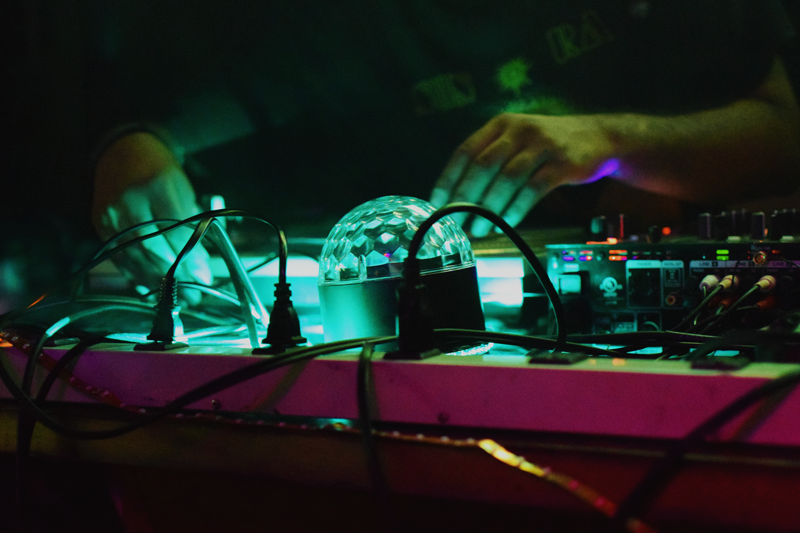
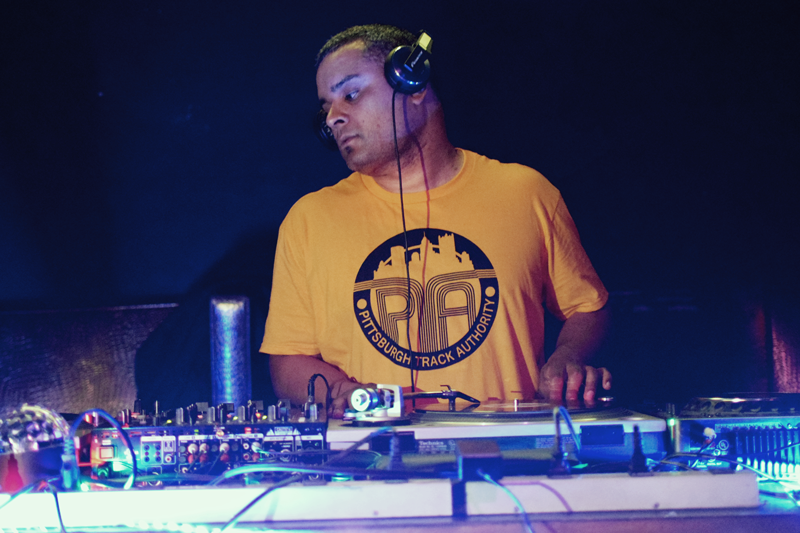
Salazar’s been riding a wave of mediaexposure, some of it surrounding his new album, Chicanismo, due out on September 7 via Love What You Feel, and more of it due to his popularity as an East Los Angeles musician turned Underground Resistance protege. His performance proved a bit difficult due to sound issues he was having with one of the turntables. He continued to work the mix as best he could with the technical difficulties he was facing, and dealing with these issues in the heat of a mix is definitely a test of artist’s ability to keep their cool. After Salazar faded off his set with an uplifting techno track, the soundboard cables were disconnected from Salazar’s mixer and plugged directly into metaphysical melody of Svengalisghost.
Svengalisghost quickly showed the crowd that he has more energy on a Thursday night than most people have all weekend. Svengali strangles the microphone with both hands and wraps them around the mic’s windscreen like a old-school beat-boxer. The sparse crowd slowly closed in on him as he stacked layer upon layer of distortion over intense and haunting sequencer patterns. The fluorescent black light that covered him during his performance fit the supernatural aura of the militant beats that were accentuated by his haunting vocals.
Svengali performed a set that was overflowing with raw hardware arrangements and effects, and the crowd reactions could barely be deciphered from the screams coming from the souls inside his machines. He managed to deliver a brutal and punishing set with ease, all the while keeping the focus on creating that connection with the crowd that has made his live performances so prominent.
It’s exciting to see these types of Thursday night lineups happening in Los Angeles, and you can’t help but appreciate a group of promoters who can curate lineups that are pushing the idea of interesting pairings when it comes to their headliners and supporting acts. It’s also good to know that these promoters have even more forward thinking lineups coming up in the next couple of weeks. Moony Habits have their next event on June 19 at the Gold Bar @ 333, with Andrés of Black Mahogany, and London Jazz figurehead Mark de Clive-Lowe with his full band, CHURCH. The Black Lodge will host an Independence Day party in July with Derek Michael and Sage Caswell. The party is free and will be held at Hyperion Tavern in Silverlake. Follow The Black Lodge and Moony Habits to find out more.
We last heard from Konstruktiv label boss, Rekord 61, last April when he shared his remix of label newcomer BuRu. At he end of the month, Rekord 61 and Konstruktiv will return with the release of Vremya, a four-track EP which lands backed by a remix from Rolando. Vremya is driven along by Rekord 61’s gritty rhythms, with his three originals all employing slamming drum lines to great affect. Pulled from the release is “Iskra,” a hazy techno cut with gradually evolving percussion, a booming low end, and fluttering synth work, which fittingly rounds out the EP. “Iskra” can be downloaded for free below, with the full EP available for purchase here.
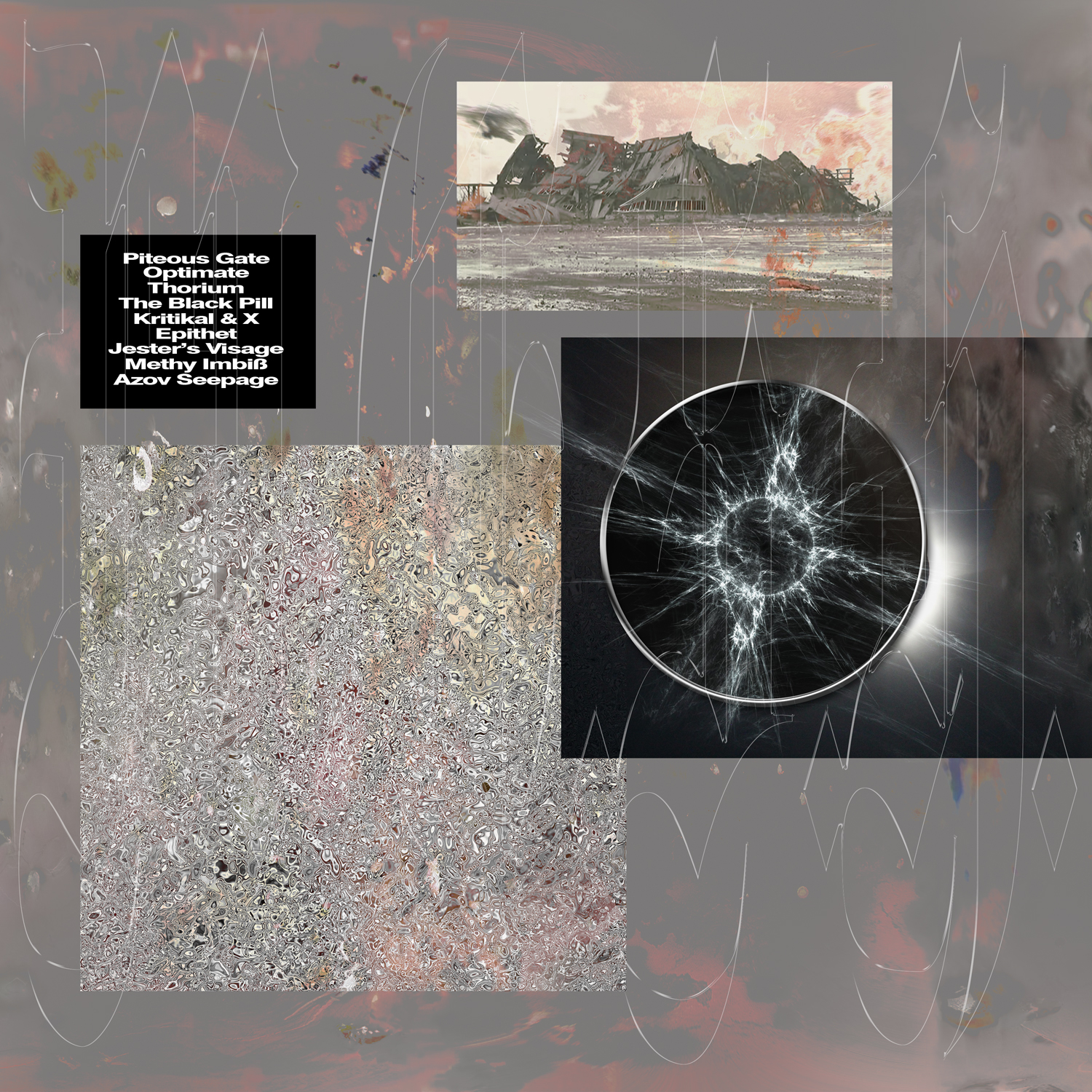
Recent XLR8R podcast alumni M.E.S.H. has announced his debut album, Piteous Gate, which will be released via PAN on July 17.
Following on from his highly regarded Scythians EP—also released on PAN—and the Infra-Dusk / Infra-Dawn EP, the Janus collective member presents nine tracks of highly futurist club sounds where “tightly gridded and sculpted sound juts up against loose-wristed improvisation, automated processes, and collage. Standard club syncopation is twisted by sliding tempos, cut and paste time signatures, and indeterminate pacing.”
Piteous Gate will be released on July 17, with the full tracklisting below.
Students of deep house, at least those who do more than skim the surface of what the sound has to offer, know that the French-born, Berlin-based man known as YokoO is a talented purveyor of the four-to-the-floor arts, making and playing the kind of material that hits you right in the heart while moving the rest of your body to the dance floor. It’s music that’s made fans out of people like Lee Burridge, Kollektiv Turmstrasse and Matthew Dekay—and we think the rest of the world will soon be catching up, as his upcoming gig schedule is as packed as they come (check the video interview below for the rundown). And then there’s his upcoming release schedule: There’s the marble-vinyl Reach for Me EP, complete with remixes from Trus’me and Clio (among others), just released on 22 Digit; another EP out June 29 on Kollektiv Turmstrasse’s label, Musik Gewinnt Freunde; a cut on the upcoming summer sampler on Burridge and Dekay’s All Day I Dream; a single featuring vocalist Seabourne coming out on German label Save Us in September, featuring a remix from Luc Angenehm (“one of my favorite artists lately—the young man is a genius”); a single produced with Canadian duo In2Deep coming out on L’Enfant Terrible Records later in the year, with remixes by Patlac and Gab Rhome; a three track EP on Kindisch, also coming out after the summer; and finally, a full EP release for All Day I Dream, produced in collaboration the Melbourne, Australia–based Retza.
And then there’s this podcast. It’s one of the most scrumptious, gorgeous sets that XLR8R has run in recent months—which, consider we’ve hosted mixes from the likes of Laurent Garnier, Audiofly, Dance Spirit, Fort Romeau and Virginia lately, is saying quite a bit. As YokoO explains in the video, the session’s emotions run the gamut from joy to sadness, love and loneliness and back again, its soothing passages punctuated with moments of pure drama. In short, it’s a musically rich hour of listening pleasure. Our suggestion: Grab a glass of wine (or whatever) and settle in for a while.
Just over a year ago, Matrixxman delivered a mix to XLR8R for our podcast series—and what a glorious mix it was, reeling us in with such seminal cuts as “Optimo” from NYC dub-funk combo Liquid Liquid, the Italo-tinged synth oddball “Hot on The Heels of Love” by the art-industrial overlords of Throbbing Gristle and the stripped-down disco glory of the Trammps “Whatever Happened to the Music” via that track’s great Paul Simpson dub, before settling down to alternate between beautiful deep house, jack-worthy techno and the like. (Check that podcast out here.) “With that set,” the man born Charles McCloud Duff says, “I felt it was important to lay out my influences as a producer, with all those disparate themes within the mix.”
At the time, that decision made total sense. Though Matrixxman was certainly not new to the production game—he had worked in the early days of this decade with then-partner Paavo “Earthman” Steinkamp under the 5kinandbone5 moniker, following that up with work on Classicworks, Discobelle, Soo Wavey (the label he ran with Vin Sol) and Ghostly International imprint Spectral Sound, among others. Still, he was something of an unknown quantity, and that kind of introduction to the world was in order. But now, Matrixxman is far beyond the introductory stage of his career: Ever since that mix, the producer’s been on fire, largely via a string of great releases that have seen him refine his sound; it’s been distilled to a style that fuses the dystopian feel of sci-fi electro and Detroit techno to the joyful jackability of Chicago house, laced with a charming wide-eyed innocence that emanates from Duff himself. He’s capped off that run with Homesick, a fantastic new long-player coming out on Ghostly on July 10—and having heard the album, we can safely predict that Matrixxman will not be fading into the digital ether anytime soon. XLR8R recently caught up with the Bay Area artist for a brief, freewheeling chat—and here are are the results of that conversation.
People originally became familiar with the Matrixxman name through your work 5kinandbone5. Had you been making music before that? I had been doing stuff here and there, fooling around–but nothing really seemed to really gel until the past five years. That was around when I started working with people who mattered. Music still wasn’t a full-fledged career for me, though I making progress towards that.
So it’s safe to say that things really started to come together around the formation of 5kinandbone5. I would say so. 5kinandbone5 was a duo with my best friend Paavo Steinkamp, who’s doing some really good techno on his own now—I’m really happy he’s reentered the picture. Our interests were really diverse; we were both raised on hip-hop and drum & bass, and both had an affinity for proper dance music as well. We’re both capable of producing a wide variety of music, so we were having a field day making whatever the hell we wanted, without regard to genre.
Sort of like that podcast you did for us last year? Yes, and I’ll still play the odd Italo or industrial record—in general, though, I’ve been leaning increasingly more techno and increasingly less house as time goes on. But there is one thing you can take away from that set that I still try to do, to the best of my abilities: I still try to traverse a wide variety of terrain. My pet peeve in live is a DJ that plays a set that comes off as one long, anonymous blur. I’m looking for peaks and valleys; I’m looking for frenetic mayhem.
That actually describes the feel of the new album. Even though you’ve narrowed your sound down a bit, there still seems to be quite a bit of diversity, with elements of house, acid, Detroit techno and lots more in there. Well, I still think that it’s fun to not limit oneself too much.
Why did you start working solo in the first place? Paavo’s life obligations were taking over, and even when 5kinandbone5 was still going, I was doing a lot of the 5kinandbone5 stuff myself. There’s certainly no malice or bad blood, but it made sense to do what I was already doing and replicate it by myself. I wanted to be able to see something through from start to finish by myself, and for that to have some kind of impact. I just wanted to do something.
On a very prosaic level, why did you originally choose the name Matrixxman? Actually, I would say that question is very far from prosaic! It started out initially as a Max Headroom–inspired persona—a character who had gotten trapped inside the network. It was very much tongue-in-cheek—however, over the years, it’s taken on a life of its own. It’s touched on something deeper. I consider myself a futurist, and a proponent of the transhuminist movement, so the name references the role that technology will play in the next evolutionary steps of humanity.
You’re right—it’s not so prosaic. What kind of steps? Thinks like uploading one’s consciousness, for instance, or the myriad of interesting things that will ensue when the technological singularity shit hits the fan, as it were. [laughs]
“The notion that people will be digitizing one’s self and living sans physicality is quite frightening to humanity, by and large. But I personally think that it’s the most exciting shit ever.”
You welcome that shit hitting the fan, correct? Oh, yeah. I mean, I get that it’s inherently scary to people. The notion that people will be digitizing one’s self and living sans physicality is quite frightening to humanity, by and large. But I personally think that it’s the most exciting shit ever.
Does all this inform the music that you make as Matrixxman? It colors it immensely. It’s driving the underlying emotional fabric of my compositions. I’m dealing with machines, and attempting to inject those lifeless machines with some life. If I could make them sentient, I would, but that’s far off the realm of possibility for me at this point. Some people use the word mechanistic to describe it, but I prefer the word machinistic. It refers to our existential relationship with machines. The whole dichotomy of being separate from machines, yet unified, is something that I’m attempting to explore.
It sounds like you are looking forward to the day when you can merge with whatever kind of future machines will be used in the music-making process. Definitely. I’m sure there will be a plethora of crazy-ass devices that will be able to do things like transcribe note-for-note notations based on your thoughts. It will be so cool.
Speaking of machinery, did I read somewhere that Joey Beltram’s “Forklift” was the first 12-inch single that you ever bought? That does sound about right. He was calling himself JB3 for that, I think.
You can hear vague echoes of that record, and some of the similar tough, almost industrial techno coming out in the early ’90s, in your work. It’s extremely flattering that you would mention Joey Beltram and me in the same breath. That era of Joey Beltram stuff is exemplary—it’s quintessential music. What I do is definitely highly informed by that era of techno.
Your music has a futuristic feel, but it also harkens back to classic tropes of the past as well; there 303s, 808s, old-school electro rhythms and whatnot throughout the album. Are you using those kinds of things to signify a sort of retro-futurism, or simply a love of analog sounds, or is it something else? Well, there are times that I have tried to stay away from drum machines to make music that was a little more digital sounding, but for the most part, I’m drawn to those things. I’m drawn to music with a dystopian edge, juxtaposed with something a little more modern and maybe a little more optimistic. That kind of music can be so beautiful. And if my own music didn’t have that sort of juxtaposition, I don’t think it would be quite as dynamic.
So making forward-thinking tracks with retro sounds and equipment isn’t a contradiction for you? I can see how it might be a kind of ass-backward approach [laughs], attempting to make futuristic music using machines from the ’80s. But I do find something endearing about the whole process.
Endearing is a good word for it. The dichotomy lends the music a very emotive edge, particularly for people who have grown up on those sounds, or at least have been hearing them for a while. Yeah, there’s definitely a sentiment of familiarity involved. It taps into archetypes that are ingrained in us.
It’s almost a clubland version of Joseph Campbell’s mythic narratives or something. We could invoke some Jungian philosophy, but that would probably bore the hell out of your readers.
“You could say that the intent has been there for a long time, but now the floodgates have opened.”
This is your first full-length album, but you’ve been going full-speed lately on the production front, particularly over the past year or so, and your star certainly is on the ascent. Does it feel that way to you? From my point of view, it seems like this all has taken an inordinate amount of time from when I made my first forays into producing, from the initial desire to make a contribution to the scene to today. You could say that the intent has been there for a long time, but now the floodgates have opened. I mean, it was ’98 when I got my first synth and sampler. Granted, I wasn’t able to really actualize my desires back then, but there certainly was an intense desire to do so. So what’s that…17 years of psychic energy?
And now that energy is coming full circle in a way. Definitely. But I had to find the ability to focus, and once I did, it was a cathartic experience. When people look at my output rate lately and ask me what’s up with that, I say “Nothing much—I’m just making fucking music!” There’s actually a bit of a bottleneck; I’ve been holding back on releasing some of my stuff.
But with the album, you’re able to release 12 songs at once. That must help to loosen up the bottleneck a bit. You would think so, but not really. I actually had well over two and a half hours of finished material for the album, and I think that what I didn’t use is as compelling as what made it on to the album.
You could have worse problems. Speaking of Ghostly, how did you originally hook up with the Ghostly-Spectral crew? It really seems like a good fit. Ghostly is the shit. Sam [Valenti IV, the head of Ghostly] is the truth. He had gotten wind of The XX Files, which was doing some damage on the scene; “Protocol” is still getting played at Berghain, which is a real honor. It didn’t even dawn on me that I had made an underground hit until well after the fact. Anyway, it got into Sam’s hands, we started chatting, and before you know it, I was sending him music. Ghostly is a great home, and its Detroit-area lineage is invaluable.
For the kind of music you’re making, it definitely makes sense to be associated with Detroit, even obliquely. It’s a dream come true. You know, I never believed in my most optimistic thoughts that things would pan out like this. I couldn’t think of a more optimal scenario.
It’s good that you have a backlog of tracks. Looking at your gigging schedule, it seems like your dates will keep you plenty busy over the next few months. Yes, that is fortunate. Berghain, Dekmantel, Melt! Festival…the scale of the dates has increased exponentially, just from last year. And last year was an exponential increase from last year.
Does the fact that you’ll be playing for huge crowds at some of these dates make you nervous at all? One would be lying if they said there was no trepidation involved. It’s an unknown; it’s a new experience. That being said, I feel fortunate that I’ve carved out a bit of a niche for myself. It’s rare that I have to subjugate my desires when I play—and that’s a great feeling.
Parachute Records are set to launch two new series of Various Artist compilations.
First of all there is Void Transcripts, which is comprised entirely of meditative and hypnotic experiments in found sounds, modular synth work and guitar tones. It steers away from the label’s previous output to show a new, adventurous side that they are looking forward to explore more of in the future.
Artists featured include At Vilander, Blue Mountain Club, D1T1, Dead Heat and House of Leaves.
The compilation is due to be released June 29 on 10” vinyl and digital formats, with beautiful photography by Alison Scarpulla.
Track listing: Void Transcripts
A1: House ov Leaves – A Safe Haven From the Problems of the Real World
A2: Blue Mountain Club – He Has Plans For You
B1: At Vilander – The Subliminal Sense of Absorption
B2: Dead Heat – Dedication
B3: D1T1 – 001
Then there is Fabric Safety Apparatus VOL.1. – the first in a new series of club-oriented selections presented by Parachute.
Fabric Safety Apparatus Vol. 1 is scheduled for release July 27 in a 2×12” package designed by Kero.
Track listing: Fabric Safety Apparatus Vol. 1
A1: Avatism – Hessdalen
A2: Wrong Assessment – Weight of Truth (Tier One)
B1: South London Ordnance – New Mods (Elevation)
B2: Ayarcana – Hybrid Assistive Limb
C1: Max_M – Slope
C2: Clockwork – Blame
D1: Meze – Page 105
D2: Metrist – Ms. Crrot
A exclusive teaser video to mark the series can be streamed below.
Berlin-based Italian duo Italian duo Mind Against have teamed up with Somne to produce the beautiful Vertere EP.
Constantly turning around itself, the winding melody of “Vertere” turns outward and inward at the same time, bringing the listener on a journey outward while mirroring a simultaneous labyrinthine journey inward.
On remix duties there is Tobias Freund. This long time mainstay of the electronic music scene has taken the material and turned it inward in his own unique way elevate it to another level.
The Vertere EP is scheduled for release June 29 via Life and Death, with lead track “Vertere” available to stream in full below.
At the end of May, Bologna’s roBOt Festival announced the first 10 artists to perform at this year’s edition with slots going to Ben UFO, Nina Kraviz, Levon Vincent, and Squarepusher, among others. Now, roBOt Festival has announced 10 more names to join the lineup including Lee Gamble, Lawrence English, Holly Herndon, Lory D, JETS, Jackmaster, Seven Davis Jr., Clap! Clap!, and Tiga. More names will be announced in the lead up to the festival, which runs from October 7 to October 10. You can find more information here.
Berlin-based DJ/producer/label boss Alex Niggemann is currently on a six-date USA/Canada tour and is set to release his new Stellar EP.
Niggemann has long been a master of capturing and encompassing elements of darkness, mystery and uplifting melancholic beauty, and the stunning Stellar EP bears all the hallmarks of an artist who is at the top of his game.
The tension-building energy of opening track “Stellar” beautifully showcases these attributes, while “Asterism” steers a subtle and melancholic path, before morphing into a track full of emotive energy and desire. To complete this package, “Asterism” is treated to a remix from Belgium’s Locked Groove.
The Stellar EP is scheduled for release June 22 via Niggemann’s own AEON imprint. To mark the occasion, XLR8R spoke with Niggemann to find out more about about the tour and the impending release.
“Gravity,” a free track exclusive to XLR8R, can be downloaded below.
US Tour Dates:
June 11 – Treehouse, Miami June 12 – Espace Reunion, Montreal June 13 – Fox Cabaret, Vancouver June 14 – Sunday Social, Audio, San Francisco June 17 – Clinic, Los Angeles June 20 – Flash, Washington, D.C.
Tracklisting: Stellar
1. Stellar
2. Asterism
3. Asterism (Locked Groove Remix)
______
So let’s begin with the North American tour. Briefly describe how you chose both the cities and venues that you’re playing?
After eight years of touring, I know about most cities and their club scenes. I get to know about the clubs/event/promoters, when requests come in and tours are planned. If it comes to cities I haven’t been to, I usually do some research on my own and trust experiences and recommendations of colleagues or management.
I try to visit as many cities as I can in the US, I just can’t do them all at the same time!
Generally speaking, how do you select the gigs that you play? Do you try to push yourself artistically by playing shows where you know you’ll be challenged?
Yes, totally. There are clubs that live from their reputation – meaning they only care about the art itself and not so much about money and business. I actually like to have those different challenges – it makes me aware of focusing less what an audience think about me. I’m a perfectionist and do really want to leave every single show with a good impression.
As a Berlin resident who produces a European blend of house and techno, how does playing in the U.S compare to the shows you play in mainland Europe? How does the musical output of your sets in the U.S differ to those in Europe?
I don’t think we can compare the U.S as a whole, just as we can’t with the whole of Europe. There are cities with a huge tradition of House/Techno like Detroit, Chicago, New York or cities that are hotspots right now, like Miami or LA. I might play a bit rougher/harder when in Chicago or Detroit, but in general, I try to play the same as I do in Europe.
In times of digitalization, people have access to music wherever they are – meaning, they listen to the same music, sets and podcasts. So, there’s no reason for me to differ very much, as people are coming to my shows because of that sound.
Let’s talk about the your new Stellar EP. Was there a particular idea or inspiration behind it?
Actually, in my eyes, I set myself a pretty high standard production-wise with the music I released last year, which led me into a kind of creative hole. I wanted to top everything I did in 2014 and put myself under a lot of pressure until I forced myself to relax and just go with the flow. I realized, once again, it’s hard to be creative when you set yourself limits/borders music-wise. So in some kind of way, this EP is a mixture of the frustrated mood I had before producing these tunes and the moment I taught myself to just do different things instead of trying to achieve or top something I did the year before. These tunes actually relieved myself and I think you can hear it. It’s something different to what I did last year, although still having the melancholy emotions and drive that I love to combine in most of my music.
Any particular reason behind the name, Stellar EP?
No, not really. I just liked the word. But, I like if the names of the different tracks of an EP are from the same category, like “Tangram” and “Maze” – both names for Asian puzzles.
The EP in general, especially “Asterism”, is extremely dark, mysterious and beautifully ominous. Where does this intense darkness originate from?
I think it comes from that dark mood I was in when I produced these tunes. They were actually not in my happiest days, but I like to be inspired by all kinds of different moods. I like to go into the studio whether I’m sad – as it makes me think about something else – or when I’m extremely happy.
It also happens that when I like the track I’m working on so much, I become happy while producing it, so emotions are always in a state of flux and flow. When stuck in a hole emotionally, then sounds reflect the sadness, but the arrangement usually also reflects the happy moments. This can lead to an interesting contrast in the music, I think.
Briefly describe the production process behind the EP – how long did it take to produce?
Roughly, it took around two weeks each track. It usually takes that long, as I don’t start and finish a track in one session. I think it is quite important to take some breaks in between – start something else and listen again. It’s a good quality control tool. Plus, being on the road in between, doesn’t let me finish tracks earlier. But, usually, sound design takes me around a day, arrangement two days, and mixing another day.
Your EP output has been pretty prolific over the years – but do you have set plans to follow up Paranoid Funk with another full-length LP?
Yes, and I’m already working on it a bit here and there. I plan it for 2016.