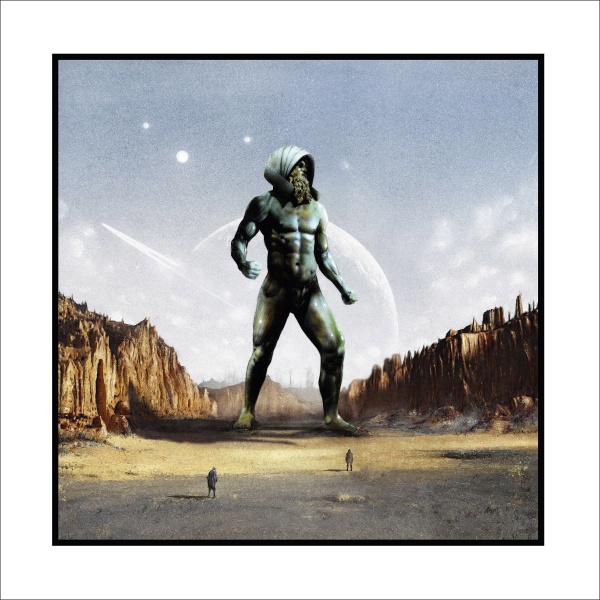
Earlier this year, Italian producer and RBMA alum Panoram unveiled plans to inaugurate his Wandering Eye label with a new album in April. Entitled Background Story, the forthcoming effort deals in “spaced-out filter sweeps,” otherworldly synthwork, and saturated guitar and strings, and is described as “a meditation on the nature of memories and reality, each song digging deeper into the mind in the search for fragmentary details.”
Background Story arrives as the successor to Panoram’s diffusive Everyone is a Door LP on Edinburgh imprint Firecracker, and will see an official release this week. For the moment, however, the artist has shared a teaser video that plays with viewpoint and perception and can be watched below, where the album’s complete tracklist and preview clips have also been included.
1. Mind Puncture 2. There Was A Hole Here 3. Black Milk Shower 4. Background Story 5. Fog 6. Dead Plastic 7. The Persistent Image Of The Left Eye 8. Anamnesis 9. Hyperuranion 10. You Are Correctly Lost
Barcelona based imprint The Monkey Bar Records will release the upcoming EP by left field house act Pajaro Dune, which, to quote the label, will be “pure obscure deepness with a scent of house.” The four track EP will be limited to 300 records and will feature a “Cosmic Remix” by French techno producer Zadig, who turns in a psychedelic rework of “A Sudden Desire.” Not included on the vinyl release is the epic track we’ve been gifted here, “A Sudden Desire (Zadig Remix),” a two stepping, pad drenched cut with classic Detroit influences. You can download “A Sudden Desire (Zadig Remix)” for free below, with a full preview of the EP also included.
Word has come that Barron Machat, of LA-based label Hippos in Tanks, has died at the age of 27. As reported by Resident Advisor this morning, Machat served as founder and operating CEO of the imprint, which has released leftfield electronic, pop, and R&B from the likes of Autre Ne Veut, Nguzunguzu, Laurel Halo, Hype Williams and Dean Blunt, James Ferraro, and more. News began circulating via tweets from Machat’s colleagues, Tri Angle head Robin Carolan and Oneohtrix Point Never, although no cause of death has been shared as of yet.
Following on from their trilogy of EP’s for the peerless R&S Records, Appleblim and Second Storey (a.k.a. ALSO) released their debut self titled LP this week to great acclaim. Featured as a standalone digital release is a remix by the always enigmatic UK producer Shackleton. The Skull Disco co-founder (alongside Appleblim) has turned in an atmospheric, otherworldly rework; twisting the original into layers of evolving soundscapes and sci-fi like bleeps. The remix can be streamed in full below, and keep an eye on R&S for the digital release.
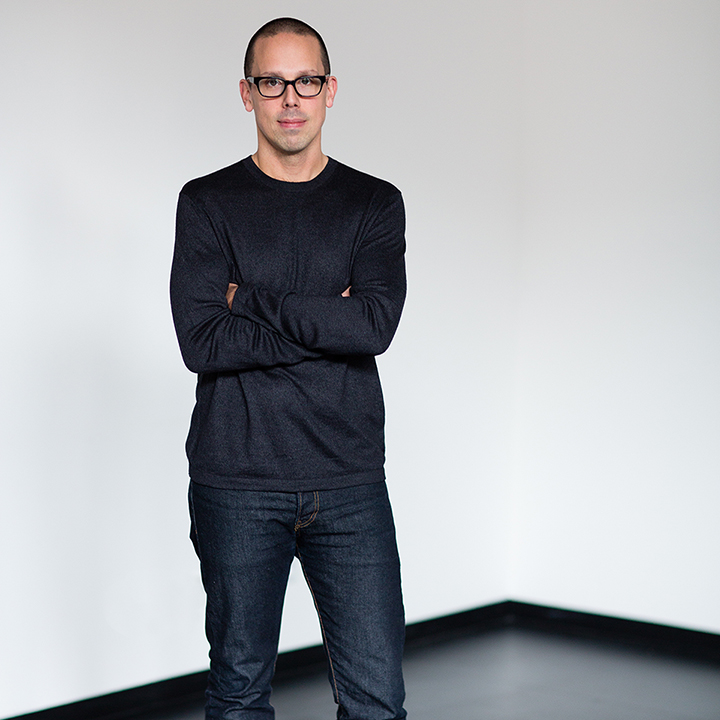
Dennis DeSantis is a composer, sound designer and percussionist based in New York City. His background in music is deep: He received a Doctor of Musical Arts degree in composition from the Eastman School of Music, and also holds degrees from Yale and Western Michigan University. And his day job is writing the technical documentation for Ableton’s products, including the sprawling, ever-expanding beast that is Ableton Live.
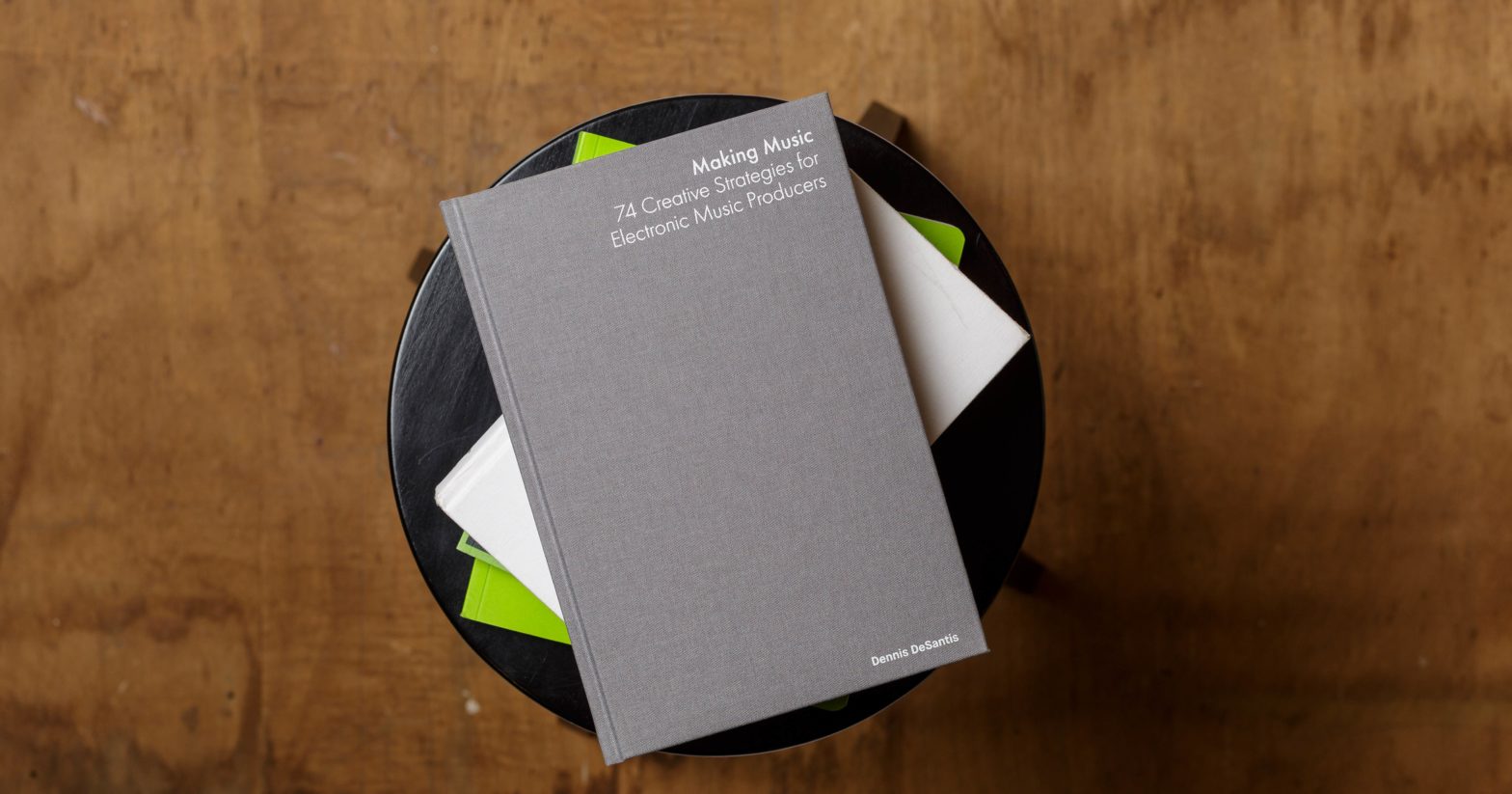
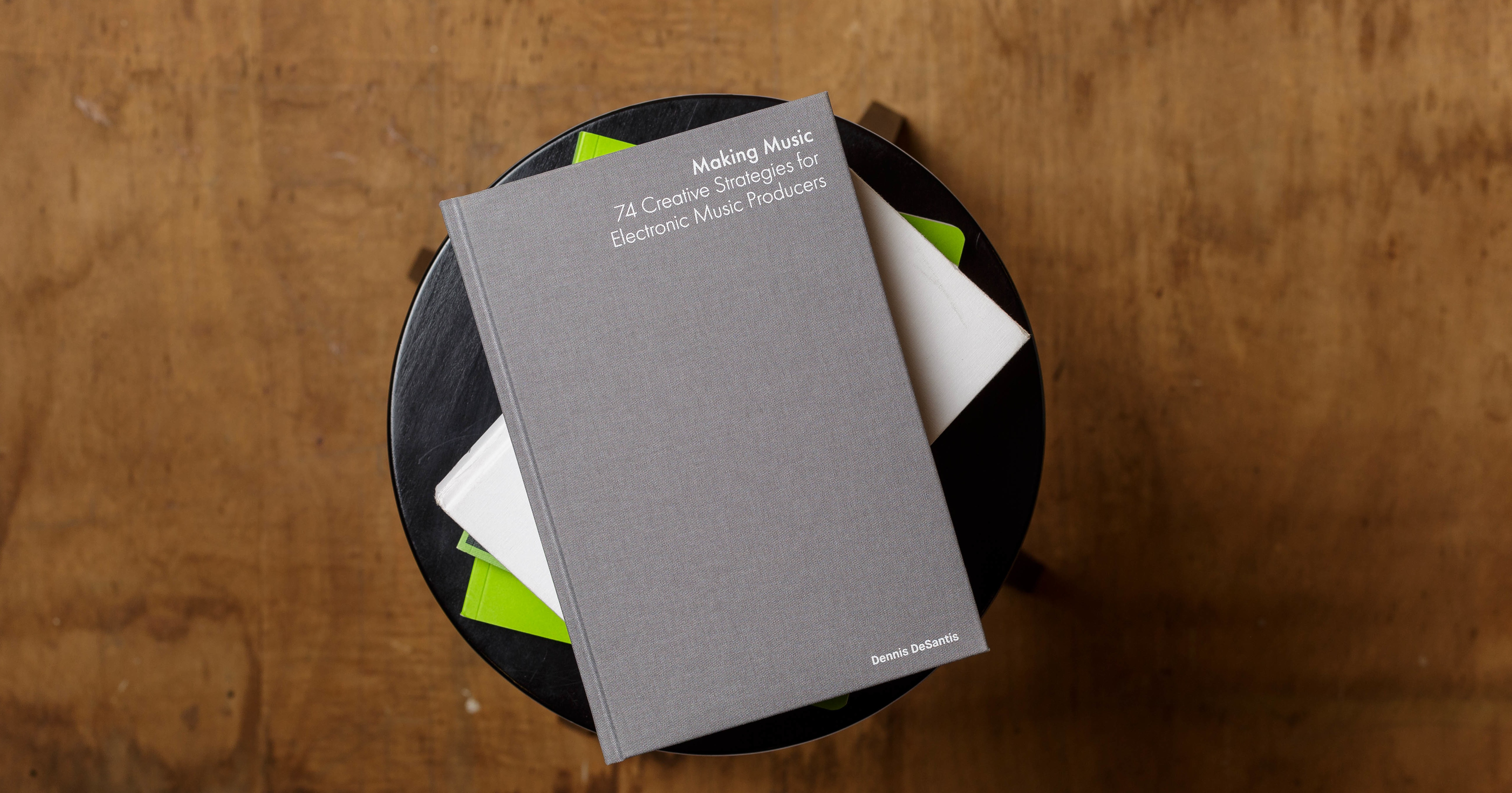
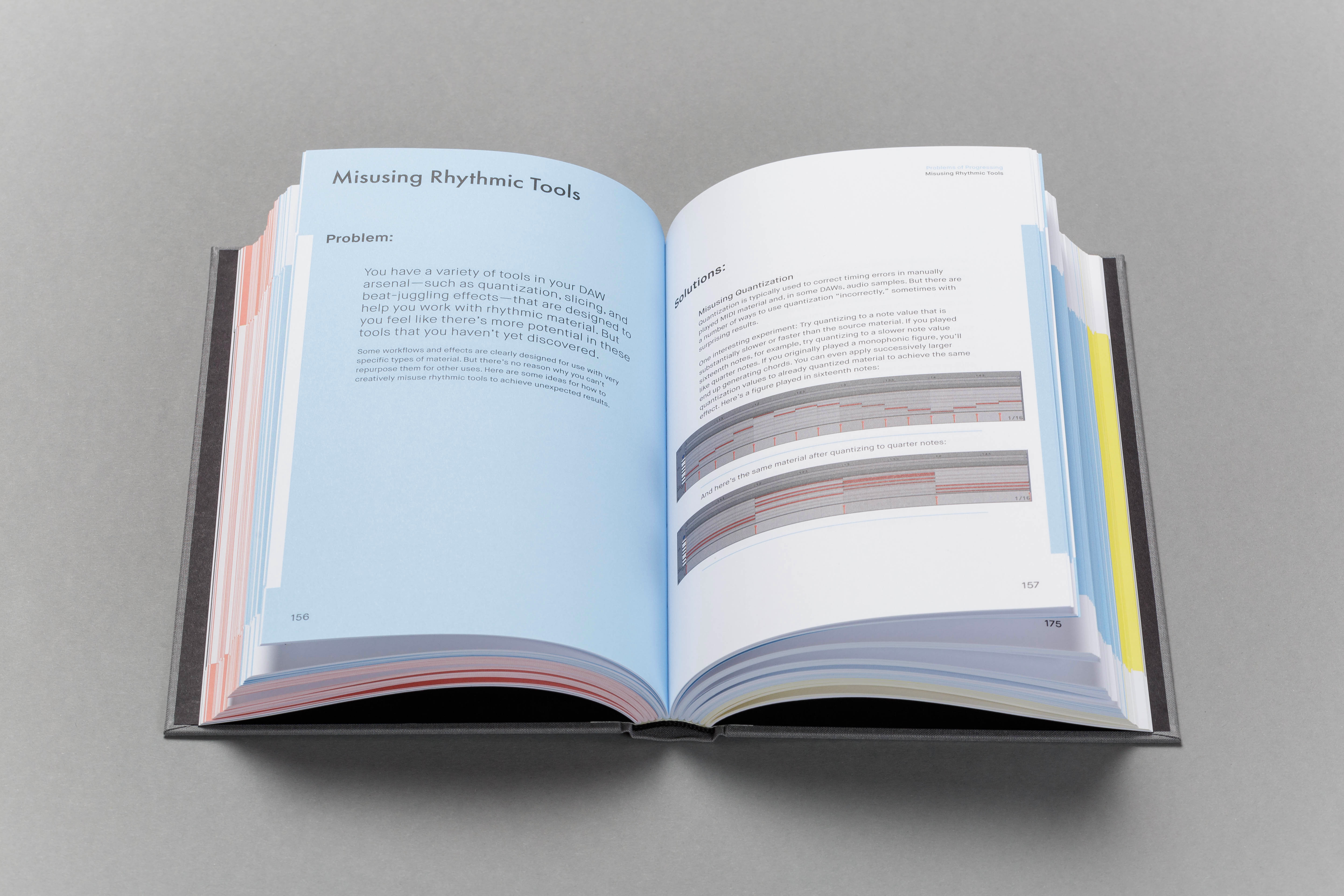
DeSantis’ new book, Making Music: A Book of Creative Strategies, is published by Ableton but it’s not Ableton-specific. Instead, the beautiful hardback tome is a DAW-agnostic tool, aimed at music producers looking for help beyond the technical variety; sections have names like “Programming Beats 1: On Looseness” and “Dramatic Arc”. We spoke to Dennis about how he compiled and organized his techniques to keep the creative juices flowing.
How did this book originally come together? I’ve been thinking about doing a book in this direction for a long time. This was based on seeing lots of artists and musicians struggle with the same kinds of problems, regardless of what their skill level was. And these problems had nothing to do with technology—they really had to do with getting over creative blocks, or being musical, or taking a small pile of ideas and turning them into a finished song. When I started looking around to see who had addressed this, I found more and more tutorials about sidechain compression.
Why did you decide to have Ableton publish the book, as opposed to a traditional music book publisher? I’d originally planned to do it as my own recreational project, on my own time, and shop it around to the kinds of publishers that deal with music tech stuff in general. I mentioned it one day to our CEO, Gerhard Behles, and he was like, “Well, why don’t we publish it?” I thought that was kinda crazy at first—what business do we have going into the publishing business? But the more I talked to him and thought about it, the more I realized that it totally made sense. Our company goal is to help people become better musicians, and one way that we’ve been able to do that is by inventing technology products, but another way is through education—trying to help people become better musicians. It sold out in two minutes, which was crazy—so now we have to print more. Good problem to have.
What kind of research did you do for the project? I had a few casual conversations with a few artists—mostly my friends and some who are classical composers, because that’s the world I came from—just to ask them questions in general about where they get stuck and how they get out of it. And through talking to these people, I started to develop the idea to organize it into three big sections: Problems of Beginning, Problems of Progressing, and Problems of Finishing. But the rest of it is mostly out of my head—it’s the things that I do myself. I think if I were to do another volume, I’d want to get more people’s opinions.
There are two big threads of the type of stuff in here: there’s the chapters that have to do with psychological and philosophical approaches to music-making, and then the ones that are sort of raw music theory. With those, the idea was to distill what I learned from classical education down to the absolute bare minimum that you’d need to make sense of these concepts, without 800 years of music history and examples from Mozart. What do you need to know how harmony works? When I learned harmony, it was part of a very structured musical process that made the topic seem really big, and I think it’s actually not that big.
From your vantage point at Ableton, roughly what percentage of the electronic music producers you encounter come from a classically-trained background? It’s not very common that I meet people who went through a university curriculum studying classical composition or something. That seems to be the minority. There are a lot of people out there who took piano lessons as a kid, and try to bring some of that to what they do as an electronic musician. There are probably more people—especially with the explosion in the last few years of electronic producers in America—coming at this for the first time. This is their first exposure to musicianship at all, and in the 70s they would have bought a guitar, and now they’re buying Ableton Live…or pirating it. This is their first attempt at musical expression in any way, and they have a huge mountain to climb because they have the technical hurdles to get over, as well as the musical ones.
I see a lot of comments on YouTube videos or Internet forums where people really just appear to be completely lost. They feel helpless, like they’re looking into this void, and some of the hope between this and what I do on the technical side, is to kind of demystify this process a little bit.
The incognito and elusive artist Man Power has announced his self titled debut which will land on Correspondant Records May 25. Having previously released on Hivern Discs, rumours are abound that it may be label head, John Talabot himself. Whoever it is, Man Power has a genre bending, eclectic approach, which will be reinforced with the new full length. “The best way I can describe the process of making this album is like doing a jigsaw puzzle, in the dark, but you have to cut out the pieces yourself.” Man Power says. You can check out the video for “Inside” below, with a full track listing, ahead of the May release.
Tracklist: 01. A Start Of Sorts 02. Boys Beware 03. Bielsteiner feat. M.Rolfe 04. French Basic 05. Forget To Remember 06. Lude 07. Hunting Swan 08. Tofu ist der Teufel 09. Inside 10. TEN 11. Fin
Fred P’sSoul People offshoot, Boards, have announced it’s first full length release in the form of Portrait of the Falling Sky by Spanish producer, DJ, and A Harmless Deed label head Jose Cabrera (a.k.a. J.C.). It will be the first full length from Cabrera, who has previously released a split EP with Fred on Soul People, as well as cuts on Deeply Rooted House. Portrait of the Falling Sky is a heady mix of deep, hypnotic, techno with a list of collaborators including Illian Tape boss Dario Zenker, Psynote, and Tadeo. Boards will release the album June 1 and in the meantime you can preview the full release, including tracklisting, below.
Tracklist:
A1 Caliban A2 Endorphinas (feat. Kastil) B1 Human Behavior B2 Hydra B3 King of the Wild Frontier C1 Nebula 584 (feat. Dario Zenker) C2 Nereid D1 Hyperion (feat. Tadeo) D2 Titania D3 Dementia (feat. Psynote)
We last heard from Polish born, New England-based sound architect Derek Piotr in 2013 when he offered up “Intersection of Rivers,” a track from his brilliant Tempatempat LP, which was released in 2014. On May 5, Piotr will return to the long player format with his new solo album, Bahar, which roughly translates as “spring” in Turkish, or “sea” in Maltese. The album was entirely self produced and showcases Piotr’s classical training for the first time in his solo career. We’ve been gifted “Day Residue”, a beautiful amalgamation of sound design and nostalgic-feeling found sounds; unfolding more and more with each listen. Bahar will be released via bit-phalanx and you can grab “Day Residue” for free below.
“That album name came kind of last minute,” Mike Greene says as he sits in a Williamsburg, Brooklyn hotel room, relaxing before a late-night gig at New York’s club of the moment, Good Room. “I had the track “Insides,” but I didn’t have a name for the whole thing yet. I ended up choosing it because I like the way it implied the guts, or the texture, or the meat of it. When I was making the album, I was interested in crafting the sounds—really building it up from scratch. It’s really about getting deep into it.”
It’s safe to say that on Insides, just released on Ghostly International, the London-based artist better known as Fort Romeau does get deep into it. By turns somber and celebratory, restrained and exuberant, it’s perhaps his strongest work yet—which, considering the immense appeal of his 2012 debut, Kingdoms (on the 100% Silk label) and a string of EPs for Ghostly, is saying quite a bit. His music (mostly) slots into the “deep house” category, but it’s an highly textured sort of house, much of it boasting a hazy, dreamlike aura that’s more bliss than bump. Which is not so say Greene doesn’t know his way around a jacking beat, as a listen to the second half of his recent XLR8R podcast will attest.
You’ve been quoted as saying that that you’re a fan of “slow listening,” that we should pay more attention to the music we consume. Are you also an acolyte of slow producing? I’m actually really fast, at least compared to the producers that I know. I’m pretty disciplined with the work. Everyday that I’m not traveling, I’ll be doing nine hours in the studio. That inevitably means I’ll be making a fair amount of music, and then it’s just a case of distilling it down—cutting the wheat from the chaff, really.
How much material did you have to distill from for this album? If you were to include every half-finished idea—every start and stop—it would probably be about a hundred. But that’s including things that I might have worked on for two hours, and then abandoned. I think that when you are working on a track for two hours, and it hasn’t got a sense of identity yet, it usually isn’t going to work out. That’s not to say I can finish a track in two hours, because I certainly couldn’t. But if the kernel isn’t there yet, I’ll feel like I’m going down the wrong path.
“I’ve branched out in terms of references—referencing other music and other genres, basically broadening the scope of the sound.”
This is your second LP, and you’ve released a number of well-received EPs. How do you think you’ve progressed as a producer over that time? I feel like there’s been an evolution since Kingdoms. I do still like Kingdoms, and definitely think that it had lots of good ideas; a lot of the themes of the records and the sounds of Kingdoms and Insides are related. But I’ve really focused on the craft side of putting music together since then. I’ve also branched out in terms of references—referencing other music and other genres, basically broadening the scope of the sound.
I think you can hear that in the new record, and your recent music in general. It seems a bit more fleshed out than your earlier material. It’s important for me to feel that my music is growing. To knock out identical carbon copies…it’s hard for me to see the point in doing that.
You’ve said in past interviews that “the serendipity of working with certain machines shape the sounds you use and the way tracks become formulated.” Do you still find that to be true? That’s particularly applicable to the approach I had while making Insides. There was a lot of sample-based material in Kingdoms, whether that was vocal samples, loops, repitched sounds or whatever. With this one, I wanted to make it as much as possible from scratch. Obviously, when you’re working with any kind of machinery, system or medium, that medium imparts its own influence on the way in which you work, and on the music itself. Certain machines steer you into working certain ways. Using a sequencer that’s step-sequence–based will have a different outcome than working with something that’s played with a keyboard, for example. I think it’s important to acknowledge that, and to utilize that in a way that is considerate of the instruments that you are using. That way, you deepen the relationship with those instruments.
“If you think about all of the engineers at Roland or Korg, all of the people who develop the sounds of these classic machines, they’re as responsible as anyone is for the sound world that we inhabit in electronic music.”
That’s probably true of all producers, particularly in electronic music—but one rarely hears it articulated. There’s an element of accreditation within electronic music. If you think about all of the engineers at Roland or Korg, all of the people who develop the sounds of these classic machines, they’re as responsible as anyone is for the sound world that we inhabit in electronic music. I didn’t develop the sound of the 707 kick drum or the 909 snare drum; they’re sounds that predate me, and permeate so much electronic music. It’s interesting to consider authorship in relationship to the people who made the machines. It’s almost an unspoken thing, but it’s worth noting.
Your music has generally been recognizable as house music, but it’s always been a particularly warm, intimate form of house. Is that something that comes naturally to you? Is it a reflection of your personality? I think it really is. There are occasions where I’ve tried to make things a bit more aggressive or harder, but every time I do it…I don’t know. The music of mine that I’m most happy with is music that feels really honest. It’s funny—I can listen to really pummeling Berghain techno, or really stripped-down jacking house tracks, and love it. But I feel that if I were to actually make really aggressive music, it would be something of a pastiche. It wouldn’t be me. And if I’m going to put something out into the world, it has to represent where I’m coming from. Otherwise, it would feel inauthentic.
Perhaps you could use another pseudonym if you ever do want to put out some pummeling techno. Yeah, perhaps one that people could pronounce this time. [laughs]
Speaking of that, where did you get the name Fort Romeau? There’s not a lot to it. When I did the 100% Silk record, I still didn’t have a name, and it was going to be coming out soon. I was on holiday with my wife in the south of France, and we were driving around, talking about what to call this. We drove through this town called Font-Romeu, and said, “Well, why don’t you just take that name and change it a little?” So that’s what I did. It sounded a little moody and a little exotic, and maybe a little sexy, so we like, “Yeah!”
There actually are a few tougher moments on Insides, perhaps some of the toughest music you’ve released. Is that the influence of having DJed a lot over the past few years? I think the reason that some of the tracks are a little harder hitting and punchier is that when you DJ a lot, you get a sense of how to reduce things down to just the elements that you need. I suppose the clubbiest track on the record is “All I Want,” and that one is really quite pared down. I think that having that kind of simplicity and directness tends to lead you to that kind of sound. So it is informed by playing out a lot, but it’s not just from the desire to make something that’s tough. It’s a byproduct of reductionism as well.
So what’s next for Fort Romeau? Well, we’ve already gotten some remixes from the album done, so there’s going to be a remix EP. That’s already mastered. And I’m already planning some new 12-inches for later this year; I feel like there’s still a trajectory of things that I’d like to try as Fort Romeau, things from the sound world of Fort Romeau and its references. I actually struggle to make music that strays very far from that. I’m working on that, but it’s okay—I think I still have plenty of steam as Fort Romeau.
Irish producer, and one half of Lakker, Ian McDonnell (a.k.a. Eomac) will release his latest EP, Frozen Souls via the Inner Surface Music imprint May 12. Following on from his release on Stroboscopic Artefacts Five Years series, the four track EP is a dusty and hypnotic outing and will also feature a remix from Serbian techno duo Ontal, who turn in a typically dark and powerful rework of the title cut. “Frozen Souls” opens the EP with it’s static drenched pads and buried kick drums before “Heretic” drives things forward with distorted, dance floor focused precision. The machine-like “Charon” rounds out proceedings, showing Eomac’s Warp and IDM influences and a more experimental touch. You can check out full tracklist below, with the EP arriving May 12.