Following behind recent releases from Gingy and Leon Vynehall, Clone Royal Oak has revealed plans to drop the four-track EKR’s Galactic Dance EP from Japanese producer Takuya Matsumoto later this month. Serving as Matsumoto’s debut on the imprint, the forthcoming effort is simply described as “a beautiful four-track EP with unique tracks from this talented Japanese producer.”
Fortunately, Clone (a label we recently featured as part of our Labels We Love series) has provided preview snippets for all four of the forthcoming record’s jazz-flecked tracks. The preview stream can be found below, along with the EKR’s Galactic Dance EP’s complete tracklist; Matsumoto’s debut for Clone Royal Oak is set to see a release on November 17.
A1. EKR’s Galactic Dance (Part 1) A2. EKR’s Galactic Dance (Part 2) B1. The Sun on the Refugees B2. Satellite Orbit Funk
London’s Whities imprint has tapped Kowton to deliver a three-track 12″ for the label’s second release. Following behind the Young Turks-associated label’s inaugural outing from Terron (which arrived bacj in February), Kowton’s forthcoming 12″ finds the Bristol artist delivering three efficient and percussive dancefloor cuts, all of which appear to feature synthetic bell tones in one form or another.
The vinyl version of Whities 002 will see a release on November 24, with a digital version of the three-track 12″ set to be available a few weeks after. For now, Kowton’s upcoming record can be previewed below.
The fast-paced 1080p label seems intent on continuing its run of plucking fertile talent from places no one else thought to look with the debut release from Mongo Skato, I Don’t Give It, just on the horizon. A New Zealand-based producer, Skato’s forthcoming eight-track debut is said to deliver a range of “euphoric” and “deranged” hybrid technoid productions influenced by “recently discovered dirt-cheap ’90s house and techno records.” Our first glimpse into how Skato’s various aims and inspirations may all converge on I Don’t Give It comes in the form of “Turismoc,” a track which steadily bounces with lo-fi rhythms that serve as the structural base for an array of fuzzy chords and playful melodies whose tones land somewhere between cheap digital synths and decades-old video-game music. Finished off with just a touch of funk, “Turismoc” seems to indicate that Mongo Skato’s debut outing will sit nicely amongst the rest of the 1080p catalog when it officially joins the ranks on December 2.
In the rapidly evolving world of electronic music, it’s all but impossible to keep track of every new artist, label, party, and genre. At the same time, certain names will inevitably pop up again and again at the XLR8R office, some of which we’ve only given passing mention to on the site. In an effort to get our readers up to speed with some of the things—both new and old—that we’ve been digging lately, we recently launched a new feature series called ‘Get Familiar,’ which aims to shine a spotlight on subjects we think are worthy of a little more attention.
For the past several years, some of the most talked-about figures in the world of techno have been the freaks—the outsiders, the punks, the weirdos, the people on the fringes who approach electronic music from non-traditional perspectives, bringing to bear influences from punk, industrial, noise, experimental, and hardcore to create dance music that sounds anything but ordinary. Beau Wanzer, self-described weirdo, is one of these figures; his music incorporates the atmosphere and motifs of early industrial, the rhythms of vintage minimal synth, and the raw, gritty feel of turn-of-the-century European electro.
Wanzer’s story begins when he was a teenager, buying CDs and records sound-unheard from now-defunct chain stores all over the Midwest—growing up, he never spent more than a year in one place. “This was ’94, ’95,” he says. “I was 14 or 15. I would always pick out what I thought were the weirdest, most interesting covers. That’s how I found Front 242, Databank A, Death in June, all these weird goth and industrial CDs that were there.” A key influence on Wanzer’s sound was Dirk Ivens, a Belgian industrial musician who in 1980 started Absolute Body Control, an influential minimal wave band, and was later part of harder-edged EBM act The Klinik and also recorded solo as Dive. “I was always listening to Absolute Body Control,” he says. “I was super into all the Antler Subway stuff [a Belgian label that released The Klinik and other EBM and new beat]. Later, I got really into Cold Meat Industry stuff, and when I was 17, I heard the first P•A•L CD, Signum. That blew my mind and opened me up to all the Ant-Zen sound [an experimental and industrial music label based out of Germany].”
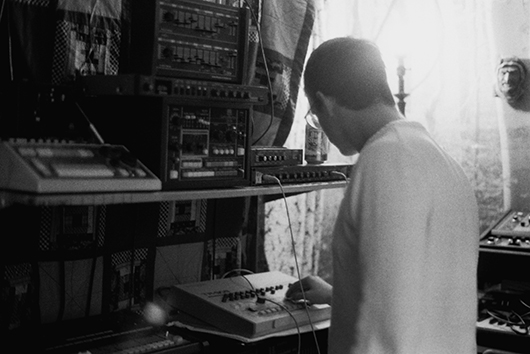
Beau Wanzer
Despite his passion for industrial sounds, techno was not an unknown quantity for Wanzer. “All my friends were going to raves at that time,” he explains. “They were listening to techno, and I heard it all, but it wasn’t my thing. It wasn’t hard enough for me. You know, when you’re that age, you want the most extreme stuff you can get. So when they were going to raves, I was going to punk shows, noise shows, all that.” At age 18, Wanzer acquired his first synthesizer, a Roland Juno-6, and began steadily recording material. However, the building blocks of Wanzer’s musical career didn’t begin to fall into place until later, when he moved to Chicago at the turn of the millennium.
Wanzer began working at a Chicago record store, Weekend Records & Soap, in 2001 (which also sold—you guessed it—soap). Weekend was owned by James Marlon Magas, a long-active member of the Midwest punk and no wave scene who also released a handful of electro records, as Magas, on ADULT.’s Ersatz Audio label. It was at Weekend where Wanzer discovered the raw electro and outsider techno sounds of labels like Bunker and Crème Organization from the Netherlands, Invasion Planète from France, and the reissue of Liaisons Dangereuses’ self-titled record from 1981. “At that time, we were the only record store in Chicago bringing in Bunker, Crème, all the weird shit,” he says. “When I first heard Liaisons Dangereuses, it floored me. It just changed my world, I think. It was so alien. I had never heard anything like it before.”
During this time, Wanzer was recording material at a breakneck pace. “I was never thinking, ‘I want to put this out,'” he says. “I’d just go home and record. I’d record about a track per day, since about 2000,” a regimen he’s kept up to this day. He continues, “I’d pick two or three drum machines, a synth, and sit down and work with those two or four pieces. I don’t go in with any kind of intention, no melody in my head or anything like that. I’ll find a beat I like, and then build on that. I rarely, if ever, multitrack things. Everything’s just stereo out, and there it is. For the most part, it’s one take, one shot.”
While working at Weekend, Wanzer met fellow Chicago resident Melvin Oliphant III (a.k.a. Traxx) and the two became friends, bonding over music and records when Oliphant would visit the shop. At the time, Oliphant had just started his own record label, Nation, and the pair began recording music together. “Melvin had his label, had a couple releases out, and we weren’t hanging out with the intention of putting out music or even making music, we were just listening to records,” Wanzer recalls. Still, It wasn’t long until they started recording together, creating off-kilter hardware house music that would eventually be released under the name Mutant Beat Dance. (Over the years, Wanzer has also become involved in a number of other collaborative projects as well, including Streetwalker with Elon Katz of White Car, Civil Duty with Shawn O’Sullivan of Led Er Est, and Juzer with Dan Jugle.)
However, when Wanzer works as a solo artist, his productions take a different tack, amping up the darkness and often slowing down the rhythms. His first solo release came in 2008, on a three-track Nation compilation, a year before Mutant Beat Dance’s first record. Bearing the cheeky title “F. U. Klaxon,” it’s a grim but gorgeous piece, with a throbbing drumbeat keeping time under a gurgling synth, fuzzed-out vocals, and an insistent minor-key melody. A handful of compilation releases followed, but it wasn’t until 2013 that his first solo 12″ was released on New York’s L.I.E.S. The record featured a track that put him on the radar of many DJs, the even-more-cheekily titled “Balls of Steel.” Embodying Wanzer’s minimalist approach (it was recorded with a single drum machine and a microphone—nothing more), the track features a plodding electro rhythm with Wanzer’s disembodied vocals interspersed, proclaiming: “I should stop smoking/It’s killing my body/Everyone should try it/I’ve got balls of steel.“
Wanzer’s just-released eponymous first LP is ragged, rough, and woozy, playing with genres throughout, the whole thing cobbled together from dozens of archival cuts dating back to 2002. In spite of its rough edges, the one theme that binds the album together—and, in fact, links all of Wanzer’s productions—is humor. The album’s artwork harks back to the bygone era of ’70s and ’80s horror films, a genre of film that always teetered on the edge of absurdity as directors often toyed with their audiences—audiences who knew they were being messed with, but loved it all the same. Even the track titles (e.g. “Mob Boss,” “Slow Down Sir,” “Shitty Cough 2,” “Storm Food”) are winks and nods to a knowing crowd, lightening the mood of what would otherwise be particularly dour collection of music. “I obviously like dark music, but dark music with a sense of humor is key,” says Wanzer. “I’ve never taken myself too seriously, and that’s something I hope to convey with my music. It’s good to have a sense of humor with whatever you do—balancing the macabre with a sense of playfulness.”
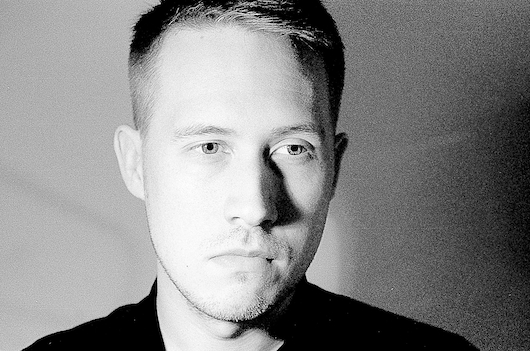
Two sessions from a six-hour B2B set between acclaimed UK selectors Ben UFO and Joy Orbison (pictured above) have been made available to stream. Popping up on Orbison’s SoundCloud earlier today, the recordings were taken from a joint appearance hosted by ZeeZout in the weeks preceding this year’s Amsterdam Dance Event. Running roughly 45 minutes each, the “Day” installment deals in slow house grooves, while techno dominates the “Night” mix. Both sessions can be heard below and downloaded here.
The pair also kicks off a North American tour later this week, with six shows spread across two weekends. Details of scheduled stops can be found after the jump.
November 13 Seattle – Q November 14 Denver – Cluster Studios November 15 Chicago – Spybar November 20 Montreal – Stereobar November 21 NYC – BLKMARKET November 22 Toronto
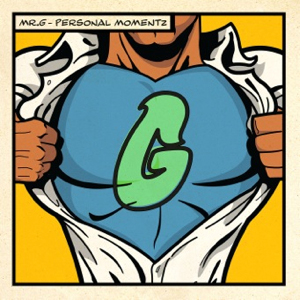
Mr. G‘s sad recent losses have very much been our gain. Colin McBean’s well-received last album, 2012’s State of Flux, was inspired by the passing of a close friend, and this new one was produced in a 10-day period sometime after the death of the Londoner’s father. And it shows: even though much of his work over the last decade has been focussed on tough, dusty, and elongated house, Personal Momentz feels even more expertly distilled and positively storied than anything he has released before.
In someone else’s hands, 12 tracks of ostensibly similar basement tracks would surely grow tiring. Mr. G, though, who is known, and celebrated, for giving up a little piece of himself in each production—particularly in his always personally poignant titles—makes sure to imbue each one with a little something that keeps dancers hooked: a bit of cute drum EQing here, a devastating vocal sample there, or a kinked drum pattern underneath it all is always enough, and never too much.
His tried and tested formula combines thick and heavy bass (picked up from Studio One records and the reggae sound system he worked for as a youth) with the headier, long-form hypnosis of techno (which he made as part of The Advent back in the ’90s) to expertly economical, yet efficient, effect. McBean captures the essence of humid and intimate backroom clubbing like few others, and isn’t afraid to leave in the occasional bit of oddness, so long as it feels right to him. Opener “Faith” is actually one of the new LP’s wilder cuts, thanks to the evangelical call-and-response vocals that dominate a grubby, barely restrained bottom end. Elsewhere, there is fat, lazy beatdown on “Hip Flexer” and a nod to his Jamaican roots on the dark and militant stomper “Thingz and Stuff (Mango Boy Red Eye Mix).”
Reading into, as one must, the track entitled “Dad,” which starts with far-off keys and lonely drums, we can assume Mr. G has dealt well with his father’s passing. Crushing as the track is to start, some warm-blooded bass and spinning jazz synths soon appear, slowly transforming the mood into one of optimism. There’s even room for a joke, as a sampled comedian speaks of death, wonders why people complain about the cost of funerals, and laughs at the fact that people say, “Didn’t he look like himself?” to a stiff body in a casket. Moody, deep, and heady as this album often is, then, these rays of light are what stop it from being too depressing on the whole.
After that point, some of the grit and dirt disappears. It’s as if McBean has shaken off a somber cloud and is ready to face the outside world. As such, things get progressively cleaner and more colorful, and by the time the heavenly xylophone chords and spiritual female cries of “Angels (Ascending)” creep into earshot, things have gotten positively uplifting. Uplifting in Mr. G terms, that is, because there is still a firmly rooted bottom end that keeps listeners entrenched in his heavyweight grooves. What’s more, the closing “Dark Heart,” with its monstrously skewed lines, ghoulish tech overtones, and darkly futuristic robo-vox, certainly hints that menacing mental demons are never too far away.
LA beatsmith Ras G has shared details of a follow-up to his 2011 album, Down to Earth. As reported by Resident Advisor earlier today, Down 2 Earth Vol. 2 (The Standard Bap Edition) will be jointly issued next month by Leaving and Stones Throw, the two labels also behind a brace of beat tapes by the producer in recent years. Described as “his smoothest work to date,” Ras G’s latest effort was crafted as “a tribute to the boom-bap-style hip-hop of his upbringing,” and is set to arrive on December 2. In the meantime, the album’s tracklist has been posted below, along with an advance stream of LP cut “Take it Slow.”
1. Imamu’s Time…. 2. Take it Slow 3. Polo Jacket & Dashiki 4. Nah Test 5. Waiting in Vain feat. KhaILL Sadiq 6. Fake Nice Friends… 7. Uno Uno 8. 50 Cent Phillies 9. Quincy’s 2000 10. Duppy Conquer… 11. Reciprocate the Vibe 12. Mental Field Trips 13. Fly Away…. 14. Vero Cai… 15. Let _G Know… (Keep it a Billion) 16. Love and Peace 17. Lacking Give a Damn… 18. Dark Nights
Four years ago, XLR8R published a podcast from a couple of up-and-comers out of Chicago, DJ Rashad and DJ Spinn. At the time, the two were relatively unknown, but they were also the leading figures in the city’s footwork scene, which was only then just starting to properly break out beyond its intensely local origins. However, not everyone shared our enthusiasm for Rashad and Spinn and their rapid-fire creations; it’s comical to look back at the comments now, but the podcast ignited something a firestorm amongst electronic music fans, as many felt that juke and footwork weren’t “real” music and didn’t deserve the attention. They couldn’t have been more wrong.
In 2014, footwork has touched nearly every corner of the electronic spectrum, and has become a key component of the music being turned out by highly respected labels such as Hyperdub and Planet Mu. Many of the genre’s leading artists have become fixtures on the international club circuit, and when DJ Rashad tragically passed away earlier this year, his death was mourned around the globe. In fact, footwork has become so large that Hyperdub has decided to put out a new compilation, Next Life, which drops this week and celebrates the talents of Rashad’s Teklife crew, particularly its second generation of producers. (It’s also a charity release; all profits from sales of the CD will be given to DJ Rashad’s son.) Despite the abundance of young artists on the record, it’s generally agreed that DJ Earl is the one who’s currently burning the brightest, so it felt right to have him follow in the footsteps of Rashad and Spinn with an XLR8R podcast of his own.
On a basic level, Earl’s podcast is an extended Next Life preview, as the initial two-thirds of the mix is dominated by selections from the compilation. Nevertheless, the young producer was also smart enough to not pass up an opportunity to showcase his own talents, which is why the podcast’s closing run consists of nothing but unreleased cuts, all of which Earl himself at the very least had a hand in producing. As for the music, it’s all footwork, but the genre is even more expansive now than it was back in 2010. There are hard, booming anthems and more abstract, introspective cuts. There are tunes that experiment with jungle alongside tracks that sound like a futuristic brand of high-speed techno. Footwork may be the template, but talented producers like DJ Earl have found a whole lot of room to operate within its parameters. As such, we’re betting that his podcast won’t kick up the same sort of fuss that the one from Rashad and Spinn once did.
01 DJ Spinn & Taso “Burn That Kush” (Hyperdub) 02 Heavee “8 Bit Shit” (Hyperdub) 03 DJ Chap “Glacier Bar” (Hyperdub) 04 DJ Phil “GodZ House” (Hyperdub) 05 DJ Manny “Harvey Rachet” (Hyperdub) 06 DJ Taye & DJ Manny “The Matrix” (Hyperdub) 07 RP Boo “That’s It for Lil’ Ma” (Hyperdub) 08 Durban “I’m So” (Hyperdub) 09 DJ Tre “DNB Spaceout” (Hyperdub) 10 DJ Paypal “FM Blast” (Hyperdub) 11 Taso “Drop That Thang” (Hyperdub) 12 Boylan “He’s Watching Us” (Hyperdub) 13 Gant-Man “Jungle Juke” (Hyperdub) 14 DJ Rashad, DJ Spinn, DJ Taso, DJ Manny “OTS” (Hyperdub) 15 DJ Earl & DJ Taye “Wurkkin Da Bass” (Hyperdub) 16 DJ Earl & DJ Taye “Do This Again” (Hyperdub) 17 DJ Rashad & MoonDoctoR “Can You Feel It” (Freshmoon ) 18 DJ Earl “In the Jungle” 19 DJ Earl & Sirr Tmo “Acidwave” 20 DJ Earl “Off Molly” 21 DJ Earl & DJ Taye “PPG” 22 DJ Earl, DJ Taye, DJ Paypal “KYAO Keyzz” 23 DJ Earl, DJ Manny, DJ Taye “Lotta A$$” 24 DJ Earl, DJ Manny, DJ Taye “MoonBird VIP”
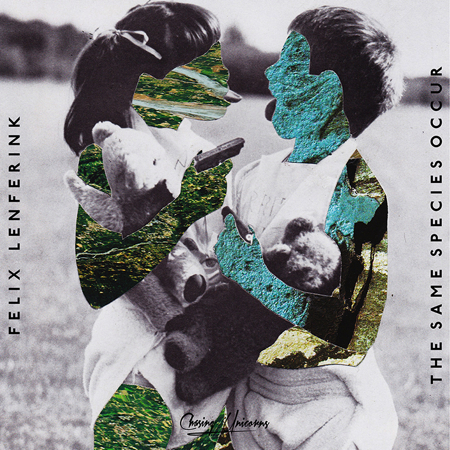
Tracks like “Geronto” are all but impossible to classify in terms of genre. Serving as the closing cut to Felix Lenferink‘s (actually one of the many aliases of Holland-based producer Steve Mensink) upcoming The Same Species Occur EP, “Geronto” fuses together a number of bass music permutations, its low-end content surely fit for the club, while a swirling procession of bright synth melodies and jazzy chords fill out the track’s upper half. A delightfully manic production, “Geronto” is one of five tracks set to be included on the forthcoming The Same Species Occur EP, which will serve as South London label Chasing Unicorns’ 11th release when it lands on November 24. In the meantime, the rest of the record can be previewed after the jump.
Ross Tones (a.k.a. Throwing Snow) has shared news of a forthcoming 12″ on Houndstooth to close out 2014. Entitled Avarice, the record will include two versions of the title track, which first appeared on the prolific UK producer’s debut Mosaic LP back in June. (The original traffics in “discordant, layered strings and a heady drone,” while the VIP refix—premiering below—is said to pack a bit more of a punch.) Also included on the upcoming single is the “As You Fall VIP,” which features London-based songwriter and visual artist Py and was reportedly “developed for the dancefloor” during Tones’ last international tour, and a closing remix of “Hypnotise” from Aus label head Will Saul with Komon and vocalist Kid A.
Avarice is set to see an official release on December 1, and until then, Tones’ VIP rework of “Avarice” has been made available to stream below, along with the single’s full tracklist.
1. Avarice VIP 2. Avarice 3. As You Fall VIP (feat. Py) 4. Hypnotise (Will Saul & Komon Remix) (feat. Kid A)