London producer Auntie Flo will touch down on Permanent Vacation with the Hey Don’t Make Trouble (It’s the Woman of Your Boss) EP next month. Featuring “two full-on afro-futurist stompers,” the record is said to find Auntie Flo (real name Brian d’Souza) continuing to distill his worldly influences into a uniquely potent brand of club music. In addition to the two new productions from Auntie Flo, the EP will also include a remix from the man’s frequent live collaborator and fellow London transplant Esa; his “Afro Acid” rework of “Hey Don’t Make Trouble” serves as the record’s sole b-side.
Hey Don’t Make Trouble (It’s the Woman of Your Boss) will see an official release on April 25, but before then, its artwork and tracklist are included below.
A1 Hey, Don’t Make Trouble A2 Woman Of Your Boss B1 Hey, Don’t Make Trouble (Esa Afro Acid Remix)
Announced at the beginning of the year, Krystal Klear‘s Cold Tonic label got its start with a two-track 12″ from the Manchester DJ/producer, and is once again gearing up to drop a new record from the busy label head. As Dummy reports, “Dance 7FS” b/w “Fumer Tue” will mark Cold Tonic’s second release when it arrives on April 14, 10 days after Krystal Klear’s appearance in Room 2 a London’s Fabric club. We’re treated to a stream of the a-side from that forthcoming 12″ before then, a stripped-down and straightforward dancefloor tune with just the slightest touches of acid neo-soul. “Dance 7FS” can be heard in its entirety below, ahead of its arrival in the middle of next month.
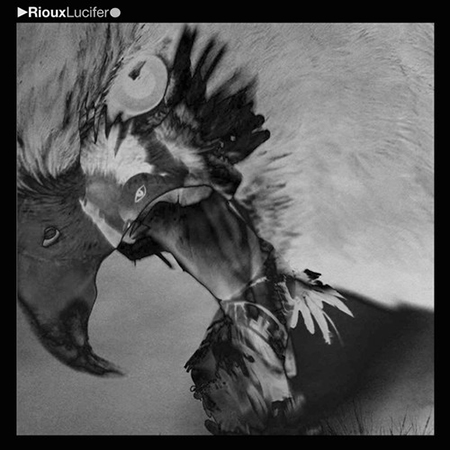
Rioux is no stranger to XLR8R‘s Downloads feed, having been featured twice in the past couple months for his “Trails” and “Maze1” singles, and the Brooklyn-based producer returns once again today with a new ominous house cut called “Lucifer.” Said to be inspired by his “Detroit roots and time spent living in Berlin,” the third installment in Rioux’s monthly singles series travels in a different direction from the previous tracks, and yet manages to maintain his tradition of dynamism with diverse analog and digital sounds. Synth vortexes are accented with cowbell patterns and a funk-tinged bassline throughout the winding course of “Lucifer.” And for those readers in or around New York this week, Rioux will perform along with SETH (a.k.a. Gobby and James K), Spirit Guide, Headaches, and Kashaka at the Silent Barn in Brooklyn on March 28; more details for the event are available here.
One of the numerous standout tracks from Leon Vynehall‘s excellent new mini-album for Martyn’s 3024 label, Music for the Uninvited, “Inside the Deku Tree” is given the video treatment today in the form of a clip of VHS- and Super 8-sourced visuals created by The29Nov. The Berlin-based production team gives their piece an overtly DIY feel, splicing together old home movies from analog mediums, not at all unlike the tape-centric sampling and recording process that Leon Vynehall used for his new music. “Inside the Deku Tree” is as nostalgic as its new video, too, and not only because it’s named after a place from 1998 video game The Legend of Zelda: Ocarina of Time—the song’s mass of airy string samples, softly shuffling beats, and jazzy keys are dusty and absolutely soaked with the age of another time.
The29Nov’s new video for Leon Vynehall’s “Inside the Deku Tree” can be watched below, where the UK DJ/producer’s upcoming US tour dates are also available.
3/4 – Brooklyn, Output w/ Martyn 4/4 – San Francisco, Icee Hot @ The Public Works w/ Anthony Parasole 9/4 – Boston, Re:Set @ Phoenix Landing 10/4 – Philadelphia, The Dolphin Tavern 11/4 – Chicago, Spybar w/ Ben UFO 12/4 – Detroit, The Grasshopper Underground w/ Martyn
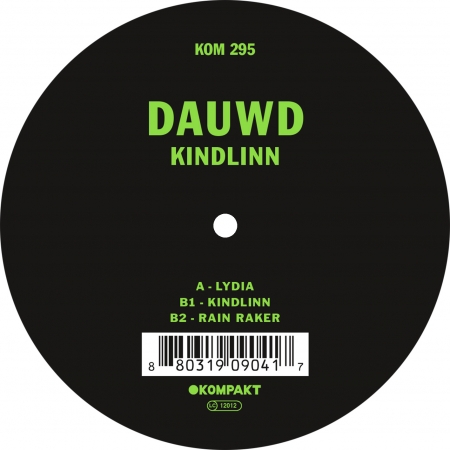
With his Kindlinn EP on the way early next month via Kompakt, London DJ/producer Dauwd has been giving fans previews of the forthcoming record’s three tracks. We’ve already heard a-side cut “Lydia,” and now, EP closer “Rain Raker” can be streamed in full. Dauwd’s latest production was apparently made “almost entirely” using a TB-303, though its floating synthscapes and loose rhythms certainly don’t sound as if they were created with the iconic hardware. But once things get moving a little more towards the end of “Rain Raker,” some of the 303’s recognizable sounds become a bit more apparent.
The entirety of the heavily atmospheric Kindlinn EP closing track is available to stream below, ahead of its release on April 7.
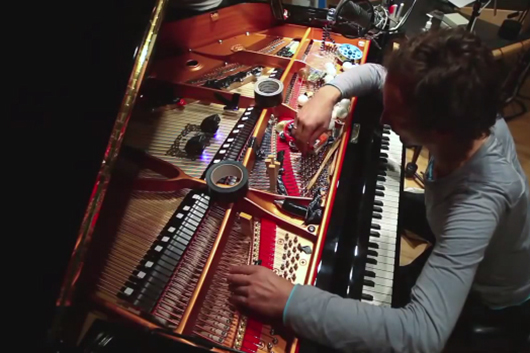
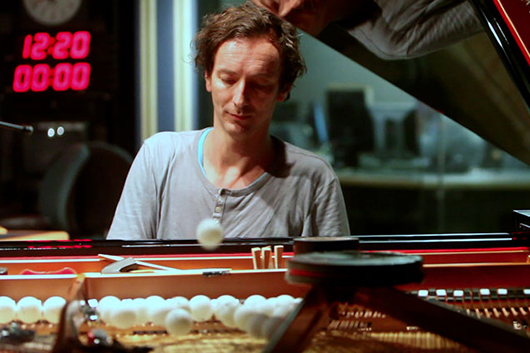
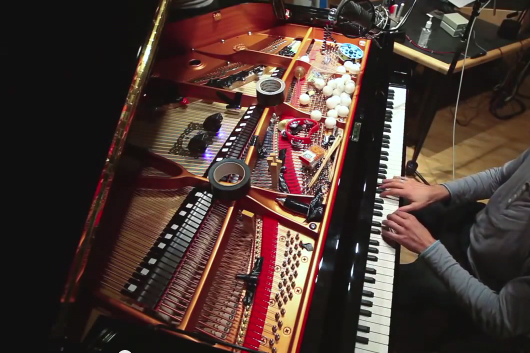
Last week, German composer and pianist Hauschka (a.k.a. Volker Bertelmann) released his latest LP, ‘Abandoned City.’ (For those who haven’t heard it, the album is still streaming online.) A concept album that finds Hauschka employing improvisational techniques while creating music to accompany an imaginary journey through ruined urban landscapes, ‘Abandoned City’ also showcases Bertelmann’s skill with the prepared piano. While many pianists prefer to focus on classic sounds, Hauschka takes things further, altering the instrument by placing objects on or between the strings, hammers, and dampers. Though the benefits of his methods—and the expanded musical possibilities they facilitate—are likely apparent to just about anyone who’s heard his output, we still figured that Bertelmann could pass along some further insights. He obliged by detailing a few of his methods, but also took the time to explain the conceptual appeal of the prepared piano, and even shared some tips for properly amplifying the instrument.
Prepared pianos
Somehow, it seems to me strange that once a machine or an instrument is built, only a very few people try to find out which possibilities are possible in all extremes.
I think preparing the piano is a decision for sound as well as an abstraction of the instrument itself. In essence, you can add layers that create the sound of an orchestra.
I personally started preparing the piano in order to create electronic music with an analog instrument instead of using electronics or a computer. The first sound I came up with was a hi-hat sound created by a Christmas cake bag that was given to me by a friend in a studio. I think that example demonstrates the principle of my work, but it also reflects the idea of how important it is to stay as creative as possible. I give randomness enough space in my work, but also give it a deeper sense by incorporating it into a broader concept.
John Cage mentioned the concept of randomness as a part of getting away from his own habits and increasing the chance of finding something new. I totally agree with that and in fact, it can be compared to the simple act of walking.
If you walk everyday to the same place—for example, maybe to your work—and you always take the same route, it gives you security and familiarity. You can find your way in your sleep even; but if you purposely change directions or take a different route every day, you will have different and maybe eye-opening experiences.
I like both methods, but you have to know when it’s time to change your habits.
Pianos are synthesizers
Of course this is not true, as pianos are analog instruments and synthesizers have oscillators as their sound source. But looking into the different types of preparations, the piano tone can be altered or added to. I also try to create sustainable notes through this process. Here is a basic rundown of the sounds I create:
Mutes
I use felt wedges and mutes that piano tuners are using to mute the overtones and to shorten the note in general. The other good way to mute the piano tones is to use, believe it or not, art erasers. They are very flexible and they stick to the strings without leaving any material on the strings themselves.
Some of the mutes can add an additional tone as well, especially when you use wooden material. I tape saxophone and clarinet reeds together and stick them between the two strings. That mostly creates a wonderfully full hi-hat sound.
Sustained sounds
The problem with a piano is that you can’t create steady carpets of sound that sustain as much as you want them to. You need to find a way to trigger the string constantly, but at the same time have them be quiet enough to have unwanted sounds added. For this, I use ebows that were built for electric guitar in the ’70s. They work perfectly on the piano. If you use them on the bass notes, you have to put two together, as long as the strings are thin enough that they can find space to resonate.
The lowest area on the piano can’t be triggered with the old ebows. The other method is using electric motors that are quiet, similar to small vibrators. You have to paste them at the end of the string with gaffer tape, so that they rattle on the string. You can then regulate the sustain with the sustain pedal.
Percussive sounds
I use a lot of paper and foil to create hi-frequency percussive sounds like clicks, hi-hats, or crackle sounds. They have to be arranged between the hammer and the string of a piano. A good material for this is a light filter.
For a more rattling sound, I use beer bottle caps, necklaces, or marbles. When these kinds of things are loose, they can create their own rhythms that are quite interesting.
Amplification
Another big theme for me is piano amplification. It is difficult to get the whole spectrum of frequency amplified enough to fill a whole stadium or a large venue. My first experience with that was when I played at Roskilde Festival in Denmark. I was in a tent in front of 3000 people, and I played with a string quartet and the pieces were very lyrical and dynamic and quiet.
At the same time, Gogol Bordello was performing on the big stage next to us and we had to incorporate their bass notes to actually make an acceptable performance. So we tried to transpose the pieces to the key in which Gorgol Bordello was playing. That’s an example of the kind of open concept that I appreciate, but on the other hand, it was after this show that I decided that I want to fill the space of a big concert hall or stadium with a pure piano sound, so that people can’t hear the sound from a competing stage next door.
We decided to use six mics on the piano, plus a Helpinstill pickup. This allowed us to boost the bass so much that it nearly sounded like a hip-hop bassline. Because I travel with my sound guy, he can always adjust the volume of bass and depending on the piece, it is great to have the very pure piano sound correctly balanced.
Which pianos can be prepared
You can do all of these things with an upright and a grand piano. The gravity works differently on each type though, as the preparations are hanging on an upright piano, while they’re lying on a grand piano.
The unprepared piano
One of the things that people might think is that I only love prepared pianos. However, I have to admit that the purity of the piano sound is one of the most beautiful things that I know.
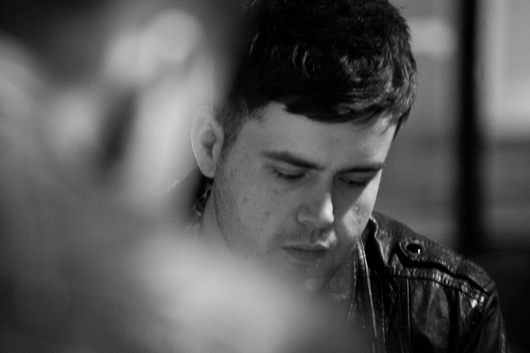
Ann Arbor resident Charles Trees (or simply Trees, pictured above) crafts tangled hybrids that tie together sections of hip-hop, jazz, and electronics into adventurous formations. Over the years, his work has landed on labels such as Moodgadget, Ghostly, Musique Large, and—as of next week—Madrid’s Lovemonk imprint, which will release the man’s Rootwork EP on March 31. Alongside the four original productions which grace the upcoming effort’s tracklist is this remix from the violently un-Googleable DJ F, who reins in “Rootwork” by bringing the focus squarely on cascading layers of synths and a set of dusty breaks. Before the rest of Trees’ new EP hits on Monday, the entire affair—which includes a remix from Ghostly mainstay Shigeto—can be streamed after the jump.
Following the recent release of an eponymous LP via his own Mahogani label, Detroit house legend Moodymann (a.k.a. Kenny Dixon Jr.) has shared a new video for album closer “Sloppy Cosmic,” a remix of Funkadelic’s “Cosmic Slop.” Featuring a multimedia collage of images from Moodymann’s Soul Skate events interspersed with footage from his performance at Motor Unit in Paris, the piece has a DIY aesthetic that fittingly mirrors the loose 11-minute jam—during which Moodymann imbues Funkadelic’s guitar-heavy original song with a patient and relaxed touch.
XLR8R Couldn't find the embed function for type: "vimeo" and source: "<iframe src="//player.vimeo.com/video/89672225" width="530" height="298" frameborder="0" webkitallowfullscreen="" mozallowfullscreen="" allowfullscreen=""></iframe>".
Electronic Beats‘ acclaimed Slices video series recently made the switch to a weekly online format—episodes were previously delivered to subscribers on DVD—and the latest installment features a roundtable discussion between electronic heavyweights Moderat and Jon Hopkins. Apparently, the German trio (a collaboration between Modeselektor and Apparat) recently invited UK producer Hopkins to open up for the group in its hometown of Berlin, and Electronic Beats managed to sit down with the four producers for an extended chat before the show. The 10-minute video includes live footage of both Hopkins’ and Moderat’s performances, and also finds the artists discussing a variety of topics. During the course of the conversation, they touch upon exactly what they like about each other’s music, the importance of visuals in a live set, and how their production and performance methodologies differ. Electronic Beats’ original post is here, though the video can also be viewed in its entirety below.
Manchester-based DJ/producer Lone has remained fairly active since the release of his last album, 2012’s solid Galaxy Garden. Between dropping the excellent “Airglow Fires” b/w “Begin to Begin” single (which offered one of 2013’s best songs), sharing random freebies, and doing a couple of remixes here and there, the artist born Matt Cutler has never been far from the XLR8R news feed. But he’s now primed to return in a much bigger way, as details of Lone’s next full-length record for R&S have found their way online.
Granted, we don’t have all the facts on the upcoming Reality Testing LP (artwork above), but we do know that it will feature 12 tracks—two of which are “Airglow Fires” and “Begin to Begin”—said to “reference the history of electronic music” with elements of “Detroit techno, rave to jungle, and everything else in between.” Cutler’s next album won’t be released until June, but we’ve included the jazzy “Airglow Fires” and “Begin to Begin” tunes below as a reminder of the vibrant sounds it will offer this summer.