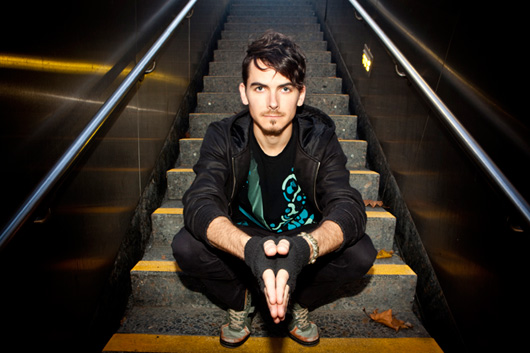
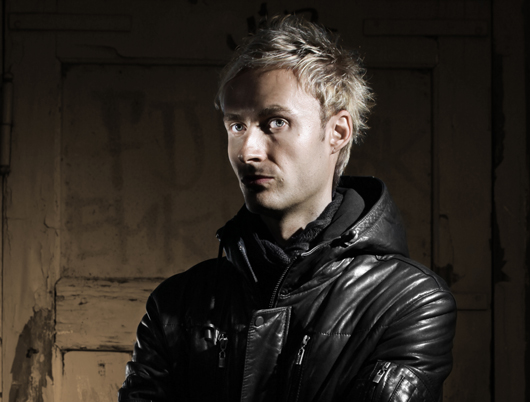
XLR8R’s Inbox brings it home this week with San Francisco-based creative bass producer and Ancestor Media founder, Brendan Angelides (a.k.a. Eskmo). Angelides takes us to the top of his playlist, obsesses over Les Claypool, eats his way through San Francisco, and receives an odd conical gift from fans. Look for Eskmo’s split 12-inch with Eprom, out in early 2010 on Warp.
XLR8R: What’s the weirdest story you have ever heard about yourself? Brendan Angelides: Having someone personally tell me about an amazing set I did at an event I never played at.
What are the top three most played songs on your iTunes? The National “Brainy” Mew “Why Are You Looking Grave?” Aphex Twin “Blue Calx”
What band did you want to be in when you were 15? Primus. I used to be obsessed with Les Claypool.
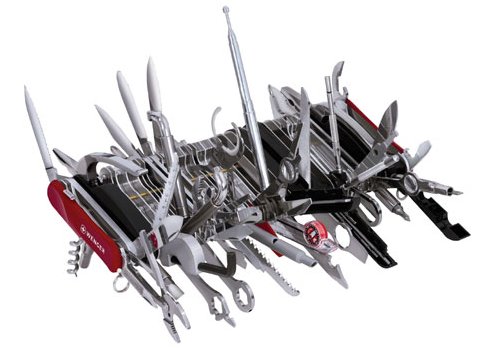
What is the strangest gift you’ve ever received from a fan? A pyramid cone made out of a hard resin, iron, and copper.
Of the cities you’ve visited, which has been the most unexpectedly enjoyable? Edinburgh, Scotland.
What is your favorite studio toy? A Detective Dunny, given to me by a sweet lady.
What is your favorite item of clothing? Creative Rec shoes. I’m a big fan.
If you could have any superhero power, what would it be? I can already fly, so the power to plant seeds anywhere, everywhere, however.
What color is your music? I try to hit all the colors for different reasons. Some songs definitely have a specific tone in mind, while others blend a few of them. Better that way (in my own opinion).
For what sorts of things did you always get in trouble when you were little? Drawing in class; not paying attention; jumping off the swings; sneaking in extra minutes of Nintendo at home.
If someone were to translate your most recent album into a painting, would it fall most closely under cubism, surrealism, impressionism, expressionism, or realism? Surrealism and Expressionism combined.
What was the last movie you saw? Goodbye Solo. Great flick!
Complete this sentence: In the future… There will be holographic movie theaters.
Best decision you’ve made in the last year? I couldn’t even say honestly. It’s all good.
What’s next? My first single on Warp is coming out in early 2010, with my friend Swan doing vocals. On the A side is my good friend EPROM. Very soon a new mix of mine—I usually do one a year—is being featured on Flying Lotus’ Brainfeeder site. [I’m] finishing up some music with Amon Tobin. Some more tour dates are being planned in the states and Europe. [I’m] working on an album. More unnamed remixes and collabs coming along the way. Meet Tom Waits, play in Japan, fall in love all over again.
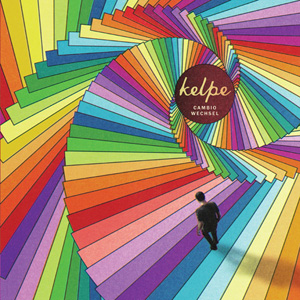
English producer Kelpe (a.k.a. Kel McKeown) works in the potentially conservative field of downtempo funk, but in his clever hands, the funk is anything but conventional. Although music that springs from hip-hop-centric techniques can fall prey to predictability as much as any other style, Kelpe repeatedly finds fresh ways to tamper with funk’s templates on his third full-length, Cambio Wechsel. Throughout the 12-track album, Kelpe maintains an intuitive psychedelic sensibility along with a disjunctive-yet-hypnotic compositional approach akin to Wagon Christ’s work on his classic 1995 trip-hop opus Throbbing Pouch; both releases have that same restless, ingenious fraying of familiar production tactics that mark them as the work of mavericks.
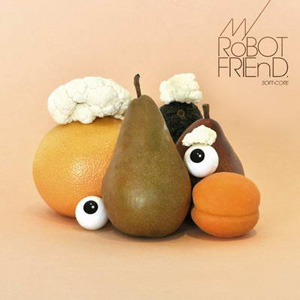
On his third full-length album, Soft-Core, the imaginative Howard Robot of New York-based My Robot Friend has retrofitted his usual light-dappled indie-electronic milieu with a surprisingly simpatico cast of diverse musical characters. A cover of Luna’s “23 Minutes in Brussels” finds Robot alone in his multi-textured electronic element, while “The Short Game,” a clicking, infectious collaboration with Germany’s Zombie Nation, draws comparisons to Hot Chip with its soft mood and sweetly aching vocals. The bot waltzes through a dream world of ’80s-reminiscent synth-pop with Yaz’s Alison Moyet on “Waiting” and into the wistful, spacious “Astronaut” with dream-pop veteran Dean Wareham. Add to this mix a few starry-eyed collaborations with Outputmessage, and it’s a very pretty machine this robot has created.
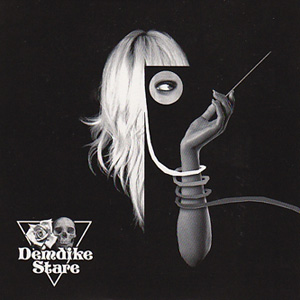
Miles Whittaker has been a bewitchingly busy fella of late, releasing warehouse techno under his MLZ moniker, playing dubby doubles with Gary Howell in Pendle Coven and Andy Stott in the cheeky Millie & Andrea, and now teaming up with Sean Canty in the earthy, neo-pagan Demdike Stare. Spread too thin on the dark side, you say? Not by a long shot. “Suspicious Drone” gets the (witches’) ball rolling rudely with an effects-treated gong and sustained subsonic bass tremors, “Haxan Dub” is a slo-mo 2-step march, and “Jannisary” samples world-beat strings and riddims to come up with something deliciously otherworldly. Sneaky, sinister, and sick in all the right ways.
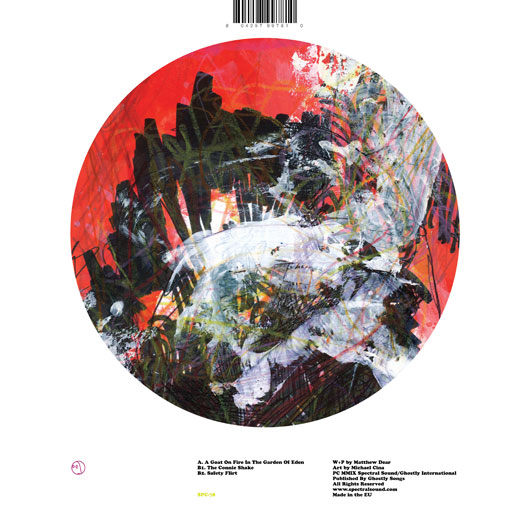
With clients as seemingly disparate as Hewlett-Packard, Pepsi, and Ghostly International, Minneapolis-based Michael Cina is a workhorse designer whose oeuvre is exemplary of an artist thinking in multiple media without elevating one over another.
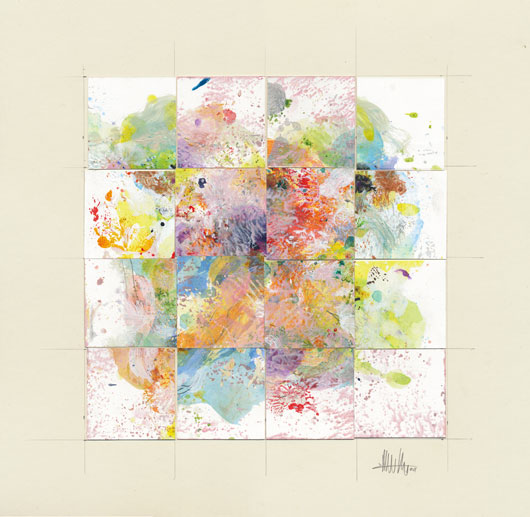
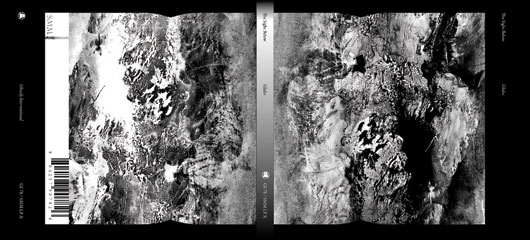
An inheritor of the idea of the gesamtkunstwerk (total artwork), Cina’s precise graphic design and typography for his YouWorkForThem design showcase is informed by his more abstract paintings, and vice-versa. “I don’t feel my career is based on a specific style like a lot of artists and designers,” Cina acknowledges, but this penchant for a more holistic view of what design and art can accomplish explains his many successes: collaborative design work has yielded contracts from Coca-Cola, Pepsi, and numerous other corporate giants, while his paintings have graced the covers of magazines and records for Kate Simko, Bodycode, and many more techno heavyweights. A former DJ and electronic music fan himself, Cina is meticulous about his record-cover design process, listening to the album repeatedly and “thinking about what it would look like, or how to represent it.” With a palette that’s equally informed by Twombly and Rothko, Cina’s covers complement the abstracted but obviously sensual music within, bringing some much-needed color to the often black-and-white world of techno sleeves. Here, he talks about his processes, organizational skills (or lack thereof), and most important influences.
?Did you study design? If so, what did you get from your education that wouldn’t necessarily translate to job skills? Yes, I studied Graphic Communication and did horribly. I was DJing in Dallas at the time, but DJing more than doing school work. I slowly dropped out of college after five years and DJed for a year until reality woke me up. The most important things I learned were to work hard, be meticulous, and never be late. In school they would have you do 400 or more ideas for just a logo, the final had to be drawn exact (Rapidograph pens and Mylar), and there were no late projects.
??Do you find yourself coming back to certain themes throughout your work? I have always been attracted to maps, diagrams, the cosmos, patterns, typography.
??What do you do when you are faced with a creative block? Work harder (this is both good and bad). I should probably just read, but I seem to work until I get something going. Another good route is to just start over or just stop working on the project. There is nothing better than deleting a file that has troubled you.
Have you had a mentor-figure in your career who has influenced your work, work ethic, or process?? Emil Ruder was my main source into proper design. Before I dropped out of school, I picked up a paperback of Typographie for seven bucks and read it over and over and stared at the images. That book showed me ways to think and approach visual ideas that I was never taught. All my life I have wanted a real mentor, someone like Wolfgang Weingart or Wim Crouwel.
What typeface would you like to never see used again? Papyrus. ??
What’s your process like? What’s the first thing you usually do? Normally I will get a brief and just sit on it for a day, let it float around in my head. Sometimes I have an idea right away, and normally those don’t work out. Sometimes I sketch, sometimes I write down words. The main prerequisite for success is knowing what the client wants or knowing where it should go. That direction always leads me to good results.
What do you find to be the biggest obstacle when designing type? There are many. The first is ratio. I will draw five or so letters and realize that a curve is wrong or the metrics are bad. I redraw everything again, maybe five more times, until I get it right. If you don’t start over, your typeface will not turn out how it should and you resent it. This is something that took years to learn—you always fix mistakes. After that, it is either the lowercase or uppercase. If I start on lowercase letters, I don’t know how the upper will look, really, and that stumps me. There are different proportions and looks, too, so you have to get past that. Then, how many weights are you going to do, or any at all? Alternates or not? I always want alternates. Then you have to finish the full font. All 250 or more characters for a basic Latin set. That is the largest obstacle, as it is just a chore. Then exporting can be a royal pain as well. So the full process is an obstacle. Sometimes I really wonder why I do it until I see people use it well; that is probably the biggest payoff. ??
The two ends of the Michael Cina spectrum seem to be your abstract and gestural paintings, and the more rigid typography on the other. Do you feel one end is a reaction against the other? ?Totally. I struggle a lot without being “loose” enough in my design. It is easy for me to work with structure and grids. When you do art, you have to be loose, and the media fights against you. It’s a wonderful process because, unlike design, your work has to be perfect how it is. You can’t just tweak the colors in Photoshop or move something over a little. A painting is final. I learn a lot about typography/design through painting.
?What kind of music do you listen to while you work? ?Recently, it has been all modern classical, drone, ambient-kinda stuff. I really work well when I can concentrate. I really hate it when music distracts you and throws you off. Sometimes you don’t even know it’s the music. Right now, I am listening to Ethernet but the last two weeks I have been enjoying Loscil, Fjordne, Supersilent, Deathprod, Steven R Smith, aAirial, Ben Klock, The Sight Below, Kirby Leyland, and Mokira. Overall, I listen to everything—I am a music fanatic. ?
What ideas or directive, if any, did Ghostly give you when you started working with them? [Label head] Sam Valenti is a visionary and I respect what he is doing 100%. When he asked me to do some work for Ghostly, Sam just said to do what you feel. He has stuck to his word this entire time and really is an advocate for design. As a designer, when someone says “do what you want,” it really means “do what you want, but after I see it I am going to give you a list of changes.” That has never happened. Overall, it is the most pure work I have done to date. ?
Which designers in the past seem to have had the biggest influence on your work? ?For design: Emil Ruder, Wolfgang Weingart, Wim Crouwel, Bauhaus School, Josef Muller-Brockmann, Karel Martens, Jacqueline Casey. For art: Rothko, Richter, Rauschenberg, Keiichi Tanaami, Cy Twombly, Warhol, Christopher Wool. ??
What are your five favorite album covers of all time, and why? ?Let me start by saying that ECM, Factory, Blue Note, and 4AD overall did no wrong. Lee Morgan’s The Rumproller is absolute classic typographic warping. Led Zeppelin’s Presence… Seeing this as a seven-year-old kid, it rocked my world. I spent hours of my life staring at this cover and thinking about what that object could be and why is it so important? I asked my parents what that object was and they didn’t know. Hipgnosis really were artists that happened to do album covers. Howlin Wolf’s This is Howlin’ Wolf’s new album. He doesn’t like it. He didn’t like his electric guitar at first either. It was pretty daring for Cadet to do a series of all text records; it fit in with the advertisements of the day. It also says he didn’t like the LP on the front cover. A true recipe for success! (Also see Muddy Waters’ Electric Mud and Section 25’s Section 25.) The 4AD compilation Lonely is an Eyesore, this album just rocked my world when I saw it. I didn’t even know what design was when I first bought it, but I knew this was perfection. Dave Liebman’s Drum Ode. If you forced me to pick one ECM cover, this would be it.
Where in nature do you find the most interesting shapes and forms? All of nature contains patterns and math at the structure. There really isn’t much in nature that I don’t like looking at; that is one of the reasons I live in Minnesota. As an artist, all I am doing is ripping off what nature has already done 1000 times better. ??
What’s the best advice you’ve ever received? I don’t even know what the best piece of advice would be. Most of what I learn in life is by making mistakes, not so much advice. My life is a path of mistakes. Listening to what other people say is hard for me to do.
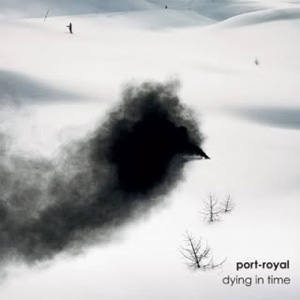
Though the album’s starkly snowy cover might have something to do with it, Genoa’s port-royal does evoke a crystalline, wintery quality on its third full-length. High-frequency washes, plaintive delayed guitars, and tinkling synths abound amidst rhythm structures that evoke Squarepusher and Aphex Twin. The icy sheen makes the listening process feel a bit like a slalom ride down Mont Blanc, the apex coming towards the album’s midpoint with the M83-like glassiness of “I Used to Be Sad.” Other tracks, like “Susy: Blue East Fading,” recall Stars of the Lid, but with a nice shuffle behind the synth swells. If one can stand its brilliant cold without shivering, dying in time might be one of the most fulfilling records of the year.
We’ve already established through our recent series of year-end posts that we love making lists, and, duh, you love reading them. Now, XLR8R would like to share a list we love. Over on the Ghostly website, the stylish and ground-breaking label put its collective opinion together for a wonderful list of 110 favorite albums from the past 10 years. The label presents its list objectively, organizing the picks alphabetically and excluding any Ghostly artists, and in its trademark clean and simple design. Peep list action here.
Check in with Inbox as we pick the brain of Berlin-based experimental dubstep maestro Robert Koch (a.k.a. Robot Koch). The talented producer (and founder of Jahcoozi) selects some choice karaoke tunes, finesses his way out of sticky on-stage situations, bogarts musical instruments from family members, and juggles a mind-boggling assortment of projects. Robot Koch’s debut full-length, Death Star Droid, is out now on his own label, Robots Don’t Sleep.
XLR8R: Which track has received the most plays in your iTunes library?
What’s the greatest number of people you’ve sat with in a standard-size Jacuzzi?
Only four people. It was with the two other Jahcoozi guys and a strange old man in a weird hotel in Romania.
What is your go-to karaoke song?
Haha, embarrassingly enough, it’s “Africa” by Toto. Or “The Heat is On” by Glenn Frey.
Worst live show experience?
I was booked to play with Jahcoozi at some big show in an old theater with live TV and radio broadcast. During soundcheck everything was fine, but someone from the stage crew must have disconnected the power of my soundcard. When the host announced the band, I realized that my laptop didn’t recognize it. This was like five seconds before we were supposed to start, and somehow still figured it all out at the last second. It was scary.
Favorite city to play?
Zürich: good people, good food, good sound. The Swiss people don’t save money on the wrong end.
Favorite studio toy?
My old Bontempi keyboard, which was originally my sister’s. She lost interest in it, so I played with it since I was 12.
What is one thing you couldn’t live without (excluding the obvious essential, i.e. air, water, etc.)?
Music. Also too obvious? I guess silence is vital too.
What’s the weirdest thing you’ve purchased at a thrift store?
This yellow toy creature that sits on top of my studio monitors. It’s watching me right now.
If you could reduce your music to a single word, what would it be?
Wood.
If you could re-score any existing movie, which would you choose?
What’s the strangest mash-up combo you’ve ever heard (or created)?
I heard that there is a band playing DJ Shadow songs from Entroducing live with acoustic instruments. I’ve never heard them, but I like the idea.
You’ve remixed a lot of folks (Amanda Blank, Justine Electra, Rustie, etc.). Who’s next ?
I’m making a bunch of remix swaps at the moment with Slugabed (Planet Mu), Loops Haunt (Black Acre), Body Language (Norm Rex), etc.
If you could only display one color of light to during your set, which would you choose?
I’d go for no light if I had the choice.
Complete this sentence: In the future…
I gotta trust my intuition more.
Stupidest thing you’ve done in the last 12 months?
Saying “yes” to a lot of things that my intuition told me to say “no” to.
What’s next?
The new Jahcoozi album is gonna drop on BPitch Control next year. I’ve got a new Robot Koch EP coming out soon as well, including remixes and new material. I’m making beats for some other people’s records, making new remixes, and will produce an album with Grace, the singer who was featured on The Doors cover on Death Star Droid. Plus, I’ll play shows in the U.S., Japan, Europe, and Africa. I’ve already started working on an album in Nairobi last month that will feature Jahcoozi, Gebrüder Teichmann, and Modeselektor, all teaming up with Kenyan artists. World music 2.0.
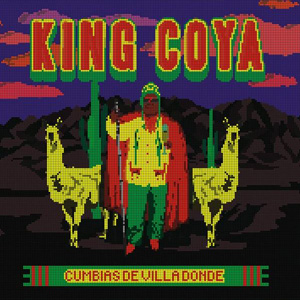
As cumbia is increasingly embraced worldwide, it’s exciting to see how this folkloric tradition has been given so many new treatments. On Cumbias de Villa Donde, Argentina’s King Coya (of Zizek) is staking his own spot in the future of South American-inspired electronic music with no shortage of creativity. This collection of remixes and original material begins with the sultry slow-and-low riddims of “Villa Donde” and only becomes more colorful from there. With “Trocitos De Madera (KC Version),” KC takes us into the club with uptempo melodies and then has no problem bringing the beat back to chill zone on “Cumbiatron.” To see where cumbia is headed next, Coya’s latest is a smart place to start.
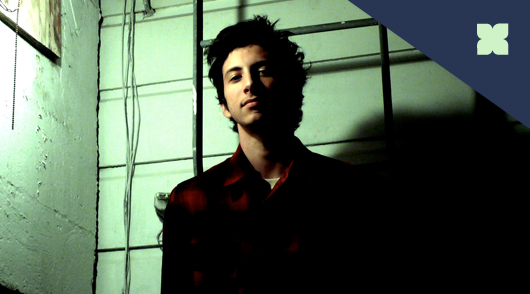
LA native Henry Laufer may be a young fella, but the 19-year-old producer, better known as Shlohmo, has rocketed on to our radar screen in recent months with his lo-fi, psychedelic mix of abstract hip-hop, dubstep-flavored wonk, bouncy synth-funk, breezy trip-hop, and what sounds like lost gems from the mid-’90s Mo’ Wax catalog. Now splitting time between San Francisco and LA, in January Shlohmo will be releasing the Shlohmoshun Deluxe mini-album, so we decided to enlist him for the XLR8R podcast series now, before dude seriously blows up. On this exclusive, hour-long mix, he puts together a sampling of his own productions with a litany of unreleased and limited-release tunes, many courtesy of his compatriots in the Wedidit collective, which Shlohmo co-founded in 2008 while still a senior in high school. As our last podcast of 2009, we’re guessing this mix will appeal to fans of Flying Lotus, Nosaj Thing, and LA’s burgeoning beat scene while hopefully whetting everyone’s appetite for more great music (and XLR8R podcasts) to come in 2010.
01 Shlohmo “Tall Grass” 02 Juj “Pomegranate Limeade Just Spilled All Over My Laptop” (Wedidit) 03 Shlohmo “Windowlight” 04 Non Epic “Cops Helping Kids” (Wedidit) 05 Ground Is Lava “Get On My Water Level” (Wedidit) 06 Joseph “Untitled” (Unreleased (Wedidit) 07 Shlohmo “7AM (Devonwho Remix)” (Friends of Friends) 08 Juj “SoulBounce” (Wedidit) 09 Shlohmo “Scooters” 10 Shlohmo “Teeth” (Friends of Friends) 11 Shlohmo “VOR/oFF” 12 Low Limit “Trapperkeeper” 13 Dem Hunger “Bathtub Birth” 14 Oscar McClure “Untitled” (Leaving) 15 Elan “I Can’t Breathe” (Wedidit) 16 Matthewdavid “You Know You’re Not Alone” 17 0 “Lover’s Defect” (Indigo Pyramid) 18 Dak “Hunch” (Leaving) 19 Abdul Alim (a.k.a. Knxwledge) “Spritzr” 20 Mindesign “Airways” (Record Breakin) 21 The Dene Road “And She Was Touched” 22 Non Epic “Untitled” (Wedidit) 23 Infinite Potentials “Escapizm” (Indigo Pyramid) 24 Teebs “Bern Rhythm Codeine Version” 25 Shlohmo “Shapes In The Dark”