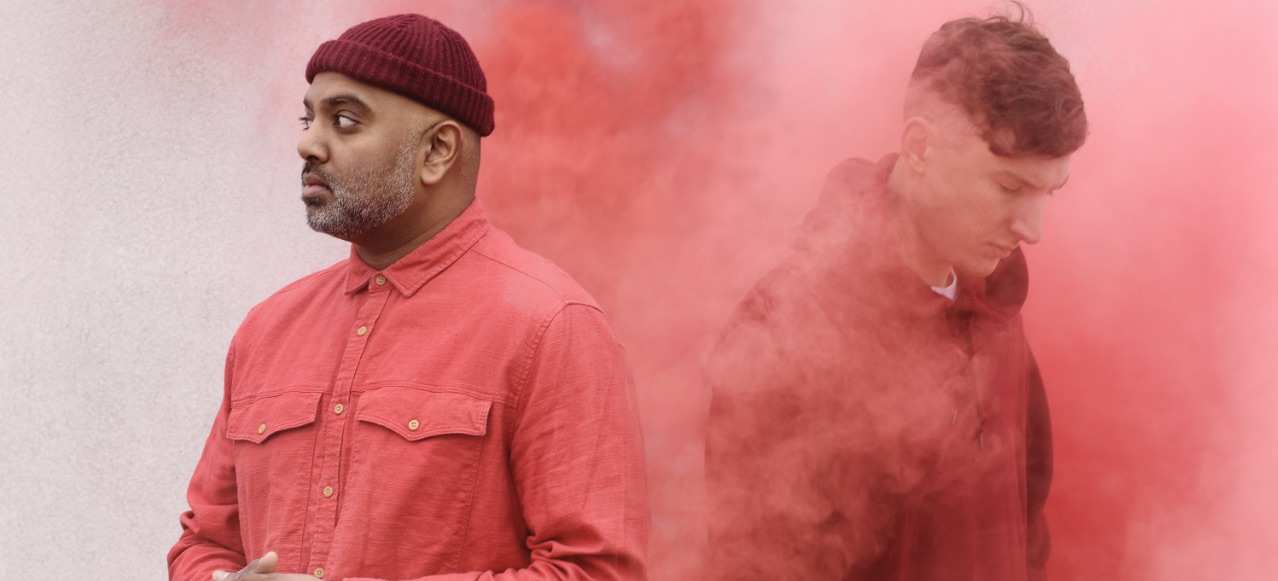
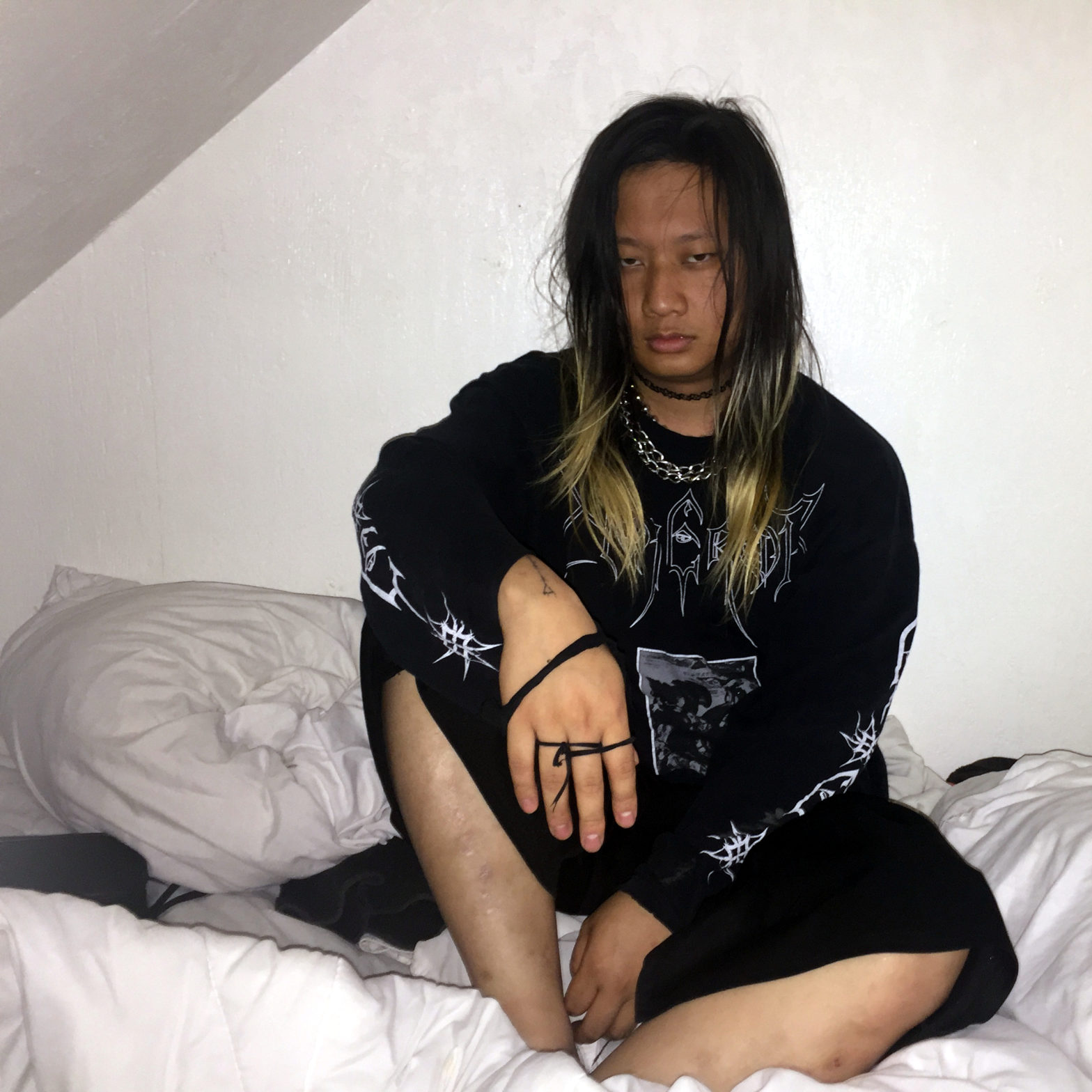
Hip-hop may have collided with electronic music many times, but no one fuses them like Ivy Lab. The London production unit, comprising established beatmakers Sabre (a.k.a Gove Kidao; left) and Stray (a.k.a J Fogel; right), has assembled an original compound between the two disparate styles, drawing partly from their past as drum & bass producers, and partly from their love of film soundtracks, synths, and the psychedelic beats of producers such as Flying Lotus or Samiyam.
Originally a trio (former member Halogenix recently went solo), Ivy Lab first pooled its individual strengths in 2013 with the single “Afterthought/Brat,” and subsequently released a run of singles and EPs for respected drum & bass label Critical. To start with, their beats conformed to a drum & bass structure, with soulful vocals, techno textures, and crisp sound design their signature. But 2014’s “Sunday Crunk” and 2015’s “Two By Two” hinted at their future direction: electronic hip-hop with subtly swung beats, weird riffs, heavy synth bass, and rowdy samples.
More recently, on their 20/20 LDN label, they’ve concentrated their formula into a deadly dosage of glowering sub and eerie melodies: a meeting point between UK and US sounds which has found them a sizeable fan base both Stateside and in Europe. It’s a sonic aesthetic vividly realized on 2015 compilation 20/20 LDN Volume One, itself a showreel of Ivy Lab tracks that made their shift of focus explicit, and the duo has since released EPs by like-minded artists such as Deft, Sinistarr, and Havelock on the label.
Their latest endeavor is debut album proper titled Death Don’t Always Taste Good: a startling calling card which intensifies and sharpens their formula. While “Cake” throws its weight around with a creeping bass riff, smacking drums, rap samples, and lysergic effects, “Fortune Teller” has weird spoken word snippets of what sounds like a séance, discordant organ drones and a beat that sounds like a body being scraped over a floor. “Vanity Fair” takes the darkness further, with a supposedly seductive voice accompanied by a sinister backdrop that is anything but. We got hold of Ivy Lab in their Tottenham, London studio via Skype to find out how they arrived at their sound, where the darkness in their music comes from, and what’s next…
What brought about your shift in sound from drum & bass to something more approaching electronic hip-hop?
J: It’s where we both come from musically. Certainly, I got into writing hip-hop before drum & bass. We just happened to start working together at a time when we were really into a certain style of drum & bass. The shift to focus to more hip-hop or halftime material was actually a shift back to our roots.
GOVE: We were carrying around bass music baggage with us when we were originally making hip-hop. People who were deep into hip-hop were like, “It’s too drum & bass.” In the space of about five or six years, we’d play the same people the same ideas of these tracks, and they’re like, “Ah, it’s quite drum & bass.” All of a sudden it turned into an asset. Like actually, there’s some virtue to hip-hop embracing all of these habits we’ve brought over as bass music producers. This circuit we’re operating in is full of people who’ve come from other forms of bass music and brought that provenance with them.
It’s interesting how you fold UK sound system influences into your sound—your stuff is different to something that might come out of LA, for instance…
G: I think that’s a British mentality. We describe our music as taking British basslines and mixing them with American drum machine electronica.
J: What we couldn’t do is break the habits of being drum & bass producers, and a lot of that is to do with an engineering sensibility. We had a good knowledge of tracks that bang across a wide range of systems because that’s part of the drum & bass engineering ethos. When we’re engineering tunes, we’re inspired by the LA beats scene, too. That’s what caused that hybrid sound.
G: Personally, my hip-hop lineage is from the late ’90s boom bap stuff coming out of New York. That’s when I was first making hip-hop, and I stopped making it when I began to have more of an affinity with drum & bass. I see it as tipping a cap, but doing it in such a way that it doesn’t step on someone else’s niche.
You’re now a duo, how has the departure of Halogenix affected your sound?
G: Historically we’ve never really announced who’s made what track. The way Ivy Lab works is that quite often individual tracks are eighty percent one of us. Other people chip in at later stages. The more R&B-tipped stuff, Lawrence [Halogenix] had done himself. We’re not doing that as much now, but we’ve all been making music so long together that we’ve been in a three-way feedback loop where we’ve subconsciously started making stuff that we know will pass the listening test of the other members of the crew. He’s not here anymore, but probably subconsciously we’re still making music that has some of his preference in it. He’s probably got that vice versa as well because it’s hard to break those kinds of habits when you’re focused on trying to deliver it all to a collective with solo music. I think things have changed a little bit, but compared to a year ago, not drastically.
What individual elements do you bring to the Ivy Lab sound?
J: Mood-wise there is a lot of cross-over, but broadly speaking, I might bring a more sunshine edge to it. Gove is darker and spookier in sound, but that’s it: we like the opposite sound as well.
G: There’s a practical difference, in that I try to make tunes in the way a producer in the late ’90s would, with those limitations. I tend to make super simple music as a result of it.
J: But I think you’ve come through an era of music, especially with the whole beats scene stuff that you look up to, which is very synth-orientated. Gove is a lot more disciplined than I am in the studio. So there’s a focused, effective approach to production that you can then hear. He writes a lot quicker than I do once he gets into a flow—the tracks start to take shape. I have learned a lot on that front from working with him.
I don’t have a go-to approach in the same way, so I’ll feel my way through the production of each track, and I guess you can hear some of that in the end result.
How did the album Death Don’t Always Taste Good come about?
G: That album is in its second incarnation. It was actually written a year ago with four or five tracks which aren’t on there now. When we partitioned away from Lawrence and he went to work solo, those tracks were no longer available for the album. The album at that time was perhaps a bit more of a somber affair; it had three or four of these very melancholy R&B songs that he’s good at writing, with full vocals from singers. Lawrence has taken those tracks for whatever future project he decides to place them on. That created a really interesting question for us: what should we do to replace those tracks? We then though, let’s not try to replace them, let’s make this a shorter project. It was perhaps a bit hefty before.
There’s a horror theme to the record in the samples used on tunes such as “Fortune Teller” or the title track. Was it deliberate to bring in that horror or psychological thriller vibe?
G: I’m not sure it’s quite as intentional as that, but it does end up being that way. One of the things we realized about our take on hip-hop, taking the bass contribution out of it for a while, is that we’re quite good at menacing music: stuff that has a lot of tension in it. We don’t really want to be trying to recreate other people’s ideas. Playing to our strengths, we do quite often end up making quite melancholic, sinister music. There’s a real satisfaction to achieving that emotion. It can sometimes be very easy to make sunshine or feel-good music, but if you want to make stuff that is both dark and emotive, that’s a bit more a challenge. So the fact that we can do that, we want to keep that ball rolling. It’s not something that is particular to this album; it’s something we’ve been doing on and off for a minute. There’s definitely that tone running through the whole thing.
J: We like achieving a dark but playful thing. If you take a horror aesthetic and underpin it with quite funky, swung beats, that juxtaposition plays through in a lot of stuff we write.
Yes, in tunes such as “Vanity Fair” for example, the way the sample works with the music is unsettling…
G: It is, yeah, it’s right on the edge. Some people have not liked it when I’ve played it to them. “I feel quite uneasy about listening to this, like, what are you trying to say?”
J: There’s a lot open to interpretation with that track as well.
G: We don’t like gore horror, something shocking. This is more Jacob’s Ladder: uncomfortable, constant tension.
Where does the vocal sample of the computerized voice come from on “Calculate”? Is there a comment there on the futility of social media arguments?
J: It’s from a Monty Python sketch called The Argument Room, and someone had gone and digitized the whole thing. There’s a YouTube video where someone sets up these two talking robots from the ’80s, like on Acorn or ZX Spectrum computers, and they just set them up with a script and let them go with each other, and it’s a pretty funny video to watch. It’s just these two robots arguing. It’s like a throwback version of those Alexa vs Google Home videos, where they sit there talking to each other.
It’s funny you mention that about social media. Broader political ideas like that may or may not find their way into tracks that we do. I think it’s quite a subconscious thing. I feel some way about that topic, but I don’t think it was an explicit decision to include that argument in the track for that reason. I would go back to saying it’s very much open to interpretation. It says more about the listener in terms of how they choose to digest it and what political ideas they imagined we had when writing it. I really like that openness, and I like including concepts or samples that can achieve that rather than being direct or explicit.
Sound design is obviously a big component of what you do. Is it something you spend a lot of time on in the studio, creating effects and sounds?
J: Yeah absolutely, there’s got to be an almost cinematic slickness to it. And I think that’s something we’ve grown better at. Gove, your album [as Sabre] was more concept-oriented and featured sound design heavily, that type of engineering. You ended up doing a film soundtrack, didn’t you?
G: Yeah, I did some scoring for a film a while back, and everything I did after that was very sound design-oriented because I’d learned a lot in a short period of time. The thing I realized afterward was that we’re all into making tunes where you can’t tell what the key instruments are. We love a good piano riff, we love a good guitar riff, Rhodes, like everybody does. But if a sound is, “What even is that, what category does that fall into?” then I think we feel naturally a bit attracted to using those kinds of sounds. In “Vanity Fair,” the sounds themselves are conceivably organic noises, recorded in a foley room, or they could be synth noises. It’s very hard to tell. We live in this hinterland between those two worlds, and for us, that’s the peak kind of sound you can get. A sound that could have come from the natural world, but is more likely to have come from a synth.
It’s funny that you talk about sound design, because we’ve just come back from the States where they were talking about our sound design too, and compared to a lot of people out there—especially a generation younger than us who understand more sophisticated digital tools than we do—I feel like their sound design is on another level compared to us. But we keep hearing people saying they rate our sound design. I think one of the reasons is that our tunes don’t have so much in there, so when you do hear something, you hear it in its full glory rather than cluttered or obscured by a different sound. That makes your sound design better because the sounds are in their full place.
Your sound has been embraced in the US, obviously the home of hip-hop, how did that feel?
G: It feels incredibly humbling, the fact it’s come to us so swiftly is amazing. We decided to put our effort, our time, and our energy into enamoring ourselves with that audience. It’s exhausting, what we’ve chosen to do is an incredibly inefficient way of living your life, going in and out of a country solidly for the last couple of years [for gigs] rather than touring in meaningful chunks. It’s been really hard work, but it’s been totally worth it. It’s a readymade audience.
What makes the electronic hip-hop scene vibrant is that it’s inspiring a lot of talent. A lot of bass music genres are going through a transition, and that transition is also happening in the American audience. There’s a lot of dubstep fans, drum & bass fans, and hip-hop fans, trap fans, even mainstream dance fans in the States who are going through a transition in their listening tastes. A lot of this stuff is appealing to them. The EDM generation is getting a bit older, the people who grew up on [EDM festival] Hard LA, they’re on the other side of 25 now, and I think they find resonance in the stuff we’re making. And just the sheer volume of people out there. It’s something that is a bit easier to crystallize, because [the audience] is so much more readymade than in Europe, which for us is essentially Holland, Belgium, north Germany—that’s where our heartlands are in terms of support for this stuff.
G: We don’t have to make caveats or excuses, explanations about why we’re playing what we’re playing now. It doesn’t happen, and that gives you the luxury or extra confidence in what you’re doing. It’s hard not to embrace that positivity.
What are your thoughts on trap, obviously a way off what you do?
J: I like the concept. I’m down with the notion of extremely limited instrumentation in order to go and work within that constraint. It can make you really creative and turn that instrumentation into something new. Basically, it doesn’t have a lack of imagination, as much as people perceive it to. We’re down with listening to it; in fact, both of us listen to a fair amount of underground trap music or music that’s made with that instrumentation. Our impression of it is that it’s a craft to learn, to make that stuff sound imaginative. The roll of the hi-hats, or the weight of the 808… I think with that stuff, there are people who are so well versed in doing it well, we don’t feel the need to go and step on their toes.
G: I’d say there are probably three strands to trap. You’ve got the very brash, unapologetic, Nordic-tinged festival trap, which I don’t think either of us has much of an affinity to. Then you’ve got this very bombastic, highfalutin, overconfident, kind of trap, which is quite Southern. We’re quite cool to listen to it. Then, you’ve got a more modern era, more melancholy, somber, a bit like our music, slightly spooky end of trap music, where the beats and the 808s are still there, but the samples and melodies that go over the top of it are much closer to what we do. That, we genuinely love. The fact that the drums and the basslines haven’t had that much attention put into them, all the heavy lifting is being done by some spooky Hammer horror riff, or weird ethnic flute sample, all the stuff that J was saying about limiting instrumentation, we love those tunes. Some people would assume coming from where we come from, that we would be offended or turned off by the brashness of that music. Actually, we’re not; we’re kind of down with it.
J: We get the charm and appeal to that aesthetic or vibe. You can draw parallels to how the “Amen” break is used in drum & bass, there’s a certain core track aesthetic there that we totally get and enjoy.
Would you say there’s a specific sound for your 20/20 LDN label now?
G: I would use the phrase you used at the start of this, and that’s “electronic hip-hop.” It’s a phrase I’ve only heard used a few times, but I heard it yesterday actually, speaking to the Foreign Beggars guys, speaking to Metropolis. He described his stuff as “electronic hip-hop,” and the idea really resonated with us. We used to have a slight BPM limitation. When we first set up 20/20, all of our stuff was in that 75 to 85BPM kind of mold. We’ve come to realize that what actually codifies this movement is electronic ideas with hip-hop sonics. So we’re now making a concerted effort to cover a much wider spectrum of BPMs.
J: There are a few conjoining satellite sister genres that are in play as well. Like halftime, drum machine electronica or footwork, jungle juke. Stuff that has connections to the foundations of the 20/20 sound, drum & bass, and hip-hop, places we came from. Basically, stuff that can fit into the same set. We’re certainly looking to broaden the label. A vast majority of the music that has been released on the label thus far has had a dancefloor sensibility to it. It’s engineered well, stuff that we would play in our sets, and is structured for DJs.
G: But that point will become less of a thing as time goes by.
J: That’s the aim. We don’t want to lose that side, because we don’t want to stop being DJs any time soon. We want to keep releasing the music that we play, but at the same time, we want to broaden what the label is about to incorporate listening music.
What are your more immediate plans with 20/20 LDN?
G: We’ll probably take a little break over summer, and provide studio time to some of the acts who are London-based, who want to put music out for us: Tim Parker and Deft. There are some larger acts that we’ve finally been able to go up to in confidence and say, “20/20 is up and running, how do you feel about being part of it?” One thing we are doing is writing music with a lot of rappers. I guess being in proximity with Foreign Beggars because we share a studio with them, there’s gonna be a lot more rapper orientated music for the short term.
J: We want to solidify our States presence. Talking about signing music, some of these guys that we want to sign are over in the States, and we want to merge the two worlds and work with people a lot more out there. The same with the club night, we just got back from a pretty successful tour, a 20/20 LDN tour out in the States that lasted about a month. The numbers at the nights were really good. We’d like to do that again.