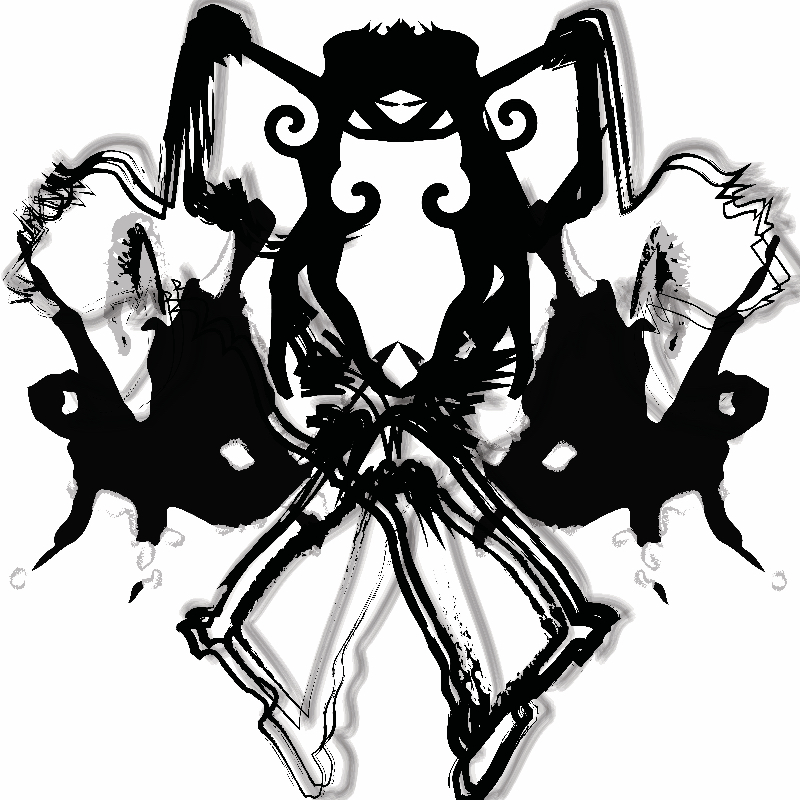
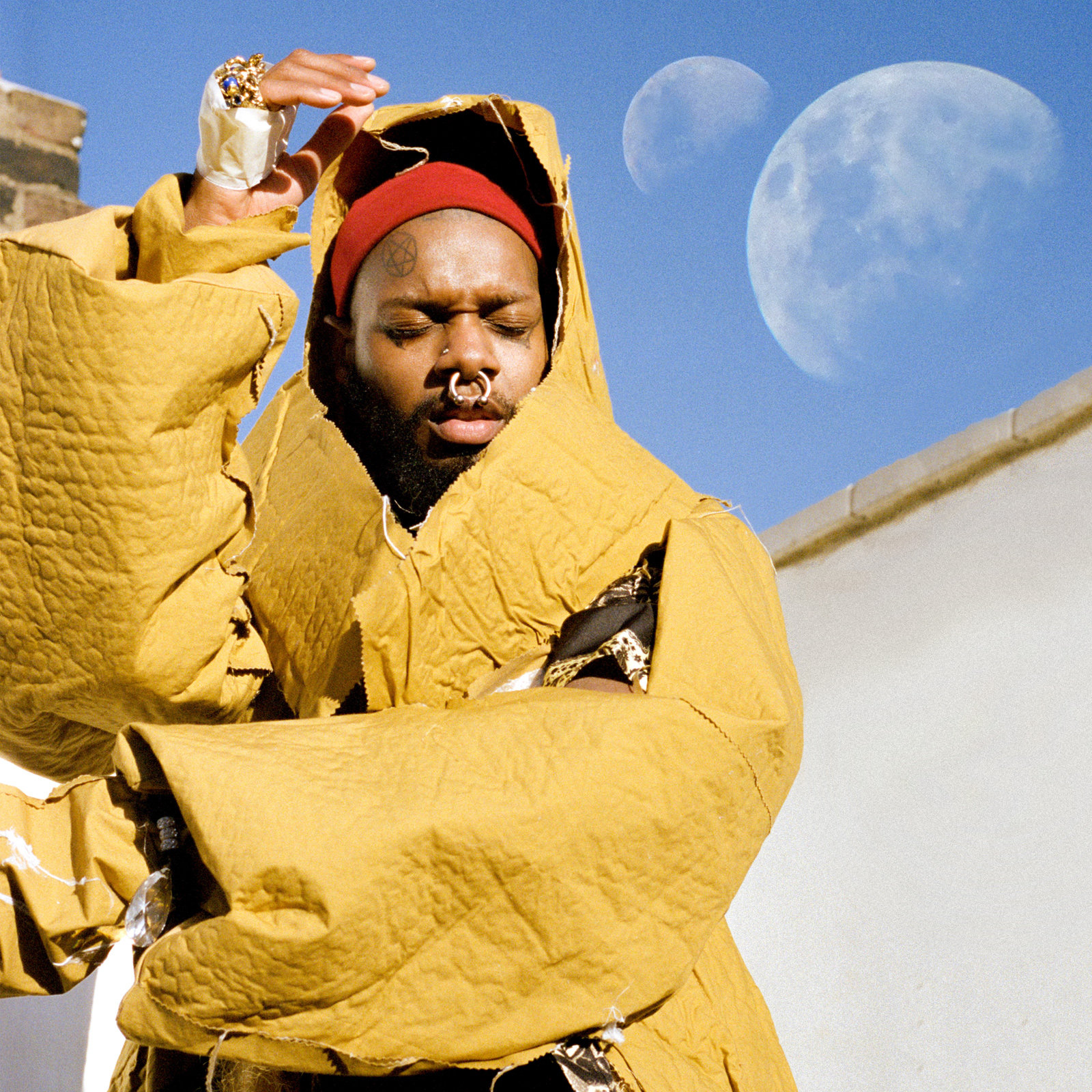
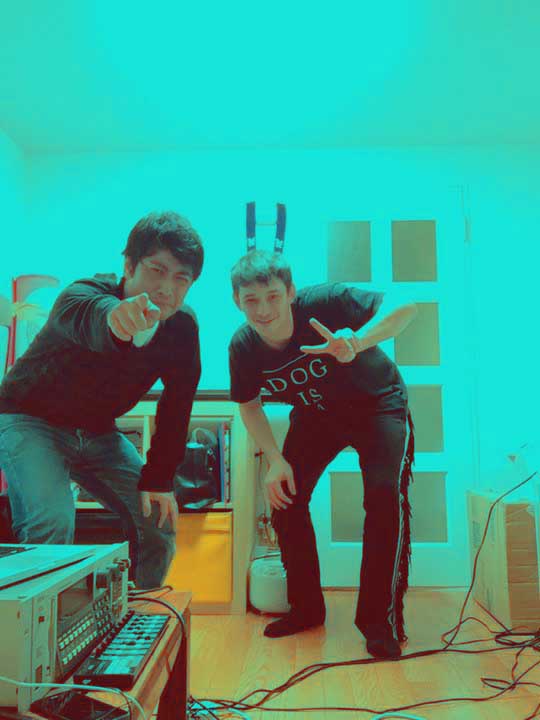
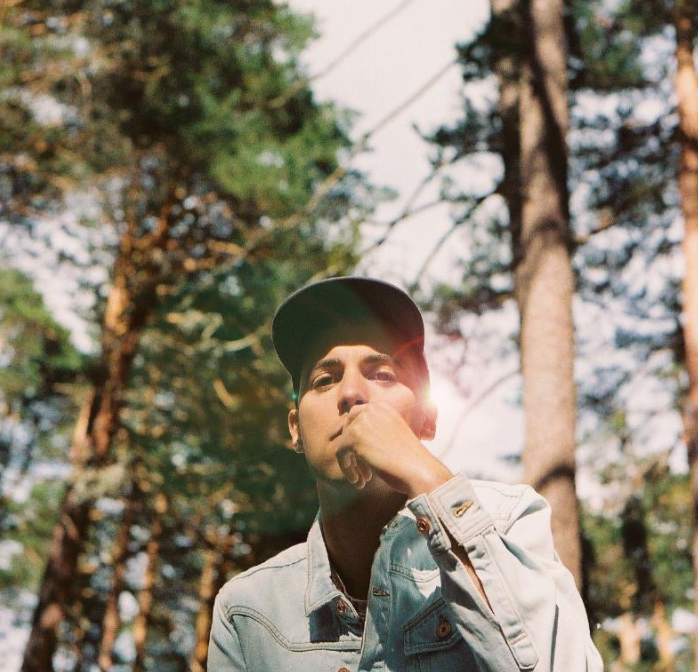
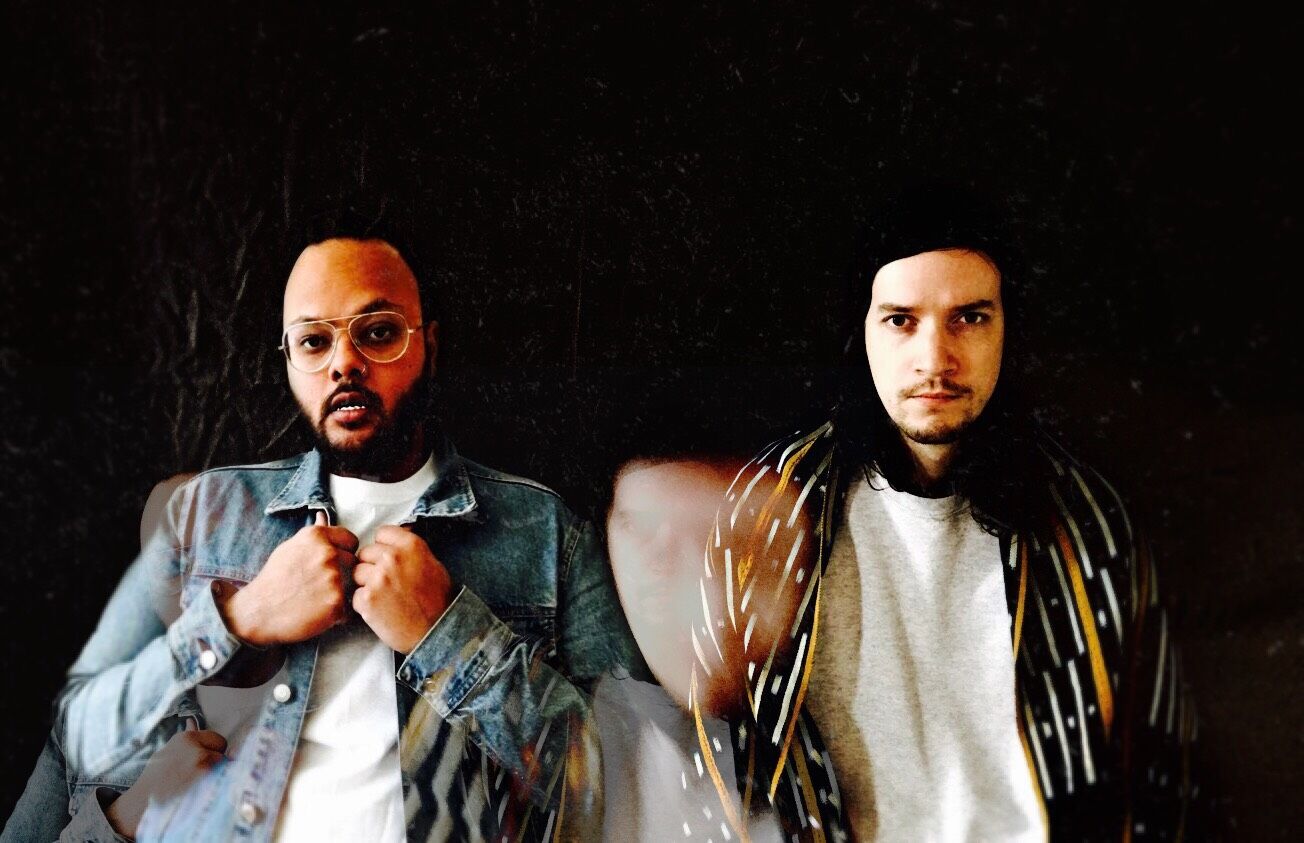
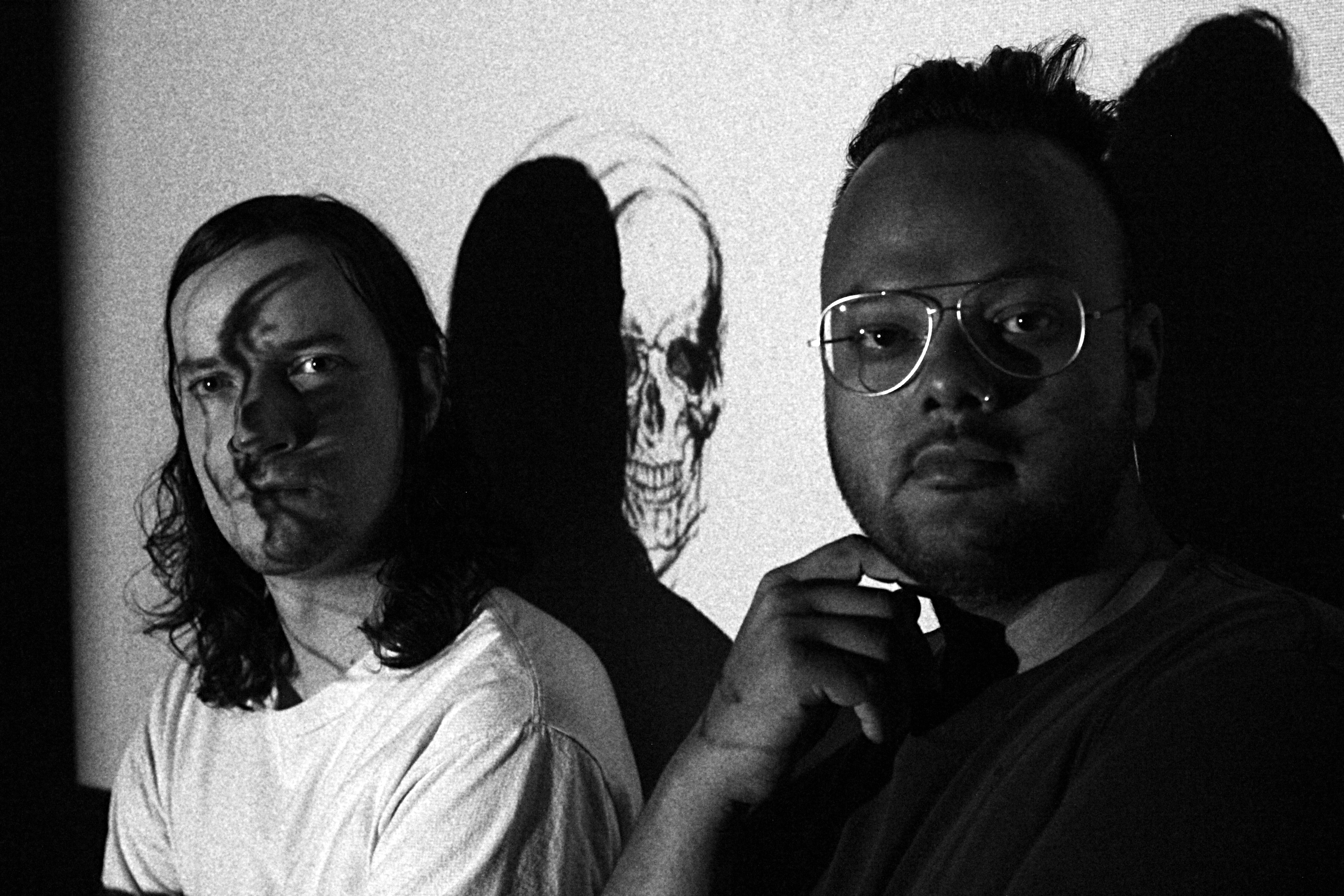
Known respectively for their independent work as Botany and Lushlife, Austin producer Spencer Stephenson and Philadelphia emcee Raj Haldar will release their debut album as The Skull Eclipses—an 11-track self-titled affair set to land on March 9. The duo initially set out to pay homage to the genres that convergently inspired them to start producing music in the late ’90s and early ’00s—jungle, breakbeat, drum & bass, trip-hop, electronic ambient, etc.—and bring them into the context of contemporary hip-hop. The outcome is a heavy-hitting, 11-track post-rap montage that seeks refuge from the present by opening doors to the past, winding up with something altogether more futuristic than either of its authors had consciously intended.
The title The Skull Eclipses was originally given to a demo that Stephenson sent Haldar in 2014, but it quickly became apt for the darker subject matter and emotional tone that the record and project assumed. Accordingly, Haldar’s lyrics are a free-associative expression of grim frustrations that he and Stephenson felt could be lost behind the perceived sunniness of their solo identities: the value of life amid a growing population, Islamophobia directed at people with brown skin (Haldar himself is Bengali), poverty, pharmaceutical abuse, mortality, mental illness, international conflict, police shootings, and the continual failure of the drug-war that began when the album’s creators were just children.
Haldar’s words and vocal performances were written and recorded during a weeklong artist residency in Tulum, Mexico. This spot was chosen partly for its connection to the obscure Federico Fellini and Milo Manara graphic novel “Viaje a Tulum,” but also for the city’s history as a centre of conflict, worship, and ancient mystery. However, what was glimpsed there instead fueled the grievances of the album’s more earthly subject matter. “Tulum is where wealthy “ecotourists” spend thousands of dollars a night, while the locals’ hard work never stops,” Haldar remarks, “so the increasing problems of wealth distribution were never out of sight or mind, even in a place that looks like paradise.”
The Skull Eclipses is not without a well-suited guest roster. On “Pillars,” Felicia Douglass from the Brooklyn band Ava Luna lends an infectious chorus. Lojii borrows the spotlight for an immaculate, off-the-cuff performance on “Gun Glitters.” Open Mike Eagle lists a few of the infamously inexcusable reasons for police shootings in recent times on the mournful “Gone.” Though perhaps the most surprising appearance is ambient luminary Laraaji who contributes his trademark electric zither to “Yearn Infinite II,” a slow churning interlude that precedes the album’s breakbeat closer “Spacecrafts in Rajasthan.”
Eager to learn more about the project, the release, and the inspirations behind it, XLR8R caught up with the duo one afternoon via Skype.
In support of the release, the duo also shared “Angels Don’t Mind,” streaming and available for download via the WeTransfer button.
You’re both well-known musicians in your own right. What’s the inspiration behind The Skull Eclipses?
SS: We’ve been friends for years and Raj approached me about making an EP a few years ago, so I sent him demos that were a bit out of step from Botany stuff in tone. Spiritually we allowed ourselves to express our more troubled and pessimistic sides without apology, which arose from our natural dialogue with each other. We tend to be pretty sardonic in our personal conversations, and that just made it onto the record, to the point that it felt appropriate to give it all a separate title from our own works.
“If you look at my solo productions as being somewhat of a painkiller, then The Skull Eclipses could be the withdrawal, or something like it.”
So do you feel the new material is a lot darker, and perhaps evenhonest than your solo works?
SS: I wouldn’t consider my solo music dishonest in any way, even where a narrative is invoked. I feel like the through-line through all of my music is emotional sincerity. I think of this project as being slightly less prone to levity, but then I’ve always tried to emphasize a sense of slight unease, or even tragedy in my solo stuff as well. If you look at my solo productions as being somewhat of a painkiller, then The Skull Eclipses could be the withdrawal, or something like it.
RH: As a music fan, I’ve always had a penchant for the kind of shit where a sunny disposition is betrayed by an underlying sadness. A lot of the solo Lushlife work carries that vibe, I’d imagine. With The Skull Eclipses, from a lyrical point of view, I was very much reacting to the moment in time in which it was conceived—in the lead-up to the Trump election, and where racism and nationalism were deeply rooted in the zeitgeist all over the world. It’s strange times in the Western World, and the only way to parse that in my mind and engage with it through the music is to be much more direct than I’ve ever been before.
Why do you think you feel more free to express yourselves in a collaboration?
RH: After meeting through shared admiration of each other’s work, we built an actual human bond in the ensuing seven or eight years. And, while I think of all of the mutual touchstones we have as musicians and music fans, the thing that really makes the collaborative engine work with us is the non-musical human connection. We’re homies at a very core level, you know?
SS: I don’t know about it being more free, necessarily. My musical process is always super freeing for me emotionally and cognitively, even when I’m by myself. It has to be cathartic, or the resulting track doesn’t make it onto an album. For Raj and I, our mutual catharsis was acknowledging that the 20th century made some pretty big promises that our generation is living in the failure of. We just dealt with it all head-on, lyrically and tonally.
How and when did you guys come together to begin working together?
SS: When I worked with the rapper Milo on my second record as Botany, it was written somewhere that that was my “first time working with a rapper” which wasn’t true at all. I’ve actually been producing beats for Lushlife records since 2010, some of which made it onto his album Plateau Vision. So after a few years of friendship and trading music, Raj approached me to do an EP in 2014.
RH: Yeah, looking back at Plateau Vision, Spencer’s contributions always feel like a highlight to me. There’s this hint of some kind of magic that I hear on those tracks, and I wanted to explore that further once we were both in the right headspace. I think it was pretty clear that there was something happening when we started working together towards an EP, and things just naturally progressed to a point where we had enough to say for an album’s worth of material. From there, it just seemed appropriate—given that this project was markedly different than our individual output—to give this vehicle its own name and visual presence.
“Musically, we wanted to combine some of our shared influences into a type of hip-hop that nobody, even ourselves, had really heard before, using rap vocals as a complementary texture as if it were any other instrument in the mix.”
Did you have a clear sound aesthetic in mind when you first entered the studio?
SS: Musically, we wanted to combine some of our shared influences into a type of hip-hop that nobody, even ourselves, had really heard before, using rap vocals as a complementary texture as if it were any other instrument in the mix. My thinking was that I’d use Raj’s vocals to create the same type of abstract sound beds I make on my own records, but I think we ended up with something altogether more accessible than if I were left to my own devices, in a good way.
RH: Of all the producers and beatmakers out there, Spencer has an uncanny ability to imply boom-bap in the most unlikely contexts. I can hear the DNA of hip-hop classicism even when he’s making drumless ambient compositions. In that way, I think I’m really able to explore as an emcee to really far out places, while still feeling anchored to the soul of hip-hop.
At what point did you realise you were going to make an album—rather than just experiment on some tracks?
SS: I think that was always the goal; we just didn’t know it would be a full-length. I usually aim to make full albums out of anything I’m working on. Like stalactites, I just let the water find the path of least resistance and the structures that get the biggest the quickest become records.
You say the project became “more than just a one-plus-one combination” of you individual sounds. Is it fair to say you surprised by the results of your early experiments?
SS: I think I was most surprised at how well we orbited each other creatively. I aimed to make something fairly far-out in rap terms, and I think Raj helped reign me back into a bit more of an intelligible place. We found a nice equilibrium between our sensibilities that was never disagreeable, ever.
RH: From working with Spencer in a one-off capacity, I knew there was potential, but I didn’t quite realize how beautifully we’d build off each other. It’s sort of life-affirming, actually. I spent most of my career writing and recording in solitude, more or less. To feel like there’s an ongoing cosmic rhythm with another artist that’s leading to fresh, new ideas has been exciting.
Where does the alias “The Skull Eclipses” come from. What’s the story/idea behind it?
SS: One of the first demos I sent Raj was titled that, the one that eventually became “Spacecrafts in Rajasthan.” When we decided to have a new mutual name, I selected that because it seemed to symbolize the sentiment of the record—the light of the sun being blocked (Eclipsed) by the most straightforward symbol of mortality, the Skull. It felt appropriately Jungian, with a kind of darker ‘60s psych vibe. Though I never really judged its worth as a group name. It was like “yeah that’s the title, moving on.”
“…we are rewinding the clock on underground music to try to find these alternate-history points where psychedelia and hip-hop could have intersected and imagining that with modern production tools.”
How would you describe the album, for those who haven’t heard it?
SS: There’s a line on the track “Angels Don’t Mind” that says “Stereolab inside a powder-blue baby Jag, it makes me sad I don’t ever gotta tell them that,” and I think that impressionistically sums up what we’re doing. In some ways, we are rewinding the clock on underground music to try to find these alternate-history points where psychedelia and hip-hop could have intersected and imagining that with modern production tools.
RH: I humbly ask folks to listen to it and create those descriptors in their own mind.
Raj, I understand that there are some hidden meanings behind the lyrics—that they reflect a certain sentiment of yours. Can you describe to me the inspiration for the lyrics?
RH: One of the best things about hip-hop to me as a kid, was listening and relistening to decode the codified lyrics from my favourite rappers—A Tribe Called Quest, De La Soul, Black Thoughts of The Roots. So as an emcee, I naturally tend to speak in slang and code myself. Over the years, I’ve sort of created a secret language all of my own, where “bedouins” are street corner boys and the “cosmos” is the city at night. In one sense, The Skull Eclipses delves deeper into that world than ever before, but somehow at the same time, I’m making some social and political declarations completely plain, too. It was impossible not to deal with issues like Islamophobia, wealth inequality, and the awful power of social media on a record that was made during the ascendancy of Donald Trump.
What’s your process for writing lyrics? How do you go about it?
RH: I have a modest sort of background as a jazz player. There’s a mode that you get into when you’re improvising—I guess what psychologists call a “flow state”—where it really does feel like something out-of-body takes over the creative process, at that moment. Writing raps is very much the same feeling for me. What draws me to Spencer’s compositions is that they pull the syllables right out of me. Walking through your day-to-day life you amass all these experiences, and subconsciously they begin to emanate over the tracks, usually starting from a mumble.
Is this different to when you’re working alone?
RH: No matter who, what, or where—that’s how the process seems to work for me. It reminds me of that sample from DJ Shadow’s Endtroducing—I think it’s on “Building Steam with a Grain of Salt,” where some disembodied voice says, and I’m paraphrasing: “It’s not really me that’s coming—it’s the music coming through me.”
What was the process for the tracks: make the beats first and then add the lyrics?
SS: At first, in demo stages, yeah. But I think we wanted consciously to break the normal mould of producer-sends-beats, rapper-raps. We did a lot of the post-production in the same room with each other and I even asked Raj to add whole verses, ad-libs, and entirely new songs on the spot during our sessions.
RH: One thing I had never done in the past is give up even a hint of creative control lyrically. I think it’s a huge testament to the depth of our creative partnership that for the first time in some of these sessions, Spencer was helping shape some of the lyrical content and delivery. I trust his ear and his intellectual capacity to that degree.
So Spencer sent all of the beats to you in Tulum, and the lyrics were then all written based on the beats, barring the post-production edits?
SS: I sent him a zip folder of about eight or so beats while he was still going about life in Philly, and one day he was like, “Fuck it, I’m going to Mexico and I’m going to power through these in one week.” When those were done, we laid the whole project to rest for awhile, and the next time we met up we did two or three more tracks right there in my apartment that ended up making it onto the album.
Spencer, where and when were the beats produced? Did Raj have any say on these?
SS: I made them all in the same third-floor apartment unit where I recorded my albums Dimming Awe, The Light is Raw, and Deepak Verbera. It had a sliding glass door that overlooked a couple of dumpsters, an office building, and a Mexican restaurant, and it was right across the street from a warehouse where Janis Joplin lived for part of the ‘60s. Raj had some curative say in which beats he did or didn’t want to use, and in post-production, we hashed out some of the arrangements together. Mostly we talked about the spirit of the jungle, drum & bass, and downtempo stuff from the late ’90s that spurred us both to start creating music in the way that we do now. I don’t think it’s entirely clear to people who know about Lushlife that he’s a great producer, so even if he wasn’t moving pieces around himself, he was still a co-producer in a verbal way.
Raj, why did you decide to record and write in Tulum, Mexico?
RH: It sort of just happened that as Spencer started sending me early demos for the project, I was asked to do an artist-in-residence for a week in Tulum. The place has kind of a magical power to it—with the ancient pyramids, UNESCO protected rainforest, and pristine beaches. I travelled down, armed with a batch of demos and a simple recording rig. For a whole week, I was able to stay one hundred percent focused—writing about modern life from a place that felt a million miles away from it in a lot of ways. At the same time though, being in this ultra-exclusive beach community that prides itself on its eco-tourism while clearly leveraging cheap labour from the local working people, I also realized that the ills of capitalism that we talk about on this record are never really that far away.
How do you feel this impacted the record?
RH: Well yeah, strangely the trip to Tulum had this unintended effect, where the lyrics became much more sociopolitically weighty than I ever would imagine, if you told me I was going to write rhymes in what a lot of folks consider a paradise. But, that’s really what’s at the core of the record too—the hugely illusory nature of modern life.
How did you choose the guest appearances on the release?
RH: Honestly, a lot of it was just Spencer and I, as fans, thinking of who we’d hear on a particular track. A lot of the artists on the record are friends, but some folks, like ambient godhead, Laraaji we reached out to cold. He somehow just made perfect sense on this rap record, and we are very blessed to have his, and everyone else’s contributions.
How long did the whole album take to produce and record?
SS: Honestly, it’s been 85 percent completed for maybe two years. Like I said before we tried to do a lot of sequencing, planning, and additional production in the same room as each other, and that meant Raj had to take trips to Austin, which meant we did about five sessions between 2015 and now. But those final tweaks were very important to the record. All told from the first demo to masters, it was three years of sporadic work. I released three Botany full-lengths in that time.
Did you produce more than the 11 tracks that appear on the album?
Yeah, definitely.
Looking forward, what are the next steps for the project?
RH: I’m looking forward to playing this record live.
SS: Yeah, we have some shows coming up, and we’re working out a live set with me on drumset triggering samples and visuals, but as for the next studio creation, I’m just now beginning to receive some ideas. I imagine we’ll continue to deconstruct and really carve away at what qualifies as hip-hop, structurally.
Can we expect new material, anytime soon, or do you see this as a one-off collaboration?
SS: I don’t see it as either a one-off or a new thing we have to beat into the ground with five follow-ups planned in advance. It exists right now, I’m not looking down the road at this point to figure out how to “carry our brand” or whatever. I’d be happy continuing the project, and I’d be just as happy to just throw some beats at a Lushlife record, The Skull Eclipses be damned. I can see us making a really stripped down mixtape that is true-to-form sparse late ‘80s drum machine rap, with a “pause-tape” aesthetic under this name.
RH: Right, I don’t think either of us feels a huge burden to solidify things for the future. The Skull Eclipses as an idea kind of lives in this moment and it could continue to live if it needs to and we feel that there’s something else to say..