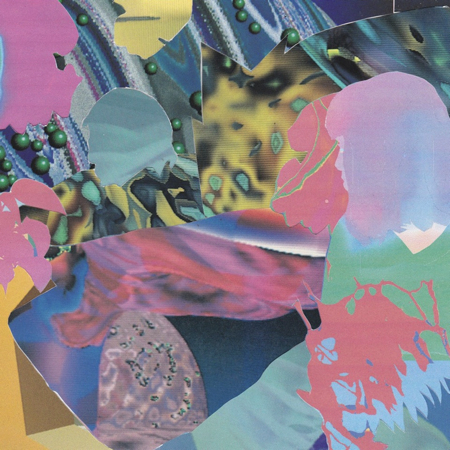
From its opening blast of shattering “glass,” it’s clear that Flatland, the debut LP by Berlin-based artist Objekt (a.k.a. TJ Hertz), means to make a statement. That initial note is a showoff-y bit of sound design that would sit as a highlight in the middle of a lesser album, but Hertz has a high pedigree; he’s worked for Native Instruments and previously self-released a highly regarded series of 12″s, among other accolades, and PAN, Flatland‘s backing label, is nothing if not esteemed. Some artists like to let their machines think for themselves, letting sounds blur together and emphasizing accidents; Hertz, however, is a control freak, and Flatland showcases this with intensity. As such, it would be difficult to say anything detrimental about the sheer skill required in making it. This is the kind of release that’s going to make a lot of producers feel inadequate.
A decent comparison might be found in the glossy concrète of Oneohtrix Point Never’s R Plus Seven, or in an act like Autechre, which tends to bury its hooks in complicated three-dimensional arrangements. Flatland is upfront and extremely polished, but as with those artists, its memorable moments come less from sustained grooves than brief, catchy bursts. There are exceptions in the Powell-esque (i.e. sort of techno-rock) chug of “Strays” and the bouncy “Dogma,” which reminds of some Cut Hands moments, like “Nine Night” from Black Mamba, but is ultimately smoother and features mechanical blips. “One Stitch Follows Another,” toward the LP’s end, is another highlight; its submerged pulse is broken up by interjections of synthetic noise, but its overlay of beautiful bell patterns pushes it into elegiac territory.
These interruptions, or deliberate quirks, are central to Flatland, an album that recalls many other artists but is resolutely not a facsimile. Consider “First Witness,” which is emptied out like Wiley’s eski instrumentals, but comes laced with strange vocal pitch manipulations that resemble an alien language, or “Agnes Apparatus,” a song that sounds like a low-key, electro Sun Ra, its simple metallic melody drifting in space. The microrhythms and acid B-boy-isms of the tightly wound “Ratchet,” meanwhile, should please fans of “Ganzfeld,” a track Objekt released on a split earlier in the year that was quite possibly his funkiest moment to date.
Could Flatland be called clinical? Probably. As with any album so immaculately hyper-detailed, it is constantly changing focal points—not in the sense that it is particularly ADHD, but more that its buried charms reveal themselves after the initial thrills of tracks like “Strays” and “Dogma” have passed. It is technically dazzling, but one wonders how deep its well will run moving forward. It isn’t the only gleaming, high-definition LP released this year, which increasingly feels like a watershed moment for intricate computer music. If anything, Flatland will stand as emblematic of an overall shift toward finicky sound design after several years of lower-fidelity material taking the spotlight. Most of Objekt’s older recordings sound blunt and obvious in comparison to Flatland; it will be interesting to hear how much farther into chopped-up abstraction he can push his sound.
Mood Hut—an imprint we recently highlighted as part of our Labels We Love series— associate Tanner Matt (a.k.a. Hashman Deejay) has been on a steady rise since the Future Times outpost released his debut 12″, Tangerine, in January of this year. Now, the Vancouver artist is set to release his debut album, Sandopolis, via the DC-based imprint next month.
Hashman Deejay’s forthcoming LP is described by the label as “six tracks of that sweet spot dance, in the tradition of Virgo 4, Stickman Records, or the classic Italian acronym house labels like MBG and DFC,” and, serving as our first taste, album cut “Sandfish” falls in neatly with that description. Hashman Deejay’s chord-fueled “Sandfish” production can be streamed in full below, where we’ve also included the complete tracklist for Sandopolis, which is set to drop via Future Times in mid-November. (via Resident Advisor)
Last week, XLR8R once again headed to The Netherlands to partake in the annual Amsterdam Dance Event, better known simply as ADE. This was our fourth year in attendance, and at this point, it’s difficult to explain just how big ADE has become. Unlike many of the events and festivals that XLR8R covers, ADE is not some niche event targeting a specific fragment of the electronic sphere. The Amsterdam Dance Event is a behemoth, an industry conference with a huge focus on the business of electronic music, which is why its daytime schedule offers up an extensive array of panels, workshops, lectures, and product demonstrations. (Meetings are also an essential piece of the puzzle, particularly for those looking to make deals and/or network.) Luckily for those in attendance, ADE also can be relied upon to present a wide variety of parties (something to the tune of 20 to 40 per night), a handful of which feature some pretty incredible line-ups. Over the course of five days and (very long) nights, we did our best to hit as many of these parties as possible, and jotted down a few notes along the way. Now that the festivities have come to a close, we wanted to share a few of our reflections after what proved to be a very intense week in Amsterdam.
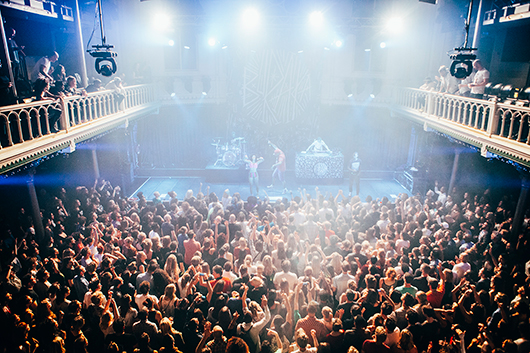
Buraka Som Sistema at Paradiso (photo by Ali Mousavi)
Buraka Som Sistema started things off right.
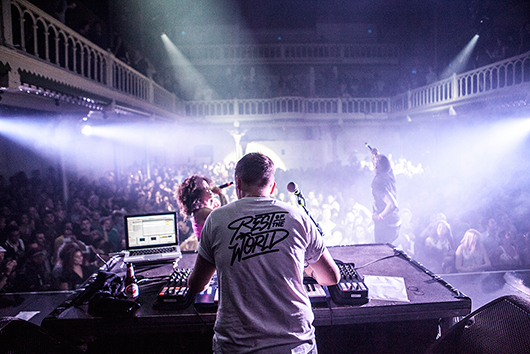
By the time we arrived in Amsterdam on Wednesday evening, the first night of ADE was already in full swing, which sent us immediately scrambling to join the fray. During a marathon event like ADE, the first performance that one sees is rarely that consequential, but when it’s a good one, it can help establish a tone for the week. As such, we were drawn to the party-starting sounds of Buraka Som Sistema. The Portuguese kuduro/global bass outfit may not appear on XLR8R as frequently as it once did—although the Buraka-affiliated Enchufada label often pops up on the site—but there’s little question that the long-running group still knows how to deliver in a live setting. Admittedly, the show’s 8:30 p.m. start time had us wondering how things would go, but our fears quickly melted away once we entered the absolutely rammed Paradiso theater, where a full-blown party was underway.
At this point, Buraka Som Sistema has transcended its club roots; the five-piece outfit is a essentially a festival act now, but the transition has been made without sacrificing too much of what made its music interesting in the first place. At ADE, the crowd ate up Buraka’s high-energy mix of big-room electro and techno with various African, Latin, and Caribbean rhythms. It’s not the most nuanced of sounds, but it’s certainly effective and a whole lot of fun, especially when delivered with one of the group’s producers (DJ Riot) perched behind a full drumkit and Buraka’s three MCs regularly hyping the crowd. Songs from 2008’s Black Diamond, such as “Sound of Kuduro” and “Kalemba (Wegue Wegue),” undoubtedly elicited the wildest responses, but with Buraka periodically inviting members of the crowd on stage (at one point, something like 100 girls were dancing alongside the group), firing confetti canons, and engaging the audience with call-and-response refrains, the energy rarely dipped during the rest of the set. Some of the performance was a bit silly, of course, yet Buraka is one of the few electronic acts that can incorporate crowd-revving antics and actual showmanship without seeming gauche or overly tacky. Without question, the group is all about bringing the party, but it’s not a party that anyone would or should be embarrassed to attend. And with multiple nights of serious, heads-down DJ sets ahead of us, starting off our ADE experience with a real show proved to be a great decision.
Buraka Som Sistema at Paradiso (photo by Ali Mousavi)
It quickly became apparent that seeing everything we wanted to see would be impossible.
Although it seems crazy now, there was once a time when XLR8R used to decline ADE’s invitations. At recently as five years ago, the conference, which began in 1996, was more rooted in the commercial end of dance music, and we simply didn’t feel like there were enough XLR8R-relevant artists participating to warrant a trip to Amsterdam. Nowadays, things have changed. While ADE’s core is undoubtedly still based around more commercial sounds and shows (more on that later), its organizers have effectively expanded the event in recent years to include more credible acts, labels, and promoters. In all honesty, it sometimes feels like ADE has even gone too far to cater to the tastemaker crowd; not because it’s a bad thing to see so many credible artists on the bill, but because it’s questionable whether or not there’s enough of an audience for these acts to support five or more events in a single night. Granted, it’s odd to be taking issue with ADE presenting too many opportunities to watch great music, but it’s also interesting that the growth of the “underground” has been paralleled by a sharp decline in “we’re all in this together” camaraderie, especially amongst promoters. At ADE, this has manifested in the simple reality that on some nights, there were simply too many good shows happening simultaneously that targeted the same audience.
As such, going out each night required a lot of planning, at least for those who hoped to see even a fraction of the artists on their agenda. Things were particularly difficult on Thursday, where Trouw had a Colours vs. Clone Records night with Hessle Audio, Midland, Leon Vynehall, and more; Dekmantel took over the North Sea Jazz Club with Boddika, Surgeon, Juju & Jordash, and Joey Anderson; Ninja Tune presented a showcase at OT301 with Actress, Martyn & copeland, Seven Davis Jr., and Moire; Melkweg was taken over by Modeselektor, which presented a Modeselektion night with L-Vis 1990, Dark Sky, Henrik Schwarz, Nosaj Thing, Akkord, Schlachthofbronx, and others; Surefire staged its showcase at Sugar Factory with Appleblim, Livity Sound, Addison Groove, Peverelist, and Second Storey; Knekelhuis brought Hieroglyphic Being and Beau Wanzer to Radion; and the local Tape Records crew hosted Funkinevil, Marcellus Pittman, and Mark Du Mosch at Tolhuistin. And those were just the shows we considered attending that night, as numerous others had at least an artist or two who we found interesting and would have been happy to see under different circumstances.
Things did mellow out a bit on Friday and Saturday, when several venues shifted their sights towards more commercial sounds, but there was never a point where we felt like there wasn’t something going on that we wanted to see. While this occasionally required making some tough choices—and ultimately missing a ton of acts that we had wanted to check out—we do recognize that this is something that many would consider to be a “good” problem for ADE attendees.
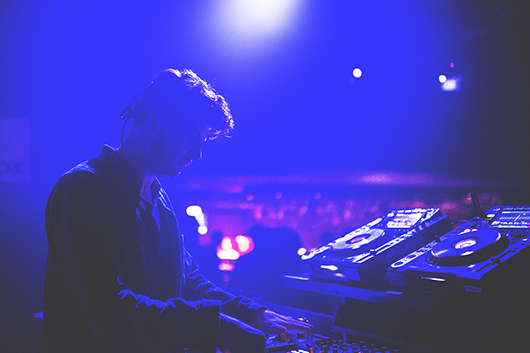
Addison Groove at Sugar Factory (photo by Eva de Korte)
As a host city, Amsterdam has few drawbacks.
We’ve commented on this in previous years, but when it comes to cuteness, Amsterdam is just about impossible to beat. With its distinct architecture, canals, and general air of pleasantness, Amsterdam is a wonderful place to explore, particularly on a bicycle. (In all honesty, having a bicycle is pretty much essential to the Amsterdam experience, and the city caters to that reality with an extensive series of bike lanes and a general deference to cyclists that only exists in a few places on Earth. As such, renting a bicycle was something we did within the first few hours of getting to town.) Beyond that, it’s clean, people are friendly, everyone speaks English, and the overall vibe is a relaxed one. Obviously, Amsterdam isn’t perfect—it’s an expensive place, the food (with a few notable exceptions) is often mediocre at best, and cloudy/rainy days are pretty much the norm, but on the whole, someone would be hard pressed to truly have a bad time in the city.
More specific to ADE, Amsterdam also earns high marks as a clubbing destination. The mere fact that the city is able to accommodate hundreds of thousands of partiers during ADE is impressive in its own right, particularly when one considers how many venues are required, not to mention all the equipment and staff needed to keep them running. Having observed the ADE cycle for several years now, it’s become clear that electronic music is a genuine industry here, and seems to be respected as a viable part of the economy. While the city’s laid-back atmosphere creates an environment in which people are allowed, and even encouraged, to party, Amsterdam takes things a step further during ADE, and actually facilitates this extra wave of late-night activity. It’s a refreshing attitude, and one that a lot of other cities could learn from.
Paula Temple and Jem the Misfit at EYE (photo by Tania Gualeni)
Paula Temple seriously caught our attention.
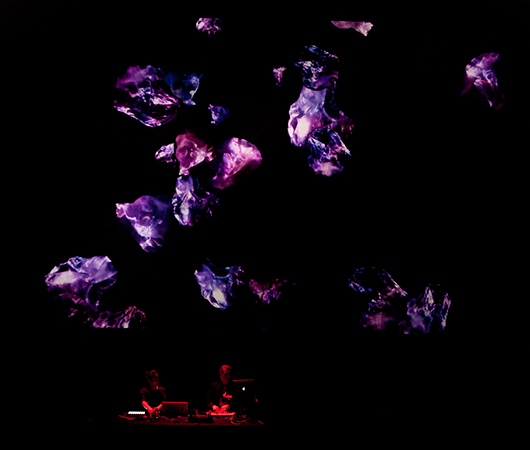
Over the past few years, we’ve periodically reported on the music of Paula Temple, but ADE was XLR8R‘s first chance to see her perform. The Berlin-based British producer and R&S affiliate actually appeared at a number of different ADE events, but the one we caught was Friday’s Nonagon, a special collaborative audio-visual performance with Jem the Misfit at a theater in the EYE (The Netherlands’ national museum for film), which resides in an absolutely stunning building right on the harbor. Impressive setting aside, we still weren’t sure how Temple’s noisy techno excursions would fare in a seated theater, but our concerns ultimately proved to be fruitless—the set was one of the most compelling things we witnessed all week.
Jem the Misfit’s visuals, which placed a heavy focus on close-up shots of unique stones/crystals and oddly compelling imagery of things like butter melting, were vibrant and undeniably potent, while Temple’s music did the rest of the work. Performing beneath the theater’s enormous screen (with Jem the Misfit right alongside her), Temple’s set was very strong, even as she moved between distortion-laced dirge and pounding techno assaults. A few tracks did include relatively pop vocal refrains, but Temple’s moody beat constructions helped to maintain a stark and foreboding vibe. The system could have been louder and a bit more consistent, as the volume seemed to drop about halfway through the set, but the experience of being in the theater was a rewarding one nonetheless. And given that much of the music on offer was newly created especially for the show, we eventually left thinking that Temple is someone we’ll need to keep a close eye on in the months ahead. She’s released some excellent music already, but it seems like her best is yet to come.
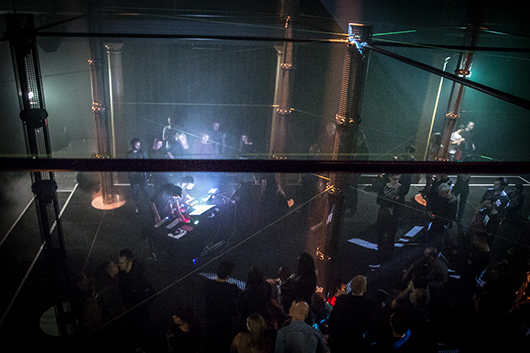
4DSOUND at Compagnietheater (photo by Georg Schroll)
We didn’t entirely understand how 4DSOUND worked, but it definitely sounded great.
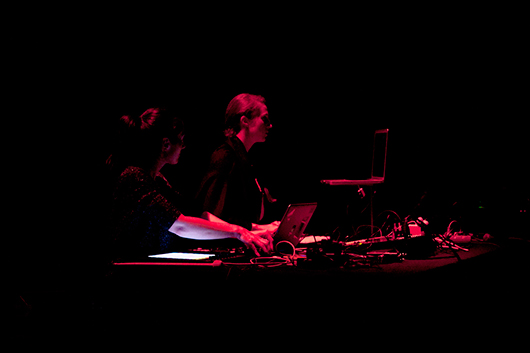
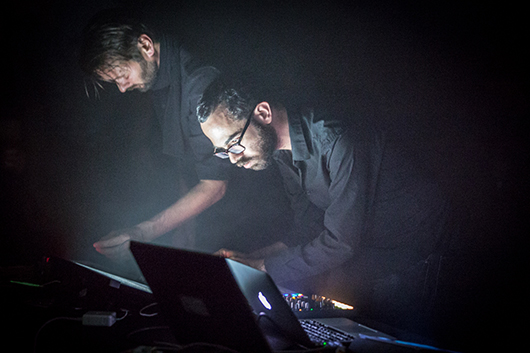
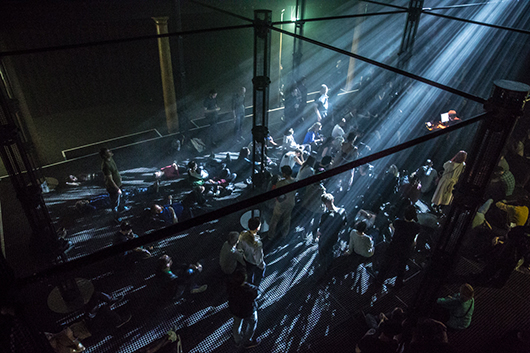
In the weeks leading up to ADE, checking out the 4DSOUND system was one of the few things we knew that we had to do during our time in Amsterdam. Honestly, we weren’t exactly sure how the system worked or why it was being touted as an impressive new innovation, but the project—and the artists involved—seemed interesting enough to warrant our attention. On Thursday, 4DSOUND had partnered with the Raster-Noton label for a special ADE showcase at Compagnietheater, where the system was being housed all week. We arrived in time for the night’s first performance, a collaborative session from Robert Lippok and Peter Kirn, who sought to “produce a live structure in sound, space, and rhythm, composing on the basis of designed spaces by architects Arno Brandlhuber, Matteo Ferroni, and Jason Danziger commissioned specifically for this project.”
While this may sound like the usual sort of empty promo-speak, the idea of creating a music-based “structure” is actually something that’s feasible with 4DSOUND. The system resided within a sort of metal lattice, which filled up the majority of the room, and while its sleek design certainly looked cool, it also enabled users to program sounds to specific locations in the space. (For instance, a hi-hat sound could be programmed to only be emitted from speakers in a particular corner of the room.) It’s difficult to explain the effect in words, but when used properly, it allows artists to create a rich, constantly moving and evolving piece that not only sounds amazing, but also comes much closer to what sounds are like in the real world. Lippok’s and Kirn’s set, which nicely combined pensive washes of noise and distortion with light, floating melodies, was a completely immersive experience, one that sounded different depending on exactly where the listener sat in the room. (Walking around during the performance further added to the novelty, as the sounds being presented would change and evolve with each step.) Unfortunately, 4DSOUND is such an enormous (and expensive) undertaking that it likely won’t be widely implemented anytime soon—it also doesn’t help that most artists don’t really have the technical know-how to utilize the system properly—but it still offered something a cut above the average sound-art experience.
Robert Lippok and Peter Kirn at 4DSOUND at Compagnietheater (photo by Georg Schroll)
4DSOUND at Compagnietheater (photo by Georg Schroll)
Dekmantel made the best of a bad situation.
Over the past few months, the local Dekmantel crew—which is responsible for the excellent festival of the same name—once again rolled out an impressive series of ADE parties, with four nights of absolutely stacked line-ups. Unfortunately, about a month before the conference began, the venue which Dekmantel had booked—the MC Theater, a place we admittedly haven’t loved in the past—went into bankruptcy. As a result, instead of having a two-room, 1700-person capacity venue at their disposal, Dekmantel’s organizers were left with the 550-person capacity North Sea Jazz Club, which sits right next door to the MC Theater. Going forward with the shows meant taking a huge loss during ADE, but Dekmantel still elected to move forward with downsized versions of its events, largely in an effort to not suddenly cancel on the dozens of acts that had been booked. It was an admirable decision, but it that made getting into the Dekmantel events all but impossible for anyone that hadn’t bought a presale ticket.
In the end, we only managed to make it to a Dekmantel party on Thursday, where we caught a typically quality set from New Jersey house explorer Joey Anderson, and an absolutely stellar live session from Amsterdam-based duo Juju & Jordash. Granted, the pair always impresses with its improvisational approach and obvious mastery of its gear, but Thursday night found the group performing at an hour (1 a.m. to 2 a.m.) when keeping the dancefloor moving was an absolutely necessity. As such, the duo played harder than we’ve been accustomed to seeing, and while we always enjoy the psychedelic tendrils of Juju & Jordash’s music, this more direct and booming approach really sounded excellent. It wasn’t quite techno, but it definitely had a raw feel and plenty of low-end punch that we didn’t expect. We would never advocate for any act to change its sound, but it was definitely nice to see that Juju & Jordash were fully capable of turning up the heat.
Livity Sound at Sugar Factory (photo by Eva de Korte)
Crème Organization and L.I.E.S. might have thrown the week’s best party.
On Friday night, Dutch imprint Crème Organization and NYC outpost L.I.E.S. joined forces at Studio 80, a venue which generally books quality acts but unfortunately sits right in the most touristy part of central Amsterdam. As such, the crowd was something of an unusual mix, with dudes in Hollister t-shirts bro-ing out next to awkwardly fashionable vinyl diehards. The club was completely packed, its dark and humid confines not offering much in the way of chillout space, but somehow, the party still worked, probably because of the uniformly excellent music on offer. By the time we arrived, Miami’s Greg Beato was wrapping up his set with quality slices of unpolished electro in the main room, while Steve Summers presented a live set of more chugging techno sounds in the smaller back room. He would eventually give away to Randomer, the only British member of the L.I.E.S. cadre, whose set nimbly combined hard-edged, distorted techno with a distinctly UK sensibility; his occasional forays into unusual rhythms and percussion patterns (think Hessle Audio) were a welcome change of pace.
Still, the night’s brightest moments belonged to the Dutch, namely Legowelt and Crème Organization boss TLR. The former played live, serving up a compelling, synth-soaked brew of house and techno that simultaneously referenced both ’90s Detroit and 16-bit videogame soundtracks. It was excellent stuff, but TLR was even better, with a DJ set that nimbly moved between genres but spiced things up with plenty of propulsive electro. With daybreak rapidly approaching, TLR eventually gave way to young artist Innershades, who deftly maintained the party vibe. It’s safe to assume that the dancefloor kept jumping well into Saturday morning, but an intense need to sleep eventually sent us toward the door sometime after 6 a.m.
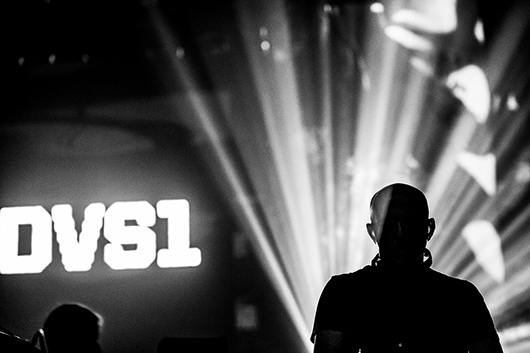
On Saturday night, we elected to start our night at the Electric Deluxe showcase, as we were enticed by the fact that Lucy and DVS1 would be kicking off the festivities. Furthermore, after a week in which we had seen a lot of house, checking out a proper techno event seemed like a good change of pace. The party was happening at Gashouder, which we saw was located in a park on the western end of the city (where a number of other venues also reside), so we hopped on our bike and trekked across town. However, even before we walked into the venue, it was clear that we had made a mistake, as Gashouder turned out to be a 5000-person capacity, arena-like venue that had been decked out in the same manner that one would expect a corporate American “rave” event to be. The audience was young, glowsticks were in the air, the venue had a designated massage zone and a mini food court, and we were even forced to place our coat into a tiny locker—at a cost of six (!) euros. Despite all of that, the music was fine, as both Lucy and DVS1 (the only acts we stuck around to see, although the rest of the bill included Nina Kraviz, AnD, Speedy J, and others) played well, but in that context, their selections really lost all meaning. These kinds of massive parties are almost entirely divorced from underground club culture, so when we were actually at one, we found it hard not to fixate on just how much of the electronic music industry is purely focused on making money and maximizing profits. Walking around the party, we came across several industry professionals, and the few positive comments that they could muster were generally in reference to the high quality of the event production; of course, that was all well and good, but those observations essentially sidestepped the fact that these kinds of large-scale events are essentially devoid of any soul, not to mention a quality vibe for people in search of more than glossy visuals and a lazer show.
In truth, we’re not trying to pick on the Electric Deluxe event—it just happened to be the only party of this kind that we happened to attend, and our presence was basically an accident that could have been avoided with a bit more research. On the one hand, that speaks to how diverse ADE has become, as it’s absolutely possible to attend the conference and only go to high-quality events in cool spaces curated by legitimate music fans. On the other, it was a good reminder of exactly what ADE is and always has been. There may be a festival element to the Amsterdam Dance Event, but this is very much an industry event, something which is put on by mechanical rights organizations (the people who collect royalties, publishing, etc.) in The Netherlands. Even with all the parties on offer, ADE is an event that caters to and is designed for people who want to do business, which means that many of those in attendance are agents, managers, bookers, festival organizers, promoters, label representatives, gear representatives, and other folks whose primary interest is making money. That’s not an implicitly bad thing—after all, journalists are also part of the ADE equation, and few of us are working for free—but it does color the tone of the proceedings. ADE is what it is, and that shouldn’t be glossed over, not matter how many credible artists get booked.
Speaking of reiteration, no XLR8R review of ADE would be complete without a few paragraphs of gushing about the greatness of Trouw. At this point, there’s no question that it’s the best club in Amsterdam, and most people seem to agree that it’s one of the best clubs in the world, which is why it’s so disappointing that the place will be closing for good in early 2015. As such, this was Trouw’s last ADE, and the club unsurprisingly made it count with a stellar series of parties hosted by the likes of Rush Hour, Colours, Clone, Hessle Audio, Resident Advisor, and others, all of which featured some top-notch talent, both from Amsterdam’s local scene and from further afield. Throughout the week, the atmosphere at Trouw was a joyous one, and the impressive sets were simply too numerous to list. Still, a few especially serendipitous moments did take place, such as Thursday night’s epic back-to-back session in the main room, which included the likes of Ben UFO, Pangaea, Pearson Sound, Leon Vynehall, Serge, Jackmaster, Midland, and Cinnaman trading off records—and getting a bit nostalgic with their selections—during the party’s final few hours.
Still, it was Sunday, the final day of Trouw’s ADE run, that proved to be the most memorable. Granted, these ADE closing parties are always special at Trouw, as both the staff and the crowd shed their collective stresses from the week and truly let loose. Furthermore, the club decided to do something special and opened a third room for just one night. (Dubbed De Natte Cel, it once served as a bathroom deep inside the massive building.) Covered in tiles and almost immediately dripping with precipitation, the room was an excellent addition to the day’s festivities, which began at 8 a.m. on Sunday and ran straight through until Monday morning. Sunday’s performances were also notably good, as Solar was unexpectedly tasked for a five-plus hour set in the afternoon when Omar-S‘ plane was delayed, prompting the San Francisco DJ to deliver a top-flight journey through house, techno, electro, new wave, and industrial as the dancefloor gradually came to a boil throughout the afternoon. He eventually turned things over to Gerd Janson, a Trouw regular who lived up to his esteemed reputation with a set of high-energy house and disco that had the main room going wild. As the night wore on, Tom Trago, Talaboman, Mano Le Tough, and Job Jobse stepped in, while many of the club’s residents—including Trouw founder Olaf Boswijk—kept things humming in the basement downstairs. Over in De Natte Cel, Omar-S finally got on the decks, as did longtime Trouw favorite Traxx and a collection of Rush Hour all-stars. Even as the hour grew late (or early, depending on one’s perspective), the club stayed incredibly full and smiles were in abundance. Everyone knew that this was the last time there would be a Trouw party during ADE, and we all wanted to celebrate.
Over the weekend, London-based Canadian Dan Snaith (a.k.a. Caribou) became the latest contributor to BBC Radio 1’s venerable Essential Mix series. The two-hour session is a characteristically diverse one from the artist who also DJs/produces under the name Daphni, with cuts from the likes of Joy Orbison & Boddika, Butric, and Pearson Sound rubbing up against tracks by James Brown, Lil Wayne, and the Silver Apples. Snaith also includes two previously unheard Daphni productions in the set, lending an already intriguing mix some extra exclusive cache.
Caribou’s Essential Mix can be streamed in full here, where a full tracklist for the set can also be found. In addition, our recent Rewind session with the accomplished artist—which found Caribou, in his own words, looking back at his entire discography—can be read here.
The Wrong Island imprint has been in operation for just over a year, releasing cozy electronic outings from artists such as Automatic Tasty, M|O|O|N, and—starting tomorrow—Line Idle (a.k.a. Aleks Jurczyk, the resident synth specialist at Glasgow’s Rubadub shop). Before his Woodblocks EP lands, the label has passed along this remix of the effort’s title track from Automatic Tasty who, in his own words, is said to have “smushed” the track up, running the tune’s percolating sound bites through “tape delays, then recorded to reel-to-reel, and back through tape delay.” Reportedly, Automatic Tasty also sneaks in bits of 808, 101, and Juno underneath as well. The rework—which origianlly came to us with the lengthy official title “Automatic Tasty’s Entirely Quite Useless at Chopping Logs Mix”—can be grabbed below, while Line Idle’s upcoming Woodblocks EP is available to preivew after the jump before it lands in both vinyl and digital forms tomorrow.
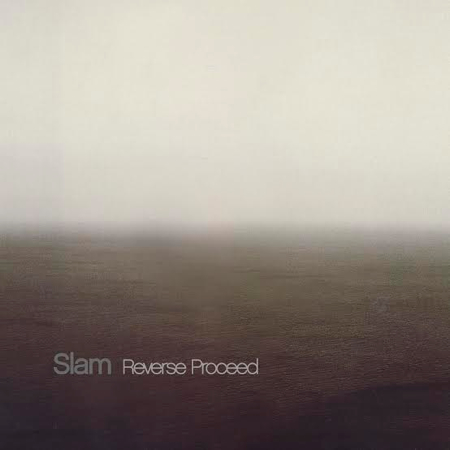
In its 20-plus-year career, Scottish production duo Slam has done a lot. After playing an integral role in the development of Glasgow’s underground house scene of the late ’80s, Slam has been behind a consistent string of quality releases that continuously found the pair keen to explore the ever-evolving corners of house and techno throughout the past two decades. 2014 has hardly seen Slam let up, with the pair set to return to its own Soma label with Reverse Proceed, a 14-track album that can now be streamed in full on XLR8R ahead of its release next week.
Spanning just over an hour, Reverse Proceed is intended as one continuous piece of music, with each of its efforts winding into the next. To that end, Slam seems happy to take its time building up the LP’s momentum, with its opening 20 minutes brewing in immersive ambient electronics. The record takes a sharp turn with its fifth track, “Synchronicity,” laying into a sluggish four-on-the-floor which eventually opens up the gates for the burrowing techno of “Ghosts of Detroit,” the adventurous dancefloor explorations of “Pattern A3” and “Factory Music,” and the hard-hitting stomp of “Rotary.” Across it all, the Glaswegian duo sounds confident as ever, pushing and pulling an arsenal of hardware machines towards various ends of the electronic spectrum, all with a veteran’s touch.
Officially out on October 27 via Soma, Slam’s Reverse Proceed LP is streaming in full below.
1. Tokyo Subway 2. Visual Capture 3. Reverse Proceed 4. Cirklon Bells 5. Synchronicity 6. Ghosts of Detroit 7. Relevant Question 8. Pattern A3 9. Factory Music 10. Convolute 11. Catacoustics 12. Irritant 13. Rotary 14. Resolved
Throughout the week, a whole lot of material gets posted here on XLR8R. And while we know—and love—that some hardcore readers will eagerly pour over every single news story, interview, podcast, video, and MP3 download that appears on the site, we also realize that for most people, it’s impossible to see everything, which means that some quality XLR8R content is likely to get missed in the hustle and bustle of everyone’s daily lives. In the interest of making it easier for everyone to catch up, every Friday we present The Lowdown, a weekly wrap-up of the top 10 tidbits from our site.
1. The music world was saddened this week by the death of seminal LFO member and frequent Bjork collaborator Mark Bell.
2. All week long, XLR8R ran its annual Labels We Love series, and the most popular feature was our list of 10 of our favorite labels, along with five new imprints worth watching.
3. UK producer Julio Bashmore (pictured above) debuted a disco-indebted new single, “Rhythm of Auld,” which is said to precede a new album.
4. This week’s XLR8R podcast was assembled by Berlin expat Lando, who will be soon launching a new label, Myth Music, with his own new EP.
5. Bonobo announced the impending release of a new EP for Ninja Tune, and shared a stream of the title track.
6. We kicked off Labels We Love with an in-depth profile of long-running Dutch imprint Clone Records.
7. The top tune in our Downloads section this week was a sparkling remix of Repeat Pattern’s “Half of Half” by UK producer Submerse.
8. London’s Hyperdub was also the subject of a Labels We Love feature, as we asked founder Kode9 to list 10 of the imprint’s most memorable tracks—one for each year of its existence.
9. Labels We Love also included a fascinating B2B conversation between Night Slugs’ Bok Bok and PAN’s Bill Kouligas.
10. Brooklyn beatmaker FaltyDL shared news of an unpronounceable new EP for Ninja Tune, and shared a stream of a new track.
An expanded version of the The Lowdown is also available via a weekly email newsletter. Those interested in an even more in-depth round-up of XLR8R content should sign up by entering their email address below.
Dutch synth specialist Legowelt and Brooklyn DJ/producer Willie Burns have let loose the first episode of Relics of the Past, a peculiar online TV series which sees the two artists starring in and providing the show’s soundtrack.
In the series’ first installment, Legowelt and Burns begin by skateboarding around town before returning home to lift weights, smoke weed, and play with synthesizers. Eventually, they discover an ancient relic in a cupboard and enlist the help of the gardner—played by Jeroen Warmenhoven (a.k.a. DJ Overdose)—to help them do away with its evil spirits. The first episode of what is planned to be an ongoing series can be watched in full below.
For the final MP3 to appear in our Downloads section this week, we’re taking a bit of a left turn in order to dive into some refracted tape manipulations from Night & Tickets. Though we don’t know much about the outfit—other than that it hails from Vladivostok, Russia—we do know Night & Tickets’ Actually I Really Hate Summer cassette will serve as one of four tapes to appear in the Constellation Tatsu label’s “Fall Batch” of releases (all out on November 1). Featured here, “August Morning in My City” finds Night & Tickets slowly bringing together a collection of glowing textures, lined with heavy layers of hiss and noise, and constantly manipulated through any number of electronic devices. A collage of disparate samples and ever-morphing synth tones, the track does sneak in a handful of drum breaks throughout its run, which giving production a sense of forward momentum as Night & Tickets continues to add to its (somewhat surprisingly) warm and inviting sonic construction.
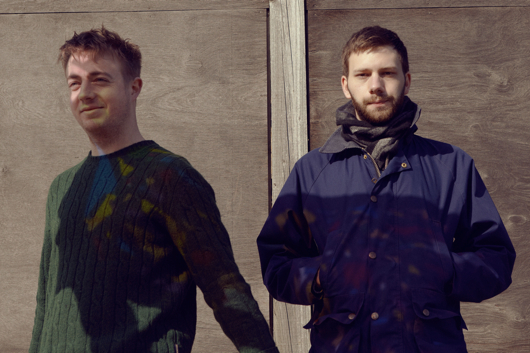
Ahead of a slew of upcoming DJ dates in the UK and Europe, Warp duo Mount Kimbie has shared a new mix. The 50-minute session finds the pair throwing a few of its own tunes in alongside a diverse set of tracks from the likes of Actress, Raudive, James Blake, Jonwayne, Benedek, Willie Burns, Bass Clef, and John Maus, among others.
Mount Kimbie’s new mix can be streamed below, where the full list for the pair’s clutch of upcoming European/UK DJ dates has also been included.
Bass Clef – Clapton Deep Mount Kimbie – Fifty Mile View James Blake – Buzzard And Kestrel Sigha – Shapes Owiny Sigoma Bandowiny Techno Actress – Lets Fly Jonwayne – Altitude Mount Kimbie – Meter Pale Tone John Maus – Cop Killer Actress – Shadow From Tartarus Benedek – Cold Flame Pearson Sound – Figment Reagenz (Ft Fred P) – Keep Building Animal Collective – Peacebone (Pantha Du Prince Remix) Luke Hess – Transform The Signatures – Come Rain Or Come Shine Howes – Asiko Raudive – Health Benedek – Jmz Nenad Markovic – Swamp Milk Jen Workshop – Untitled B1 Willie Burns – Gonna Get You Rick Wilhite – Magic Water