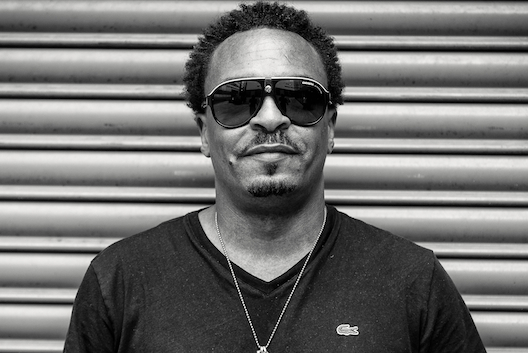
Accomplished underground producers Jerome Sydenham, Ron Trent, and Aybee have combined forces as S.A.T., a collaborative project that will issue a self-titled LP in November. Set to appear on Sydenham’s Ibadan label, the eight-track effort is said to have stemmed from a conversation the three had over dinner, which then led to them working together on a track, and eventually deciding to together craft an album’s worth of material. A press release further explains, “With the mood in Jerome Sydenham’s Berlin studio loose and organic, the trio set out to produce an album full of the elements they love about the dancefloor experience. After three weeks of living in the studio, the S.A.T. album has emerged.”
With each artist having a distinct style (Sydenham’s and Trent’s being honed over each of their 20-plus-year careers), it’s unclear exactly where these three producers will meet as S.A.T., though the results are likely to land somewhere along the percussive ends of hypnotic techno and truly deep house. While we await the first bits of audio to emerge from the S.A.T. LP, the record’s artwork and tracklist can be found below; the LP is currently slated to arrive on November 25.
01. The Rig 02. Feral 03. Papa Smurf 04. The Gate 05. Fallout 06. Rhythm of the Universe – S.A.T. Rendition feat. Function 07. She Was 08. Fishfarmdisco 0x. Yaphet (digi bonus track)
Ahead of a string of North American DJ dates, Bonobo has turned in a new mix for free download. Appearing on Thump, the now NYC-based DJ/electronic musician’s latest set places its focus on soulful and percussive tunes aimed at the dancefloor, touching on tracks from Moderat, Leon Vynehall, and others in the course of its 50-minute run.
Bonobo’s full Mixed By session can be streamed below and downloaded here, though it appears without an accompanying tracklist. The full list of Bonobo’s upcoming North American tour dates can be peeped over on Thump, while details of the man’s forthcoming live album/DVD can be found here.
Daddy Kev’s ever-growing Alpha Pup label is set to add a new LP from budding LA talent Elusive to its catalog later this month. Pulled from the upcoming Blue Blanc album is “Forbidden Fruit,” a jazz-touched production that finds Elusive trying his hand at the off-kilter rhythms, loose percussion, and bluesy chords that have become staples of the SoCal beat scene. Still, Elusive finds ways to add his own touch to the proceedings, taking time out to focus on some delicate snaps and hiding sneaky Rhodes leads underneath sections of the lopsided affair. “Forbidden Fruit” can be downloaded below before the producer’s Blue Blanc LP officially lands on September 16.
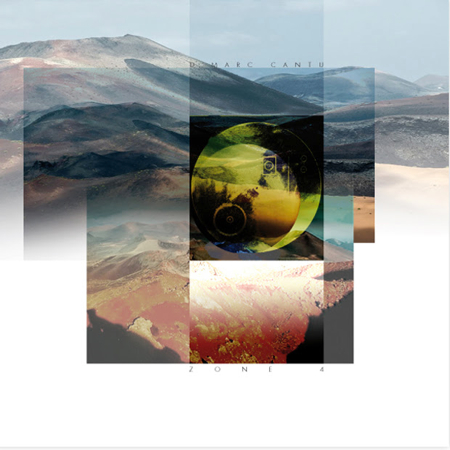
Ann Arbor artist D’Marc Cantu will issue his ZONE 4 EP next week via Barcelona’s Shaddock label. Said to present four tracks that have been “carefully thought out, [and] crafted to flow in and out of one another in mood as well as presence,” each track from the prolific producer’s next effort is intended to “narrate a chapter of the science-fiction tale ZONE 4.” A such, the record appears striped with floating textures and space-destined melodies, all of which ride atop steady drum machine rhythms and rounded basslines. “ZONE 4 was the first project that I created as a whole idea,” Cantu himself explains in a press release, “It sat for a number of years, shelved until the day that I found a label that would honor it the way I had envisioned.”
Set to arrive in stores next week, D’Marc Cantu’s forthcoming EP/sci-fi narrative can be previewed below.
Recent Bubblin’ Up artist—and even more recent NYC transplant—Austin Cesear will return to the Public Information label (who dropped his debut release back in 2012) with a six-track mini-LP later this month. Titled West Side, the record is said to have been heavily inspired by Cesear’s former place of residence, Oakland, California, where the industrial landscape of the city’s docks were interpreted back in the studio as six murky electronic productions.
Serving as our first taste of West Side is lead track “La Paloma,” which has received a video treatment from director Paul Clipson. Consisting of footage shot on 16mm film in San Francisco—with its images, layers, and effects manipulated live in-camera—the entrancing video for “La Paloma” can be watched below, where the full tracklist for Austin Ceaser’s forthcoming mini-LP (set to drop on September 29) has also been included.
A1. La Paloma A2. Ain’t It So (Necessary) A3. Cloven Hoov B1. Easy Bend B2. Samareda B3. Bee Free (Warlick Mix)
Buenos Aires producer El Remolón is set to head across the globe with plans to tour around Europe for the month of September. Preceding the tour, the longtime ZZK affiliate has revealed Selva B-Sides, a collection of bonus tracks and special remixes which follow the release of his Selva LP for the label earlier this year. Included in the collection is this remix of Mali vocal group Tartit‘s “Ehe Ehenia.” Bolstered by floor-focused rhythms and brooding synth textures, El Remolón turns the song into a dark and hypnotic expedition into tribal club music. The full list of the Latin experimenter’s upcoming tour dates can be peeped after the jump, while the full Selva B-Sides collection can be picked up for free directly from here.
September 12 Mashit Up @ Cologne September 13 Panke @ Berlin September 16 Global Amigos @ Prague September 18 Dando La Brasa @ Bilbao September 19 Dabadaba @ San Sebastian September 20 BAM Festival @ Barcelona September 25 Cafe Berlin @ Madrid September 26 Södra Teatern @ Stockholm September 27 Banda Aparte @ Islas Canarias
The past year or so in UK dance music has been marked by the rapid ascendance of a new wave of instrumental grime producers, many of whom are affiliated with London’s monthly Boxed clubnight. Slackk (a.k.a. Paul Lynch), a Boxed co-founder, stands as one of the most consistently inventive and forward-thinking of these figures, but he actually began honing his craft well before grime was hit with this recent swell of critical popularity. Since 2010, he’s released records on labels such as Numbers, Unknown to the Unknown, and Local Action, and he also heads up the archival Grimetapes website. Now, he’s put together his debut album, Palm Tree Fire.
Like last year’s Failed Gods EP, the new LP is out on the UK’s Local Action label, and it finds Slackk offering up 16 tracks of intricate, evocative grime that are firmly in the lineage of the romantic instrumentals pioneered by cult grime crew Ruff Sqwad during the early-to-mid 2000s. Where Lynch’s previous releases often drew a relatively clear distinction between more conventional, aggressive tracks and the occasional foray into atmospheric mood music, Palm Tree Fire cohesively blends these two impulses—many tracks retain the abrasive stance that’s so integral to grime, but they also introduce new layers of complexity into the genre’s sonic vocabulary.
The album’s opening title track is a testament to this newfound sophistication. Pairing a woozy 8-bit synth line with staccato snare hits, the tune achieves a balance between cold and warm that grime producers often strive for but rarely pull off this well. Many of Palm Tree Fire‘s tracks betray a vaguely Eastern sensibility—a nod to grime tradition in the form of what Kode9 once dubbed ‘sinogrime,’ a strain of the genre featuring Asian-influenced melodies and stretching back as far as Wiley’s early productions, most notably “Shanghai.” Hewing closest to that template here is the tellingly named “Three Kingdoms,” which uses pan flute, delicately plucked notes, and a scuffed, uneasy rhythm to evoke an eerie, future-forward mysticism. Similarly, “Puma Walk”—another album highlight—interweaves multiple uneasily pitched synth lines over strutting drums. These kinds of tracks suggest a deep knowledge of grime’s history, which isn’t exactly surprising given Lynch’s prior experience as a producer, not to mention his clear dedication to archiving and documenting the scene. Still, it would have been easy for this sort of attention to historical detail to come across as clinical, but Palm Tree Fire‘s sonic inventiveness ensures that the music is much more than a nostalgic exercise.
The galvanization of London’s new breed of grime artists around Boxed has resulted in some dazzlingly innovative music from a genre that five years ago looked dead in the water. But while this resurgence is undoubtedly charting new territories for the genre, it also has a tendency to celebrate innovation for innovation’s sake. Slackk’s debut album isn’t immune from this, and does have some moments that feel too artful or too refined (the mournful strings and juddering rhythm of “Jackal,” the lethargic desert soundscapes of “Litherland”), but on the whole, the LP is an impressive achievement. Lynch has created a fully realized, statement-like grime album that shows just how much the music has evolved from its roots in the housing projects of East London.
FaltyDL has unveiled a new video for “New Haven,” taken from his recent full-length, Into the Wild. Directed by Blair Neal and Kyle McDonald, the video is described as a “technological feat,” making use of “drone cameras for dramatic aerial shots, high speed cameras for super slow-mo video, and an experimental film technique known as Schlieren Imaging to visualize the normally invisible flow of air.” The 17-track Into the Wild dropped last month via Ninja Tune, and the video for “New Haven” can be watched in full below.
The premise of LANDR, from Montreal-based startup MixGenius, mirrors that of many other services in our newly remodeled digital lives: remove the middleman and replace him with a host of multifaceted computer algorithms to do the job better, faster, and cheaper. LANDR is an attempt to apply this very model to the realm of music production—specifically, the mastering process.
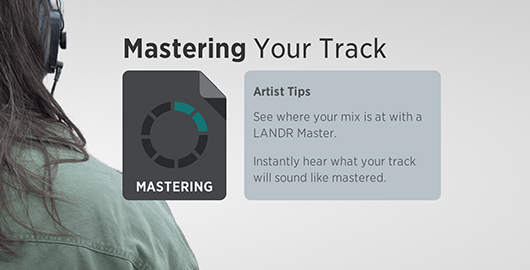
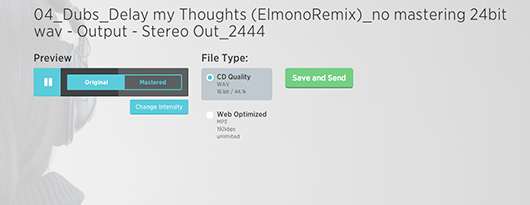
Perhaps unsurprisingly, given its scope, LANDR is the brainchild of a musician, a DSP researcher, and an astrophysicist. The heart of the company behind it, MixGenius, is its staff of roughly a dozen engineers. They’ve created what the company calls its “algorithmic digital mastering tool,” which uses machine learning to master music tracks without the need for a living, breathing mastering engineer. Users can upload their track, adjust the intensity of the mastering process, and within a few minutes listen to an A-B comparison of the original and the mastered track (and download it if the results are to their liking). For $9 a month, users get four uncompressed WAV masters; $19 a month brings unlimited WAV masters; 192 kbps MP3 files are free.
Without question, LANDR is the kind of technology that tends to ruffle feathers, but we wanted to examine how it actually performed. In practice, LANDR fared pretty well in mastering tracks we threw at it. The results were comparable and quite often better than applying a preset from iZotope’s Ozone plug-in (probably the most accessible and popular option out there for the untrained mastering engineer, starting at $250). It produced consistently solid, loud-without-being-slammed masters from a wide range of material, and did so immediately; the LANDR mastering process takes only as long as a track takes to upload to the site.
Where LANDR differs from the likes of Ozone and other software suites is in its ever-evolving nature. It’s designed as a self-learning engine, and gets smarter with every mix its users upload, and every choice they make. Currently, it takes just basic data from these interactions: whether a user likes the mastering job enough to download the resulting mastered file, for instance. But the breadth and detail of the data it’s able to parse from its userbase will continue to expand, and accordingly, there’s an engine update every two or three weeks to reflect what it has learned.
Many mastering engineers have a hard time explaining exactly what it is they do to tracks that get sent their way, alluding to a certain “feel” they get for the music at hand. If the same track is given to two different mastering engineers, two versions will come back that sound (at least subtly) different. LANDR, however, will send back the same track every time, precisely because it’s doing away with the human element. This is both LANDR’s guiding principle and the very reason why it’s unlikely to supplant mastering engineers altogether: mastering is equal parts art and science, and LANDR would appear far more capable of the latter than the former. Just as Instagram hasn’t replaced Photoshop, it’s unlikely that LANDR will replace the intimacy and knowledge of a highly skilled professional.
“Mastering engineers don’t bat 1000, and neither will LANDR,” says Thomas Sontag, head of communications and artist relations at MixGenius. (He also handles A&R duties at Montreal-based label Turbo Recordings.) “There’s a lot of complexity there, and what determines the best result is highly subjective. The beauty of LANDR is that everything is designed to come as close as possible to the psychoacoustic goal, and everything is built to improve based on the feedback and continued testing. There’s a feeling that the work we’re doing is building up a body of research and data that’s just going to improve.”
It’s a faith in the strength of the algorithm—especially its ability to learn and adapt—that serves as LANDR’s core competency. “If we grant that Siri is going to get better at helping with our lives and that these technologies really are the way of the future, well, we think that we can kind of run that space as far as mixing and mastering goes, and helping people finish their tracks,” continues Sontag. “We see loads of room for improvement. One of the things we’re working the most on right now is more granularity in the genre detection, so the system can more accurately decide on the overall mastering style.”
Indeed, there’s a psychological element to the cloud-based model as well. “That feeling of mystery is a big part of it,” says Sontag. “People don’t have the confidence and sense that they can properly master something themselves—and no offense to anyone, but that’s usually true. It’s really hard to do.” Sending the track off—even to a robot—and having it returned to you in better shape than it started fits nicely with the traditional workflow of producer and mastering engineer.
Somewhat similar to the way in which Shazam picks apart a song to identify it, LANDR uses big data and machine learning to understand what a track is and to process it, based on previously submitted tracks. Sontag imagines a not-so-distant future in which home producers upload the stems of a song they’ve made, select something along the lines of a preset for how they would like their record mixed (’60s psych, ’80s acid house), and let LANDR do the rest. While he won’t give a hard date for when a mixing-focused iteration of LANDR might be released, he says work on it has already begun.
“If we think big, and we think about the future, I like the idea of the legacy of [mastering house] The Exchange having their premium version of LANDR,” says Sontag. “I think there’s also interesting potential; people see LANDR as this total robot, but they don’t realize it’s actually kind of a hybrid. It’s not just a computer doing the thinking, it’s real human engineers working on this. In a lot of ways, it is mastering, just using a slightly different toolkit.”
It’s something he and the folks at MixGenius see as a solution to the current state of music production affairs. “When you consider how many people there are trying to make music now—the boom, specifically in electronic music—that when they take their little crack at it, that they have an option that makes them feel a little more confident about sharing that music with the world. I think that in the short term, LANDR is a mastering solution in line with certain realities of our time: we’re not just dealing with bands that spent a lot of money recording their album. We’re dealing with kids in their bedrooms, pumping out track after track. That’s the kind of era we’re living in.”
Dutch intstitution Clone has announced that it will re-release house pioneer Roy Davis Jr.‘s Roy’s Chicago Basement Traxx via its Jack for Daze series. The record was originally issued 20 years ago, as a four-track EP on the US-based Kumba label. For the forthcoming reissue, however, Clone has reportedly selected the record’s three most “dirty, raw, jacking and most of all intense” tracks, distinguished by “Jerking rhythms, hypnotic synths, and live arrangements stripped to the bare essentials.”
Roy’s Chicago Basement Traxx is set to arrive on October 13, and we’ve posted its artwork and tracklist below. Clips can be streamed here via Clone’s website.
A1 Chemical Warfare B1 Broken Machines B2 Jack Da Rhythms