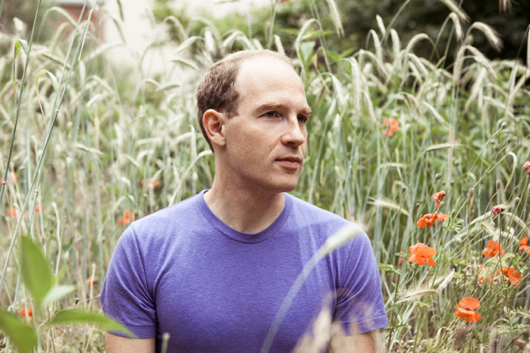
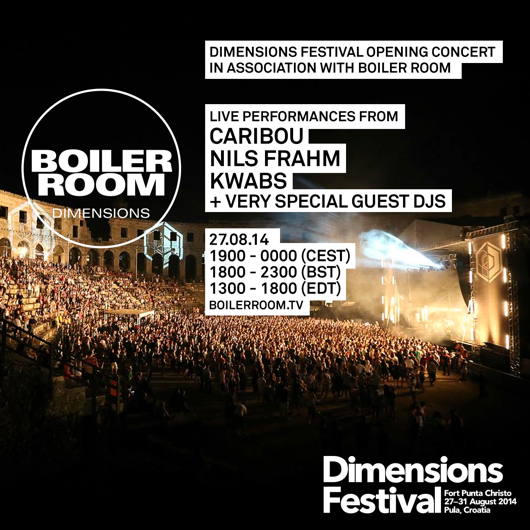
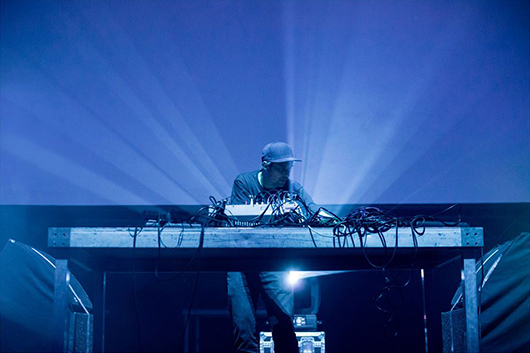
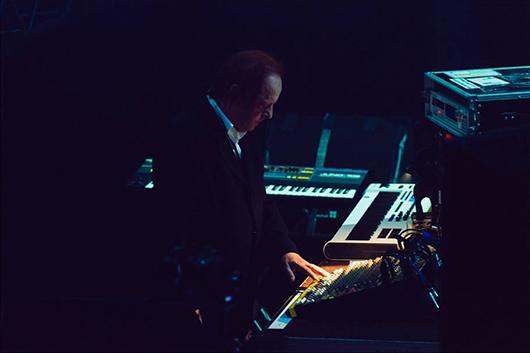
With his forthcomingOur Love LP a little over a month away from seeing its release, Caribou has revealed plans to stream his live performance from the Dimensions Festival‘s opening concert tomorrow. Set to be broadcast by Boiler Room beginning at 1 pm EDT, the Croatian festival’s opening concert will also feature live performances from exceptional pianist and composer Nils Frahm, London vocalist Kwabs, and some “very special guest DJs.”
Taking place inside a 2000-year-old Roman amphitheater in the Croatian city of Pula, Caribou’s live set is expected to begin around 4:45 pm EDT. The flier for the upcoming broadcast has been included below.
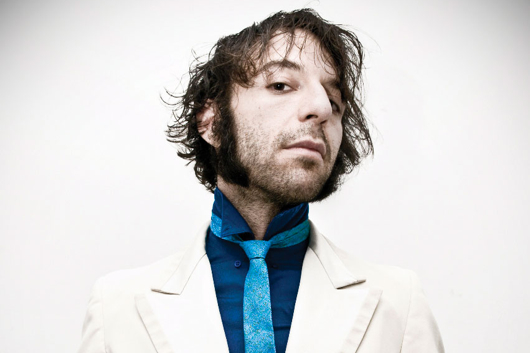
Home to artists such as Shlohmo, LOL Boys, Groundislava, Salva, and others over the years, 2014 marks the fifth anniversary of Los Angeles imprint Friends of Friends. To mark the occasion, the label is said to have a compilation in the works (as well as a pair of anniversary shows in LA and Seattle next month), but first, the label has tapped LA beatmaker Daedelus—who recently announced his forthcoming The Light Brigade LP for Brainfeeder—to put together a label-spanning Five Years of FoF mix. The 40-plus-minute session is said to be made entirely of songs from the Friends of Friends catalog, which includes a number of jaunts into moody beat territory as well as a handful of more club-rooted affairs.
Though no tacklist has appeared along with it, Daedelus’ Five Years of FoF mix can be streamed and download in full below. Details of the label’s 5oFoF compilation, and some other “fun goodies,” are still forthcoming at this time.
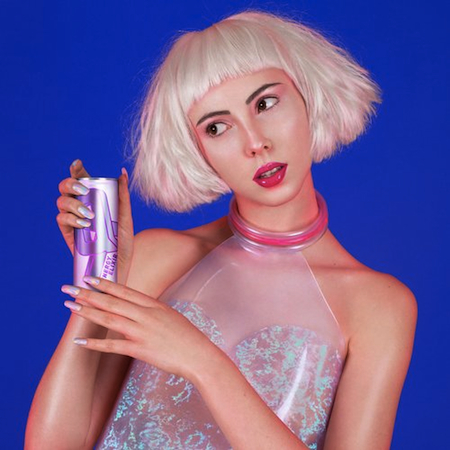
Shortly following the release of “Lemonade” b/w “Hard” on Numbers, UK producer SOPHIE has teamed up with PC Music head A. G. Cook to form QT, a collaboration which today has dropped a new single via XL. “Hey QT” is said to combine “sugar-sweet, glossy, hyperreal pop with the kind of playful, twisted, provocative electronics” associated with both of its creators. According to a press release, the QT project itself is conceptualized as a brand, specifically an “Energy Elixir,” in which “organic and synthetic meet to stimulate an uplifting club sensation”—much like the track itself. “Hey QT” is out today via XL, and can be streamed in full below.
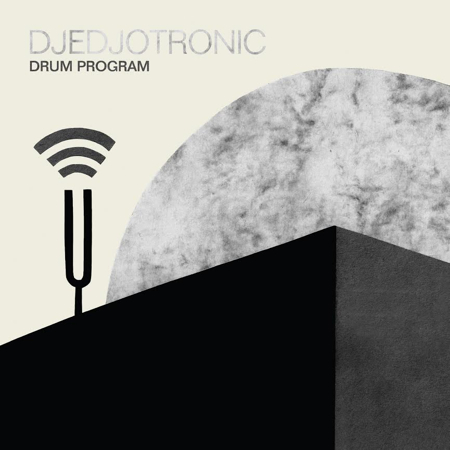
Landing somewhere between space-age electro and steely techno, “Rotten” is one of five tracks set to appear on Djedjotronic‘s forthcoming Drum Program EP. Built around industrial percussion tones and crisp drum machine hits, the track is acutely focused on its rhythmic content, looking only to a few icy, atmospheric touches and a sequence of looping bleeps to provide any sort of outright musical components. As it turns out, that’s really all “Rotten” needs, as its rhythmic patterns frequently shift and evolve throughout the effort’s four-plus minute run, making for an effective dancefloor tool. “Rotten” and the rest of Djedjotronic’s Drum Program EP are set to arrive on September 1.
Berlin Atonal, which wrapped up a five-day run in the German capital during the early hours of Monday morning, was ostensibly a music festival, but it was much more than that. Art and food also played a big role, but Atonal wasn’t really about those things either.
Oh, sure, some stellar performances were witnessed by thousands of people each night; art installations in five strategic locations complemented the music or provided a needed escape from it at times; and the nightly rotation of street food vendors, who fronted a grassy picnic area in what was an otherwise largely steel and concrete industrial environment, offered selections that ranged from British pork pies and Scotch eggs to German noodles and Japanese pancakes—and that was just on the closing night.
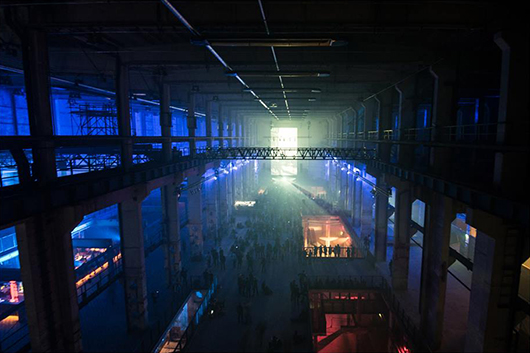
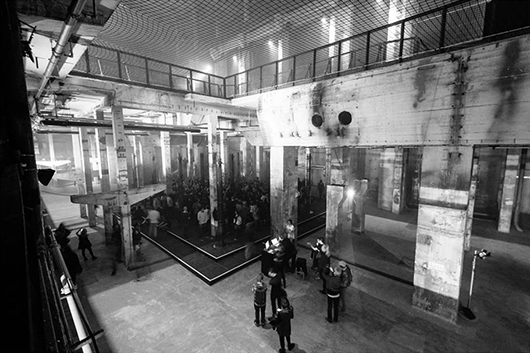
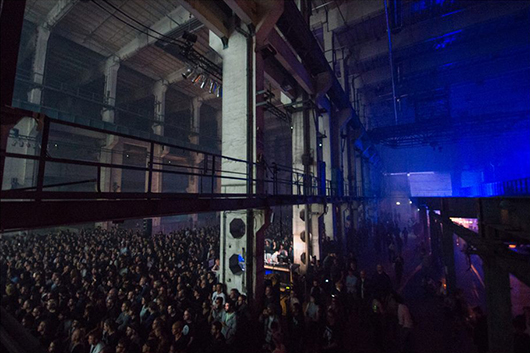
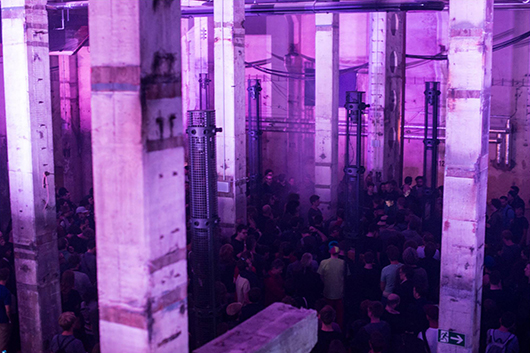
In the end though, Atonal was clearly about place—and a spectacular reuse of space. Kraftwerk Berlin, which sits inside the same building that houses Tresor, was Atonal’s primary home base, although the festivities were spread throughout the titanic, once-abandoned East Berlin power station that became the club’s new home in 2006. As the weekend came to a close, it was obvious that the venue was the hands-down star of the festival. (Let’s put it this way: the word “cathedral” was overheard multiple times throughout the long weekend.) Each night, people streamed into its bottom level, with a bar to the right, a merch table and coat check (it was an unseasonably chilly week in Berlin) to the left, and a newly built staircase awaiting directly ahead.
Up the stairs and to the left sat PARSEC, an installation that begged repeated visits. A vertical, audio-visual spinning machine consisting of 16 identical analog modular synthesizers and assembled with the intention of creating a swarming motion of sound and light, PARSEC kept plenty of people from immediately heading up an additional set of stairs to the right, even though that climb would ultimately lead them onto Kraftwerk Berlin’s massive main floor.
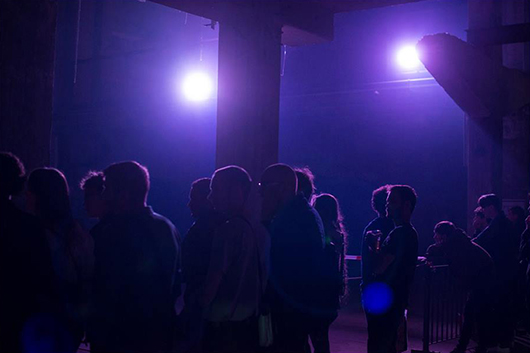
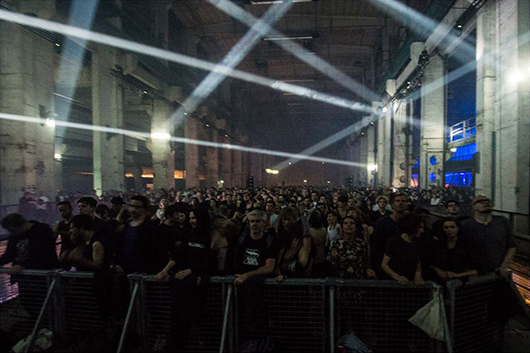
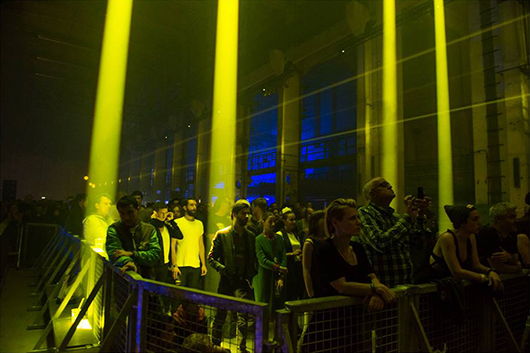
Still, it was on the main floor that people stood night after night (in fairness, some did sit cross-legged on the ground, as if they were perched on a green meadow or hill), in a space that was often tightly packed from front to back. Despite these crowded confines, they remained, 30 or 40 to a row, watching, listening, and dancing to an array of sounds that were not strictly dance music. In fact, many of Atonal’s offerings had little to do with the dancefloor, at least thematically. This was a quiet, respectful party, even though an overwhelming number of the people in attendance were young, in their early 20s or even younger. A healthy smattering of older geezers could be spotted in the crowd as well, but Atonal was a party all the same. People seemed genuinely thrilled to be there.
The first Berlin Atonal took place in 1982 at a location in Kreuzberg, which was then part of West Berlin. Last year, the festival was revived in its new location, following a break of more than 20 years. Despite this lengthy gap, Atonal’s founder, Dimitri Hegemann, who also launched Tresor in 1991, still has his hand in the current festival. However, the responsibility of running the day-to-day grind has fallen to younger acolytes Harry Glass, Paulo Reachi, and Lauren von Oswald—the nephew of Berlin techno master Moritz von Oswald of Basic Channel, Maurizio, Chain Reaction, and Rhythm & Sound fame.
Atonal line-ups have always been impressive, as groups like Psychic TV, Einsturzende Neubauten, Test Dept, and 808 State played during the early years, and when the festival was revived last year, Jon Hassell, Glenn Branca, Actress, Kassem Mosse, Vladislav Delay, and Juan Atkins were all part of the bill. In terms of talent, the 2014 edition was not only similarly excellent, but it also presented arguably the festival’s most diverse collection of performers to date; as such, its spotlight swayed between relatively unknown audio-video projects like Dasha Rush presents Antarctic Takt and more established veterans like Canadian soundscaper Tim Hecker. Ike Yard represented for the no wave crowd, while those craving something more ambient could take solace in the sounds of drum & bass production team Source Direct and techno groover TV Victor. There were ambient groups producing pure pastoral bliss, dark noise crews that artfully blackened the mood of the big room, and other outfits that did a little of each. Simply put, Atonal showcased a lot of challenging music, and that music was made all the more impressive by the fact that it was being presented in a space that challenged the artists right back (with its enormity, not its acoustics; in fact, the sound quality throughout the festival was uncannily superb, with no annoying echo or delay mucking up the performances).
As thrilling as the main stage of Kraftwerk Berlin proved to be, its shows generally wrapped up around midnight or so, which would have been rather early by Berlin standards. But the festival didn’t end there, as organizers planned an extensive series of aftershows, which prompted actual Tresor-style, 12-hour dance marathons that raged through the night and into the following afternoon. However, while some Atonal festivalgoers took part in both the festival proper and these late-night activities, for the most part, the aftershows played host to a different crowd, one that was slightly younger. Spread across the Globus and Ohm spaces (which are also part of the Tresor complex), along with Tresor itself, the aftershow line-ups featured mostly DJ sets, and included the likes of Millie & Andrea, Pinch, Powell, Scion, Vessel, Roly Porter, James Ginzburg, Alec Empire, talent from the Liberation Technologies imprint, and others.
As if that wasn’t enough, Atonal also put together a number of panel discussions, workshops, and seminars, all of which were set in an old control room of the power plant. In short, there was more than enough activity on offer throughout Atonal’s five days, and although it would have been impossible to experience it all, we’ve put together a list of five particularly memorable highlights.
Atonal 4D
Biosphere
5. Atonal 4D series
Not everyone agreed that these micro-concerts, which took place on the bottom level of Kraftwerk Berlin, were special. The shows started early (6 p.m.), and were often so crowded that the artist could only be heard and not seen. On the other hand, there was something perfect about seeing boundary-pushing artists like Norway’s Biosphere, Mexico’s Murcof, and Germany’s Senking circled by adoring fans, extraordinary architecture, and a unique surround-sound system. (Side note: the 4D soundsystem was designed by engineers in Amsterdam and was also used for a continuously running installation by Thomas Vaquie when the live shows were not happening.) Minor grumbles aside, the experience of being at the 4D shows was a singular one, and they proved to be immensely popular; both Murcof and Biosphere wound up performing an extra set at 7 p.m. to accommodate the high demand.
Ensemble Modern
4. Opening night
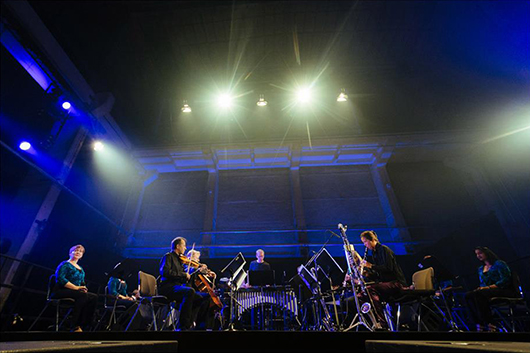
An air of intense anticipation marked the start of Atonal on Wednesday night. Organizers and fans alike were buzzing, but most of the opening-night pressure fell upon the Ensemble Modern, a company based in Frankfurt with musicians from all over the world. The group had been tasked with interpreting Steve Reich’s Music for 18 Musicians, a modern classical standard bearer from 1978 that laid the groundwork for all sorts of minimalism that followed. As it turned out, there was no need for the audience to worry, as the piece—a series of 10 pulses, including repetitive melodies and vocal harmonies—was rendered with grace and a loving, expert touch. The ensemble also performed another famous Reich number, Drumming Part 1. (Reich himself, now 77, had considered attending, but ultimately did not make the event.)
Also part of the opening night line-up were Austrian media artist Konrad Becker, who performed as Monoton, and Imaginary Softwoods, an audio-visual project of former Emeralds member John Elliott, which featured Dutch video artist Tarik Barri.
DSCRD
3. DSCRD, Dalhous, and Sendai
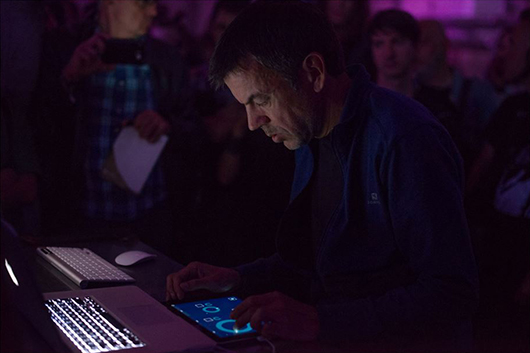
Though they did not play consecutive sets on Thursday night, the live performances from French digital/analog band DSCRD, Edinburgh duo and Blackest Ever Black affiliate Dalhous (pictured at top), and Sendai (the collaborative project of Belgian artists Peter van Hoesen and Yves de Mey) configured into a suite of sorts, bringing together elements of noise, assertive African-inspired drum programming, and blissed-out ambient interludes. With five scruffy guys on stage, all of them perched behind computers, controllers, and other hardware, DSCRD scored points simply for looking a bit odd. Sendai let its music do the talking, and the pair unfurled some absolutely fierce rolling basslines. Dalhous was perhaps the most adventurous of the three, and dared to be ugly, then pretty, before wrapping up its set by bringing the program back into the darkness in which it started.
Miles Whittaker
2. Miles Whittaker
Miles Whittaker‘s Atonal set on Thursday night was billed as his solo debut in Germany, though it’s worth noting that he lives in Berlin now and has previously performed in the city as one half of Demdike Stare. It was also promoted as an A/V performance, which had prompted festivalgoers to speculate about what sort of visual weirdness Whittaker would bring to the table, especially given the bewitching film work that Demdike Stare has concocted in past. However, once the performance began, no video was screened; more importantly, it didn’t seem to matter. In the end, the lack of visuals actually worked to give the music—a smart, subtle hybrid that combined elements of Berlin, Detroit, and Manchester—a sharper focus. Working deliberately, Whittaker would add one rhythmic element after another, each one giving the music a little more life; eventually, his creations felt like they were swirling and soaring on their own. The momentum kept building as he moved through through acid, dub, and even UK hardcore, and as the journey came to a close, it was clear that Whittaker had put together a stunningly compelling session that was somehow both grimey and beautiful at the same time.
Cabaret Voltaire
1. Cabaret Voltaire
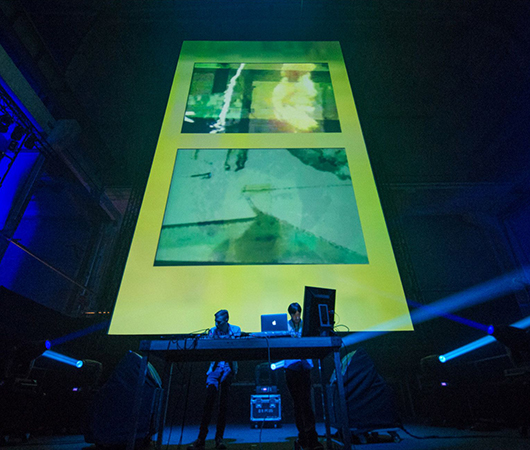
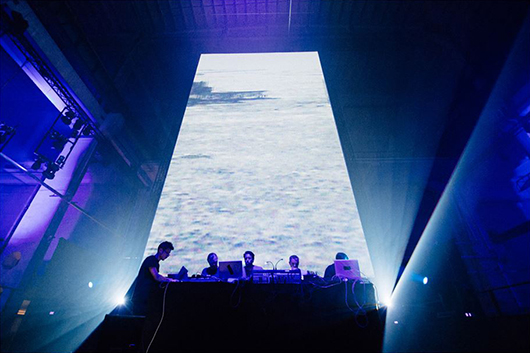
There was more than enough excitement to go around in the days and weeks leading up to Atonal 2014, but the most anticipated appearance had to be that of Richard H. Kirk, who alone carried the burden of representing Cabaret Voltaire. (In its ’80s and ’90s heyday, the group featured three performers: Stephen Mallinder, Chris Watson, and Kirk. Watson—now a recordist for the BBC—and Mallinder are not part of the current project.) When the show was announced, Kirk had said he was not interested in making Cabaret Voltaire into a nostalgia act, and his performance on Saturday night proved that he was not kidding. Playing to what was clearly the largest crowd of the entire festival, his music was raw and loud, combining rapid-fire beats, strange vocal snippets, and guitar samples that had been converted into driving, synthetic shards of hot white noise. Stylistically, there was an undeniable similarity to classic Cabaret Voltaire, but the sound was also very much of the now, and quite modern.
Kirk also brought three VHS tapes, which were split vertically across the stage’s massive screen backdrop. The effect was hallucinatory, as images of ’80s political leaders (Ronald Reagan, Margaret Thatcher, Muammar Gaddafi) and pop-culture icons (Andy Warhol, Francis Bacon) were cut up, bleached out, and mixed with violent imagery showing African revolutionaries, Islamist militants, and other people at war. Although the footage was vintage, it was still shocking—mostly because these kinds of scenes are still commonplace in much of the world.
Honoring the past while operating in the present and looking toward the future, Kirk’s performance as Cabaret Voltaire was a great comeback, but it was also symbolic of what made Atonal such a rich and engaging experience. While the venue may have ultimately stolen the festival spotlight, it was the organizers’ curatorial vision, which traced lines through decades of avant garde and experimental sounds right up to the present and into the future, was unique, even in the context of an increasingly crowded festival landscape. In the years to come, it’s a safe bet that plenty of festivalgoers will come to Atonal simply to gawk at the expansive confines of Kraftwerk Berlin, but they’ll stay—and likely return in the years that follow—because of the inventive sights and sounds that they’ll find once they walk through the door.
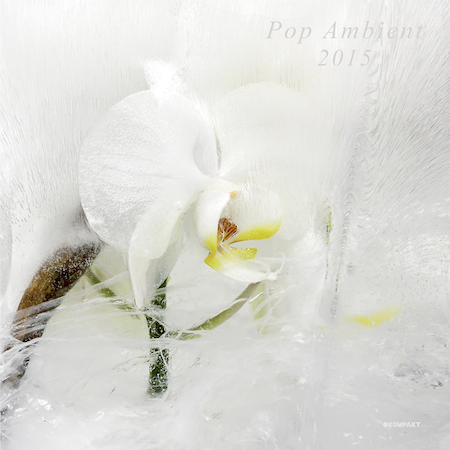
Kompakt has detailed the next installment in its long-running Pop Ambient series, which brings together experimental and ambient offerings from the Cologne-based outpost. Curated by label co-founder Wolfgang Voigt, the series reportedly aims to introduce emerging artists alongside more established contemporaries; to that effect, the forthcoming edition will present newcomers such as Thore Pfeiffer and Max Wuerden alongside returning series contributors Leandro Fresco, Ulf Lohmann, and Jens-Uwe Beyer. Pop Ambient 2015 will see an official release on November 10, and its tracklist can be found below, where all previous compilations—dating back to 2001—have also been made available to stream.
01. Thore Pfeiffer – Wie Es Euch Gefa?Llt 02. Thore Pfeiffer – Nero 03. Dirk Leyers – Daydreamer 04. Gregor Schwellenbach – Assperg 05. Leandro Fresco – Nada Es Para Siempre 06. Max Wuerden – Container Love 07. Ulf Lohmann – Refresh 08. Bvdub – In White Pagodas I’ll Wait Foryou 09. Jens-Uwe Beyer – Moewen 10. Gustavo Lamas – Jovenes Ambient (Remake)
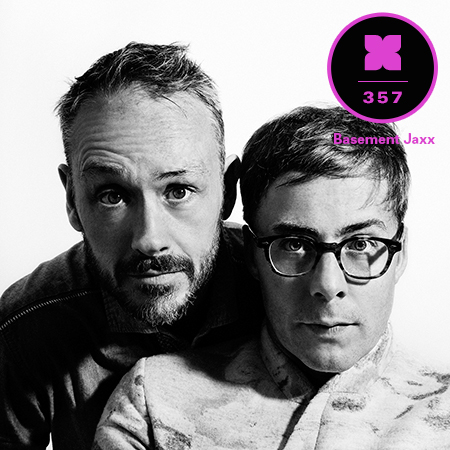
Quiet isn’t a word that many people would use to describe Basement Jaxx, but in recent years, the lively UK duo of Felix Buxton and Simon Ratcliffe has maintained a relatively low profile. Still, even though the outfit responsible for international smash hits like “Where’s Your Head At?” and “Red Alert” may have stepped out of the spotlight a bit, the pair hasn’t exactly mellowed with age. This week, Basement Jaxx is releasing its seventh studio album, Junto; as expected, it’s a madcap, genre-hopping effort that finds Buxton and Ratcliffe delivering another batch of shuffling house rhythms, soulful vocal turns, and oddball pop experiments. That being said, as inventive as Basement Jaxx’s productions have been over the years, the duo first made its name in the DJ booth. (Basement Jaxx was actually the name of the pair’s mid-’90s club night; it was followed by another party called Rooty, whose name was later used as the title of the group’s second LP.) Curious to see if the boys’ DJ chops were intact, we invited them to put together an exclusive mix for the XLR8R podcast series.
The 48-minute effort includes a number selections from Junto, but Basement Jaxx does dig deeper, tossing in everything from its 1995 single “Be Free” to tracks from Terrence Parker, Alden Tyrell, and Head High. The pair has never been shy about its love for bold, pop-leaning vocals, and that continues here, as even the tracks from other producers are frequently blended with acapellas from the Basement Jaxx catalog. The sound is primarily rooted in house, but there are frequent detours into other styles and the percussion is quite varied, as the duo often seems inspired by the sounds and rhythms of Latin America, the Caribbean, and Africa. At the end of the day though, these details are secondary, as the mix seems to indicate that Basement Jaxx’s primary motivation remains a simple one: having fun.
01 Basement Jaxx “Taiko” (Atlantic Jaxx) vs. Maya Angelou “Phenomenal Woman” 02 Basement Jaxx “Power to the People” (Atlantic Jaxx) vs. DJ Graham B “Sambamadness” (Freestyle) 03 Basement Jaxx “Power to the People (Accordion Dub)” (Atlantic Jaxx) 04 Alex Metric & Oliver “Hope” (Owsla) 05 Alden Tyrell “Wurk It” (Clone Jack for Daze) vs. Head High “Power Seat” (Power House) 06 Disclosure x Friend Within “The Mechanism” (PMR) vs. Basement Jaxx “Fall Down (Acapella)” 07 Basement Jaxx “Never Say Never (Wayward Mix)” (Atlantic Jaxx) 08 Christian Nielsen “Throwback” (Play It Down) vs. Chaemini “Untitled (Acapella)” 09 Gabriel D’Or & Bordoy “Real Diamond” (Selected) vs. Basement Jaxx “Back 2 the Wild (Acapella)” 10 Eddie Niguel “Absolute” (Midnight Shift) vs. Basement Jaxx “Unicorn (Club Acapella)” 11 Basement Jaxx “Rock This Road” (Atlantic Jaxx) 12 Terrence Parker “Your Love” (Parker Music Works) 13 Loui Fernandez “Kazuco” (Ametist) 14 Basement Jaxx “Angel Is Coming” (Atlantic Jaxx) 15 Luciaen “Origins (Wild Origins)” (Basaec) 16 Basement Jaxx “Buffalo” (Atlantic Jaxx) 17 Basement Jaxx “Be Free” (Atlantic Jaxx)
Ahead of the release of his debut album for Domino subsidiary Double Six, Berlin-based producer George FitzGerald has delivered the latest installment in FACT‘s longstanding mix series. The nearly hour-long recording comes described by the UK outpost as “high-class house” and includes two unreleased cuts from FitzGerald’s forthcoming LP, as well as selections from his own ManMakeMusic label, Marquis Hawkes, Daniel Avery, and Simian Mobile Disco. The mix can be streamed and downloaded below, where a tracklist has also been included.
Lawrence – Teaser 2 (Kompakt) George FitzGerald – ? Simian Mobile Disco – Tangents (Anti Records) Marquis Hawkes – Tunnel (Creme Organization) Daniel Avery – All I Need (Roman Flügel remix) (Phantasy) Imre Kiss – Non (Lobster Theremin) Björk – Violently Happy (One Little Indian) xxxy – Evade (Ten Thousand Yen) Crystal Maze – Orchidea Nera (Echovolt) Barnt – Chappell (Hinge Finger) George FitzGerald – ? Locked Groove – Enigma (Hotflush Recordings) Skudge – Phantom (Seldom Felt Remix) Trikk – Abstract Language (Man Make Music) Randomer – Huh (L.I.E.S) Fold – ? Phil Gerus – Voice to Voice Lip to Lip (Man Make Music)
Daisuke Tanabe is set to return to German label Ki with his Floating Underwater LP next month. Spanning 15 tracks, the record shows off the Japanese producer’s (and former RBMA participant’s) knack for crafting genre-defying beats. On “Origami”—a cut pulled from the first half of Floating Underwater—Tanabe sews together an off-kilter array of hi-fi percussion and fuzzy chords with a disjointed bass synth. The resulting concoction is pleasantly reminiscent of Uprock Narratives-era Prefuse 73—burnt with a touch of soul, the track can be unpredictable, though its spastic, miniature movements never venture too far off the map. An alluring taste of Tabane’s forthcoming full-length, “Origami” can be download below before Floating Underwater officially drops on September 15.
Viennese label Pomelo will issue a duo of 20th-anniversary 12″s this fall. As Resident Advisor reports, the label has recruited seven local artists to contribute tracks to the split release, which will feature new material from the likes of Tin Man and live techno outfit Elektro Guzzi (pictured above). The first installment, 20 Years #1, is due out on September 1, with 20 Years #2 set to follow on October 6. Tracklists for both EPs can be found below, where Pulsinger & Irl’s “Wasted at Work” has been made available to preview.
20 Years #1 A1 Pulsinger & Irl – Wasted at Work A2 Altroy – TokuiWaza B1 DJ Glow – Genetic Modification B2 Buffered Multiple – Furthrrr Investigations
20 Years #2 A1 Tin Man – Detroit B1 Elektro Guzzi – Radicale B2 Digilog – Mind Gap