Back in June, UK DJ/producer Midland made the announcement that he would be launching a new label with a 12″ of his own productions the following month. And now that Graded has been firmly established with “Archive 01” b/w “Realtime,” the Londoner has unveiled his outpost’s next release, a three-track EP called Diving Bell. As the preview of the EP indicates, Midland’s next record is heavy on drum/percussion-centric dancefloor music, featuring a tune actually named “Drumtrack” and two versions of the titular cut, the original and a “Drum Dub.” Sizable snippets of the Diving Bell EP can be heard below, before the record drops on November 25.
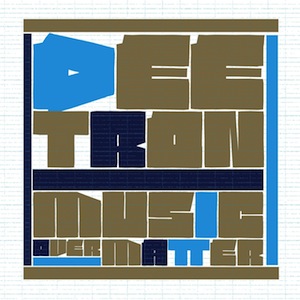
It’s taken eight years, but Swiss techno producer Deetron (a.k.a. Sam Geiser) has finally released his sophomore album. In that nearly decade-long stretch, his sound has changed considerably, moving away from the Detroit-inspired sci-fi techno and deep house that characterized his work in the late ’90s and early ’00s. The past few years in particular have seen him embrace a more pop-oriented approach rooted in traditional songcraft, with collaborative works alongside artists like Seth Troxler and Hercules & Love Affair. Music Over Matter is an extension of this recent side of his discography, emphasizing these qualities by incorporating a large number of guest vocalists and co-producers to make an LP that feels like his most accessible to date.
With that said, it’s also his least cohesive record as well. Music Over Matter‘s 13 tracks are an incongruous grab bag, with solo cuts and new collaborative material sitting next to seemingly random odds-and-ends from the past few years. The gap in time, context, and style makes for a listening experience that feels almost like a DJ mix in the way it uses so many voices to convey its moods. This feeling is experienced right from the start, as the off-kilter R&B of “Thinking (feat. Cooly G)” melts into the synthesized nu-disco pop of “Crave (feat. Hercules and Love Affair),” a single from last year. Geiser’s background instrumentation ought to be a unifying factor here, but, for some reason, it’s not. He’s too much of a chameleon, choosing to change his own sound to match his collaborator as opposed to the other way around.
The collaborations that work best are those which see Geiser employing more complex arrangements. The best of these comes with “Rhythm (feat. Ben Westbeech),” the LP’s first single. It plays to Westbeech’s talents as a singer, carrying his direct and soulful vocals on a driving rush of ’90s house rhythms, lush piano chords, and swirling synth tones. The structure is intricate; the song builds and breaks down in all the right places, but somehow never feels obvious. Another instance of creative collaboration comes in “Insatiable (feat. Delvis),” which touches on Strictly Rhythm-style house revivalism, but goes beyond mere nostalgia thanks to the Belgian singer’s considerable vocal contortions.
Geiser proves to be a nimble shapeshifter over the course of Music Over Matter, but a few of the tracks on the LP feel like an attempt to re-skin previous works by his collaborators. For instance, “Love Song (feat. Seth Troxler)” sounds like a rehash of Art Department’s “Living the Life (feat. Seth Troxler),” especially with its similarly goofy monologue. Along the same lines, “Bright City Lights,” recorded with Fritz Kalkbrenner, would be a dead ringer for Kalkbrenner’s own folksy “Sky and Sand,” except that here, the German vocalist weirdly chooses to affect an Irish lilt, emphasizing an invisible “h” as he sings, “Bright city lights been gone/Hum and silence fills the h’early morn.”
Ultimately, the best moments on the LP come when Geiser is working alone. Within these tracks, there’s a sizable Detroit house influence; sampled bongos, MPC pads, and moody Rhodes chords recall European retellings of the sound in the vein of Trus’me and Motor City Drum Ensemble. The first instance of this is “Sing (Album Version),” a shortened, two-minute-teaser version of a track that first appeared as a seven-minute b-side on Geiser’s Troxler-featuring Each Step 12″ from 2010. Barring the length, it’s untouched, with warm vocal pads that rise up in rotating patterns through a current of churning disco percussion. This more overt classic-house style also colors “Can’t Love You More,” which appeared earlier this year as a single on his Character EP. It’s a muted affair, pushing its vocals and organ stabs beneath a warbling filter and plucky hits of guitar. Like “Sing,” it’s a compelling tune, but the success of these two tracks—and all of the previously released material on the LP—brings up a point about Music Over Matter as a whole: a fair amount of this album has been heard before, and the tracks that are new aren’t necessarily showcasing Deetron at his best.
Last weekend, XLR8R headed to Asheville, North Carolina for the inaugural edition of the city’s Mountain Oasis festival. (For a complete rundown of our experience, take a look at our official review.) Amidst all the musical happenings, we took the time to speak with a couple of our favorite artists, including Ital (a.k.a. Daniel Martin-McCormick). The Brooklyn-based experimentalist has been involved with music since he emerged with DC punk band Black Eyes in the early 2000s, and later worked his way through dub, noise, and dance influences as part of Mi Ami before striking out on his own as Ital a few years back. Since then, he’s kept a rather busy schedule, so we were lucky to pin him down for a few minutes backstage at the Orange Peel during The Bug’s cataclysmic set. Over the course of our conversation, Martin-McCormick told us about his recent release on Germany’s Workshop label, his musical experiences in the South, and the shock of encountering EDM in real life for the first time.
XLR8R: How did you hook up with the Workshop guys? Ital: I met Even Tuell on my last trip to Europe. He was DJing and played a Light Asylum song and stuff. I’d imagined… not that they’d be dicks, but that everything would be super tasteful. And he was like, “Nah, fuck it, I don’t care. It’s a good song.”
Have you played in Asheville before, perhaps with one of the bands you used to be in? Maybe with Black Eyes… maybe with Mi Ami, but I don’t think so. I have a feeling Black Eyes played here 10 years ago. We did a lot of US tours.
What’s it like playing electronic music in the south as opposed to being here as part of a punk band? It’s cool, last night [at the Nightlight in Carrboro, with $tinkworx and Dynamo Dreesen] was like a party. I feel like in LA, New York, SF, and Chicago, people are pretty up on their electronic music. There’s a scene of people who are making it and some clubs and stuff. Last night, when I played in Carrboro, after the show, people were just like, “thank you.” There’s stuff happening around Chapel Hill, but it feels like overall it’s an uphill battle. But this is crazy cuz [Mountain Oasis] is such an EDM festival. Tonight, the fucking guy between The Bug and me… do you know this guy, Robert DeLong?
I looked him up because I’d never heard the name before, but I’ve never heard him. He’s like a singer-songwriter, right? Yeah! It’s fucking like Mumford & Sons plus Skrillex. It was fucking packed. All these people were there in raver gear. He had this acoustic guitar, would do these emotional lyrics, then go into the big drop. It was so bad that it was pretty amazing. There were probably about three times as many people there for that than there are watching The Bug right now, at least. From the front to the back of the room, hands up, people in this giant mass. He’s like, “What a fuckin’ great club tonight!”
It’s funny because that is just a world I never interact with, and now I’m playing this show being like, “Oh, there are a lot of guys with comfortable-fitting pants and hoodies with a blazer over it and the Kanye glasses going like this.” [puts arms in the air] I’m like, “Oh, this actually does exist. It’s not just this concept you read about on SPIN sometimes.” It kind of reminds me of the way there’s a bunch of underground music that’s poppy and then there’s this nether region… it’s not that big, but between, like, Animal Collective or Dirty Projectors, these top-shelf indie bands and these bottom-shelf pop bands. There’s this zone of indie guys that try to make it big and nobody wants that. [There’s also] a sort of weird no man’s land between EDM and all the rest of electronic music. It’s all electronic music, and you can play on the same stage and everything, but in the end, it feels like such different approaches, conceptualizations, languages, and stuff like that. Even though, theoretically, it’s the same.
There’s this one zone of people, what I guess you’d call the underground, and when you see something like a giant EDM DJ—people with big gestures, big music, big poppy vibes—it doesn’t feel like there’s a continuum. There’s a continuum between like Vatican Shadow on the one end, Kassem Mosse in the middle, and Theo Parrish on the other end. It’s one of many spectrums, but you can see how, through neighboring abutments and stuff like that, eventually one reaches the other. I feel like there’s this gap, and on the other side of this chasm is this EDM thing.
Emerging from a background in “New Music” (a brand of classical music that has been expanded and informed by the minimalist tradition), Lorna Dune (born Lorna Krier, pictured above) has made a determined shift to techno without letting go of her prior interests in “high art.” The recently released Miamisphere EP is Lorna’s first foray into that realm, but her synthesist and minimalist leanings allow for an transition to the structures of the genre, exploring more romantic and sublime zones. L.I.E.S. affiliate Terekke‘s dusty and expansive remix of the title track turns the drifting synth odyssey into a bubbling, circuitous production. “Miamisphere (Terekke Remix)” submerges the original tune’s soaring harmonic progressions into its foundation, and propels itself with a solitary kick that seems to endlessly unwind with each revelatory development.
Considering the critical hosannas that met the duo’s first album, Crooks and Lovers, the reception for Mount Kimbie‘s second album has been a bit lukewarm. These CSFLY Remixes seem almost like a corrective, recruiting three purposely of-the-moment remixers—Detroit’s hyped MPC mangler Kyle Hall, Hamburg’s evergreen DJ Koze, and crushworthy reshaper Lee Gamble—to put any doubts about the pair’s relevance to bed. This EP doesn’t fully succeed in this regard, and is more interesting for this shortcoming. Granted, nothing in particular was wrong with Cold Spring Fault Less Youth, which neither stagnated nor pushed into uncomfortable territory outside of the group’s wheelhouse; the LP was essentially another installment of Mount Kimbie’s sweet, quotidian, yet rhythmically involved contribution to the mournful side of UK bass. This EP is guilty of overreaching in a way the album wasn’t, but it’s not without its delights.
Kyle Hall and Lee Gamble both take on the album’s most ambivalent cut, “You Took Your Time.” With a guest turn from UK crooner King Krule, the original was somewhat soppy and overwrought, but Hall and Gamble both sidestep the song’s drippy vocals. It’s a wise decision, and yet, without Krule, the remixes seem hollow, as they showcase none of Mount Kimbie’s talent for desktop polyrhythms and affecting melody. Hall goes for a purplish boogie of grainy hi-hats and synth-envelope tweaks that come off like he’s making do with rather than making the most of his source material. Gamble puts those components through a kind of homeopathic ringer, where only the memory remains, and yet it feels overcautious and lacking in a direction. DJ Koze, as per usual, wins the prize for both inventiveness and fidelity to the original, deferring the vocals of “Made to Stray” for a delicious five minutes of off-the-grid deep-house tweaks before dropping into the hook with a seismic sense of relief. The most and least that can be said of this EP is that it should send us back to Cold Spring Fault Less Youth with less hype-jaundiced ears.
With its classic piano chords and soulful bounce, RJD2‘s “Temperamental,” from his recent More Is Than Isn’t LP, was primed to be reworked into a house edit. Ascending Los Angeles producer Sage Caswell (pictured above)—who helped inaugurate the Peach label earlier this year and is due to deliver an EP via the Urulu-helmed Amadeus label sometime year—appears to be the first to see this inclination through, reworking the Motown-infused hip-hop tune into a sufficiently rolling dancefloor number. Focusing on the original tune‘s vocal hook (provided by Phonte Coleman) and jumpy piano, Caswell adds a thick assmeblage of straightforward rythyms, lacing a steady four-on-the-floor shuffle with an orgy of hats and painstakingly placed FXs. The results make for an edit that thankfully retains the initial catchiness of RJD2’s track, but gives them—at least in terms of dancefloor music—a much sturdier sonic footing. Caswell can be found venturing into similar sonic territory live in LA next month at the first anniversary of the Far Away party, performing alongside Kim Ann Foxman, Mike Servito, and others; more details can be found here.
Benjamin Damage is a pretty good techno alias, though it’s somewhat misleading considering the UK-born, Berlin-based producer’s music. It may deliver a cinder block to the head, but he’s taken the time to hand-felt the surface. That means we’re just as likely to encounter one of his cuts in Cassy’s sublime, Ibiza-informed Fabric 71 mix as in the company of Modeselektor’s hand-picked 50Weapons rave-wrecking crew. Given that, we can either choose to read the toughened-up sound of his 4600 EP as a reaction against certain reviews of his debut LP, Heliosphere, which accused him of sacrificing depth for range, or simply as the kind of concentration demanded by an EP, particularly one based around the sound of the rare ETI 4600 synth. Either way, it’s hard to argue with the results, as the record offers three tracks of Damage at his most punishing and one of him at his most lulling.
“ETI Rework” takes the basic, familiar form of a storming techno cut. Damage pushes it as far as he can imagine, turning it into something like the cratered techno equivalent of a jack track, an experiment taking simple principles to an extreme. The song bears straight down on the listener, but it doesn’t take itself too seriously; the garbled synth blurt at the center sounds bodily on its own, until an accumulation of acid-gouged layers encase it in scrap metal. Twisting in the solar breeze, the drifting “Nebula” is an unashamed and gorgeous chillout. Its wispy, cosmic pastoralia is unguarded enough to make vintage Border Community sound cold-blooded. “Revolve” and “Recursion” double back to the first track’s loop-techno template. Both “Re-” tracks feature details that soften the edges, but it’s hard to get unstuck from the reverie induced by “Nebula.”
Spanish singer/producer and frequent John Talabot collaborator Pional is set to drop his latest EP via Young Turks next week, and has preempted that auspicious occasion with a full stream of its four moody tracks. Courtesy of Dazed Digital, the silky house grooves and soft vocal melodies of Pional’s Invisible/Amenaza can be heard in their entirety in the player below.
Still riding on his increasing wave of popularity, UK DJ/producer Breach (a.k.a. Ben Westbeech) has just dropped a stream of the exclusive track lifted from his forthcoming edition of !K7‘s DJ-Kicks mix album series. Called “Beroving,” the tune exists in a strain of buoyantly straightforward house music similar to Westbeech’s recent break-out singles for Dirtybird and Atlantic—albeit with a decidedly sensual edge. Breach’s latest production can be streamed in full below, before his DJ-Kicks drops on November 26, two week’s after John Talabot release his own highly anticipated installment.
The recent transition of Croydon dubstep pioneer Skream (a.k.a. Oliver Jones) towards disco and house has been greeted with a fair bit of consternation in some circles. It’s not particularly hard to see why this is the case, given the magnitude of the producer’s departure from dubstep and the coinciding resurgent popularity of house and garage in the UK, but in many ways, the move shouldn’t be all that surprising. The producer has already experienced substantial commercial success with Magnetic Man—the trio consisting of himself, Benga, and Artwork—has remixed Duke Dumont’s huge pop-house hit “Need U,” and has spent most of his recent interviews banging on about how tired he is of playing dubstep while professing his love for disco and house. If the buoyant disco beats of “Rollercoaster”—which features Sam Frank on vocals—don’t come entirely as a shock though, what is surprising is just how conventional they sound.
The tune is a glossy slice of neo-disco, which opens with a vocoded voice and steady claps before it launches into a fully fledged disco groove, complete with shuffling guitars and technicolor synths, the whole thing rounded out with Frank’s Jamiroquai-esque vocals. “Rollercoaster” is catchy and well-produced enough, but with its almost focus-grouped precision, the song ends up feeling like an approximation of the glitz and glamor of disco rather than an effective engagement with it. This is a real shame and surprise, particularly when they’re contrasted with Jones’ frankly excellent remixes of Duke Dumont (“Need U”) and Rudimental (“Hell Could Freeze”) from earlier this year, both of which suggested the producer’s move towards disco had the potential to be as interesting as his dubstep career.
The remixes bundled with “Rollercoaster” unfortunately fare little better than the original. Drop the Lime alias Curses’ version pairs the vocals with bubbling bass and synthesized strings in a largely failed effort to give it a bit more heft. Hrdvsion similarly beefs up the track’s low end, while Jimmy Edgar offers the most effective reinterpretation of the track, reimagining it as a futurist techno ballad. Put simply, “Rollercoaster” is a disappointingly insipid first proper disco outing from a producer who’s already dabbled in the style to some degree of success; perhaps something better is on the horizon.